


 Скачать презентацию CANADIAN UNMANNED AIR VEHICLE UAV SYSTEM OPERATIONS Drone
916b628b40354414ecd9e872928be244.ppt
- Количество слайдов: 21
 CANADIAN UNMANNED AIR VEHICLE (UAV) SYSTEM OPERATIONS Drone. Fair Calgary 2016 19 June, 2016
 OVERVIEW Provide an overview of current regulatory regime and the proposed framework for future UAV regulations. 2
 WHAT IS AN UNMANNED AIR VEHICLE (UAV) SYSTEM? Ø Unmanned Air Vehicle - a power-driven aircraft, other than a model aircraft, that is designed to fly without a human operator on board. Ø Model Aircraft - an aircraft with a total weight not exceeding 35 kg that is mechanically driven or launched into flight for recreational purposes and not designed to carry persons or other living creatures Ø A UAV System includes: o the unmanned aircraft (UAV); o any associated control station(s); and o the command control links Ø Also known as Unmanned Aircraft System (UAS), Remotely-Piloted Aircraft System (RPAS)…. but not DRONES. Ø The term “drone” is misleading, as there is always a person in the loop. Ø Automated versus Autonomous. 3
 WHAT AUTHORIZATION IS REQUIRED TO OPERATE A UAV Ø Two ways to legally operate a UAV ØApply for a Special Flight Operations Certificate o Required by the CARs ØOperate under an Exemption to the SFOC requirement o 2 kg or less o Above 2 kgs to not exceeding 25 kgs 4
 SPECIAL FLIGHT OPERATIONS CERTIFICATE (SFOC) Ø Applications for SFOC are dealt with on a case-by-case basis. o Individual assessments of the associated risks are conducted for each operation before SFOC is issued. o Operating certificates issued once a applicant demonstrates that risks can be managed to an acceptable level. o Operating conditions vary depending on aircraft performance capabilities, mission requirements, operating environment and complexity of the operation. Ø Applicants are responsible for ensuring that the safety of persons and property on the ground and other airspace users is not jeopardized. Ø SFOC requirements found in our UAV Staff Instruction 5
 SPECIAL FLIGHT OPERATIONS CERTIFICATE (SFOC) Ø Four types of SFOCs processes o Compliant UAV Operator o Must have compliant UAV, Compliant Pilots and must be deemed a compliant Operator o Restricted – Complex o Higher risk, more complex, foreign operators…. doesn’t fall into any other category o Restricted – Simplified o Class G airspace, 3 nm from an aerodrome, maximum altitude 300 ft, no closer than 100 ft, no dangerous cargo o Oversized Model Aircraft o MAAC and AMA members flying aircraft greater than 35 kgs 6
 UAV EXEMPTIONS Ø Two (2) exemptions approved to permit lower-risk UAV operations without an SFOC o 2 kg or less has 37 conditions o 2 kg - 25 kg has 58 conditions Ø Only apply to operations in Canadian Airspace Ø Not applicable to: o Autonomous UAVs, Model Aircraft, Foreign Operators Ø Those that cannot or choose not to operate under the exemption must apply for an SFOC – regardless of size Ø An Advisory Circular has been released to provide greater understanding of the conditions. 7
 SAMPLE SAFETY CONDITIONS Ø Ø Ø Ø At least 5 nm away from any aerodrome or built-up area Below 300 feet Daylight only Only in Class G airspace (no forest fire, restricted airspace, air shows) Maintain visual contact – No First Person View Always give way to manned aircraft Specified distances from people, buildings, vehicles etc. No over-flight of persons Specified weather limits Minimum age requirements Pre-flight planning – Notice to Airmen, site survey, check for radio interference Specified training requirements Aircraft safe for flight – maintain in accordance with manufacturer’s instructions Notification requirements – before flight for 2 -25 Kg Notify after incidents and accidents 8
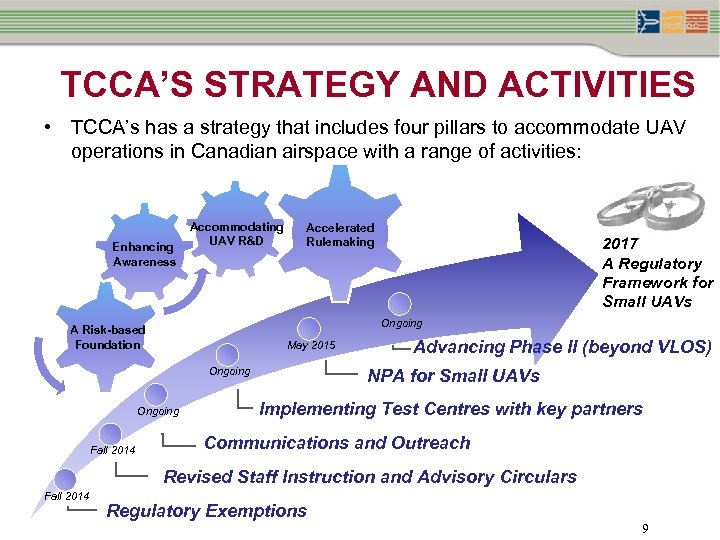 TCCA’S STRATEGY AND ACTIVITIES • TCCA’s has a strategy that includes four pillars to accommodate UAV operations in Canadian airspace with a range of activities: Enhancing Awareness Accommodating UAV R&D Accelerated Rulemaking Ongoing A Risk-based Foundation May 2015 Ongoing Fall 2014 2017 A Regulatory Framework for Small UAVs Advancing Phase II (beyond VLOS) NPA for Small UAVs Implementing Test Centres with key partners Communications and Outreach Revised Staff Instruction and Advisory Circulars Fall 2014 Regulatory Exemptions 9
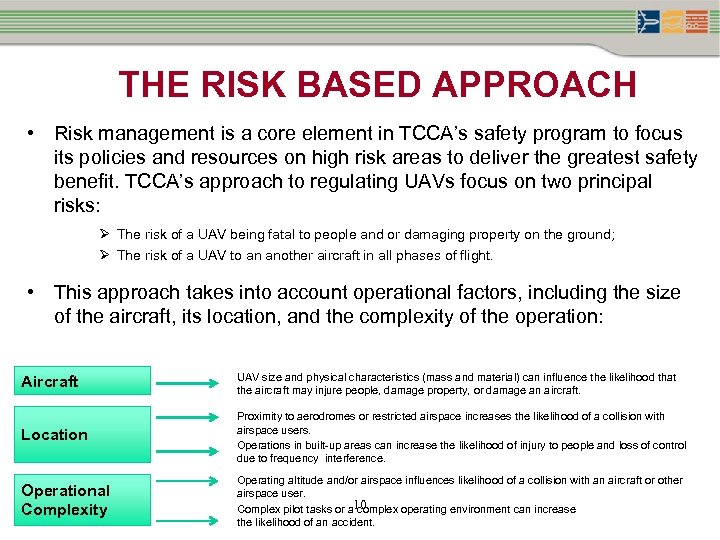 THE RISK BASED APPROACH • Risk management is a core element in TCCA’s safety program to focus its policies and resources on high risk areas to deliver the greatest safety benefit. TCCA’s approach to regulating UAVs focus on two principal risks: Ø The risk of a UAV being fatal to people and or damaging property on the ground; Ø The risk of a UAV to an another aircraft in all phases of flight. • This approach takes into account operational factors, including the size of the aircraft, its location, and the complexity of the operation: Aircraft UAV size and physical characteristics (mass and material) can influence the likelihood that the aircraft may injure people, damage property, or damage an aircraft. Location Proximity to aerodromes or restricted airspace increases the likelihood of a collision with airspace users. Operations in built-up areas can increase the likelihood of injury to people and loss of control due to frequency interference. Operational Complexity Operating altitude and/or airspace influences likelihood of a collision with an aircraft or other airspace user. 10 Complex pilot tasks or a complex operating environment can increase the likelihood of an accident.
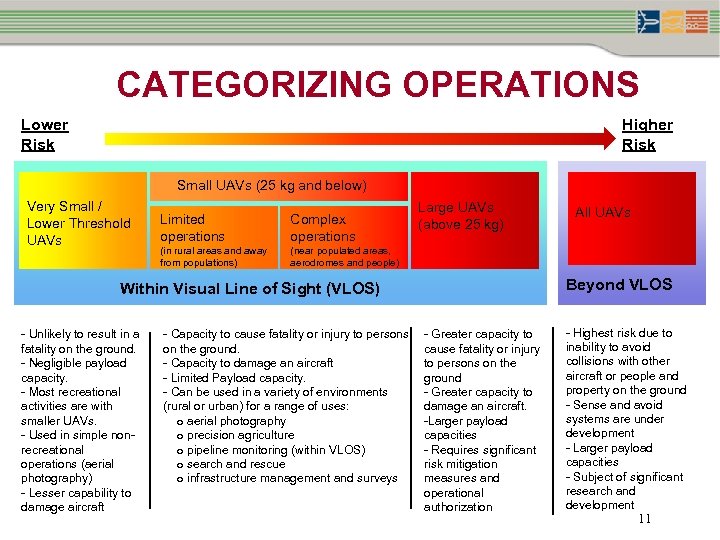 CATEGORIZING OPERATIONS Lower Risk Higher Risk Small UAVs (25 kg and below) Very Small / Lower Threshold UAVs Limited operations Complex operations (in rural areas and away from populations) Large UAVs (above 25 kg) (near populated areas, aerodromes and people) Beyond VLOS Within Visual Line of Sight (VLOS) - Unlikely to result in a fatality on the ground. - Negligible payload capacity. - Most recreational activities are with smaller UAVs. - Used in simple nonrecreational operations (aerial photography) - Lesser capability to damage aircraft All UAVs - Capacity to cause fatality or injury to persons on the ground. - Capacity to damage an aircraft - Limited Payload capacity. - Can be used in a variety of environments (rural or urban) for a range of uses: o aerial photography o precision agriculture o pipeline monitoring (within VLOS) o search and rescue o infrastructure management and surveys - Greater capacity to cause fatality or injury to persons on the ground - Greater capacity to damage an aircraft. -Larger payload capacities - Requires significant risk mitigation measures and operational authorization - Highest risk due to inability to avoid collisions with other aircraft or people and property on the ground - Sense and avoid systems are under development - Larger payload capacities - Subject of significant research and development 11
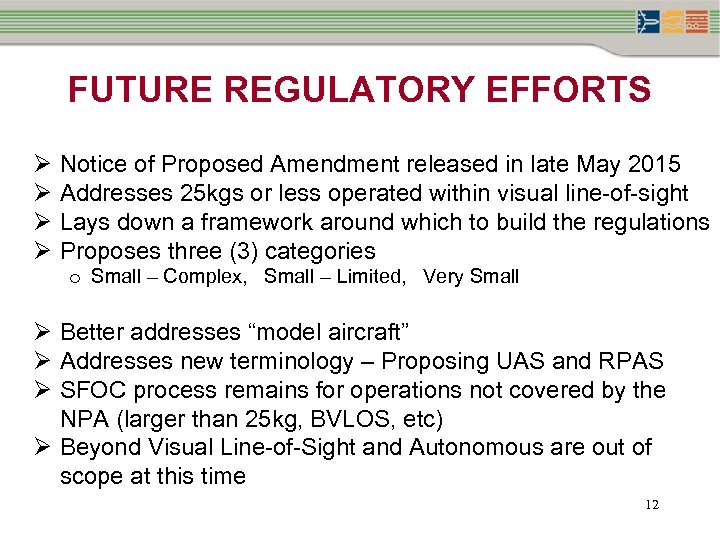 FUTURE REGULATORY EFFORTS Ø Ø Notice of Proposed Amendment released in late May 2015 Addresses 25 kgs or less operated within visual line-of-sight Lays down a framework around which to build the regulations Proposes three (3) categories o Small – Complex, Small – Limited, Very Small Ø Better addresses “model aircraft” Ø Addresses new terminology – Proposing UAS and RPAS Ø SFOC process remains for operations not covered by the NPA (larger than 25 kg, BVLOS, etc) Ø Beyond Visual Line-of-Sight and Autonomous are out of scope at this time 12
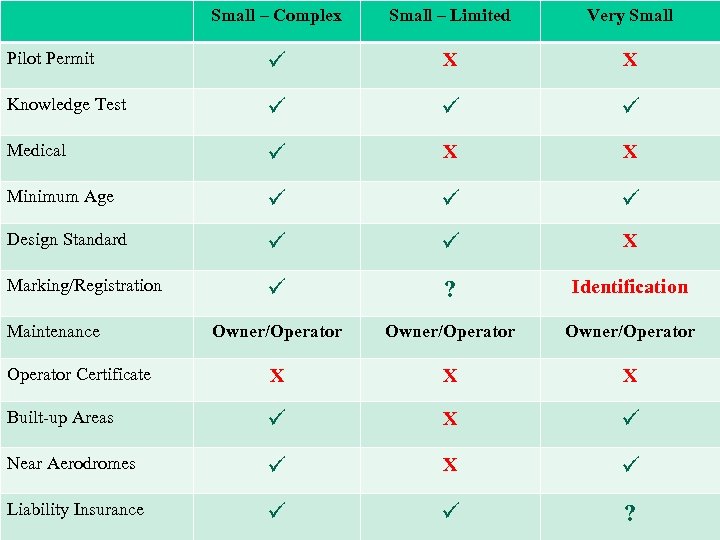 Small – Complex Small – Limited Very Small Pilot Permit ü X X Knowledge Test ü ü ü Medical ü X X Minimum Age ü ü ü Design Standard ü ü X Marking/Registration ü ? Identification Owner/Operator Certificate X X X Built-up Areas ü X ü Near Aerodromes ü X ü Liability Insurance ü ü ? Maintenance UAV NPA 13
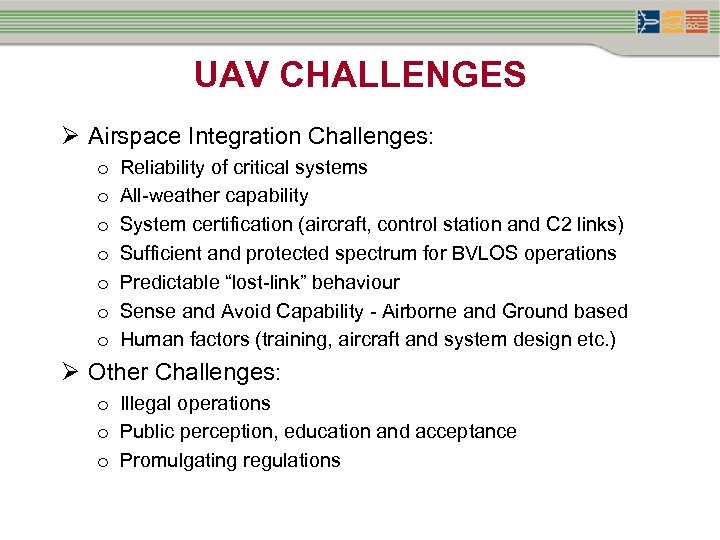 UAV CHALLENGES Ø Airspace Integration Challenges: o o o o Reliability of critical systems All-weather capability System certification (aircraft, control station and C 2 links) Sufficient and protected spectrum for BVLOS operations Predictable “lost-link” behaviour Sense and Avoid Capability - Airborne and Ground based Human factors (training, aircraft and system design etc. ) Ø Other Challenges: o Illegal operations o Public perception, education and acceptance o Promulgating regulations
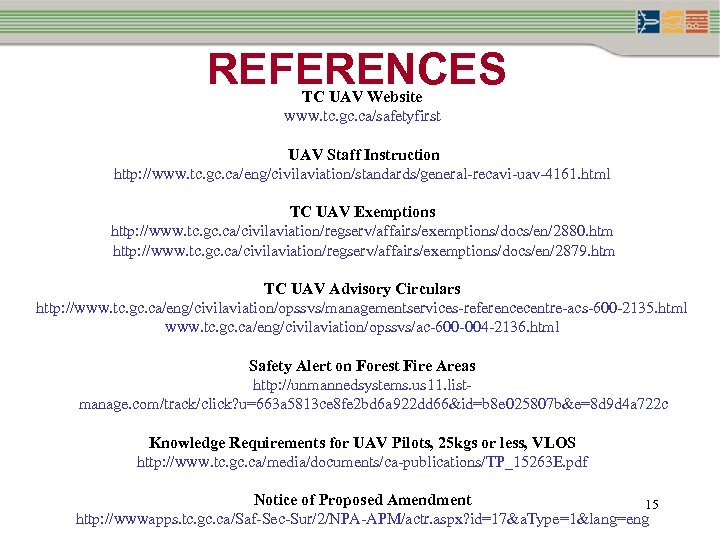 REFERENCES TC UAV Website www. tc. gc. ca/safetyfirst UAV Staff Instruction http: //www. tc. gc. ca/eng/civilaviation/standards/general-recavi-uav-4161. html TC UAV Exemptions http: //www. tc. gc. ca/civilaviation/regserv/affairs/exemptions/docs/en/2880. htm http: //www. tc. gc. ca/civilaviation/regserv/affairs/exemptions/docs/en/2879. htm TC UAV Advisory Circulars http: //www. tc. gc. ca/eng/civilaviation/opssvs/managementservices-referencecentre-acs-600 -2135. html www. tc. gc. ca/eng/civilaviation/opssvs/ac-600 -004 -2136. html Safety Alert on Forest Fire Areas http: //unmannedsystems. us 11. listmanage. com/track/click? u=663 a 5813 ce 8 fe 2 bd 6 a 922 dd 66&id=b 8 e 025807 b&e=8 d 9 d 4 a 722 c Knowledge Requirements for UAV Pilots, 25 kgs or less, VLOS http: //www. tc. gc. ca/media/documents/ca-publications/TP_15263 E. pdf Notice of Proposed Amendment 15 http: //wwwapps. tc. gc. ca/Saf-Sec-Sur/2/NPA-APM/actr. aspx? id=17&a. Type=1&lang=eng
 QUESTIONS/DISCUSSION 16
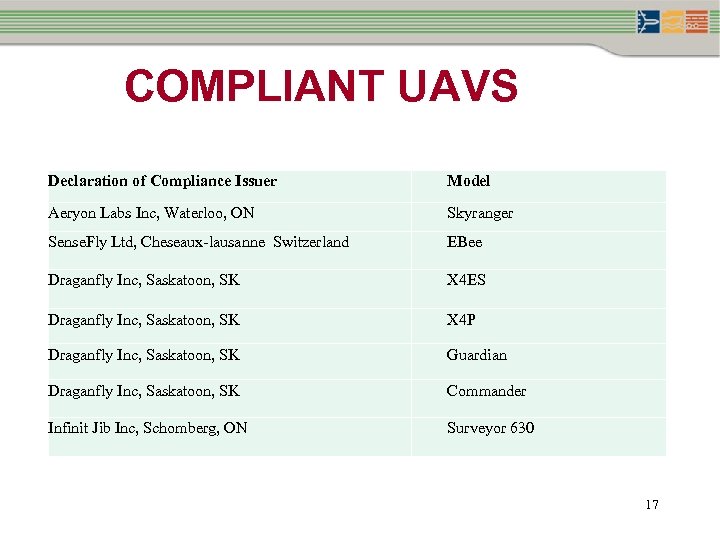 COMPLIANT UAVS Declaration of Compliance Issuer Model Aeryon Labs Inc, Waterloo, ON Skyranger Sense. Fly Ltd, Cheseaux-lausanne Switzerland EBee Draganfly Inc, Saskatoon, SK X 4 ES Draganfly Inc, Saskatoon, SK X 4 P Draganfly Inc, Saskatoon, SK Guardian Draganfly Inc, Saskatoon, SK Commander Infinit Jib Inc, Schomberg, ON Surveyor 630 17
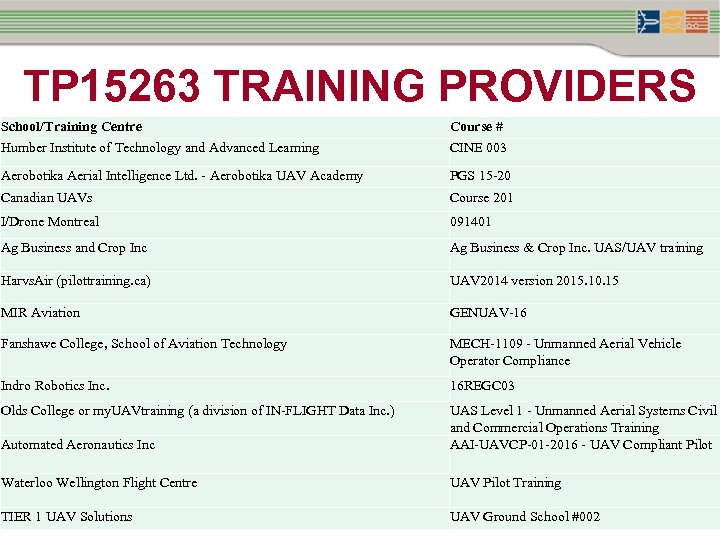 TP 15263 TRAINING PROVIDERS School/Training Centre Course # Humber Institute of Technology and Advanced Learning CINE 003 Aerobotika Aerial Intelligence Ltd. - Aerobotika UAV Academy PGS 15 -20 Canadian UAVs Course 201 I/Drone Montreal 091401 Ag Business and Crop Inc Ag Business & Crop Inc. UAS/UAV training Harvs. Air (pilottraining. ca) UAV 2014 version 2015. 10. 15 MIR Aviation GENUAV-16 Fanshawe College, School of Aviation Technology MECH-1109 - Unmanned Aerial Vehicle Operator Compliance Indro Robotics Inc. 16 REGC 03 Olds College or my. UAVtraining (a division of IN-FLIGHT Data Inc. ) Automated Aeronautics Inc UAS Level 1 - Unmanned Aerial Systems Civil and Commercial Operations Training AAI-UAVCP-01 -2016 - UAV Compliant Pilot Waterloo Wellington Flight Centre UAV Pilot Training TIER 1 UAV Solutions UAV Ground School #002 18
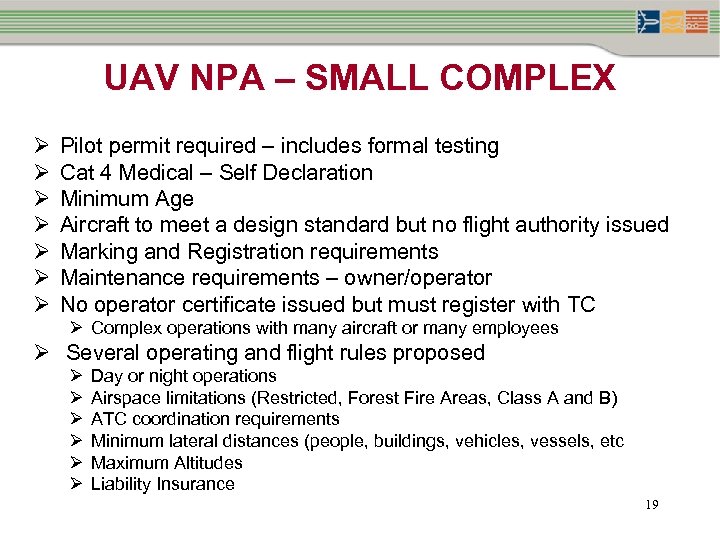 UAV NPA – SMALL COMPLEX Ø Ø Ø Ø Pilot permit required – includes formal testing Cat 4 Medical – Self Declaration Minimum Age Aircraft to meet a design standard but no flight authority issued Marking and Registration requirements Maintenance requirements – owner/operator No operator certificate issued but must register with TC Ø Complex operations with many aircraft or many employees Ø Several operating and flight rules proposed Ø Ø Ø Day or night operations Airspace limitations (Restricted, Forest Fire Areas, Class A and B) ATC coordination requirements Minimum lateral distances (people, buildings, vehicles, vessels, etc Maximum Altitudes Liability Insurance 19
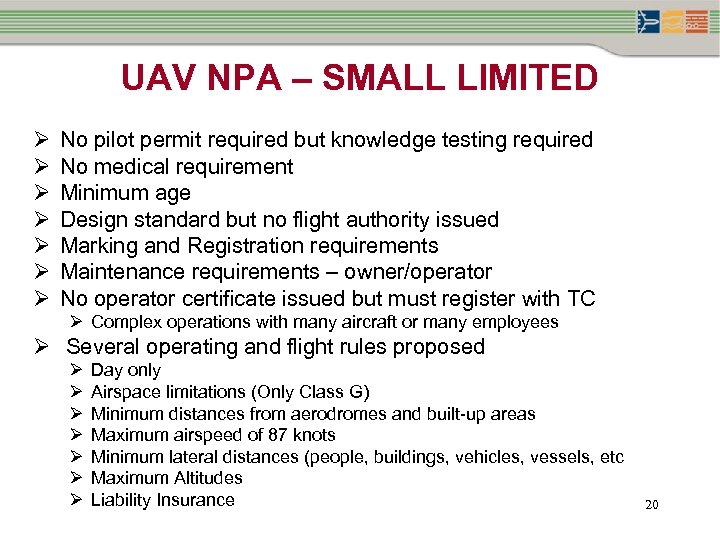 UAV NPA – SMALL LIMITED Ø Ø Ø Ø No pilot permit required but knowledge testing required No medical requirement Minimum age Design standard but no flight authority issued Marking and Registration requirements Maintenance requirements – owner/operator No operator certificate issued but must register with TC Ø Complex operations with many aircraft or many employees Ø Several operating and flight rules proposed Ø Ø Ø Ø Day only Airspace limitations (Only Class G) Minimum distances from aerodromes and built-up areas Maximum airspeed of 87 knots Minimum lateral distances (people, buildings, vehicles, vessels, etc Maximum Altitudes Liability Insurance 20
 UAV NPA – VERY SMALL Ø Ø Ø Ø No pilot permit required but knowledge testing required No medical requirement Minimum age No design standard but no flight authority issued No Marking/Registration requirements - aircraft identification Maintenance requirements – owner/operator No operator certificate issued but must register with TC Ø Complex operations with many aircraft or many employees Ø Several operating and flight rules proposed Ø Ø Ø Ø Day only Airspace limitations (Only Class G) Minimum distances from aerodromes Operations in built-up areas Maximum airspeed of 87 knots Minimum lateral distances (people, animals, buildings, vehicles, vessels, etc Maximum Altitudes 21