


 Скачать презентацию Canadian Heart Health Strategy FNHM National Forum March
8e3d9f19325ed02a6f960de65c7a4131.ppt
- Количество слайдов: 17
 Canadian Heart Health Strategy FNHM National Forum March 2008 Rose Sones Senior Policy, AFN Health Secretariat
 Heart Health in First Nations o From the 2002/03 RHS: – – – 2 FN higher risk of mortality by acute myocardial infarction, 72. 7 per 100, 000, compared to 52. 1 per 100, 00 for all Canadians FN routine early testing for heart disease such as cholesterol testing is generally lower than for all Canadians Social determinants of health (housing, access to health services) likely affects FN more than Canadians Cultural/spiritual health likely a significant factor for FN, we know that depression is correlated with heart disease Diabetes rate and trend in FN is higher than for all Canadians, 20% in 2002/03, doubled since 1997.
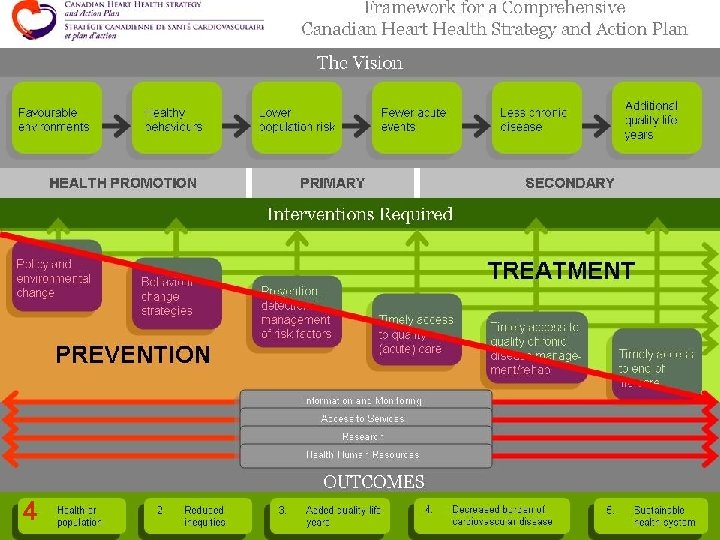
 What is the Canadian Heart Health Strategy (CHHS) o o o Announced as a federal government initiative at the Canadian Cardiovascular Congress in 2006 Funded by the Public Health Agency of Canada Mandate to develop a national Action Plan to reduce the growing burden and loss due to cardiovascular disease Take a collaborative and inclusive approach to develop the Action Plan – – 3 Stakeholder-driven Comprehensive and integrated Strategy covering the full continuum of health (prevention to end-of-life care) and spanning the life course (birth to death).
 4
4
 CHHS Governance and Structure o o Secretariat at Heart & Stroke Foundation offices. Steering Committee as decision-maker – – 5 Chair Eldon Smith, University of Calgary, Editor of Canadian Journal of Cardiology Director Carmen Connolly Members include experts in cardiology, Heart and Stroke Foundation, Canadian Cardiovascular Society, Canadian Stroke Network, Canada Health Info-Way, US CDC, CIHI, Canadian Diabetes Association, two provincial/territorial government reps Members also include Jeff Reading from CIHR-Inst of Aboriginal Peoples Health
 Priorities by Working Group o Theme Working Groups – – – o 6 Strengthening information systems for monitoring, management, evaluation and policy development Creating environments conducive to cardiovascular health Preventing, detecting and managing major risk factors Theme 4 - Addressing and enhancing Aboriginal/indigenous cardiovascular health Timely access to quality acute care and diagnostics Timely access to quality chronic disease management, rehabilitation services and end-of-life planning and care Each Working Group is drafting a paper, and these will forum the basis for the CHHS Action Plan.
 Priorities by Issue o Cross-cutting issues essential to the development of the CHHS-AP were also considered by each Theme Working Group as its work progresses. The cross-cutting issues are: – – – 7 Reducing the impact on cardiovascular outcomes that results from disparities. Expanding the knowledge base. Translating knowledge into action. Addressing the impact/outcomes of interventions. Addressing and enhancing Aboriginal/indigenous cardiovascular health.
 Theme 4 – Aboriginal Heart Health o Theme 4 Working Group – Membership includes: l l l 8 Richard Jock, AFN CEO Jeff Reading, CIHR-Inst of Aboriginal Health Laura Arbour from UVIC; Treena Delormier from Kahnawake; Lyall Higginson from Ottawa Heart Inst; James Irvine from Northern SK RHA; Nathan Matthew from FN Education Streering Committee in BC; Sharon Rudderham from Eskasoni; Stanley Vollant from University of Ottawa; Kue Young from University of Toronto
 Theme 4 Draft Paper o The Working Group drafted “Addressing and Enhancing Aboriginal/Indigenous Cardiovascular Health” in Jan/08, based on: – – – 9 Kahnawake Schools Diabetes Prevention Project in QC - multicomponent lifestyle modification intervention in schools involving parents, hospital physicians, dietitians, local universities & school officials Sandy Lake Health and Diabetes Project in ON - collaborative, integrated approach to addressing diabetes by working with schools, families and community Alaska Inuit Heart Health Project - dietary intervention that supplements with omega 3 fatty acids and reduces the intake of palmitic acid
 …continued – – – 10 Tui’kn Initiative in Cape Breton Island in NS - collaborative project of 5 FN communities working with RHAs and Dalhousie University to create a cross-jurisdictional model of primary health care Strong Heart Study in US - genetics study that may have some application to Canada New South Wales Aboriginal Vascular Health Program in Australia – coordinated assortment of community-proposed and delivered projects to increase access to clinical services, improve service coordination and increase collaboration for diabetes, circulatory disease, and renal disease
 …continued – – 11 Diabetes Risk Evaluation and Microalbuminuria (DREAM) Study in SK - research study in collaboration with Battlefords TC Health Services demonstrating that nurse practitioners are as effective as physicians in implementing an algorithm for a course of treatment related to diabetes and hypertension Believing We Can Reduce the Aboriginal Incidence of Diabetes (BRAID) in AB – screening study to obtain information on the prevalence of diabetes and metabolic syndrome, collaboration of the Aboriginal Diabetes Initiative and the University of Alberta Food Security in Canada’s North - food mail program which subsidizes the cost of shipping nutritious food, community freezer program which uses collaborative policy and interventions to reinforce a subsistence economy and traditional ethical codes Heart and Stroke Foundation of SK - provides outreach and services to health care providers in Aboriginal communities concerning stroke
 Recommendations from the Working Group - 1 o Policy – – – o Research – – 12 Integrated model for primary health care with collaboration between communities, programs and across jurisdictions Programs are responsive to community needs and initiative Apply CHHS-AP standards of care to Aboriginal communities (ie. Defibrillators, oxygen therapy, etc) Ensure the Heart & Stroke Foundation adopts a position statement on how they work with Aboriginal people Create community-based policy on tobacco reduction – – Address information gaps with data, improve surveillance in Aboriginal communities Explore use of quality-of-life indices Support research on intervention and evaluation studies on food security Establish accurate database on chronic disease interventions
 Recommendations From the Working Group - 2 o Intervention – – – 13 Implement comprehensive prevention programming Develop integrated primary health care teams that respect traditional knowledge Address disparities in access to care by expanding nurse practitioners Bolster food security Match interventions to individual and community readiness Engage community institutions in healthy public policy campaigns on tobacco reduction
 Recommendations From the Working Group - 3 o Human Resources – – 14 – Support Aboriginal HHR: chronic disease intervention, mentoring and exchange, increase bursaries, increase # of seats in medicine and nursing, expand Heart & Stroke Foundation outreach Improve cultural competency of non-Aboriginal providers with residency incentives in the north, rotating specialists for isolated communities, cultural competency education in curricula Set proficiency standards and training models for chronic disease interventions
 Recent Activities o The draft Theme 4 paper was reviewed, and there is good content in the draft, but AFN requested five points to strengthen the document, on February 22: – – Reduction of tobacco use can be done through policy and regulation, AND education and health promotion. FN heart health is more affected by the determinants of health than other Canadians l l – 15 access to services is a key factor, and primary health care model does not compare between mainstream and FN Intervention is needed now, more than prevention Collaboration is required to address this issue, such as the BC Tripartite Health Plan, AHTF Integration projects
 …continued – – Health data must honour OCAP, and FN/I controlled databases are required that would “cross-walk” data to P/T databases Interventions and health promotion is community-based l l o Next Steps: – – – 16 approaches in mainstream health may or may not be appropriate in FN communities Development of capacity in FN communities is key – CHHS Steering Committee reviews the Working Group Theme Papers, to develop the Action Plan Meets June 9 -10 in Ottawa Intent to draft Action Plan to present at the national Cardiovascular Conference on October www. cardiocongress. org Action Plan intended to be the request for a strategic funding approach for heart health
 Questions o o o 17 What is happening in your community in heart health? What is needed to address FN heart health? For further information, please see the CHHS website at http: //www. chhs-scsc. ca