


 Скачать презентацию Canadian English History Linguistic historians usually cannot
Canadian English.pptx
- Количество слайдов: 12
 Canadian English
 History Linguistic historians usually cannot identify a single event or period of time as the beginning of a particular dialect. This is so because there are normally many conditions needed for a speech variety to emerge as a distinct homegeneous form. We can attribute the unique characteristics of a dialect not only to the geographical or social isolation of its speakers, but to the speech of the various populations from which it descends or with whom it has had contact. One (perhaps oversimplistic) way of characterizing Canadian English is as a hybrid of British and American Englishes. It would certainly seem that way to the initiate: Canadians drive trucks, not lorries, but a Canadian who is pissed is intoxicated, and not (necessarily) angry. Canadians use British spellings like labour, colour, and cheque, but American spellings like plow, draft, and program. Although spelling habits don't really say anything about dialect speech patterns, they may be exploited by the cynic who says there is no Canadian spelling. There also always the anecdotes of Canadians also 'sounding' halfway between the other two, but the lay-person's means of describing dialect differences rarely can quantify that kind of judgement. The idea that a dialect is a hybrid often implies that it is not a distinct variety. Coupled with a collective sensitivity about their own identity, English Canadians will bristle at the suggestion that their speech is half-American, half-British, and not at all their own. This need not be the case: a dialect can be seen as a hybrid in terms of its history, but as a distinct form in terms of its current usage. That is, Canadians can claim to speak a distinct variety of English that has the English of both Americans and British as its predecessors.
 We can tie the dualistic background of Canadian English directly to the dualistic background of the settlement of English Canada. Following the seizing of the French colony of Quebec in 1761, all of eastern North America was under the control of the British Empire. The thirteen American colonies had already been densely settled, and the dialects of the eastern seaboard had begun to emerge. Maritime Canada had also seen settlement, which is part of why Maritime English remains distinct today. However, Upper Canada, the region that was to become Ontario, now Canada's most populous province, was at that time sparsely settled. Migration of Europeans to Ontario lagged behind that of the eastern colonies for several reasons, notably among them the harshness of the winter and its distance from ocean ports. Following the American Revolution, however, settlement of Ontario increased in pace, both with the continuing arrival of Europeans, but more significantly with the migration of Loyalists (or "Tories") who fled the United States. Chambers (1993, 1997) claims it is the speech of the first wave of Loyalists, who arrived in southern Ontario from Pennsylvania and Virginia in the 1780's, that forms the basis of early Canadian English. Later waves of New England loyalists and Scottish and Irish immigrants in the mid 19 th century are thought to have had little effect on the dialect, except where their numbers were too large to have simply been absorbed into the settled population.
 The social conditions of the time both allowed for Canadian English to diverge from other American dialects, and arguably may have encouraged it to do so. It was able to diverge because it was spoken in an area both geographically and politically separated from the eastern United States. Although the introduction of steam power and railroads (and ultimately, air travel) reduces the effect of geographical distance, the political border between Canada and the US has remained a factor in maintaining the relative isolation of Canadian English from its southern neighbour. One can also imagine how the sentiments of Loyalists and British Canadians may have encouraged them, perhaps not even consciously, to try to avoid using American-sounding speech. Whether they were successful is debatable, but it is certainly clear that British English was beyond revival in North America. Chambers provides an overview of how writers of the time tended to decry the vernacular of Upper Canada. Amid such testimonials is evidence that the English of Upper Canada had become a homogeneous variety by the 1860's: the historian William Canniff noted in 1852 that the speech of those born as Canadians was quite uniform despite the diversity of accents spoken by their parents. This homogeneity of Upper Canadian speech provides an explanation of why modern Canadian English is so uniform across the entire country. In the late 19 th century, the settlement of western Canada saw a surge in migration of Ontarians, who eventually outnumbered the French-speaking and aboriginal communities of the Prairies to such an extent that later waves of immigration assimilated to the English-speaking population. As a result, the phonological differences among the English spoken today in Vancouver, Calgary, and Toronto are minimal.
 Canadian Phonology Canadian English shares a number of phonological properties with Standard American English. Among these are syllable-final rhoticity and alveolar flapping. Canadian English can be called rhotic because, like in Standard American and Irish English, syllable-final r is pronounced in words like car and farm. Interestingly, the English spoken in Lunenburg, Nova Scotia, stands out as a rare r-dropping Canadian dialect. Flapping is the process of replacing an intervocalic t or d with a quick voiced tap of the tongue against the alveolar ridge. In both Canadian and American English, it can only occur if the t or d is between two vowels, and as long as the second vowel is not stressed. As a result, the alveolar stops in waiting, wading, seated, seeded, and capital are all flapped. Flapping can also occur if there is an r between the first vowel and the alveolar stop, as in words like barter and party. In Canadian English, this feature is age-graded. Woods (1993) shows that older Canadians are less likely than younger ones to replace alveolar stops with flaps.
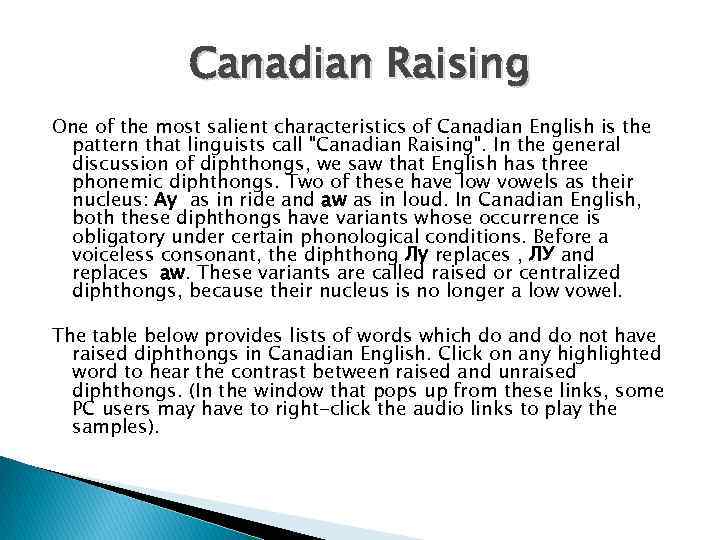 Canadian Raising One of the most salient characteristics of Canadian English is the pattern that linguists call "Canadian Raising". In the general discussion of diphthongs, we saw that English has three phonemic diphthongs. Two of these have low vowels as their nucleus: Ay as in ride and aw as in loud. In Canadian English, both these diphthongs have variants whose occurrence is obligatory under certain phonological conditions. Before a voiceless consonant, the diphthong Лy replaces , ЛУ and replaces aw. These variants are called raised or centralized diphthongs, because their nucleus is no longer a low vowel. The table below provides lists of words which do and do not have raised diphthongs in Canadian English. Click on any highlighted word to hear the contrast between raised and unraised diphthongs. (In the window that pops up from these links, some PC users may have to right-click the audio links to play the samples).
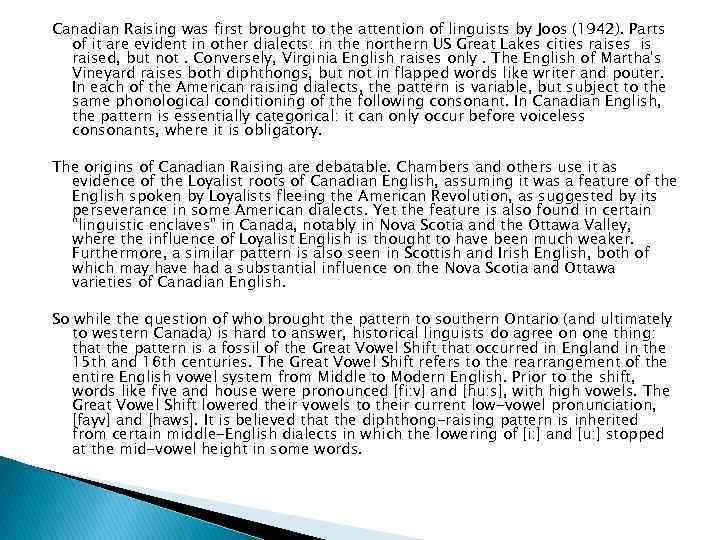 Canadian Raising was first brought to the attention of linguists by Joos (1942). Parts of it are evident in other dialects: in the northern US Great Lakes cities raises is raised, but not. Conversely, Virginia English raises only. The English of Martha's Vineyard raises both diphthongs, but not in flapped words like writer and pouter. In each of the American raising dialects, the pattern is variable, but subject to the same phonological conditioning of the following consonant. In Canadian English, the pattern is essentially categorical: it can only occur before voiceless consonants, where it is obligatory. The origins of Canadian Raising are debatable. Chambers and others use it as evidence of the Loyalist roots of Canadian English, assuming it was a feature of the English spoken by Loyalists fleeing the American Revolution, as suggested by its perseverance in some American dialects. Yet the feature is also found in certain "linguistic enclaves" in Canada, notably in Nova Scotia and the Ottawa Valley, where the influence of Loyalist English is thought to have been much weaker. Furthermore, a similar pattern is also seen in Scottish and Irish English, both of which may have had a substantial influence on the Nova Scotia and Ottawa varieties of Canadian English. So while the question of who brought the pattern to southern Ontario (and ultimately to western Canada) is hard to answer, historical linguists do agree on one thing: that the pattern is a fossil of the Great Vowel Shift that occurred in England in the 15 th and 16 th centuries. The Great Vowel Shift refers to the rearrangement of the entire English vowel system from Middle to Modern English. Prior to the shift, words like five and house were pronounced [fi: v] and [hu: s], with high vowels. The Great Vowel Shift lowered their vowels to their current low-vowel pronunciation, [fayv] and [haws]. It is believed that the diphthong-raising pattern is inherited from certain middle-English dialects in which the lowering of [i: ] and [u: ] stopped at the mid-vowel height in some words.
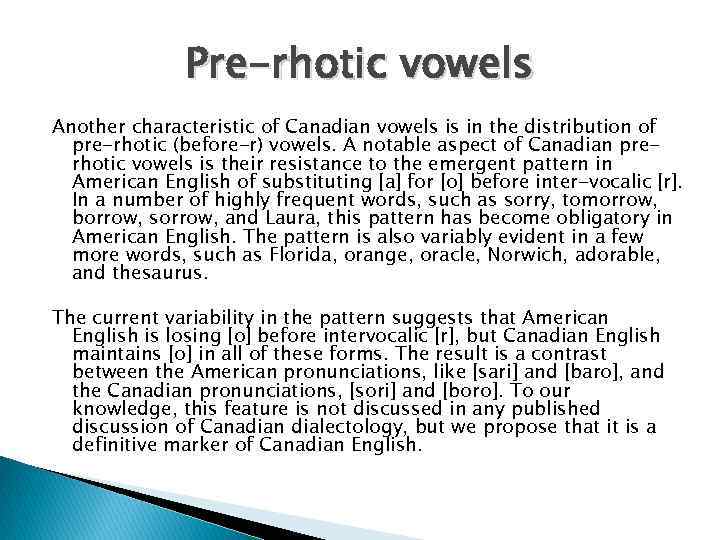 Pre-rhotic vowels Another characteristic of Canadian vowels is in the distribution of pre-rhotic (before-r) vowels. A notable aspect of Canadian prerhotic vowels is their resistance to the emergent pattern in American English of substituting [a] for [o] before inter-vocalic [r]. In a number of highly frequent words, such as sorry, tomorrow, borrow, sorrow, and Laura, this pattern has become obligatory in American English. The pattern is also variably evident in a few more words, such as Florida, orange, oracle, Norwich, adorable, and thesaurus. The current variability in the pattern suggests that American English is losing [o] before intervocalic [r], but Canadian English maintains [o] in all of these forms. The result is a contrast between the American pronunciations, like [sari] and [baro], and the Canadian pronunciations, [sori] and [boro]. To our knowledge, this feature is not discussed in any published discussion of Canadian dialectology, but we propose that it is a definitive marker of Canadian English.
![While Canadian English maintains [o] before intervocalic [r], it has nearly or completely lost](https://present5.com/presentation/115015046_139302168/image-9.jpg "While Canadian English maintains [o] before intervocalic [r], it has nearly or completely lost") While Canadian English maintains [o] before intervocalic [r], it has nearly or completely lost the distinction between and in the same position. A result of this is homophony for the word pairs marry-merry and Barry-berry. In a survey of Ottawa residents, Woods (1993) finds the pattern to be age-related: older speakers tend to pronounce marry as [mæri], while younger speakers are likely to pronounce it so that it rhymes with merry. It is Woods' claim that the retention of [æri] is a Canadianism, since it is also a Britishism. We contend that the loss of [æri] is a property of Canadian English that distinguishes it from other varieties in close proximity, like the English of New York and New England, where [æri] is preserved.
While Canadian English maintains [o] before intervocalic [r], it has nearly or completely lost the distinction between and in the same position. A result of this is homophony for the word pairs marry-merry and Barry-berry. In a survey of Ottawa residents, Woods (1993) finds the pattern to be age-related: older speakers tend to pronounce marry as [mæri], while younger speakers are likely to pronounce it so that it rhymes with merry. It is Woods' claim that the retention of [æri] is a Canadianism, since it is also a Britishism. We contend that the loss of [æri] is a property of Canadian English that distinguishes it from other varieties in close proximity, like the English of New York and New England, where [æri] is preserved.
 Borrowings with low vowels A final, curious property of Canadian English is in its foreign /a/ nativization. This is the way the dialect pronounces borrowed words with low vowels, such as pasta, Mazda, drama, and taco. There is a strong tendency for Canadians to pronounce these words with a front AE , while Americans tend to use [a]. Though the pattern is somewhat variable, Boberg (2000) finds that for 15 such borrowings, the Canadian pronunciation is always more likely than the American pronunciation to have AE. For example, 82% of his American informants pronounce panorama with AE in the third syllable, compared to 94% of Canadians. In a parallel manner, 5% of the Americans in his study pronounce pasta with AE in the first syllable, compared to 81% of Canadians. The following table provides a list of items Boberg used. You should note that for nearly each word, at least 70% of his Canadian informants had a pronunciation with AE , with the exception of macho, taco, and Vietnam. In these cases, however, the Canadian pronunciation was still more likely to use AE than the American pronunciation was.
 Some other words that seem to pattern with macho in Canadian English, by tending to use [a] instead of AE , include Bach, Guatamala, kamikaze, karate and garbanzo. Why the Canadian pronunciation of these items tends to use [a] is a mystery, but as the two lists above show, the overwhelming pattern is for Canadian English to use AE in borrowings with low vowels. Furthermore, the use of AE instead of [a] is productive: Canadians, when confronted with novel foreign words, continue to assign AE to them.
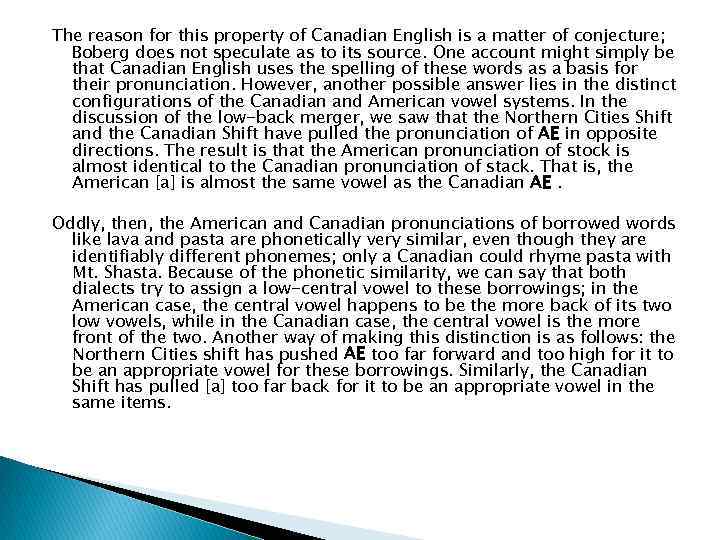 The reason for this property of Canadian English is a matter of conjecture; Boberg does not speculate as to its source. One account might simply be that Canadian English uses the spelling of these words as a basis for their pronunciation. However, another possible answer lies in the distinct configurations of the Canadian and American vowel systems. In the discussion of the low-back merger, we saw that the Northern Cities Shift and the Canadian Shift have pulled the pronunciation of AE in opposite directions. The result is that the American pronunciation of stock is almost identical to the Canadian pronunciation of stack. That is, the American [a] is almost the same vowel as the Canadian AE. Oddly, then, the American and Canadian pronunciations of borrowed words like lava and pasta are phonetically very similar, even though they are identifiably different phonemes; only a Canadian could rhyme pasta with Mt. Shasta. Because of the phonetic similarity, we can say that both dialects try to assign a low-central vowel to these borrowings; in the American case, the central vowel happens to be the more back of its two low vowels, while in the Canadian case, the central vowel is the more front of the two. Another way of making this distinction is as follows: the Northern Cities shift has pushed AE too far forward and too high for it to be an appropriate vowel for these borrowings. Similarly, the Canadian Shift has pulled [a] too far back for it to be an appropriate vowel in the same items.