 Скачать презентацию Canadian Association of Movers December 2007 Building Value
30605f044716715191c5fb07f0b7acae.ppt
- Количество слайдов: 28



Canadian Association of Movers December 2007 Building Value for Succession Luanna Mc. Gowan Succession Planning Specialist 1 Pricewaterhouse. Coopers LLP
Succession Planning Overview of today’s presentation What is a succession plan? Why plan for succession? When to plan? How to plan? 2 Pricewaterhouse. Coopers LLP
Succession Planning WHAT is it? Planning for transfer of ownership and management responsibilities Deals with such issues as: • Who will take over the business? • Within what timeframe will the transition take place? • How will the transition be structured? • What are evolving roles and responsibilities? 3 Pricewaterhouse. Coopers LLP
Succession Planning WHAT is it? A succession plan is different from, but closely tied to, an ESTATE PLAN An estate plan provides for a tax effective disposition of all of one’s assets at death (including shares of a business) Dovetail with succession plan • Successor may inherit shares/lifetime planning • “Equalization” for heirs not involved 4 Pricewaterhouse. Coopers LLP
Why have a Succession Plan? Over the next few years, Canada’s entrepreneurs will retire in significant numbers: • 39% within the next 5 years • 67% within the next 10 years Source: Pw. C Pulse Survey, 2007 5 Pricewaterhouse. Coopers LLP
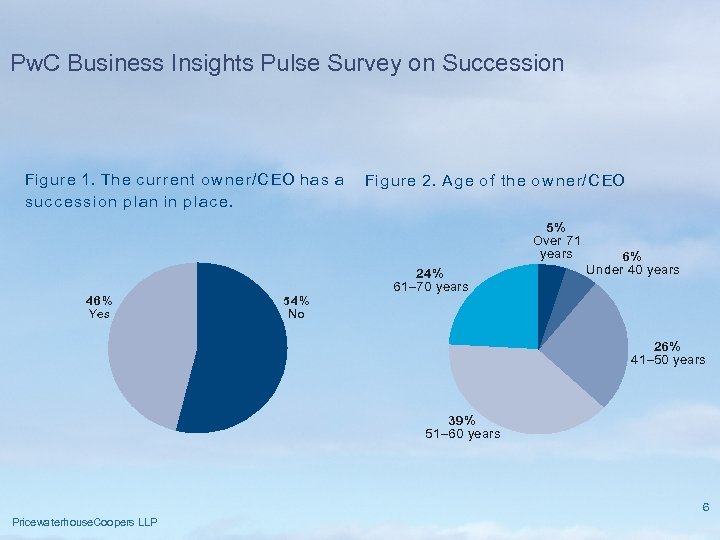
Pw. C Business Insights Pulse Survey on Succession Fig ure 1. The c urren t o w ner/C EO has a suc c ess ion p lan in p lac e. Fig ure 2. Ag e o f the o w ner/C EO 5% Over 71 years 46% Yes 5 4% No 24% 61– 70 years 6% Under 40 years 26% 41– 50 years 39% 51– 60 years 6 Pricewaterhouse. Coopers LLP
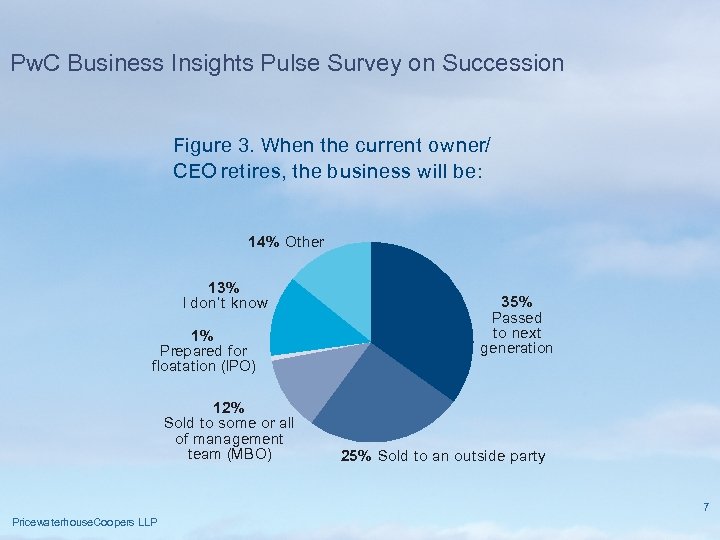
Pw. C Business Insights Pulse Survey on Succession Figure 3. When the current owner/ CEO retires, the business will be: 14% Other 13% I don’t know 1% Prepared for floatation (IPO) 12% Sold to some or all of management team (MBO) 35% Passed to next generation 25% Sold to an outside party 7 Pricewaterhouse. Coopers LLP
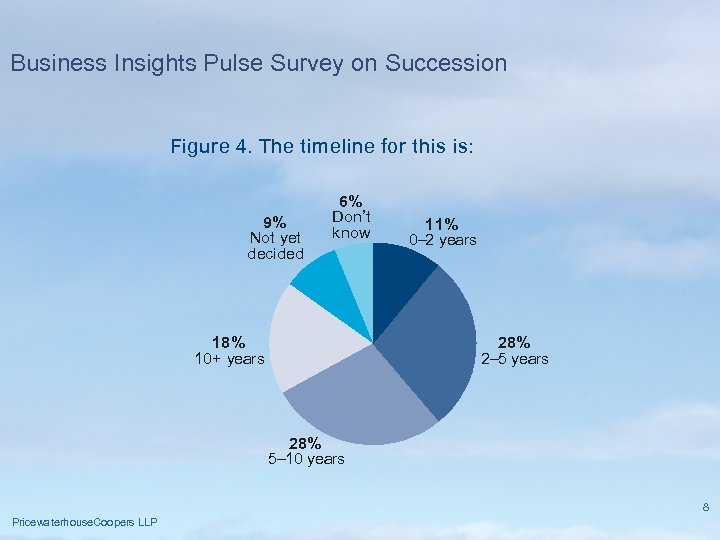
Business Insights Pulse Survey on Succession Figure 4. The timeline for this is: 9% Not yet decided 6% Don’t know 18% 10+ years 11% 0– 2 years 28% 2– 5 years 28% 5– 10 years 8 Pricewaterhouse. Coopers LLP
Succession Planning – WHY plan? Statistics 80 – 90% of Canadian businesses are family owned and managed and account for nearly half of Canada’s gross national product Only 30% will continue as a family operation into the second generation Only 10% will remain a family-owned and managed enterprise into the third generation Only 1% will make it to the fourth generation 9 Pricewaterhouse. Coopers LLP
Reasons for Failure • Entrepreneurs fail to plan (topics of death and retirement too hard to address) • Plans are devised by entrepreneur according to own perspective and desires • Tax driven planning • Unresolved issues in family and/or business 10 Pricewaterhouse. Coopers LLP
Reasons for Failure Succession • The founder did not have an adequate succession plan in place • Chosen successor was not properly prepared for taking over the business • A clear successor to the founder was never identified • Chosen successor did not want to manage the business 11 Pricewaterhouse. Coopers LLP
Reasons for Failure Financial Planning • Founder did not have an adequate estate plan in place • Founder did not adequately prepare for transfer of the business • Needed to raise funds to pay estate taxes • Financial advisors performed inadequately • Insufficient capital to run business effectively 12 Pricewaterhouse. Coopers LLP
Reasons for Failure Other • Conflicts with family members both within and out of the business (e. g. active/inactive siblings) • Conflicts with non-family employees in the business (e. g. career path, uncertainty) • One or more key employees left the company • Management mistakes after business was inherited 13 Pricewaterhouse. Coopers LLP
The Answer? Proper Planning Effective Communication 14 Pricewaterhouse. Coopers LLP
Succession Planning WHEN to plan… Entrepreneurs should be planning for succession in contemplation of, and after, any of the following events: • Retirement • Commencement or restructuring of the business • Death (of spouse, beneficiary, key employee, potential successor) • Birth of children or grandchildren • Marriage or divorce 15 Pricewaterhouse. Coopers LLP
Succession Planning WHEN to plan… Entrepreneurs should be planning for succession in contemplation of, and after, any of the following events: • Major change in circumstances (e. g. illness or disability) • Tax or other relevant legislative changes • Sale of all or portion of the business • Employment of family members in the business • Buying buy-sell insurance; insurance to fund purchase • Changes to existing wills, estate and succession plans 16 Pricewaterhouse. Coopers LLP
Succession Planning WHEN to plan… Planning for the succession of a business is not an event – it is a process. Many entrepreneurs assume that they do not need to start planning for succession until their later years. However, this is not the case. As the owner advances through the various business, ownership and family stages, their goals and circumstances change and it is necessary to revise plans. 17 Pricewaterhouse. Coopers LLP

Succession Planning How to Plan… 18 Pricewaterhouse. Coopers LLP
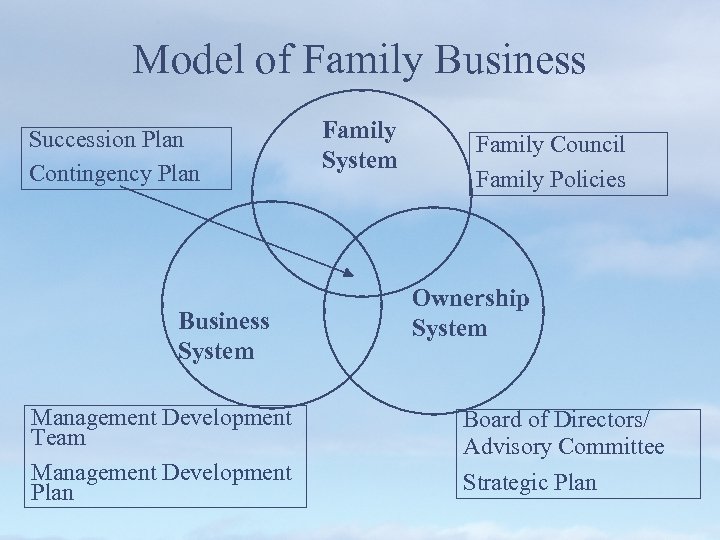
Model of Family Business Succession Plan Contingency Plan Business System Management Development Team Management Development Plan Family System Family Council Family Policies Ownership System Board of Directors/ Advisory Committee Strategic Plan
Typical Objectives Identified • Maintaining economic independence • Ensuring short-term and long-term success of the business • Maintaining family harmony • Minimizing tax 20 Pricewaterhouse. Coopers LLP
Succession Planning – How to plan… Planning Documents Legal Documents • Wills • Powers of Attorney • Shareholders’ Agreement • Domestic Agreement • Trust document • Other Plans and Policies • Contingency Plan • Management Development Plan • Personal Development Plans • Strategic Plan • Family Participation Plan • Other 21 Pricewaterhouse. Coopers LLP
Succession Options • Inter-generational transfer • Management buy-out/employee buy-in • Sale to third party • Other 22 Pricewaterhouse. Coopers LLP
Case Study Intergenerational transfer • Parents started business • 4 active children, 1 inactive • Reorganization • Poor communication • Inadequate training of successors • No contingency plan (not aware) 23 Pricewaterhouse. Coopers LLP
Case Study Management buy-out • No next generation successors • Proposal to entrepreneur to buyout • Entrepreneur vs manager • Value • Funding • Timing 24 Pricewaterhouse. Coopers LLP
Case Study Sale to Third Party • No next generation successors • No management interest • Contacts in industry 25 Pricewaterhouse. Coopers LLP

Succession Planning Best Practices 26 Pricewaterhouse. Coopers LLP
Succession Planning Best Practices • Open communication • Understanding perspectives • Building trust • Harmony • Good Governance • Values, Vision, Mission • Plans and Policies • Clear ARAs • Education 27 Pricewaterhouse. Coopers LLP
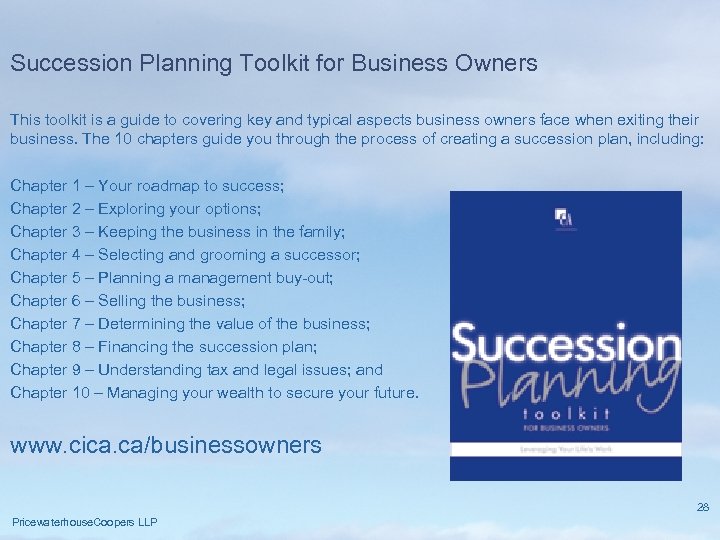
Succession Planning Toolkit for Business Owners This toolkit is a guide to covering key and typical aspects business owners face when exiting their business. The 10 chapters guide you through the process of creating a succession plan, including: Chapter 1 – Your roadmap to success; Chapter 2 – Exploring your options; Chapter 3 – Keeping the business in the family; Chapter 4 – Selecting and grooming a successor; Chapter 5 – Planning a management buy-out; Chapter 6 – Selling the business; Chapter 7 – Determining the value of the business; Chapter 8 – Financing the succession plan; Chapter 9 – Understanding tax and legal issues; and Chapter 10 – Managing your wealth to secure your future. www. cica. ca/businessowners 28 Pricewaterhouse. Coopers LLP
Скачать презентацию Canadian Association of Movers December 2007 Building Value
30605f044716715191c5fb07f0b7acae.ppt