 Скачать презентацию CANADA-UNITED STATES AGRICULTURE POLICY Presented by Chris Leggett
d7b754b13526556987e25f4778c20db4.ppt
- Количество слайдов: 28



CANADA-UNITED STATES AGRICULTURE POLICY Presented by: Chris Leggett Agriculture Counselor Canadian Embassy, Washington DC 1
OVERVIEW u Canadian and US agriculture policies share similar goals… u … but there are differences in approach u These differences result in Canadian concerns with US Farm Bill and certain other food policies… u … but do not overshadow the cooperation in and mutual benefits of our bilateral relationship 2
Why does Canada care about US farm policy? u U. S. sets trends: Canadian farmers want same levels/types of support that their U. S. neighbours enjoy u Competition: domestic, U. S. and international markets u WTO negotiations 3
Why should the U. S. care about Canadian farm policy? u #1 trading partners u Integrated food production sector u Farmers/ranchers deal with similar challenges – can learn from each other’s best practices u Competition 4
Canada and the U. S. are Major Agri-food Traders u The U. S. is the 2 nd largest agri-food exporter in the world, Canada is the 4 th largest. u 27% of US agriculture goods are exported u Over 50% of Canadian agriculture goods are exported u 95% of the world’s consumers live outside our borders 5
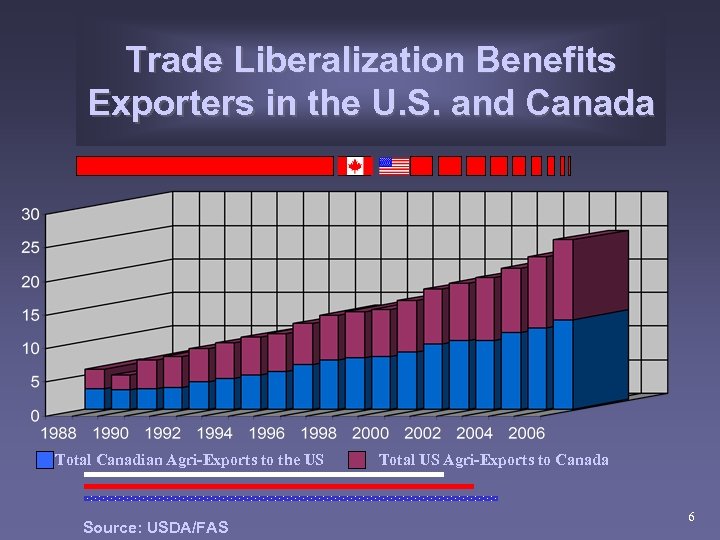
Trade Liberalization Benefits Exporters in the U. S. and Canada Total Canadian Agri-Exports to the US Source: USDA/FAS Total US Agri-Exports to Canada 6
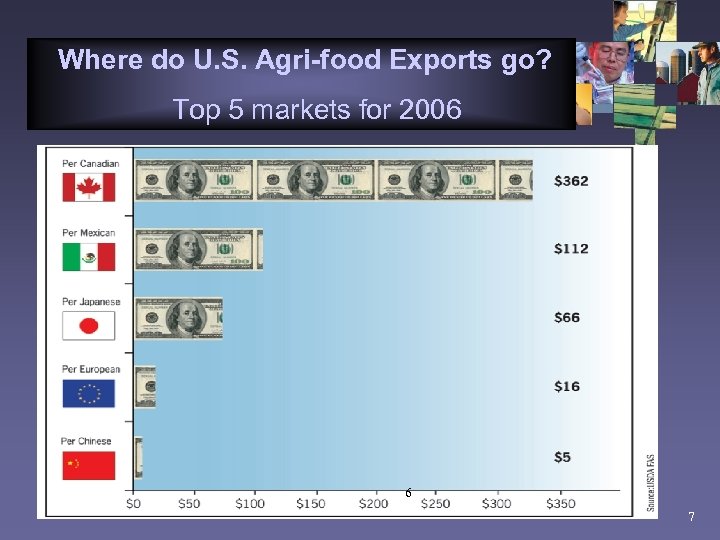
Where do U. S. Agri-food Exports go? Top 5 markets for 2006 6 7
How Canadian Agricultural Policy is Developed u Shared jurisdiction with provinces u Policies developed by government(s) u Consultation with industry and stakeholders u Process is usually via Cabinet and Treasury Board, but any changes to Acts go through Parliament 8
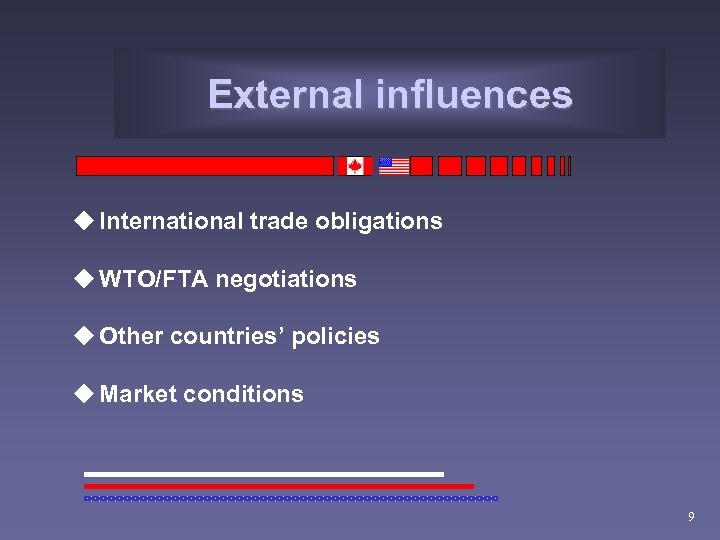
External influences u International trade obligations u WTO/FTA negotiations u Other countries’ policies u Market conditions 9
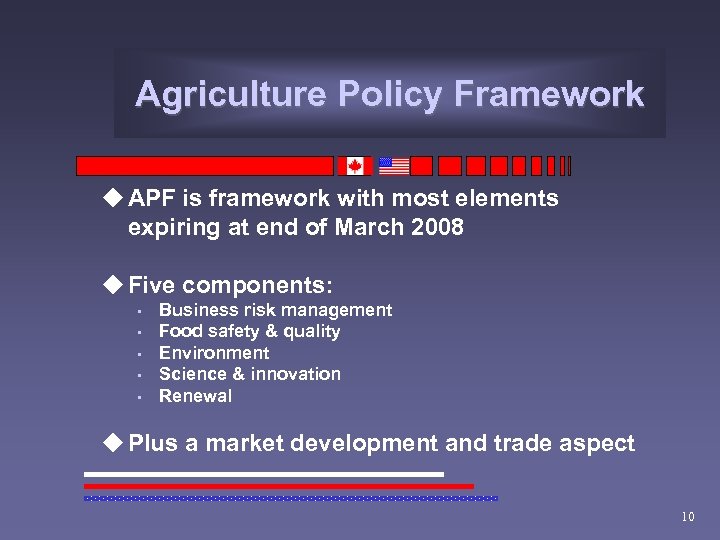
Agriculture Policy Framework u APF is framework with most elements expiring at end of March 2008 u Five components: • • • Business risk management Food safety & quality Environment Science & innovation Renewal u Plus a market development and trade aspect 10
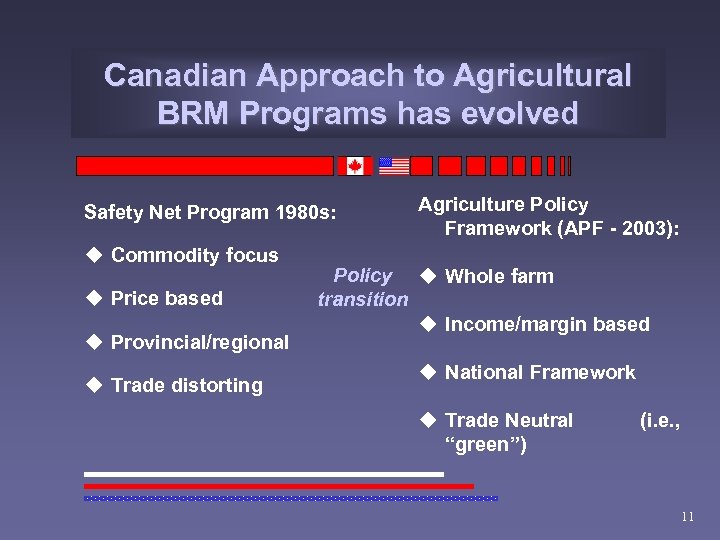
Canadian Approach to Agricultural BRM Programs has evolved Safety Net Program 1980 s: u Commodity focus u Price based u Provincial/regional u Trade distorting Agriculture Policy Framework (APF - 2003): Policy u Whole farm transition u Income/margin based u National Framework u Trade Neutral “green”) (i. e. , 11
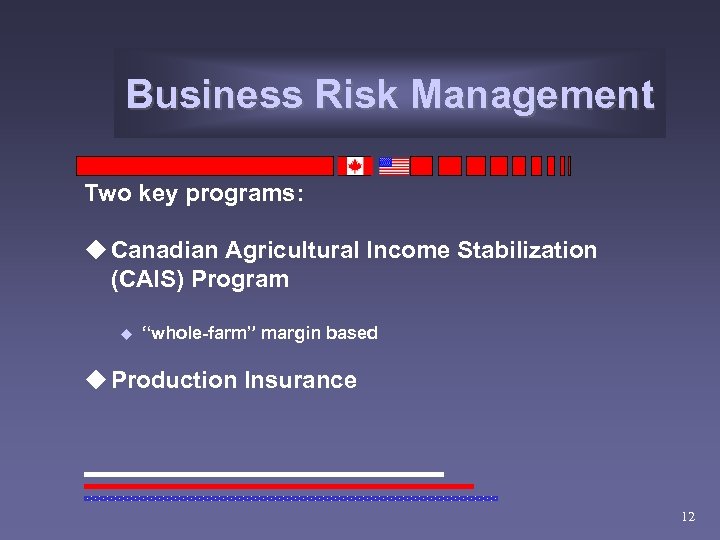
Business Risk Management Two key programs: u Canadian Agricultural Income Stabilization (CAIS) Program u “whole-farm” margin based u Production Insurance 12
CAIS: Strengths u Production neutral (allows market signals to prevail) u Whole-farm u Demand driven u Payments based on need - not an entitlement u Margin based – takes into account both sides of the financial equation 13
CAIS: Challenges u In the long term, does not address declining margins u Complex to administer and understand u Lacks predictability u Timeliness – fiscal year calculation 14
Growing Forward: Toward a New Agriculture Policy Framework u Focusing on building a competitive and innovative sector u Being proactive in managing risks u Ensuring the sector contributes to society's priorities 15
Proposed New Business Risk Management Strategies u Agri. Invest u Agri. Stability u Agri. Recovery u Agri. Insurance 16
Context for developing new programs in Canada u Farm income continues to decline u The cost of inputs have gone up u Overall though, off-farm income has gone up 17
Producer interests similar in Canada and US u Canadian stakeholders have indicated that they want to see u A move to an outcome-based system u Greater focus on innovation u Programs to build on successes of food safety and environment u Flexible program design and delivery u Reduction of administrative burden and simplification of programs u Regulatory issues addressed to enable the sector to be innovative and competitive 18
Common themes u Primary producers u u u Profitability key concern Should be paid for contributions to environment and food safety Need to attract young farmers into the sector u Processors: u u u Need to reduce government impediments to innovation and growth Regulatory issues Research and development priorities u Food security 19
Canadian concerns with 2007 Farm Bill u Most proposals to date maintain the current structure of 2002 Farm Bill u US commodity programs that trigger large subsidy payments u Programs that mask market signals, distort production decisions and reduce prices u Country of Origin Labelling u Sugar provisions 20
Beyond Farm Policy u Food Safety • • • Increased inspection rates User fees Ports of entry u Seasonal Agricultural Workers Program u Healthcare 21
Canada’s trade policy objectives u Canada seeking a fairer international trade environment for producers and processors u elimination of all forms of export subsidies u substantial reduction of trade distorting domestic support u real and substantial improvements in market access 22
Multi-track approach u WTO agriculture negotiations u WTO is key forum for achieving fairer rules and enhanced trade liberalization u Canada wants an ambitious outcome u Regional and bilateral trade negotiations u Closely monitoring FTA initiatives by others, incl. USA u Advocacy initiatives u Technical trade discussions and standard-setting u Litigation 23
WTO Challenge of US Agricultural Subsidies Background: u Longstanding concerns with U. S. subsidy programs and their impacts on Canadian farmers u Consultations held on February 7 u Panel requested June 7, again on November 8 24
WTO Challenge of US Agricultural Subsidies Grounds u Total US trade-distorting support (amber box) exceeds the US WTO commitment levels. u Covers wide range of products (including corn, wheat, soybeans, dairy, sugar, etc. ) and dozens of U. S. subsidy programs (including DPs, CCPs, LDPs, etc. ) 25
WTO Panel – why now? u Reflects importance Canada attaches to addressing harmful effects of US agricultural subsidies u Underlines need to meet WTO commitments as US Farm Bill is drafted this year u Does not indicate that Canada has given up on WTO negotiations, which remains preferred approach to levelling international playing field for our agricultural producers 26
Conclusions u Trade is important for Canadian agricultural sector, particularly with US u Canadian agricultural policy is evolving to meet new challenges u Canada has concerns about lack of change in 2007 Farm Bill support programs u But overall, benefits of our bilateral relationship far outweigh any challenges we face 27
GOT QUESTIONS? 28
Скачать презентацию CANADA-UNITED STATES AGRICULTURE POLICY Presented by Chris Leggett
d7b754b13526556987e25f4778c20db4.ppt