



 Canada
 General information n n n n Canada’s Landmass Capital Provinces and Territories Geography Climate Mountains Lakes Rivers n n n n Animals Parks and Historic Sites Natural Resources People of Canada Education and Sports Currency Emblem, Flag, Anthem
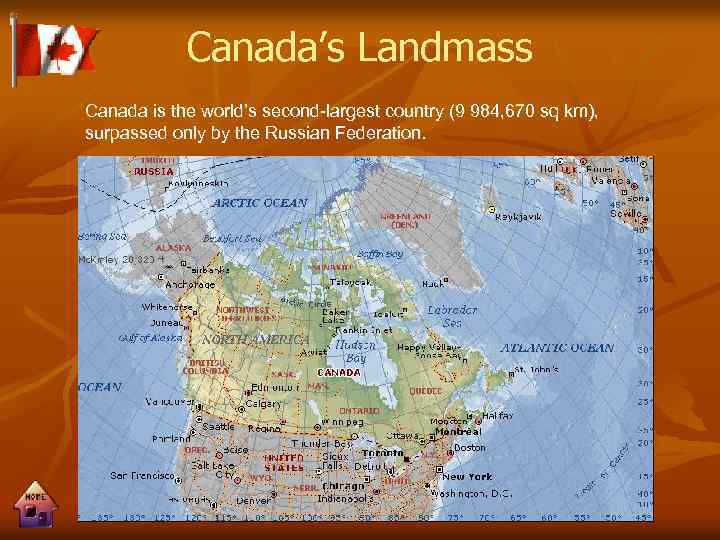 Canada’s Landmass Canada is the world’s second-largest country (9 984, 670 sq km), surpassed only by the Russian Federation.
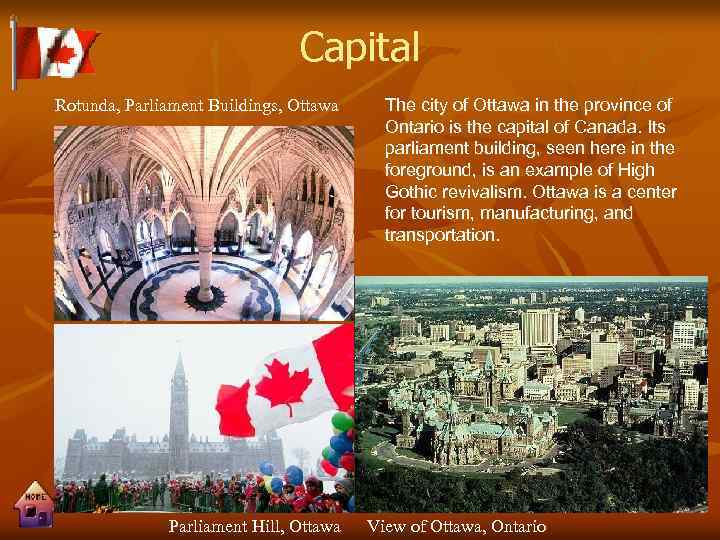 Capital Rotunda, Parliament Buildings, Ottawa Parliament Hill, Ottawa The city of Ottawa in the province of Ontario is the capital of Canada. Its parliament building, seen here in the foreground, is an example of High Gothic revivalism. Ottawa is a center for tourism, manufacturing, and transportation. View of Ottawa, Ontario
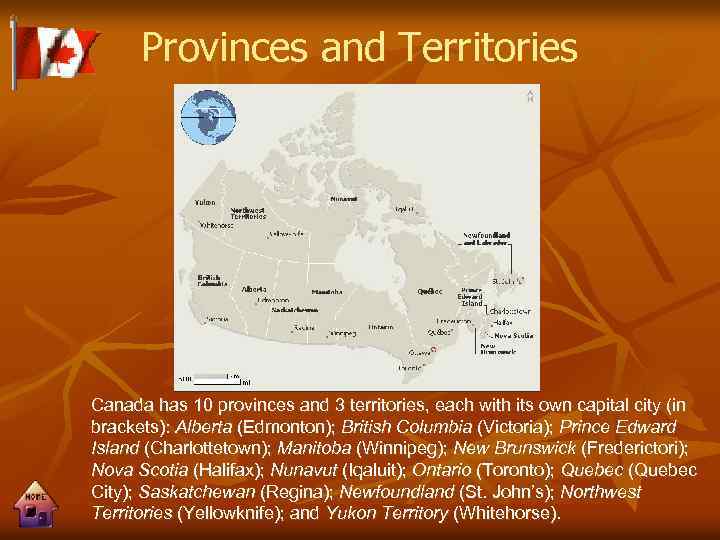 Provinces and Territories Canada has 10 provinces and 3 territories, each with its own capital city (in brackets): Alberta (Edmonton); British Columbia (Victoria); Prince Edward Island (Charlottetown); Manitoba (Winnipeg); New Brunswick (Frederictori); Nova Scotia (Halifax); Nunavut (Iqaluit); Ontario (Toronto); Quebec (Quebec City); Saskatchewan (Regina); Newfoundland (St. John’s); Northwest Territories (Yellowknife); and Yukon Territory (Whitehorse).
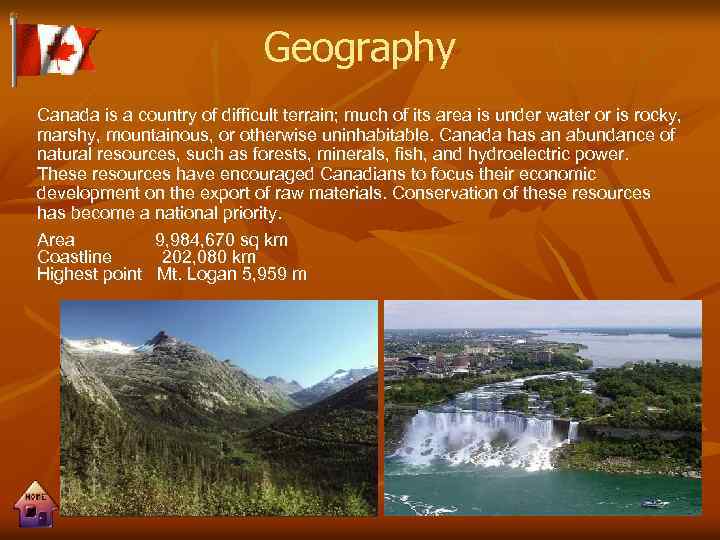 Geography Canada is a country of difficult terrain; much of its area is under water or is rocky, marshy, mountainous, or otherwise uninhabitable. Canada has an abundance of natural resources, such as forests, minerals, fish, and hydroelectric power. These resources have encouraged Canadians to focus their economic development on the export of raw materials. Conservation of these resources has become a national priority. Area 9, 984, 670 sq km Coastline 202, 080 km Highest point Mt. Logan 5, 959 m
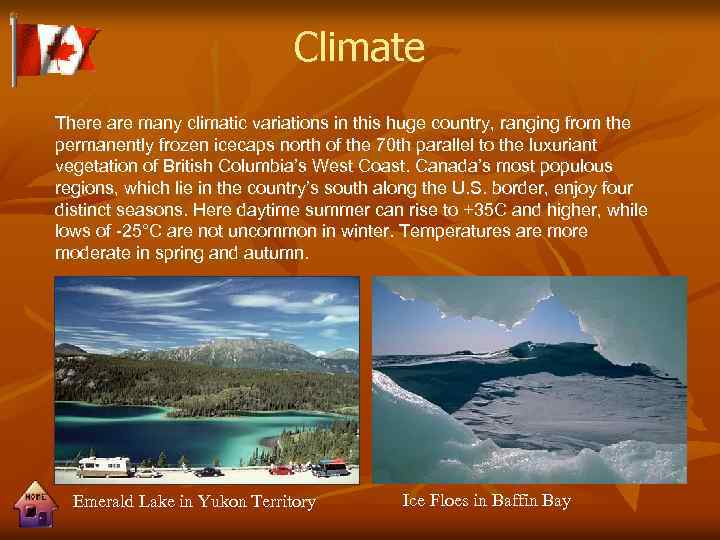 Climate There are many climatic variations in this huge country, ranging from the permanently frozen icecaps north of the 70 th parallel to the luxuriant vegetation of British Columbia’s West Coast. Canada’s most populous regions, which lie in the country’s south along the U. S. border, enjoy four distinct seasons. Here daytime summer can rise to +35 C and higher, while lows of -25°C are not uncommon in winter. Temperatures are moderate in spring and autumn. Emerald Lake in Yukon Territory Ice Floes in Baffin Bay
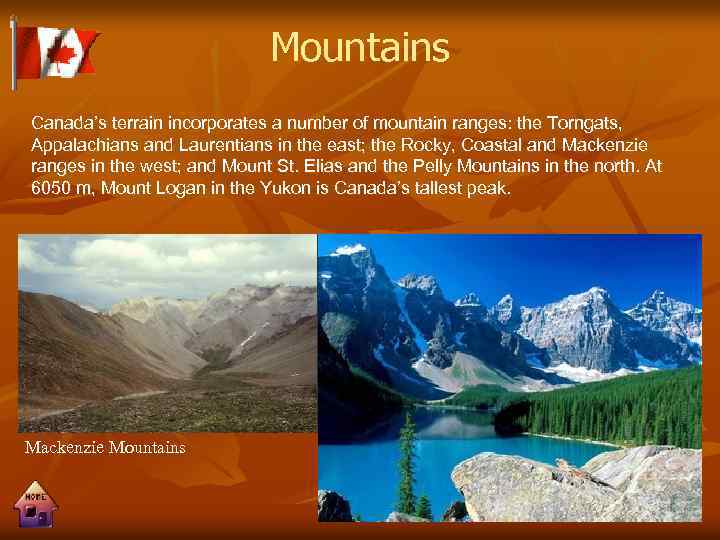 Mountains Canada’s terrain incorporates a number of mountain ranges: the Torngats, Appalachians and Laurentians in the east; the Rocky, Coastal and Mackenzie ranges in the west; and Mount St. Elias and the Pelly Mountains in the north. At 6050 m, Mount Logan in the Yukon is Canada’s tallest peak. Mackenzie Mountains
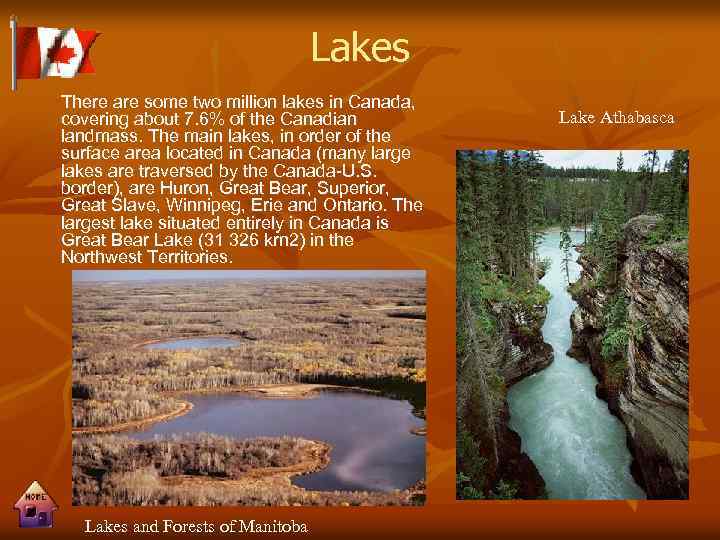 Lakes There are some two million lakes in Canada, covering about 7. 6% of the Canadian landmass. The main lakes, in order of the surface area located in Canada (many large lakes are traversed by the Canada-U. S. border), are Huron, Great Bear, Superior, Great Slave, Winnipeg, Erie and Ontario. The largest lake situated entirely in Canada is Great Bear Lake (31 326 krn 2) in the Northwest Territories. Lakes and Forests of Manitoba Lake Athabasca
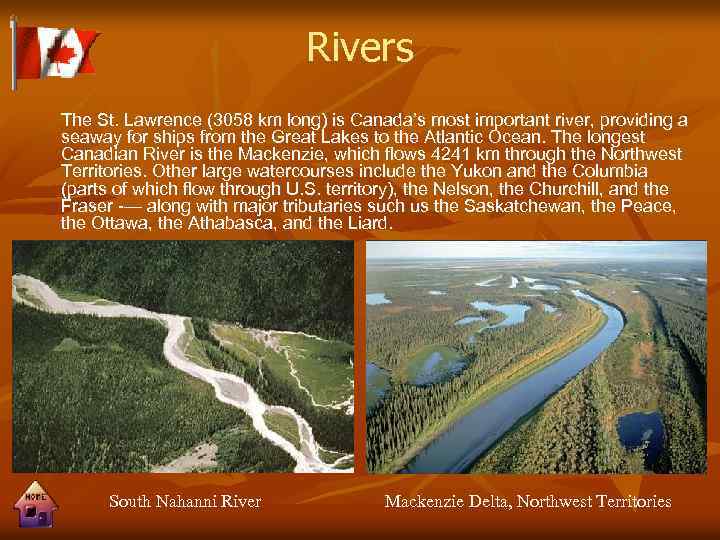 Rivers The St. Lawrence (3058 km long) is Canada’s most important river, providing a seaway for ships from the Great Lakes to the Atlantic Ocean. The longest Canadian River is the Mackenzie, which flows 4241 km through the Northwest Territories. Other large watercourses include the Yukon and the Columbia (parts of which flow through U. S. territory), the Nelson, the Churchill, and the Fraser -— along with major tributaries such us the Saskatchewan, the Peace, the Ottawa, the Athabasca, and the Liard. South Nahanni River Mackenzie Delta, Northwest Territories
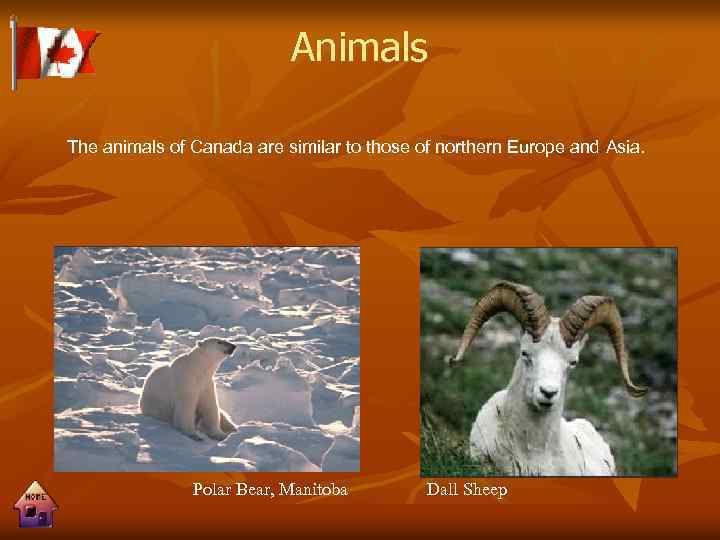 Animals The animals of Canada are similar to those of northern Europe and Asia. Polar Bear, Manitoba Dall Sheep
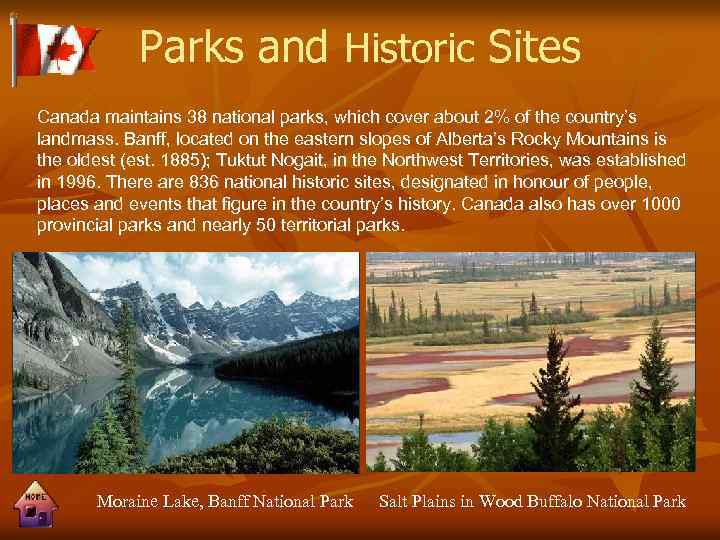 Parks and Historic Sites Canada maintains 38 national parks, which cover about 2% of the country’s landmass. Banff, located on the eastern slopes of Alberta’s Rocky Mountains is the oldest (est. 1885); Tuktut Nogait, in the Northwest Territories, was established in 1996. There are 836 national historic sites, designated in honour of people, places and events that figure in the country’s history. Canada also has over 1000 provincial parks and nearly 50 territorial parks. Moraine Lake, Banff National Park Salt Plains in Wood Buffalo National Park
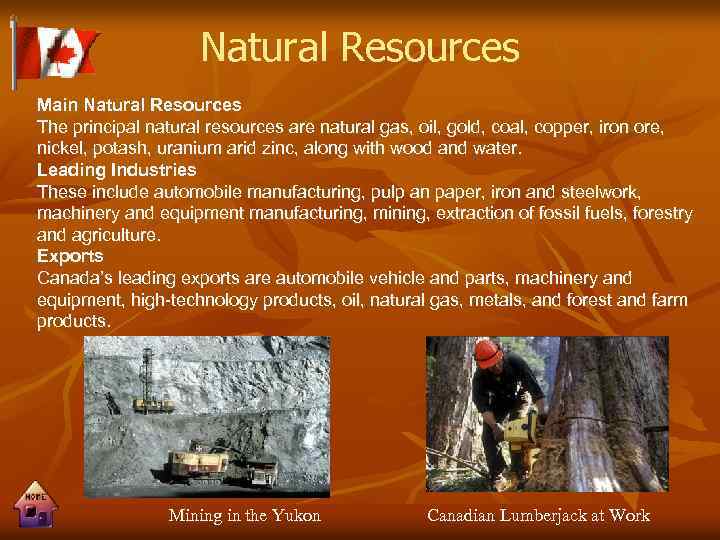 Natural Resources Main Natural Resources The principal natural resources are natural gas, oil, gold, coal, copper, iron ore, nickel, potash, uranium arid zinc, along with wood and water. Leading Industries These include automobile manufacturing, pulp an paper, iron and steelwork, machinery and equipment manufacturing, mining, extraction of fossil fuels, forestry and agriculture. Exports Canada’s leading exports are automobile vehicle and parts, machinery and equipment, high-technology products, oil, natural gas, metals, and forest and farm products. Mining in the Yukon Canadian Lumberjack at Work
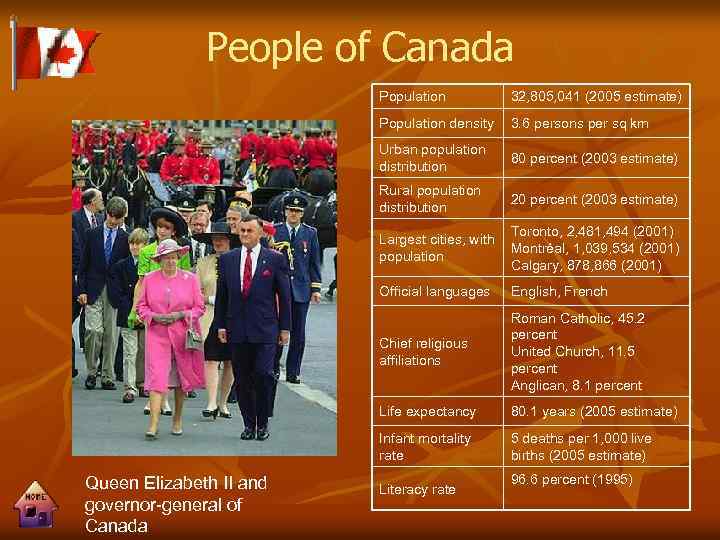 People of Canada Population 32, 805, 041 (2005 estimate) Population density 3. 6 persons per sq km Urban population distribution 80 percent (2003 estimate) Rural population distribution 20 percent (2003 estimate) Toronto, 2, 481, 494 (2001) Largest cities, with Montréal, 1, 039, 534 (2001) population Calgary, 878, 866 (2001) Official languages Chief religious affiliations Roman Catholic, 45. 2 percent United Church, 11. 5 percent Anglican, 8. 1 percent Life expectancy 80. 1 years (2005 estimate) Infant mortality rate Queen Elizabeth II and governor-general of Canada English, French 5 deaths per 1, 000 live births (2005 estimate) Literacy rate 96. 6 percent (1995)
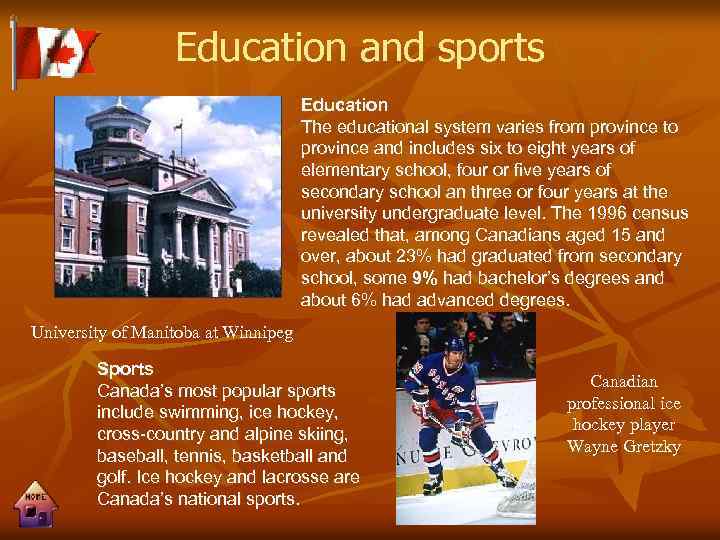 Education and sports Education The educational system varies from province to province and includes six to eight years of elementary school, four or five years of secondary school an three or four years at the university undergraduate level. The 1996 census revealed that, among Canadians aged 15 and over, about 23% had graduated from secondary school, some 9% had bachelor’s degrees and about 6% had advanced degrees. University of Manitoba at Winnipeg Sports Canada’s most popular sports include swimming, ice hockey, cross-country and alpine skiing, baseball, tennis, basketball and golf. Ice hockey and lacrosse are Canada’s national sports. Canadian professional ice hockey player Wayne Gretzky
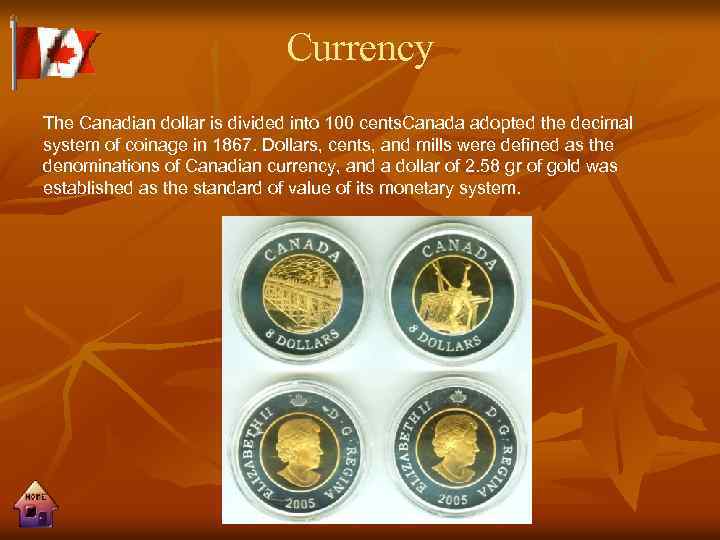 Currency The Canadian dollar is divided into 100 cents. Canada adopted the decimal system of coinage in 1867. Dollars, cents, and mills were defined as the denominations of Canadian currency, and a dollar of 2. 58 gr of gold was established as the standard of value of its monetary system.
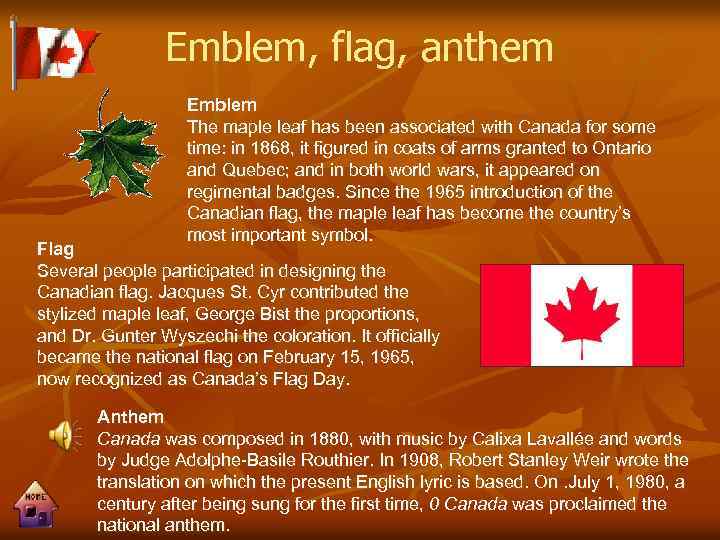 Emblem, flag, anthem Emblem The maple leaf has been associated with Canada for some time: in 1868, it figured in coats of arms granted to Ontario and Quebec; and in both world wars, it appeared on regimental badges. Since the 1965 introduction of the Canadian flag, the maple leaf has become the country’s most important symbol. Flag Several people participated in designing the Canadian flag. Jacques St. Cyr contributed the stylized maple leaf, George Bist the proportions, and Dr. Gunter Wyszechi the coloration. It officially became the national flag on February 15, 1965, now recognized as Canada’s Flag Day. Anthem Canada was composed in 1880, with music by Calixa Lavallée and words by Judge Adolphe-Basile Routhier. In 1908, Robert Stanley Weir wrote the translation on which the present English lyric is based. On. July 1, 1980, a century after being sung for the first time, 0 Canada was proclaimed the national anthem.