


 Скачать презентацию Can you explain my child s Audiological Report Karen
3026982e97460514ded8c01e4eaf9afd.ppt
- Количество слайдов: 41
 Can you explain my child’s Audiological Report? Karen Clark, M. A. , CCC-A 1, 2 Karen M. Ditty, Au. D. , CCC-A 2, 4 Patti Martin, Ph. D. , CCC-A 2, 3 UTD /Callier Center for Communication Disorders Dallas, TX 2 National Center for Hearing Assessment and Management 1 Logan, UT 3 Arkansas Children’s Hospital Little Rock, AR ENT Specialists, PA Houston, TX 4 Texas
 Faculty Disclosure Information In the past 12 months, we have not had a significant financial interest or other relationship with the manufacturer of the product or provider of the services that will be discussed in our presentation. This presentation will not include discussion of pharmaceuticals or devices that have not been approved by the FDA.
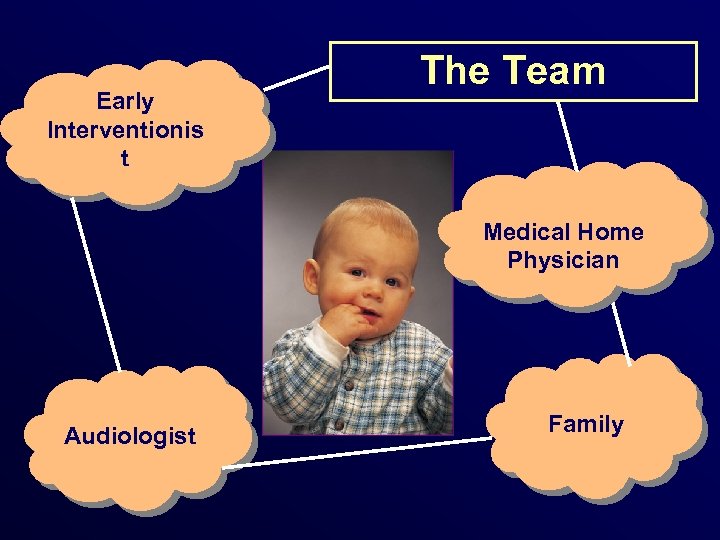 Early Interventionis t The Team Medical Home Physician Audiologist Family
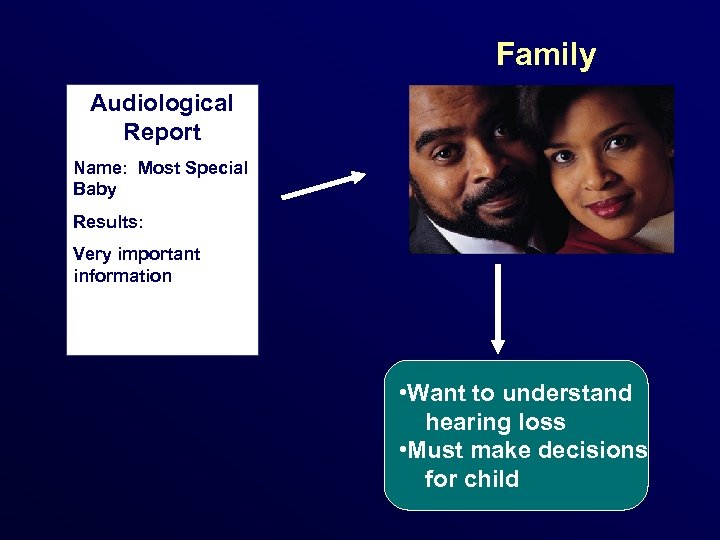 Family Audiological Report Name: Most Special Baby Results: Very important information • Want to understand hearing loss • Must make decisions for child
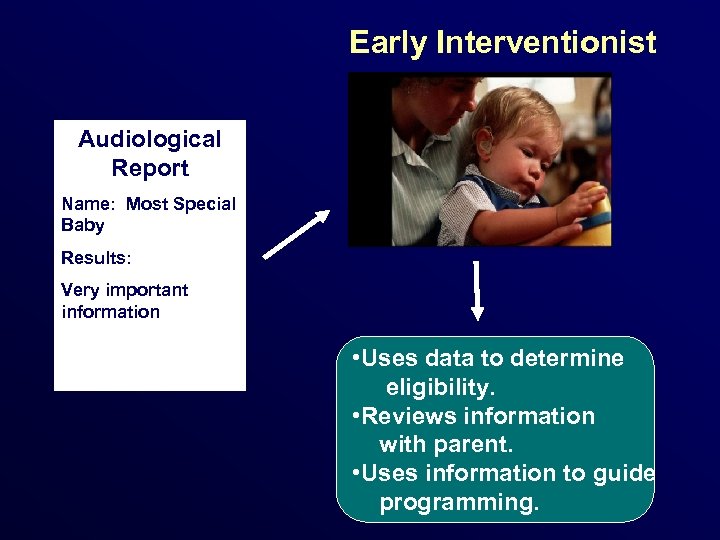 Early Interventionist Audiological Report Name: Most Special Baby Results: Very important information • Uses data to determine eligibility. • Reviews information with parent. • Uses information to guide programming.
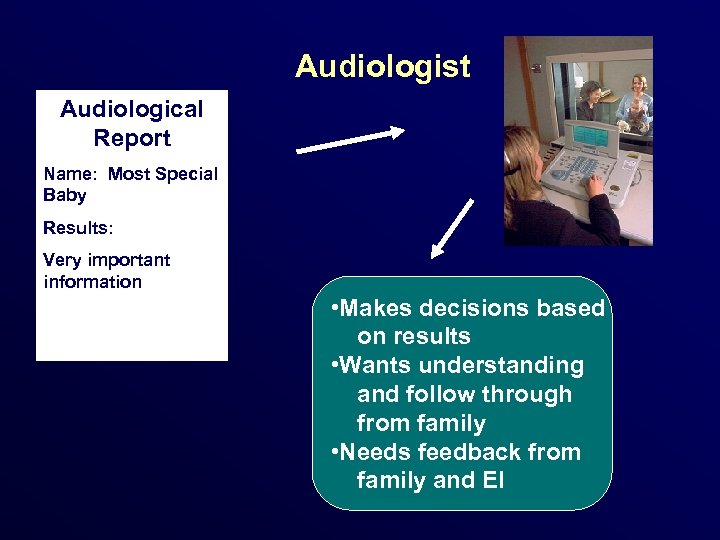 Audiologist Audiological Report Name: Most Special Baby Results: Very important information • Makes decisions based on results • Wants understanding and follow through from family • Needs feedback from family and EI
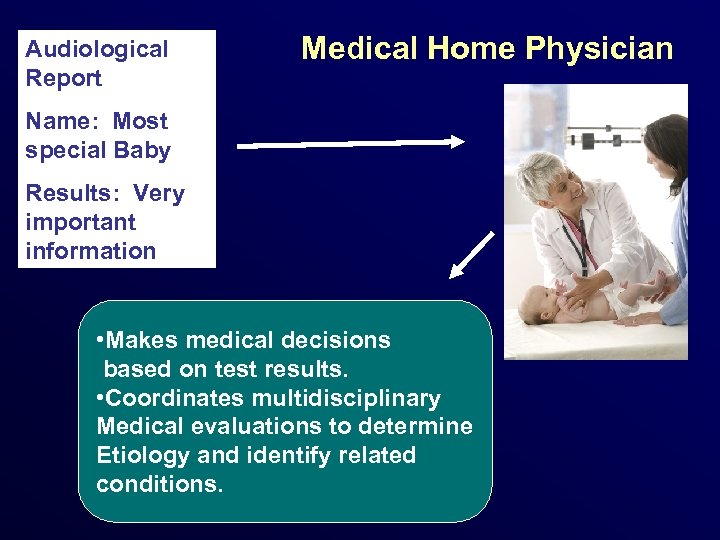 Audiological Report Medical Home Physician Name: Most special Baby Results: Very important information • Makes medical decisions based on test results. • Coordinates multidisciplinary Medical evaluations to determine Etiology and identify related conditions.
 The Goal A Family-Professional partnership that supports collaborative sharing of audiological information. Partnership “. . defined as a relationship of mutual respect between two or more competent persons who have agreed to commit and share their knowledge, skills, and experience in meeting the needs of the child” (SKI-HI Curriculum 2004).
 Challenges to Collaborative Sharing of Audiological Data • Audiological information is increasingly complex. – Gone are the days when the EI needed only understand simple Xs and Os on a graph. – Current assessment protocols leave heads spinning with acronyms and multiple pieces of data – tone burst ABR, click ABR, OAE, ASSR, REM, bone, air, acoustic reflex……
 Challenges to Collaborative Sharing of Audiological Data • Early interventionists have widely varied backgrounds. – Even with training in intervention specific to infants and toddlers who are deaf and hard of hearing, rapidly evolving clinical practice makes staying current a challenge. – Parents and early interventionists may not know the questions to ask.
 Challenges to Collaborative Sharing of Audiological Data • Audiologists have varying knowledge, experience, and skill in infant assessment. – Even when audiologists have training and skill specific to infants, there is wide variability in the way reports are written and results presented. • Audiologists may have difficulty conveying complex data in easily understood terms. • Time – never enough for anyone.

 Improved understanding of Audiological Data within the Partnership!
 Understanding terminology! • Do not need to know how to do the tests, but need to know what tests are performed, and generally what they are measuring. • Examples: • Immittance: Middle ear system • Otoacoustic Emissions: Peripheral, outer hair cells, is pre-neural • Auditory Brainstem Response: test that can be used to assess auditory function in infants and young children
 What should you see in an audiological report from a Pediatric Audiologist? Audiologist • Medical History summary • Auditory Brainstem Response (ABR) results which include: – Tone Burst, Bone Conduction testing – Auditory Steady state Audiometry • Tympanometric results (High Frequency Probe Tone or infants < 6 Months) • Otoacoustic Emissions Results • Behavioral Audiometry (when age appropriate) • Hearing aid results, if obtained • Specific Recommendations
 Why are so many audiological tests performed and reported? • Cross Check Principle
 Why is the Audiological Report so Complicated?
 Does the audiological report have to be so complicated? • NO, • But…. – The report must be understood by other audiologists and professionals with terminology that is legally correct.
 What is the Audiologist required to report ? • Although there are no national protocols or standards many states have guidelines for their audiologists. – These guidelines can be obtained via the following link on the NCHAM website: – http: //www. infanthearing. org/states/table. html
 American Speech Language & Hearing Association • Working on a standard of care with Pediatric Audiologists. • Developed a draft copy of “Roles, Knowledge, and Skills: Audiologists Providing Clinical Services to Infants and Young Children Birth to 5 Years of Age” http: //www. asha. org/peer-review/audclinservbirthto 5 KS. htm
 How can you interpret the audiological report to your families? • HEAR! – H: History (medical and audiological) – E: Evaluate tests that were performed – A: Audiological summary for each ear – R: Review Recommendations
 Medical and Audiological History • Was there a hearing screen at birth? – Results? • Have there been subsequent audiologicals provided since newborn hearing screen? – Results? • Were there any medical complications that may put the child “at risk” for hearing loss? – Positive CMV screening? – Prolonged stay in the NICU? – Hyperbilirubinema, anoxia, or other medical complications? • Were there any surgeries that have been performed for chronic middle ear effusion? – PE tubes?
 Evaluate audiological tests • Was a cross check principle used? – If testing was not performed was an explanation as to why put in the report?
 Audiological summary for each ear • Does the report address the hearing status of each ear in a clear and understandable manner utilizing common terminology used in audiological report writing? – If testing was incomplete for an ear, was an explanation provided?
 Recommendations • Are the recommendations consistent with the test findings? • Are timely follow up appointments established when necessary? • Are referrals made to the appropriate educational facilities?
 How can you explain the audiological report to your families? • Example 1 DOB: January 2005 • Medical History: – Significant history includes not passing newborn hearing screen, hyperbilirubinemia and congenital anomalies for he right ear. What is important about this medical history?
 How can you explain the audiological report to your families? • Audiological History EXAMPLE 1 • January 2005: ABR results consistent with a moderate peripheral auditory impairment for the frequency range 2000 -4000 Hz bilaterally. A response was observed to click stimuli via bone conduction down to 30 d. Bn. HL: however, could not be replicated due to awakening of child. • June 2005: ABR results consistent with a moderate peripheral auditory impairment for the frequency range 2000 -4000 Hz and 500 Hz for the left ear. Further testing could not be completed due to awakening. • Why was this test repeated in June? Why so many months later?
 How can you explain the audiological report to your families? • Evaluate other assessments of the infant’s hearing status. ( This case indicated no other tests beside ABR were performed. ) Why would knowing immittance results be beneficial? When they could not complete the test the first time, why were they unable to get bone conduction testing the 2 nd time?
 Audiological summary for each ear • EXAMPLE 1 October 2005: – Synchronous neural responses to click stimuli were consistent with a severe peripheral auditory impairment for the frequency range 2000 -4000 Hz for each ear. – Synchronous neural responses to tone burst stimuli were consistent with a severe peripheral auditory impairment at 500 Hz for the left ear and a moderate peripheral auditory impairment for the right ear at 500 Hz and 4000 Hz. – No responses were observed to click stimuli via unmasked bone conduction at equipment limits (45 d. Bn. HL).
 How can you explain the Audiological report to your families? How is the wording different from the 1 st ABRs and the October ABR? • “ABR results consistent with a moderate peripheral auditory impairment for the frequency range 2000 -4000 Hz bilaterally. ” • “ Synchronous neural responses to click stimuli were consistent with a severe peripheral auditory impairment for the frequency range 2000 -4000 Hz for each ear” • Do the results mean different things? • Was there a change in this child’s hearing status? No suggestion as to why the change in hearing status occurred • Why would a comment regarding change in hearing status be beneficial?
 How can you explain the audiological report to your families? • Example 1 Recommendations – Be seen for Otologic evaluation due to identification of auditory impairment. (Was this not done earlier with the hearing loss that was identified? ) – Receive trial period with hearing aids pending otologic clearance. – Initiate Program for Amplification application process. – Be seen for behavioral audiological follow-up in 3 -6 months. – Receive aural habilitative services. – Continue to receive Early childhood intervention services. (When was this child referred? Why was he referred? )
 HEAR • History: Medical and Audiological – What is significant with this child’s history? • Evaluate tests performed: – What battery of tests were discussed in all the evaluations? • Audiological summary of test results for each ear. – What did you learn here? • Recommendations – What did you learn here?
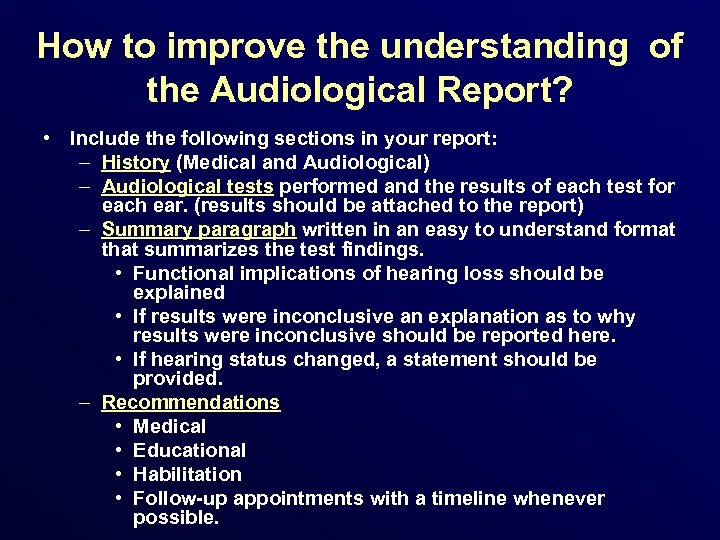 How to improve the understanding of the Audiological Report? • Include the following sections in your report: – History (Medical and Audiological) – Audiological tests performed and the results of each test for each ear. (results should be attached to the report) – Summary paragraph written in an easy to understand format that summarizes the test findings. • Functional implications of hearing loss should be explained • If results were inconclusive an explanation as to why results were inconclusive should be reported here. • If hearing status changed, a statement should be provided. – Recommendations • Medical • Educational • Habilitation • Follow-up appointments with a timeline whenever possible.
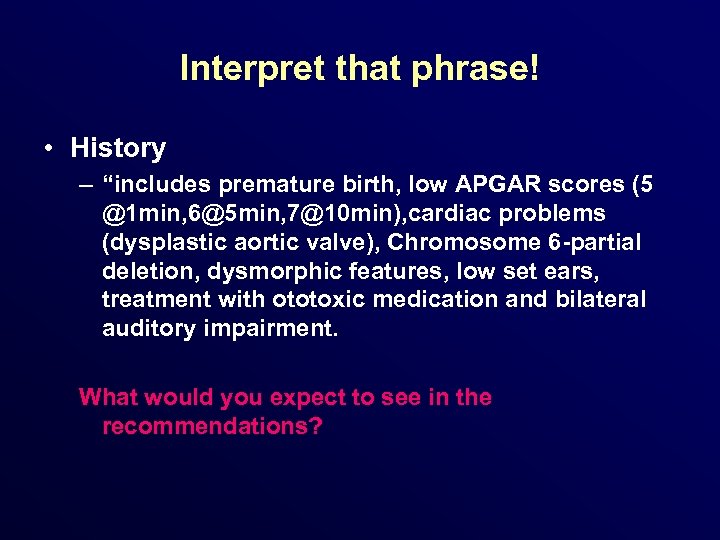 Interpret that phrase! • History – “includes premature birth, low APGAR scores (5 @1 min, 6@5 min, 7@10 min), cardiac problems (dysplastic aortic valve), Chromosome 6 -partial deletion, dysmorphic features, low set ears, treatment with ototoxic medication and bilateral auditory impairment. What would you expect to see in the recommendations?
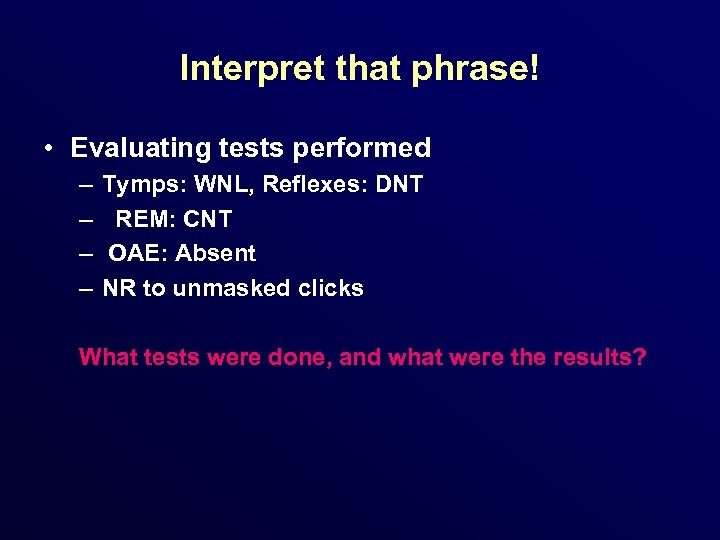 Interpret that phrase! • Evaluating tests performed – – Tymps: WNL, Reflexes: DNT REM: CNT OAE: Absent NR to unmasked clicks What tests were done, and what were the results?
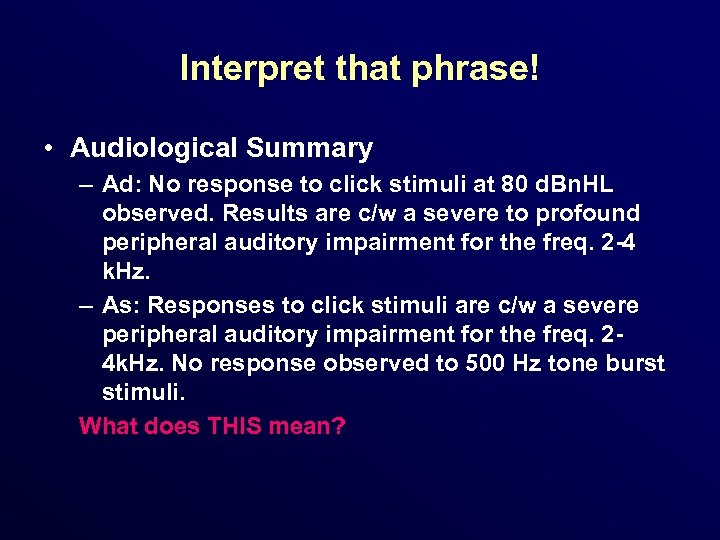 Interpret that phrase! • Audiological Summary – Ad: No response to click stimuli at 80 d. Bn. HL observed. Results are c/w a severe to profound peripheral auditory impairment for the freq. 2 -4 k. Hz. – As: Responses to click stimuli are c/w a severe peripheral auditory impairment for the freq. 24 k. Hz. No response observed to 500 Hz tone burst stimuli. What does THIS mean?
 Interpret that phrase! • Recommendations – Appropriate educational services. – Aural rehab – Be seen for otologic evaluation due to identification of auditory impairment. – Regular audiological evaluations and monitoring. What does THIS mean?
 How do you interpret the Audiological Report? • Boystown National Research hospital has an excellent glossary for parents and professionals to better interpret test results. • http: //www. babyhearing. org/He aring. Amplification/Glossary/in dex. asp
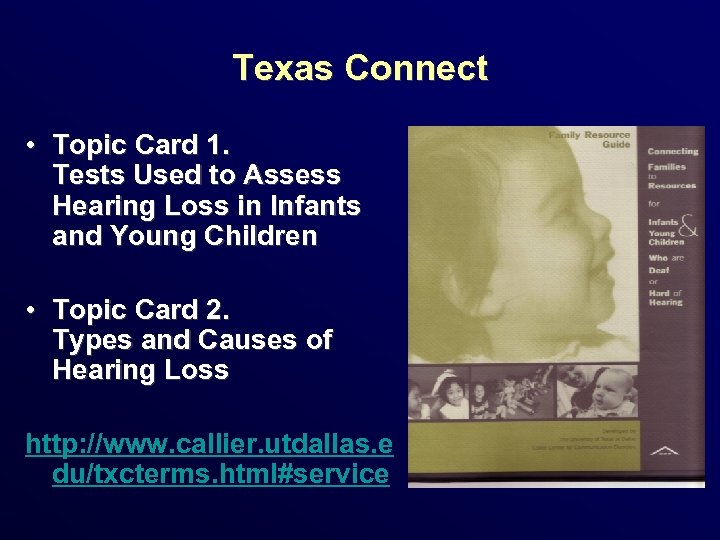 Texas Connect • Topic Card 1. Tests Used to Assess Hearing Loss in Infants and Young Children • Topic Card 2. Types and Causes of Hearing Loss http: //www. callier. utdallas. e du/txcterms. html#service
 List of Acronyms Listen-Up • http: //www. listen-up. org/htm/acronyms. htm CDC: Early Hearing detection and Intervention Program • http: //www. cdc. gov/ncbddd/ehdi/abbrev. htm VA-SOTAC Resource Guide ACRONYMS • http: //www. nr. cc. va. us/cdhh/sotac%20 resour ce%20 guide/acronyms. htm
 Resources on the Web • American Speech Language and Hearing Association http: //www. asha. org/peer-review/aud-clinservbirthto 5 KS. htm • Joint Committee for Infant Hearing http: //www. jcih. org/history. htm • Texas Connect http: //www. callier. utdallas. edu/txc. html • National Center for Hearing Assessment and management www. infanthearing. org • Boystown national Research Hospital “My Baby’s Hearing” www. infanthearing. org