


 Скачать презентацию CAN WE USE OPTICS TO IMAGE TRACKS AND
83385663f667790bc11000dea60f816d.ppt
- Количество слайдов: 18
 CAN WE USE OPTICS TO IMAGE TRACKS AND WHAT WOULD IT GET US? John Learned University of Hawaii At Kam. LAND Collaboration meeting Gatlinburg, Tennessee, 4/05 Byron Dieterle has done optical studies, thought about problem, and been a great help in developing this idea. John Learned at Gatlinburg 4/05 Tracking in Kam. LAND?
 • If we can design the optics with enough light collection adequate depth of field • and not much rescattering of light • Reconstruct tracks and precise vertices. John Learned at Gatlinburg 4/05 Basic Idea: a Scintillator “Bubble Chamber”
 • Accelerator neutrinos: superior recognition of electron events and rejection of πos. • PDK: excellent K mode resolution. • SN: resolution of direction. • Reactors: better e+-n direction resolution. • Solar Nu’s: Some directionality. • Muons: very accurate track reconstruction, increased rejection of backgrounds. • Nuclearites, Q-Balls, etc. : not presently recorded in SK or KL (? )… opportunity. John Learned at Gatlinburg 4/05 Kam. LAND Physics Applications
 • • Aperture: assume 8 x 17”PMTs (~1. 2 m pupil) Similar QE, efficiency Assume 8 wide field cameras ~2. 4 PE/cm track in each camera 40 Me. V track yields ~200 pixels 1 Me. V yields ~10 pixels Aim for resolution ~4 mm Implies camera with ~4 M pixels => commerically available CCDs John Learned at Gatlinburg 4/05 Sensitivity & Implications
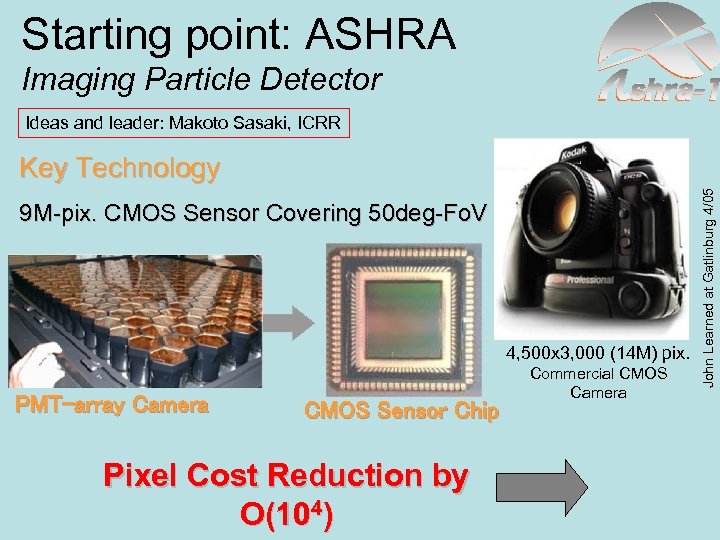 Starting point: ASHRA Imaging Particle Detector Ideas and leader: Makoto Sasaki, ICRR 9 M-pix. CMOS Sensor Covering 50 deg-Fo. V 4, 500 x 3, 000 (14 M) pix. PMT-array Camera CMOS Sensor Chip Pixel Cost Reduction by O(104) Commercial CMOS Camera John Learned at Gatlinburg 4/05 Key Technology
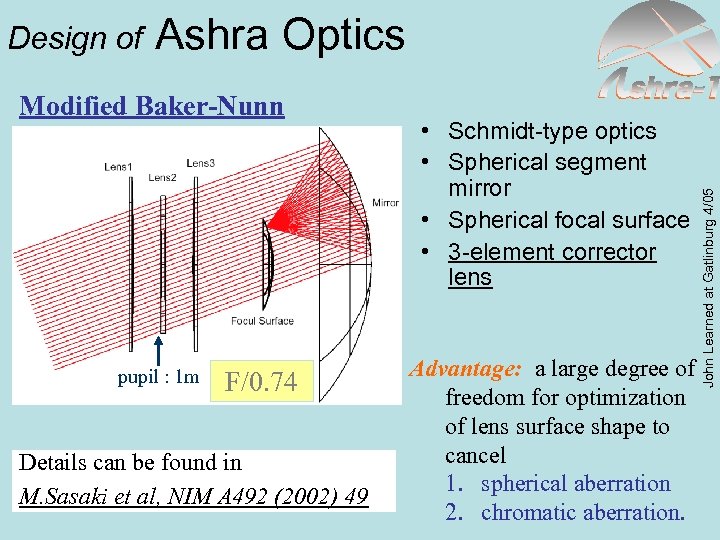 Ashra Optics Modified Baker-Nunn pupil : 1 m F/0. 74 Details can be found in M. Sasaki et al, NIM A 492 (2002) 49 • Schmidt-type optics • Spherical segment mirror • Spherical focal surface • 3 -element corrector lens Advantage: a large degree of freedom for optimization of lens surface shape to cancel 1. spherical aberration 2. chromatic aberration. John Learned at Gatlinburg 4/05 Design of
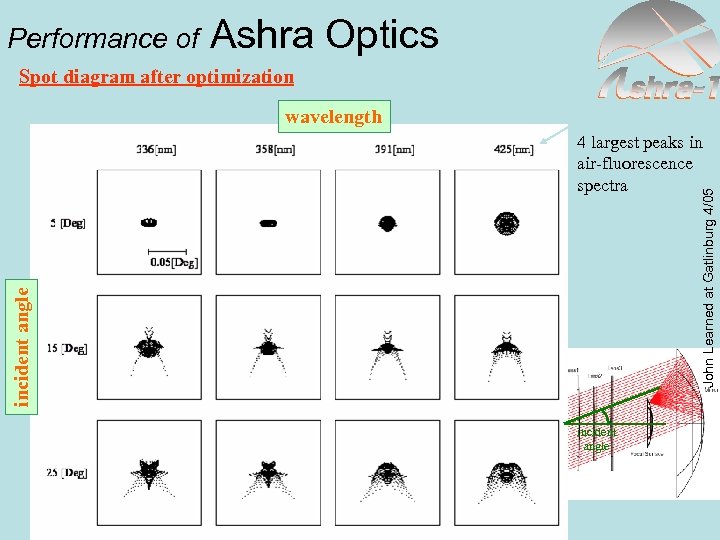 Performance of Ashra Optics Spot diagram after optimization wavelength incident angle John Learned at Gatlinburg 4/05 4 largest peaks in air-fluorescence spectra incident angle
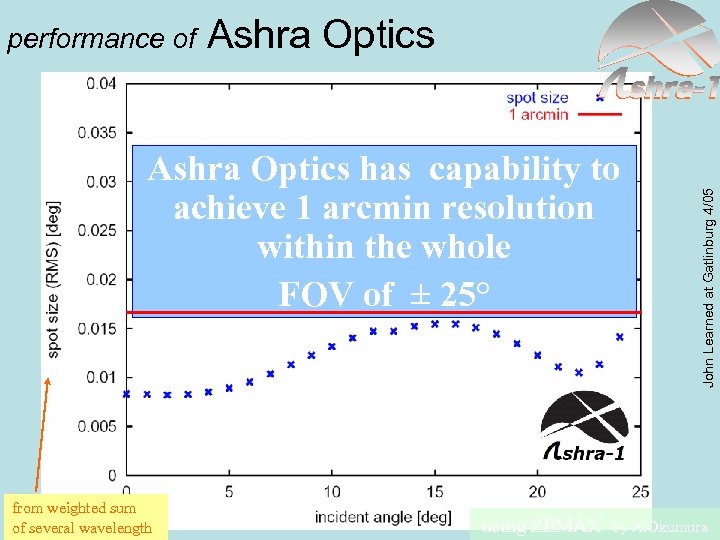 Ashra Optics has capability to achieve 1 arcmin resolution within the whole Spot size = 0. 0167°(1 arcmin) FOV of ± 25° incident angle from weighted sum of several wavelength using ZEMAX John Learned at Gatlinburg 4/05 performance of by A. Okumura
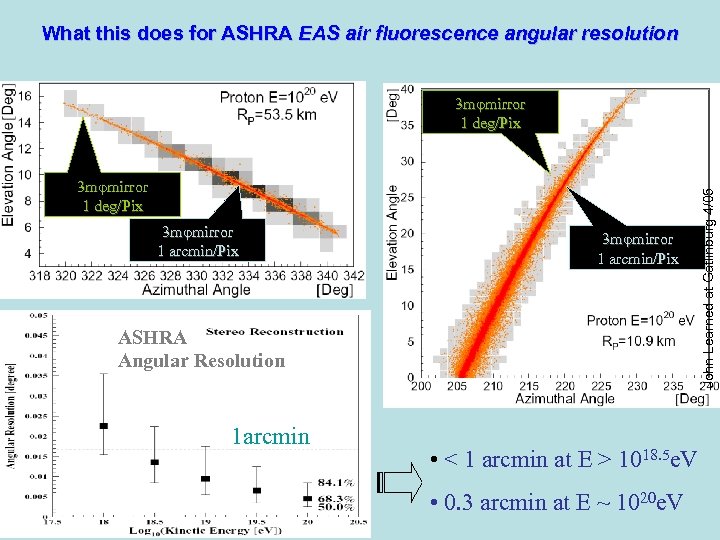 What this does for ASHRA EAS air fluorescence angular resolution 3 mφmirror 1 deg/Pix 3 mφmirror 1 arcmin/Pix ASHRA Angular Resolution 1 arcmin • < 1 arcmin at E > 1018. 5 e. V • 0. 3 arcmin at E ~ 1020 e. V John Learned at Gatlinburg 4/05 3 mφmirror 1 deg/Pix
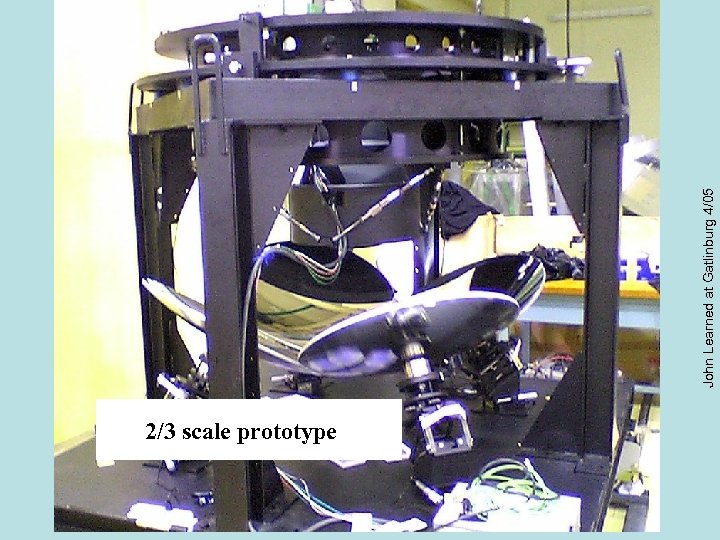 • I. I. • 補正レンズ • ミラー 2/3 scale prototype John Learned at Gatlinburg 4/05 R&D 状況ー 2/3モデル望遠鏡
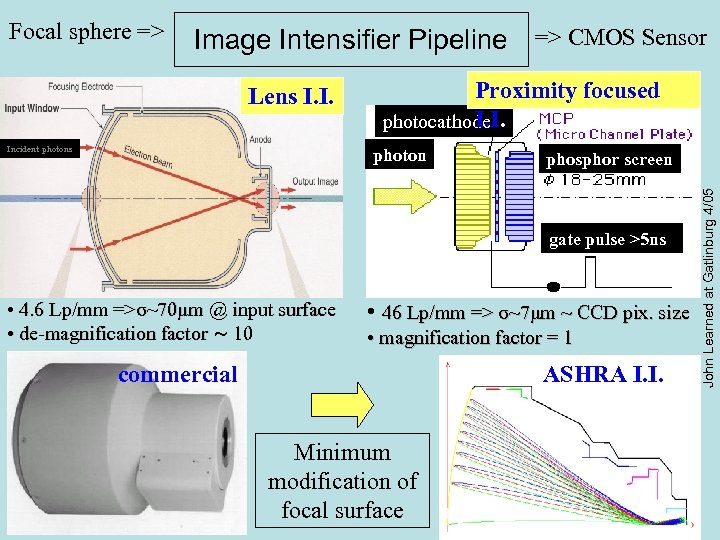 Image Intensifier Pipeline => CMOS Sensor Lens I. I. Incident photons Proximity focused I. I. photocathode photon phosphor screen gate pulse >5 ns • 4. 6 Lp/mm =>σ~70μm @ input surface • de-magnification factor ~ 10 • 46 Lp/mm => σ~7μm ~ CCD pix. size • magnification factor = 1 commercial ASHRA I. I. Minimum modification of focal surface John Learned at Gatlinburg 4/05 Focal sphere =>
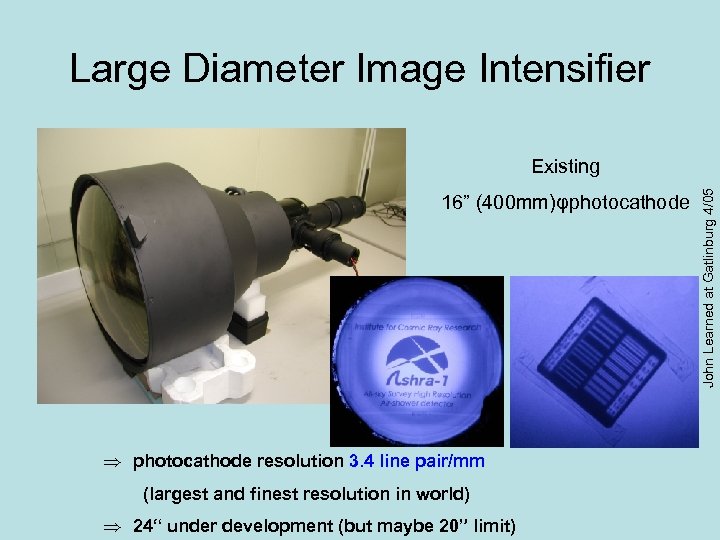 Large Diameter Image Intensifier 16” (400 mm)φphotocathode Þ photocathode resolution 3. 4 line pair/mm (largest and finest resolution in world) Þ 24“ under development (but maybe 20” limit) John Learned at Gatlinburg 4/05 Existing
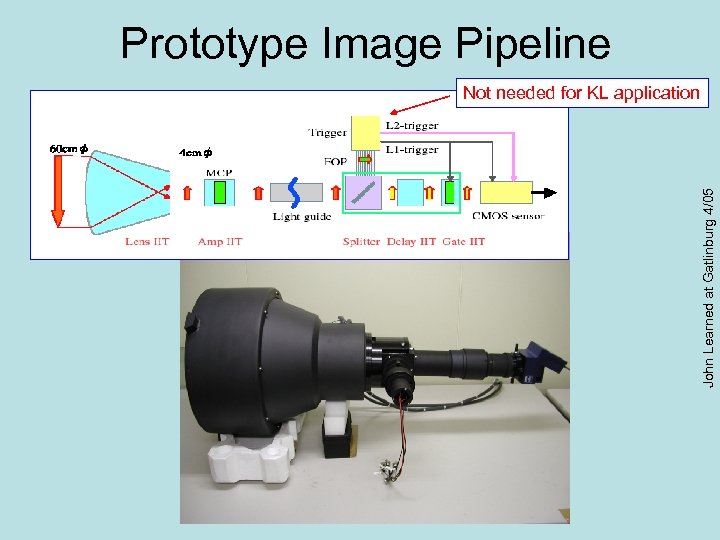 Prototype Image Pipeline John Learned at Gatlinburg 4/05 Not needed for KL application
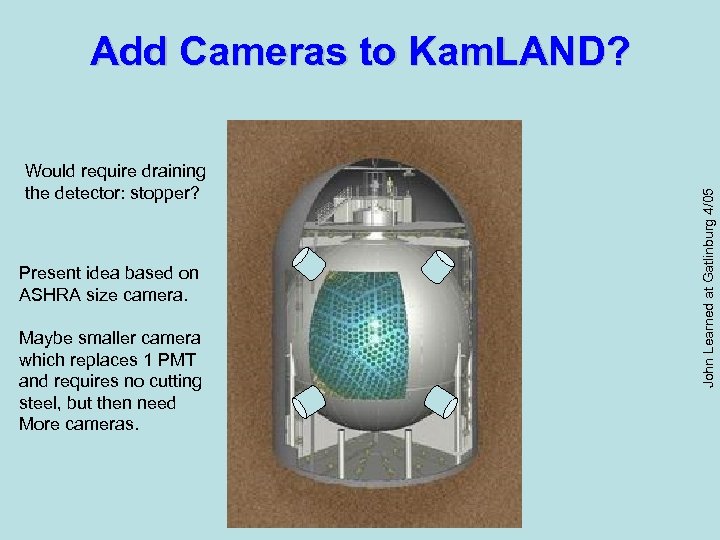 Would require draining the detector: stopper? Present idea based on ASHRA size camera. Maybe smaller camera which replaces 1 PMT and requires no cutting steel, but then need More cameras. John Learned at Gatlinburg 4/05 Add Cameras to Kam. LAND?
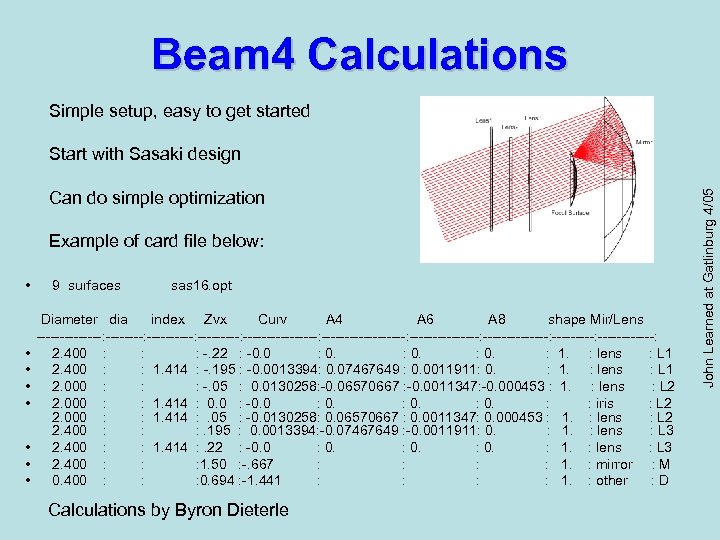 Beam 4 Calculations Simple setup, easy to get started Can do simple optimization Example of card file below: • • 9 surfaces sas 16. opt Diameter dia index Zvx Curv A 4 A 6 A 8 shape Mir/Lens -------: ----------: ----------------: ---------: 2. 400 : : : -. 22 : -0. 0 : 0. : 1. : lens : L 1 2. 400 : : 1. 414 : -. 195 : -0. 0013394: 0. 07467649 : 0. 0011911: 0. : 1. : lens : L 1 2. 000 : : : -. 05 : 0. 0130258: -0. 06570667 : -0. 0011347: -0. 000453 : 1. : lens : L 2 2. 000 : : 1. 414 : 0. 0 : -0. 0 : 0. : : iris : L 2 2. 000 : : 1. 414 : . 05 : -0. 0130258: 0. 06570667 : 0. 0011347: 0. 000453 : 1. : lens : L 2 2. 400 : : : . 195 : 0. 0013394: -0. 07467649 : -0. 0011911: 0. : 1. : lens : L 3 2. 400 : : 1. 414 : . 22 : -0. 0 : 0. : 1. : lens : L 3 2. 400 : : : 1. 50 : -. 667 : : 1. : mirror : M 0. 400 : : : 0. 694 : -1. 441 : : 1. : other : D Calculations by Byron Dieterle John Learned at Gatlinburg 4/05 Start with Sasaki design
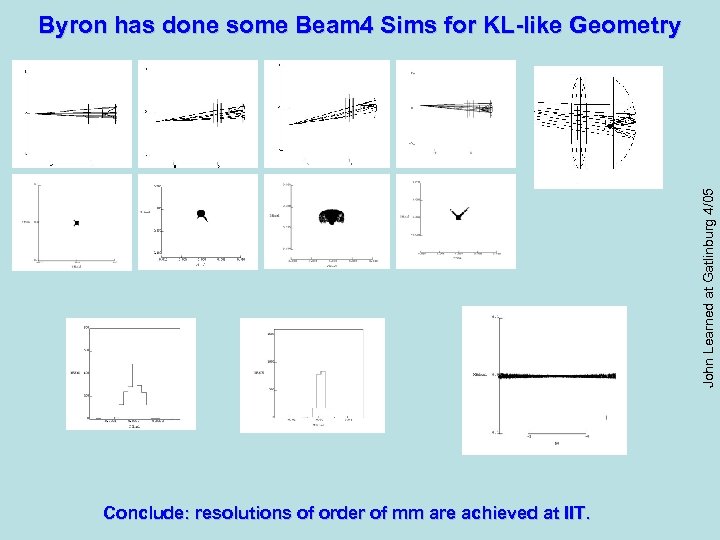 John Learned at Gatlinburg 4/05 Byron has done some Beam 4 Sims for KL-like Geometry Conclude: resolutions of order of mm are achieved at IIT.
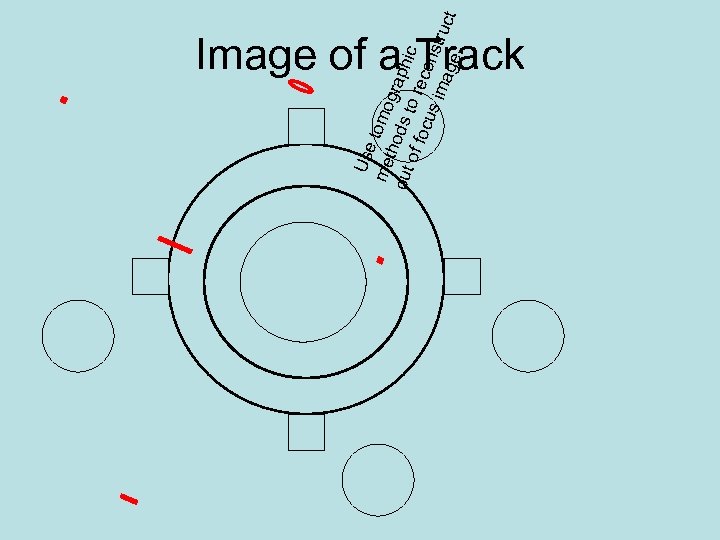 Use me tomo t g out hods raphi of f to re c ocu c s im onstr age uct. Image of a Track
 • Idea to add imaging to Kam. LAND needs study…. optics, design practicality, sensitivity, reconstruction. • How about small camera in place of a neck 6” PMT? Could do muon tracks, nuclearites? • Biggest question: does it buy us something really important? • Should we pursue it? Anyone interested? John Learned at Gatlinburg 4/05 Conclusion