


 Скачать презентацию Can Social Media Impact Cultural Competence and How
12d16266b22b1f21158bba72cc901e80.ppt
- Количество слайдов: 24
 Can Social Media Impact Cultural Competence and How do we Measure it: A Systematic Literature Review Marianne Justus, Ph. D. , University of Phoenix Jodi Menees, Ph. D. , University of Phoenix AECT International Convention Las Vegas, NV October 2016
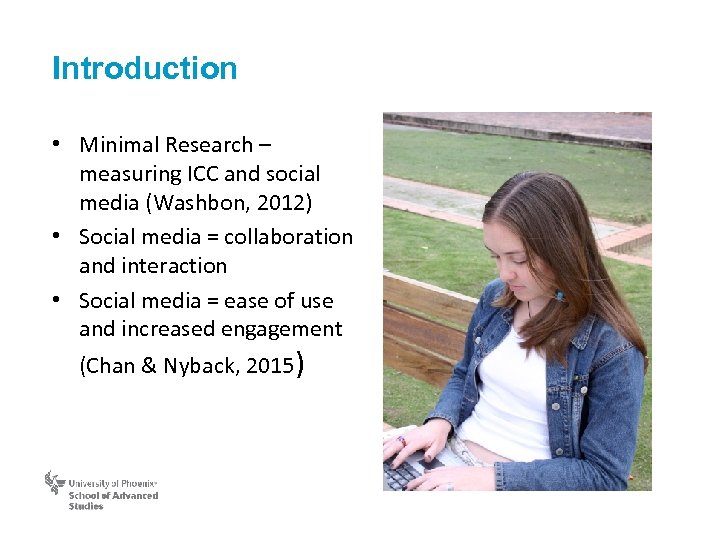 Introduction • Minimal Research – measuring ICC and social media (Washbon, 2012) • Social media = collaboration and interaction • Social media = ease of use and increased engagement (Chan & Nyback, 2015)
 What We Do Not Know • What role can social media play in online environments that are culturally diverse? • Can students build cultural competence when studying in virtual environments? • Are current cultural competence assessments valid when social media has been integrated (as a tool for delivery) in the curriculum?
 Research Questions • Research Question 1: What are the major constructs being measured by current methods for measuring cultural competence? • Research Question 2: Can existing assessment concepts be used or adapted to measure cultural competency in today’s social media driven society?
 Problem Statement • Current ICC assessments are problematic: Ø No clear definition of cultural competence. Ø Increases/decreases in ICC may be context driven (those who live in a diverse environment may demonstrate less ICC). Ø Measurements can ignore social inequalities amongst marginalized populations beyond race Ø Open, transparent communications of social media may skew current measurements.
 Purpose Statement • To investigate whether • An opportunity to make the assumptions and curriculum decisions concepts within based on current measures are measurements related appropriate within to more meaningful, contexts that have transparent and integrated technology satisfying interactions and social media. amongst participants.
 Method and Procedures • Cooper’s (1985) framework for literature review analysis) to investigate the reliability and appropriateness of ICC elements and concepts when used as measures in classrooms that support the integration of technology. • A systematic literature review (SLR) resulted in 67 articles and books identified as relevant.
 MULTICULTURAL COMPETENCY What is cultural What is social media? competence? § networked tools that • a set of knowledge and emphasize the social skills to help individuals aspects of the Internet engage more as a channel for effectively in culturally communication, diverse environments. collaboration, and (Vasquez, 2009). creative expression (Dabbagh & Reo, 2011 a)
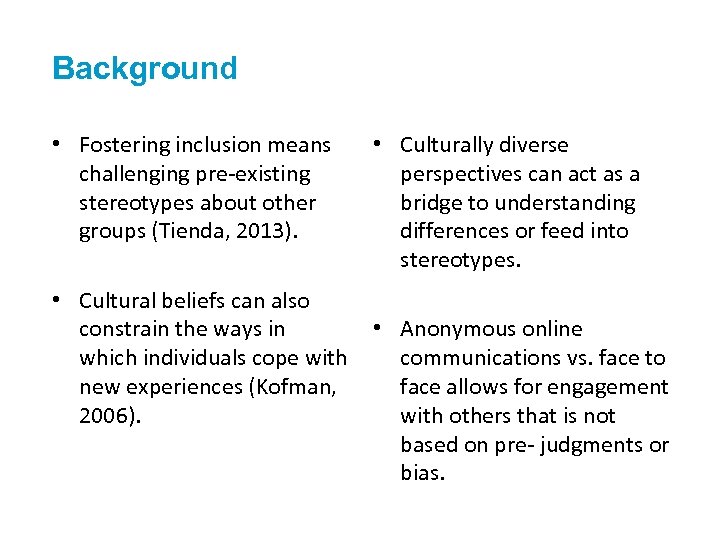 Background • Fostering inclusion means challenging pre-existing stereotypes about other groups (Tienda, 2013). • Culturally diverse perspectives can act as a bridge to understanding differences or feed into stereotypes. • Cultural beliefs can also constrain the ways in • Anonymous online which individuals cope with communications vs. face to new experiences (Kofman, face allows for engagement 2006). with others that is not based on pre- judgments or bias.
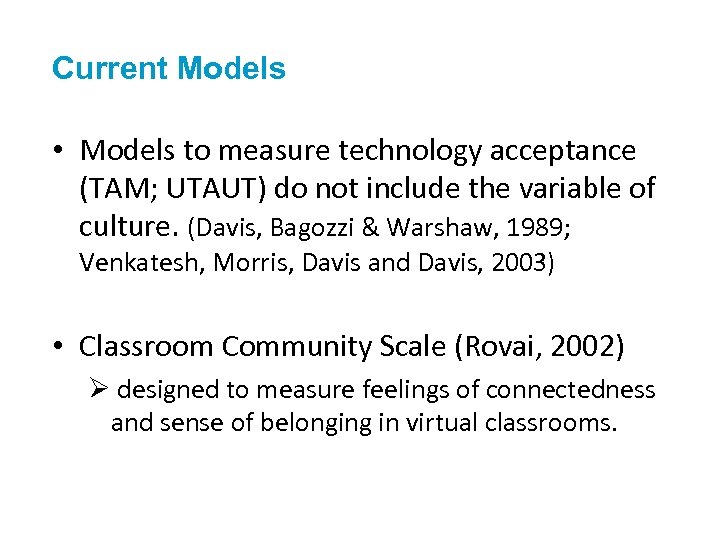 Current Models • Models to measure technology acceptance (TAM; UTAUT) do not include the variable of culture. (Davis, Bagozzi & Warshaw, 1989; Venkatesh, Morris, Davis and Davis, 2003) • Classroom Community Scale (Rovai, 2002) Ø designed to measure feelings of connectedness and sense of belonging in virtual classrooms.
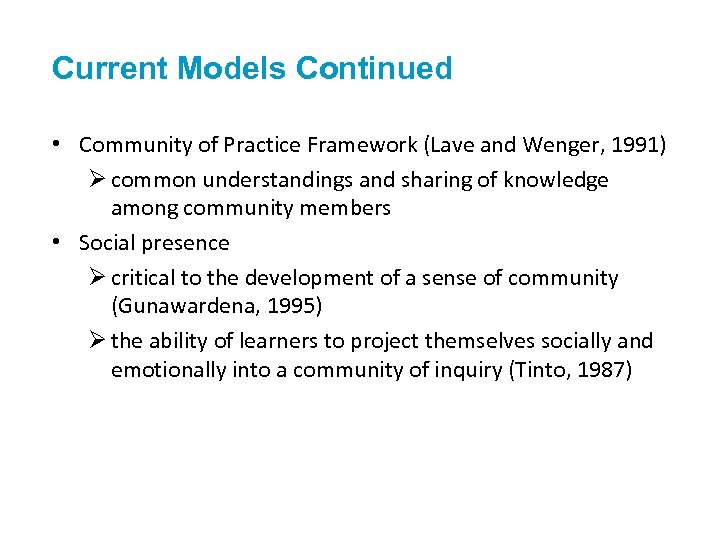 Current Models Continued • Community of Practice Framework (Lave and Wenger, 1991) Ø common understandings and sharing of knowledge among community members • Social presence Ø critical to the development of a sense of community (Gunawardena, 1995) Ø the ability of learners to project themselves socially and emotionally into a community of inquiry (Tinto, 1987)
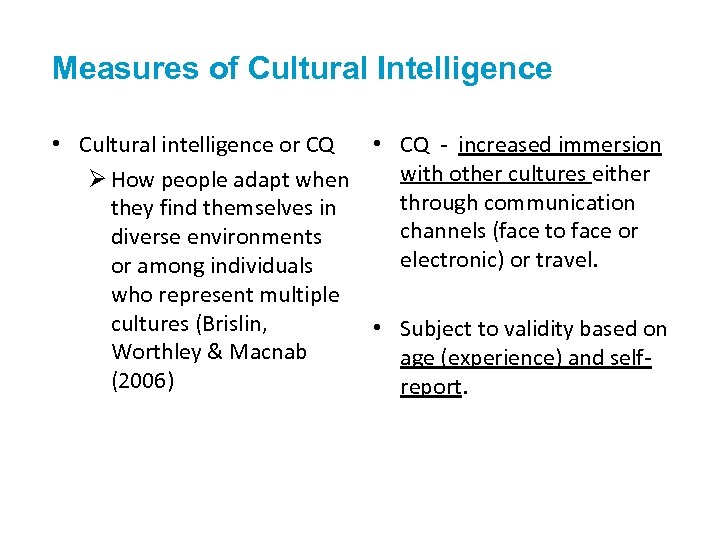 Measures of Cultural Intelligence • Cultural intelligence or CQ • CQ - increased immersion with other cultures either Ø How people adapt when through communication they find themselves in channels (face to face or diverse environments electronic) or travel. or among individuals who represent multiple cultures (Brislin, • Subject to validity based on Worthley & Macnab age (experience) and self(2006) report.
 Measures of Cultural Competence • Kumas-Tan et al (2007) found assumptions built into assessments: a) culture is a matter of ethnicity & race b) it is the “other person” who has the problem c) practitioners are culturally incompetent if lacking familiarity with the “other” d) the dominant culture (Caucasian) does not have a culture.
 Cultural Competence • Focus of assessments was on knowledge and not practice (applying ICC knowledge). • Study was done with healthcare professionals. • Recommendation - conceptual understandings of culture should consider “not only ethnicity and race but also gender, age, income, education, sexual orientation and faith” (Kumas-Tan et al, 2007).
 Leader Perspectives • Bustamante, Nelson and Onwuegbuzie (2009) –deep-set biases within the leaders. • Competence measures as cultural artifacts shaped by country, locale and era (Krentzman & Townsend, 2008). • Scales do not reflect multiple disciplines • Biases reinforced by single cultures & disciplines.
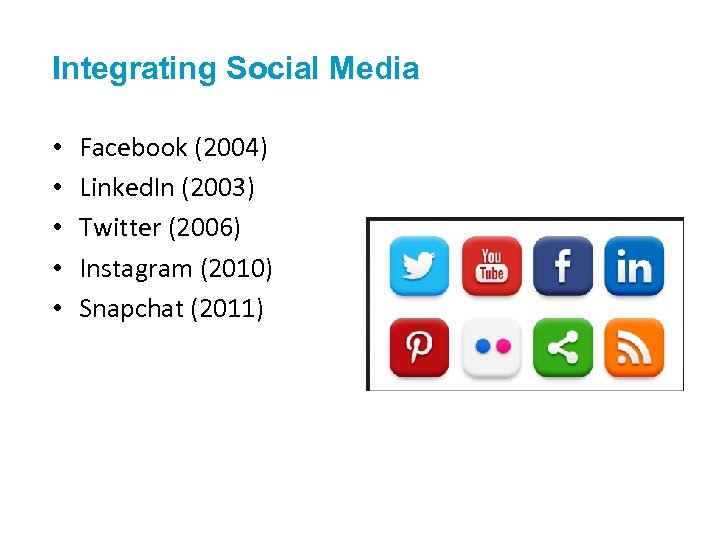 Integrating Social Media • • • Facebook (2004) Linked. In (2003) Twitter (2006) Instagram (2010) Snapchat (2011)
 Integrating Social Media • Demonstrated increases in classroom community, student engagement and interaction (Rovai, 2015). • Social presence (including live participation, feeling connected to the community at large) may lead to increased cultural understandings. • Longitudinal studies limited.
 Alternate Perspective • Are building sense of • Tools used for community and feelings of entertainment may result in connectedness and increased sharing and being belonging part of the open to new perspectives. dominant culture’s …for Western students. worldview? • Building such concepts into • Kumas-Tan (2007) measures for cultural demonstrated that these competence within diverse concepts are not virtual environments may necessarily conducive to result in flawed and increased engagement unreliable measures. within other cultures.
 Conclusions and Recommendations • Attitudes, assumptions and stereotypes can impact the classroom whether face to face or virtual. • Power relationships among participants – will informal Facebook posts, tweets and backchannel communication cement current structure? • Don’t assume an understanding of the language of ICC will result in the facilitator identifying appropriate behaviors within the classroom. • Will communities of diverse groups value social presence, sense of community, and increased engagement with others?
 Conclusions and Recommendations • Skill level of the educator – can they identify appropriate language AND implement appropriate behaviors in diverse groups? • Skill level of the educator – can they identify best technology choices for uniqueness of diverse participants?
 Recommendations • Cultural competence as a consistent and pervasive theme in the curricula should be reflected in policies of the organization and its leaders. • Policies should reflect experiences of traditionally marginalized students, whether the barriers are on the basis of race and ethnicity, gender, ability, sexual orientation or other. • Considering cultural dynamics across disciplines and cultures prior to integrating the delivery platform and the curriculum may lead to increased validity.
 References Brislin, R. , Worthley, R. , & Macnab, B. (2006). Cultural intelligence understanding behaviors that serve people’s goals. Group & Organization Management, 31(1), 40 -55. Bustamante, R. M. , Nelson, J. A. , & Onwuegbuzie, A. J. (2009). Assessing schoolwide cultural competence: Implications for school leadership preparation. Educational administration quarterly. Chan, E. , & Nyback, M. (2015). A virtual caravan-A metaphor for home-internationalization through social media: A qualitative content analysis. Nurse Education Today, 35(6), 828 -832. doi: 10. 1016/j. nedt. 2015. 01. 024 Chen, C. & Starosta, W. (1998). Foundations of Intercultural Communications. Boston, MA: Allyn & Bacon. Cooper, H. M. (1989). Integrating research : A guide for literature reviews (2 nd ed. ). Newbury Park, Calif. : Sage Publications. Dabbagh, N. , & Reo, R. (2011). Technology Integration in Higher Education: Social and organizational aspects. Davis, F. D. , Bagozzi, R. P. , & Warshaw, P. R. (1989). User acceptance of computer technology: a comparison of two theoretical models. Management science, 35(8), 982 -1003.
 References Gunwardena, C. (1995). Social presence theory and implications for interaction and collaborative learning. International Journal of Telecommunications, 1, 146 -166. Hofstede, G. (2001). Culture’s consequences: Comparing values, behaviors, institutions and organizations across nations (2 nd ed). Thousand Oaks: CA: SAGE Publications. Kofman, F. (2006). Conscious business: How to build value through values. Boulder, CO: Sounds True. Kumas-Tan, Z. Beaga, B, Loppie, C. , Mac. Leod, A. , Frank, B. (2007). Measures of cultural competence: examining hidden assumptions. Academic Medicine, 82(6), p. 548 -57. Lave, J. & Wenger, E. (1991). Situated learning: Legitimate peripheral participation. Cambridge: Cambridge University Press. Mc. Pherson, G. (2014). Sense of Community in Multicultural Blended Learning College Courses and the Relationship to Intercultural Sensitivity. (Doctoral Dissertation). Available from Pro. Quest. (UMI 3687490).
 References Rovai, A. (2002). Development of an instrument to measure classroom community. Internet and Higher Education, 5, 197 -211. Vazquez, L. (2009). Principles of culturally competent planning and placemaking. Rutgers University Professional Development Institute Advisor, November 11. http: //rutgerspdi. blogspot. com/2009/11/principles-of-culturallycompetent. html Venkatesh, V. , Morris, M. G. , Davis, G. B. , & Davis, F. D. (2003). User acceptance of information technology: Toward a unified view. MIS quarterly, 425 -478. Washbon, J. L. (2012). Learning and the new workplace: Impacts of technology change on postsecondary career and technical education. New Directions for Community Colleges, 2012(157). 43 -52. doi: 10. 1002/cc. 20005 Wenger, E. (1998). Community of practice: Learning, meaning & identity. New York: Cambridge University Press.