


 Скачать презентацию Can Case-Studies Change The Teaching Learning Paradigm
51a79cfed6839e28959344579c5b1d2a.ppt
- Количество слайдов: 38
 Can Case-Studies Change The Teaching / Learning Paradigm? Michel A. Wattiaux Department of Dairy Science Wattiaux@wisc. edu 263 3493 http: //www. dairynutrient. wisc. edu/dairynutrient/scholarship. htm © M. A. Wattiaux, 2003; Slide
 Objectives 1 *Challenge in educating the next generation 2 *On a student’s journey through the university 3 *On the student’s role 4 *On the teacher’s role 5 *The learning space 6 *Developing critical thinking skills 7 *Case-Studies 8 *Final thoughts. © M. A. Wattiaux, 2003; Slide 2
 Teaching as a Discovery (“Research”) Process You can use the literature to find out what others have done, what works and does not work, and give you ideas about what “to try” next (What an idea!) Exhibit 11. 1 Research Findings on Lecture Exhibit 11. 2 Research Findings on Instructional Methods and Learning Diamond, D. 1998. Designing and Assessing Course and Curriculum, A Practical Guide Jossey-Bass Publishers © M. A. Wattiaux, 2003; Slide 3
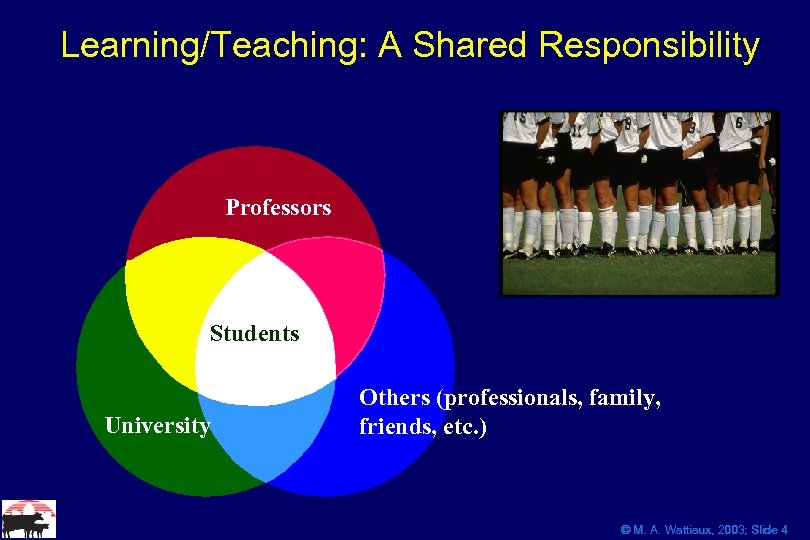 Learning/Teaching: A Shared Responsibility Professors Students University Others (professionals, family, friends, etc. ) © M. A. Wattiaux, 2003; Slide 4
 Equipping Students for 21 st Century Careers The goal of the College of Agriculture and Life Sciences (CALS) is to ensure that every student develops: ê Specialized knowledge in at least one discipline. . . ê The ability to think critically and creatively… ê The ability to communicate effectively… ê A global perspective: an appreciation for interdependencies… ê The ability to work with others… ê A respect for truth, a tolerance for diverse views and a sense of professional ethics. © M. A. Wattiaux, 2003; Slide 5
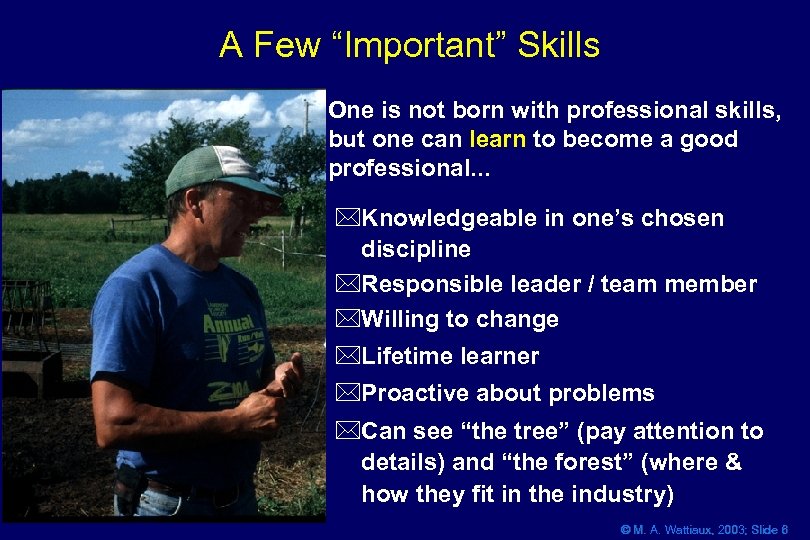 A Few “Important” Skills One is not born with professional skills, but one can learn to become a good professional. . . *Knowledgeable in one’s chosen discipline *Responsible leader / team member *Willing to change *Lifetime learner *Proactive about problems *Can see “the tree” (pay attention to details) and “the forest” (where & how they fit in the industry) © M. A. Wattiaux, 2003; Slide 6
 Changing Role of Faculty in the Learning Process *Faculty = Instructional Delivery System. The faculty are disciplinary experts who impart knowledge by lecturing. *Faculty = Designer of Learning Environment. The faculty study and apply best methods for producing learning and student success. © M. A. Wattiaux, 2003; Slide 7
 On a student’s journey through the University. . . © M. A. Wattiaux, 2003; Slide 8
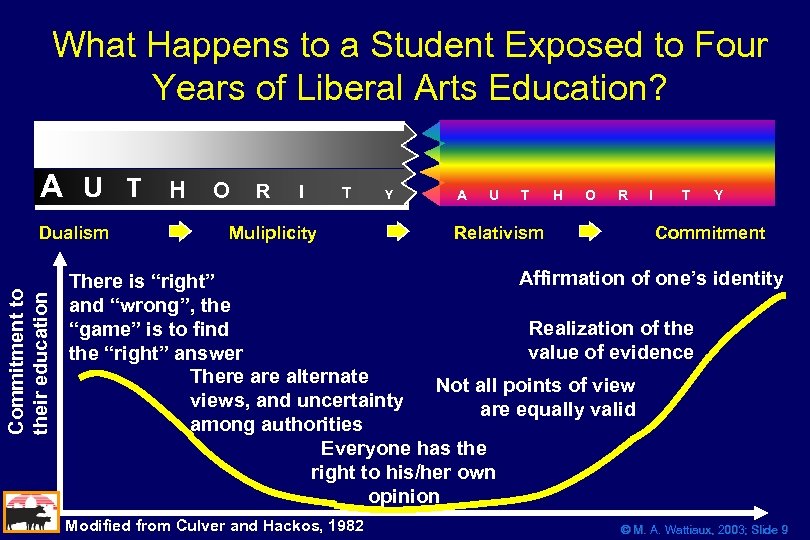 What Happens to a Student Exposed to Four Years of Liberal Arts Education? A U T Commitment to their education Dualism H O R I T Muliplicity Y A U T Relativism H O R I T Y Commitment Affirmation of one’s identity There is “right” and “wrong”, the Realization of the “game” is to find value of evidence the “right” answer There alternate Not all points of views, and uncertainty are equally valid among authorities Everyone has the right to his/her own opinion Modified from Culver and Hackos, 1982 © M. A. Wattiaux, 2003; Slide 9
 On the Student’s Role. . . Please take 2 -3 minutes to write down your own definition of Learning is… … to gather and unify knowledge for oneself © M. A. Wattiaux, 2003; Slide 10
 The Student’s Role… Students must be willing “to reconsider” what learning is all about: *Learning is not a spectator sport; *Learning goes beyond memorizing prepackaged assignments and spitting out answers; *Learning comes from analyzing and evaluating evidence (data); *Learning is not following somebody else’s opinion; *Learning is both an individual (with all preacquired knowledge) and a team process; *People learn (and professors teach) in different ways. © M. A. Wattiaux, 2003; Slide 11
 The Student’s Role… Learning and building upon Learning Styles: Ê What type of information do I preferentially perceive? Ë How do I “internalize” external information? Ê Sensory (external) versus intuitive (internal) Ë Visual (pictures) versus auditory (words) Ì How should the material be organized to make sense? Í How do I “process” information? Î How do I make progress in my understanding? Ì Inductive (inference) versus deductive (deduction) Í Actively (engagement) versus reflectively (introspection) Î Sequentially (by steps) versus globally (holistically) © M. A. Wattiaux, 2003; Slide 12
 The Teacher’s Role… Please take 2 -3 minutes to write down your own definition of teaching Teaching is… … to empower students to learn, i. e. , gather and unify knowledge for themselves © M. A. Wattiaux, 2003; Slide 13
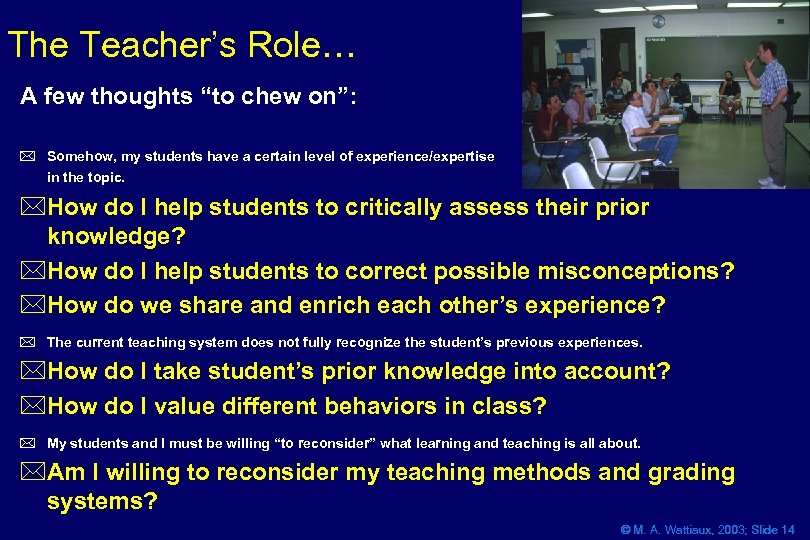 The Teacher’s Role… A few thoughts “to chew on”: * Somehow, my students have a certain level of experience/expertise in the topic. *How do I help students to critically assess their prior knowledge? *How do I help students to correct possible misconceptions? *How do we share and enrich each other’s experience? * The current teaching system does not fully recognize the student’s previous experiences. *How do I take student’s prior knowledge into account? *How do I value different behaviors in class? * My students and I must be willing “to reconsider” what learning and teaching is all about. *Am I willing to reconsider my teaching methods and grading systems? © M. A. Wattiaux, 2003; Slide 14
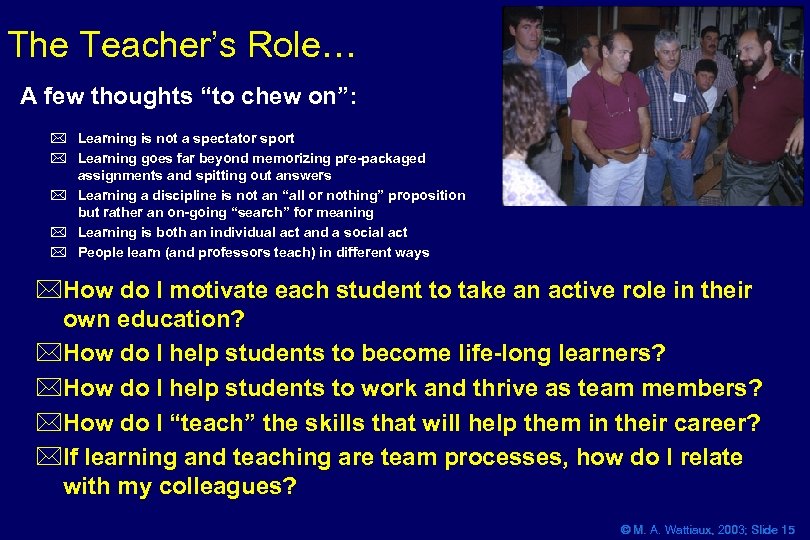 The Teacher’s Role… A few thoughts “to chew on”: * Learning is not a spectator sport * Learning goes far beyond memorizing pre-packaged assignments and spitting out answers * Learning a discipline is not an “all or nothing” proposition but rather an on-going “search” for meaning * Learning is both an individual act and a social act * People learn (and professors teach) in different ways *How do I motivate each student to take an active role in their own education? *How do I help students to become life-long learners? *How do I help students to work and thrive as team members? *How do I “teach” the skills that will help them in their career? *If learning and teaching are team processes, how do I relate with my colleagues? © M. A. Wattiaux, 2003; Slide 15
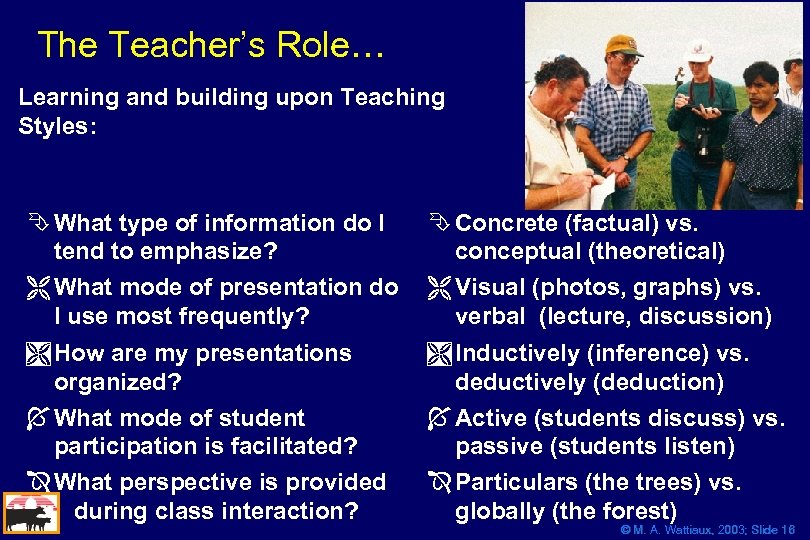 The Teacher’s Role… Learning and building upon Teaching Styles: Ê What type of information do I tend to emphasize? Ë What mode of presentation do I use most frequently? Ê Concrete (factual) vs. conceptual (theoretical) Ë Visual (photos, graphs) vs. verbal (lecture, discussion) Ì How are my presentations organized? Í What mode of student participation is facilitated? Î What perspective is provided during class interaction? Ì Inductively (inference) vs. deductively (deduction) Í Active (students discuss) vs. passive (students listen) Î Particulars (the trees) vs. globally (the forest) © M. A. Wattiaux, 2003; Slide 16
 The Learning Space © M. A. Wattiaux, 2003; Slide 17
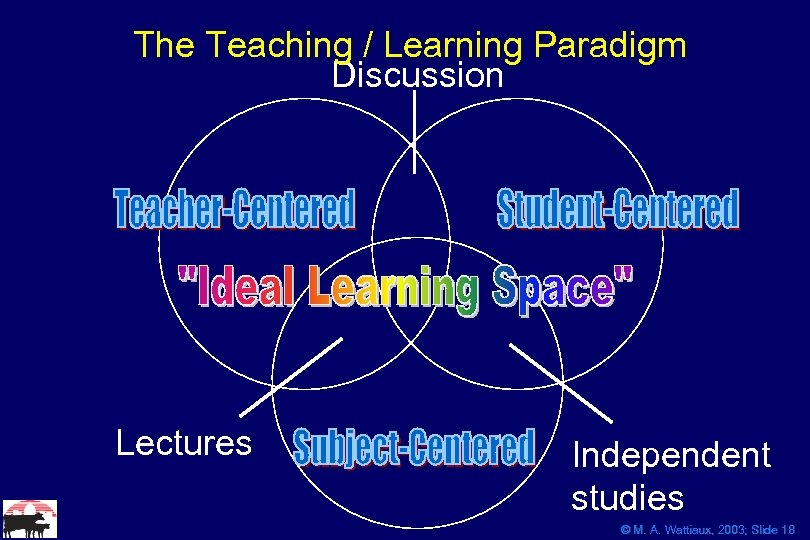 The Teaching / Learning Paradigm Discussion Lectures Independent studies © M. A. Wattiaux, 2003; Slide 18
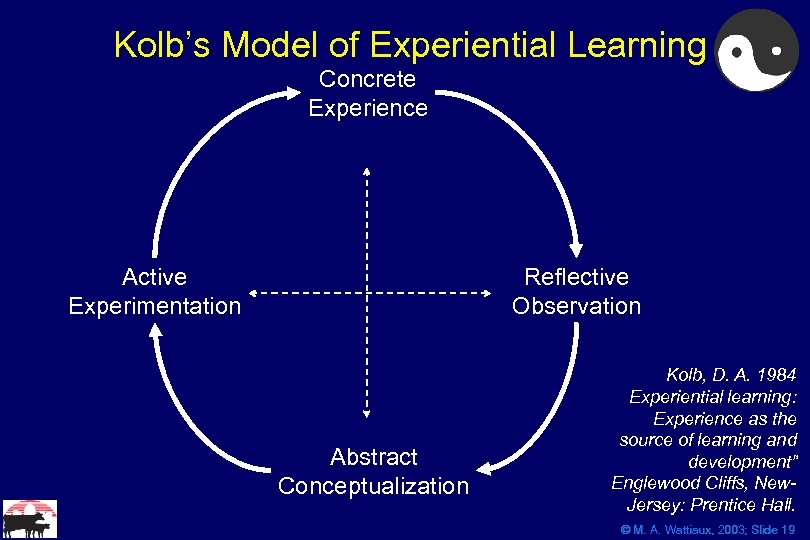 Kolb’s Model of Experiential Learning Concrete Experience Active Experimentation Reflective Observation Abstract Conceptualization Kolb, D. A. 1984 Experiential learning: Experience as the source of learning and development” Englewood Cliffs, New. Jersey: Prentice Hall. © M. A. Wattiaux, 2003; Slide 19
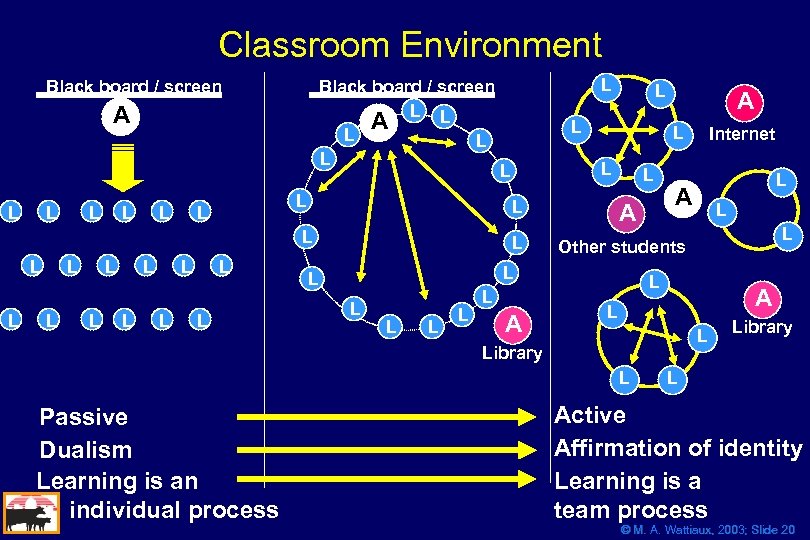 Classroom Environment Black board / screen A L L L L L L L L A L L L A L L Library L Passive Dualism Learning is an individual process Internet Other students L L A L L Library L Active Affirmation of identity Learning is a team process © M. A. Wattiaux, 2003; Slide 20
 Developing Critical Thinking Skills © M. A. Wattiaux, 2003; Slide 21
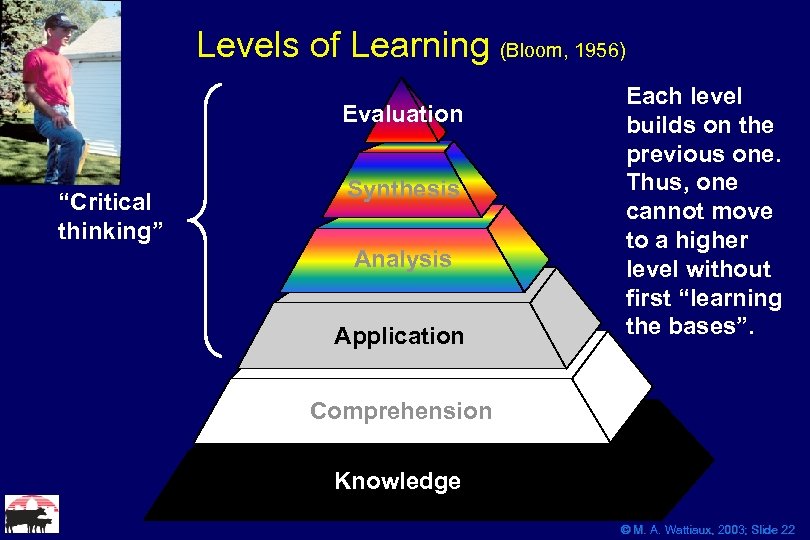 Levels of Learning (Bloom, 1956) Evaluation “Critical thinking” Synthesis Analysis Application Each level builds on the previous one. Thus, one cannot move to a higher level without first “learning the bases”. Comprehension Knowledge © M. A. Wattiaux, 2003; Slide 22
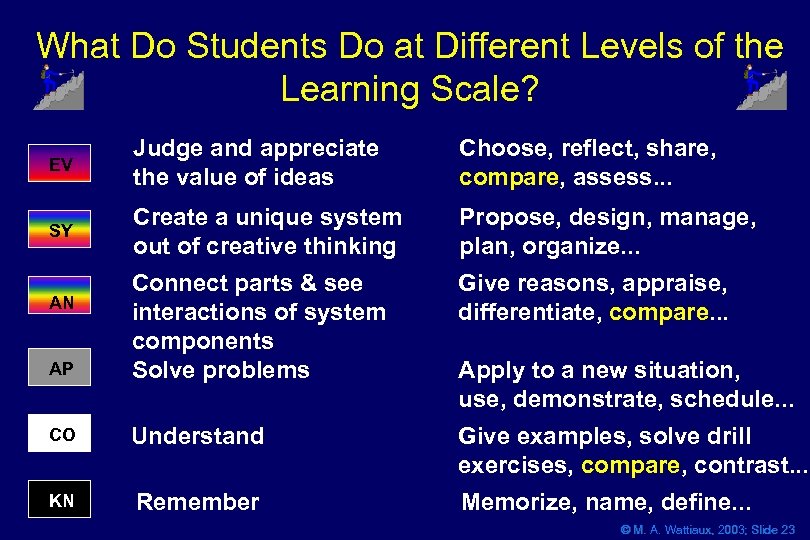 What Do Students Do at Different Levels of the Learning Scale? EV Judge and appreciate the value of ideas Choose, reflect, share, compare, assess. . . SY Create a unique system out of creative thinking Propose, design, manage, plan, organize. . . Give reasons, appraise, differentiate, compare. . . AP Connect parts & see interactions of system components Solve problems CO Understand Give examples, solve drill exercises, compare, contrast. . . KN Remember Memorize, name, define. . . AN Apply to a new situation, use, demonstrate, schedule. . . © M. A. Wattiaux, 2003; Slide 23
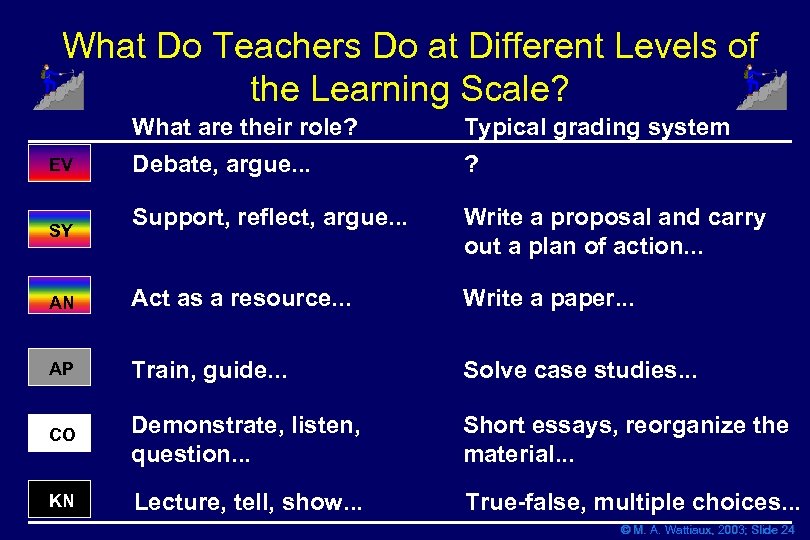 What Do Teachers Do at Different Levels of the Learning Scale? What are their role? Typical grading system Debate, argue. . . ? Support, reflect, argue. . . Write a proposal and carry out a plan of action. . . AN Act as a resource. . . Write a paper. . . AP Train, guide. . . Solve case studies. . . CO Demonstrate, listen, question. . . Short essays, reorganize the material. . . KN Lecture, tell, show. . . True-false, multiple choices. . . EV SY © M. A. Wattiaux, 2003; Slide 24
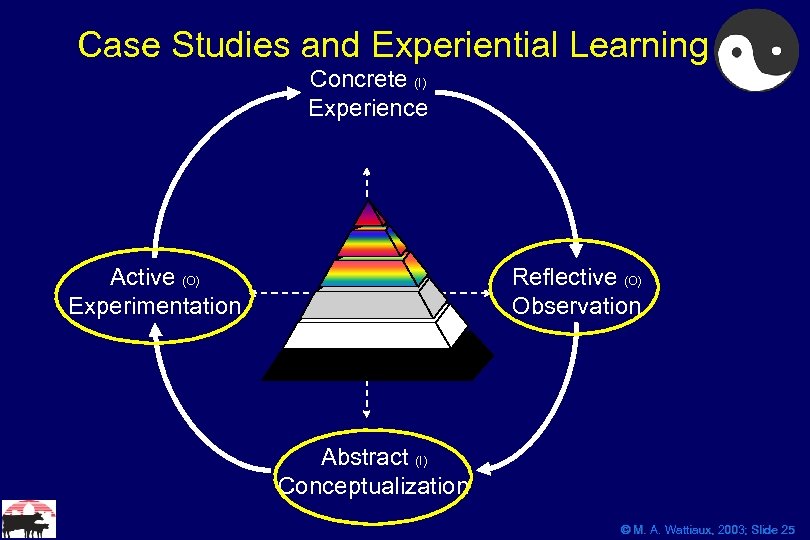 Case Studies and Experiential Learning Concrete (I) Experience Active (O) Experimentation Reflective (O) Observation Abstract (I) Conceptualization © M. A. Wattiaux, 2003; Slide 25
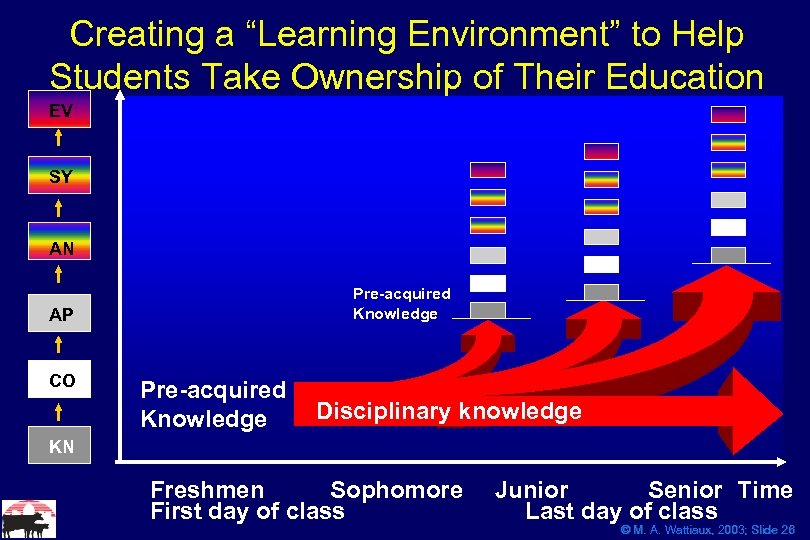 Creating a “Learning Environment” to Help Students Take Ownership of Their Education EV SY AN Pre-acquired Knowledge AP CO Pre-acquired Knowledge Disciplinary knowledge KN Freshmen Sophomore First day of class Junior Senior Time Last day of class © M. A. Wattiaux, 2003; Slide 26
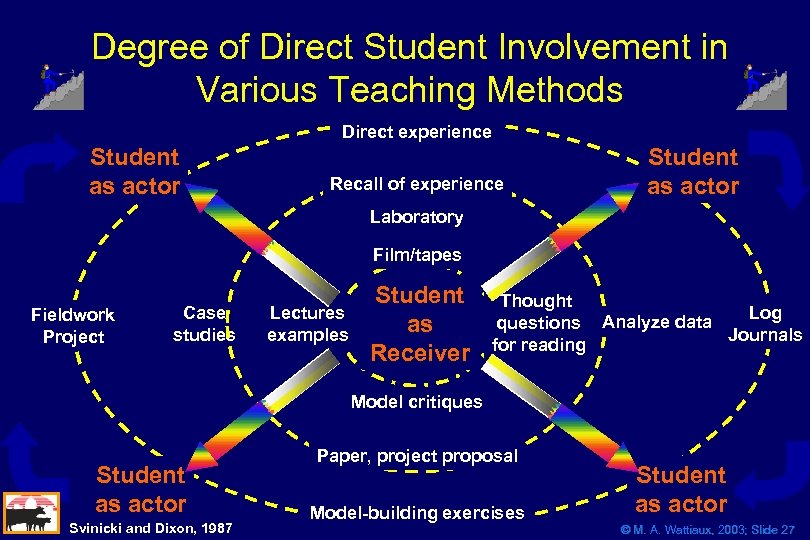 Degree of Direct Student Involvement in Various Teaching Methods Direct experience Student as actor Recall of experience Student as actor Laboratory Film/tapes Fieldwork Project Case studies Lectures examples Student as Receiver Thought Log questions Analyze data Journals for reading Model critiques Student as actor Svinicki and Dixon, 1987 Paper, project proposal Model-building exercises Student as actor © M. A. Wattiaux, 2003; Slide 27
 Case Studies © M. A. Wattiaux, 2003; Slide 28
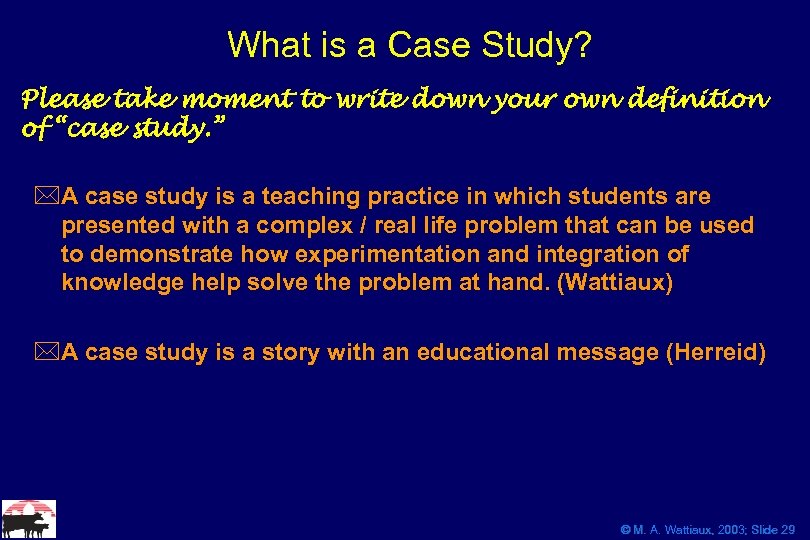 What is a Case Study? Please take moment to write down your own definition of “case study. ” *A case study is a teaching practice in which students are presented with a complex / real life problem that can be used to demonstrate how experimentation and integration of knowledge help solve the problem at hand. (Wattiaux) *A case study is a story with an educational message (Herreid) © M. A. Wattiaux, 2003; Slide 29
 What Makes a Good Case? (C. F. Herreid, 1998) Please take moment to write down what you believe makes a good case study 1. A good case serves a teaching function (i. e, a pedagogic utility) Can you think of examples of “stories” that would help illustrate a point, a concept, or a dilemma that is currently built into your course syllabus? 2. A good case tells a story What are good stories made of? © M. A. Wattiaux, 2003; Slide 30
 What Makes a Good Case? (C. F. Herreid, 1998) 3. A good case is set in the past five years Why should it be? 4. A good case creates empathy with the central characters Why? 5. A good case includes dialogue among characters Why? 6. A good case is relevant to the reader How do you make a story “relevant”? © M. A. Wattiaux, 2003; Slide 31
 What Makes a Good Case? (C. F. Herreid, 1998) 7. A good case requires dilemmas be solved There must be a conflict, something important is at stake, etc. 8. A good case has generality What is the moral of the story? 9. A good case is short This should not preclude “long cases. ” If Complexity is to be introduced, it should be done in stages. © M. A. Wattiaux, 2003; Slide 32
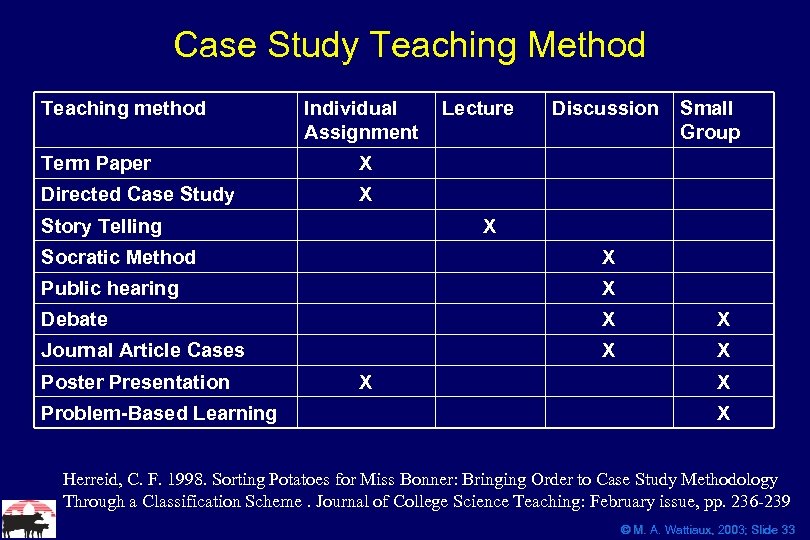 Case Study Teaching Method Teaching method Individual Assignment Term Paper Discussion Small Group X Directed Case Study Lecture X Story Telling X Socratic Method X Public hearing X Debate X X Journal Article Cases X X Poster Presentation Problem-Based Learning X X X Herreid, C. F. 1998. Sorting Potatoes for Miss Bonner: Bringing Order to Case Study Methodology Through a Classification Scheme. Journal of College Science Teaching: February issue, pp. 236 -239 © M. A. Wattiaux, 2003; Slide 33
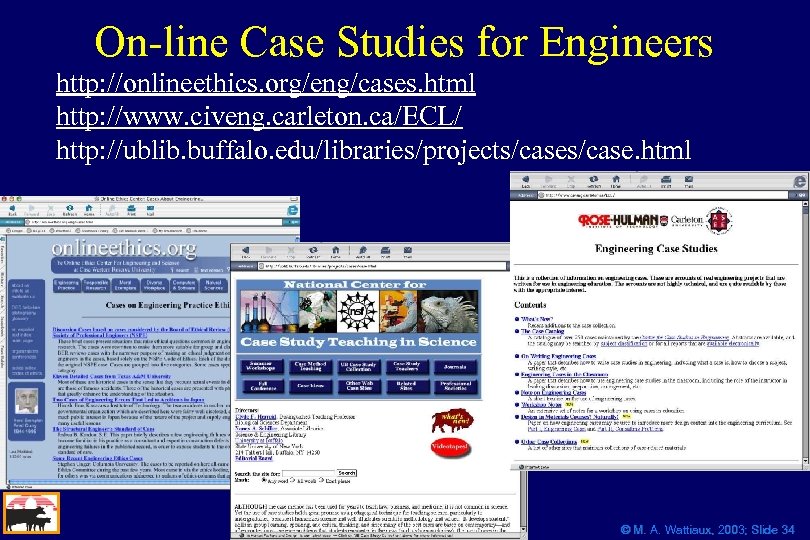 On-line Case Studies for Engineers http: //onlineethics. org/eng/cases. html http: //www. civeng. carleton. ca/ECL/ http: //ublib. buffalo. edu/libraries/projects/case. html © M. A. Wattiaux, 2003; Slide 34
 Final Thoughts © M. A. Wattiaux, 2003; Slide 35
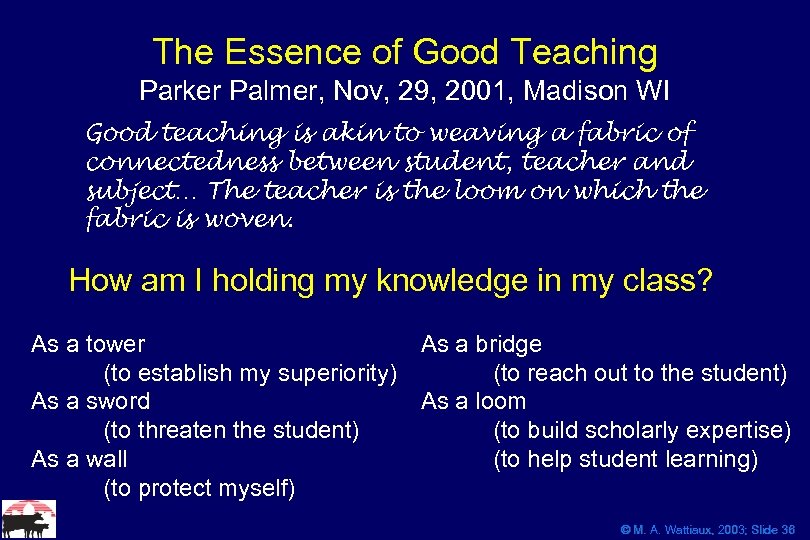 The Essence of Good Teaching Parker Palmer, Nov, 29, 2001, Madison WI Good teaching is akin to weaving a fabric of connectedness between student, teacher and subject… The teacher is the loom on which the fabric is woven. How am I holding my knowledge in my class? As a tower (to establish my superiority) As a sword (to threaten the student) As a wall (to protect myself) As a bridge (to reach out to the student) As a loom (to build scholarly expertise) (to help student learning) © M. A. Wattiaux, 2003; Slide 36
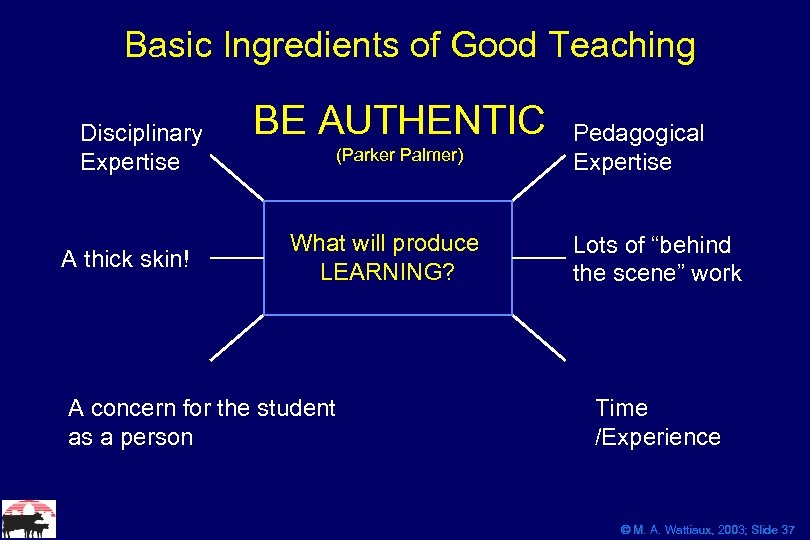 Basic Ingredients of Good Teaching Disciplinary Expertise A thick skin! BE AUTHENTIC (Parker Palmer) What will produce LEARNING? A concern for the student as a person Pedagogical Expertise Lots of “behind the scene” work Time /Experience © M. A. Wattiaux, 2003; Slide 37
 Good Luck in Your Teaching ! © M. A. Wattiaux, 2003; Slide 38