 Скачать презентацию Campus Violence Prevention and Response Best Practices for
c89f26e5220a867b47ce29e4ab0f9789.ppt
- Количество слайдов: 42



Campus Violence Prevention and Response: Best Practices for Massachusetts Higher Education Prepared by Applied Risk Management
Introduction Applied Risk Management Department of Higher Education, Campus Safety and Violence Prevention Task Force Consulting Team: • Security Experts from ARM • Criminologists / Academics • Law Enforcement / Violence Prevention 2/
Process What information did we use? • National and local crime statistics • National and local best practices • Surveys • Dr. Fox’s & other research 3/
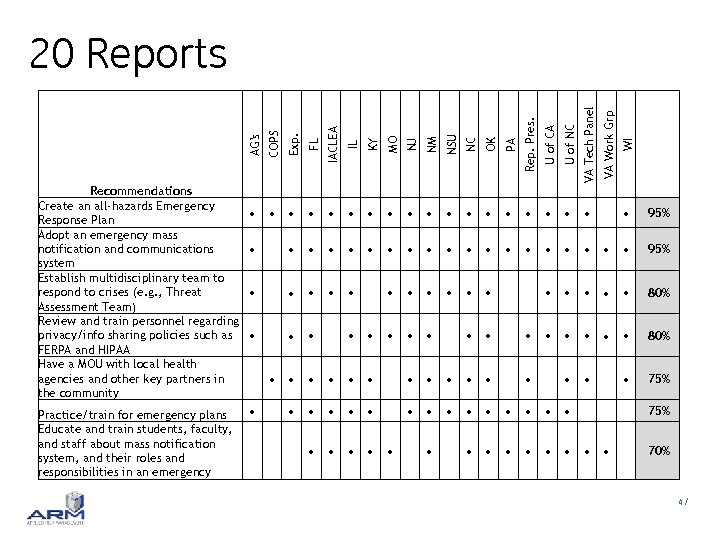
Practice/train for emergency plans Educate and train students, faculty, and staff about mass notification system, and their roles and responsibilities in an emergency Exp. FL IACLEA IL KY MO NJ NM NSU NC OK PA Rep. Pres. U of CA U of NC VA Tech Panel • • • • • WI COPS Recommendations Create an all-hazards Emergency Response Plan Adopt an emergency mass notification and communications system Establish multidisciplinary team to respond to crises (e. g. , Threat Assessment Team) Review and train personnel regarding privacy/info sharing policies such as FERPA and HIPAA Have a MOU with local health agencies and other key partners in the community VA Work Grp AG's 20 Reports • 95% • • • 80% • • • 75% • • • • • • • • • • • • • • • • • • • • 75% • • • 70% 4/

Nature and Scope of the Problem 5/
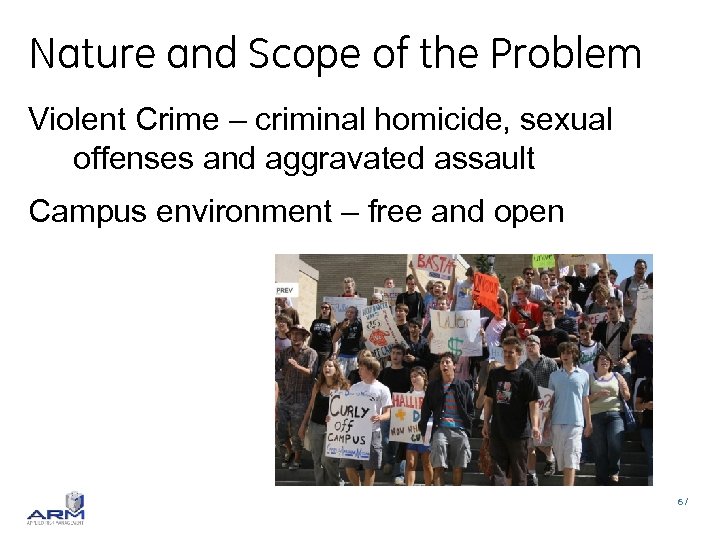
Nature and Scope of the Problem Violent Crime – criminal homicide, sexual offenses and aggravated assault Campus environment – free and open 6/
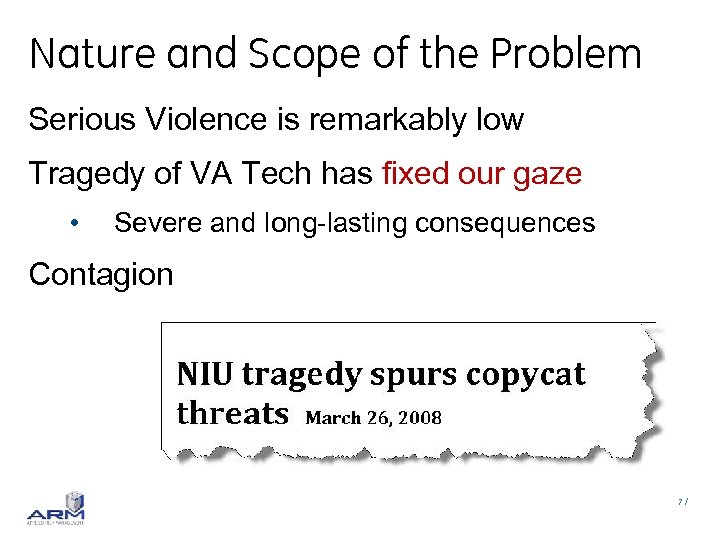
Nature and Scope of the Problem Serious Violence is remarkably low Tragedy of VA Tech has fixed our gaze • Severe and long-lasting consequences Contagion 7/

National and Local Best Practices 8/
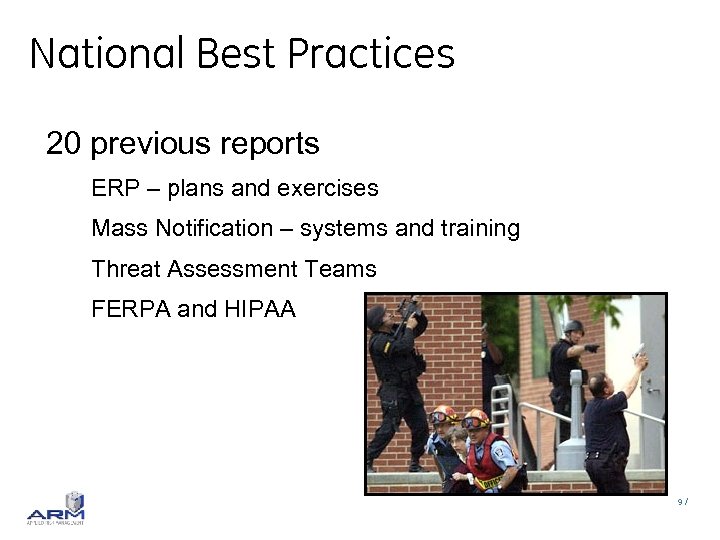
National Best Practices 20 previous reports ERP – plans and exercises Mass Notification – systems and training Threat Assessment Teams FERPA and HIPAA 9/
National Best Practices 20 previous reports MOU with local agencies Train community to recognize threats Conduct risk assessments Interoperable communications NIMS Training 10 /
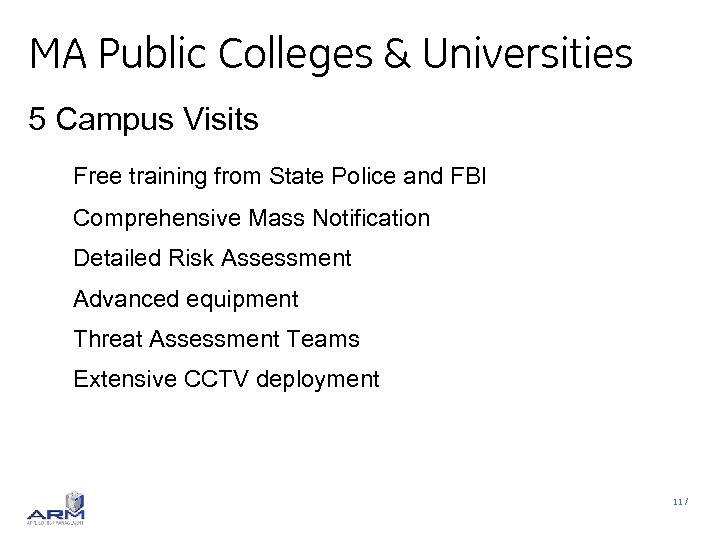
MA Public Colleges & Universities 5 Campus Visits Free training from State Police and FBI Comprehensive Mass Notification Detailed Risk Assessment Advanced equipment Threat Assessment Teams Extensive CCTV deployment 11 /

Existing Conditions: 133 Question Survey 12 /
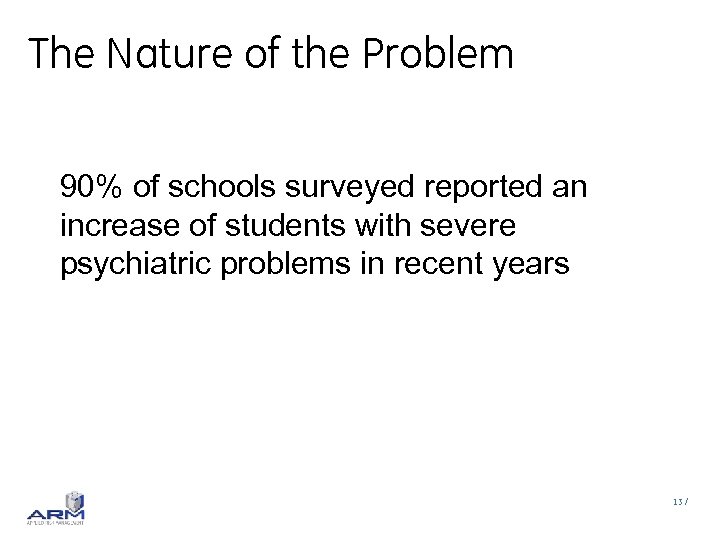
The Nature of the Problem 90% of schools surveyed reported an increase of students with severe psychiatric problems in recent years 13 /

14 /
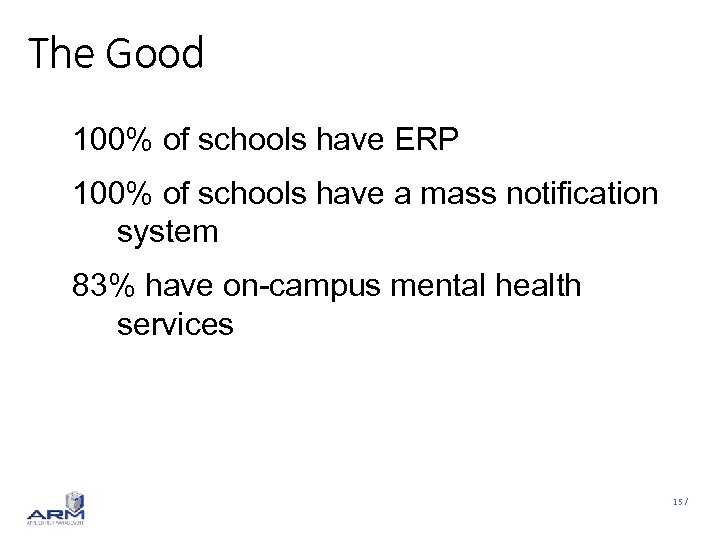
The Good 100% of schools have ERP 100% of schools have a mass notification system 83% have on-campus mental health services 15 /
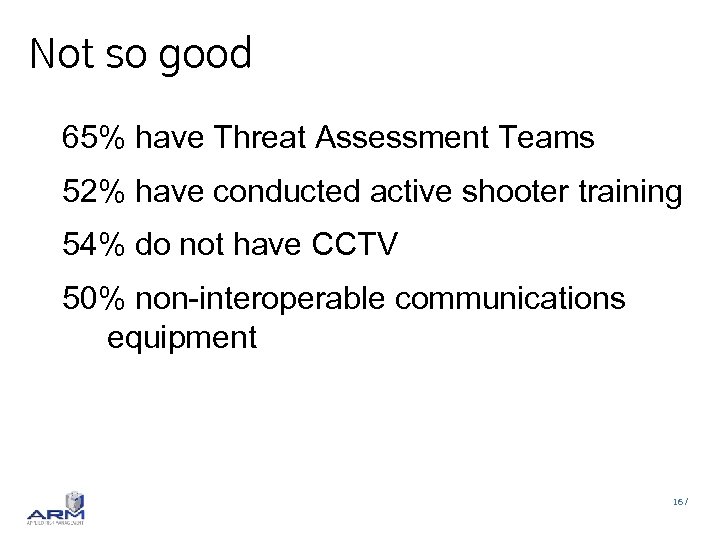
Not so good 65% have Threat Assessment Teams 52% have conducted active shooter training 54% do not have CCTV 50% non-interoperable communications equipment 16 /
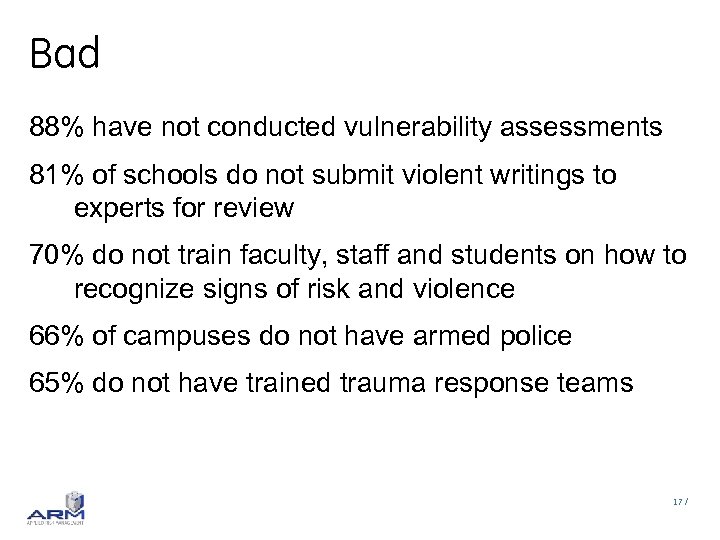
Bad 88% have not conducted vulnerability assessments 81% of schools do not submit violent writings to experts for review 70% do not train faculty, staff and students on how to recognize signs of risk and violence 66% of campuses do not have armed police 65% do not have trained trauma response teams 17 /

Recommendations 18 /
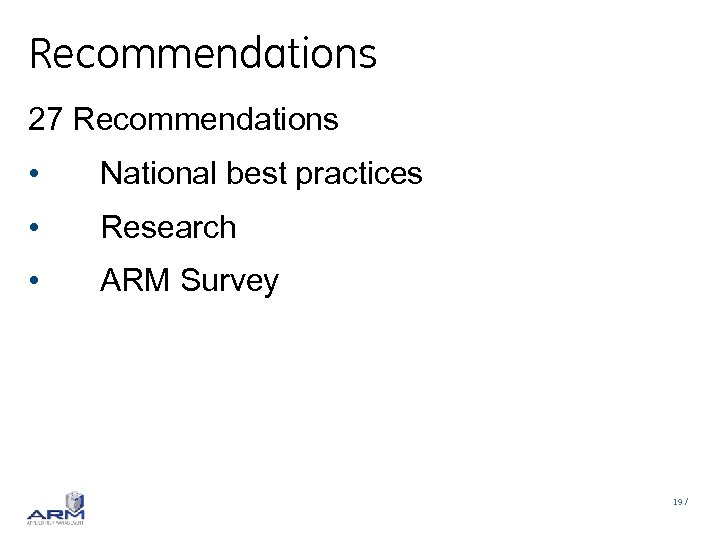
Recommendations 27 Recommendations • National best practices • Research • ARM Survey 19 /
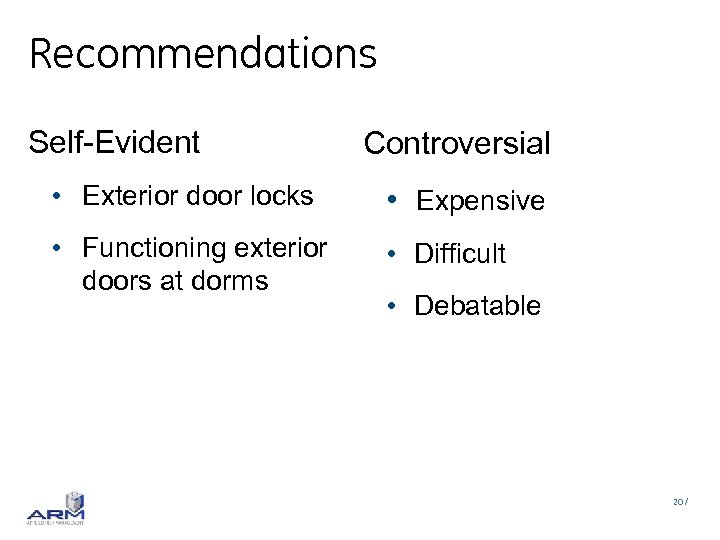
Recommendations Self-Evident Controversial • Exterior door locks • Expensive • Functioning exterior doors at dorms • Difficult • Debatable 20 /
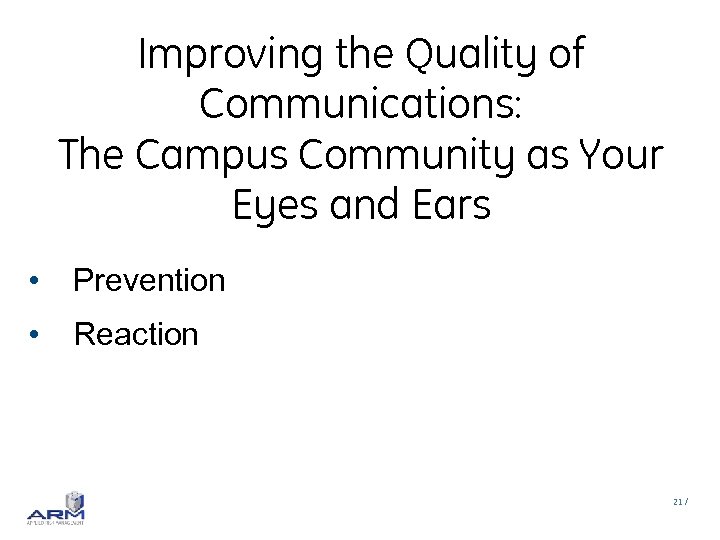
Improving the Quality of Communications: The Campus Community as Your Eyes and Ears • Prevention • Reaction 21 /
Recommendations to improve communications between faculty / staff and TAT / campus police 22 /
Recommendation 15 Faculty and staff should receive training in identifying students at risk GOAL: increase the probability that a possibly violent individual will receive help & avert any violence Issues: Efficacy Making judgments Liability issues 23 /
Recommendation 3 Writings, drawings, and other forms of individual expression reflecting violent fantasy and causing a faculty member to be fearful or concerned about safety, should be evaluated contextually for any potential threat. Higher education must permit, even encourage, free and individual expression Must be mechanisms in place to get help when concerns arise 24 /
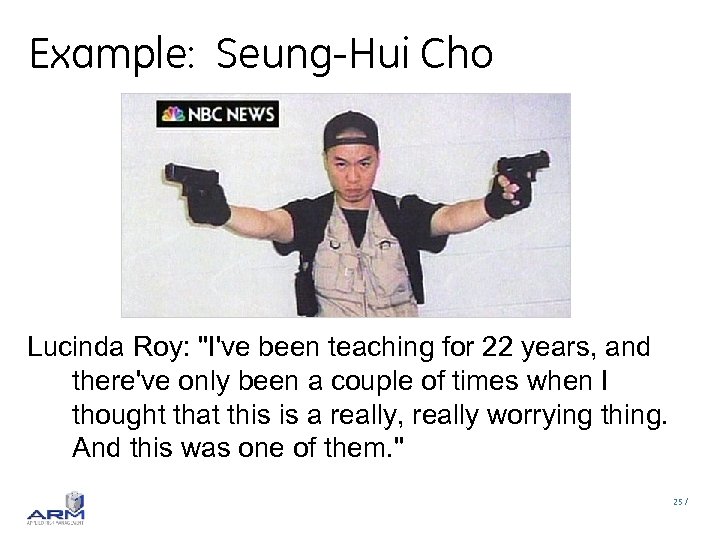
Example: Seung-Hui Cho Lucinda Roy: "I've been teaching for 22 years, and there've only been a couple of times when I thought that this is a really, really worrying thing. And this was one of them. " 25 /
Recommendation 17 Faculty and staff should be informed about the appropriate protocol in the event of a crisis • Help or get out of the way? • Faculty/staff responsibility? 26 /
Recommendations to improve communications between students and administration 27 /
Recommendation 1 Campus mental health services should be clearly available and easily accessible to students Many violent individuals do not seek out help Real goal is to make it SO EASILY ACCESSIBLE that we encourage help-seeking behaviors among troubled individuals 28 /
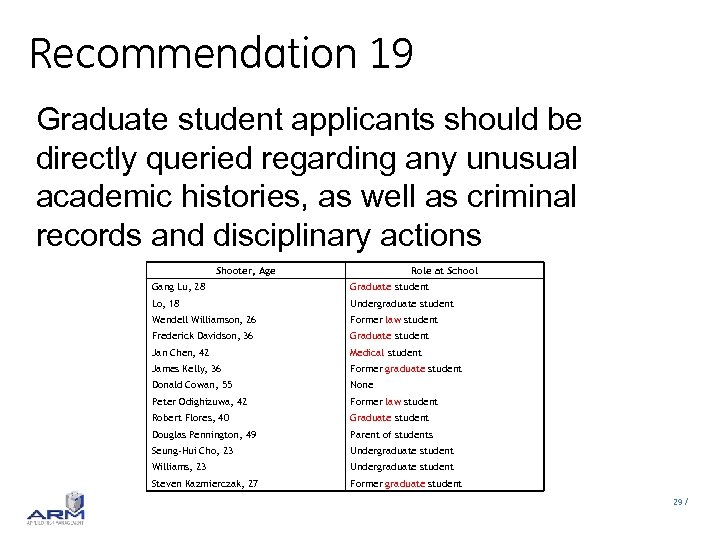
Recommendation 19 Graduate student applicants should be directly queried regarding any unusual academic histories, as well as criminal records and disciplinary actions Shooter, Age Role at School Gang Lu, 28 Graduate student Lo, 18 Undergraduate student Wendell Williamson, 26 Former law student Frederick Davidson, 36 Graduate student Jan Chen, 42 Medical student James Kelly, 36 Former graduate student Donald Cowan, 55 None Peter Odighizuwa, 42 Former law student Robert Flores, 40 Graduate student Douglas Pennington, 49 Parent of students Seung-Hui Cho, 23 Undergraduate student Williams, 23 Undergraduate student Steven Kazmierczak, 27 Former graduate student 29 /

Assessments 30 /
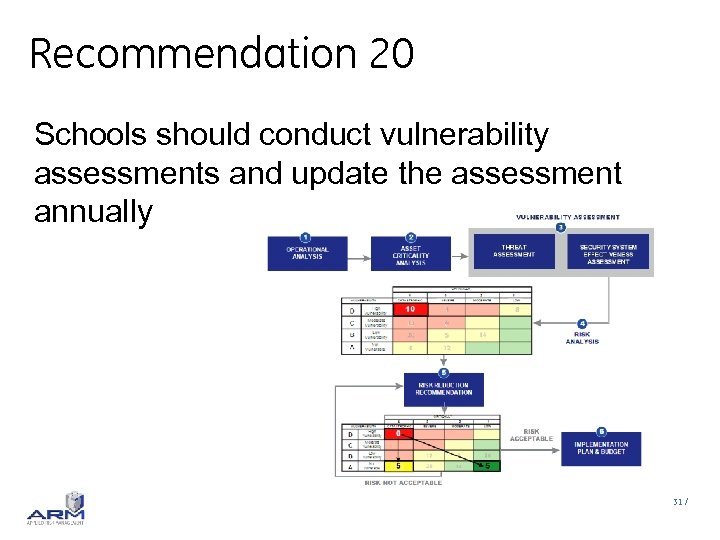
Recommendation 20 Schools should conduct vulnerability assessments and update the assessment annually 31 /
Recommendation 24 & 25 Every school should institute, train and maintain a threat assessment team The TAT should consist of representatives from various departments and agencies including student services, counseling, faculty, police, HR and legal. 32 /
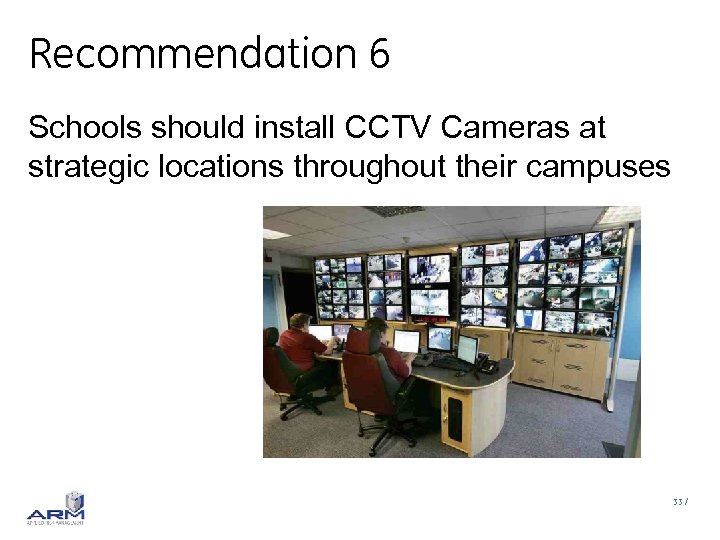
Recommendation 6 Schools should install CCTV Cameras at strategic locations throughout their campuses 33 /

Response 34 /
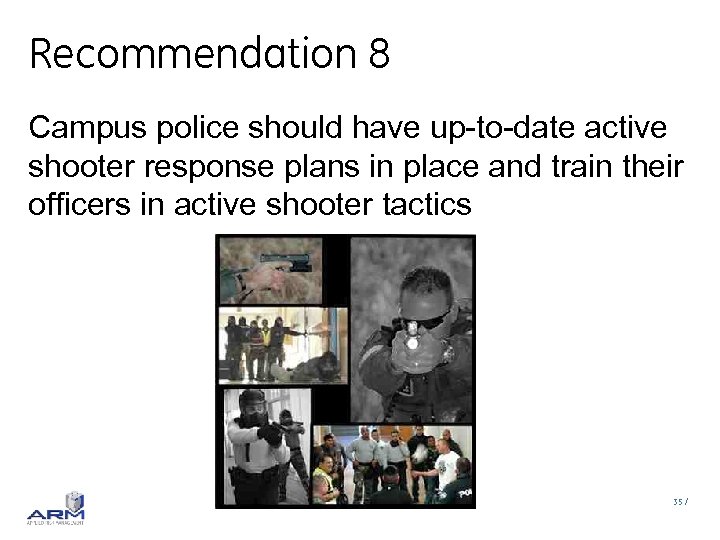
Recommendation 8 Campus police should have up-to-date active shooter response plans in place and train their officers in active shooter tactics 35 /
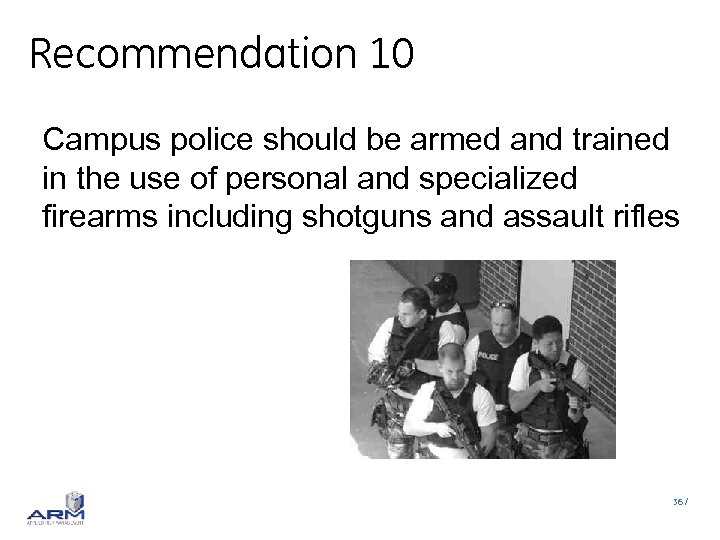
Recommendation 10 Campus police should be armed and trained in the use of personal and specialized firearms including shotguns and assault rifles 36 /

Conclusions 37 /
Conclusions: Considerations • Serious violence on campus is rare but consequences are devastating • Security entails costs – fiscal and otherwise – that must be considered and weighed 38 /
Conclusions: Prevention Information sharing is the best prevention, but it is not enough by itself 39 /
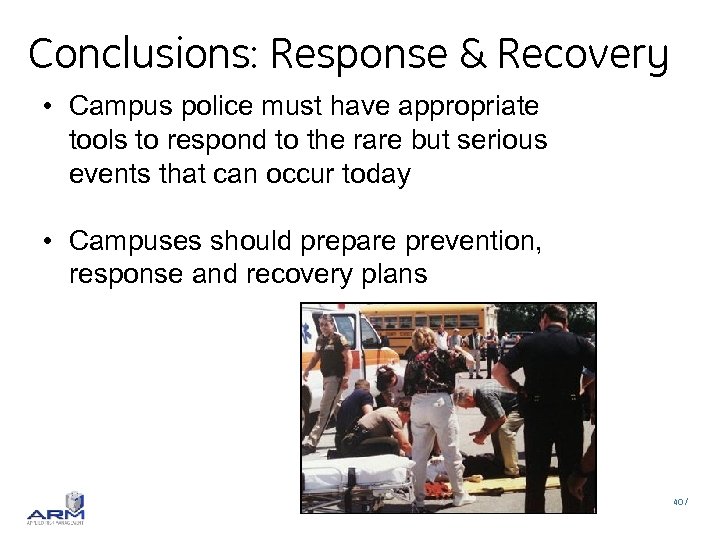
Conclusions: Response & Recovery • Campus police must have appropriate tools to respond to the rare but serious events that can occur today • Campuses should prepare prevention, response and recovery plans 40 /
Final Conclusions • Universities present unique challenges: security versus free thought • Recommendations are designed to balance both needs • Recommendations address both serious violence and more prevalent issues • The new reality: education and law enforcement must collaborate 41 /

Questions 90 Maple Street Suite 3 B Stoneham, MA 02180 888 365 -8888 www. arm-security. com Copies of the report are now available in the lobby 42 /
Скачать презентацию Campus Violence Prevention and Response Best Practices for
c89f26e5220a867b47ce29e4ab0f9789.ppt