


 Скачать презентацию CAMPUS MASTER PLAN Campus Master Plan Update Task
8ad3bad901caccd13b8c7085eeb4a78f.ppt
- Количество слайдов: 31
 CAMPUS MASTER PLAN Campus Master Plan Update Task Force Reports March 8, 2010
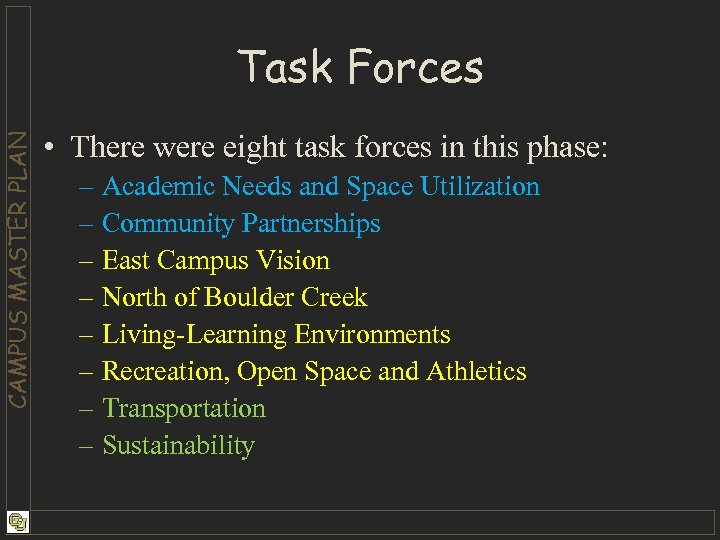 CAMPUS MASTER PLAN Task Forces • There were eight task forces in this phase: – Academic Needs and Space Utilization – Community Partnerships – East Campus Vision – North of Boulder Creek – Living-Learning Environments – Recreation, Open Space and Athletics – Transportation – Sustainability
 CAMPUS MASTER PLAN Task Forces • Nearly 120 people participated • Composed of faculty, students, staff, City representatives, and community representatives • Worked October 2009 to January 2010 • Final reports are nearly ready – 4 reports are on web site, the rest will be up by the end of the week.
 CAMPUS MASTER PLAN Task Forces • Charged with – Examining their areas in light of Flagship 2030 Strategic Plan goals – Looking for areas of cooperation and potential partnerships – Improving the utilization of our resources – Studying specific issues of their focus area
 Planning Assumptions • Growth Drivers – Enrollment – historic rates vs. state rate • Undergraduate – small increase • Graduate – moderate increase
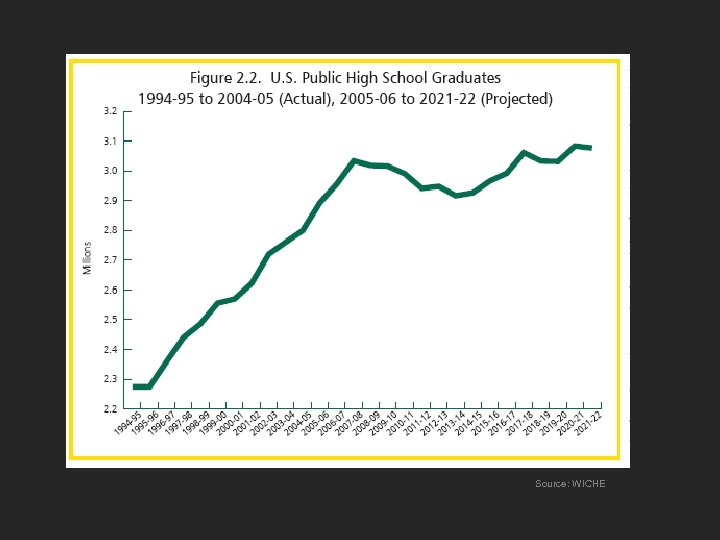 Source: WICHE
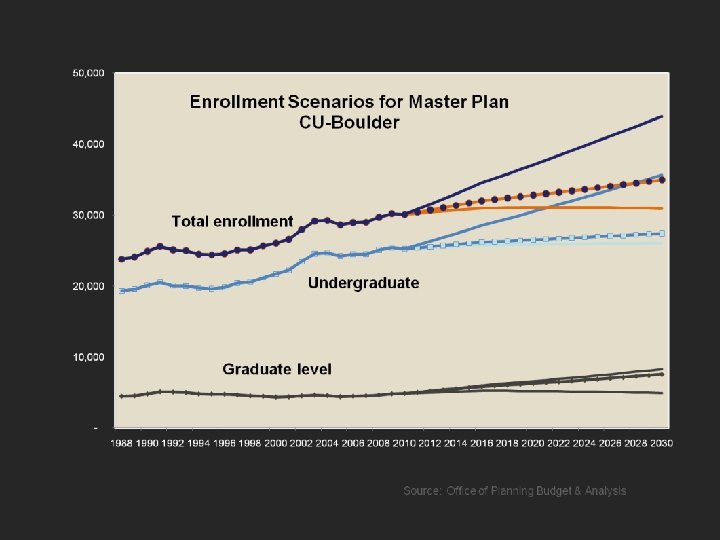
 Planning Assumptions • Growth Drivers – Enrollment – historic rates • Undergraduate – small increase • Graduate – moderate increase – Research – continued strong growth • 2004 to 2008 expenditures of $1. 29 B • Growth of between 3% and 6% per year – Employment • Employee loss is not sustainable • 300 employees lost between 2001 and 2009
 Planning Assumptions • International students – Increase 900 to 1800 more students • Housing – Freshmen live-in rule is retained – Raising upper division undergraduate (Soph. , Jr. , Sr. ) residents from less than 5% to 20%. – Greater emphasis on family housing for graduate and international students – Address the demand for faculty and staff housing
 Planning Assumptions • Housing (cont. ) – Unmet demand of 1500 undergraduate beds after 1000 beds are brought on line in 2011 – Family housing stock is at the end of its life • 300 Tenure and tenure-track (TTT) faculty will be hired between 2007 and 2020. – Increased research facilities – Increased research staff (assume 3 professional, 3 student)
 CAMPUS MASTER PLAN Academic Needs & Space Utilization • • UG enrollment growth from 25, 408 to 26, 951 by 2030 GRAD enrollment growth from 4, 788 to 7, 100 by 2030 International students up 900 to 1800 by 2016 Sensible plan for 250 new TTT faculty by 2020
 CAMPUS MASTER PLAN Academic Needs & Space Utilization • Facilities Improvements – Large Classroom (600 to 750 seats) – 1, 000 seat performance venues (Music and Theater) – 3 additional science buildings (Geosciences, Chemistry 2, NREL) – Library welcome / Information Center – Science Museum – As facilities as provided, allow for instructor needs; Consider use of former IBS buildings & other backfill space for instructors – Convert vacated Henderson Museum/ MCOL and ENVD – Convert underutilized, obsolete space on MC for faculty and graduate student offices with partitions
 CAMPUS MASTER PLAN Community Partnerships • Key Principles – Institutional relations & cooperative planning • Regular meetings of leadership • Commitment to transparency, shared information • Provide incentives and broaden the definition of faculty teaching, service, and research to encourage community engagement • Create an affiliate culture that supports diversity and mutual understanding – Resource leveraging – Move the city and university toward a creative economy
 Community Partnerships Creative Economy: “We propose that campus planning draw from the tenets of a “creative economy” as a “hybrid” model for economic growth, one premised upon technology, the arts, information, culture, the environment and entrepreneurialism. ” -Community Partnerships Task Force Report
 CAMPUS MASTER PLAN Community Partnerships • Design Elements – Seek common values that sustain economic, social & environmental growth and responsibility – Sensitivity to proximity – Develop common areas that promote public safety, functionality and a Boulder “aesthetic. ” – Reserve space for future development – Infill and density planning that supports decongestion and efficient economic development – Promote alternative transportation
 CAMPUS MASTER PLAN East Campus Vision • Five Academic-Research Cores – Life Sciences (CIMB, Biochemistry, Ch. BE, IPHY, etc. ) – Geosciences (ENVS, ATOC, INSTAAR, USGS, CIRES, etc. ) – Energy (RASIE, NREL) – Astrophysical & Space Sciences (LASP, CASA) – Social Sciences and Humanities (SLHS, Linguistics, Philosophy) • Engineering and Federal partnerships integrated into Academic-Research Clusters
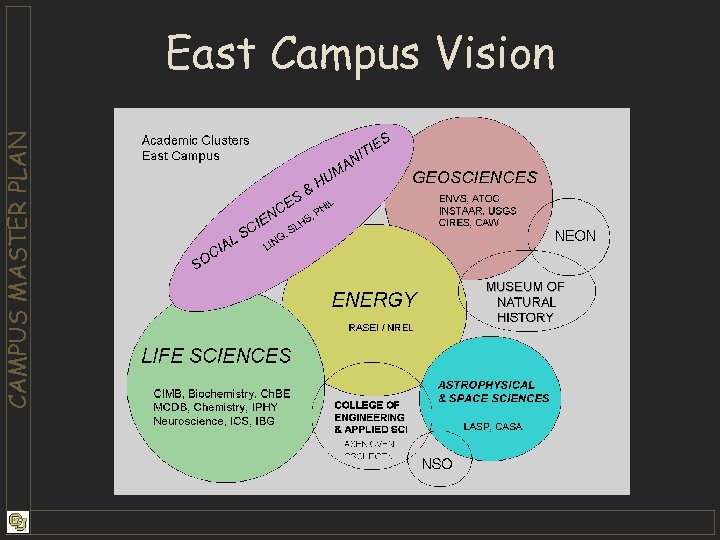 CAMPUS MASTER PLAN East Campus Vision
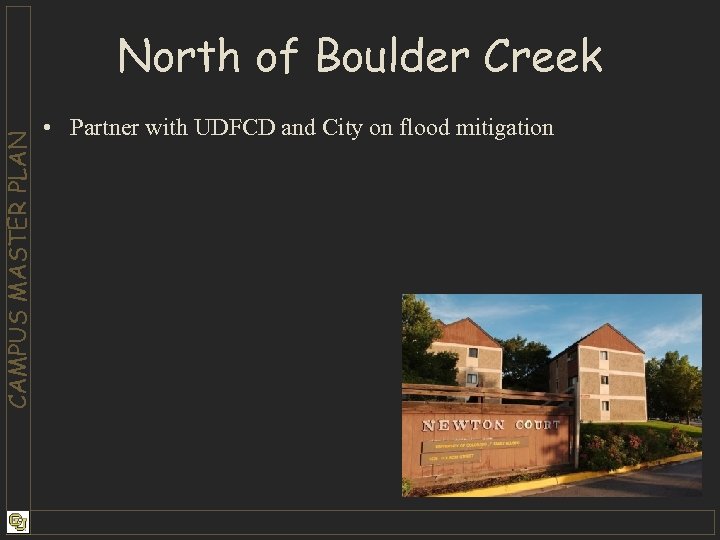 CAMPUS MASTER PLAN North of Boulder Creek • Partner with UDFCD and City on flood mitigation
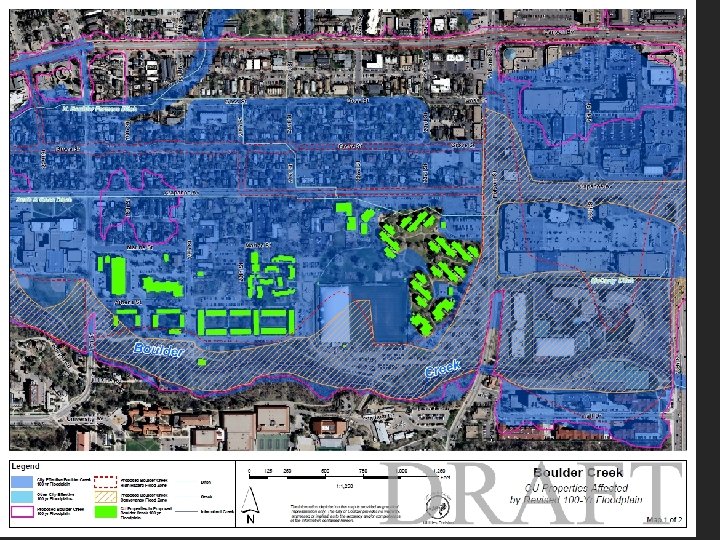 North of Boulder Creek
 CAMPUS MASTER PLAN North of Boulder Creek • Partner with UDFCD and City on flood mitigation • Create partnerships to replace affordable family housing in higher density development – – – • • Graduate students International students Faculty/staff Retired campus constituents Alumni Active and passive recreation and athletic fields in floodway Strengthen pedestrian linkages to the campus Childcare Conference Center
 CAMPUS MASTER PLAN Living-Learning Environments • Implement plan to increase the number of RAPs from 9 to up to 30 by 2030 (Flagship 2030 goal) – Developing programs (discipline specific, honors, thematic, common interest) – Identifying faculty leadership – Creating adequate facilities – Developing new financial model
 CAMPUS MASTER PLAN Recreation, Open Space & Athletics • Investing resources in recreation centers, athletic facilities and open space will result in powerful recruitment and retention tools. • Existing facilities condition, combined with 20% growth in student enrollment over the past two decades, have placed extreme pressures upon facilities which now require immediate attention • Demand cannot be met without both renovated and new facilities • Geographical distribution of facilities cause operational difficulties • Floodway/floodplain ground remains desirable for facilities • Preservation of existing open space
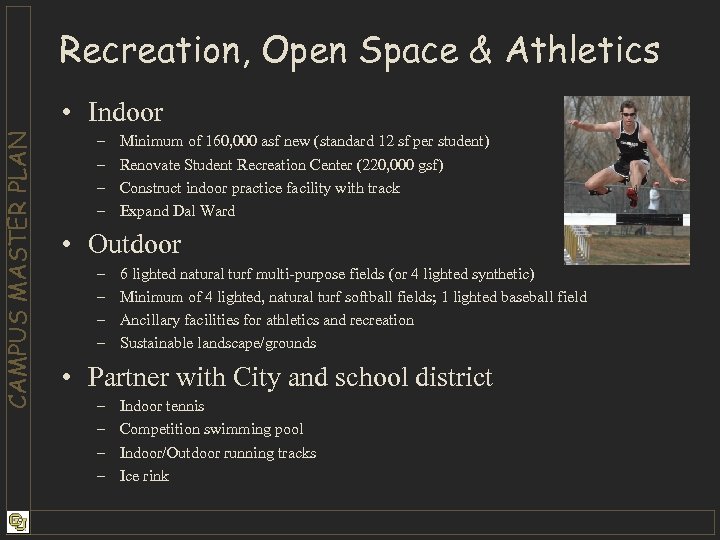 CAMPUS MASTER PLAN Recreation, Open Space & Athletics • Indoor – – Minimum of 160, 000 asf new (standard 12 sf per student) Renovate Student Recreation Center (220, 000 gsf) Construct indoor practice facility with track Expand Dal Ward • Outdoor – – 6 lighted natural turf multi-purpose fields (or 4 lighted synthetic) Minimum of 4 lighted, natural turf softball fields; 1 lighted baseball field Ancillary facilities for athletics and recreation Sustainable landscape/grounds • Partner with City and school district – – Indoor tennis Competition swimming pool Indoor/Outdoor running tracks Ice rink
 CAMPUS MASTER PLAN Transportation COMMUTE AND PARKING BETWEEN CAMPUSES O NCAMPUS • Provide incentives to reduce parking demand • Improve access to & timeliness of transit • Provide connections to Fast-tracks, BRT stops • Co-locate uses to minimize need for travel • Improve connectivity for pedestrians / cyclists • Provide scalable solutions over time • Prioritize pedestrian safety • Use variety of capital improvements to reduce intermodal conflicts
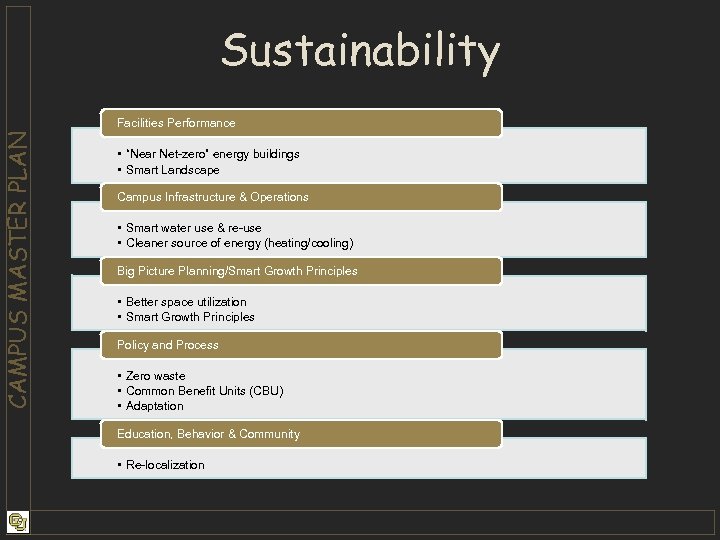 CAMPUS MASTER PLAN Sustainability Facilities Performance • “Near Net-zero” energy buildings • Smart Landscape Campus Infrastructure & Operations • Smart water use & re-use • Cleaner source of energy (heating/cooling) Big Picture Planning/Smart Growth Principles • Better space utilization • Smart Growth Principles Policy and Process • Zero waste • Common Benefit Units (CBU) • Adaptation Education, Behavior & Community • Re-localization
 Smart Growth Principles • Smart Growth strategies: – – – – – Mix of land uses Take advantage of compact building design Create a range of housing opportunities and choices Create walkable neighborhoods Foster distinctive, attractive communities with a strong sense of place Preserve open space, farmland, natural beauty and critical environmental areas Strengthen and direct development toward existing communities Provide a variety of transportation choices Make development decisions predictable, fair and cost-effective Encourage community and stakeholder collaboration in development decisions
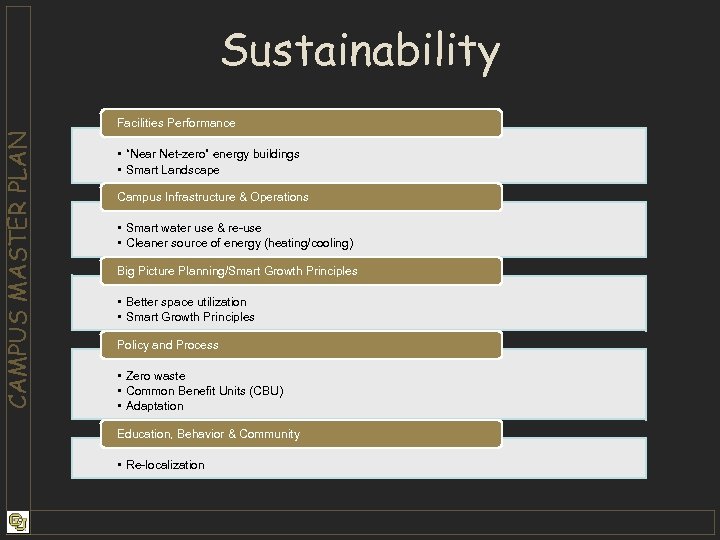 CAMPUS MASTER PLAN Sustainability Facilities Performance • “Near Net-zero” energy buildings • Smart Landscape Campus Infrastructure & Operations • Smart water use & re-use • Cleaner source of energy (heating/cooling) Big Picture Planning/Smart Growth Principles • Better space utilization • Smart Growth Principles Policy and Process • Zero waste • Common Benefit Units (CBU) • Adaptation Education, Behavior & Community • Re-localization
 Next Steps • Scenario Plans to help decide direction over the next 45 days. • Framework plans for North of Boulder Creek
 Next Steps • Scenario Plans to help decide direction over the next 45 days. • Framework plans for North of Boulder Creek • Formal Space Need Assessment • Detail study for East Campus with programs • Undergraduate housing analysis • Area updates for WV, MRS and misc. properties
 Next Steps • Results shown at a public open house in late May. • Draft plan over the summer • Public open house in late September • Formal adoption process begins in November • CCHE approval in March 2011
 CAMPUS MASTER PLAN Campus Master Plan Update http: //www. colorado. edu/masterplan/ Office of Facilities Planning March 8, 2010