 Скачать презентацию Campus Lead Testing By Kim Fulford Matthew Emery
491e101a2534d9113e515e184dc4d5fc.ppt
- Количество слайдов: 23



Campus Lead Testing By Kim Fulford Matthew Emery
Fun Facts Ancients • They regarded lead as the father of all metals, so they associated Saturn with the metal. • “Saturnine“ applies to an individual whose temperament has become gloomy, cynical, and taciturn as the results of lead intoxication. Lead used in: • face powders, rouges, and mascaras • the pigment in many paints "crazy as a painter" was an ancient catch phrase rooted in the demented behavior of lead-poisoned painters • a spermicide for informal birth control • a sweet and sour condiment popular for seasoning food • a wine preservative perfect for stopping fermentation or disguising inferior vintages "plumbing" comes from the Latin word for lead, plumbum.
History of Lead References to lead all throughout history Earliest recording of lead is found in Exodus Bronze Age brought many more documentations of lead use; original lead artifacts have been discovered also Roman’s used lead for underground pipe work; the Roman symbol can still be found today They found lead to be a very versatile metal; was very durable and malleable As time went on, leads usage decreased.
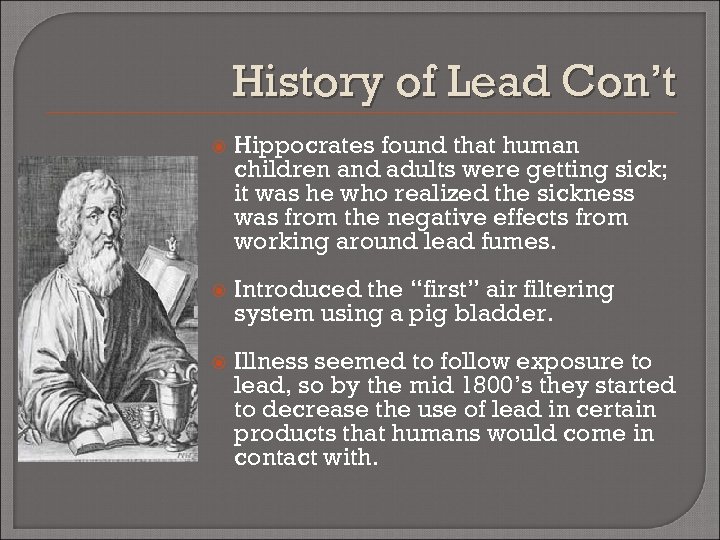
History of Lead Con’t Hippocrates found that human children and adults were getting sick; it was he who realized the sickness was from the negative effects from working around lead fumes. Introduced the “first” air filtering system using a pig bladder. Illness seemed to follow exposure to lead, so by the mid 1800’s they started to decrease the use of lead in certain products that humans would come in contact with.
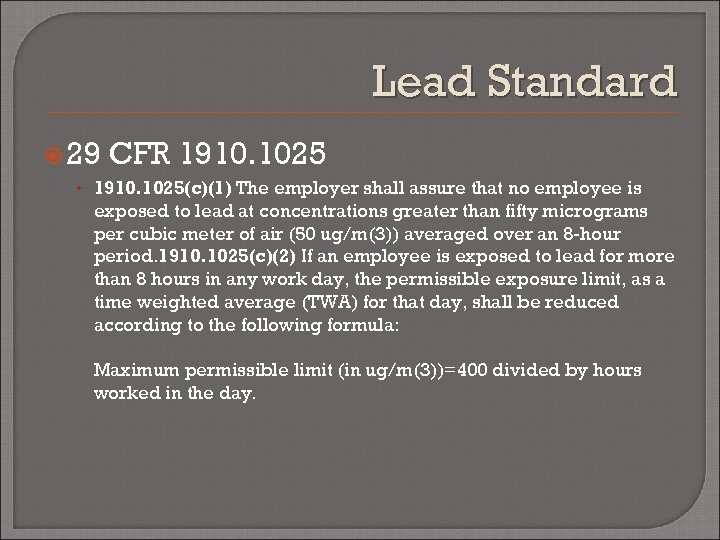
Lead Standard 29 CFR 1910. 1025 • 1910. 1025(c)(1) The employer shall assure that no employee is exposed to lead at concentrations greater than fifty micrograms per cubic meter of air (50 ug/m(3)) averaged over an 8 -hour period. 1910. 1025(c)(2) If an employee is exposed to lead for more than 8 hours in any work day, the permissible exposure limit, as a time weighted average (TWA) for that day, shall be reduced according to the following formula: Maximum permissible limit (in ug/m(3))=400 divided by hours worked in the day.
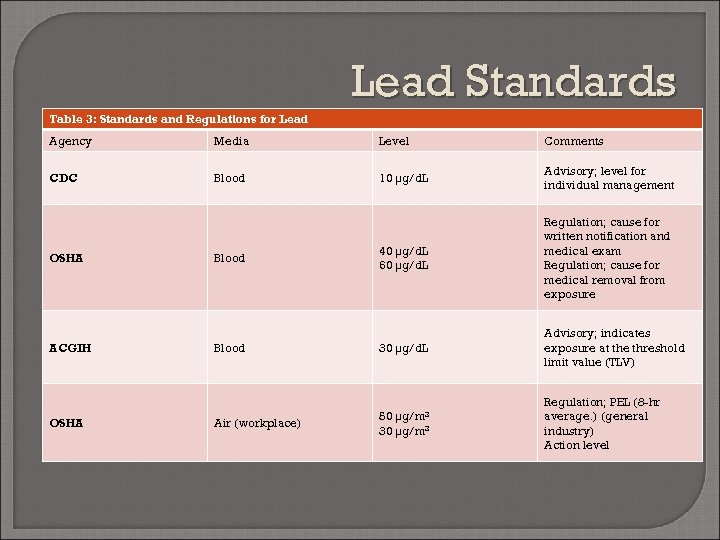
Lead Standards Table 3: Standards and Regulations for Lead Agency Media Level Comments CDC Blood 10 µg/d. L Advisory; level for individual management OSHA Blood 40 µg/d. L 60 µg/d. L Regulation; cause for written notification and medical exam Regulation; cause for medical removal from exposure ACGIH Blood 30 µg/d. L Advisory; indicates exposure at the threshold limit value (TLV) OSHA Air (workplace) µg/m 3 50 30 µg/m 3 Regulation; PEL (8 -hr average. ) (general industry) Action level
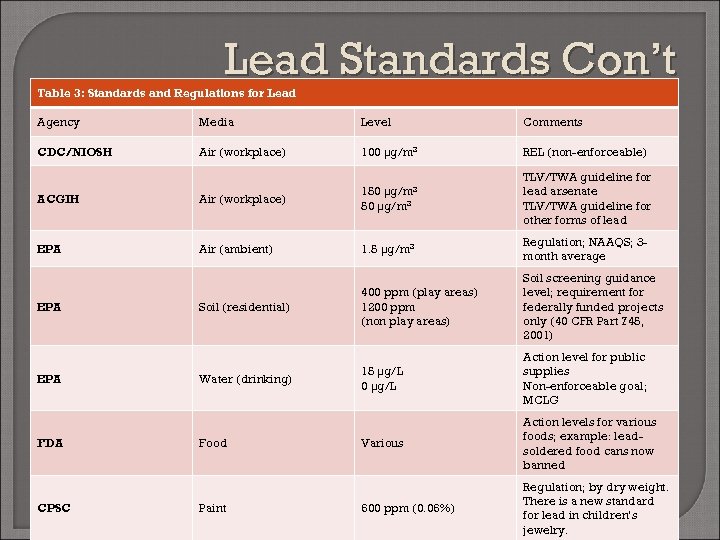
Lead Standards Con’t Table 3: Standards and Regulations for Lead Agency Media Level Comments CDC/NIOSH Air (workplace) 100 µg/m 3 REL (non-enforceable) ACGIH Air (workplace) 150 µg/m 3 TLV/TWA guideline for lead arsenate TLV/TWA guideline for other forms of lead EPA Air (ambient) 1. 5 µg/m 3 Regulation; NAAQS; 3 month average Soil (residential) 400 ppm (play areas) 1200 ppm (non play areas) Soil screening guidance level; requirement for federally funded projects only (40 CFR Part 745, 2001) Water (drinking) 15 µg/L 0 µg/L Action level for public supplies Non-enforceable goal; MCLG Various Action levels for various foods; example: leadsoldered food cans now banned 600 ppm (0. 06%) Regulation; by dry weight. There is a new standard for lead in children’s jewelry. EPA FDA CPSC Food Paint
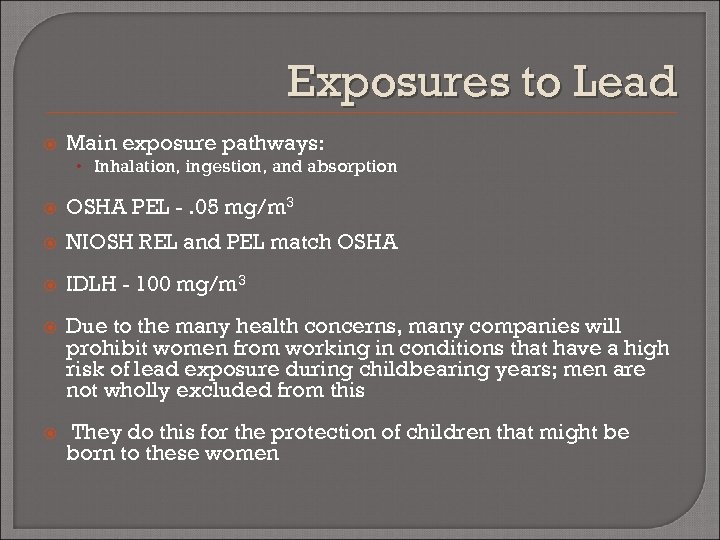
Exposures to Lead Main exposure pathways: • Inhalation, ingestion, and absorption OSHA PEL -. 05 mg/m 3 NIOSH REL and PEL match OSHA IDLH - 100 mg/m 3 Due to the many health concerns, many companies will prohibit women from working in conditions that have a high risk of lead exposure during childbearing years; men are not wholly excluded from this They do this for the protection of children that might be born to these women
Health Hazards and Regulations NIOSH: harmful effects associated with lead exposure: weakness excessive tiredness irritability constipation anorexia abdominal discomfort fine tremors wrist drop
Health Hazards Continued Target Organs and other health effects that can occur: • • Kidneys Nervous system Anemia high blood pressure impotence, infertility, and reduced sex drive Lead poisoning Neurological effects Mental retardation have occurred in the children of workers engaged in the occupations where there is lead exposure
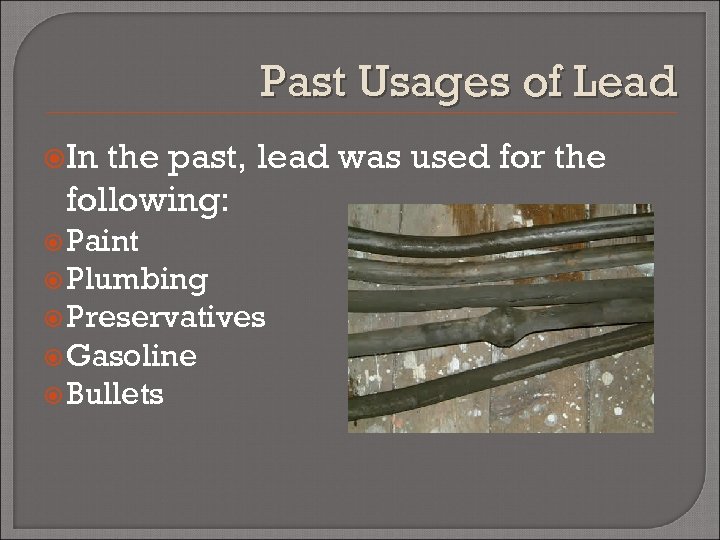
Past Usages of Lead In the past, lead was used for the following: Paint Plumbing Preservatives Gasoline Bullets
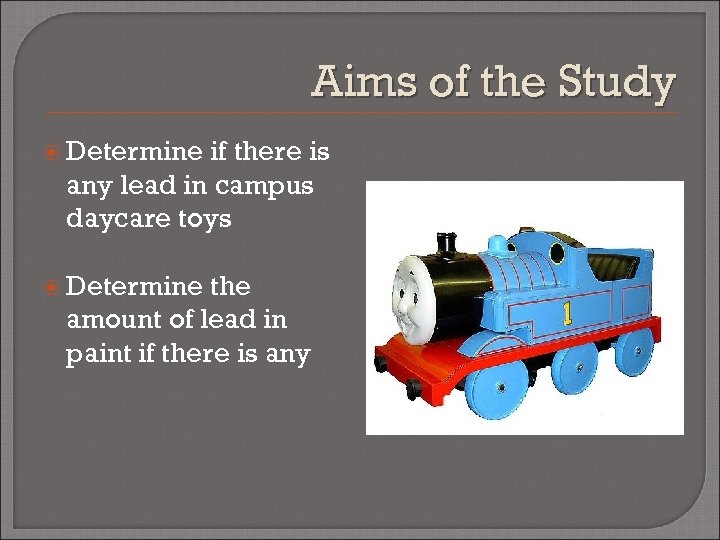
Aims of the Study Determine if there is any lead in campus daycare toys Determine the amount of lead in paint if there is any
Description of the Job Picked two locations to perform test • Knee High Day Care and Campus View Apartments Day Care Contacted toys Set both and set up times to inspect up area to perform test Selected Tested toys to be tested toys and analyzed data
Analysis Guidelines OSHA Tech Manual • Sec. I “The Use of Surface Contamination Sampling in Evaluating Safety and Health Programs” 29 CFR 1910. 132 requires the assessment of the [day care] to determine if it is likely to have [lead] present… Controlled Work Area Requiring PPE Controlled Work Area Requiring Special Cleaning Non-controlled Work Area [no PPE required]
Guidelines con’t It was determined that Day Care’s are: • Non-controlled Work Areas • Meaning that there is no reason to believe that there would be an exposure to lead or significant contamination
Technical Equipment Instant Ghost XFR Lead Testing Swabs Wipe Patches
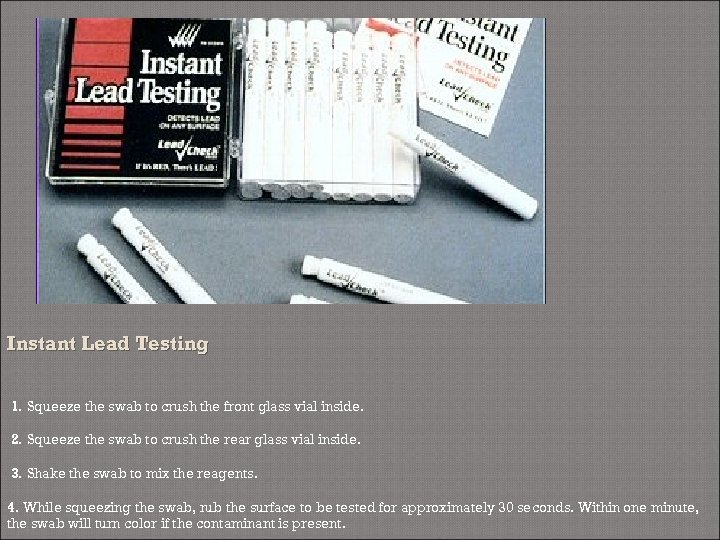
Instant Lead Testing 1. Squeeze the swab to crush the front glass vial inside. 2. Squeeze the swab to crush the rear glass vial inside. 3. Shake the swab to mix the reagents. 4. While squeezing the swab, rub the surface to be tested for approximately 30 seconds. Within one minute, the swab will turn color if the contaminant is present.
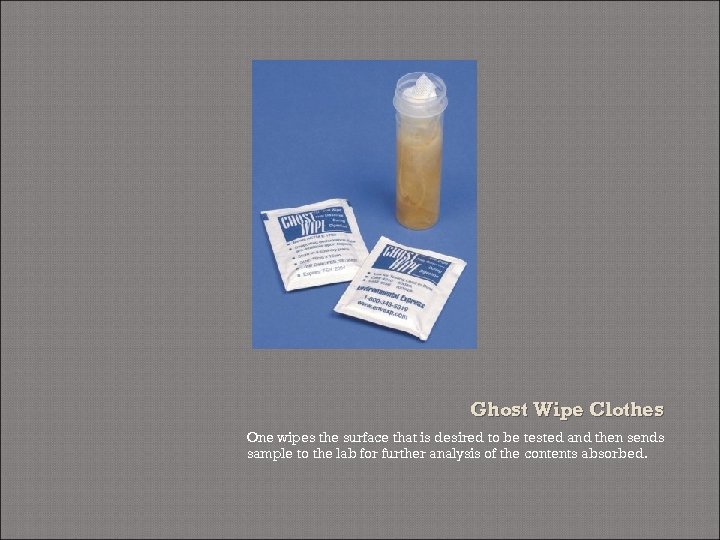
Ghost Wipe Clothes One wipes the surface that is desired to be tested and then sends sample to the lab for further analysis of the contents absorbed.
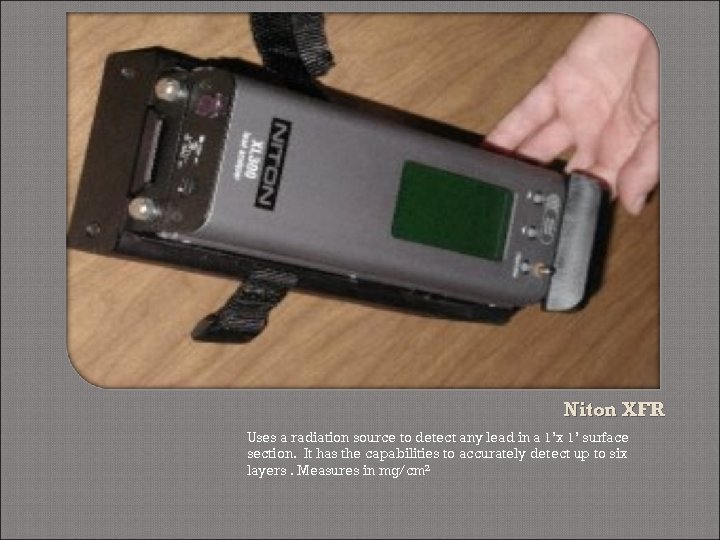
Niton XFR Uses a radiation source to detect any lead in a 1’x 1’ surface section. It has the capabilities to accurately detect up to six layers. Measures in mg/cm 2
Methods Each room with toys was thoroughly looked in and each type of toy was examined and set aside as suspect or not. • Suspect determined by Age of the toy List from EPA Makeup of the toy The XRF was then used and if any reading of lead came up then a second and third test was run with the XRF. These were averaged together. After XRF confirmed, the wipe and instant lead test was used. Any positive readings from these tools and the toy is asked to be removed. The toy is then taken back and sent to a lab if needed
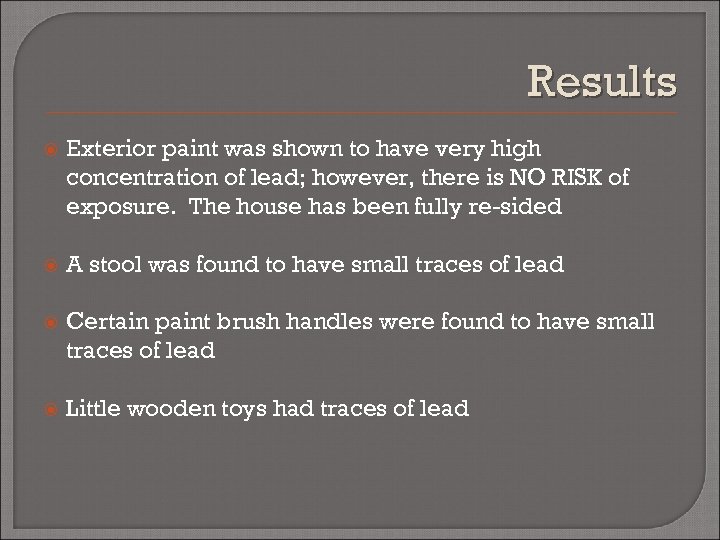
Results Exterior paint was shown to have very high concentration of lead; however, there is NO RISK of exposure. The house has been fully re-sided A stool was found to have small traces of lead Certain paint brush handles were found to have small traces of lead Little wooden toys had traces of lead
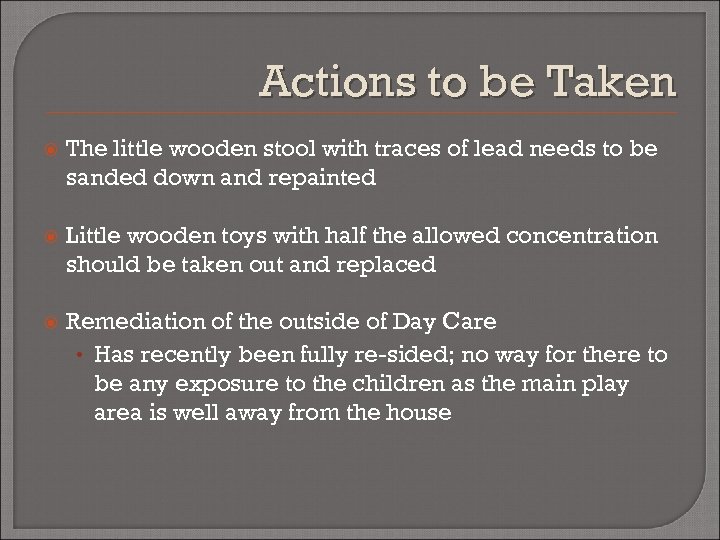
Actions to be Taken The little wooden stool with traces of lead needs to be sanded down and repainted Little wooden toys with half the allowed concentration should be taken out and replaced Remediation of the outside of Day Care • Has recently been fully re-sided; no way for there to be any exposure to the children as the main play area is well away from the house
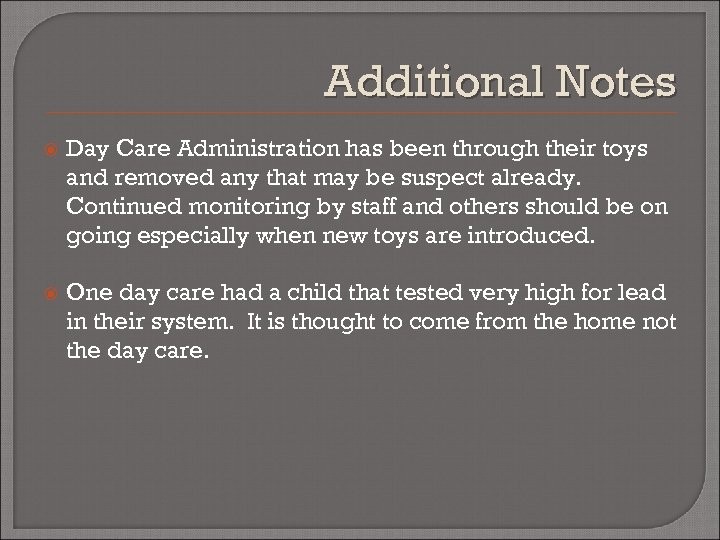
Additional Notes Day Care Administration has been through their toys and removed any that may be suspect already. Continued monitoring by staff and others should be on going especially when new toys are introduced. One day care had a child that tested very high for lead in their system. It is thought to come from the home not the day care.
Скачать презентацию Campus Lead Testing By Kim Fulford Matthew Emery
491e101a2534d9113e515e184dc4d5fc.ppt