


 Скачать презентацию Campaigns Circa 1900 Nominations Parties controlled who
4c2fb8b60be8aaeac0e39959c08dcbb2.ppt
- Количество слайдов: 51

 Campaigns Circa 1900 • Nominations: Parties controlled who was nominated. • Political Organization: Parties monopolized political organization though a system of precinct and block captains held together with the rewards of patronage. • Mass Media: And parties controlled the flow of information to the voter through daily and weekly newspapers with clear party affiliation.
 Campaigns Circa 1900 • Results: The old system was truly party centered. Parties chose the candidates, determined the issues, disseminated the information, organized and ran the campaigns. • Candidate: To be successful a candidate had to bend his will to that of the party -- typically serving a long apprenticeship, working one’s way up in the party apparatus ala G. W. Plunkett.
 Campaigns Circa 2000 • Nominations: We see a party that has lost its power to control who is nominated to primary election voters. • Political Organization: We see a party whose monopoly of political organization has been destroyed by the rise of countless special interest groups and mass media. • Mass Media: We see a party whose control of the media has vanished under a blizzard of competition. We see voters who get most of their information from the electronic mass media in 6 -second sound bites on the network news and in 30 -second spot commercials during campaigns.
 Campaigns Circa 2000 • Results: Today parties appear to be at the mercy of candidates rather than candidates being at the mercy of parties. • Where the presidency is concerned, a national convention meets and approves a platform. Then, like robots, the delegates cast their votes, and the winner in the primaries and caucuses becomes the candidate. • The party's platform is forgotten. The candidate's views are what counts, and they may change from day to day in response to the perceived needs of the campaign.
 Campaigns Circa 2000 • More Results: Modern campaigns are candidate-centered, and each candidate must rely on her own resources. It is the candidate who: – – – assembles an organization. invents a platform. produces media and buys broadcast time. raises the money. hires the experts who have displaced party functionaries in all these areas. – pays the bills. • Money is the first primary. Regardless of party, the voters are generally allowed to chose only among the candidates who have been pre-approved by wealthy contributors.
 Campaigns Circa 2000 • Candidate: – Favors incumbents who have all the advantages of name recognition and the perks of office. – Favors political outsiders who have high name recognition: Ronald Reagan (actor), Arnold Schwarzenegger (body builder turned actor), Jesse Ventura (professional wrestler), George W. Bush (president’s son), Al Franken (humorist). – Favors people who are handsome and glib, a candidate who is good with a sound bite and looks good saying it (Barak Obama). – Favors people who can raise humongous sums of money. (Hillary Clinton & Barak Obama). And it helps to be fabulously rich yourself (Ross Perot, Steve Forbes, & Mitt Romney). – Disfavors George Washington Plunkett, et al.
 How Does System Bias Change? • Change the rule, institution or procedure. • What is the most persistent cause of change in the rules of government & politics? --- POLITICS • Change the context. Change the environment. • What is the most persistent cause of change in the environment of government & politics? The most obvious reason that things are different now than they were 200 years ago? --- TECHNOLOGY
 What’s Behind the Shift from Party-Centered to Candidate-Centered Campaigns? • POLITICS: “Progressive” Party Bashing – Primary Elections – Civil Service – Initiative, Referendum & Recall • TECHNOLOGY – Electronic Media – Specialization of Campaign Functions

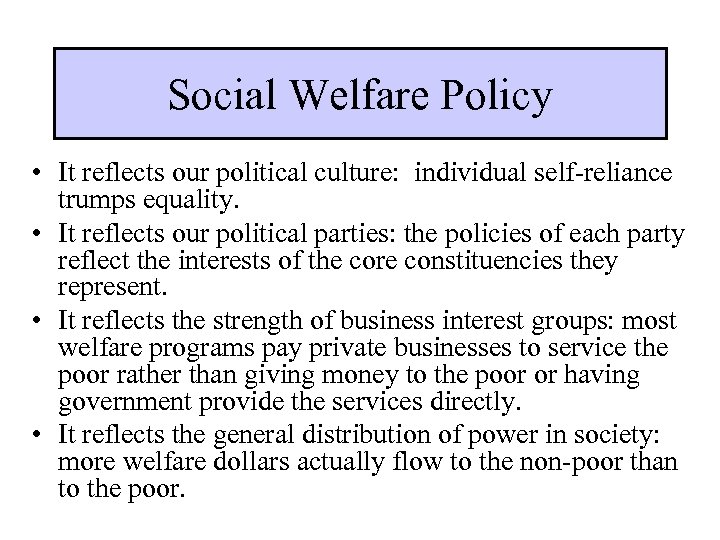 Social Welfare Policy • It reflects our political culture: individual self-reliance trumps equality. • It reflects our political parties: the policies of each party reflect the interests of the core constituencies they represent. • It reflects the strength of business interest groups: most welfare programs pay private businesses to service the poor rather than giving money to the poor or having government provide the services directly. • It reflects the general distribution of power in society: more welfare dollars actually flow to the non-poor than to the poor.
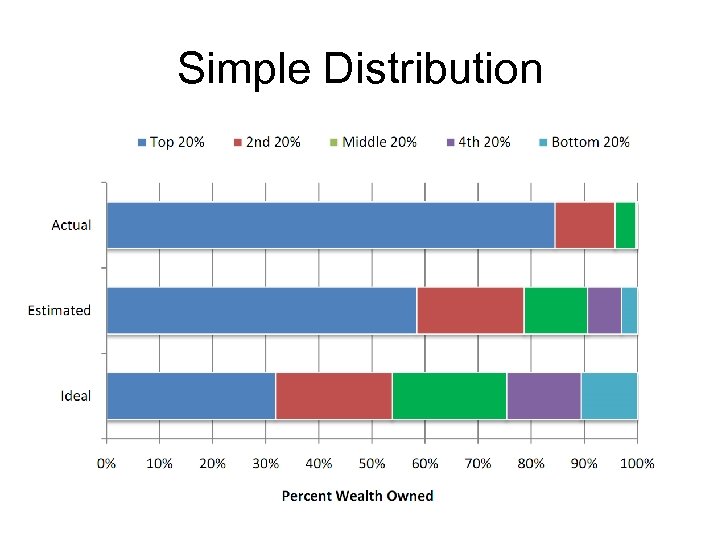
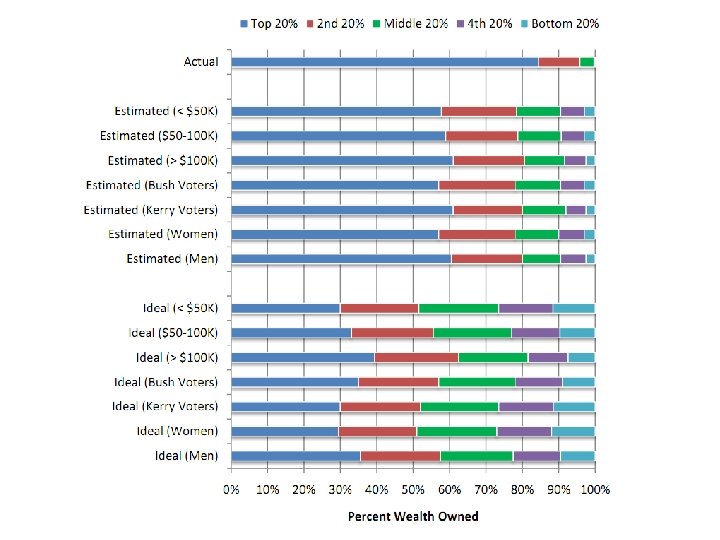
 Distribution of Wealth: USA Morton (Harvard) and Airely (Duke) in press
 Simple Distribution
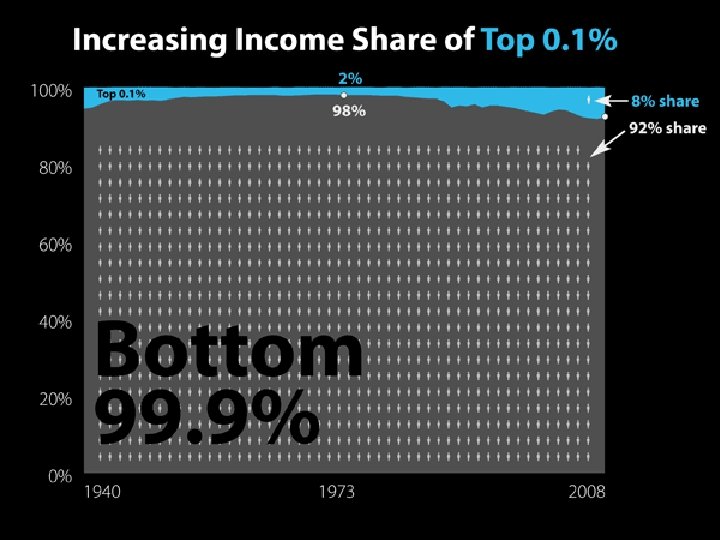
 The Great Divergence: A Study of Changing Income Inequality By Timothy Noah Slate, September 2010 http: //www. slate. com/id/2266025/entry/2 266026/
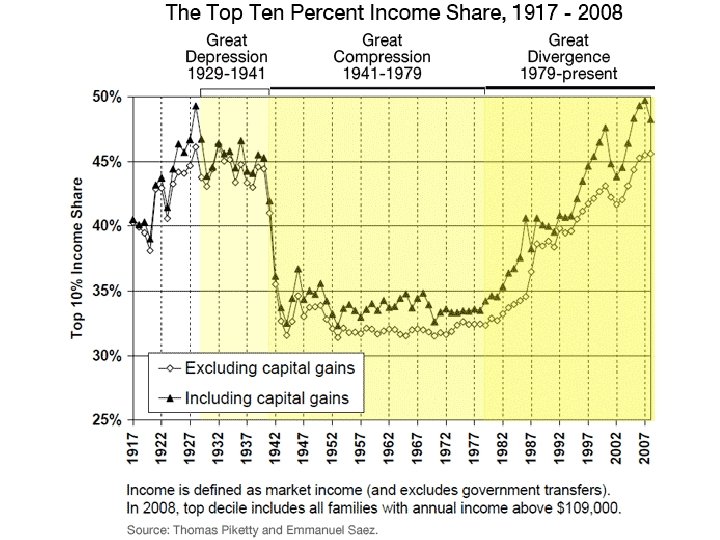
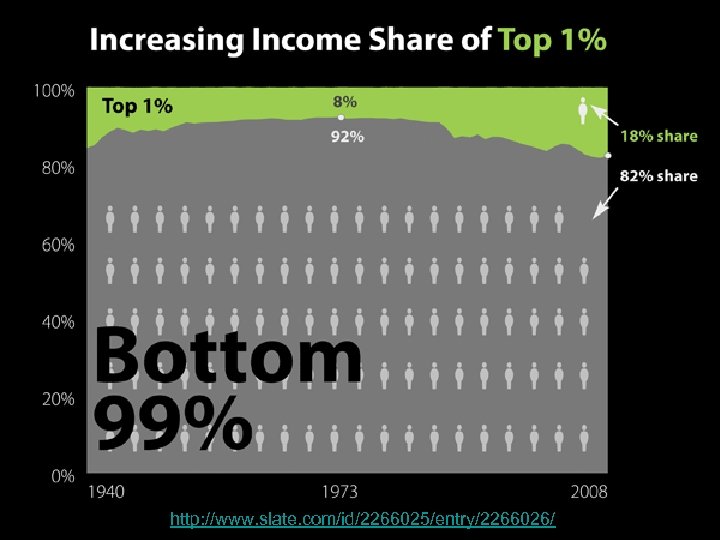 http: //www. slate. com/id/2266025/entry/2266026/
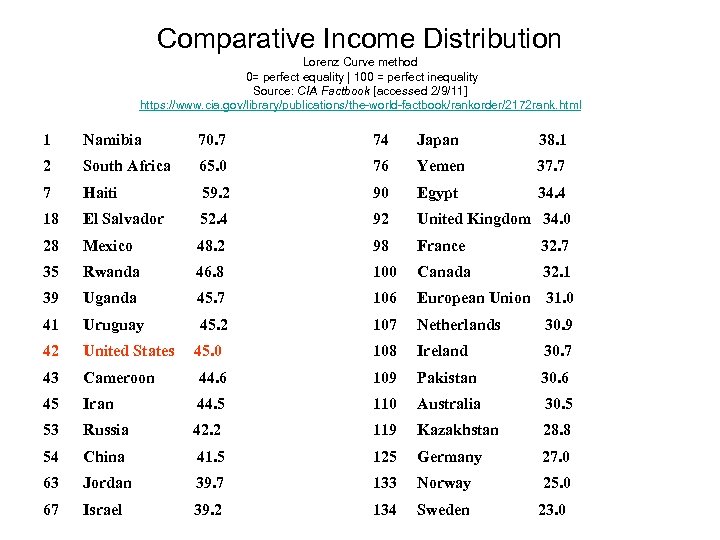 Comparative Income Distribution Lorenz Curve method 0= perfect equality | 100 = perfect inequality Source: CIA Factbook [accessed 2/9/11] https: //www. cia. gov/library/publications/the-world-factbook/rankorder/2172 rank. html 1 Namibia 70. 7 74 Japan 38. 1 2 South Africa 65. 0 76 Yemen 37. 7 7 Haiti 59. 2 90 Egypt 34. 4 18 El Salvador 52. 4 92 United Kingdom 34. 0 28 Mexico 48. 2 98 France 32. 7 35 Rwanda 46. 8 100 Canada 32. 1 39 Uganda 45. 7 106 European Union 31. 0 41 Uruguay 45. 2 107 Netherlands 30. 9 42 United States 108 Ireland 30. 7 43 Cameroon 44. 6 109 Pakistan 30. 6 45 Iran 44. 5 110 Australia 30. 5 53 Russia 42. 2 119 Kazakhstan 28. 8 54 China 41. 5 125 Germany 27. 0 63 Jordan 39. 7 133 Norway 25. 0 67 Israel 39. 2 134 Sweden 45. 0 23. 0

 The American Presidency
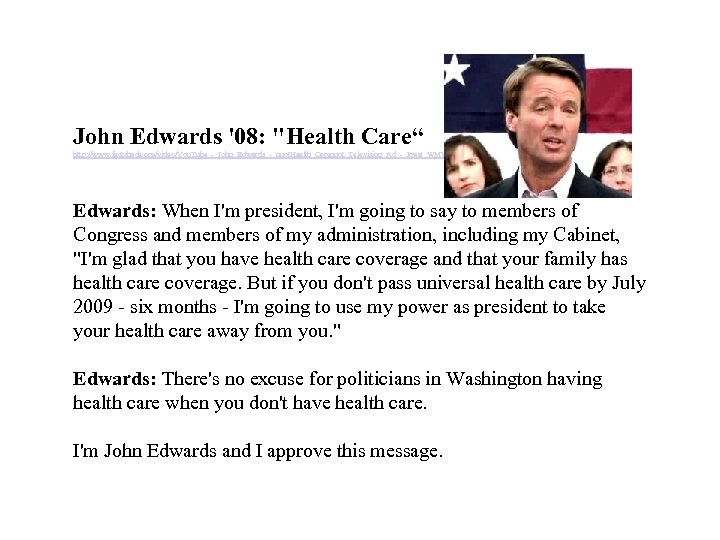 John Edwards '08: "Health Care“ http: //www. factcheck. org/video/You. Tube_-_John_Edwards_-_quot. Health_Carequot_Television_Ad_-_Iowa_WMV. wmv Edwards: When I'm president, I'm going to say to members of Congress and members of my administration, including my Cabinet, "I'm glad that you have health care coverage and that your family has health care coverage. But if you don't pass universal health care by July 2009 - six months - I'm going to use my power as president to take your health care away from you. " Edwards: There's no excuse for politicians in Washington having health care when you don't have health care. I'm John Edwards and I approve this message.
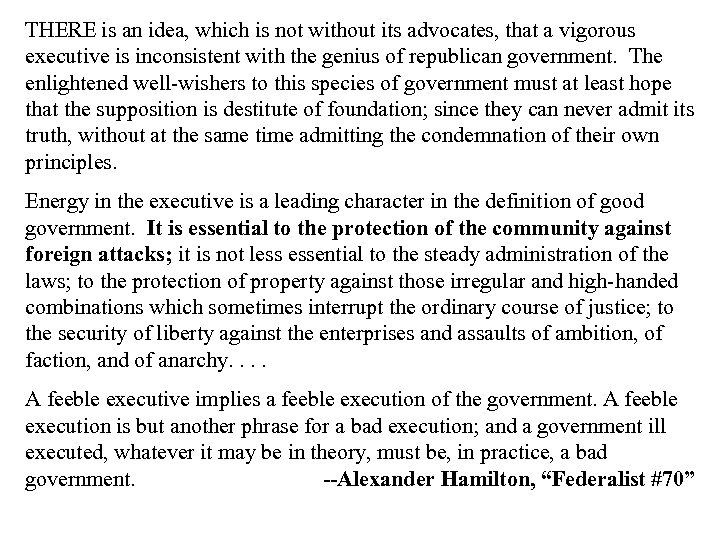 THERE is an idea, which is not without its advocates, that a vigorous executive is inconsistent with the genius of republican government. The enlightened well‑wishers to this species of government must at least hope that the supposition is destitute of foundation; since they can never admit its truth, without at the same time admitting the condemnation of their own principles. Energy in the executive is a leading character in the definition of good government. It is essential to the protection of the community against foreign attacks; it is not less essential to the steady administration of the laws; to the protection of property against those irregular and high‑handed combinations which sometimes interrupt the ordinary course of justice; to the security of liberty against the enterprises and assaults of ambition, of faction, and of anarchy. . A feeble executive implies a feeble execution of the government. A feeble execution is but another phrase for a bad execution; and a government ill executed, whatever it may be in theory, must be, in practice, a bad government. --Alexander Hamilton, “Federalist #70”
 Foreign Policy Powers under the Constitution: The Exception to Congressional Dominance?
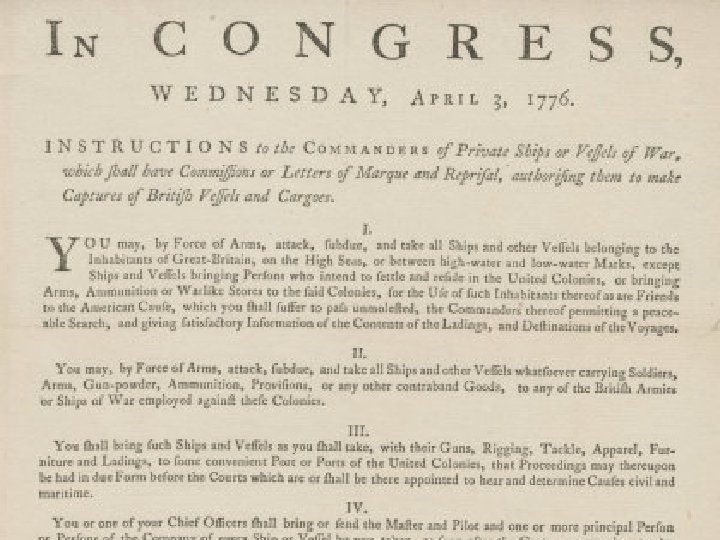
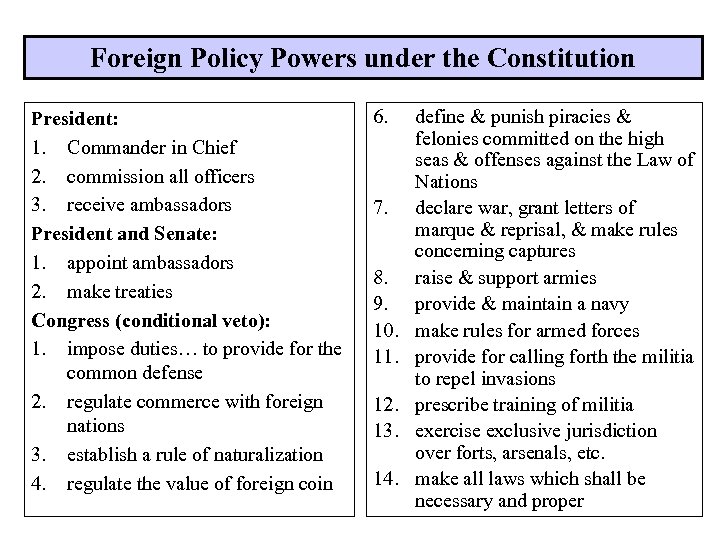 Foreign Policy Powers under the Constitution President: 1. Commander in Chief 2. commission all officers 3. receive ambassadors President and Senate: 1. appoint ambassadors 2. make treaties Congress (conditional veto): 1. impose duties… to provide for the common defense 2. regulate commerce with foreign nations 3. establish a rule of naturalization 4. regulate the value of foreign coin 6. 7. 8. 9. 10. 11. 12. 13. 14. define & punish piracies & felonies committed on the high seas & offenses against the Law of Nations declare war, grant letters of marque & reprisal, & make rules concerning captures raise & support armies provide & maintain a navy make rules for armed forces provide for calling forth the militia to repel invasions prescribe training of militia exercise exclusive jurisdiction over forts, arsenals, etc. make all laws which shall be necessary and proper
 The Imperial Presidency by Arthur Schlesinger, Jr. • Growth of presidential power has been fairly gradual, and most has been concentrated in the areas of military and foreign affairs. – George W. Bush on Iraq & Social Security • Presidential power grows in times of crisis and shrinks in time of calm. • But it always grows more than it shrinks.
 The Imperial Presidency • • Control over Information Executive Privilege Commander-in-Chief Mexican War Civil War Emancipation Proclamation Andrew Johnson Impeachment
 The Imperial Presidency • • Spanish American War World War I Treaty of Versailles League of Nations Permanent Crisis Great Depression World War II Cold War Cult of the Presidency
 The Revolutionary Presidency of Richard Nixon • • • Policy Impoundment Selective Enforcement Legislation by Executive Order Pocket Veto Perpetual and Universal Privilege Police Powers of National Government War Powers Act Congressional Budget and Impoundment Control Act Secret Wars in Laos and Cambodia Watergate Threatened Impeachment & Nixon Resignation

 Growth of Presidential Power: Technology & the Constitution • • The Framers’ fear of unified power. Secrecy and dispatch. One voice. Chief bureaucrat.

 Presidential Preference and Position on the Electoral College • Politics 262 • November 2004
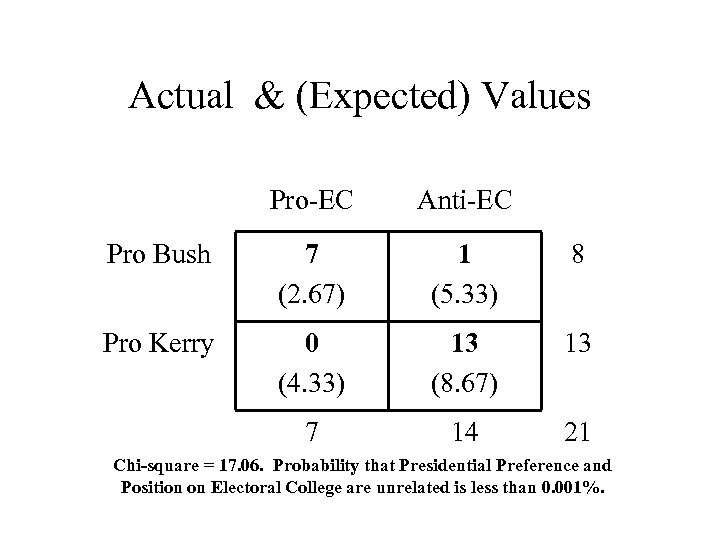 Actual & (Expected) Values Pro-EC Anti-EC Pro Bush 7 (2. 67) 1 (5. 33) 8 Pro Kerry 0 (4. 33) 13 (8. 67) 13 7 14 21 Chi-square = 17. 06. Probability that Presidential Preference and Position on Electoral College are unrelated is less than 0. 001%.
 Hypotheses?
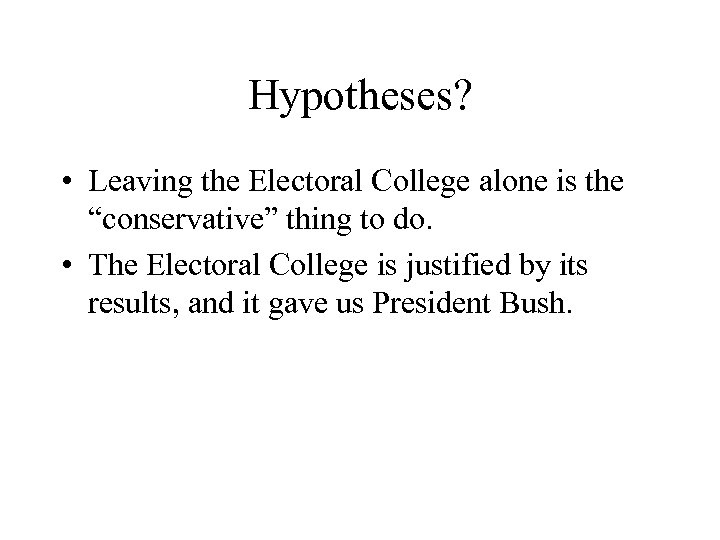 Hypotheses? • Leaving the Electoral College alone is the “conservative” thing to do. • The Electoral College is justified by its results, and it gave us President Bush.
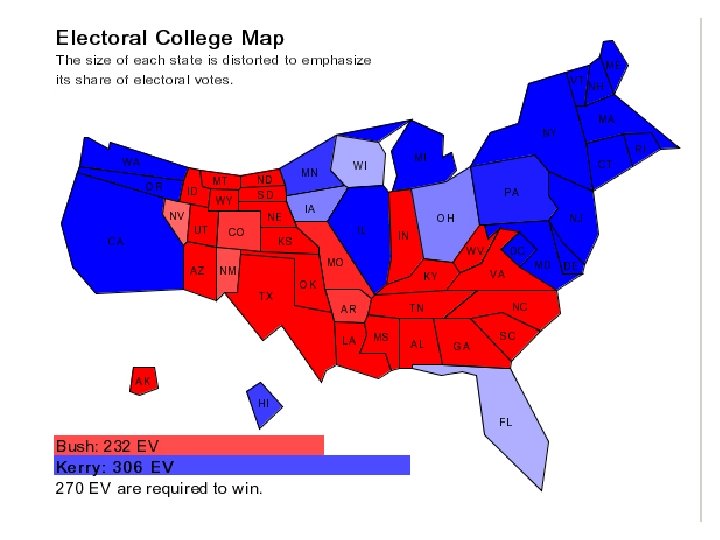
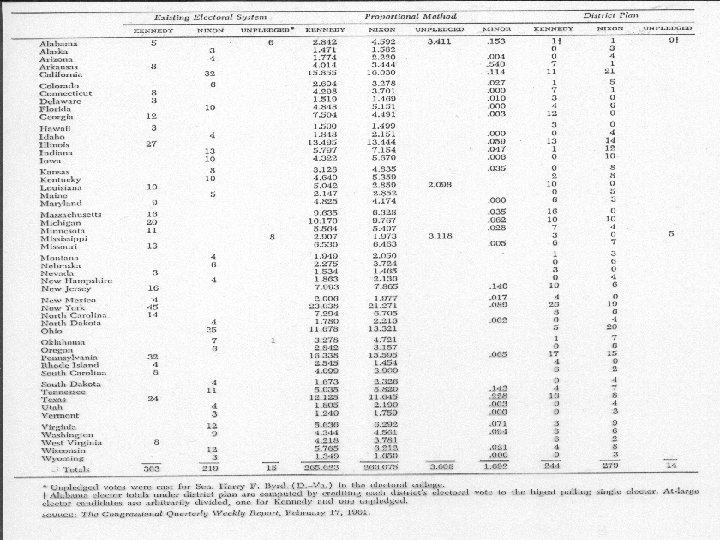
 Electoral College Biases
 Electoral College Biases • Small sates have a mathematical overrepresentation because they get at least three electoral votes regardless of how few people live there. • States with low voter turnout get protected in terms of influence because the electoral college makes voter turnout irrelevant. • States (especially large states) where either candidate might win become the key battlegrounds and gain disproportionate influence as both sides pour in massive resources.
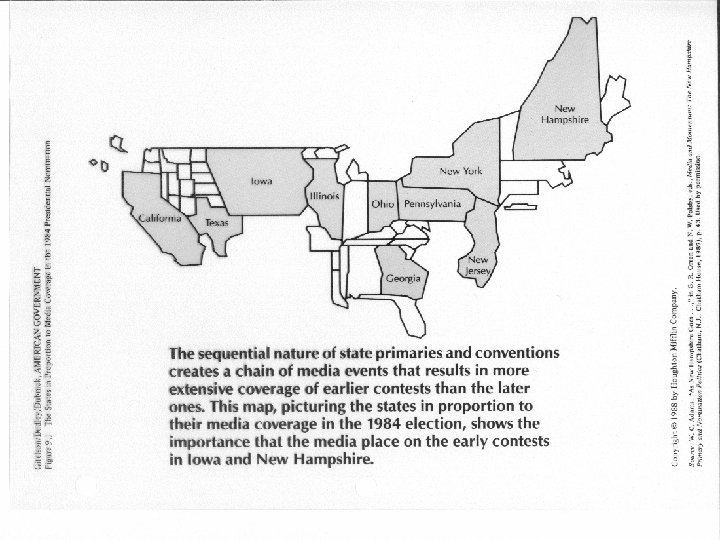
 Electoral College Biases • The system of representation in the contingency procedure is a huge departure from the currently accepted principle of one-person-one vote. • For what it's worth, a different set of states are disproportionately powerful in the nomination phase of the presidential campaign.
 Source: http: //theelectoralcollegesucks. com/
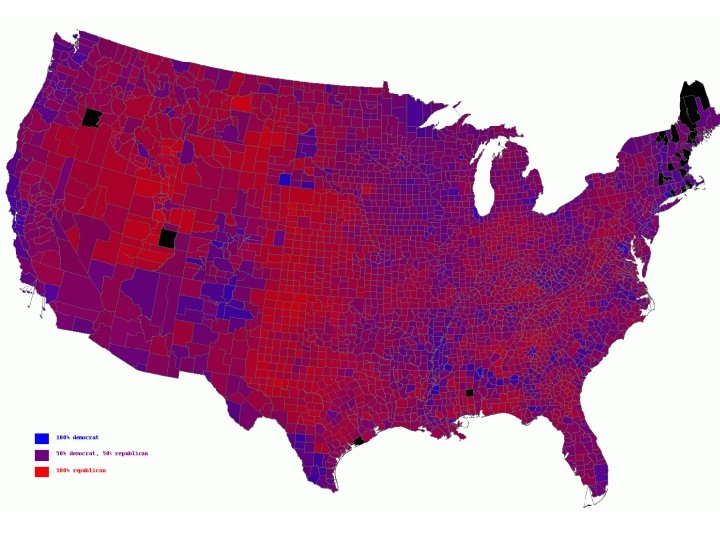
 http: //www-personal. umich. edu/~mejn/election/

 Social Welfare Policy • It reflects our political culture: individual self-reliance trumps equality. • It reflects our political parties: the policies of each party reflect the interests of the core constituencies they represent. • It reflects the strength of business interest groups: most welfare programs pay private businesses to service the poor rather than giving money to the poor or having government provide the services directly. • It reflects the general distribution of power in society: vastly more welfare dollars actually flow to the nonpoor than to the poor.