


 Скачать презентацию Campaigns and Elections Extending the Right to
258076166bb0b2d1f15eee71984cbb77.ppt
- Количество слайдов: 28
 Campaigns and Elections
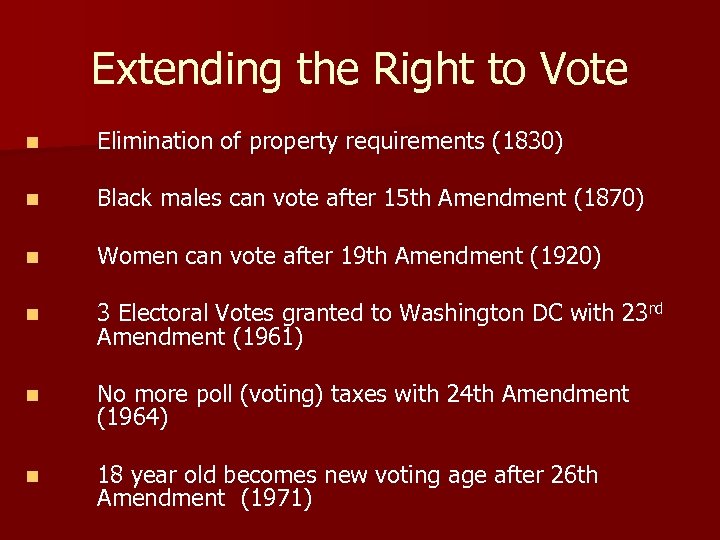 Extending the Right to Vote n Elimination of property requirements (1830) n Black males can vote after 15 th Amendment (1870) n Women can vote after 19 th Amendment (1920) n 3 Electoral Votes granted to Washington DC with 23 rd Amendment (1961) n No more poll (voting) taxes with 24 th Amendment (1964) n 18 year old becomes new voting age after 26 th Amendment (1971)
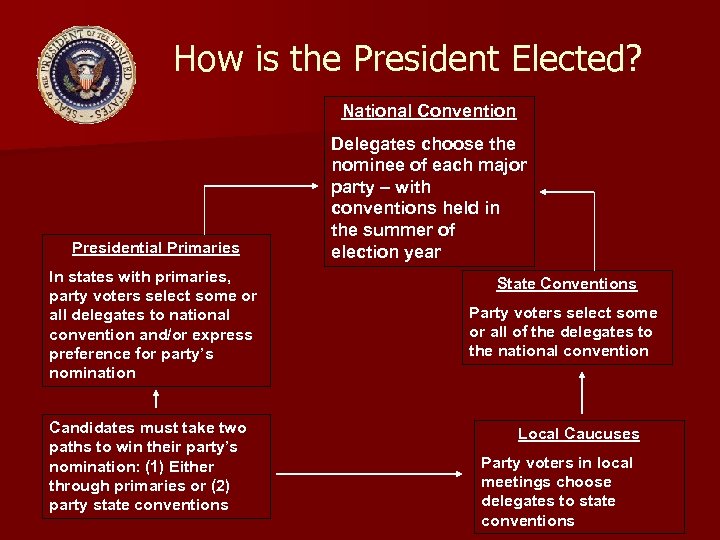 How is the President Elected? National Convention Presidential Primaries In states with primaries, party voters select some or all delegates to national convention and/or express preference for party’s nomination Candidates must take two paths to win their party’s nomination: (1) Either through primaries or (2) party state conventions Delegates choose the nominee of each major party – with conventions held in the summer of election year State Conventions Party voters select some or all of the delegates to the national convention Local Caucuses Party voters in local meetings choose delegates to state conventions
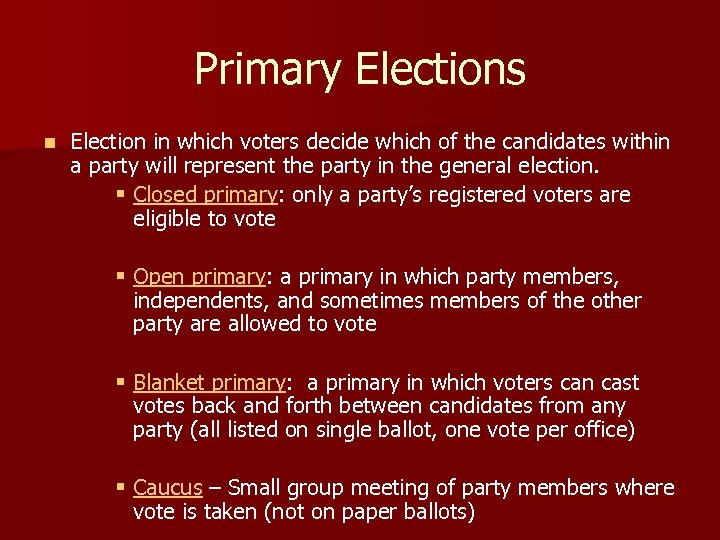 Primary Elections n Election in which voters decide which of the candidates within a party will represent the party in the general election. § Closed primary: only a party’s registered voters are eligible to vote § Open primary: a primary in which party members, independents, and sometimes members of the other party are allowed to vote § Blanket primary: a primary in which voters can cast votes back and forth between candidates from any party (all listed on single ballot, one vote per office) § Caucus – Small group meeting of party members where vote is taken (not on paper ballots)
 National Convention Schedule n Day 1 – Keynote speaker n Day 2 – Announcement of party platform – Platform tells the party’s views on the issues
 National Convention Schedule n Day 3 – Candidate nomination & speeches – Balloting from the states (majority rule) – Winner (party nominee) names a VP running mate (someone to BALANCE THE TICKET) n Day 4 – Confirm party nomination – Nominee Acceptance speech – Campaign Kickoff
 General Elections n General elections are those in which voters decide which candidates will actually fill elective public offices n Held at local, state and federal levels. n Contests between the candidates of opposing parties – Time from National Convention to November election
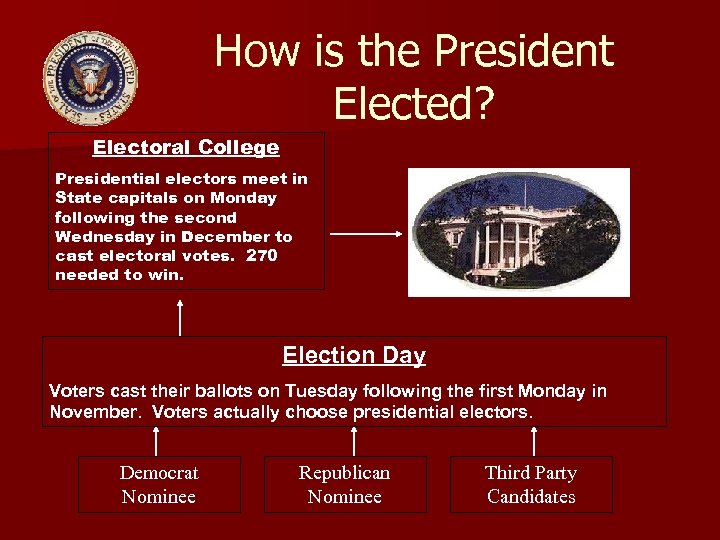 How is the President Elected? Electoral College Presidential electors meet in State capitals on Monday following the second Wednesday in December to cast electoral votes. 270 needed to win. Election Day Voters cast their ballots on Tuesday following the first Monday in November. Voters actually choose presidential electors. Democrat Nominee Republican Nominee Third Party Candidates
 How does the Electoral College Work? Electoral votes are determined by total number of senators and representatives in each state 538 total (100 Senate + 435 House + 3 DC) Largest state – California, has 55 electoral votes Example – Georgia has 2 senators and 14 representatives so our total # of electors is 16
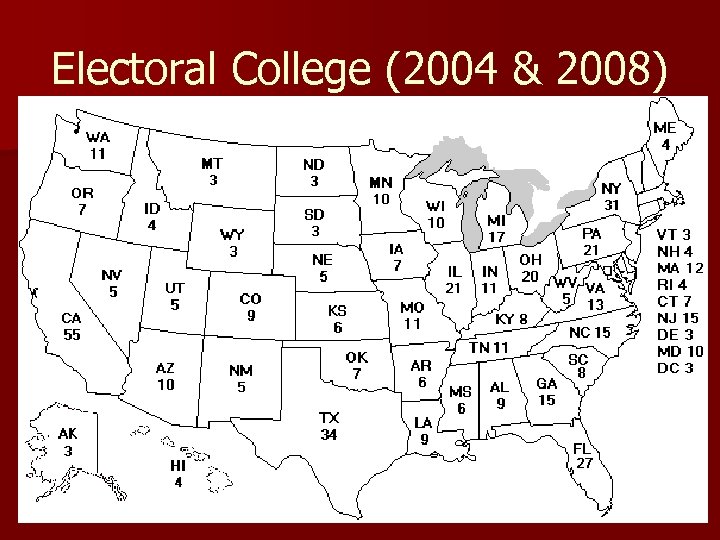 Electoral College (2004 & 2008)
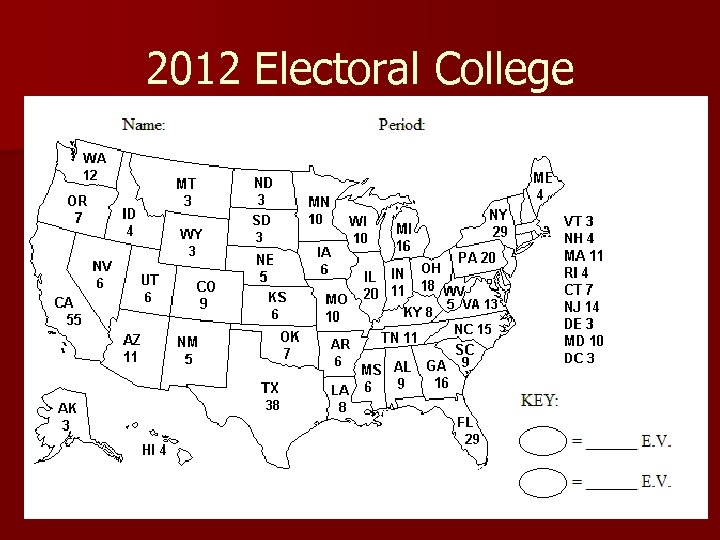 2012 Electoral College
 How does the Electoral College Work? Voters elect the slate of electors on Election Day. For Georgia: 16 Republicans or 16 Democrats, depending on majority vote. 270 of 538 electoral votes are needed to win.
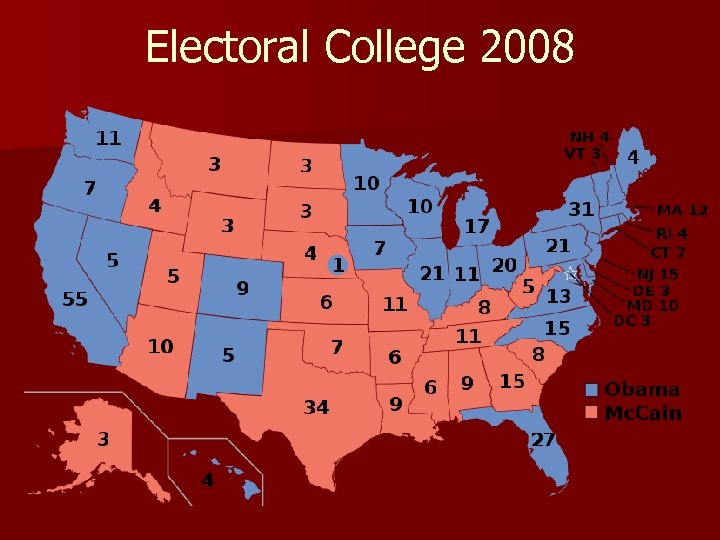 Electoral College 2008
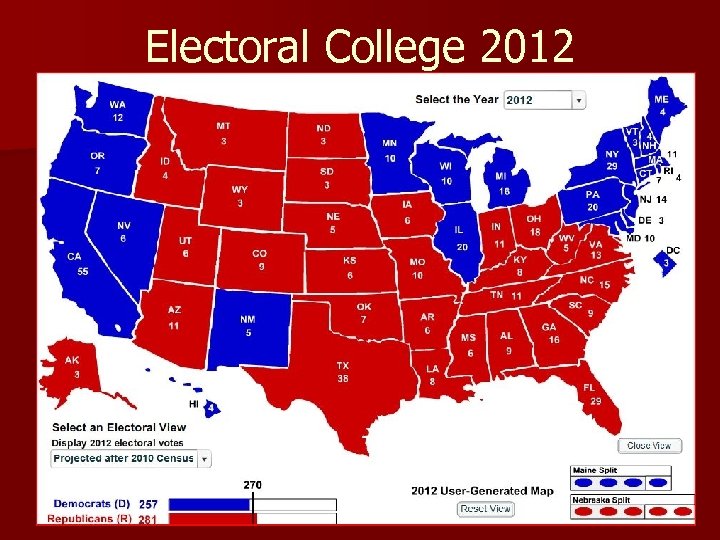 Electoral College 2012
 Electoral College Results www. 270 towin. com Use this website to review the Electoral College wins for each of our presidential elections!
 How does the Electoral College Work? If no candidate gets 270 votes the House chooses Provision of the 12 th amendment Choose from top 3 candidates One vote per state Often caused by a strong 3 rd party candidate Two elections decided this way 1801: Thomas Jefferson and Aaron Burr. It took 36 votes in the House, to choose Jefferson. 1825: Andrew Jackson and John Quincy Adams. Jackson had popular vote but neither had the electoral vote. Adams won in the House to become president.
 Lose the Popular Vote but win the Electoral College? 1824: üJohn Quincy Adams received more than 38, 000 fewer votes than Andrew Jackson üneither candidate won a majority of the Electoral College üAdams was awarded the presidency when the election was thrown to the House of Representatives. 1876: üRutherford B. Hayes a one-vote margin in the Electoral College ülost the popular vote to Samuel J. Tilden by 264, 000 votes. üHayes carried five out of the six smallest states üThese five states plus Colorado gave Hayes 22 electoral votes with only 109, 000 popular votes.
 Lose the Popular Vote but win the Electoral College? 1888 üBenjamin Harrison lost the popular vote by 95, 713 votes to Grover Cleveland, but won the electoral vote by 65. üThe South overwhelmingly supported Cleveland, and he won by more than 425, 000 votes in six southern states. However, in the rest of the country he lost by more than 300, 000 votes. 2000 üAl Gore received 50, 992, 335 votes nationwide and George W. Bush received 50, 455, 156 votes. üAfter Bush was awarded the state of Florida, he had a total of 271 electoral votes, which beat Gore's 266 electoral votes.
 Campaign Financing Presidential Primaries and General Elections are PUBLICLY funded Raise $5, 000 in 20 states and you can get individual contributions up to $250 matched by federal Treasury Regulated by FEC (a panel of 6 from each major party appointed by the President and approved by the Senate to monitor money spent and earned)
 The Campaign Finance Laws Individual Contribution Limits 1. A person is limited to $2, 500 annual contribution per candidate 2. A person is limited to $28, 500 total annual contribution to national political parties
 The Campaign Finance Laws Individual Contribution Limits 3. A person is limited to $10, 000 per year to each state, district and local parties (i. e. the Cobb County Republican and Democrat Parties) 4. A person is limited to an annual total of $108, 200 to candidates ($42, 700) and parties/ PACs ($65, 500)
 The Campaign Finance Laws Political Action Committees (PACs) 1. PACs are limited to $5, 000 annual contributions to individual candidates, other PACs, or state political parties 2. PACs are limited to $15, 000 annual contributions to national parties
 The Campaign Finance Laws The Candidate’s Perspective 1. Limited to $2, 500 per individual donor 2. $5, 000 limit per PAC contribution 3. Corporate or labor union money is prohibited
 The Campaign Finance Laws Campaign Expenditures 1. Any materials promoting a candidate must carry identifying information about the candidate’s campaign committee 2. Contributions or loans and spending over $200 must be identified on campaign disclosure reports to the FEC.
 Coverage of the Campaign: The Media & Public Opinion Polls n What voters hear and see of the candidate is primarily determined by the media in two forms – Paid media – Ads by candidates and interest groups – Free media – Coverage by the news media n Public Opinion (how people feel about candidates, elected officials and the government) is measured by public opinion polls (surveys) and used by politicians to do their job and candidates to run their campaigns.
 What is a Political Party? A group that tries to get people elected that will share their views and ideas and will work to get laws passed in their favor.
 Party Systems n The US has a two party system – There are two dominant parties – Democrats and Republicans n Minor Parties (aka 3 rd Parties) – Usually are formed because of disapproval of the two parties. – Usually focus on one or two issues or a popular potential candidate
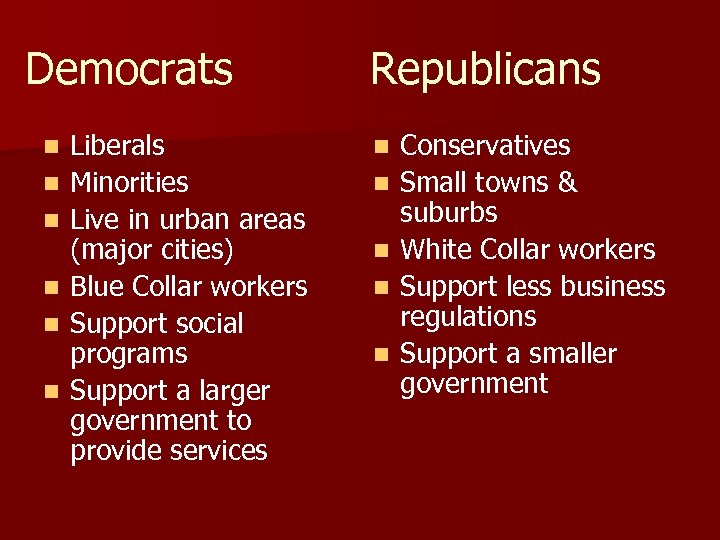 Democrats n n n Liberals Minorities Live in urban areas (major cities) Blue Collar workers Support social programs Support a larger government to provide services Republicans n n n Conservatives Small towns & suburbs White Collar workers Support less business regulations Support a smaller government