 Скачать презентацию Called by Grace Called by Grace Beloved
2a27c20a2b5cacc1c711ed805b2941b0.ppt
- Количество слайдов: 63




Called by Grace
Called by Grace Beloved, now we are children of God. 1 Jn 3: 2 - I am a child of God because of my faith in Jesus Christ. The servant is not greater than his Lord. Jn 13: 16 - I am a servant of God as I submit my life to Gods call upon it. Being a son and servant are two different aspects of our relationship to God. As a servant, I am a slave to my Master.
Called by Grace Therefore, since we are receiving a kingdom which cannot be shaken, let us have grace, by which we may serve God acceptably with reverence and godly fear. Heb. 12: 28 - The grace of God is vital in our service to God. Motions in service don’t always reveal motives in service. Those who serve God knowing that it is Gods grace that enables them will have God with them in their service. To leave grace behind leaves God behind.
Called by Grace - Grace must be the foundation of not only why we serve the Lord Jesus, but how we serve the Lord. - Paul equates grace with faith; - - Therefore it is of faith that it might be according to grace. Rom 4: 16 James tells us that; - Faith without works is dead. James 2: 17, 20, 26 - - But the opposite is true, that works without faith is also dead. Thus our service must be by grace exercised in faith.
Called by Grace But by the grace of God I am what I am, and His grace toward me was not in vain; but I labored more abundantly than they all, yet not I, but the grace of God which was with me. 1 Cor. 15: 10 - What God desired to do through Paul was not wasted (in vain), but more abundant because Paul recognized it was God doing His work using Paul. - The Christian life as with Christian ministry are all enabled, powered and to whatever extent successful only by the grace of God.
Called by Grace to Serve To me, who am less than the least of all the saints, this grace was given, that I should preach among the Gentiles the unsearchable riches of Christ. Ephesians 3: 8 - Paul knew where he came from and what he was. He did not deserve to have the privilege of the ministry he was given and he knew it was all by Gods grace. - Any other view to ministry will only minister to pride.
Why Does the Church Exist? There are 3 reasons that the church exists: 1. To Glorify God - Eph 3: 21 1. 2. “to Him be glory in the church by Christ Jesus to all generations” To Mature the Body of Christ – Eph 4: 7 -16 1. “till we all come to the unity of the faith and of the knowledge of the Son of God, to a perfect man, to the measure of the stature of the fullness of Christ …speaking the truth in love, may grow up in all things into Him who is the head—Christ— … which every part does its share, causes growth of the body for the edifying of itself in love. ”
Why Does the Church Exist? There are 3 reasons that the church exists 3. To Evangelize the World – Matt 28: 18 -20 1. “And Jesus came and spoke to them, saying, “All authority has been given to Me in heaven and on earth. Go therefore and make disciples of all the nations, baptizing them in the name of the Father and of the Son and of the Holy Spirit, teaching them to observe all things that I have commanded you; and lo, I am with you always, even to the end of the age. ” Amen”
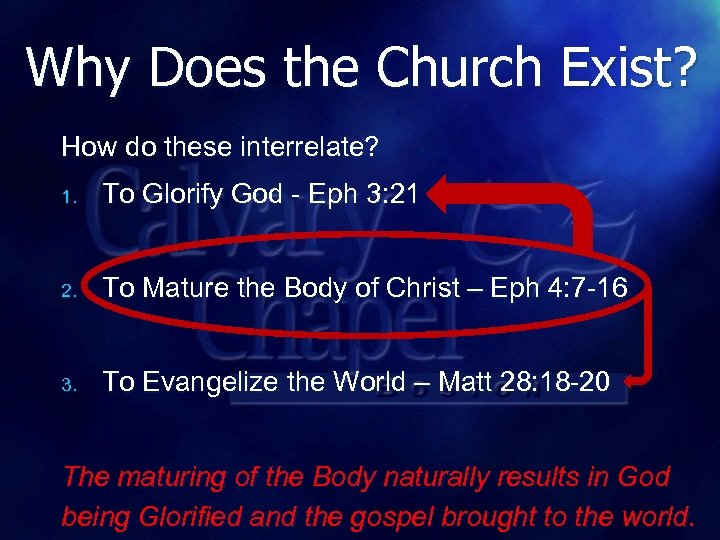
Why Does the Church Exist? How do these interrelate? 1. To Glorify God - Eph 3: 21 2. To Mature the Body of Christ – Eph 4: 7 -16 3. To Evangelize the World – Matt 28: 18 -20 The maturing of the Body naturally results in God being Glorified and the gospel brought to the world.
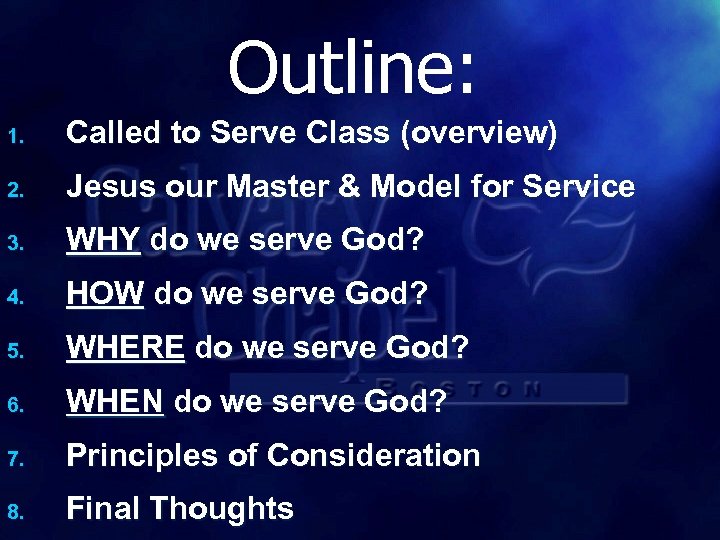
Outline: 1. Called to Serve Class (overview) 2. Jesus our Master & Model for Service 3. WHY do we serve God? 4. HOW do we serve God? 5. WHERE do we serve God? 6. WHEN do we serve God? 7. Principles of Consideration 8. Final Thoughts
Outline: 1. Called to Serve Class (overview)
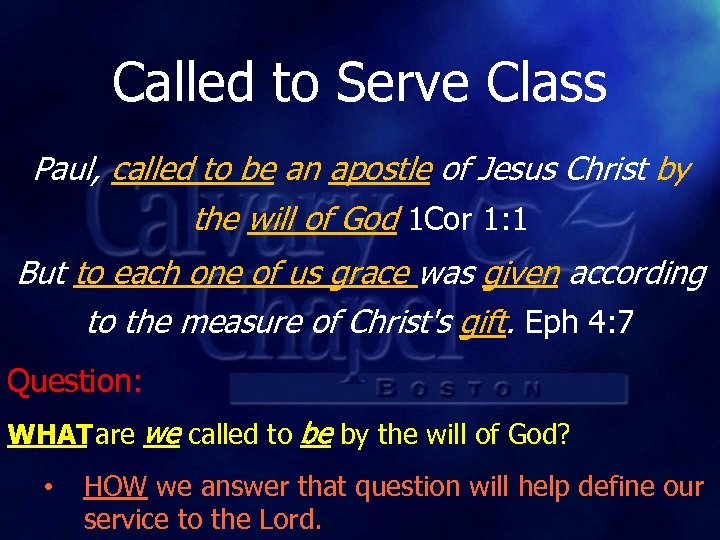
Called to Serve Class Paul, called to be an apostle of Jesus Christ by the will of God 1 Cor 1: 1 But to each one of us grace was given according to the measure of Christ's gift. Eph 4: 7 Question: WHAT are we called to be by the will of God? • HOW we answer that question will help define our service to the Lord.
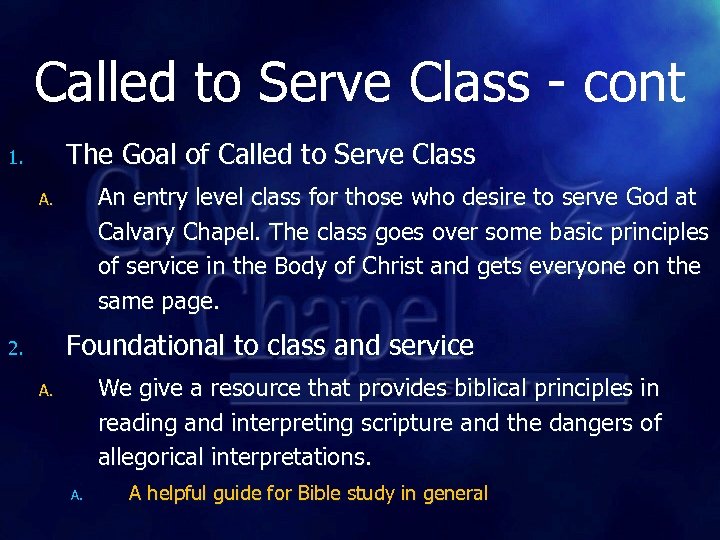
Called to Serve Class - cont The Goal of Called to Serve Class 1. An entry level class for those who desire to serve God at Calvary Chapel. The class goes over some basic principles of service in the Body of Christ and gets everyone on the same page. A. Foundational to class and service 2. We give a resource that provides biblical principles in reading and interpreting scripture and the dangers of allegorical interpretations. A. A helpful guide for Bible study in general
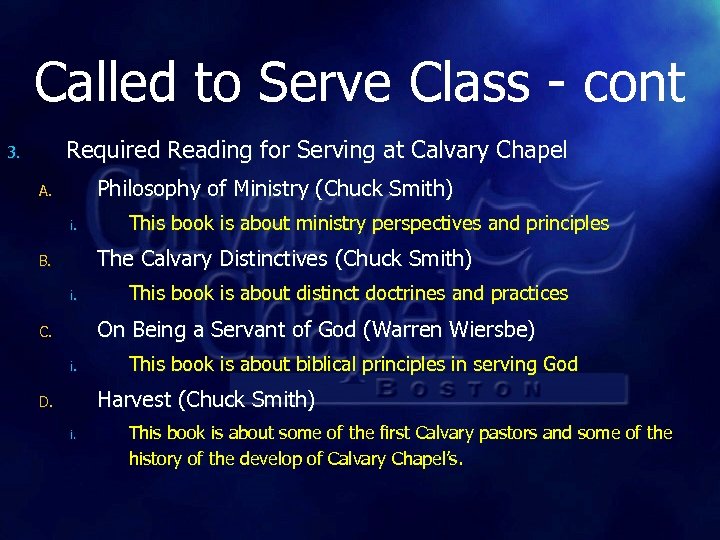
Called to Serve Class - cont Required Reading for Serving at Calvary Chapel 3. Philosophy of Ministry (Chuck Smith) A. i. This book is about ministry perspectives and principles The Calvary Distinctives (Chuck Smith) B. i. This book is about distinct doctrines and practices On Being a Servant of God (Warren Wiersbe) C. i. This book is about biblical principles in serving God Harvest (Chuck Smith) D. i. This book is about some of the first Calvary pastors and some of the history of the develop of Calvary Chapel’s.
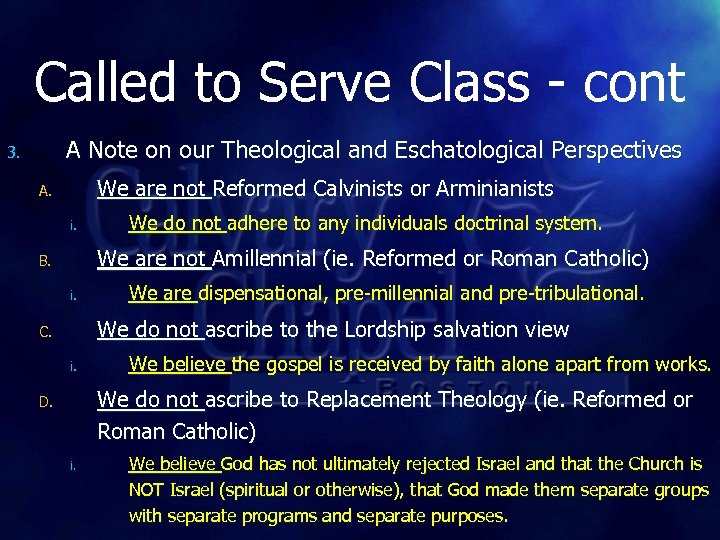
Called to Serve Class - cont A Note on our Theological and Eschatological Perspectives 3. We are not Reformed Calvinists or Arminianists A. i. We do not adhere to any individuals doctrinal system. We are not Amillennial (ie. Reformed or Roman Catholic) B. i. We are dispensational, pre-millennial and pre-tribulational. We do not ascribe to the Lordship salvation view C. i. We believe the gospel is received by faith alone apart from works. We do not ascribe to Replacement Theology (ie. Reformed or Roman Catholic) D. i. We believe God has not ultimately rejected Israel and that the Church is NOT Israel (spiritual or otherwise), that God made them separate groups with separate programs and separate purposes.
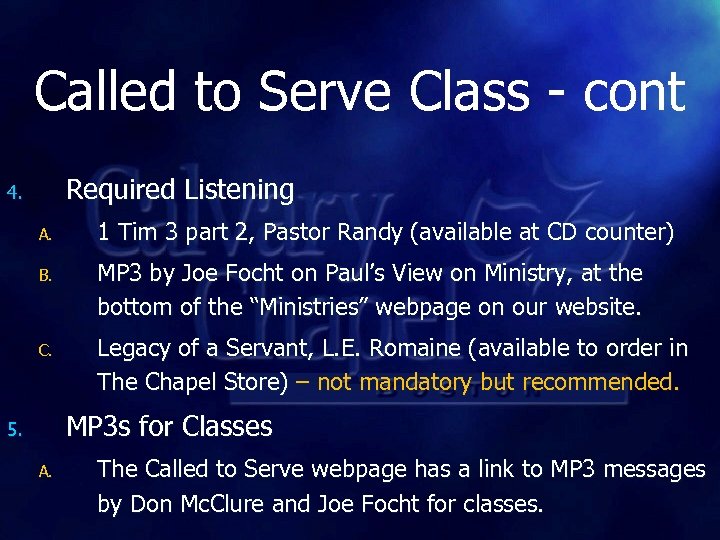
Called to Serve Class - cont Required Listening 4. A. 1 Tim 3 part 2, Pastor Randy (available at CD counter) B. MP 3 by Joe Focht on Paul’s View on Ministry, at the bottom of the “Ministries” webpage on our website. C. Legacy of a Servant, L. E. Romaine (available to order in The Chapel Store) – not mandatory but recommended. MP 3 s for Classes 5. A. The Called to Serve webpage has a link to MP 3 messages by Don Mc. Clure and Joe Focht for classes.
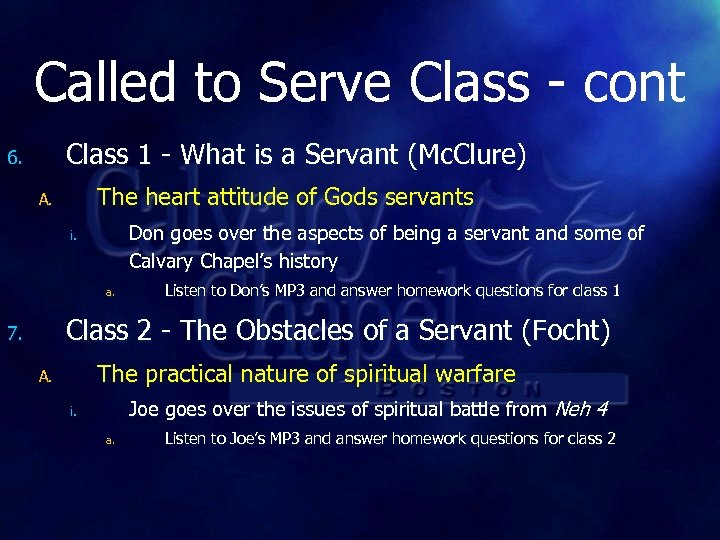
Called to Serve Class - cont Class 1 - What is a Servant (Mc. Clure) 6. The heart attitude of Gods servants A. Don goes over the aspects of being a servant and some of Calvary Chapel’s history i. a. Listen to Don’s MP 3 and answer homework questions for class 1 Class 2 - The Obstacles of a Servant (Focht) 7. The practical nature of spiritual warfare A. Joe goes over the issues of spiritual battle from Neh 4 i. a. Listen to Joe’s MP 3 and answer homework questions for class 2
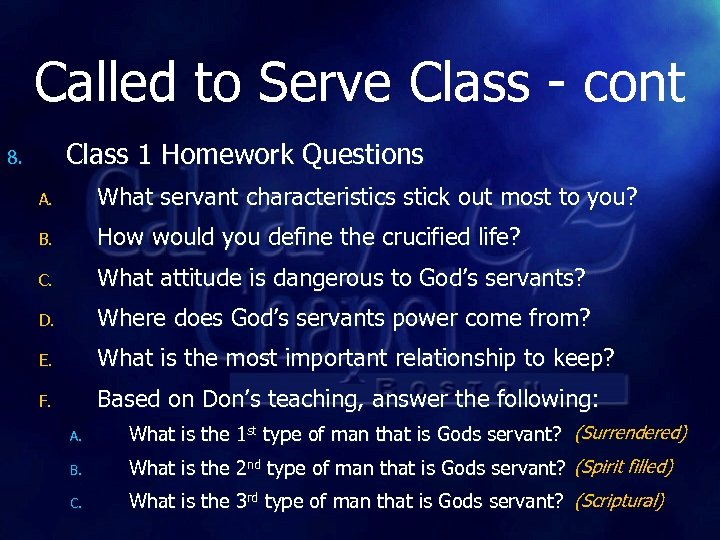
Called to Serve Class - cont Class 1 Homework Questions 8. A. What servant characteristics stick out most to you? B. How would you define the crucified life? C. What attitude is dangerous to God’s servants? D. Where does God’s servants power come from? E. What is the most important relationship to keep? F. Based on Don’s teaching, answer the following: A. What is the 1 st type of man that is Gods servant? (Surrendered) B. What is the 2 nd type of man that is Gods servant? (Spirit filled) C. Scriptural What is the 3 rd type of man that is Gods servant? (Scriptural)
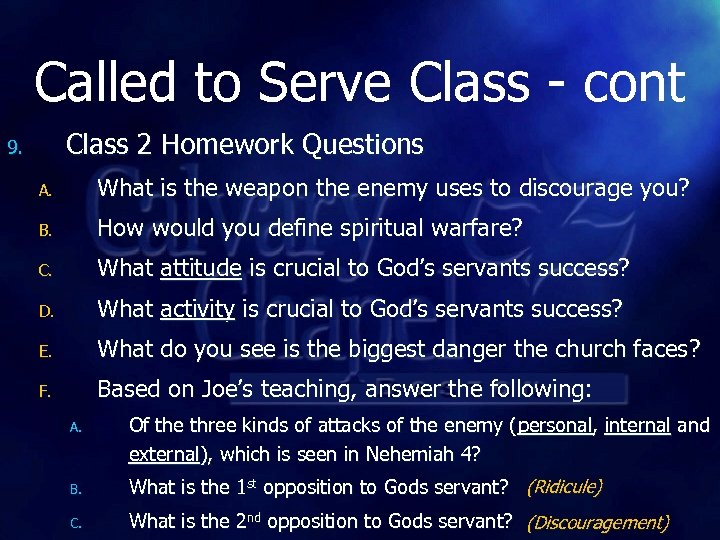
Called to Serve Class - cont Class 2 Homework Questions 9. A. What is the weapon the enemy uses to discourage you? B. How would you define spiritual warfare? C. What attitude is crucial to God’s servants success? D. What activity is crucial to God’s servants success? E. What do you see is the biggest danger the church faces? F. Based on Joe’s teaching, answer the following: A. Of the three kinds of attacks of the enemy (personal, internal and external), which is seen in Nehemiah 4? B. What is the 1 st opposition to Gods servant? (Ridicule) C. What is the 2 nd opposition to Gods servant? (Discouragement)
Outline: 1. Called to Serve Class (overview) 2. Jesus our Master & Model for Service
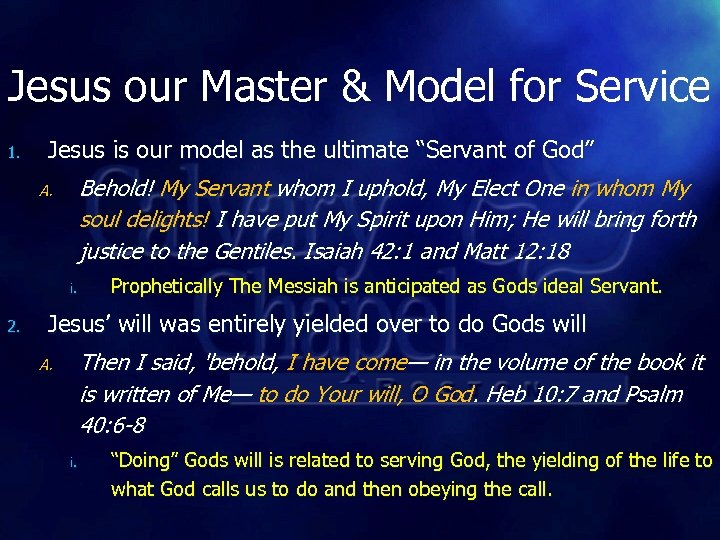
Jesus our Master & Model for Service 1. Jesus is our model as the ultimate “Servant of God” Behold! My Servant whom I uphold, My Elect One in whom My soul delights! I have put My Spirit upon Him; He will bring forth justice to the Gentiles. Isaiah 42: 1 and Matt 12: 18 A. i. 2. Prophetically The Messiah is anticipated as Gods ideal Servant. Jesus’ will was entirely yielded over to do Gods will Then I said, 'behold, I have come— in the volume of the book it is written of Me— to do Your will, O God. Heb 10: 7 and Psalm 40: 6 -8 A. i. “Doing” Gods will is related to serving God, the yielding of the life to what God calls us to do and then obeying the call.
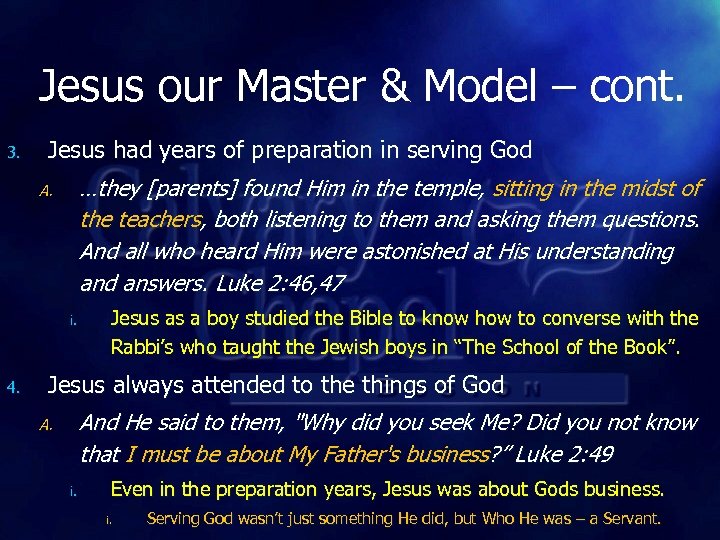
Jesus our Master & Model – cont. 3. Jesus had years of preparation in serving God …they [parents] found Him in the temple, sitting in the midst of the teachers, both listening to them and asking them questions. And all who heard Him were astonished at His understanding and answers. Luke 2: 46, 47 A. i. 4. Jesus as a boy studied the Bible to know how to converse with the Rabbi’s who taught the Jewish boys in “The School of the Book”. Jesus always attended to the things of God And He said to them, "Why did you seek Me? Did you not know that I must be about My Father's business? ” Luke 2: 49 A. i. Even in the preparation years, Jesus was about Gods business. i. Serving God wasn’t just something He did, but Who He was – a Servant.
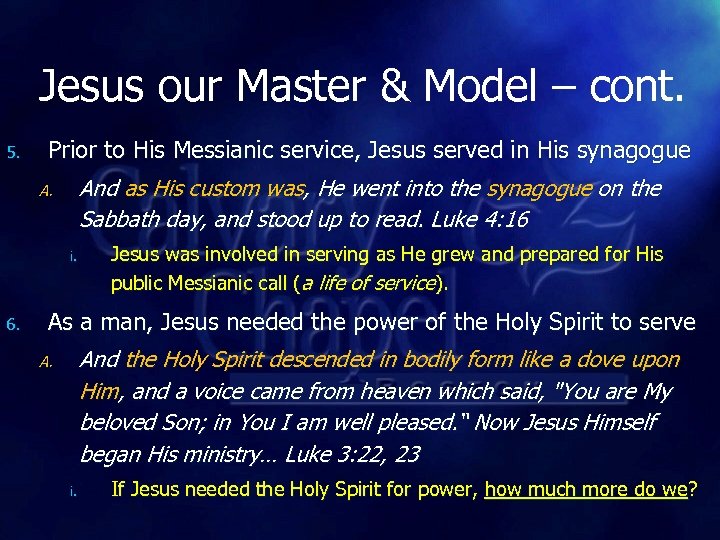
Jesus our Master & Model – cont. 5. Prior to His Messianic service, Jesus served in His synagogue And as His custom was, He went into the synagogue on the Sabbath day, and stood up to read. Luke 4: 16 A. i. 6. Jesus was involved in serving as He grew and prepared for His public Messianic call (a life of service). As a man, Jesus needed the power of the Holy Spirit to serve And the Holy Spirit descended in bodily form like a dove upon Him, and a voice came from heaven which said, "You are My beloved Son; in You I am well pleased. “ Now Jesus Himself began His ministry… Luke 3: 22, 23 A. i. If Jesus needed the Holy Spirit for power, how much more do we?
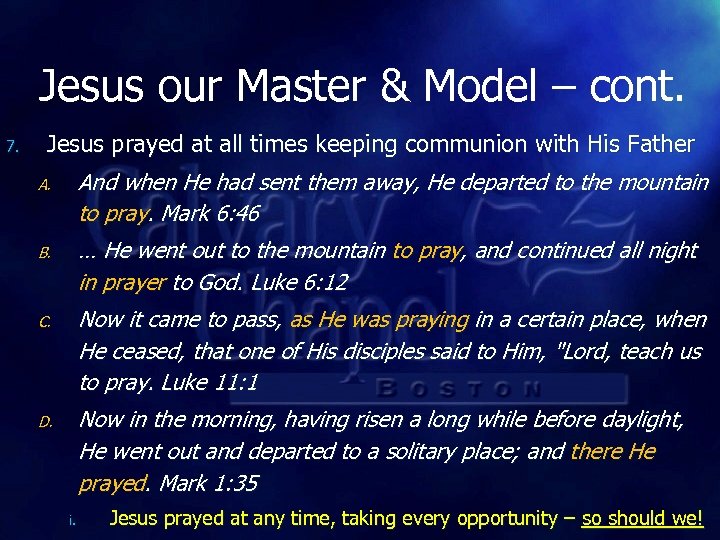
Jesus our Master & Model – cont. 7. Jesus prayed at all times keeping communion with His Father A. And when He had sent them away, He departed to the mountain to pray. Mark 6: 46 B. … He went out to the mountain to pray, and continued all night in prayer to God. Luke 6: 12 C. Now it came to pass, as He was praying in a certain place, when He ceased, that one of His disciples said to Him, "Lord, teach us to pray. Luke 11: 1 D. Now in the morning, having risen a long while before daylight, He went out and departed to a solitary place; and there He prayed. Mark 1: 35 i. Jesus prayed at any time, taking every opportunity – so should we!
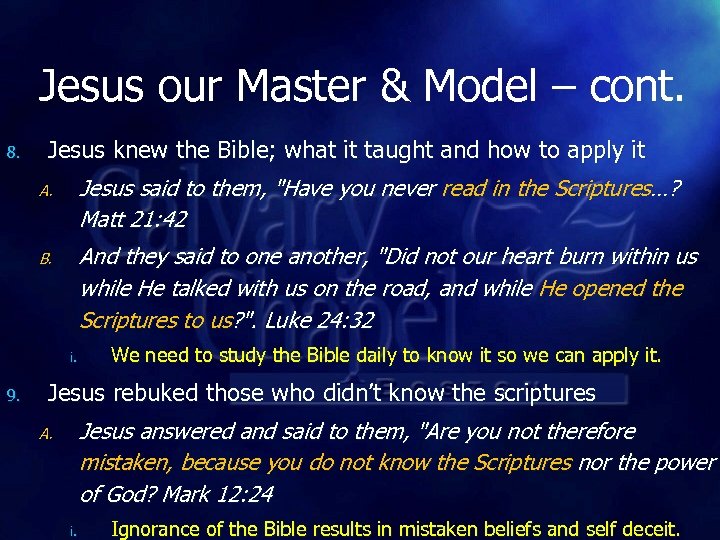
Jesus our Master & Model – cont. 8. Jesus knew the Bible; what it taught and how to apply it A. Jesus said to them, "Have you never read in the Scriptures…? Matt 21: 42 B. And they said to one another, "Did not our heart burn within us while He talked with us on the road, and while He opened the Scriptures to us? ". Luke 24: 32 i. 9. We need to study the Bible daily to know it so we can apply it. Jesus rebuked those who didn’t know the scriptures Jesus answered and said to them, "Are you not therefore mistaken, because you do not know the Scriptures nor the power of God? Mark 12: 24 A. i. Ignorance of the Bible results in mistaken beliefs and self deceit.
Outline: 1. Called to Serve Class (overview) 2. Jesus our Master & Model for Service 3. WHY do we serve God?
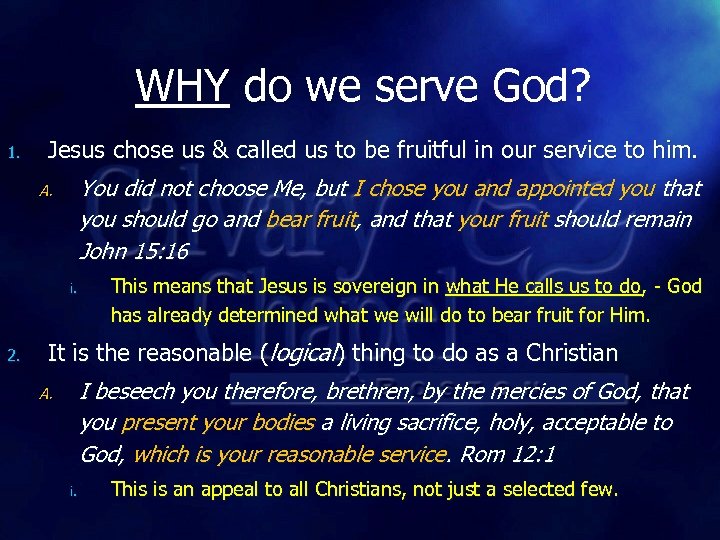
WHY do we serve God? 1. Jesus chose us & called us to be fruitful in our service to him. You did not choose Me, but I chose you and appointed you that you should go and bear fruit, and that your fruit should remain John 15: 16 A. i. 2. This means that Jesus is sovereign in what He calls us to do, - God has already determined what we will do to bear fruit for Him. It is the reasonable (logical) thing to do as a Christian I beseech you therefore, brethren, by the mercies of God, that you present your bodies a living sacrifice, holy, acceptable to God, which is your reasonable service. Rom 12: 1 A. i. This is an appeal to all Christians, not just a selected few.
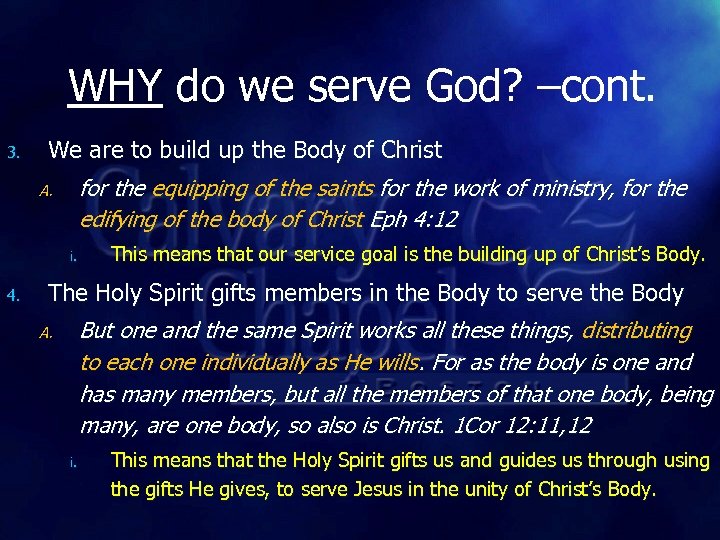
WHY do we serve God? –cont. 3. We are to build up the Body of Christ for the equipping of the saints for the work of ministry, for the edifying of the body of Christ Eph 4: 12 A. i. 4. This means that our service goal is the building up of Christ’s Body. The Holy Spirit gifts members in the Body to serve the Body But one and the same Spirit works all these things, distributing to each one individually as He wills. For as the body is one and has many members, but all the members of that one body, being many, are one body, so also is Christ. 1 Cor 12: 11, 12 A. i. This means that the Holy Spirit gifts us and guides us through using the gifts He gives, to serve Jesus in the unity of Christ’s Body.
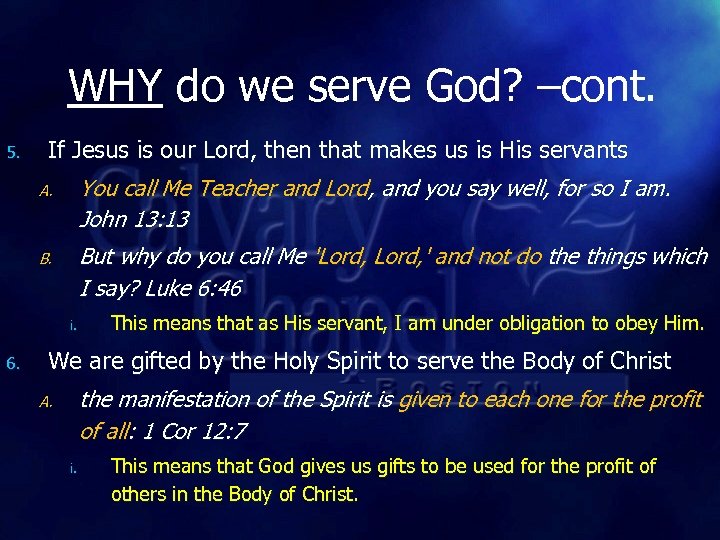
WHY do we serve God? –cont. 5. If Jesus is our Lord, then that makes us is His servants A. You call Me Teacher and Lord, and you say well, for so I am. John 13: 13 B. But why do you call Me 'Lord, ' and not do the things which I say? Luke 6: 46 i. 6. This means that as His servant, I am under obligation to obey Him. We are gifted by the Holy Spirit to serve the Body of Christ the manifestation of the Spirit is given to each one for the profit of all: 1 Cor 12: 7 A. i. This means that God gives us gifts to be used for the profit of others in the Body of Christ.
WHY do we serve God? – cont. IN SUMMARY All believers are called to serve the Lord in some capacity or another. Though circumstances may hinder or limit this for a season or other reasons, God’s purpose for believers is to follow the model Jesus set for us as Gods ideal Servant. We know this because God is conforming us in to the image of His Son (Rom 8: 29), and Jesus said, you shall worship the Lord your God and Him only shall you serve. (Matt 4: 10)
Outline: 1. Called to Serve Class (overview) 2. Jesus our Master & Model for Service 3. WHY do we serve God? 4. HOW do we serve God?
HOW do we serve God? 1. We are to have a pure (clear) conscience – proper attitude I thank God, whom I serve with a pure conscience, as my forefathers did: 1 Tim 1: 3 A. i. 2. This means that our service to God should not be out of guilt, wrong motives, without hypocrisy or duplicity. We are exhorted to use our gifts to serve with diligence Having then gifts differing according to the grace that is given to us, let us use them: if prophecy, let us prophesy in proportion to our faith; … he who exhorts, in exhortation; … he who leads, with diligence. Rom 12 A. i. This means we should put all we have into our service for Jesus Christ
HOW do we serve God? – cont. 3. We are to serve the Body of Christ in love – visible attitude Be kindly affectionate to one another with brotherly love, in honor giving preference to one another Rom 12: 10 A. i. 4. This means that love should be my greatest motive and display. We are to give our best to the Lord in our service And whatever you do, do it heartily, as to the Lord and not to men, knowing that from the Lord you will receive the reward of the inheritance; for you serve the Lord Christ. Col 3: 23, 24 A. i. This means that when serving, it is a time to serve and not socialize. As with any important responsibility, we have to pay attention to what we are doing for Jesus Christ.
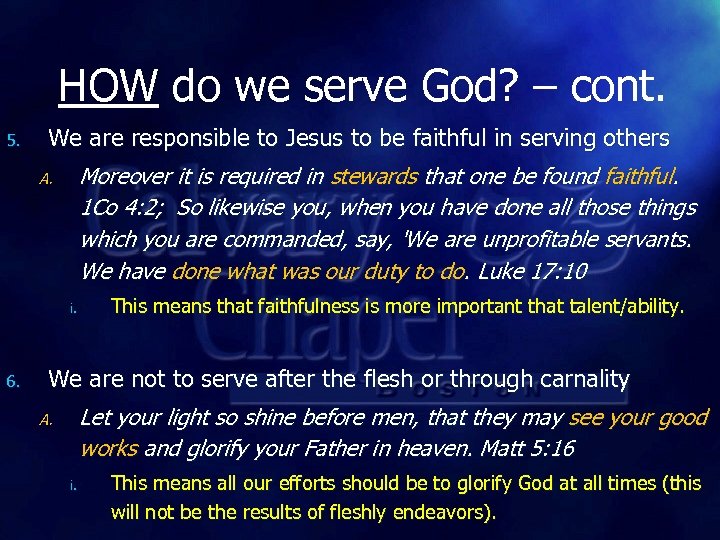
HOW do we serve God? – cont. 5. We are responsible to Jesus to be faithful in serving others Moreover it is required in stewards that one be found faithful. 1 Co 4: 2; So likewise you, when you have done all those things which you are commanded, say, 'We are unprofitable servants. We have done what was our duty to do. Luke 17: 10 A. i. 6. This means that faithfulness is more important that talent/ability. We are not to serve after the flesh or through carnality Let your light so shine before men, that they may see your good works and glorify your Father in heaven. Matt 5: 16 A. i. This means all our efforts should be to glorify God at all times (this will not be the results of fleshly endeavors).
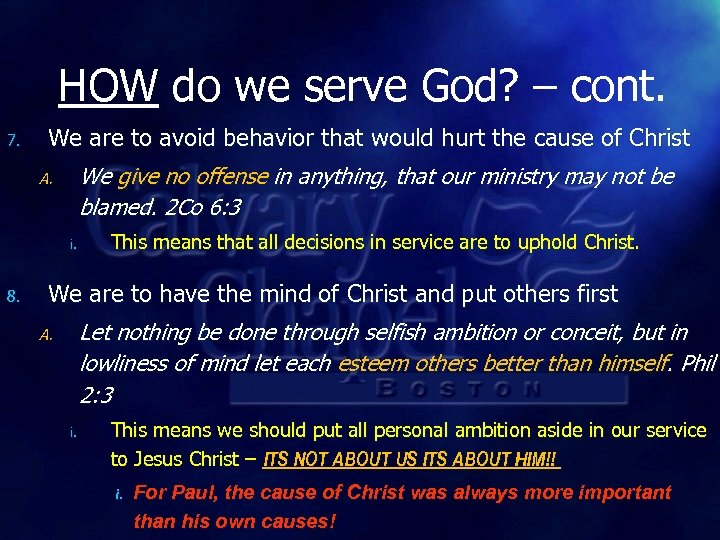
HOW do we serve God? – cont. 7. We are to avoid behavior that would hurt the cause of Christ We give no offense in anything, that our ministry may not be blamed. 2 Co 6: 3 A. i. 8. This means that all decisions in service are to uphold Christ. We are to have the mind of Christ and put others first Let nothing be done through selfish ambition or conceit, but in lowliness of mind let each esteem others better than himself. Phil 2: 3 A. i. This means we should put all personal ambition aside in our service to Jesus Christ – ITS NOT ABOUT US ITS ABOUT HIM!! i. For Paul, the cause of Christ was always more important than his own causes!
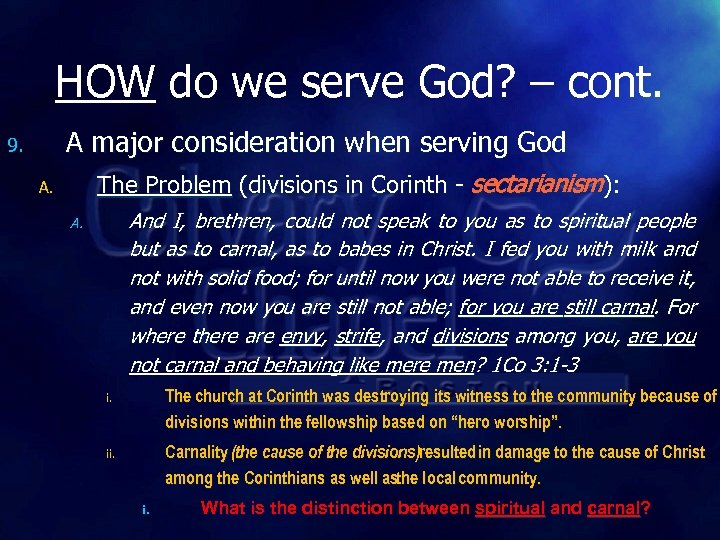
HOW do we serve God? – cont. A major consideration when serving God 9. The Problem (divisions in Corinth - sectarianism): A. And I, brethren, could not speak to you as to spiritual people but as to carnal, as to babes in Christ. I fed you with milk and not with solid food; for until now you were not able to receive it, and even now you are still not able; for you are still carnal. For where there are envy, strife, and divisions among you, are you not carnal and behaving like mere men? 1 Co 3: 1 -3 A. i. The church at Corinth was destroying its witness to the community because of divisions within the fellowship based on “hero worship”. ii. Carnality (the cause of the divisions)resulted in damage to the cause of Christ among the Corinthians as well asthe local community. i. What is the distinction between spiritual and carnal?
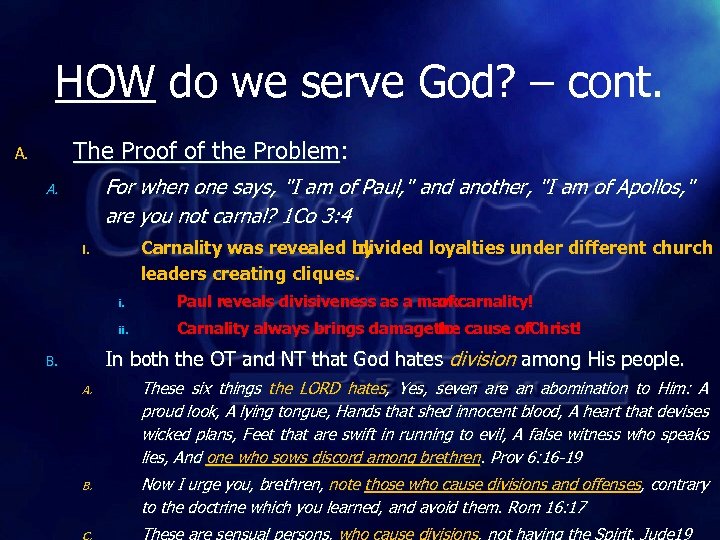
HOW do we serve God? – cont. The Proof of the Problem: A. For when one says, "I am of Paul, " and another, "I am of Apollos, " are you not carnal? 1 Co 3: 4 A. Carnality was revealed by divided loyalties under different church leaders creating cliques. i. Paul reveals divisiveness as a markcarnality! of ii. Carnality always brings damage the cause of. Christ! to In both the OT and NT that God hates division among His people. B. A. These six things the LORD hates, Yes, seven are an abomination to Him: A proud look, A lying tongue, Hands that shed innocent blood, A heart that devises wicked plans, Feet that are swift in running to evil, A false witness who speaks lies, And one who sows discord among brethren. Prov 6: 16 -19 B. Now I urge you, brethren, note those who cause divisions and offenses, contrary to the doctrine which you learned, and avoid them. Rom 16: 17
HOW do we serve God? – cont. The Planting illustration given for instruction: A. Who then is Paul, and who is Apollos, but ministers through whom you believed, as the Lord gave to each one? I planted, Apollos watered, but God gave the increase. So then neither he who plants is anything, nor he who waters, but God who gives the increase. Now he who plants and he who waters are one, and each one will receive his own reward according to his own labor. 1 Co 3: 5 -8 A. i. What does this planting illustration emphasize? ii. What perspective is Paul attempting to give the Corinthians ?
HOW do we serve God? – cont. B. From the CBL – the planting illustration emphasizes: The mature laborer for Christ does not involve himself in party dissension. The men whom God uses for work in His kingdom are really servants called to bring men to belief in Christ. God had given each minister a particular work, ability, and ministry which He used with the Word to bring the Corinthians to salvation. The emphasis is on God. As John wrote in his Gospel concerning John the Baptist: "There was a man sent from God, whose name was John" (John 1: 6).
2. HOW do we serve God? - cont Paul here asked the question, "Who then is Paul, and who is Apollos. . . ? " Although a response of "nothing" might be expected because they were merely human instruments of God, Paul did not say that. Indeed, Paul and Apollos were diakonoi ("servants" or "ministers"). Paul said in 2 Corinthians 4: 5 that they were "your servants for Jesus' sake. " Paul also used the word "steward" (oikonomous) to describe his ministry (4: 1). Divisions such as were occurring at Corinth should not be allowed because leaders and laborers are merely instruments. God accomplishes through them what He will. The Christian worker must maintain the humility, submission, and unity that come from understanding that all men work in the place to which God calls them, and all are important under God does not have "big" preachers or "small" preachers, just faithful preachers.
HOW do we serve God? – cont. All ministers and laborers then are on an equal plane. The job does not make one person more important than another. All share a common goal. Therefore, the reward given to these coworkers will depend on their personal labor. The emphasis seems to be on the labor, not the success; on the faithfulness of the servant involved. If man does his part in the work of the gospel, God will certainly do His part. The plea for unity in a good church with no division B. Paul wrote to the Ephesians beseeching them to equal out their i. profession and practice – walk worthy of the call… (4: 1) He then stated the qualities necessary to maintain unity : ii. lowliness and gentleness, with longsuffering, bearing with one another in love 4: 2
HOW do we serve God? – cont. i. "lowliness and meekness, " refer to a person's attitude toward self. A person with a proper balance between profession and practice will be humble, will not be full of haughty pride. ii. forbearance, (bearing) is a social virtue, expressing the ability to be patient with the weaknesses of other people. Paul told them to be diligent (endeavoring) to do their part in i. maintaining the unity that the Holy Spirit brings to a fellowship 4: 3 i. The absence of these qualities will definitely jeopardize Christian unity. Unity does not just happen. Because this is a present tense idea in Greek grammar, (endeavoring to keep) we must constantly cooperate with the Holy Spirit keeping unity. ii. Those who cause division in any fellowship work at cross purposes with the Holy Spirit Who is bringing unity to the church. The consequence is the limiting of Gods glory and witness to the local community.
HOW do we serve God? – cont. Key Points on Division and Unity Related to Service: C. i. Mature Christians don’t involve themselves in party dissensions ii. The emphasis in ministry is always God, never us. iii. Servants are merely instruments of God – all on an equal plane. iv. One servant isn’t more important than another. i. Though some roles may be more key at times to “edify the Body”. v. God gives the reward for the labor of His servants, not men. vi. Unity among God’s people gives proper glory and witness to Who God is in the local community they are to reach. vii. Unity does not just happen, it requires diligent maintenance. viii. Unity requires particular characteristics in the lives of believers in fellowship with one another. ix. Unity is Gods will as shown in Ephesians 4 and a key aspect of our Lords prayer in John 17: 21 -23.
HOW do we serve God? – cont. 10. We are to serve under the standards that Jesus sets For we preach not ourselves, but Christ Jesus the Lord; and ourselves your servants for Jesus' sake. 2 Co 4: 5 A. i. 11. This means that Jesus sets the standards for our service to others, not the people we are serving (they are receivers, not directors). We are to submit to those Jesus puts over us as leaders Obey those who rule over you, and be submissive, for they watch out for your souls, as those who must give account. Let them do so with joy and not with grief, for that would be unprofitable for you. Heb 13: 17 A. i. This means that in our service to Jesus we should obey those He has for our leaders, for they give account to God, not us.
HOW do we serve God? – cont. 12. We are to have our eyes on Jesus and not others A. If anyone serves Me, let him follow Me. John 12: 26 B. Jesus said to Peter, “If I will that he [John] remain till I come, what is that to you? You follow Me. ” John 21: 22 C. Who are you to judge another's servant? To his own master he stands or falls. Indeed, he will be made to stand, for God is able to make him stand. Rom 14: 4 We focus on the Lord, not others. We don’t compare calls or gifting. i. 13. Things don’t always work perfectly in service Samuel was late showing up to meet Saul to sacrifice 1 Sa 13: 8 A. i. ii. This means that we need to remain flexible in our service. Creative thinking is welcomed, but independent thinking is not
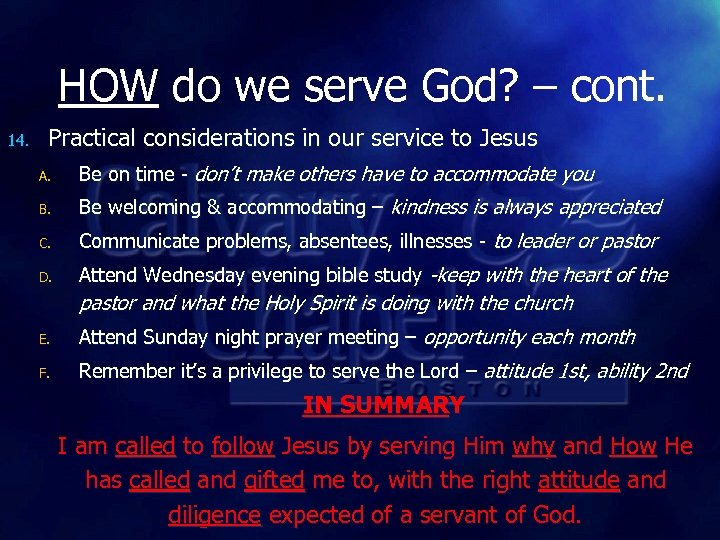
HOW do we serve God? – cont. 14. Practical considerations in our service to Jesus A. Be on time - don’t make others have to accommodate you B. Be welcoming & accommodating – kindness is always appreciated C. Communicate problems, absentees, illnesses - to leader or pastor D. Attend Wednesday evening bible study -keep with the heart of the pastor and what the Holy Spirit is doing with the church E. Attend Sunday night prayer meeting – opportunity each month F. Remember it’s a privilege to serve the Lord – attitude 1 st, ability 2 nd IN SUMMARY I am called to follow Jesus by serving Him why and How He has called and gifted me to, with the right attitude and diligence expected of a servant of God.
Outline: 1. Called to Serve Class (overview) 2. Jesus our Master & Model for Service 3. WHY do we serve God? 4. HOW do we serve God? 5. WHERE do we serve God?
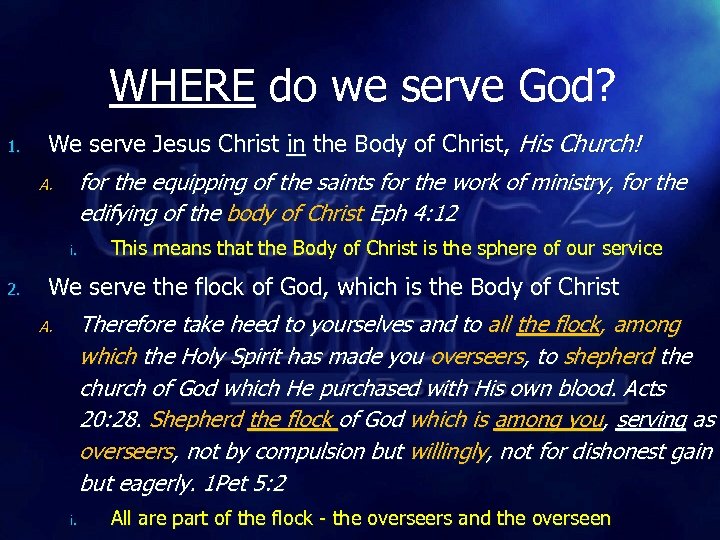
WHERE do we serve God? 1. We serve Jesus Christ in the Body of Christ, His Church! for the equipping of the saints for the work of ministry, for the edifying of the body of Christ Eph 4: 12 A. i. 2. This means that the Body of Christ is the sphere of our service We serve the flock of God, which is the Body of Christ Therefore take heed to yourselves and to all the flock, among which the Holy Spirit has made you overseers, to shepherd the church of God which He purchased with His own blood. Acts 20: 28. Shepherd the flock of God which is among you, serving as overseers, not by compulsion but willingly, not for dishonest gain but eagerly. 1 Pet 5: 2 A. i. All are part of the flock - the overseers and the overseen
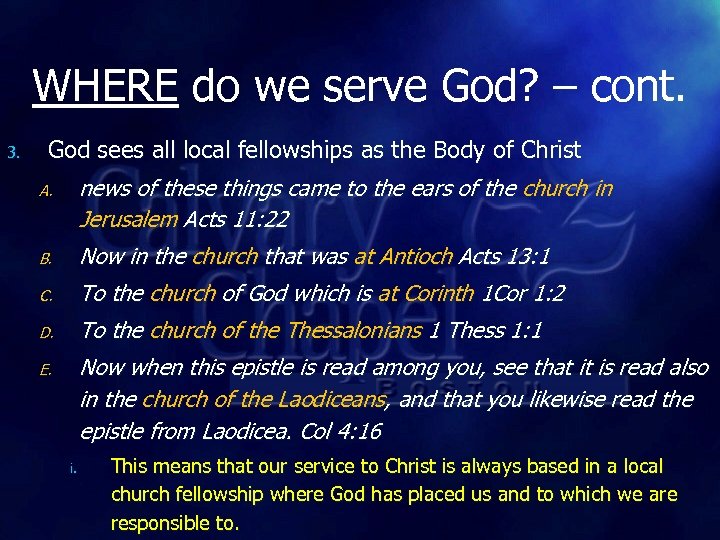
WHERE do we serve God? – cont. 3. God sees all local fellowships as the Body of Christ A. news of these things came to the ears of the church in Jerusalem Acts 11: 22 B. Now in the church that was at Antioch Acts 13: 1 C. To the church of God which is at Corinth 1 Cor 1: 2 D. To the church of the Thessalonians 1 Thess 1: 1 E. Now when this epistle is read among you, see that it is read also in the church of the Laodiceans, and that you likewise read the epistle from Laodicea. Col 4: 16 i. This means that our service to Christ is always based in a local church fellowship where God has placed us and to which we are responsible to.
WHERE do we serve God? – cont. 4. There are ministries that are extensions of the local church And He Himself gave some to be apostles, some prophets, some evangelists, and some pastors and teachers Eph 4: 11 A. i. 5. This means that some serve outside to extend the local fellowship Those who extend the Body are accountable to the Body Then, having fasted and prayed, and laid hands on them, they sent them away. Act 13: 3 … From there they sailed to Antioch, where they had been commended to the grace of God for the work which they had completed. Now when they had come and gathered the church together, they reported all that God had done with them. Acts 14: 26, 27 (Paul’s 1 st missionary journey) A. i. This means service is either in or out from the local Body of Christ
WHERE do we serve God? – cont. 6. We serve God no matter the circumstances or location A. The apostles were imprisoned for their faith Acts 4&5 B. Paul and Silas worshipped God in prison Acts 16 C. Paul served among devastating circumstances and situations 2 Cor 11 D. Paul wrote Eph, Phil, Col and Philemon from a prison cell i. This means that we don’t stop serving God because of difficulty IN SUMMARY I am called to serve God in the local Body of Christ that I attend, if I have a ministry outside the walls of the fellowship, I’m accountable to that local Body.
Outline: 1. Called to Serve Class (overview) 2. Jesus our Master & Model for Service 3. WHY do we serve God? 4. HOW do we serve God? 5. WHERE do we serve God? 6. WHEN do we serve God?
WHEN do we serve God? 1. I should be prepared at all times to serve God. Preach the word! Be ready in season and out of season. 2 Tim 4: 2 A. i. I serve in times of convenience and inconvenience I should never be under the influence of anything that would prohibit my service. And do not be drunk with wine, in which is B. dissipation; but be filled with the Spirit. Eph 5: 18 i. OT priests couldn’t drink when they served (Lev 10: 8, 9) – we are all kings and priests in the NT (Rev 1: 6) and our service is not on a rotating basis, but anytime the Holy Spirit calls – so we don’t drink I should not be in a compromising situation or cause stumbling. C. Therefore, if food makes my brother stumble, I will never again eat meat, lest I make my brother stumble. 1 Cor 8: 13 i. We remove compromise/offence – so we don’t go to R rated movies
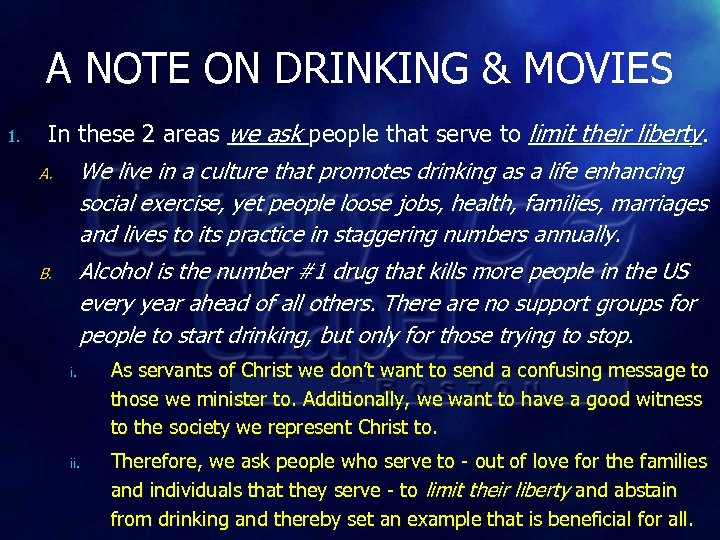
A NOTE ON DRINKING & MOVIES 1. In these 2 areas we ask people that serve to limit their liberty. A. We live in a culture that promotes drinking as a life enhancing social exercise, yet people loose jobs, health, families, marriages and lives to its practice in staggering numbers annually. B. Alcohol is the number #1 drug that kills more people in the US every year ahead of all others. There are no support groups for people to start drinking, but only for those trying to stop. i. As servants of Christ we don’t want to send a confusing message to those we minister to. Additionally, we want to have a good witness to the society we represent Christ to. ii. Therefore, we ask people who serve to - out of love for the families and individuals that they serve - to limit their liberty and abstain from drinking and thereby set an example that is beneficial for all.
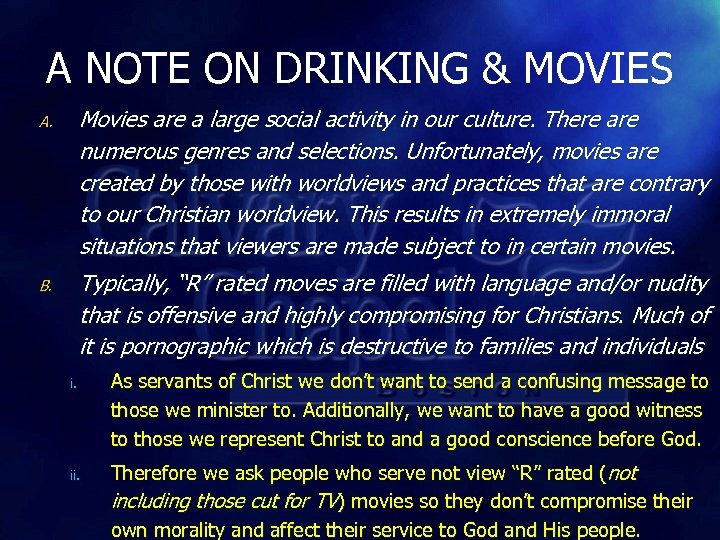
A NOTE ON DRINKING & MOVIES A. Movies are a large social activity in our culture. There are numerous genres and selections. Unfortunately, movies are created by those with worldviews and practices that are contrary to our Christian worldview. This results in extremely immoral situations that viewers are made subject to in certain movies. B. Typically, “R” rated moves are filled with language and/or nudity that is offensive and highly compromising for Christians. Much of it is pornographic which is destructive to families and individuals i. ii. As servants of Christ we don’t want to send a confusing message to those we minister to. Additionally, we want to have a good witness to those we represent Christ to and a good conscience before God. Therefore we ask people who serve not view “R” rated (not including those cut for TV) movies so they don’t compromise their own morality and affect their service to God and His people.
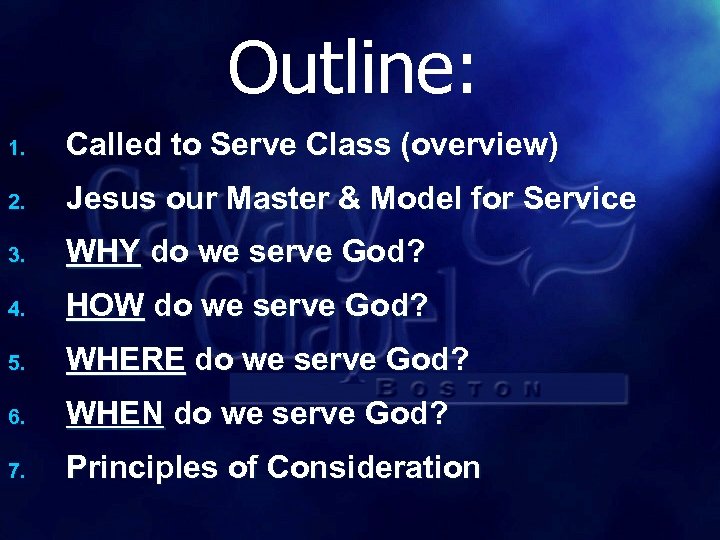
Outline: 1. Called to Serve Class (overview) 2. Jesus our Master & Model for Service 3. WHY do we serve God? 4. HOW do we serve God? 5. WHERE do we serve God? 6. WHEN do we serve God? 7. Principles of Consideration
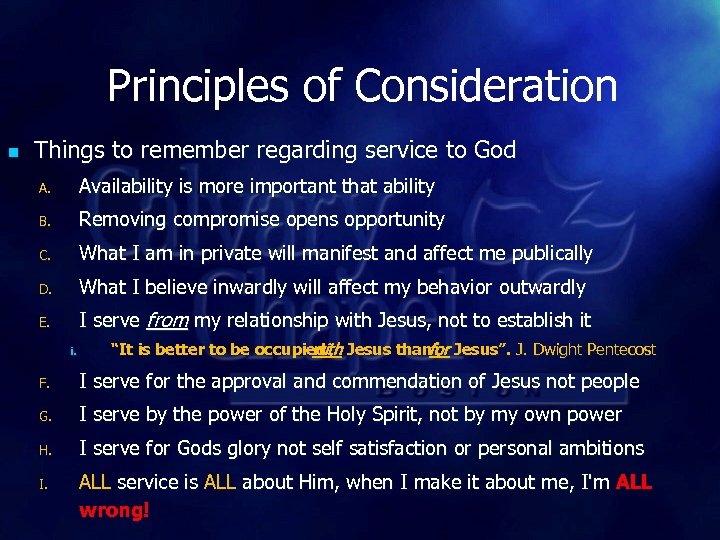
Principles of Consideration n Things to remember regarding service to God A. Availability is more important that ability B. Removing compromise opens opportunity C. What I am in private will manifest and affect me publically D. What I believe inwardly will affect my behavior outwardly E. I serve from my relationship with Jesus, not to establish it i. “It is better to be occupied Jesus thanfor Jesus”. J. Dwight Pentecost with F. I serve for the approval and commendation of Jesus not people G. I serve by the power of the Holy Spirit, not by my own power H. I serve for Gods glory not self satisfaction or personal ambitions I. ALL service is ALL about Him, when I make it about me, I'm ALL wrong!
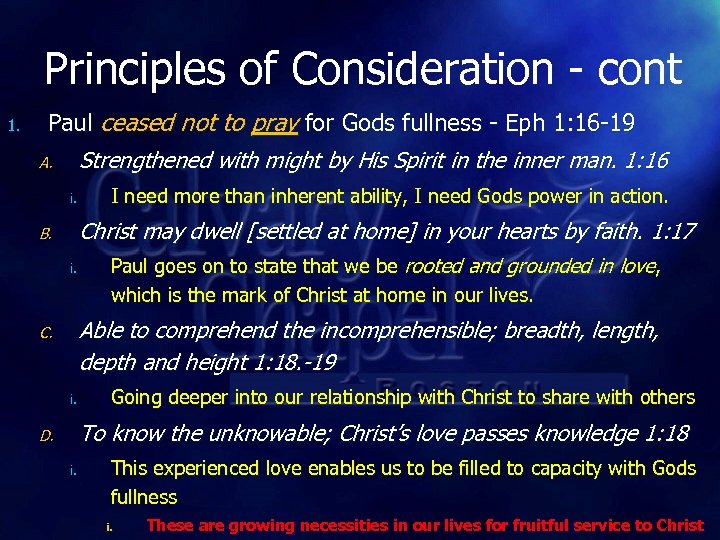
Principles of Consideration - cont 1. Paul ceased not to pray for Gods fullness - Eph 1: 16 -19 Strengthened with might by His Spirit in the inner man. 1: 16 A. i. I need more than inherent ability, I need Gods power in action. Christ may dwell [settled at home] in your hearts by faith. 1: 17 B. i. Paul goes on to state that we be rooted and grounded in love, which is the mark of Christ at home in our lives. Able to comprehend the incomprehensible; breadth, length, depth and height 1: 18. -19 C. i. Going deeper into our relationship with Christ to share with others To know the unknowable; Christ’s love passes knowledge 1: 18 D. i. This experienced love enables us to be filled to capacity with Gods fullness i. These are growing necessities in our lives for fruitful service to Christ
Outline: 1. Called to Serve Class (overview) 2. Jesus our Master & Model for Service 3. WHY do we serve God? 4. HOW do we serve God? 5. WHERE do we serve God? 6. WHEN do we serve God? 7. Principles of Consideration 8. Final Thoughts
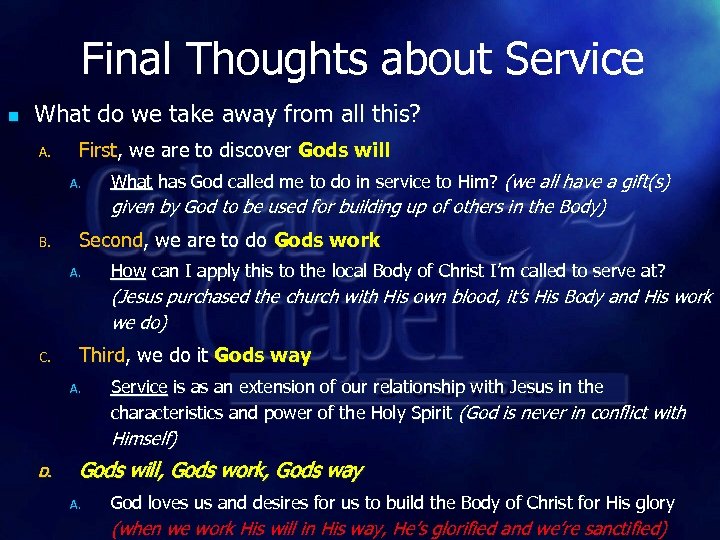
Final Thoughts about Service n What do we take away from all this? A. First, we are to discover Gods will A. What has God called me to do in service to Him? (we all have a gift(s) given by God to be used for building up of others in the Body) B. Second, we are to do Gods work A. How can I apply this to the local Body of Christ I’m called to serve at? (Jesus purchased the church with His own blood, it’s His Body and His work we do) C. Third, we do it Gods way A. Service is as an extension of our relationship with Jesus in the characteristics and power of the Holy Spirit (God is never in conflict with Himself) D. Gods will, Gods work, Gods way A. God loves us and desires for us to build the Body of Christ for His glory (when we work His will in His way, He’s glorified and we’re sanctified)
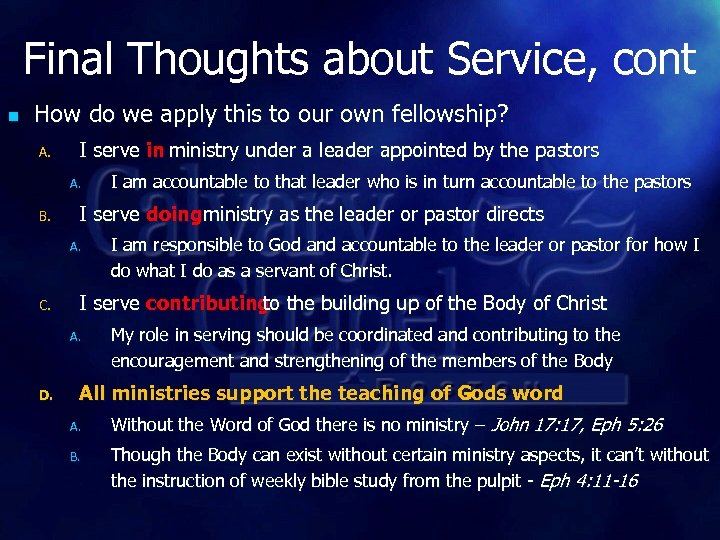
Final Thoughts about Service, cont n How do we apply this to our own fellowship? A. I serve in ministry under a leader appointed by the pastors A. B. I serve doing ministry as the leader or pastor directs A. C. I am responsible to God and accountable to the leader or pastor for how I do what I do as a servant of Christ. I serve contributing the building up of the Body of Christ to A. D. I am accountable to that leader who is in turn accountable to the pastors My role in serving should be coordinated and contributing to the encouragement and strengthening of the members of the Body All ministries support the teaching of Gods word A. Without the Word of God there is no ministry – John 17: 17, Eph 5: 26 B. Though the Body can exist without certain ministry aspects, it can’t without the instruction of weekly bible study from the pulpit - Eph 4: 11 -16
Final Thoughts about Service, cont n Relationship of the Body to the Senior Pastor A. If we believe God has called the senior pastor, we can serve under him A. B. The senior pastor provides direction for the local fellowship A. C. I can only serve under a man I believe is called by God to pastor a local fellowship, if I can’t see God working through his humanity, I will falter. Each local church as a different emphasis to their overall ministry, I need to trust that what God is leading the senior pastor to do is God directed. The senior pastor has a perspective on ministry to be carried out A. My service should reflect the perspective of the senior pastor – who would do the ministry I am performing if he could be in two places at once. But, there is much freedom within the boundaries of how ministry is exercised. D. The senior pastor has pastors to confirm the guidance of the Holy Spirit A. The Holy Spirit works to unify the Body, division is the work of the enemy of souls. Pray for the pastors that Gods guidance is clear to them.
Final Questions about Service n Questions regarding any specific ministries? A. Children's Ministry? A. B. Subject Based Bible Studies? A. C. Nursing Home, South Boston Study, Home Prayer Helps A. E. Men's, Women's, Marriage, Young Adults Outside the church ministries? A. D. Sunday School, AWANA, VBS, Nursery, Youth Group Ushers, CD duplication, Custodial, Meals, Community outreach Specialty Ministries? A. Sound, Video, Music, Missions
Скачать презентацию Called by Grace Called by Grace Beloved
2a27c20a2b5cacc1c711ed805b2941b0.ppt