 Скачать презентацию Call for Tenders OECD Feasibility Study for an
bafc2ed8c51296b7bb5d82e3d2bbb901.ppt
- Количество слайдов: 49



Call for Tenders: OECD Feasibility Study for an AHELO Assessment of Higher Education Learning Outcomes Information for bidders 9 July, 2009
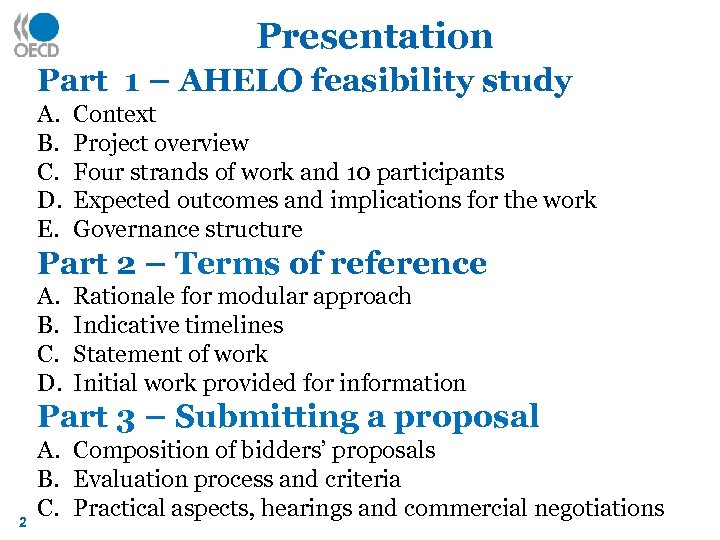
Presentation Part 1 – AHELO feasibility study A. B. C. D. E. Context Project overview Four strands of work and 10 participants Expected outcomes and implications for the work Governance structure Part 2 – Terms of reference A. B. C. D. Rationale for modular approach Indicative timelines Statement of work Initial work provided for information Part 3 – Submitting a proposal 2 A. Composition of bidders’ proposals B. Evaluation process and criteria C. Practical aspects, hearings and commercial negotiations
Part 1 – AHELO feasibility study A. Context B. Project overview C. Four strands of work and 10 participants D. Expected outcomes of the feasibility study and implications for your work E. Governance structure 3
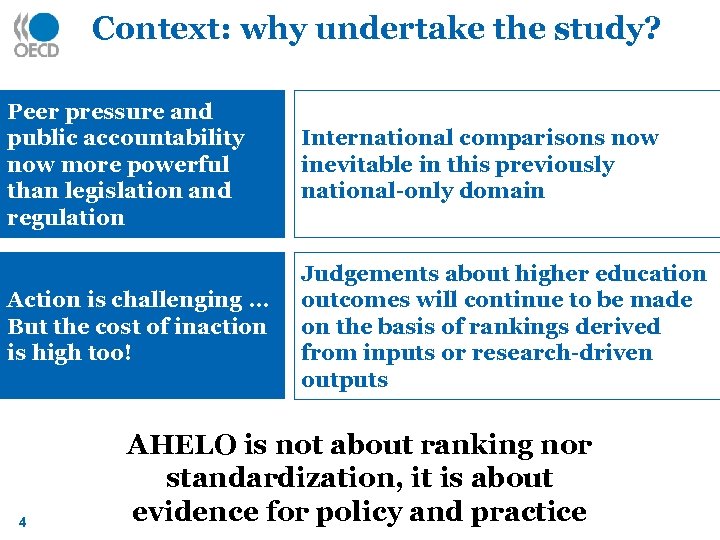
Context: why undertake the study? Peer pressure and public accountability now more powerful than legislation and regulation International comparisons now inevitable in this previously national-only domain Action is challenging. . . But the cost of inaction is high too! Judgements about higher education outcomes will continue to be made on the basis of rankings derived from inputs or research-driven outputs 4 AHELO is not about ranking nor standardization, it is about evidence for policy and practice
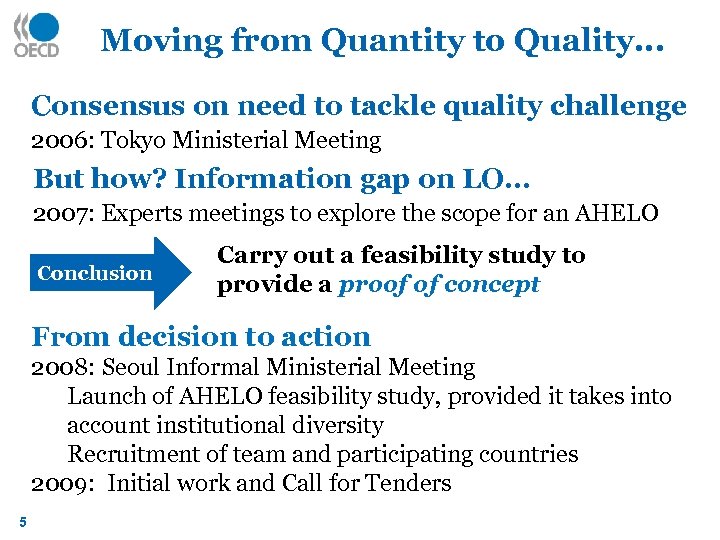
Moving from Quantity to Quality. . . Consensus on need to tackle quality challenge 2006: Tokyo Ministerial Meeting But how? Information gap on LO… 2007: Experts meetings to explore the scope for an AHELO Conclusion Carry out a feasibility study to provide a proof of concept From decision to action 2008: Seoul Informal Ministerial Meeting Launch of AHELO feasibility study, provided it takes into account institutional diversity Recruitment of team and participating countries 2009: Initial work and Call for Tenders 5
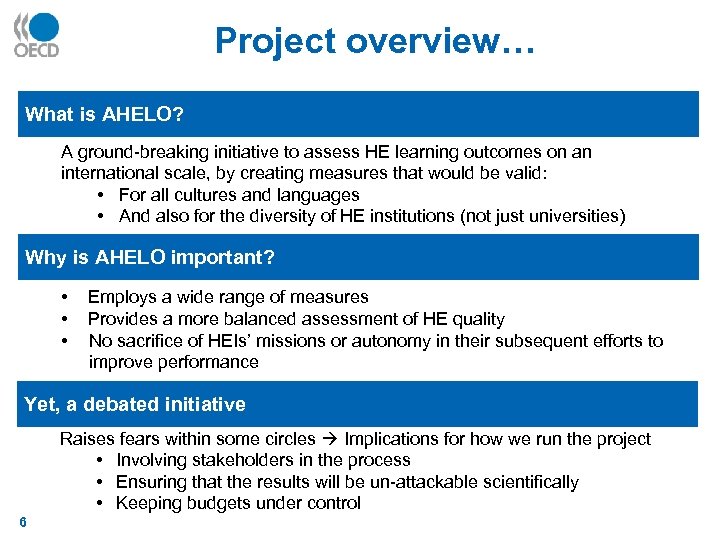
Project overview… What is AHELO? A ground-breaking initiative to assess HE learning outcomes on an international scale, by creating measures that would be valid: • For all cultures and languages • And also for the diversity of HE institutions (not just universities) Why is AHELO important? • • • Employs a wide range of measures Provides a more balanced assessment of HE quality No sacrifice of HEIs’ missions or autonomy in their subsequent efforts to improve performance Yet, a debated initiative Raises fears within some circles Implications for how we run the project • Involving stakeholders in the process • Ensuring that the results will be un-attackable scientifically • Keeping budgets under control 6
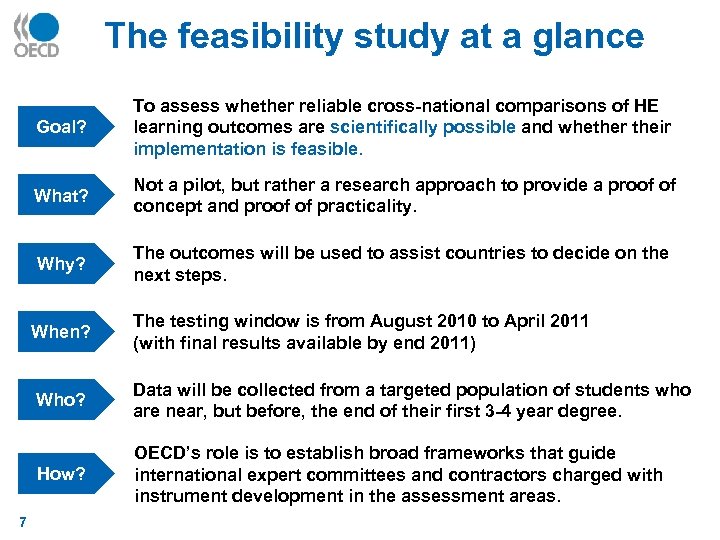
The feasibility study at a glance Goal? To assess whether reliable cross-national comparisons of HE learning outcomes are scientifically possible and whether their implementation is feasible. What? Not a pilot, but rather a research approach to provide a proof of concept and proof of practicality. Why? The outcomes will be used to assist countries to decide on the next steps. When? Who? Data will be collected from a targeted population of students who are near, but before, the end of their first 3 -4 year degree. How? 7 The testing window is from August 2010 to April 2011 (with final results available by end 2011) OECD’s role is to establish broad frameworks that guide international expert committees and contractors charged with instrument development in the assessment areas.
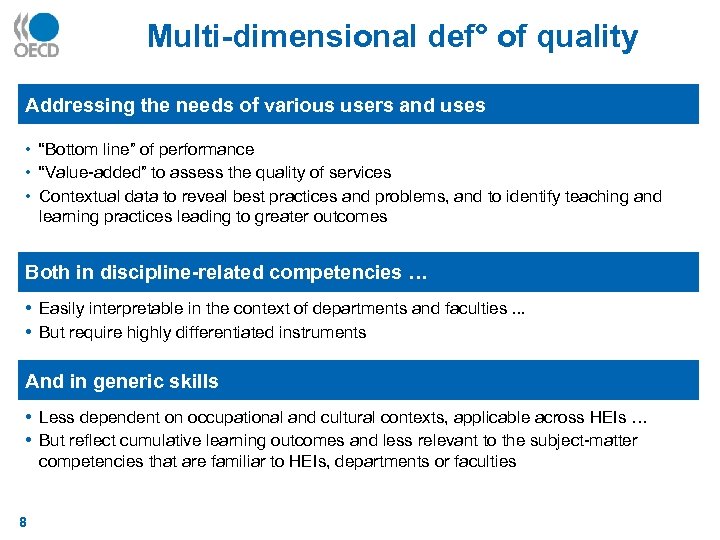
Multi-dimensional def° of quality Addressing the needs of various users and uses • “Bottom line” of performance • “Value-added” to assess the quality of services • Contextual data to reveal best practices and problems, and to identify teaching and learning practices leading to greater outcomes Both in discipline-related competencies … • Easily interpretable in the context of departments and faculties. . . • But require highly differentiated instruments And in generic skills • Less dependent on occupational and cultural contexts, applicable across HEIs … • But reflect cumulative learning outcomes and less relevant to the subject-matter competencies that are familiar to HEIs, departments or faculties 8
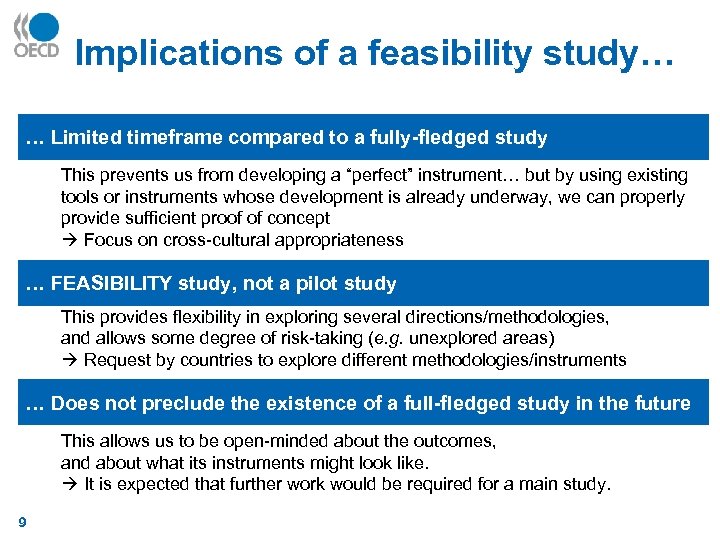
Implications of a feasibility study… … Limited timeframe compared to a fully-fledged study This prevents us from developing a “perfect” instrument… but by using existing tools or instruments whose development is already underway, we can properly provide sufficient proof of concept Focus on cross-cultural appropriateness … FEASIBILITY study, not a pilot study This provides flexibility in exploring several directions/methodologies, and allows some degree of risk-taking (e. g. unexplored areas) Request by countries to explore different methodologies/instruments … Does not preclude the existence of a full-fledged study in the future This allows us to be open-minded about the outcomes, and about what its instruments might look like. It is expected that further work would be required for a main study. 9
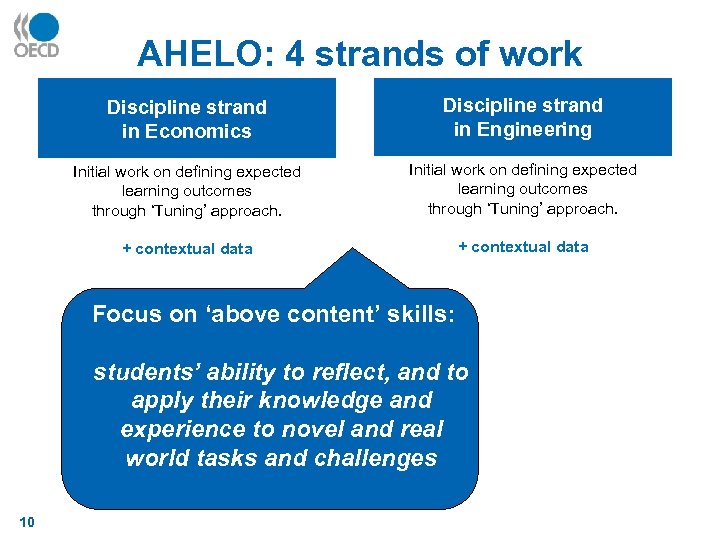
AHELO: 4 strands of work Discipline strand in Economics Discipline strand in Engineering Initial work on defining expected learning outcomes through ‘Tuning’ approach. + contextual data Focus on ‘above content’ skills: students’ ability to reflect, and to apply their knowledge and experience to novel and real world tasks and challenges 10
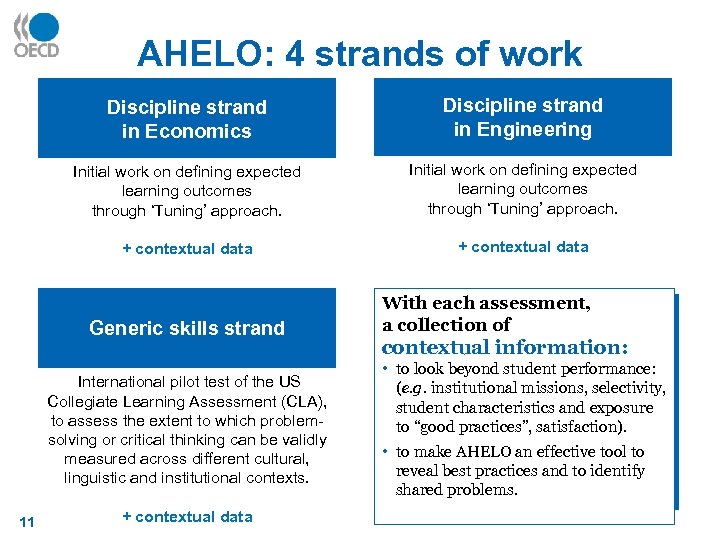
AHELO: 4 strands of work Discipline strand in Economics Discipline strand in Engineering Initial work on defining expected learning outcomes through ‘Tuning’ approach. + contextual data Generic skills strand International pilot test of the US Collegiate Learning Assessment (CLA), to assess the extent to which problemsolving or critical thinking can be validly measured across different cultural, linguistic and institutional contexts. 11 + contextual data With each assessment, a collection of contextual information: • to look beyond student performance: (e. g. institutional missions, selectivity, student characteristics and exposure to “good practices”, satisfaction). • to make AHELO an effective tool to reveal best practices and to identify shared problems.
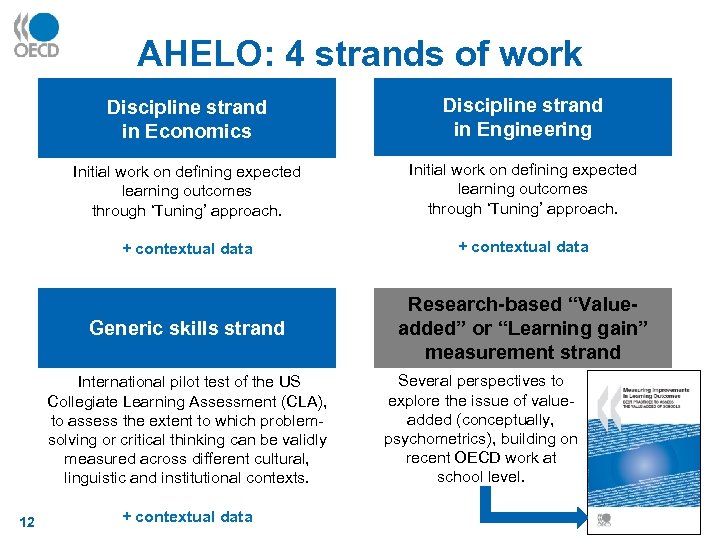
AHELO: 4 strands of work Discipline strand in Economics Discipline strand in Engineering Initial work on defining expected learning outcomes through ‘Tuning’ approach. + contextual data Generic skills strand Research-based “Valueadded” or “Learning gain” measurement strand International pilot test of the US Collegiate Learning Assessment (CLA), to assess the extent to which problemsolving or critical thinking can be validly measured across different cultural, linguistic and institutional contexts. 12 + contextual data Several perspectives to explore the issue of valueadded (conceptually, psychometrics), building on recent OECD work at school level.
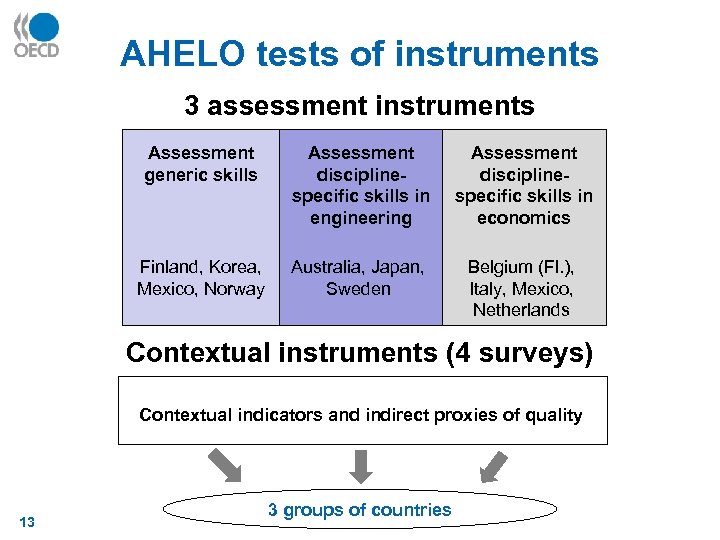
AHELO tests of instruments 3 assessment instruments Assessment generic skills Assessment disciplinespecific skills in engineering Assessment disciplinespecific skills in economics Finland, Korea, Mexico, Norway Australia, Japan, Sweden Belgium (Fl. ), Italy, Mexico, Netherlands Contextual instruments (4 surveys) Contextual indicators and indirect proxies of quality 13 3 groups of countries
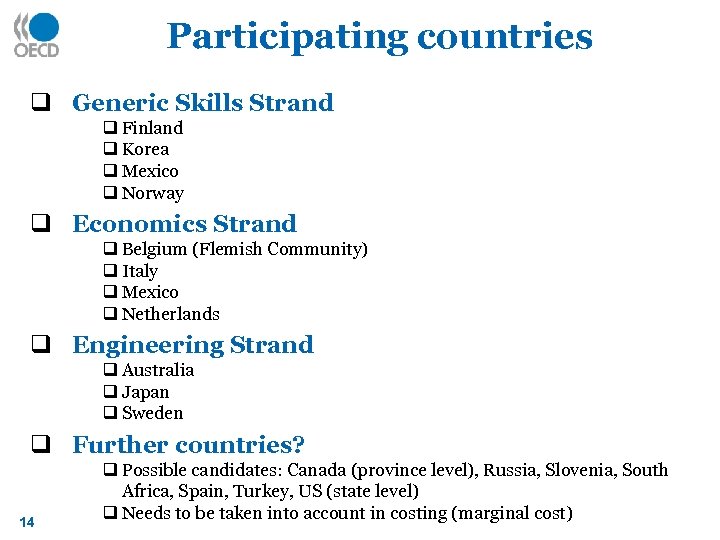
Participating countries q Generic Skills Strand q Finland q Korea q Mexico q Norway q Economics Strand q Belgium (Flemish Community) q Italy q Mexico q Netherlands q Engineering Strand q Australia q Japan q Sweden q Further countries? 14 q Possible candidates: Canada (province level), Russia, Slovenia, South Africa, Spain, Turkey, US (state level) q Needs to be taken into account in costing (marginal cost)
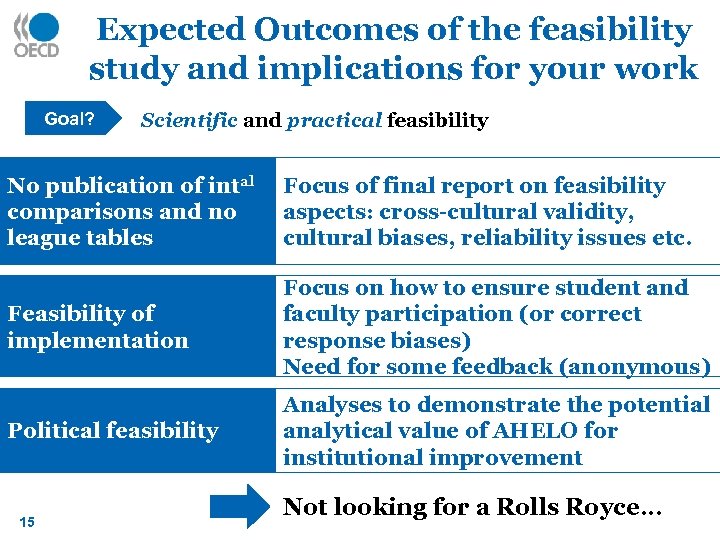
Expected Outcomes of the feasibility study and implications for your work Goal? Scientific and practical feasibility No publication of intal comparisons and no league tables Focus of final report on feasibility aspects: cross-cultural validity, cultural biases, reliability issues etc. Feasibility of implementation Focus on how to ensure student and faculty participation (or correct response biases) Need for some feedback (anonymous) Political feasibility Analyses to demonstrate the potential analytical value of AHELO for institutional improvement 15 Not looking for a Rolls Royce…
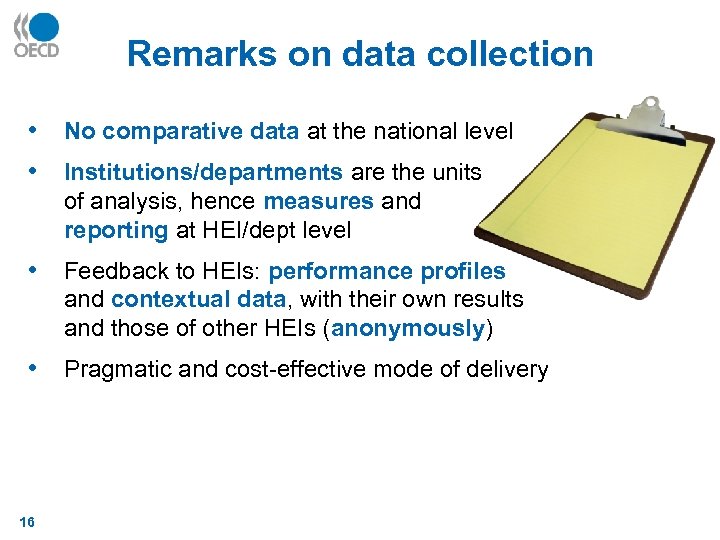
Remarks on data collection • No comparative data at the national level • Institutions/departments are the units of analysis, hence measures and reporting at HEI/dept level • Feedback to HEIs: performance profiles and contextual data, with their own results and those of other HEIs (anonymously) • Pragmatic and cost-effective mode of delivery 16
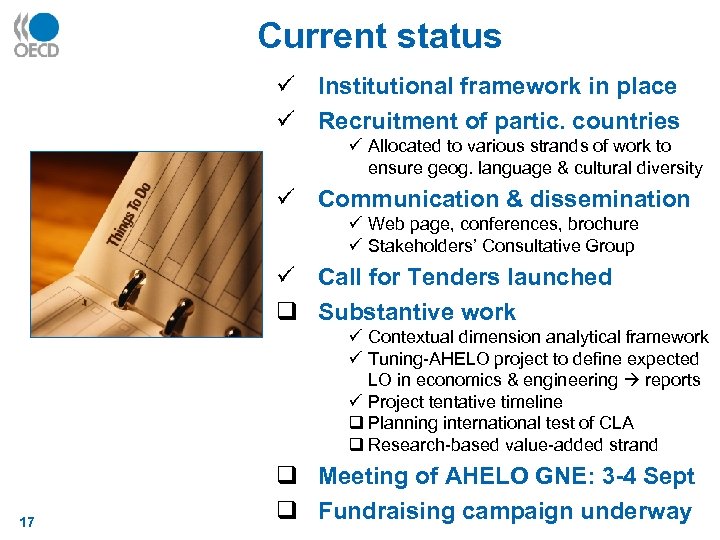
Current status ü Institutional framework in place ü Recruitment of partic. countries ü Allocated to various strands of work to ensure geog. language & cultural diversity ü Communication & dissemination ü Web page, conferences, brochure ü Stakeholders’ Consultative Group ü Call for Tenders launched q Substantive work ü Contextual dimension analytical framework ü Tuning-AHELO project to define expected LO in economics & engineering reports ü Project tentative timeline q Planning international test of CLA q Research-based value-added strand 17 q Meeting of AHELO GNE: 3 -4 Sept q Fundraising campaign underway
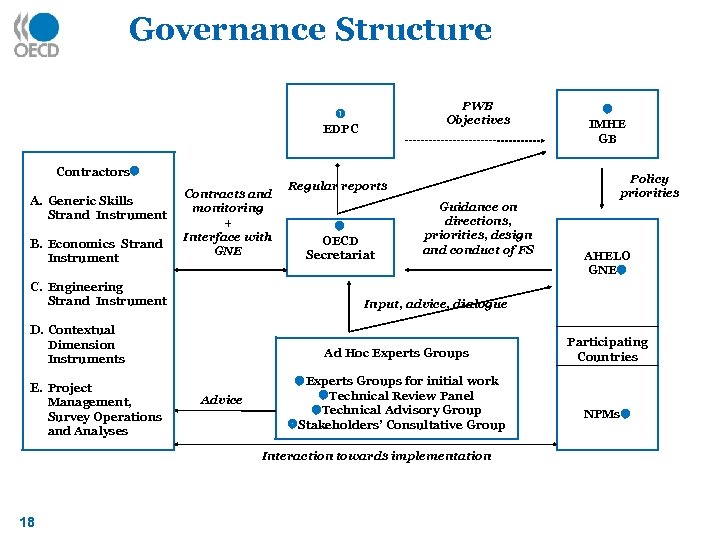
Governance Structure PWB Objectives EDPC Contractors A. Generic Skills Strand Instrument B. Economics Strand Instrument Contracts and monitoring + Interface with GNE C. Engineering Strand Instrument OECD Secretariat Guidance on directions, priorities, design and conduct of FS Ad Hoc Experts Groups Advice Experts Groups for initial work Technical Review Panel Technical Advisory Group Stakeholders’ Consultative Group Interaction towards implementation 18 Policy priorities AHELO GNE Input, advice, dialogue D. Contextual Dimension Instruments E. Project Management, Survey Operations and Analyses Regular reports IMHE GB Participating Countries NPMs
Part 2 – Terms of reference A. Rationale for modular approach B. Indicative timelines C. Statement of work D. Initial work provided for information 19
Rationale for Modular approach with a ‘coordination’ Module • Foster coherence and synergies across the • • • 20 • • • different strands (3 strands but a common goal) Benefits of more specialised expertise (few existing instruments to assess LO in HE) Benefits of pooling expertise of different contractors towards a common goals (e. g. analysis) Economies of scale (e. g. common sampling guidelines for all strands) Streamline communications across strands Incentive for cooperation between contractors Benefits of enhanced competition at Module level
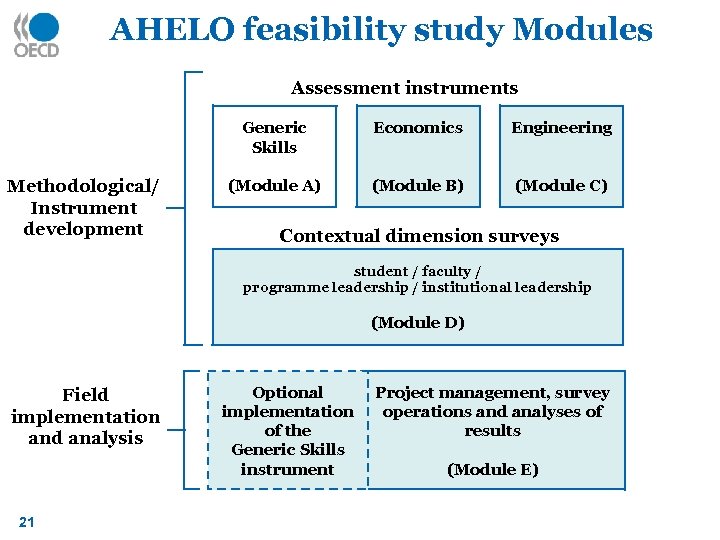
AHELO feasibility study Modules Assessment instruments Generic Skills Methodological/ Instrument development Economics Engineering (Module A) (Module B) (Module C) Contextual dimension surveys student / faculty / programme leadership / institutional leadership (Module D) Field implementation and analysis 21 Optional implementation of the Generic Skills instrument Project management, survey operations and analyses of results (Module E)
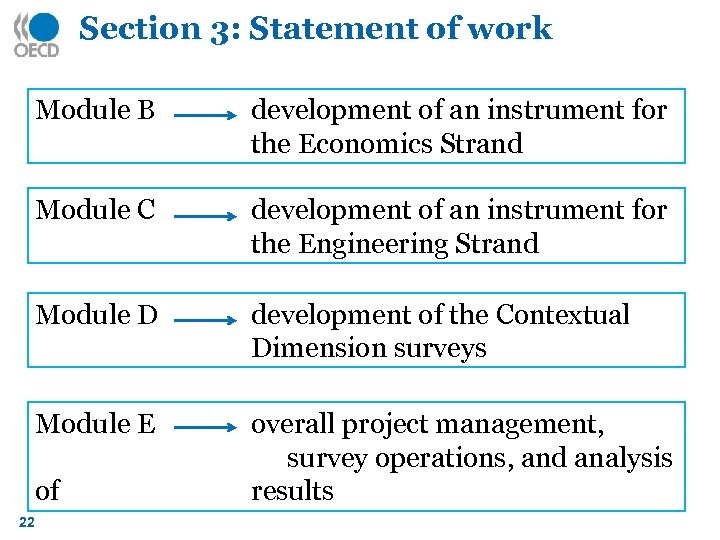
Section 3: Statement of work Module B development of an instrument for the Economics Strand Module C development of an instrument for the Engineering Strand Module D development of the Contextual Dimension surveys Module E overall project management, survey operations, and analysis results of 22
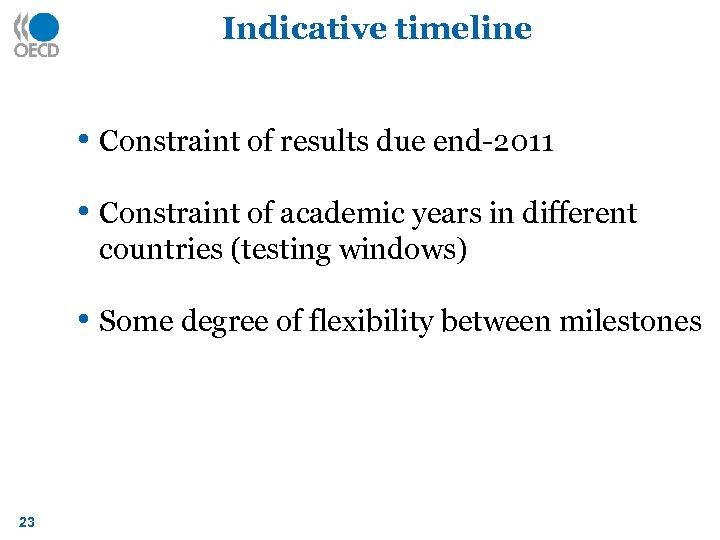
Indicative timeline • Constraint of results due end-2011 • Constraint of academic years in different countries (testing windows) • Some degree of flexibility between milestones 23
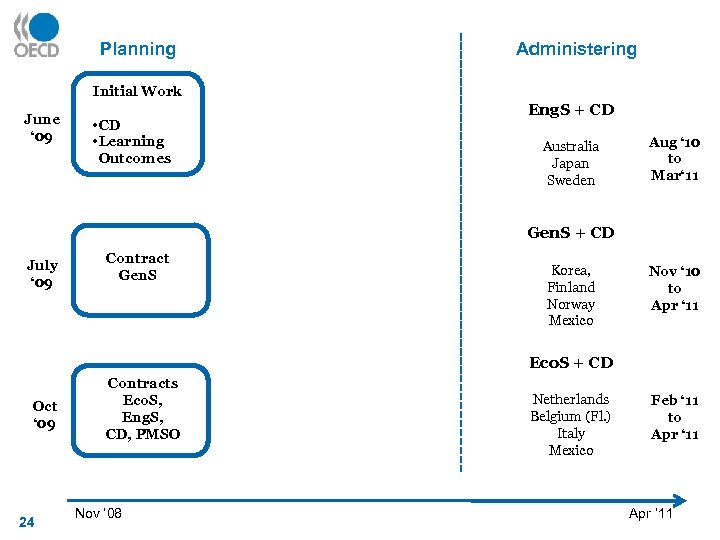
Planning Administering Initial Work June ‘ 09 • CD • Learning Outcomes Eng. S + CD Australia Japan Sweden Aug ‘ 10 to Mar‘ 11 Gen. S + CD July ‘ 09 Contract Gen. S Korea, Finland Norway Mexico Nov ‘ 10 to Apr ‘ 11 Eco. S + CD Oct ‘ 09 24 Contracts Eco. S, Eng. S, CD, PMSO Nov ‘ 08 Netherlands Belgium (Fl. ) Italy Mexico Feb ‘ 11 to Apr ‘ 11
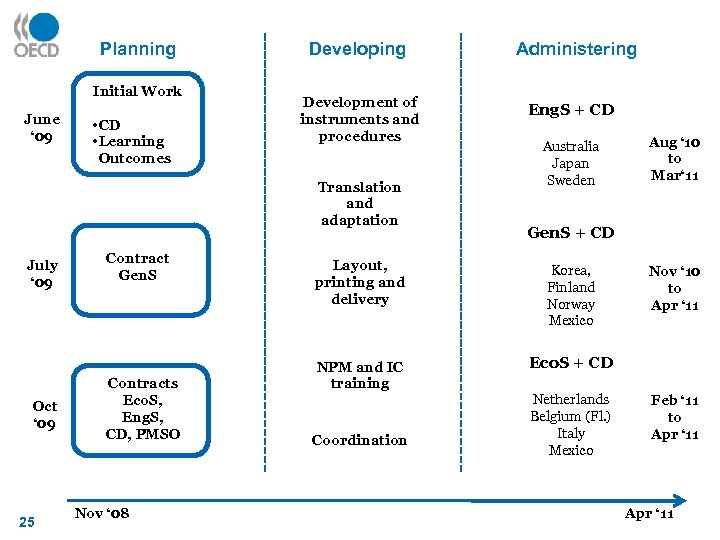
Planning Initial Work June ‘ 09 • CD • Learning Outcomes Developing Development of instruments and procedures Translation and adaptation July ‘ 09 Oct ‘ 09 25 Contract Gen. S Contracts Eco. S, Eng. S, CD, PMSO Nov ‘ 08 Administering Eng. S + CD Australia Japan Sweden Aug ‘ 10 to Mar‘ 11 Gen. S + CD Layout, printing and delivery Korea, Finland Norway Mexico NPM and IC training Eco. S + CD Coordination Netherlands Belgium (Fl. ) Italy Mexico Nov ‘ 10 to Apr ‘ 11 Feb ‘ 11 to Apr ‘ 11
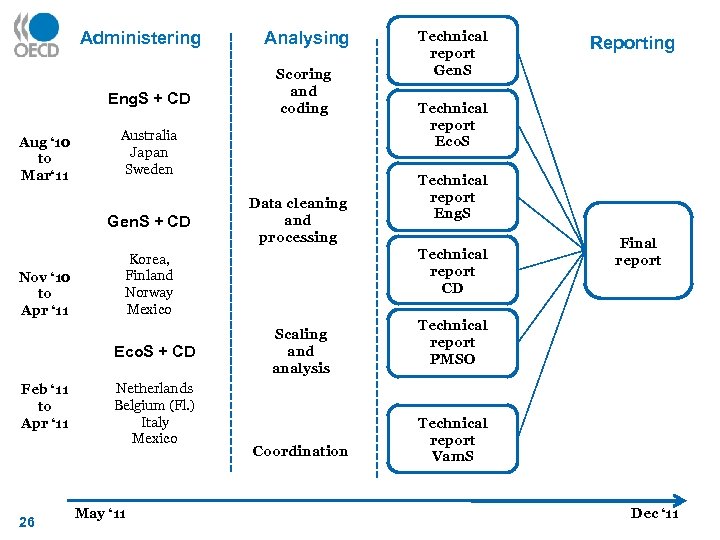
Administering Eng. S + CD Aug ‘ 10 to Mar‘ 11 26 Data cleaning and processing Netherlands Belgium (Fl. ) Italy Mexico May ‘ 11 Technical report Gen. S Scaling and analysis Coordination Reporting Technical report Eco. S Technical report Eng. S Technical report CD Korea, Finland Norway Mexico Eco. S + CD Feb ‘ 11 to Apr ‘ 11 Scoring and coding Australia Japan Sweden Gen. S + CD Nov ‘ 10 to Apr ‘ 11 Analysing Final report Technical report PMSO Technical report Vam. S Dec ‘ 11
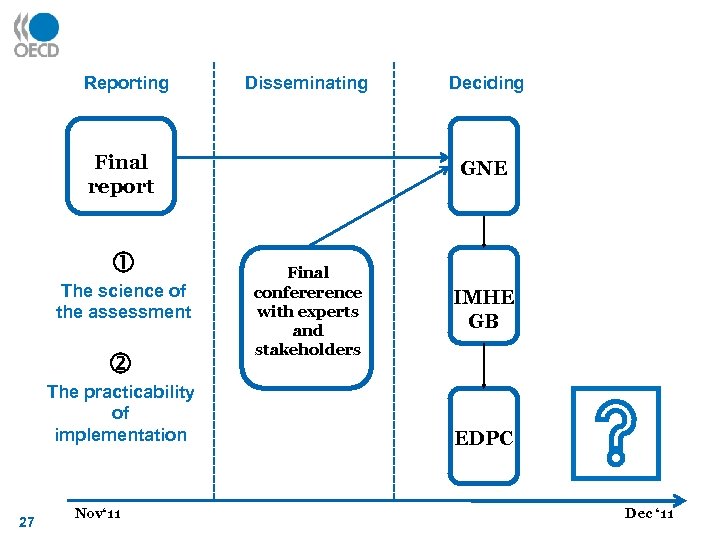
Reporting Disseminating Final report The science of the assessment The practicability of implementation 27 Nov‘ 11 Deciding GNE Final confererence with experts and stakeholders IMHE GB EDPC Dec ‘ 11
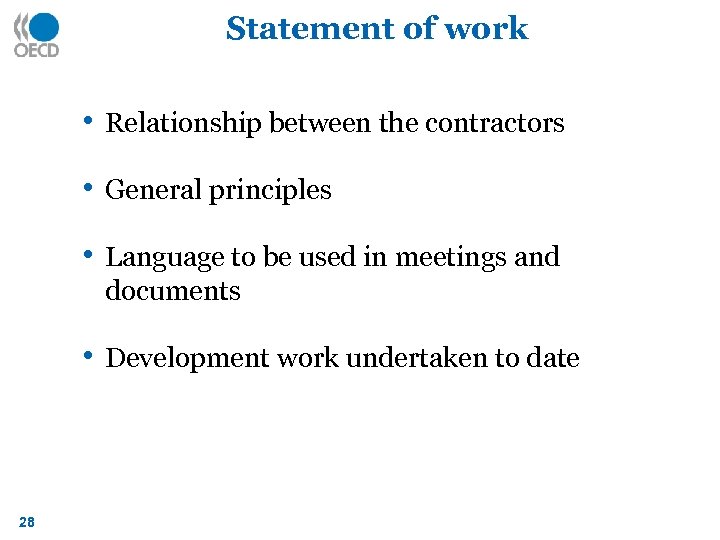
Statement of work • Relationship between the contractors • General principles • Language to be used in meetings and documents • Development work undertaken to date 28
Main tasks common to Modules B, C and D • Develop frameworks: instruments/surveys; • Develop and prepare instruments/surveys; • Contribute to the documentation of instruments/surveys and technical reports; • Work with the contractor for Module E on test delivery and analysis of results; and • Work closely with the contractor(s) undertaking other Modules. 29
Deliverables common to Modules B, C and D • Framework s and specifications; • Instruments/surveys; • Reports mapping items to framework; • Scoring/coding guides; and • Contributions to the analysis plan and to the technical and final reports. 30
Specific to Modules B and C Development of assessment instruments Assessment instruments • For two discipline-related competencies: Economics + Engineering • Aiming at ‘above content’ skills: Knowledge and skills essential for future life 31
Specific to Module D Development of the survey instruments for the Contextual Dimension Surveys instruments: • A student survey instrument (15 minutes); • A faculty survey instrument (15 minutes); • An institutional and a programme leadership surveys. 32
Module E Project management and survey operations Main tasks: • Develop an overall assessment design: • meeting the aims of the feasibility study; • coordination across the various strands of work; • analysis plan to assess the cross-national and cross-cultural validity of the instruments. • Define the student target population; • Establish and manage two groups: • NPM + TAG • Develop package for test delivery and support tools accordingly; 33
Module E Project management and survey operations Main tasks (continued): • Ensure the quality of translation/adaptation; • Establish survey procedures and operations; • Perform data verification and establish quality-control mechanisms; • Provide training and guidelines to NPMs and ICs; • Coordinate the implementation of the feasibility study; • Coordinate scaling and data analyses; and • Provide technical and analytical support for the final report. 34
Module E Project management and survey operations Deliverables: • The overall assessment design with analyses to assess the cross -national and cross-cultural validity of the various instruments; • The analysis plan, including • specification of the research questions posed by the various dimensions; • proposed analyses; and • criteria to assess success in these various dimensions; • The student sampling plans including the sampling manual for NPMs/ICs; 35
Module E Project management and survey operations Deliverables (continued): • The translation/adaptation guidelines and report on the translation/adaptation issues; • The documentation on survey procedures and quality assurance procedures: • Test administration procedures; • Technical standards; • Coding guides; and • Data management manual. • Cleaned databases with the associated documented data product; and • Analyses, tables and technical documentation for the final report. 36
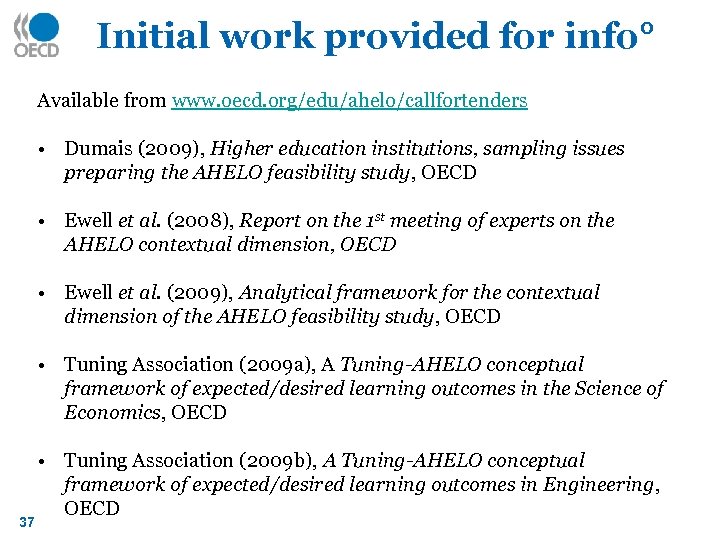
Initial work provided for info° Available from www. oecd. org/edu/ahelo/callfortenders • Dumais (2009), Higher education institutions, sampling issues preparing the AHELO feasibility study, OECD • Ewell et al. (2008), Report on the 1 st meeting of experts on the AHELO contextual dimension, OECD • Ewell et al. (2009), Analytical framework for the contextual dimension of the AHELO feasibility study, OECD • Tuning Association (2009 a), A Tuning-AHELO conceptual framework of expected/desired learning outcomes in the Science of Economics, OECD 37 • Tuning Association (2009 b), A Tuning-AHELO conceptual framework of expected/desired learning outcomes in Engineering, OECD
Part 3 – Submitting a proposal A. Composition of bidders’ proposals B. Evaluation process and criteria C. Practical aspects, hearings and commercial negotiations 38
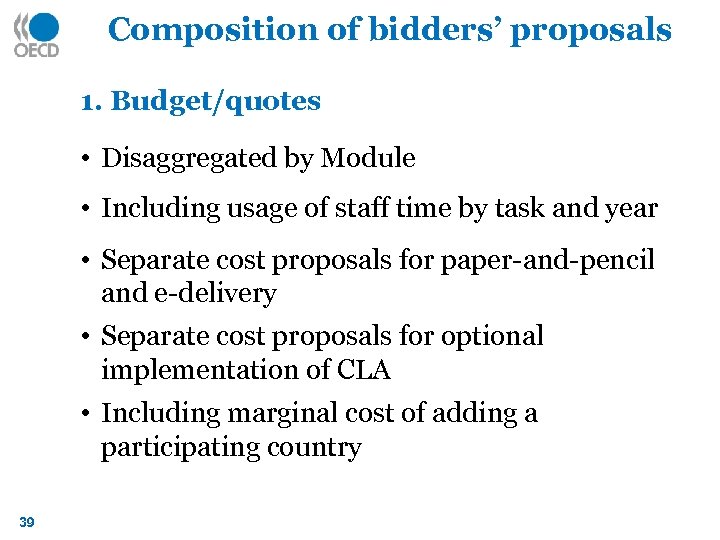
Composition of bidders’ proposals 1. Budget/quotes • Disaggregated by Module • Including usage of staff time by task and year • Separate cost proposals for paper-and-pencil and e-delivery • Separate cost proposals for optional implementation of CLA • Including marginal cost of adding a participating country 39
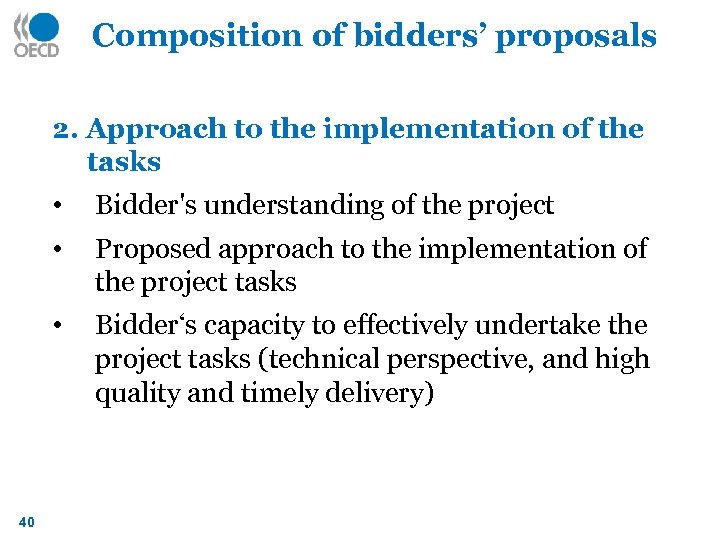
Composition of bidders’ proposals 2. Approach to the implementation of the tasks • • Proposed approach to the implementation of the project tasks • 40 Bidder's understanding of the project Bidder‘s capacity to effectively undertake the project tasks (technical perspective, and high quality and timely delivery)
Composition of bidders’ proposals 3. Organizational and management capacity • Bidder’s ability to develop collaborative working relationship with all actors/contractors and build consensus • Management structure (if sub-contractors), financial controls and quality assurance controls • Qualifications and experience of project staff • Organization’s past experience in large-scale assessment, surveys and international studies 41
Evaluation process First by a Technical Review Panel (TRP) • 4 assessment experts and 2 disciplinary experts (prof. engineering, economist) • Signed agreement stating absence of a conflict of interest and commitment not to work for any of the bidders for the duration of the FS • Shortlist proposals and recommendation to AHELO GNE Then by the AHELO Group of National Experts 42 • Shortlisted bidders will be invited to present their proposal to the AHELO GNE at its next meeting (3 -4 September, Paris) • Decision by AHELO GNE on the basis of TRP recommendation, outcomes of commercial negotiations, and presentations
Technical Review Panel (TRP) Step 1 – Quality • Technical review of individual proposals and their scoring against 4 pre-defined quality criteria • Comparative evaluation of acceptable proposals on the basis of quality Shortlist of acceptable proposals from quality perspective Step 2 – Value for money • Comparison of acceptable proposals on the basis of cost • Bonus points granted to those with best value for money 43 Overall comparative evaluation of trade-offs and recommendation to GNE Selection of proposals to be presented on 3 -4 Sept Report to GNE
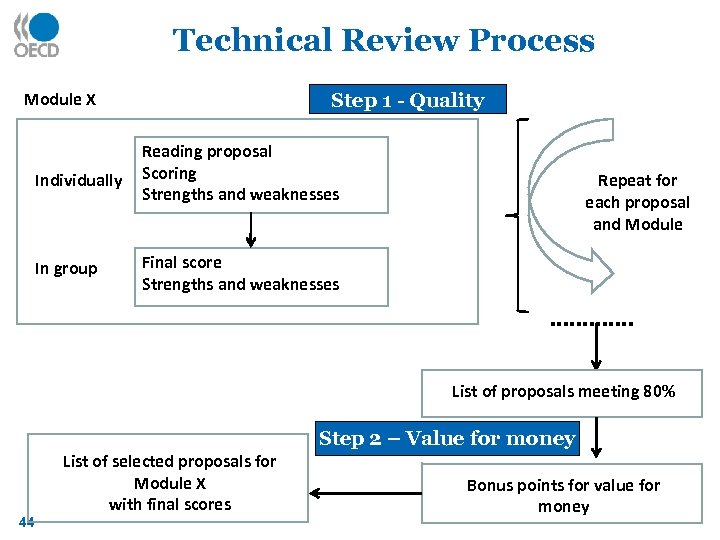
Technical Review Process Module X Step 1 - Quality Individually Reading proposal Scoring Strengths and weaknesses In group Final score Strengths and weaknesses Repeat for each proposal and Module List of proposals meeting 80% Step 2 – Value for money 44 List of selected proposals for Module X with final scores Bonus points for value for money
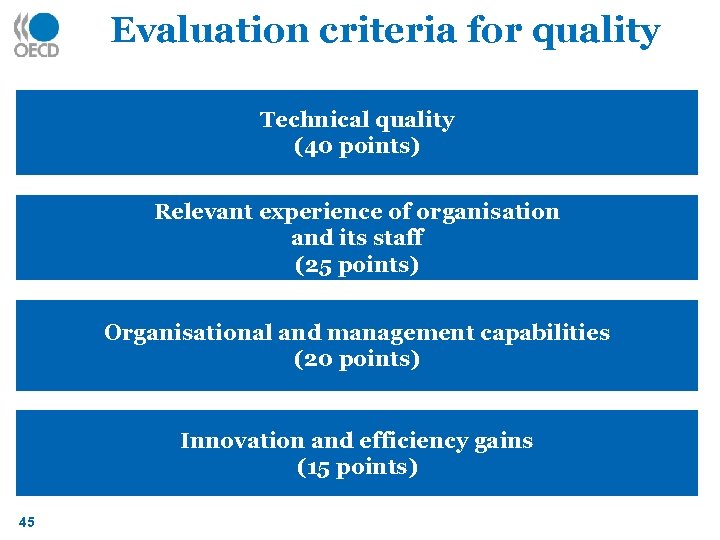
Evaluation criteria for quality Technical quality (40 points) Relevant experience of organisation and its staff (25 points) Organisational and management capabilities (20 points) Innovation and efficiency gains (15 points) 45
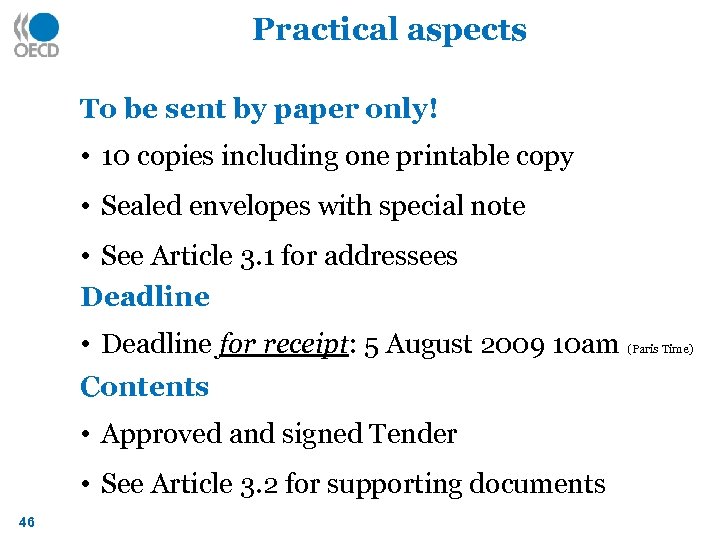
Practical aspects To be sent by paper only! • 10 copies including one printable copy • Sealed envelopes with special note • See Article 3. 1 for addressees Deadline • Deadline for receipt: 5 August 2009 10 am (Paris Time) Contents • Approved and signed Tender • See Article 3. 2 for supporting documents 46
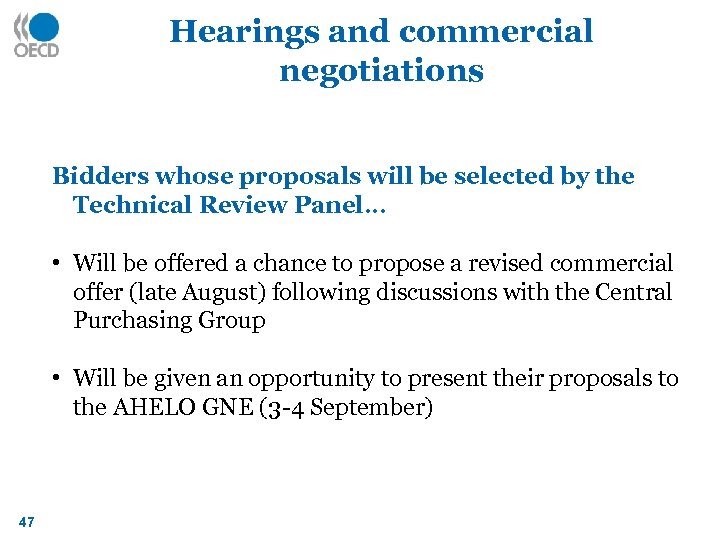
Hearings and commercial negotiations Bidders whose proposals will be selected by the Technical Review Panel… • Will be offered a chance to propose a revised commercial offer (late August) following discussions with the Central Purchasing Group • Will be given an opportunity to present their proposals to the AHELO GNE (3 -4 September) 47
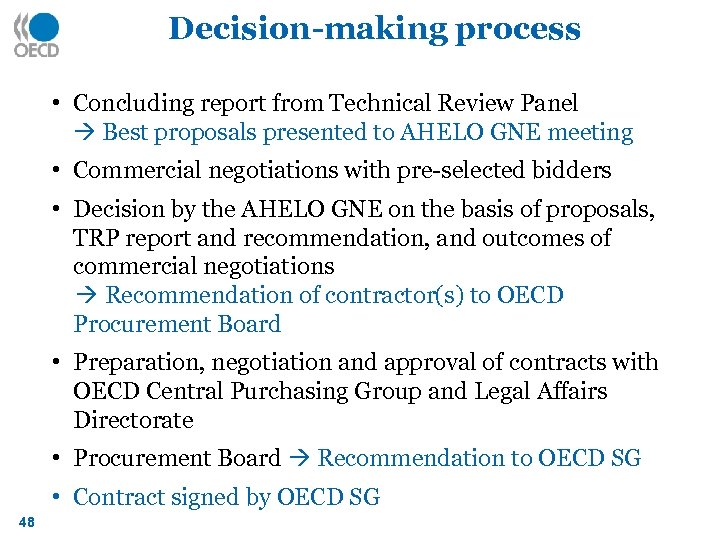
Decision-making process • Concluding report from Technical Review Panel Best proposals presented to AHELO GNE meeting • Commercial negotiations with pre-selected bidders • Decision by the AHELO GNE on the basis of proposals, TRP report and recommendation, and outcomes of commercial negotiations Recommendation of contractor(s) to OECD Procurement Board • Preparation, negotiation and approval of contracts with OECD Central Purchasing Group and Legal Affairs Directorate • Procurement Board Recommendation to OECD SG • Contract signed by OECD SG 48

Questions 49
Скачать презентацию Call for Tenders OECD Feasibility Study for an
bafc2ed8c51296b7bb5d82e3d2bbb901.ppt