


 Скачать презентацию Call Connection control Signalling the ITU-T
abc7fe8a971e479ca7491350e310e1e3.ppt
- Количество слайдов: 29
 Call & Connection control Signalling : the ITU-T SG 11 status and perspectives for “New Network control Architectures and Protocols” Alain LE ROUX ITU-T SG 11 Vice-chairman email: alainxavier. leroux@rd. francetelecom. com 1 Chitose, 9 -11 July 2002 ITU-T Workshop on IP/Optical
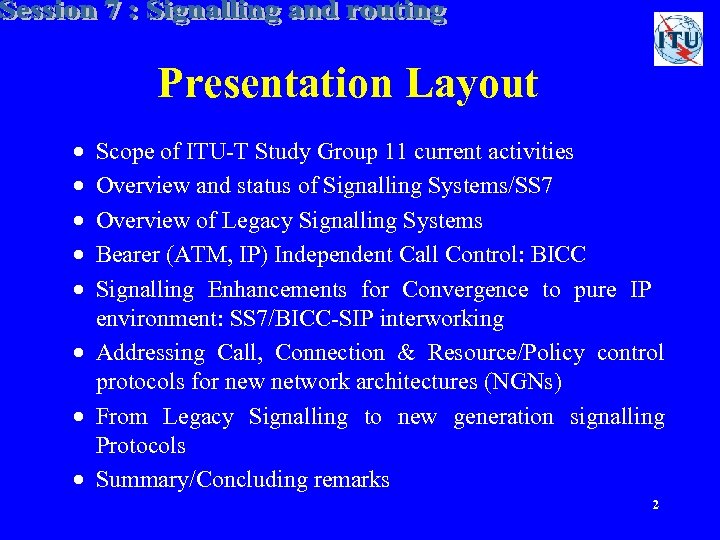 Presentation Layout · · · Scope of ITU-T Study Group 11 current activities Overview and status of Signalling Systems/SS 7 Overview of Legacy Signalling Systems Bearer (ATM, IP) Independent Call Control: BICC Signalling Enhancements for Convergence to pure IP environment: SS 7/BICC-SIP interworking · Addressing Call, Connection & Resource/Policy control protocols for new network architectures (NGNs) · From Legacy Signalling to new generation signalling Protocols · Summary/Concluding remarks 2
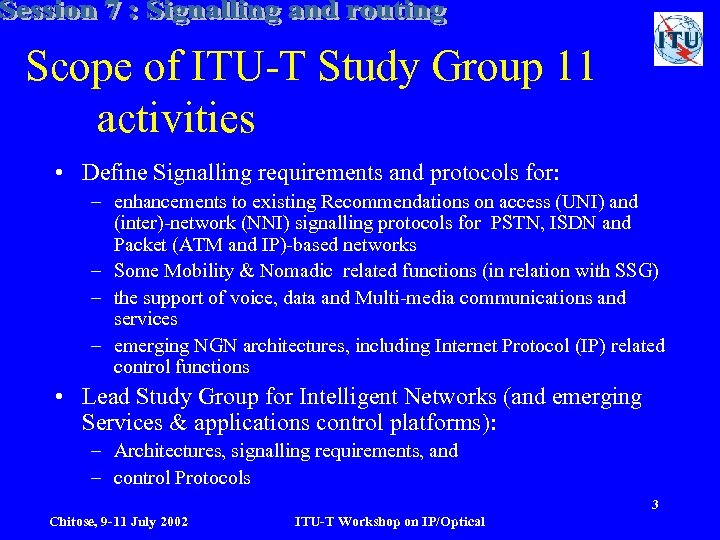 Scope of ITU-T Study Group 11 activities • Define Signalling requirements and protocols for: – enhancements to existing Recommendations on access (UNI) and (inter)-network (NNI) signalling protocols for PSTN, ISDN and Packet (ATM and IP)-based networks – Some Mobility & Nomadic related functions (in relation with SSG) – the support of voice, data and Multi-media communications and services – emerging NGN architectures, including Internet Protocol (IP) related control functions • Lead Study Group for Intelligent Networks (and emerging Services & applications control platforms): – Architectures, signalling requirements, and – control Protocols 3 Chitose, 9 -11 July 2002 ITU-T Workshop on IP/Optical
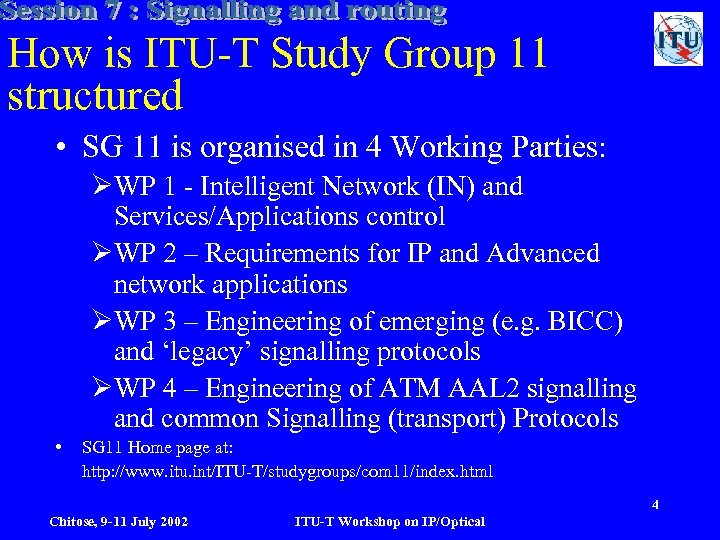 How is ITU-T Study Group 11 structured • SG 11 is organised in 4 Working Parties: ØWP 1 - Intelligent Network (IN) and Services/Applications control ØWP 2 – Requirements for IP and Advanced network applications ØWP 3 – Engineering of emerging (e. g. BICC) and ‘legacy’ signalling protocols ØWP 4 – Engineering of ATM AAL 2 signalling and common Signalling (transport) Protocols • SG 11 Home page at: http: //www. itu. int/ITU-T/studygroups/com 11/index. html 4 Chitose, 9 -11 July 2002 ITU-T Workshop on IP/Optical
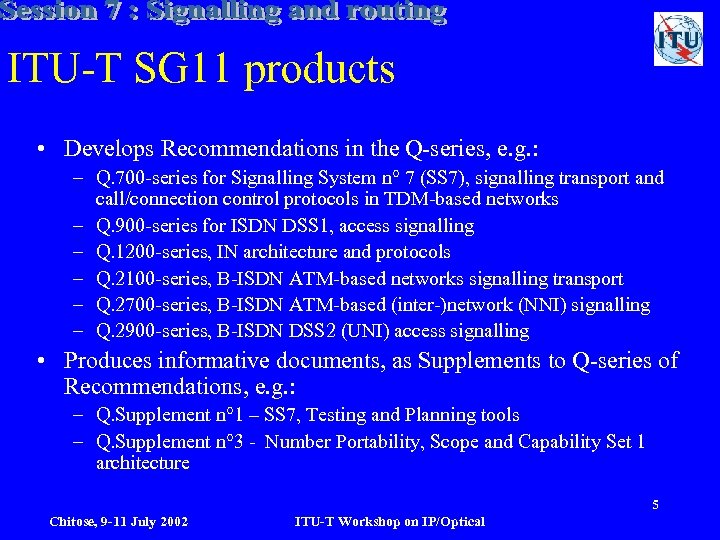 ITU-T SG 11 products • Develops Recommendations in the Q-series, e. g. : – Q. 700 -series for Signalling System n° 7 (SS 7), signalling transport and call/connection control protocols in TDM-based networks – Q. 900 -series for ISDN DSS 1, access signalling – Q. 1200 -series, IN architecture and protocols – Q. 2100 -series, B-ISDN ATM-based networks signalling transport – Q. 2700 -series, B-ISDN ATM-based (inter-)network (NNI) signalling – Q. 2900 -series, B-ISDN DSS 2 (UNI) access signalling • Produces informative documents, as Supplements to Q-series of Recommendations, e. g. : – Q. Supplement n° 1 – SS 7, Testing and Planning tools – Q. Supplement n° 3 - Number Portability, Scope and Capability Set 1 architecture 5 Chitose, 9 -11 July 2002 ITU-T Workshop on IP/Optical
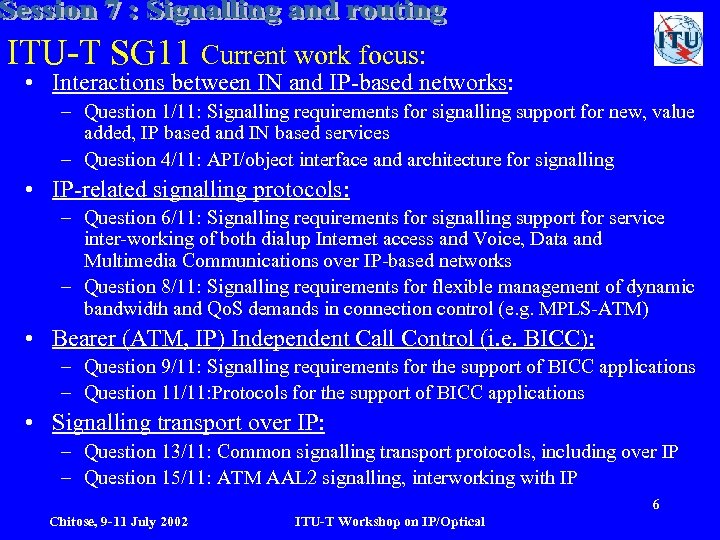 ITU-T SG 11 Current work focus: • Interactions between IN and IP-based networks: – Question 1/11: Signalling requirements for signalling support for new, value added, IP based and IN based services – Question 4/11: API/object interface and architecture for signalling • IP-related signalling protocols: – Question 6/11: Signalling requirements for signalling support for service inter-working of both dialup Internet access and Voice, Data and Multimedia Communications over IP-based networks – Question 8/11: Signalling requirements for flexible management of dynamic bandwidth and Qo. S demands in connection control (e. g. MPLS-ATM) • Bearer (ATM, IP) Independent Call Control (i. e. BICC): – Question 9/11: Signalling requirements for the support of BICC applications – Question 11/11: Protocols for the support of BICC applications • Signalling transport over IP: – Question 13/11: Common signalling transport protocols, including over IP – Question 15/11: ATM AAL 2 signalling, interworking with IP 6 Chitose, 9 -11 July 2002 ITU-T Workshop on IP/Optical
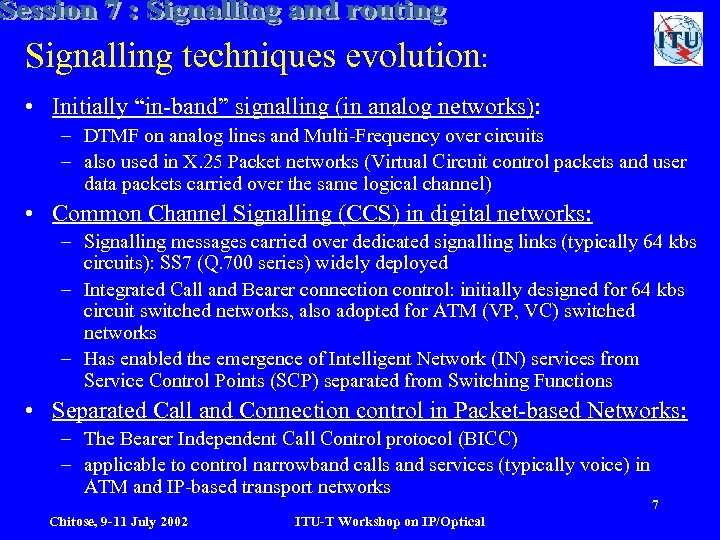 Signalling techniques evolution: • Initially “in-band” signalling (in analog networks): – DTMF on analog lines and Multi-Frequency over circuits – also used in X. 25 Packet networks (Virtual Circuit control packets and user data packets carried over the same logical channel) • Common Channel Signalling (CCS) in digital networks: – Signalling messages carried over dedicated signalling links (typically 64 kbs circuits): SS 7 (Q. 700 series) widely deployed – Integrated Call and Bearer connection control: initially designed for 64 kbs circuit switched networks, also adopted for ATM (VP, VC) switched networks – Has enabled the emergence of Intelligent Network (IN) services from Service Control Points (SCP) separated from Switching Functions • Separated Call and Connection control in Packet-based Networks: – The Bearer Independent Call Control protocol (BICC) – applicable to control narrowband calls and services (typically voice) in ATM and IP-based transport networks Chitose, 9 -11 July 2002 ITU-T Workshop on IP/Optical 7
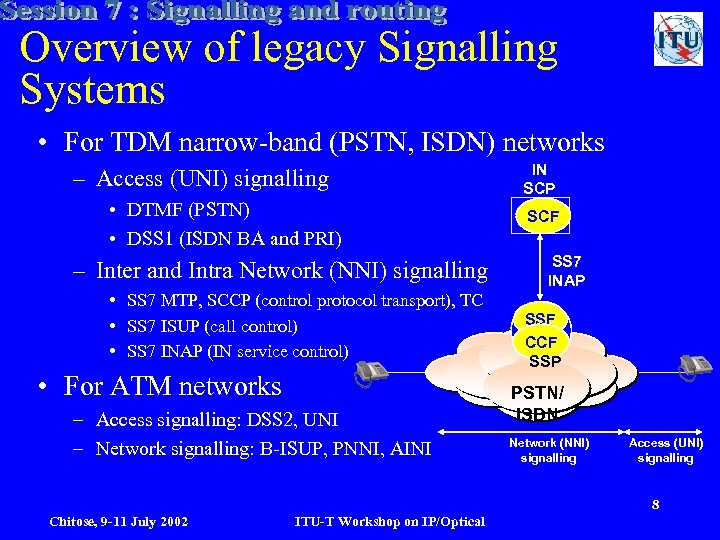 Overview of legacy Signalling Systems • For TDM narrow-band (PSTN, ISDN) networks – Access (UNI) signalling • DTMF (PSTN) • DSS 1 (ISDN BA and PRI) – Inter and Intra Network (NNI) signalling • SS 7 MTP, SCCP (control protocol transport), TC • SS 7 ISUP (call control) • SS 7 INAP (IN service control) • For ATM networks – Access signalling: DSS 2, UNI – Network signalling: B-ISUP, PNNI, AINI IN SCP SCF SS 7 INAP SSF CCF SSP PSTN/ ISDN Network (NNI) signalling Access (UNI) signalling 8 Chitose, 9 -11 July 2002 ITU-T Workshop on IP/Optical
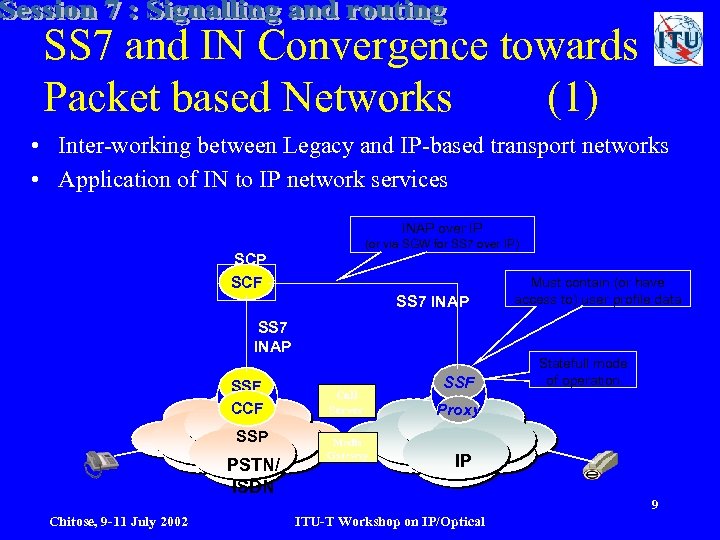 SS 7 and IN Convergence towards Packet based Networks (1) • Inter-working between Legacy and IP-based transport networks • Application of IN to IP network services INAP over IP (or via SGW for SS 7 over IP) SCP SCF SS 7 INAP Must contain (or have access to) user profile data SS 7 INAP SSF CCF SSP PSTN/ ISDN Call Server Media Gateway SSF Statefull mode of operation Proxy IP 9 Chitose, 9 -11 July 2002 ITU-T Workshop on IP/Optical
 SS 7 Convergence towards Packet based Networks (2) • Intelligent Network architecture and protocols enhanced to support the IETF PINT & SPIRITS services – IN Capability Set 4 (CS 4) Recommendations approved in May 2001, using a fast track approval process (i. e. AAP) • Q. 1241 – Introduction to IN CS 4 • Q. 1244 – Distributed Functional Plane for IN CS 4 • Q. 1248. 1 -7 – Interface Protocols for IN CS 4 – IN CS 4 Recommendations include support for the IETF • PINT (PSTN and Inter. Networking for Telephony), e. g. Click-to-dial, & • SPIRIT (Services in the PSTN/IN Requesting In. Ternet) Services, e. g. Internet Call Waiting (i. e. the requirements and architectures are in alignment). 10 Chitose, 9 -11 July 2002 ITU-T Workshop on IP/Optical
 SS 7 Convergence towards Packet based Networks (3) • For Call control signalling, Bearer Independent Call Control (BICC) protocols have been defined to apply over Packet (ATM or IP) based transport networks – BICC Capability Set 1 applicable to ATM (AAL 1 or AAL 2) transport: Recommendations have been approved in year 2000 – BICC CS 2 applicable to ATM and IP transport: a set of 15 Recommendations have been approved in June 2001. – A BICC CS 3 release with various enhancements (including interworking with SIP) is currently under development. Scope and requirements being finalized. Protocols documents approval planned in 2003. 11 Chitose, 9 -11 July 2002 ITU-T Workshop on IP/Optical
 BICC signalling protocol • The high level requirements – BICC is a Signalling protocol to ease PSTN/ISDN evolution towards (NGN) Next Generation Network (packet-based transport) architectures – Usable to control calls over any packet (ATM, IP) -based transport network – Simplifies the signalling interworking between legacy networks and NGN architectures • The solution developed in ITU-T SG 11: – The Bearer Independent Call Control (BICC) protocol – Based on SS 7 ISUP: quicker to define and to implement, easier ISUP-BICC inter-working – Multiple Capability Sets (or releases), enabling phased deployment and smooth evolution towards NGN architectures 12 Chitose, 9 -11 July 2002 ITU-T Workshop on IP/Optical
 BICC overview • What is BICC ? – an architecture that provides a means of supporting narrowband (PSTN, ISDN) services across a Packet-based backbone network without impacting the existing network interfaces and end-to-end services – a call control protocol that is unaware of the actual bearer transport being employed. Binding information identifies the bearer used for each communication instance – a call control protocol that is based on SS 7 ISUP signalling protocol commonly used in legacy networks for PSTN/ISDN intra- and internetworking – bearer (connection) control signalling protocols depend on the underlying bearer technology used (e. g. , DSS 2/UNI for ATM AAL type 1 and ATM AAL type 2, IP and/or MPLS related signalling protocols) 13 Chitose, 9 -11 July 2002 ITU-T Workshop on IP/Optical
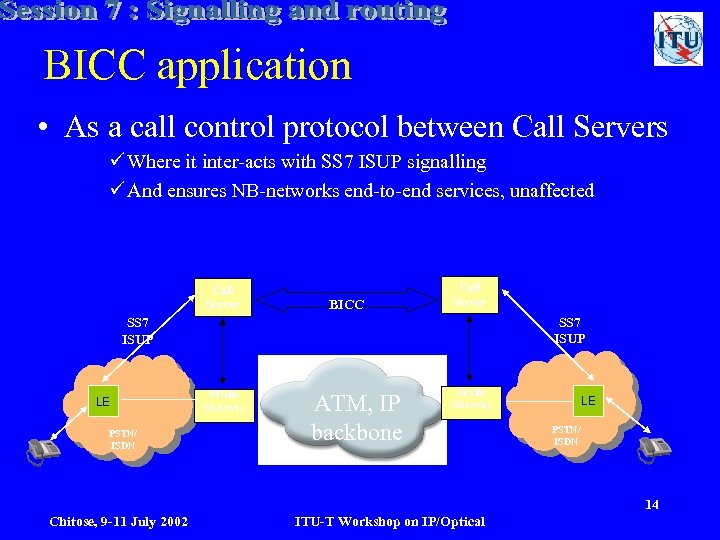 BICC application • As a call control protocol between Call Servers ü Where it inter-acts with SS 7 ISUP signalling ü And ensures NB-networks end-to-end services, unaffected Call Server BICC Call Server SS 7 ISUP LE PSTN/ ISDN Media Gateway ATM, IP backbone Media Gateway LE PSTN/ ISDN 14 Chitose, 9 -11 July 2002 ITU-T Workshop on IP/Optical
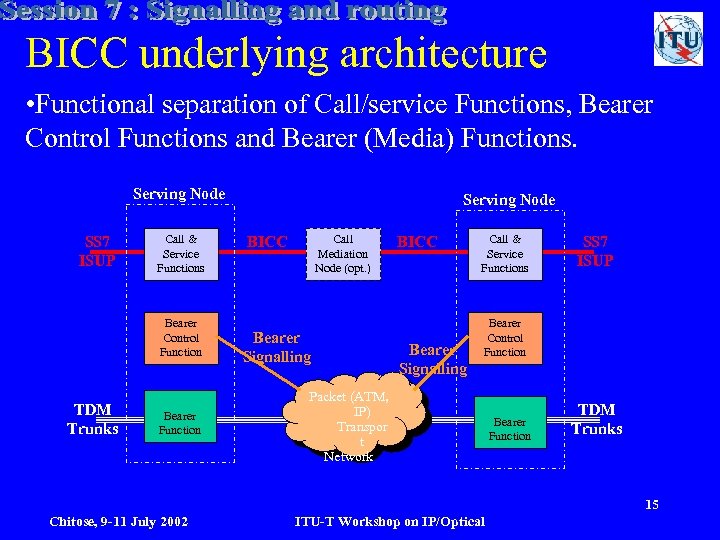 BICC underlying architecture • Functional separation of Call/service Functions, Bearer Control Functions and Bearer (Media) Functions. Serving Node SS 7 ISUP Call & Service Functions Bearer Control Function TDM Trunks Bearer Function Serving Node Call Mediation Node (opt. ) BICC Bearer Signalling Call & Service Functions SS 7 ISUP Bearer Control Function Packet (ATM, IP) Transpor t Network Bearer Function TDM Trunks 15 Chitose, 9 -11 July 2002 ITU-T Workshop on IP/Optical
 How the ITU BICC approach fits with that in IETF (1/4) Ø BICC is a pragmatic solution to enable evolution from legacy networks towards NGN architectures (using ATM and/or IP-based transport technologies) Ø It inter-acts easily with legacy signalling protocols (as it is very much based on SS 7 ISUP) Ø But it is not the only candidate protocol for call and service control in emerging networks: ü SIP and SIP-T are also under consideration for adoption by the ITU-T, for use between Call Servers (often referred to as Call Agent or “Softswitches”) Ø As such, the approaches are complementary 16 Chitose, 9 -11 July 2002 ITU-T Workshop on IP/Optical
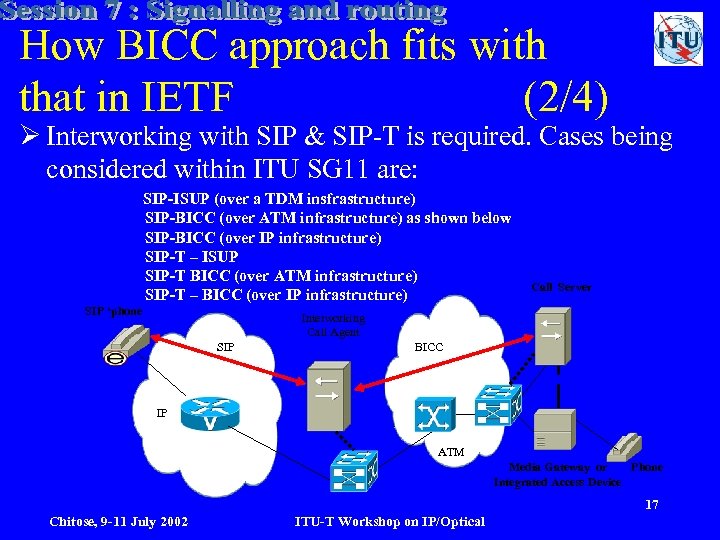 How BICC approach fits with that in IETF (2/4) Ø Interworking with SIP & SIP-T is required. Cases being considered within ITU SG 11 are: SIP-ISUP (over a TDM insfrastructure) SIP-BICC (over ATM infrastructure) as shown below SIP-BICC (over IP infrastructure) SIP-T – ISUP SIP-T BICC (over ATM infrastructure) SIP-T – BICC (over IP infrastructure) SIP ‘phone Call Server Interworking Call Agent SIP BICC IP ATM Media Gateway or Phone Integrated Access Device 17 Chitose, 9 -11 July 2002 ITU-T Workshop on IP/Optical
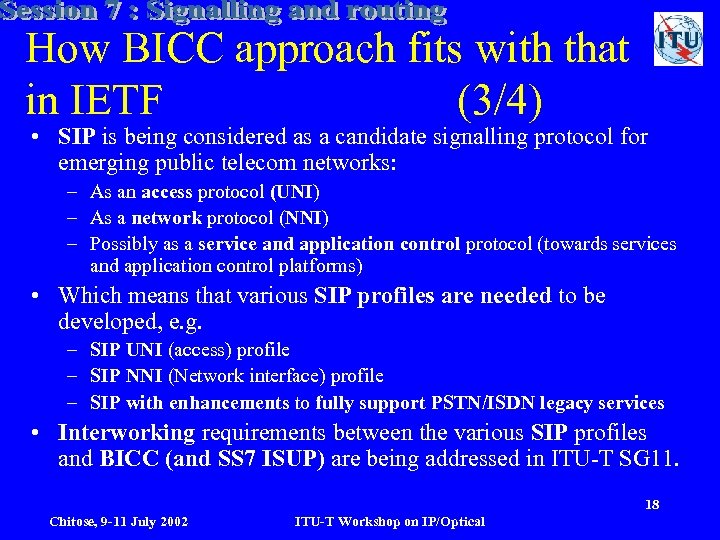 How BICC approach fits with that in IETF (3/4) • SIP is being considered as a candidate signalling protocol for emerging public telecom networks: – As an access protocol (UNI) – As a network protocol (NNI) – Possibly as a service and application control protocol (towards services and application control platforms) • Which means that various SIP profiles are needed to be developed, e. g. – SIP UNI (access) profile – SIP NNI (Network interface) profile – SIP with enhancements to fully support PSTN/ISDN legacy services • Interworking requirements between the various SIP profiles and BICC (and SS 7 ISUP) are being addressed in ITU-T SG 11. 18 Chitose, 9 -11 July 2002 ITU-T Workshop on IP/Optical
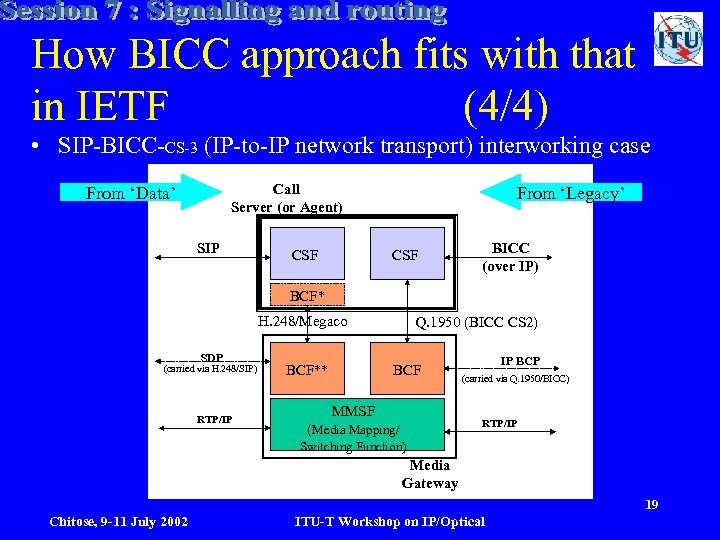 How BICC approach fits with that in IETF (4/4) • SIP-BICC-CS-3 (IP-to-IP network transport) interworking case Call Server (or Agent) From ‘Data’ SIP CSF From ‘Legacy’ CSF BICC (over IP) BCF* H. 248/Megaco SDP (carried via H. 248/SIP) RTP/IP BCF** Q. 1950 (BICC CS 2) BCF MMSF IP BCP (carried via Q. 1950/BICC) RTP/IP (Media Mapping/ Switching Function) Media Gateway 19 Chitose, 9 -11 July 2002 ITU-T Workshop on IP/Optical
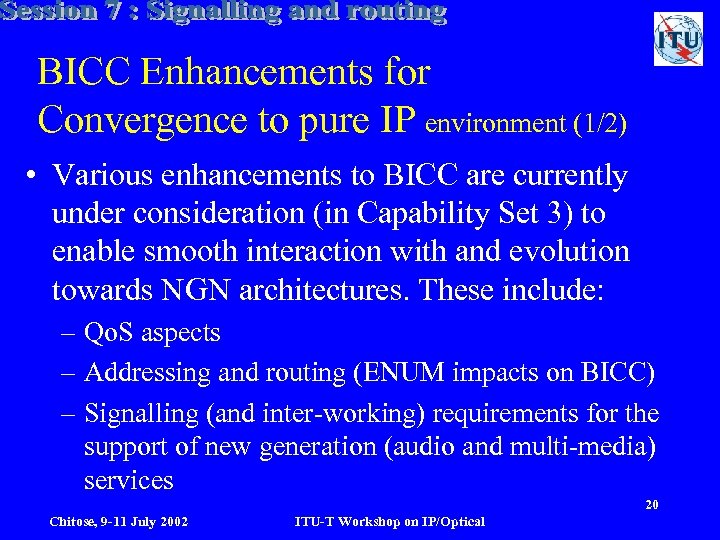 BICC Enhancements for Convergence to pure IP environment (1/2) • Various enhancements to BICC are currently under consideration (in Capability Set 3) to enable smooth interaction with and evolution towards NGN architectures. These include: – Qo. S aspects – Addressing and routing (ENUM impacts on BICC) – Signalling (and inter-working) requirements for the support of new generation (audio and multi-media) services 20 Chitose, 9 -11 July 2002 ITU-T Workshop on IP/Optical
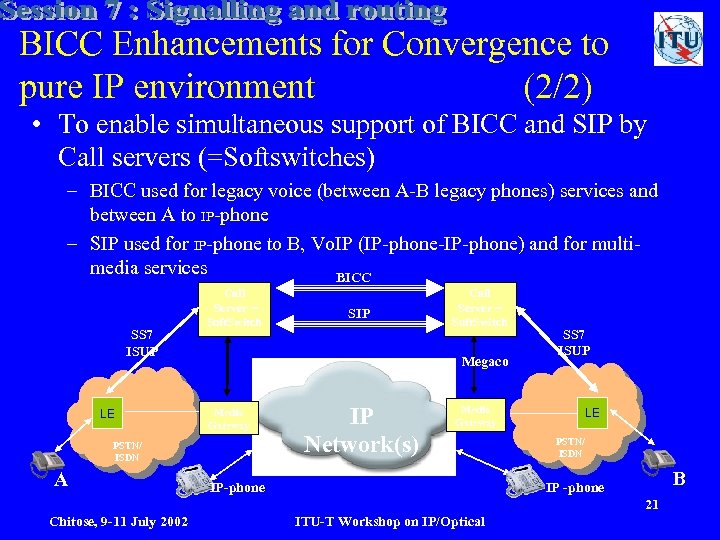 BICC Enhancements for Convergence to pure IP environment (2/2) • To enable simultaneous support of BICC and SIP by Call servers (=Softswitches) – BICC used for legacy voice (between A-B legacy phones) services and between A to IP-phone – SIP used for IP-phone to B, Vo. IP (IP-phone-IP-phone) and for multimedia services BICC SS 7 ISUP LE Call Server = Soft. Switch Megaco Media Gateway PSTN/ ISDN A SIP Call Server = Soft. Switch IP Network(s) SS 7 ISUP Media Gateway IP-phone LE PSTN/ ISDN B IP -phone 21 Chitose, 9 -11 July 2002 ITU-T Workshop on IP/Optical
 Role of BICC in emerging Telecom Networks • A pragmatic solution to evolve smoothly legacy networks towards more effective and more flexible network architectures – To support legacy services, – Offering an opportunity to share the same core network services and transport resources between legacy & IPbased networks users – With minimal investments (for enabling TDM->ATM>IP/MPLS switch-routing network evolutions) • Does not preclude the additional support of a more open and extensible signalling protocols such as SIP – For advanced multi-media and Internet oriented services – Either BICC or SIP being used on a per call/session basis Chitose, 9 -11 July 2002 ITU-T Workshop on IP/Optical 22
 Current status of the BICC use • By some fixed network operators, for TDM trunking replacement with ATM or IP transport technologies in core networks • In emerging 3 G mobile networks, to support voice traffic in the UTRAN (voice over ATM AAL type 2) – BICC is retained in 3 GPP R 99 and R 4 specifications • Some Call Servers (or Softswitches) start supporting BICC (CS 1 or CS 2) – And usually also support primarily SIP (for Vo. IP and multimedia communication services) 23 Chitose, 9 -11 July 2002 ITU-T Workshop on IP/Optical
 Call Control summary • BICC defined in ITU-T is seen as a pragmatic solution to ease transition from legacy to emerging packet-based (ATM, IP) network solutions – BICC-CS 1 and CS 2 are limited to the support of legacy services – CS 3 (under study) is expected to enable additional services • Other signalling protocols, such as SIP, are also expected to emerge in NGN architectures – To support more advanced (multi-media and IP based) services • Smooth Inter-action and interworking between both is seen as an ultimate requirement – Both are likely to co-exist in public networks for an interim period • NGN should ideally implement both to satisfy legacy network operators expectations – To enable both legacy and new generation services offering 24 Chitose, 9 -11 July 2002 ITU-T Workshop on IP/Optical
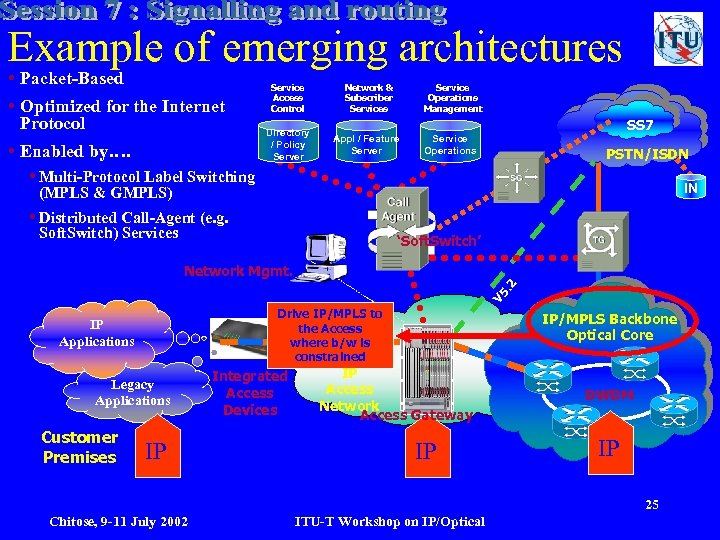 Example of emerging architectures Packet-Based Optimized for the Internet Protocol Enabled by…. Service Access Control Directory / Policy Server Network & Subscriber Services Service Operations Management Appl / Feature Server SS 7 Service Operations PSTN/ISDN Multi-Protocol Label Switching (MPLS & GMPLS) IN Distributed Call-Agent (e. g. Soft. Switch) Services ‘Soft. Switch’ V 5 . 2 Network Mgmt. Drive IP/MPLS to the Access where b/w is constrained IP Applications Legacy Applications Customer Premises IP Integrated Access Devices IP/MPLS Backbone Optical Core IP Access Network Access Gateway IP DWDM IP 25 Chitose, 9 -11 July 2002 ITU-T Workshop on IP/Optical
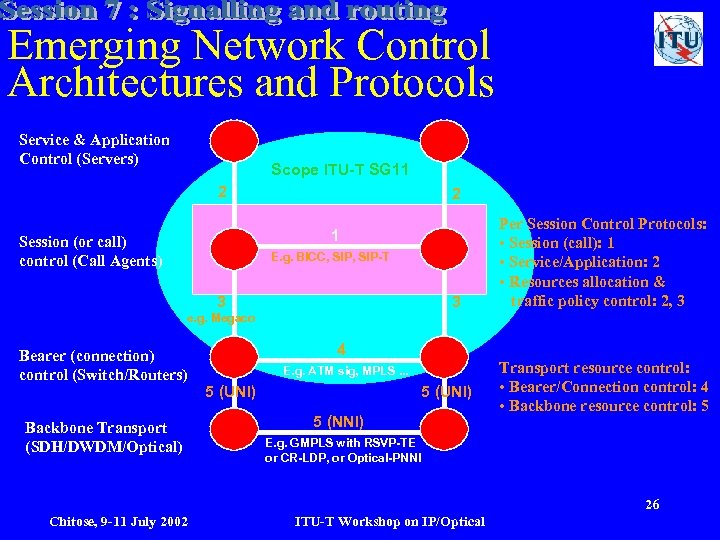 Emerging Network Control Architectures and Protocols Service & Application Control (Servers) Scope ITU-T SG 11 2 2 1 Session (or call) control (Call Agents) E. g. BICC, SIP-T 3 3 Per Session Control Protocols: • Session (call): 1 • Service/Application: 2 • Resources allocation & traffic policy control: 2, 3 e. g. Megaco Bearer (connection) control (Switch/Routers) Backbone Transport (SDH/DWDM/Optical) 4 E. g. ATM sig, MPLS. . . 5 (UNI) 5 (NNI) Transport resource control: • Bearer/Connection control: 4 • Backbone resource control: 5 E. g. GMPLS with RSVP-TE or CR-LDP, or Optical-PNNI 26 Chitose, 9 -11 July 2002 ITU-T Workshop on IP/Optical
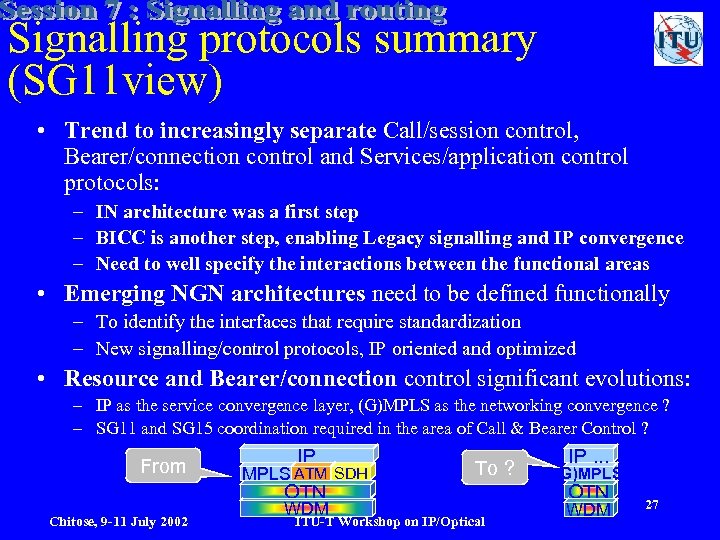 Signalling protocols summary (SG 11 view) • Trend to increasingly separate Call/session control, Bearer/connection control and Services/application control protocols: – IN architecture was a first step – BICC is another step, enabling Legacy signalling and IP convergence – Need to well specify the interactions between the functional areas • Emerging NGN architectures need to be defined functionally – To identify the interfaces that require standardization – New signalling/control protocols, IP oriented and optimized • Resource and Bearer/connection control significant evolutions: – IP as the service convergence layer, (G)MPLS as the networking convergence ? – SG 11 and SG 15 coordination required in the area of Call & Bearer Control ? From IP MPLS ATM SDH To ? OTN Chitose, 9 -11 July 2002 WDM ITU-T Workshop on IP/Optical IP. . . (G)MPLS OTN WDM 27
 N 2 CAP ? towards NGN Thank You for your attention 28 Chitose, 9 -11 July 2002 ITU-T Workshop on IP/Optical
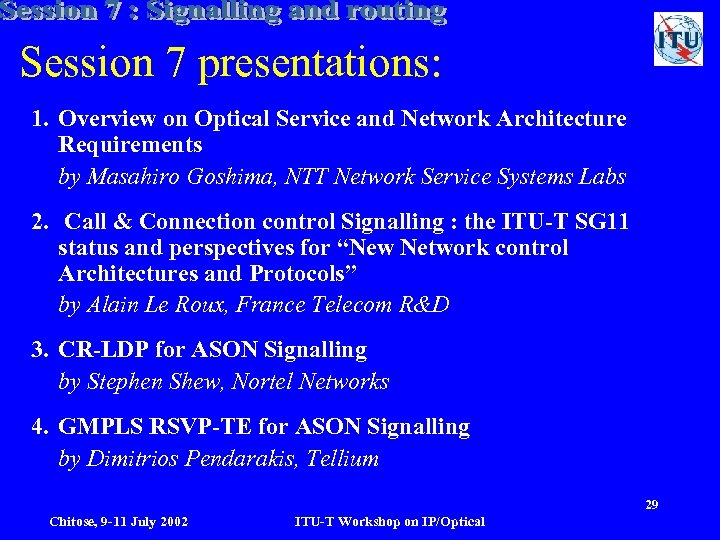 Session 7 presentations: 1. Overview on Optical Service and Network Architecture Requirements by Masahiro Goshima, NTT Network Service Systems Labs 2. Call & Connection control Signalling : the ITU-T SG 11 status and perspectives for “New Network control Architectures and Protocols” by Alain Le Roux, France Telecom R&D 3. CR-LDP for ASON Signalling by Stephen Shew, Nortel Networks 4. GMPLS RSVP-TE for ASON Signalling by Dimitrios Pendarakis, Tellium 29 Chitose, 9 -11 July 2002 ITU-T Workshop on IP/Optical