


 Скачать презентацию California Stormwater Quality Association Presents A Workshop Introducing
85615c16ef06c13a2b08da69c2c5e692.ppt
- Количество слайдов: 120
 California Stormwater Quality Association Presents A Workshop Introducing the California Stormwater Best Management Practice Handbook Industrial - Commercial February 25, 2004
 Workshop Agenda u Welcome u Introduction, Acknowledgements, and Background u Stormwater Pollution Prevention Planning for Industrial and Commercial Facilities u Break u Selecting BMPs u u Source Control BMPs Commercial Guide Sheets u Municipal Industrial Stormwater Program
 Workshop Purpose u Introduce the California Stormwater Quality Handbooks u u New Development and Redevelopment Handbook (New) Construction Handbook (Updated) Industrial – Commercial Handbook (Updated) Municipal Handbook (Updated) u Provide a detailed overview of the Industrial - Commercial Handbook
 California Stormwater Best Management Practice Handbook Industrial - Commercial Introduction, Acknowledgements and Background Presented by Jeff Endicott CDM
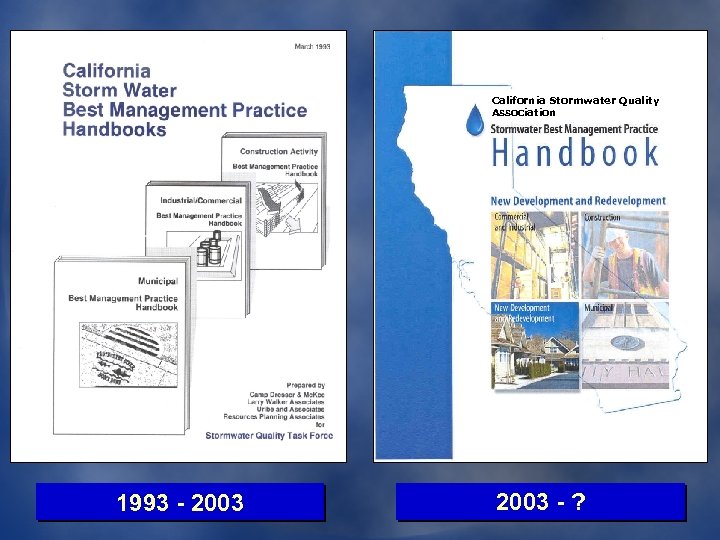 California Stormwater Quality Association 1993 - 2003 - ?
 The Association remains focused on the same mission u Members benefit from the collaborative environment u Timely information on regulatory changes u Presentations on the leading edge of stormwater quality management u Provides a forum for a common voice on statewide and national stormwater issues Assist in the development and implementation of meaningful and feasible stormwater programs
 A diverse member base represents the different stormwater perspectives u Phase I MS 4 s u Phase II MS 4 s u Port Districts u Industries u Federal facilities u Water agencies u Consultants u Industry associations u Vendors u Law firms State Board and Regional Board Staff, and US EPA Region 9 staff remain actively involved in CASQA
 There are several membership options u Membership is open to holders of NPDES stormwater permits u Affiliate membership is available to storm water professionals, trade associations or non-profit groups u Directors are elected from the NPDES permit holding members, and two at large members u The Executive Program Committee is drawn from all classes of members
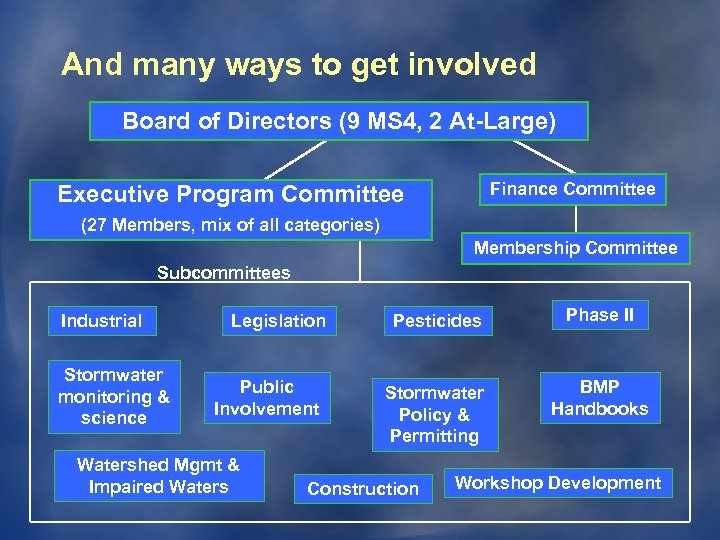 And many ways to get involved Board of Directors (9 MS 4, 2 At-Large) Finance Committee Executive Program Committee (27 Members, mix of all categories) Membership Committee Subcommittees Industrial Stormwater monitoring & science Legislation Public Involvement Watershed Mgmt & Impaired Waters Pesticides Phase II Stormwater Policy & Permitting BMP Handbooks Construction Workshop Development
 For 14 years this association has been a leading voice in stormwater issues Comments on permit development and develop guidance to assist dischargers u Developed consensus receiving water language and comment of precedent setting orders u Input on permit fee structure u Forum for exchange of public information program information and media campaign coordination u Comment on re-registrations that may affect water quality u Educate dischargers on TMDLs and provide input into their development u And the list goes on…
 Where to get more information u CASQA Web site u www. casqa. org u California BMP Handbooks Web site: u www. CABMPHandbooks. com u Sign up for the meeting notice e-mail list u kashby@lwa. com
 Questions?
 California Stormwater Best Management Practice Handbook Industrial - Commercial Acknowledgements
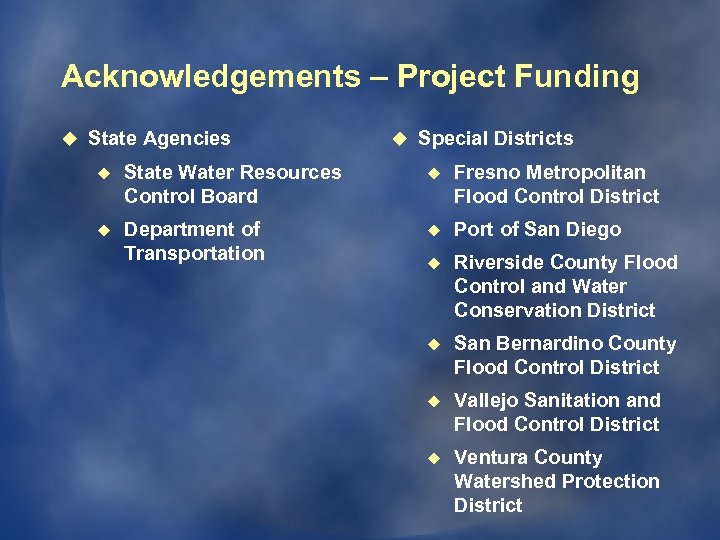 Acknowledgements – Project Funding u State Agencies u Special Districts u State Water Resources Control Board u Fresno Metropolitan Flood Control District u Department of Transportation u Port of San Diego u Riverside County Flood Control and Water Conservation District u San Bernardino County Flood Control District u Vallejo Sanitation and Flood Control District u Ventura County Watershed Protection District
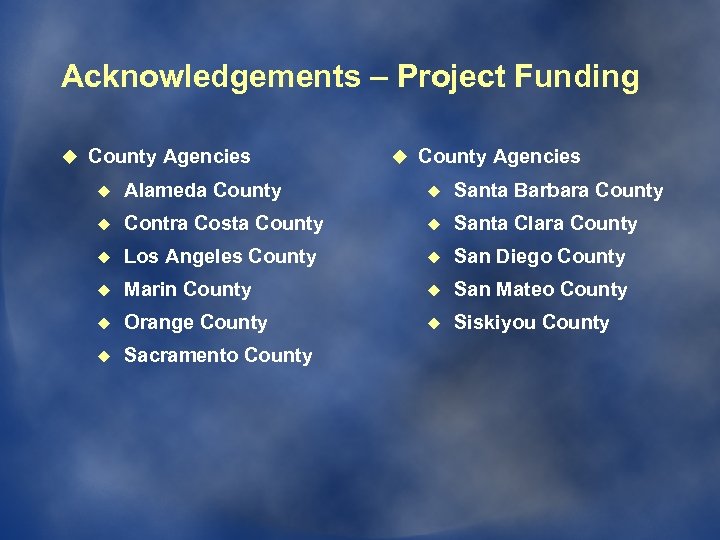 Acknowledgements – Project Funding u County Agencies u Alameda County u Santa Barbara County u Contra Costa County u Santa Clara County u Los Angeles County u San Diego County u Marin County u San Mateo County u Orange County u Siskiyou County u Sacramento County
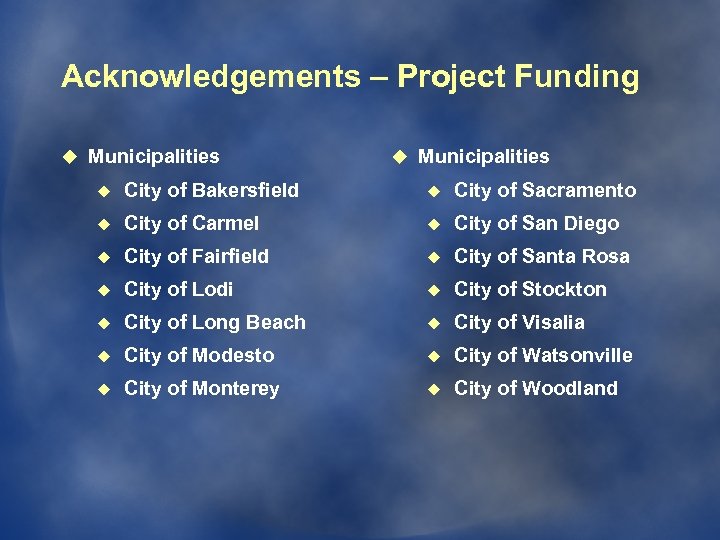 Acknowledgements – Project Funding u Municipalities u City of Bakersfield u City of Sacramento u City of Carmel u City of San Diego u City of Fairfield u City of Santa Rosa u City of Lodi u City of Stockton u City of Long Beach u City of Visalia u City of Modesto u City of Watsonville u City of Monterey u City of Woodland
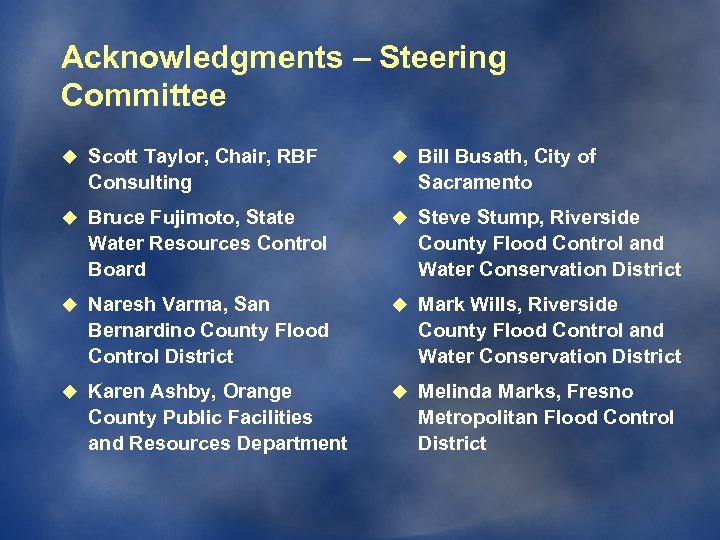 Acknowledgments – Steering Committee u Scott Taylor, Chair, RBF Consulting u Bruce Fujimoto, State Water Resources Control Board u Naresh Varma, San Bernardino County Flood Control District u Karen Ashby, Orange County Public Facilities and Resources Department u Bill Busath, City of Sacramento u Steve Stump, Riverside County Flood Control and Water Conservation District u Mark Wills, Riverside County Flood Control and Water Conservation District u Melinda Marks, Fresno Metropolitan Flood Control District
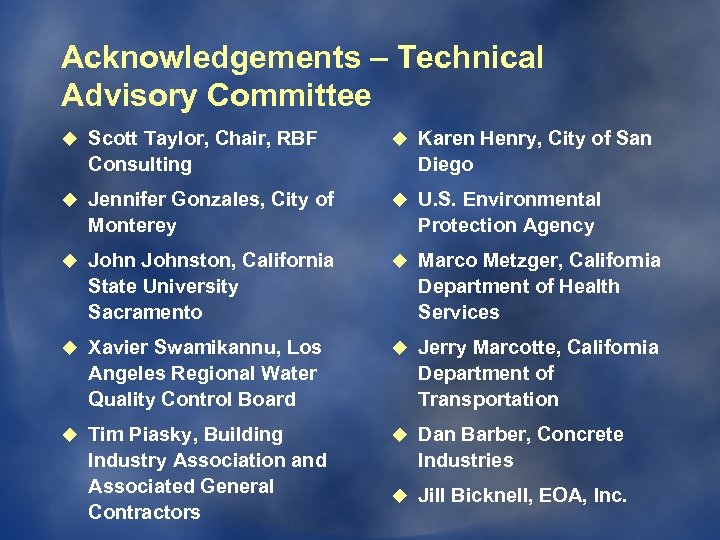 Acknowledgements – Technical Advisory Committee u Scott Taylor, Chair, RBF Consulting u Jennifer Gonzales, City of Monterey u Johnston, California State University Sacramento u Xavier Swamikannu, Los Angeles Regional Water Quality Control Board u Tim Piasky, Building Industry Association and Associated General Contractors u Karen Henry, City of San Diego u U. S. Environmental Protection Agency u Marco Metzger, California Department of Health Services u Jerry Marcotte, California Department of Transportation u Dan Barber, Concrete Industries u Jill Bicknell, EOA, Inc.
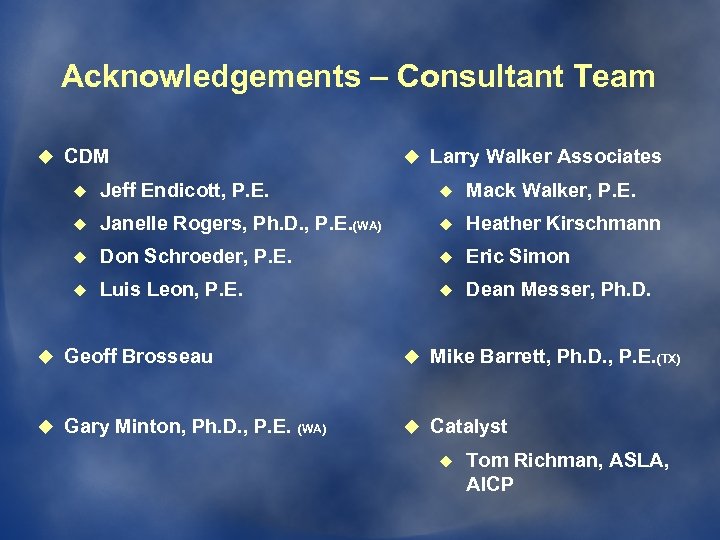 Acknowledgements – Consultant Team u CDM u Larry Walker Associates u Jeff Endicott, P. E. u Mack Walker, P. E. u Janelle Rogers, Ph. D. , P. E. (WA) u Heather Kirschmann u Don Schroeder, P. E. u Eric Simon u Luis Leon, P. E. u Dean Messer, Ph. D. u Geoff Brosseau u Gary Minton, Ph. D. , P. E. u Mike Barrett, Ph. D. , P. E. (TX) (WA) u Catalyst u Tom Richman, ASLA, AICP
 California Stormwater Best Management Practice Handbook Industrial - Commercial Background
 Stormwater Pollutants & Water Quality u Stormwater runoff naturally contains numerous constituents u Urbanization and urban activities, including industrial and commercial facilities and activities, may introduce additional constituents to runoff that can adversely impact water quality u u Sediment Nutrients u Bacteria and viruses Oil and grease u u u Metals Organics Pesticides Trash
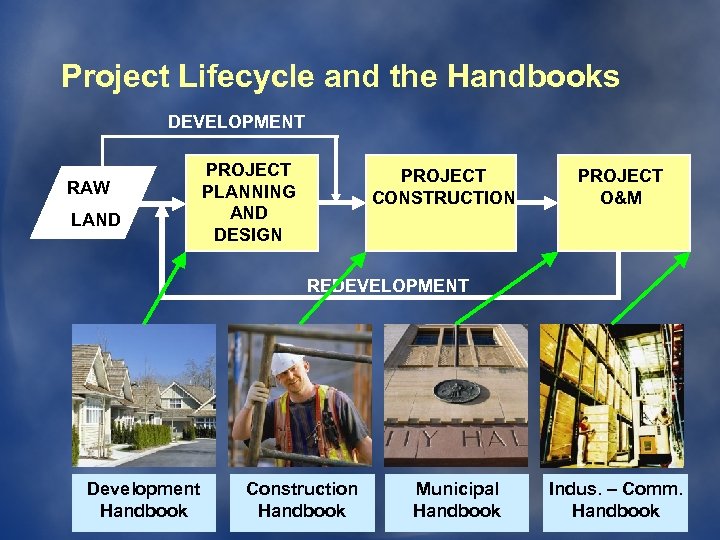 Project Lifecycle and the Handbooks DEVELOPMENT RAW LAND PROJECT PLANNING AND DESIGN PROJECT CONSTRUCTION PROJECT O&M REDEVELOPMENT Development Handbook Construction Handbook Municipal Handbook Indus. – Comm. Handbook
 Focus of this Workshop Industrial - Commercial
 Purpose of the Handbook u Provide guidance on selecting and implementing best management practices (BMPs) to reduce pollutants in runoff from industrial facilities and selected commercial businesses u The handbook will assist in meeting regulatory requirements related to industrial and commercial sites and activities
 Users of the Handbook u Individuals involved in controlling urban runoff pollution from industrial and commercial sites u Operators and owners of industrial and commercial facilities u u That are required to obtain NPDES permit coverage for their discharges That are not required to obtain NPDES permit coverage for their discharges but are committed to implementing BMPs for their site and activities
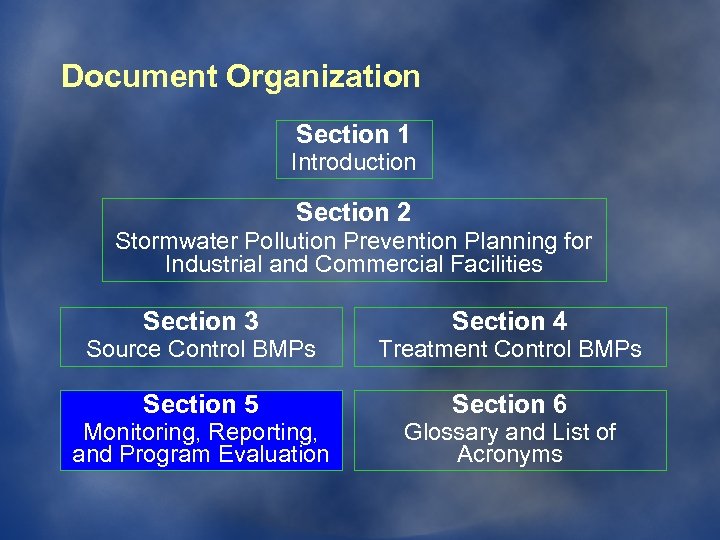
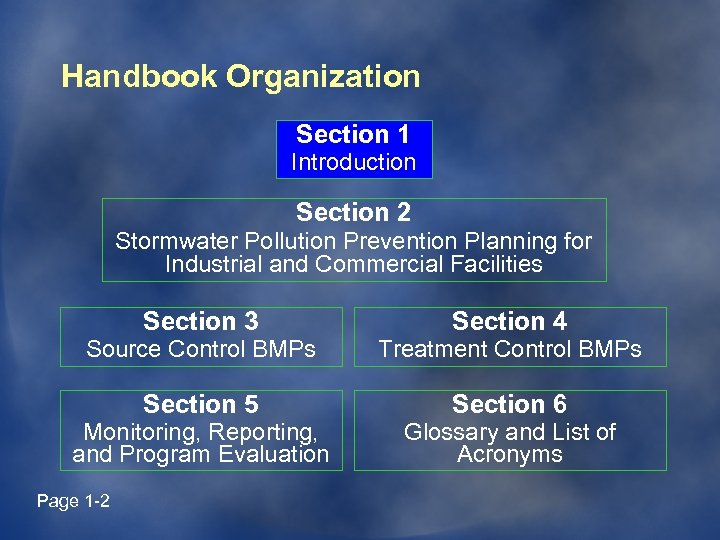 Handbook Organization Section 1 Introduction Section 2 Stormwater Pollution Prevention Planning for Industrial and Commercial Facilities Section 3 Section 4 Source Control BMPs Treatment Control BMPs Section 5 Section 6 Monitoring, Reporting, and Program Evaluation Glossary and List of Acronyms Page 1 -2
 Organization of the Handbook u Appendix A – General Industrial Activities Storm Water Permit u Appendix B – Stormwater Discharges Associated with Industrial Activities u Appendix C - Sample SWPPP u Appendix D - Business Category Stormwater Pollution Control Guide Sheets
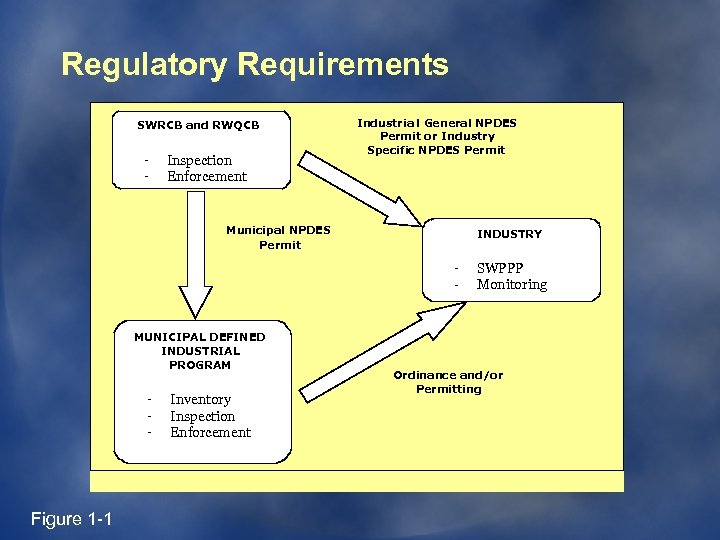 Regulatory Requirements SWRCB and RWQCB Inspection Enforcement Industria l General NPDES Permit or Industry Specific NPDES Permit Municipal NPDES Permit INDUSTRY MUNICIPAL DEFINED INDUSTRIAL PROGRAM Figure 1 -1 Inventory Inspection Enforcement SWPPP Monitoring Ordinance and/or Permitting
 Acronyms u BMP - Best Management Practice u NOI – Notice of Intent u NPDES – National Pollutant Discharge Elimination System u SWPPP – Stormwater Pollution Prevention Plan u SWPCP – Stormwater Pollution Control Plan
 How to Get the Handbook u Attend this workshop. Attendees each receive one copy of the subject handbook u Visit the California Stormwater Best Management Practice Web Site u Download an entire handbook, an individual section, an individual fact sheet, or an individual guide sheet u Search for BMPs u Check for handbook and fact sheet updates www. cabmphandbooks. com
 California Stormwater Best Management Practice Handbook Industrial - Commercial Stormwater Pollution Planning for Industrial and Commercial Facilities Presented by Malcolm Walker, P. E. Larry Walker Associates
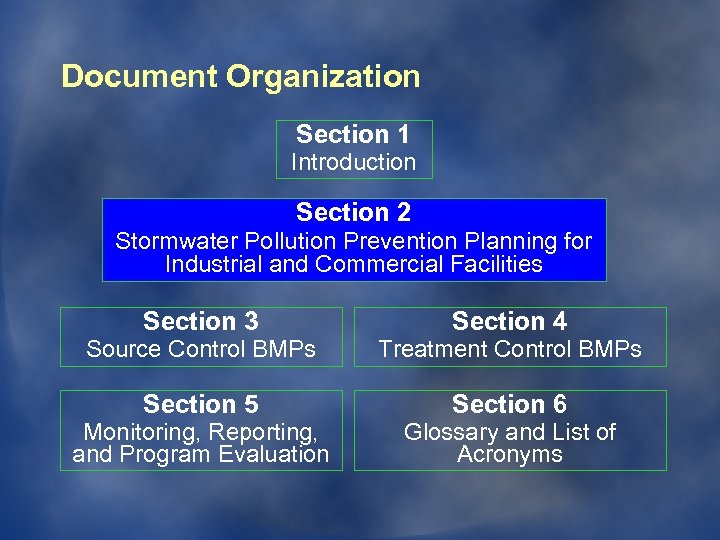 Document Organization Section 1 Introduction Section 2 Stormwater Pollution Prevention Planning for Industrial and Commercial Facilities Section 3 Section 4 Source Control BMPs Treatment Control BMPs Section 5 Section 6 Monitoring, Reporting, and Program Evaluation Glossary and List of Acronyms
 Planning Objectives u Provide an approach to develop a Stormwater Pollution Prevention Plan (SWPPP) consistent with State General Permit u Provide guidance to selected commercial businesses to reduce pollutants in stormwater discharges
 SWPPP Objectives u Identify source of pollution that affect stormwater discharges and authorized non-stormwater discharges u Select and implement BMPs to reduce pollutants in stormwater discharges and authorized non-stormwater discharges
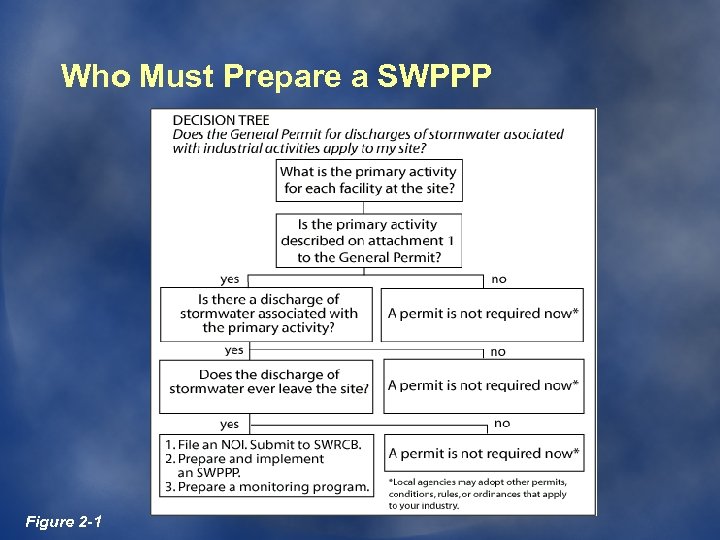 Who Must Prepare a SWPPP Figure 2 -1
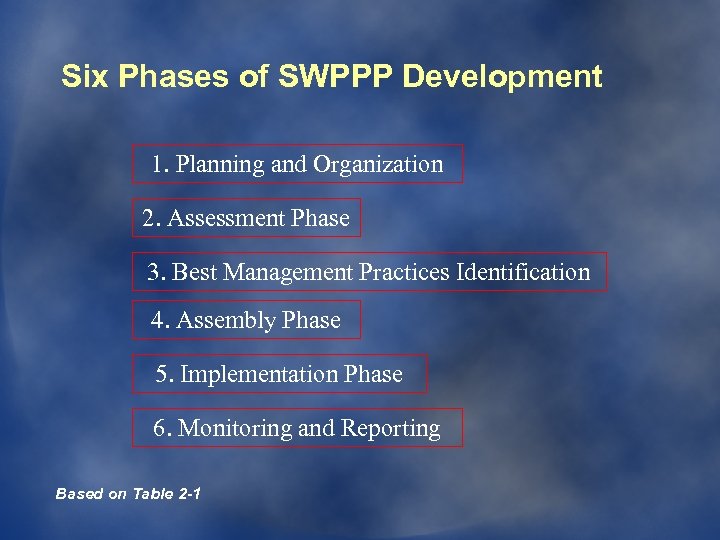 Six Phases of SWPPP Development 1. Planning and Organization 2. Assessment Phase 3. Best Management Practices Identification 4. Assembly Phase 5. Implementation Phase 6. Monitoring and Reporting Based on Table 2 -1
 PHASE 1 1. Planning and Organization 2. Assessment Phase 3. Best Management Practices Identification 4. Assembly Phase 5. Implementation Phase 6. Monitoring and Reporting
 PHASE 1 Planning & Organization • Form Pollution Prevention Team • Review Other Plans • Review Other Requirements
 Phase 1 Form Pollution Prevention Team u Typically better to have lead person u Team size reflect complexity of facility u Likely overlap with other environmental program
 Phase 1 Review Other Plans and Requirements u Site and drainage maps u Existing monitoring data u Environmental Management Plans u Regional Board requirements regarding local water bodies
 PHASE 2 1. Planning and Organization 2. Assessment Phase 3. Best Management Practices Identification 4. Assembly Phase 5. Implementation Phase 6. Monitoring and Reporting
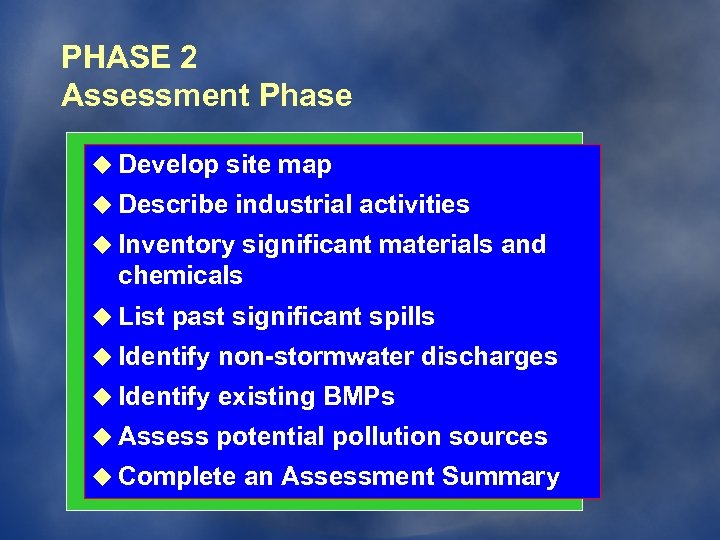 PHASE 2 Assessment Phase u Develop site map u Describe industrial activities u Inventory significant materials and chemicals u List past significant spills u Identify non-stormwater discharges u Identify existing BMPs u Assess potential pollution sources u Complete an Assessment Summary
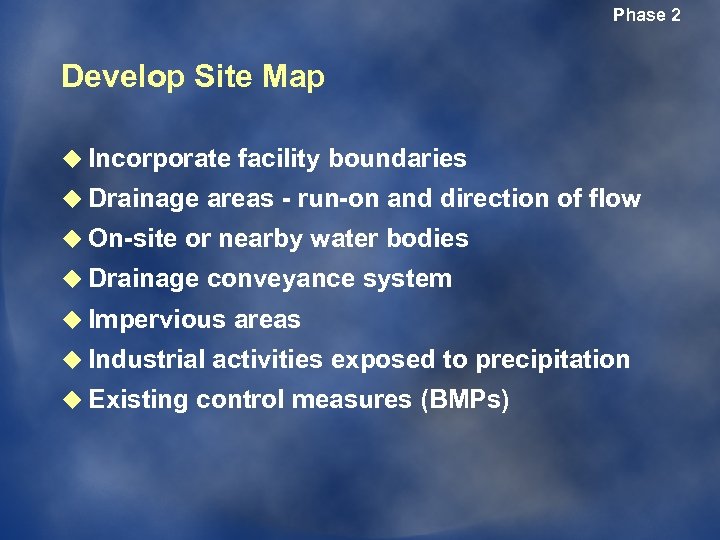 Phase 2 Develop Site Map u Incorporate facility boundaries u Drainage areas - run-on and direction of flow u On-site or nearby water bodies u Drainage conveyance system u Impervious areas u Industrial activities exposed to precipitation u Existing control measures (BMPs)
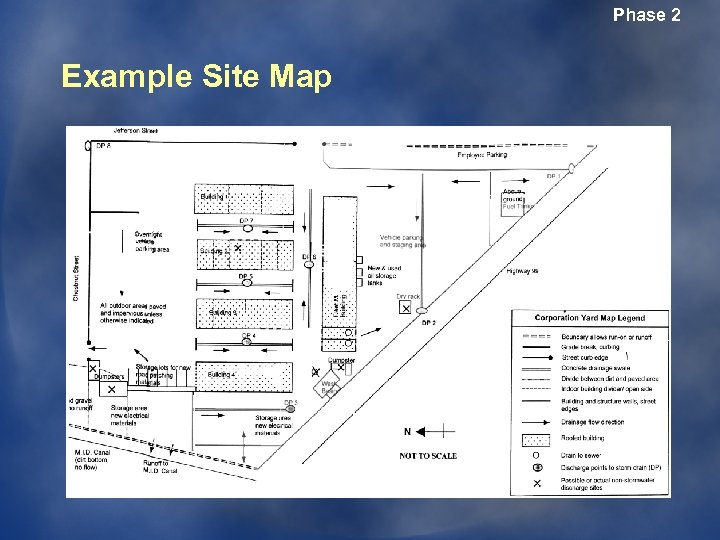 Phase 2 Example Site Map
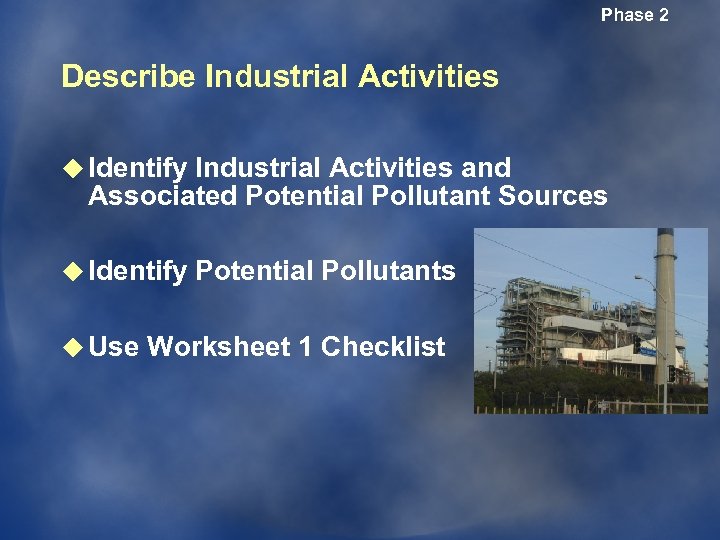 Phase 2 Describe Industrial Activities u Identify Industrial Activities and Associated Potential Pollutant Sources u Identify Potential Pollutants u Use Worksheet 1 Checklist
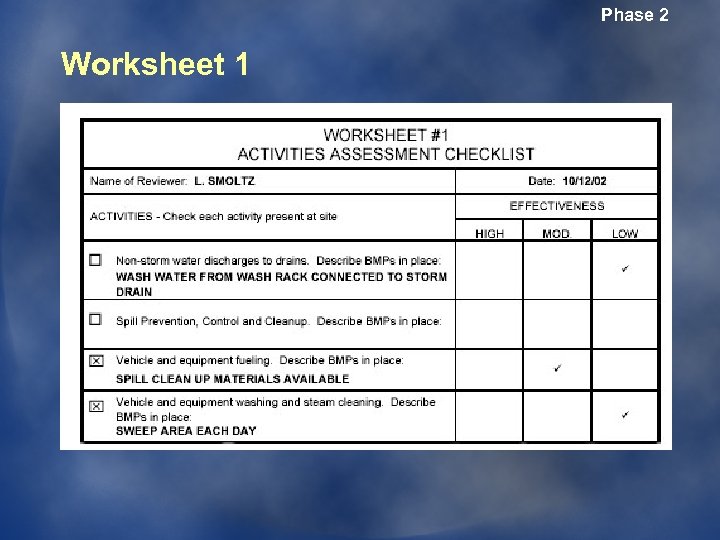 Phase 2 Worksheet 1
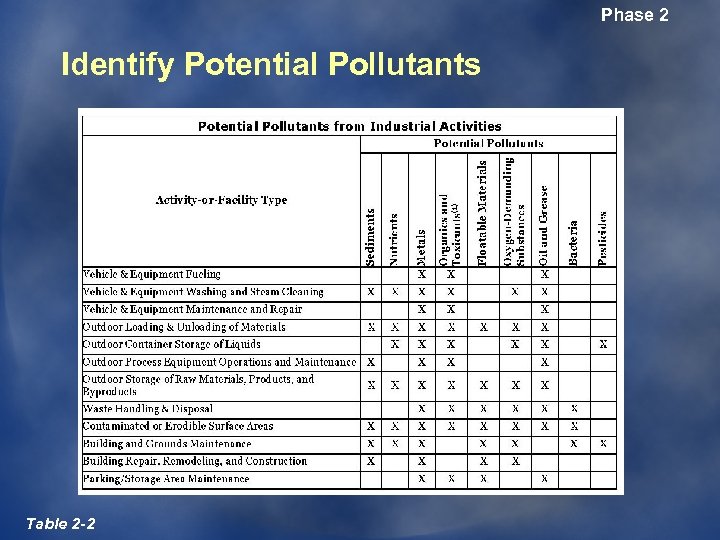 Phase 2 Identify Potential Pollutants Table 2 -2
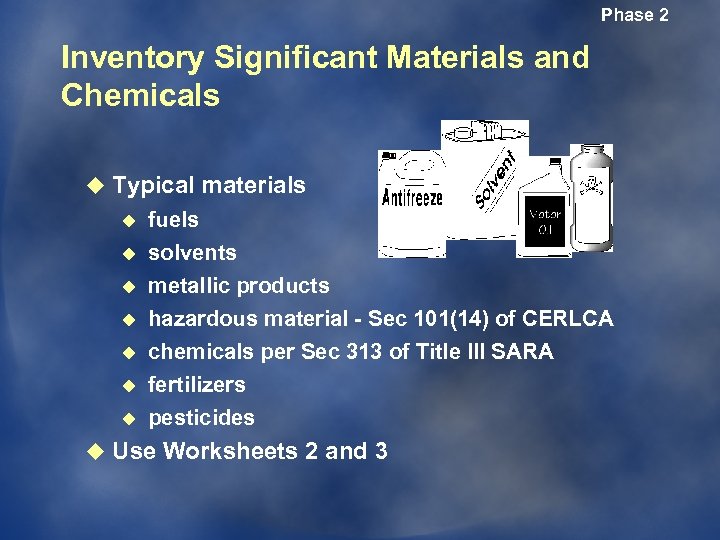 Phase 2 Inventory Significant Materials and Chemicals u Typical materials u u u u fuels solvents metallic products hazardous material - Sec 101(14) of CERLCA chemicals per Sec 313 of Title III SARA fertilizers pesticides u Use Worksheets 2 and 3
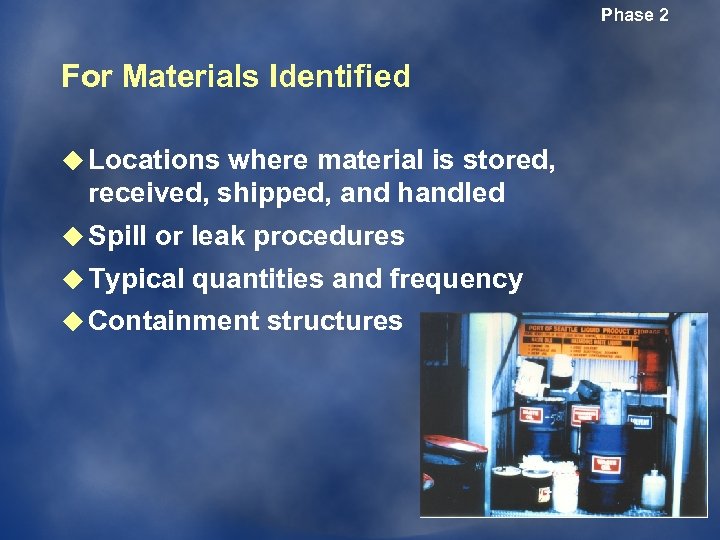 Phase 2 For Materials Identified u Locations where material is stored, received, shipped, and handled u Spill or leak procedures u Typical quantities and frequency u Containment structures
 Phase 2 List Past Significant Spills u Significant = adversely impact human health or the environment or that cause or contribute to a water standard violation u Include information regarding u type, characteristics of spilled material u preventive measures and cleanup action u quantity exposure to stormwater u Use Worksheet 4
 Phase 2 Identify Non-stormwater Discharges u Determine source, quantity, frequency and characteristics u Certain non-stormwater discharges are allowed but may vary between Regional Boards u Certification required u Use Worksheets 5 and 6
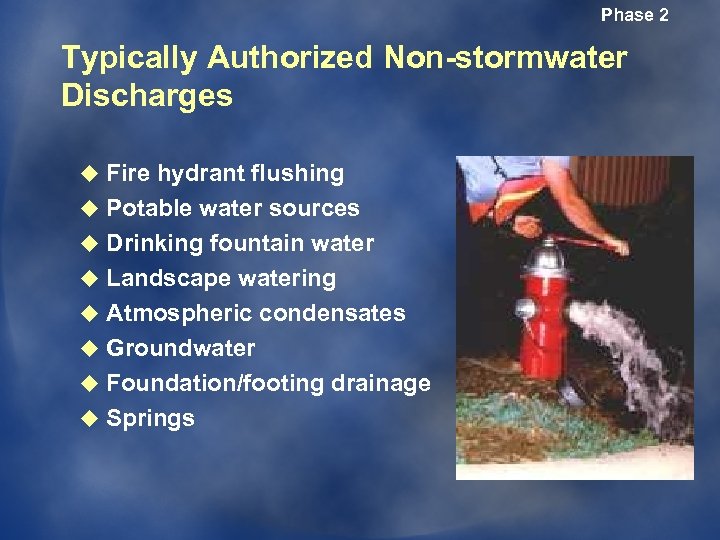 Phase 2 Typically Authorized Non-stormwater Discharges u Fire hydrant flushing u Potable water sources u Drinking fountain water u Landscape watering u Atmospheric condensates u Groundwater u Foundation/footing drainage u Springs
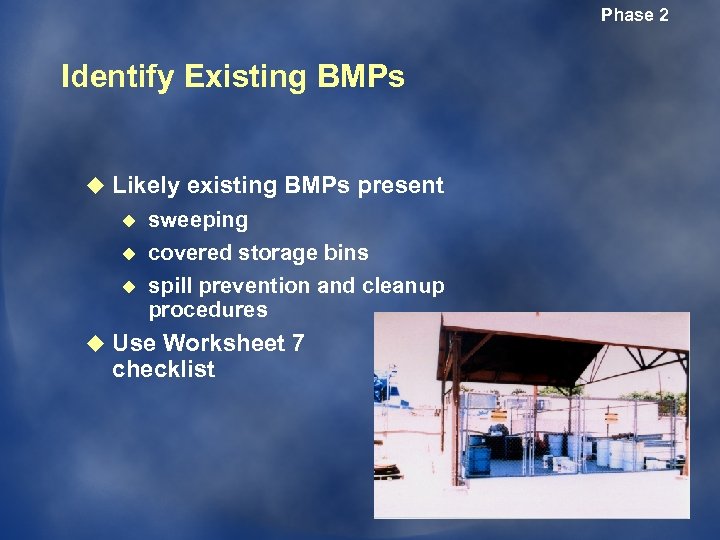 Phase 2 Identify Existing BMPs u Likely existing BMPs present u u u sweeping covered storage bins spill prevention and cleanup procedures u Use Worksheet 7 checklist
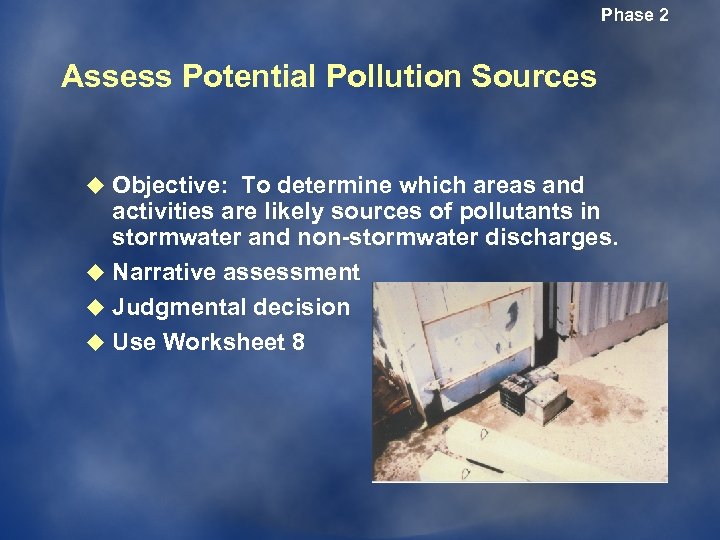 Phase 2 Assess Potential Pollution Sources u Objective: To determine which areas and activities are likely sources of pollutants in stormwater and non-stormwater discharges. u Narrative assessment u Judgmental decision u Use Worksheet 8
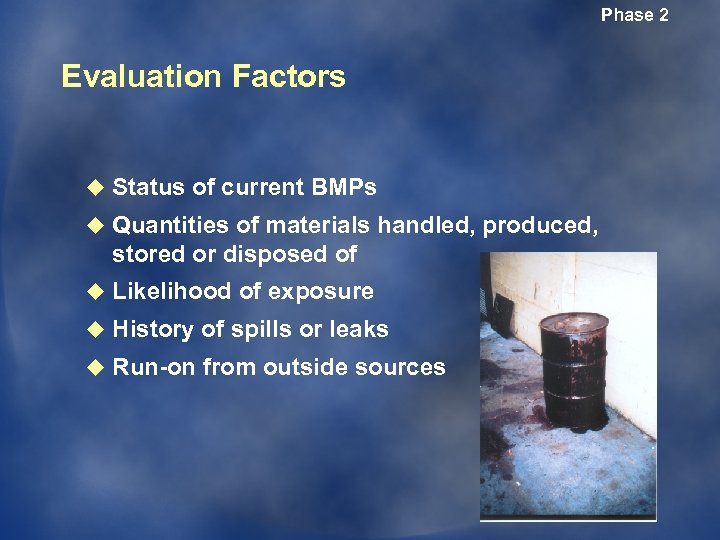 Phase 2 Evaluation Factors u Status of current BMPs u Quantities of materials handled, produced, stored or disposed of u Likelihood of exposure u History of spills or leaks u Run-on from outside sources
 Phase 2 Other Considerations in Assessing Pollution Sources u Dust generating activities u Soil erosion potential u Existing stormwater monitoring data u Supplemental field studies
 PHASE 3 1. Planning and Organization 2. Assessment Phase 3. Best Management Practices Identification 4. Assembly Phase 5. Implementation Phase 6. Monitoring and Reporting
 PHASE 3 BMP Identification u Identify erosion and sediment controls u Identify BMPs for non-stormwater u Identify source control BMPs u Identify treatment control BMPs u Prepare BMP list and prioritize u Prepare Monitoring Plan u Prepare Implementation Plan
 Phase 3 Prepare BMP List and Prioritize u Summarize BMPs list u u u Existing BMPs to be revised New BMPs u Develop implementation schedule reflecting water quality concerns, costs, and ease of implementation.
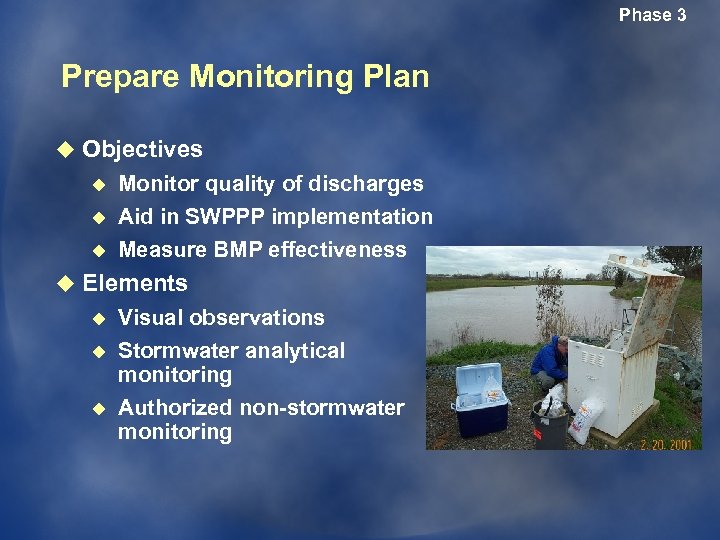 Phase 3 Prepare Monitoring Plan u Objectives u u u Monitor quality of discharges Aid in SWPPP implementation Measure BMP effectiveness u Elements u u u Visual observations Stormwater analytical monitoring Authorized non-stormwater monitoring
 Phase 3 Prepare Implementation Plan u Designate personnel responsible for SWPPP u Schedule Comprehensive Site Compliance Evaluation u Establish how records of inspections, followup actions and BMP implementation will be prepared and kept u Develop training program
 PHASE 4 1. Planning and Organization 2. Assessment Phase 3. Best Management Practices Identification 4. Assembly Phase 5. Implementation Phase 6. Monitoring and Reporting
 PHASE 4 Assemble SWPPP u Obtain Required Signatures u Select Plan Location u Assemble Document
 PHASE 5 Implementation 1. Planning and Organization 2. Assessment Phase 3. Best Management Practices Identification 4. Assembly Phase 5. Implementation Phase 6. Monitoring and Reporting
 Phase 5 - Implement SWPPP u Conduct Training u Implement BMPs u Terminate unauthorized non- stormwater discharges
 Phase 5 Implementation Training u Annual training of personnel responsible for BMP implementation u Address u u Inspections Sampling Reporting BMPs - good housekeeping, material handling procedures, etc. u Record training efforts
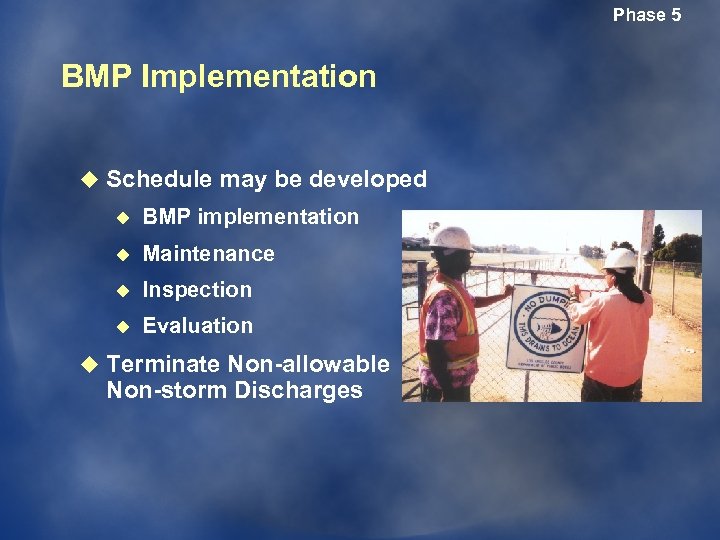 Phase 5 BMP Implementation u Schedule may be developed u BMP implementation u Maintenance u Inspection u Evaluation u Terminate Non-allowable Non-storm Discharges
 PHASE 6 Monitoring and Reporting 1. Planning and Organization 2. Assessment Phase 3. Best Management Practices Identification 4. Assembly Phase 5. Implementation Phase 6. Monitoring and Reporting
 Document Organization Section 1 Introduction Section 2 Stormwater Pollution Prevention Planning for Industrial and Commercial Facilities Section 3 Section 4 Source Control BMPs Treatment Control BMPs Section 5 Section 6 Monitoring, Reporting, and Program Evaluation Glossary and List of Acronyms
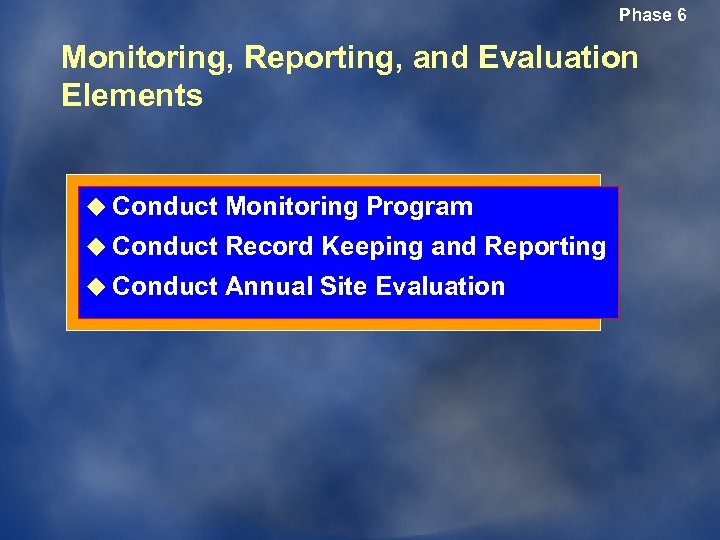 Phase 6 Monitoring, Reporting, and Evaluation Elements u Conduct Monitoring Program u Conduct Record Keeping and Reporting u Conduct Annual Site Evaluation
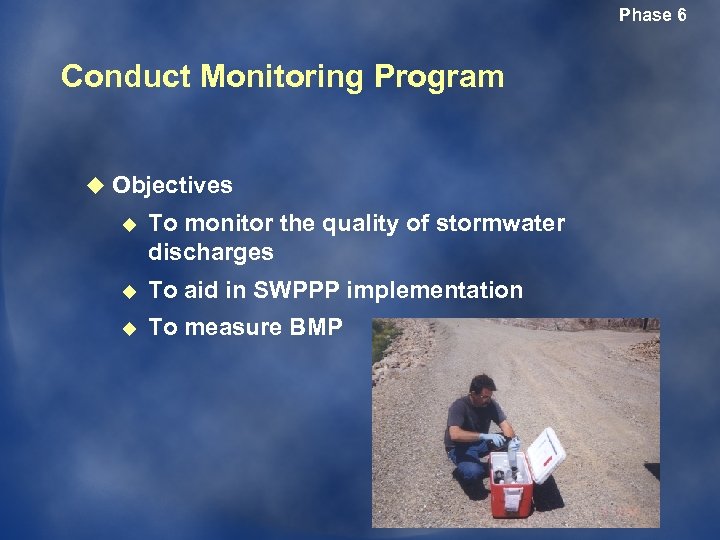 Phase 6 Conduct Monitoring Program u Objectives u To monitor the quality of stormwater discharges u To aid in SWPPP implementation u To measure BMP Effectiveness
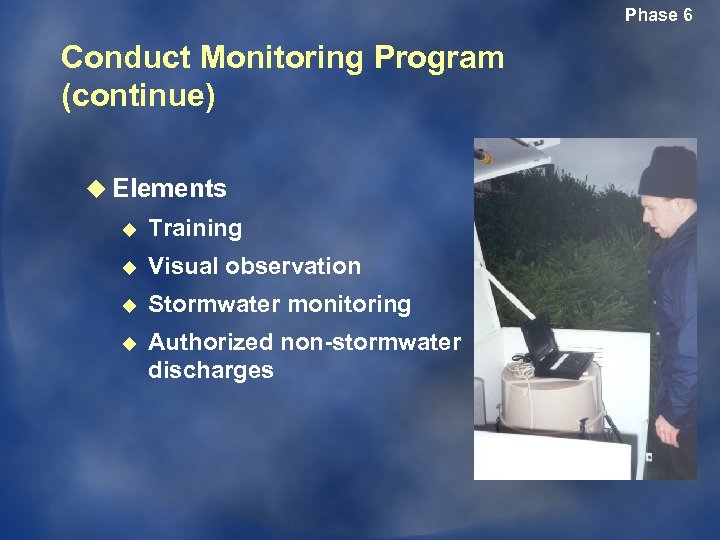 Phase 6 Conduct Monitoring Program (continue) u Elements u Training u Visual observation u Stormwater monitoring u Authorized non-stormwater discharges
 Phase 6 Monitoring Training u Review of Monitoring Plan and Health & Safety Plan u Review sampling protocols u Classroom and field sessions u Annual refresher
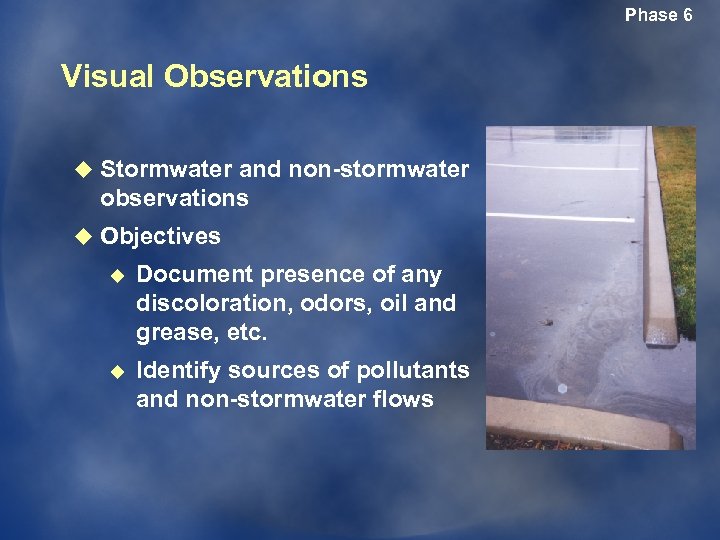 Phase 6 Visual Observations u Stormwater and non-stormwater observations u Objectives u Document presence of any discoloration, odors, oil and grease, etc. u Identify sources of pollutants and non-stormwater flows
 Phase 6 Visual Observations (continue) u Quarterly inspection of authorized and unauthorized non-stormwater discharges u One storm event per year u Daylight hours u Information recorded u date and locations u observations u follow up action
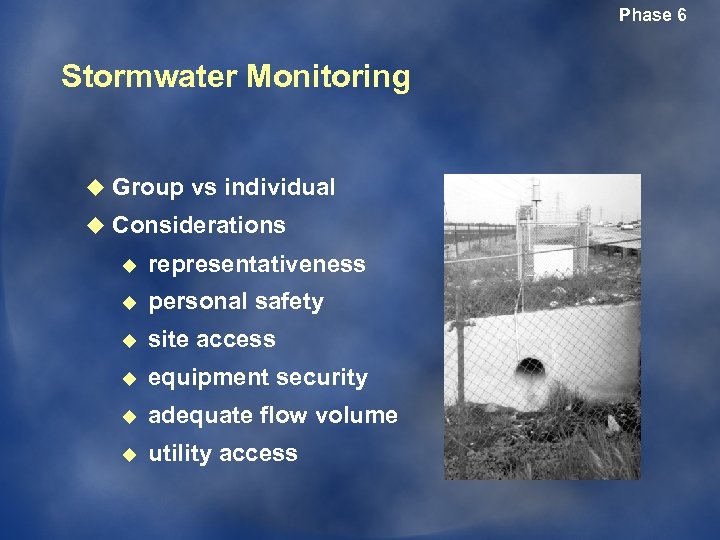 Phase 6 Stormwater Monitoring u Group vs individual u Considerations u representativeness u personal safety u site access u equipment security u adequate flow volume u utility access
 Phase 6 Stormwater Monitoring (continue) u Sampling and preservation in accordance w/ Standard Methods u Equipment properly calibrated u Laboratory analysis according to 40 CFR Part 136 u Mandatory constituents u TSS, p. H, specific conductance, and TOC u Discretionary constituents
 Phase 6 Establish Procedures to Prevent Sample Contamination (Typical) u No smoking u Never sample near a running vehicle u Wear clean, powder-free nitrile gloves when handling bottles, tubes, strainers, etc. u Do not eat or drink during sample collection u Avoid rain dripping into sample bottles Page 5 -4
 Phase 6 Conduct Record Keeping and Reporting u Date, place & time u QA/QC records u Parties conducting u Observations monitoring u Flow measurements u Analytical results, method detection limits & analytical techniques u Calibration & maintenance records u Sampling and analysis exemptions/reductions u Corrective actions u Rain event data
 Phase 6 Annual Report u Summary of visual observations u Evaluation of observations and analytical results u Documentation of BMP implementation u Laboratory results u Comprehensive Site Compliance Evaluation Report u Documentation u Detection limits
 Phase 6 Conduct Annual Site Evaluation u Review visual observations and results u Review and evaluation of BMPs u Review of current site activities u Review of current list of significant materials u Review of spills over the last 12 months u Evaluation Report
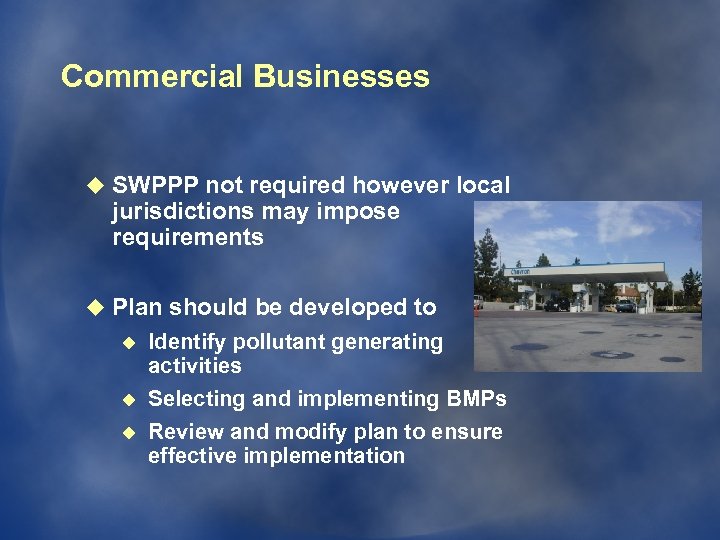 Commercial Businesses u SWPPP not required however local jurisdictions may impose requirements u Plan should be developed to u u u Identify pollutant generating activities Selecting and implementing BMPs Review and modify plan to ensure effective implementation
 Question and Answer
 California Stormwater Best Management Practice Handbook Industrial Handbook Source Control and Treatment Control BMPs Presented by Geoff Brosseau
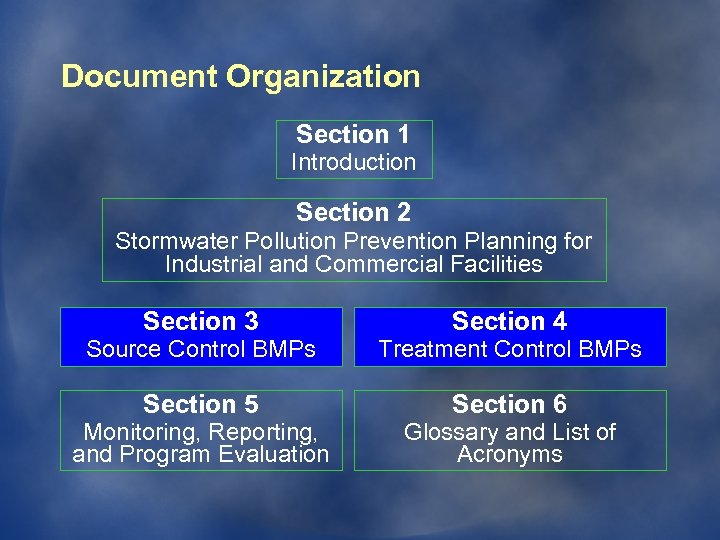 Document Organization Section 1 Introduction Section 2 Stormwater Pollution Prevention Planning for Industrial and Commercial Facilities Section 3 Section 4 Source Control BMPs Treatment Control BMPs Section 5 Section 6 Monitoring, Reporting, and Program Evaluation Glossary and List of Acronyms
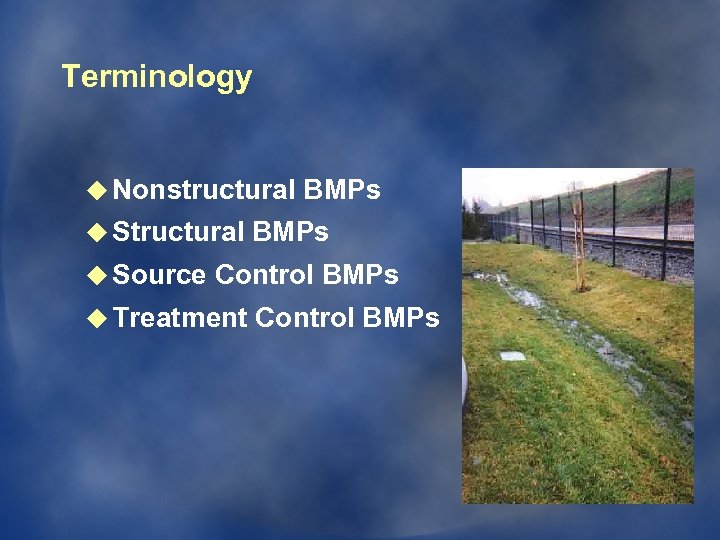 Terminology u Nonstructural BMPs u Source Control BMPs u Treatment Control BMPs
 Source Controls Operational practices that reduce potential pollutants at the source
 Identify BMPs for Non-stormwater Discharges u Options u u Terminate Obtain separate permit u Authorized non-stormwater discharges - may still require BMPs
 Identify Source Control BMPs u 80% of problem solved with 20% of effort u Start with low to modest cost BMPs u Typical effective source control BMPs u u u Berms Overhead coverage Secondary containment Moving indoors Designating wash areas
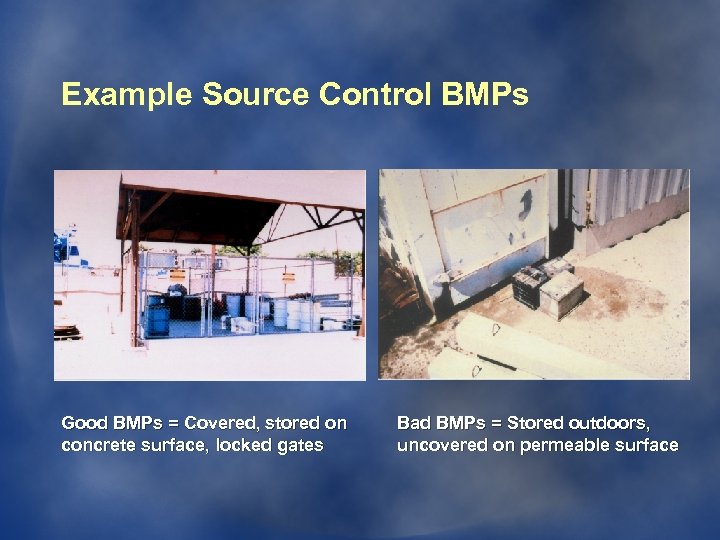 Example Source Control BMPs Good BMPs = Covered, stored on concrete surface, locked gates Bad BMPs = Stored outdoors, uncovered on permeable surface
 Fact Sheet Types u Activity-based u Common activities u Example – fueling u 16 BMPs u Business-category u Common businesses u Example - food service u 14 BMPs
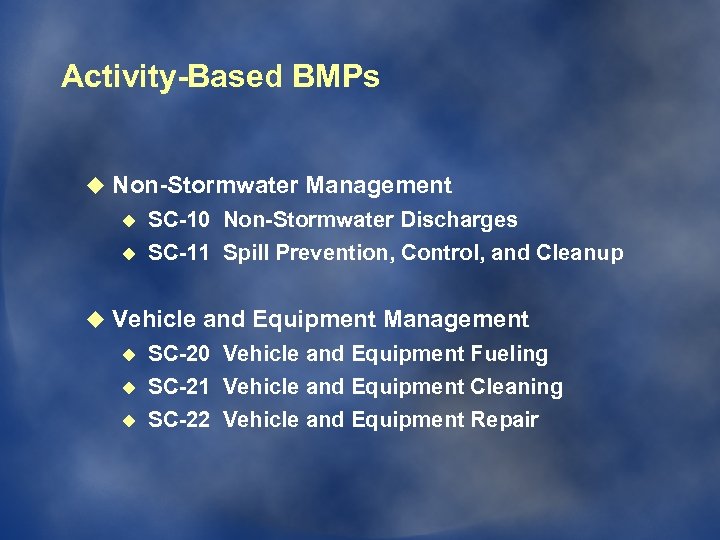 Activity-Based BMPs u Non-Stormwater Management u u SC-10 Non-Stormwater Discharges SC-11 Spill Prevention, Control, and Cleanup u Vehicle and Equipment Management u u u SC-20 Vehicle and Equipment Fueling SC-21 Vehicle and Equipment Cleaning SC-22 Vehicle and Equipment Repair
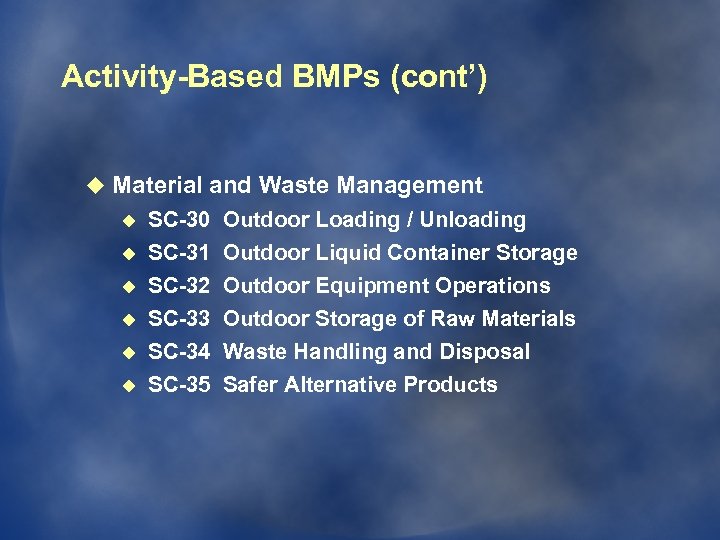 Activity-Based BMPs (cont’) u Material and Waste Management u u u SC-30 SC-31 SC-32 SC-33 SC-34 SC-35 Outdoor Loading / Unloading Outdoor Liquid Container Storage Outdoor Equipment Operations Outdoor Storage of Raw Materials Waste Handling and Disposal Safer Alternative Products
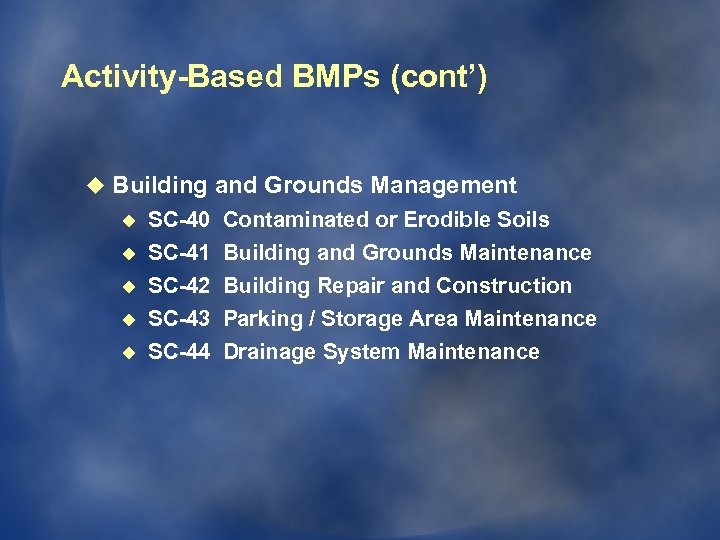 Activity-Based BMPs (cont’) u Building and Grounds Management u u u SC-40 SC-41 SC-42 SC-43 SC-44 Contaminated or Erodible Soils Building and Grounds Maintenance Building Repair and Construction Parking / Storage Area Maintenance Drainage System Maintenance
 BMP Fact Sheets u Laundry list – Some information may not be applicable u Consider modifying / simplifying, as needed u Copies u u Photocopy Handbook pages Download from: www. cabmphandbooks. com
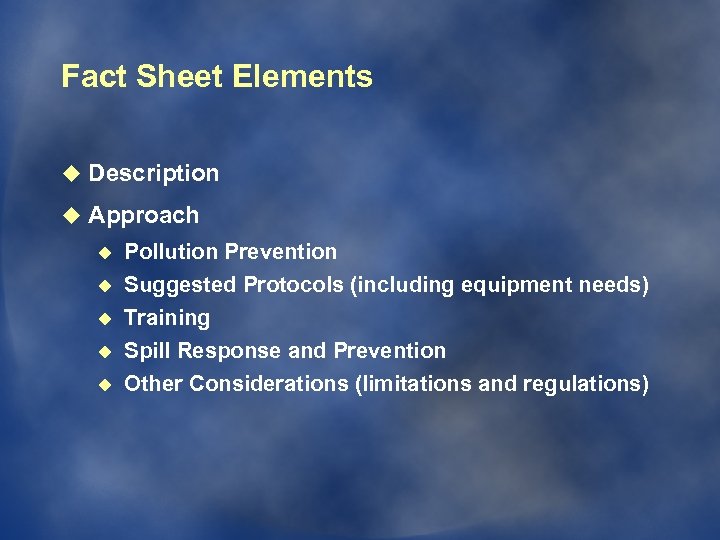 Fact Sheet Elements u Description u Approach u u u Pollution Prevention Suggested Protocols (including equipment needs) Training Spill Response and Prevention Other Considerations (limitations and regulations)
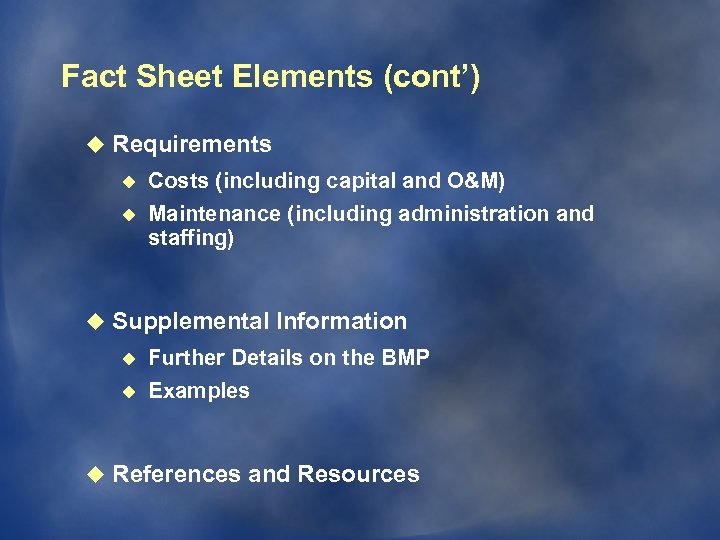 Fact Sheet Elements (cont’) u Requirements u u Costs (including capital and O&M) Maintenance (including administration and staffing) u Supplemental Information u u Further Details on the BMP Examples u References and Resources
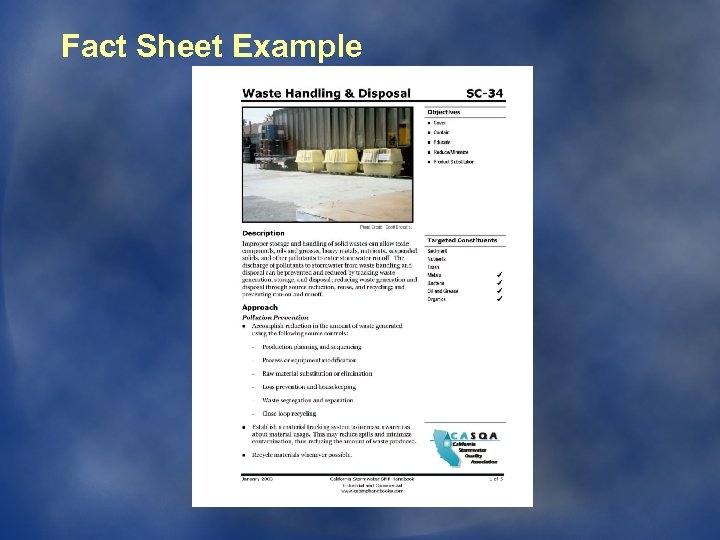 Fact Sheet Example
 Business-Category Guide Sheets u For the more common business types u Most not required to obtain General Permit coverage u Guide sheets address a collection of activities typical of these businesses
 Business-Category Guide Sheet BMPs u Animal Care and Handling Facilities u Automotive Service Facilities u u Auto Recycling Body Repair Maintenance Service Stations u Food Service Facilities u Marinas, Boatyards, and Ports
 Business-Category Guide Sheet BMPs (cont’) u Mobile Cleaning u u Transportation-Related Food Service-Related Surface Cleaning Amenities – Carpets and Upholstery – Swimming Pools and Spas – Water Softeners u Landscape Maintenance
 Guide Sheet Elements u Description u Pollutant Sources u Approach u Source Control BMPs u Treatment Control BMPs u More Information u Materials with more specific information u Other formats (e. g. , posters, videos) u References, including many web sites
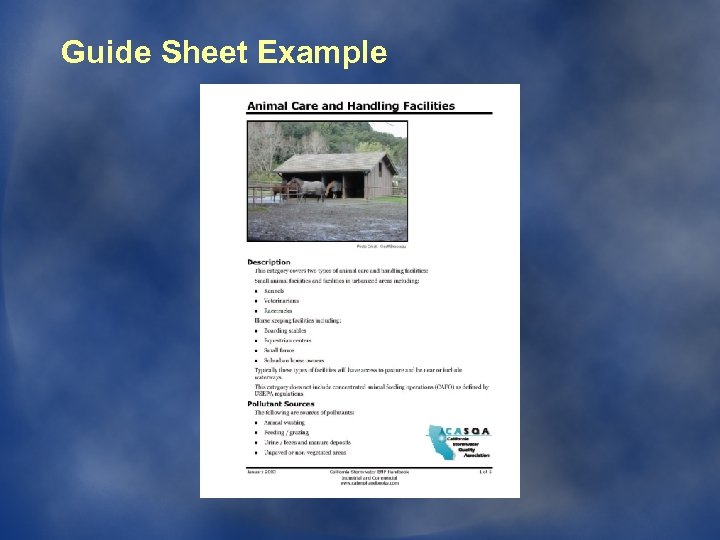 Guide Sheet Example
 Section 4 – Treatment Control Best Management Practices (BMPs)
 Treatment Controls Treatment methods to remove pollutants from stormwater
 Consider Treatment Control BMPs u Only if source control BMPs are insufficient u Consider when: u Must comply with numeric limit u More cost effective than elaborate source control BMP u Pollutant of concern only addressed by treatment control BMP
 Design Considerations for Treatment Control BMPs u Isolate pollutant generating activity and drainage system u Locate BMP close to pollutant source u Divert to sanitary sewer u Design for maintenance
 Maintenance Fact Sheets u BMP Fact Sheets, including design requirements, performance specifications, and limitations in New and Redevelopment BMP Handbook u Maintenance Fact Sheets contained in: u Municipal BMP Handbook u Industrial and Commercial BMP Handbook
 Treatment Control Types u Public Domain u Available to the public u 12 BMPs u Manufactured (Proprietary) u Purchased from vendor u Typically patented u 5 BMPs
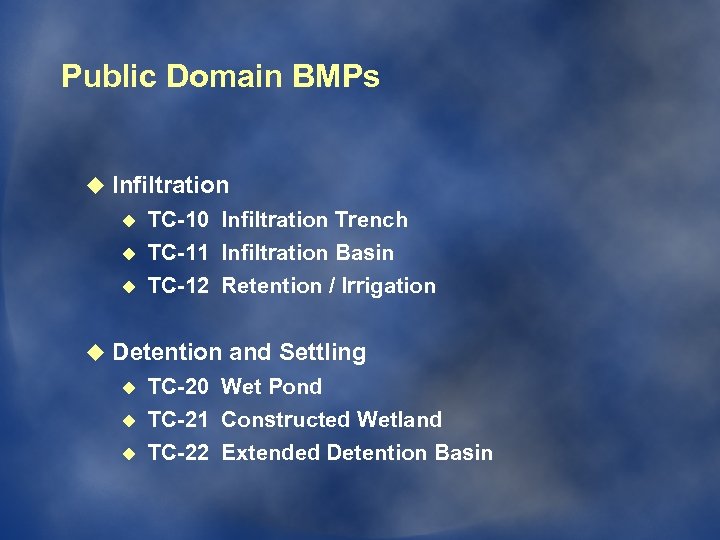 Public Domain BMPs u Infiltration u u u TC-10 Infiltration Trench TC-11 Infiltration Basin TC-12 Retention / Irrigation u Detention and Settling u u u TC-20 Wet Pond TC-21 Constructed Wetland TC-22 Extended Detention Basin
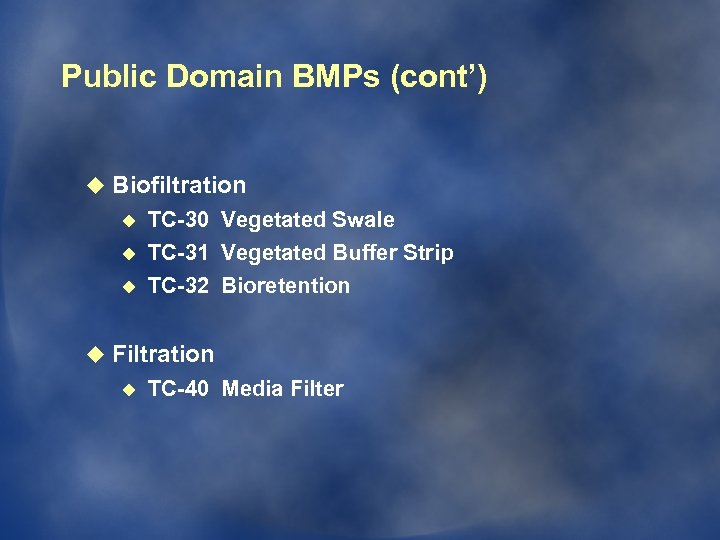 Public Domain BMPs (cont’) u Biofiltration u u u TC-30 Vegetated Swale TC-31 Vegetated Buffer Strip TC-32 Bioretention u Filtration u TC-40 Media Filter
 Public Domain BMPs (cont’) u Flow Through Separation u TC-50 Water Quality Inlet u Other u TC-60 Multiple Systems
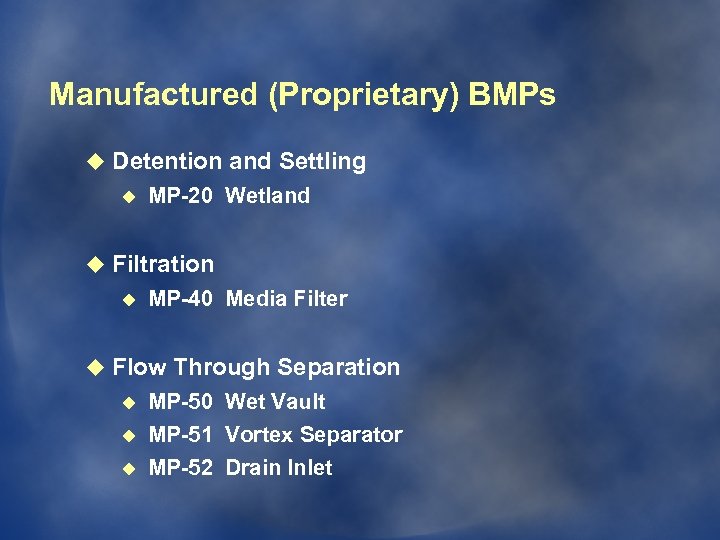 Manufactured (Proprietary) BMPs u Detention and Settling u MP-20 Wetland u Filtration u MP-40 Media Filter u Flow Through Separation u u u MP-50 Wet Vault MP-51 Vortex Separator MP-52 Drain Inlet
 Maintenance Fact Sheets u Provide specific inspection and maintenance frequencies as suggestions, your needs may vary u Consider modifying / simplifying, as needed u Manufacturers typically have recommended inspection schedules and maintenance requirements for proprietary BMPs
 Maintenance Fact Sheet Elements u General Description u Inspection / Maintenance Considerations u Inspection Activities u Maintenance Activities u Additional Information u References
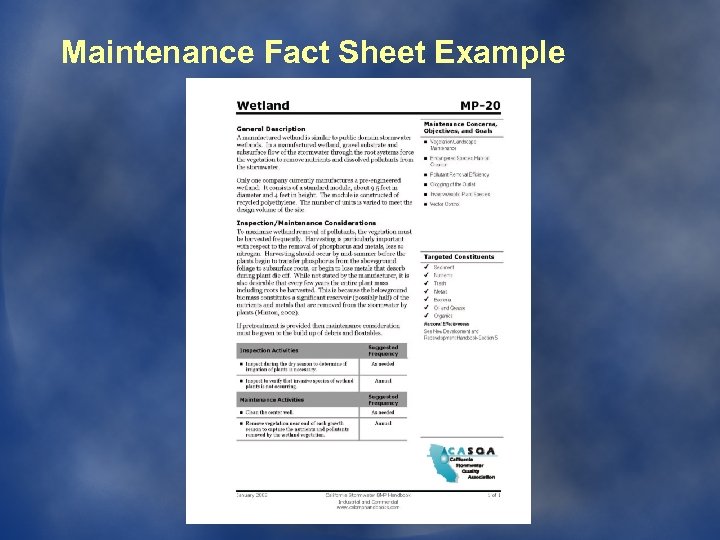 Maintenance Fact Sheet Example
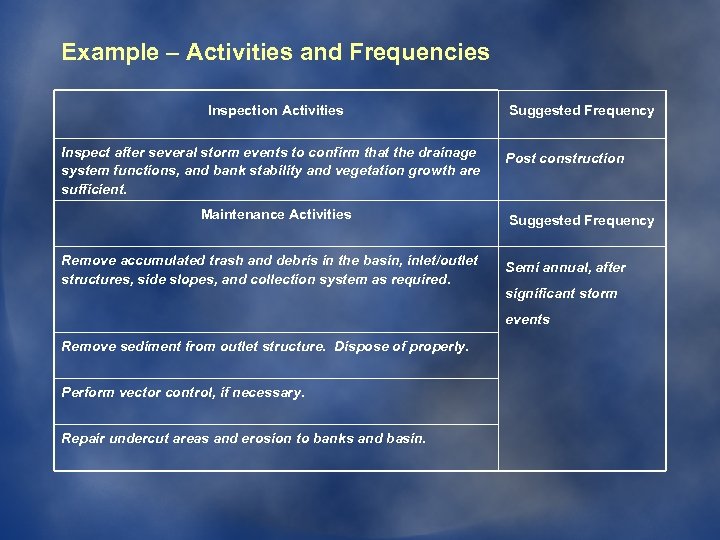 Example – Activities and Frequencies Inspection Activities Inspect after several storm events to confirm that the drainage system functions, and bank stability and vegetation growth are sufficient. Maintenance Activities Remove accumulated trash and debris in the basin, inlet/outlet structures, side slopes, and collection system as required. Suggested Frequency Post construction Suggested Frequency Semi annual, after significant storm events Remove sediment from outlet structure. Dispose of properly. Perform vector control, if necessary. Repair undercut areas and erosion to banks and basin.
 Maintenance Program u Database of properties / locations / owners- operators u Enforceable agreements – responsibilities / access (e. g. , maintenance agreement, service contract) u with owners-operators with maintenance service providers u with resource agencies (e. g. , USFWS, DFG) u u Vector control plans u Reporting
 Question and Answer