


 Скачать презентацию California SPP Results Initiative on Demand Pricing and
60f6e6bd62609665dbfea87e2182f3a2.ppt
- Количество слайдов: 58
 California SPP Results Initiative on Demand Pricing and Critical Peak Pricing July 2004 USCL Corporation Prepared by: Roger Levy; Levy Associates 1
 Results From the California State Pricing Pilot (SPP) Generally Show: • Residential and Commercial / Industrial customers don't understand their current rates. • Both groups overwhelmingly prefer the Critical Peak rates to their existing rates. • Both groups respond to these rates with substantial peak load reductions • Both groups respond to these rates with reduced overall energy use. • A majority (roughly 80%) of all customers will see reduced monthly energy bills on the Critical Peak rates. Those that don’t are being charged for their peak load. USCL Corporation Prepared by: Roger Levy; Levy Associates 2
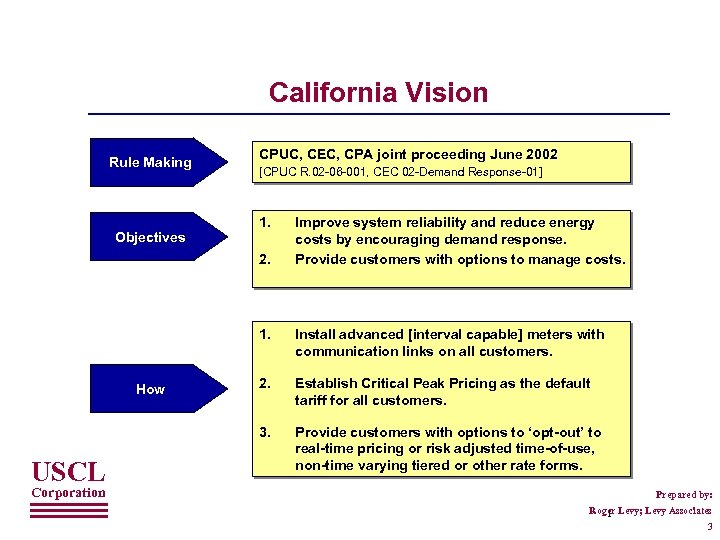 California Vision Rule Making Objectives CPUC, CEC, CPA joint proceeding June 2002 [CPUC R. 02 -06 -001, CEC 02 -Demand Response-01] 1. 2. Improve system reliability and reduce energy costs by encouraging demand response. Provide customers with options to manage costs. 1. USCL Corporation 2. Establish Critical Peak Pricing as the default tariff for all customers. 3. How Install advanced [interval capable] meters with communication links on all customers. Provide customers with options to ‘opt-out’ to real-time pricing or risk adjusted time-of-use, non-time varying tiered or other rate forms. Prepared by: Roger Levy; Levy Associates 1 3
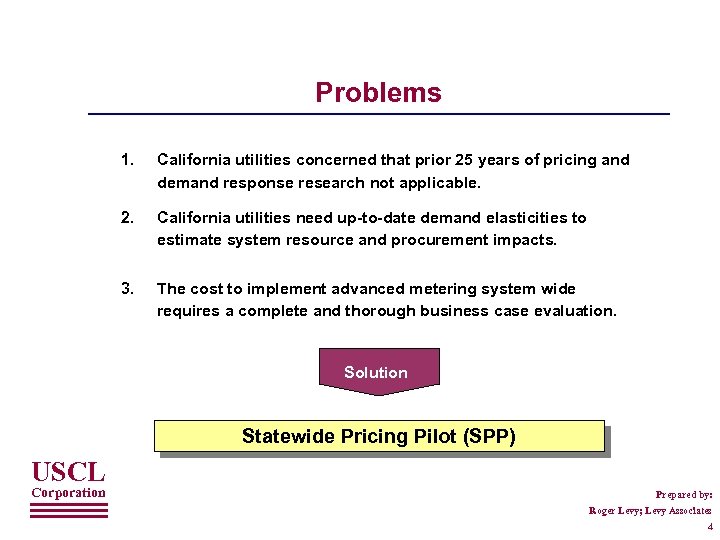 Problems 1. California utilities concerned that prior 25 years of pricing and demand response research not applicable. 2. California utilities need up-to-date demand elasticities to estimate system resource and procurement impacts. 3. The cost to implement advanced metering system wide requires a complete and thorough business case evaluation. Solution Statewide Pricing Pilot (SPP) USCL Corporation Prepared by: Roger Levy; Levy Associates 4
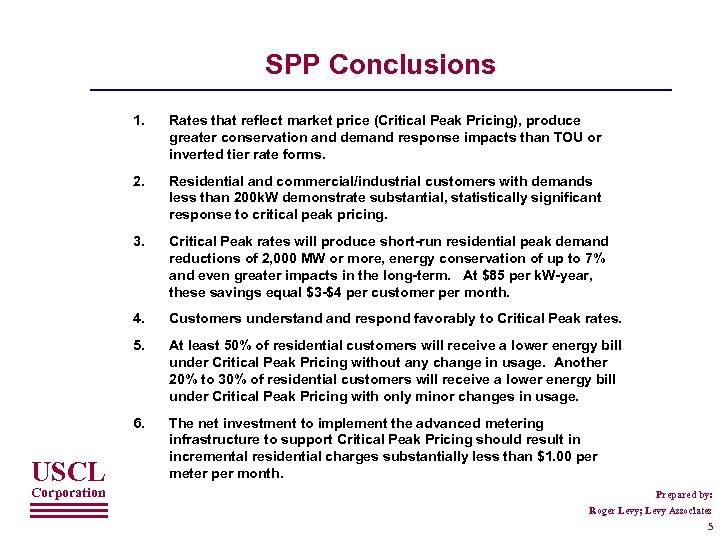 SPP Conclusions 1. 2. Critical Peak rates will produce short-run residential peak demand reductions of 2, 000 MW or more, energy conservation of up to 7% and even greater impacts in the long-term. At $85 per k. W-year, these savings equal $3 -$4 per customer per month. 4. Customers understand respond favorably to Critical Peak rates. 5. At least 50% of residential customers will receive a lower energy bill under Critical Peak Pricing without any change in usage. Another 20% to 30% of residential customers will receive a lower energy bill under Critical Peak Pricing with only minor changes in usage. 6. Corporation Residential and commercial/industrial customers with demands less than 200 k. W demonstrate substantial, statistically significant response to critical peak pricing. 3. USCL Rates that reflect market price (Critical Peak Pricing), produce greater conservation and demand response impacts than TOU or inverted tier rate forms. The net investment to implement the advanced metering infrastructure to support Critical Peak Pricing should result in incremental residential charges substantially less than $1. 00 per meter per month. Prepared by: Roger Levy; Levy Associates 5
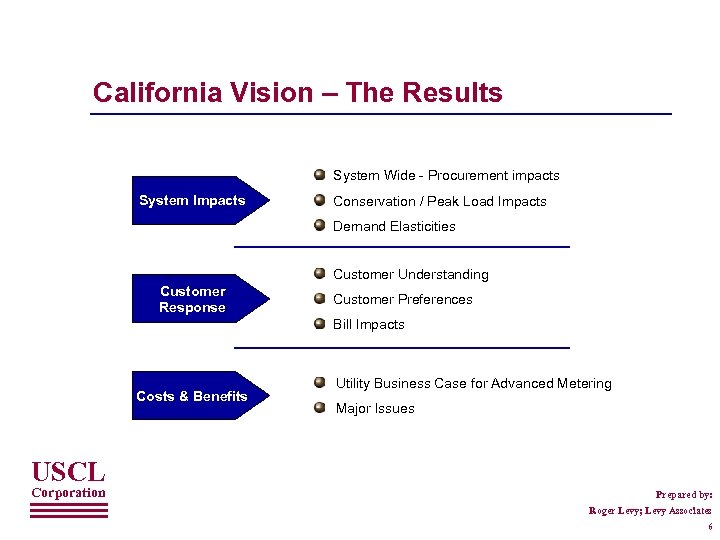 California Vision – The Results System Wide - Procurement impacts System Impacts Conservation / Peak Load Impacts Demand Elasticities Customer Understanding Customer Response Customer Preferences Bill Impacts Costs & Benefits Utility Business Case for Advanced Metering Major Issues USCL Corporation Prepared by: Roger Levy; Levy Associates 6
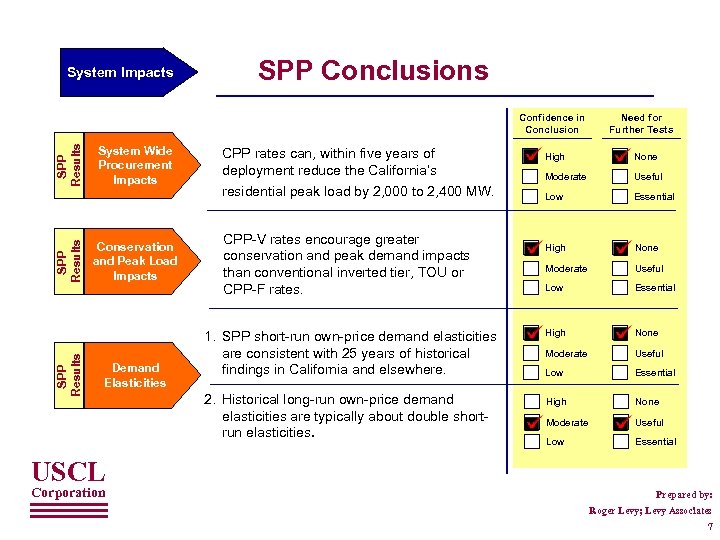 System Impacts SPP Conclusions SPP Results Confidence in Conclusion System Wide Procurement Impacts Conservation and Peak Load Impacts Demand Elasticities CPP rates can, within five years of deployment reduce the California’s residential peak load by 2, 000 to 2, 400 MW. CPP-V rates encourage greater conservation and peak demand impacts than conventional inverted tier, TOU or CPP-F rates. 1. SPP short-run own-price demand elasticities are consistent with 25 years of historical findings in California and elsewhere. 2. Historical long-run own-price demand elasticities are typically about double shortrun elasticities. Need for Further Tests High None Moderate Useful Low Essential USCL Corporation Prepared by: Roger Levy; Levy Associates 7
 California Vision – The Results RESIDENTIAL CUSTOMERS USCL Corporation Prepared by: Roger Levy; Levy Associates 8
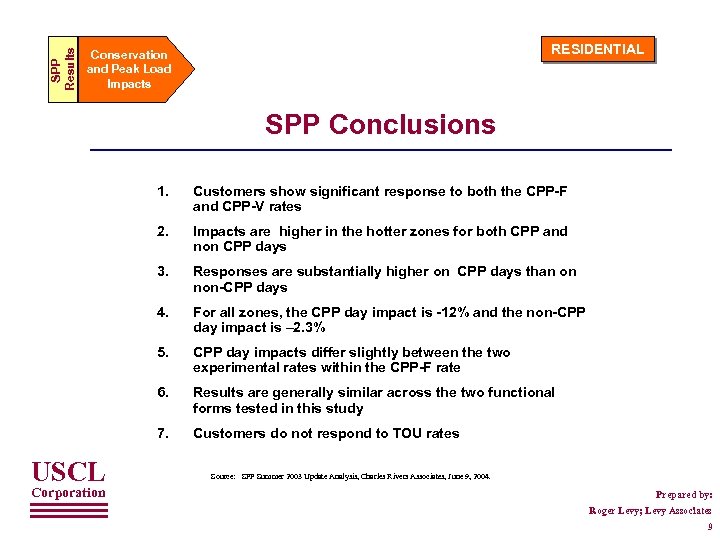 SPP Results RESIDENTIAL Conservation and Peak Load Impacts SPP Conclusions 1. 2. Responses are substantially higher on CPP days than on non-CPP days 4. For all zones, the CPP day impact is -12% and the non-CPP day impact is – 2. 3% 5. CPP day impacts differ slightly between the two experimental rates within the CPP-F rate 6. Results are generally similar across the two functional forms tested in this study 7. Corporation Impacts are higher in the hotter zones for both CPP and non CPP days 3. USCL Customers show significant response to both the CPP-F and CPP-V rates Customers do not respond to TOU rates Source: SPP Summer 2003 Update Analysis, Charles Rivers Associates, June 9, 2004. Prepared by: Roger Levy; Levy Associates 9
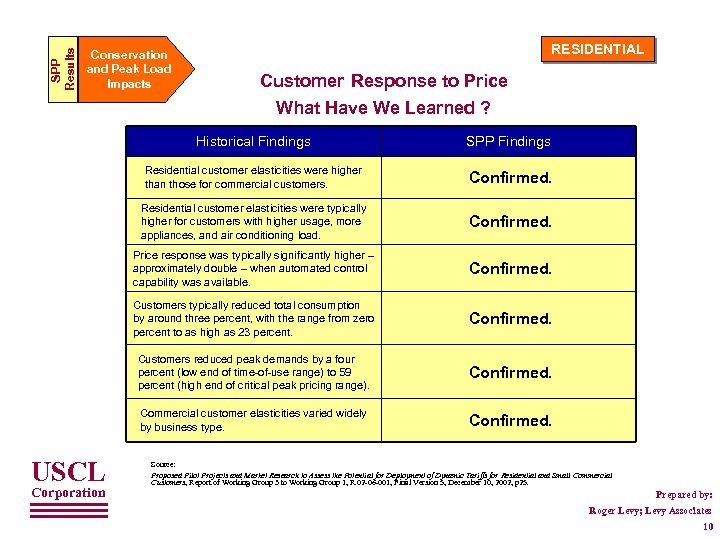 SPP Results Conservation and Peak Load Impacts RESIDENTIAL Customer Response to Price What Have We Learned ? Historical Findings Residential customer elasticities were higher than those for commercial customers. Confirmed. Price response was typically significantly higher – approximately double – when automated control capability was available. Confirmed. Customers typically reduced total consumption by around three percent, with the range from zero percent to as high as 23 percent. Confirmed. Customers reduced peak demands by a four percent (low end of time-of-use range) to 59 percent (high end of critical peak pricing range). Confirmed. Commercial customer elasticities varied widely by business type. Corporation Confirmed. Residential customer elasticities were typically higher for customers with higher usage, more appliances, and air conditioning load. USCL SPP Findings Confirmed. Source: Proposed Pilot Projects and Market Research to Assess the Potential for Deployment of Dynamic Tariffs for Residential and Small Commercial Customers, Report of Working Group 3 to Working Group 1, R. 02 -06 -001, Final Version 5, December 10, 2002, p 25. Prepared by: Roger Levy; Levy Associates 10
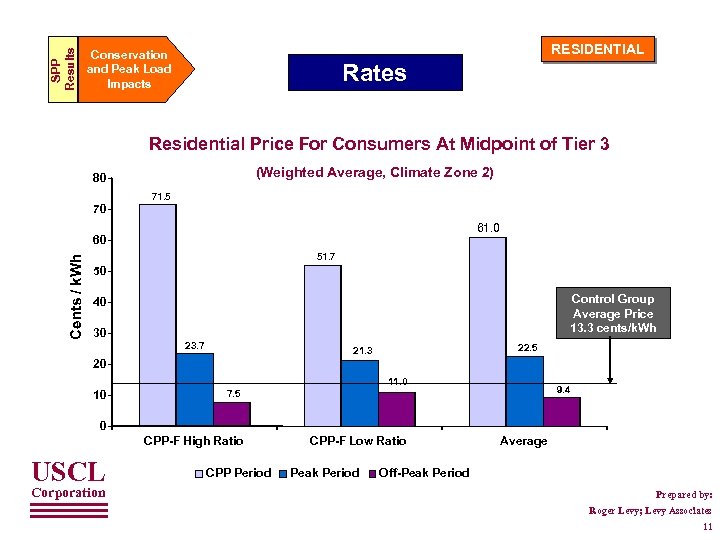 SPP Results RESIDENTIAL Conservation and Peak Load Impacts Rates Residential Price For Consumers At Midpoint of Tier 3 (Weighted Average, Climate Zone 2) 80 71. 5 70 61. 0 Cents / k. Wh 60 51. 7 50 Control Group Average Price 13. 3 cents/k. Wh 40 30 23. 7 22. 5 21. 3 20 11. 0 10 9. 4 7. 5 0 CPP-F High Ratio USCL Corporation CPP Period CPP-F Low Ratio Peak Period Average Off-Peak Period Prepared by: Roger Levy; Levy Associates 11
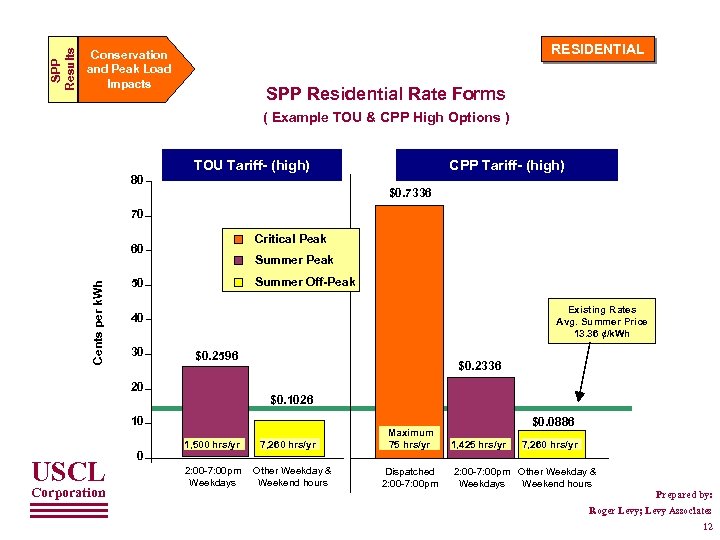 SPP Results RESIDENTIAL Conservation and Peak Load Impacts SPP Residential Rate Forms ( Example TOU & CPP High Options ) 80 TOU Tariff- (high) CPP Tariff- (high) $0. 7336 70 Critical Peak Cents per k. Wh 60 Summer Peak Summer Off-Peak 50 Existing Rates Avg. Summer Price 13. 36 ¢/k. Wh 40 30 $0. 2596 20 $0. 2336 $0. 1026 10 USCL Corporation 0 1, 500 hrs/yr 2: 00 -7: 00 pm Weekdays 7, 260 hrs/yr Other Weekday & Weekend hours Maximum 75 hrs/yr Dispatched 2: 00 -7: 00 pm $0. 0886 1, 425 hrs/yr 7, 260 hrs/yr 2: 00 -7: 00 pm Other Weekday & Weekdays Weekend hours Prepared by: Roger Levy; Levy Associates 12
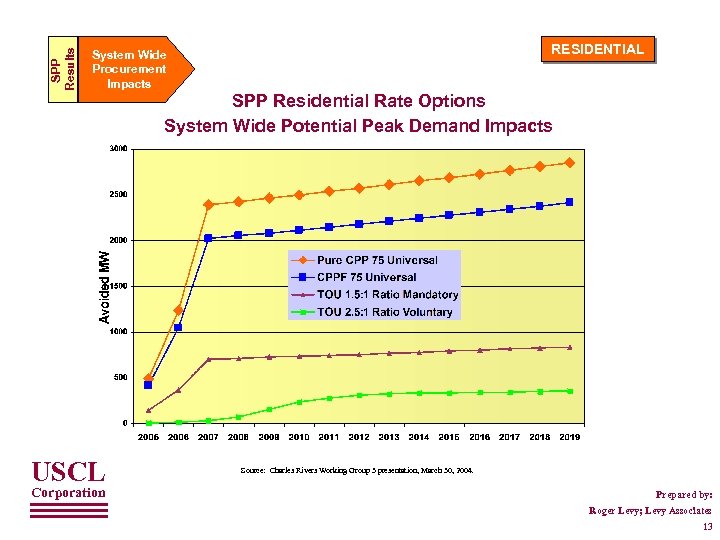 SPP Results RESIDENTIAL System Wide Procurement Impacts SPP Residential Rate Options System Wide Potential Peak Demand Impacts USCL Corporation Source: Charles Rivers Working Group 3 presentation, March 30, 2004. Prepared by: Roger Levy; Levy Associates 13
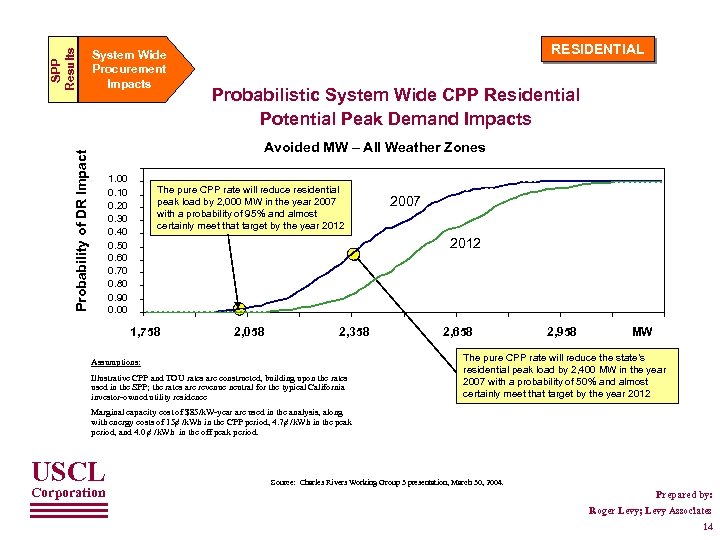 RESIDENTIAL Probabilistic System Wide CPP Residential Potential Peak Demand Impacts Avoided MW – All Weather Zones Probability of DR Impact SPP Results System Wide Procurement Impacts 1. 00 0. 10 0. 20 0. 30 0. 40 0. 50 0. 60 0. 70 0. 80 0. 90 0. 00 The pure CPP rate will reduce residential peak load by 2, 000 MW in the year 2007 with a probability of 95% and almost certainly meet that target by the year 2012 2007 2012 1, 758 2, 058 2, 358 Assumptions: Illustrative CPP and TOU rates are constructed, building upon the rates used in the SPP; the rates are revenue neutral for the typical California investor-owned utility residence 2, 658 2, 958 MW The pure CPP rate will reduce the state’s residential peak load by 2, 400 MW in the year 2007 with a probability of 50% and almost certainly meet that target by the year 2012 Marginal capacity cost of $85/k. W-year are used in the analysis, along with energy costs of 15¢ /k. Wh in the CPP period, 4. 7¢ /k. Wh in the peak period, and 4. 0 ¢ /k. Wh in the off peak period. USCL Corporation Source: Charles Rivers Working Group 3 presentation, March 30, 2004. Prepared by: Roger Levy; Levy Associates 14
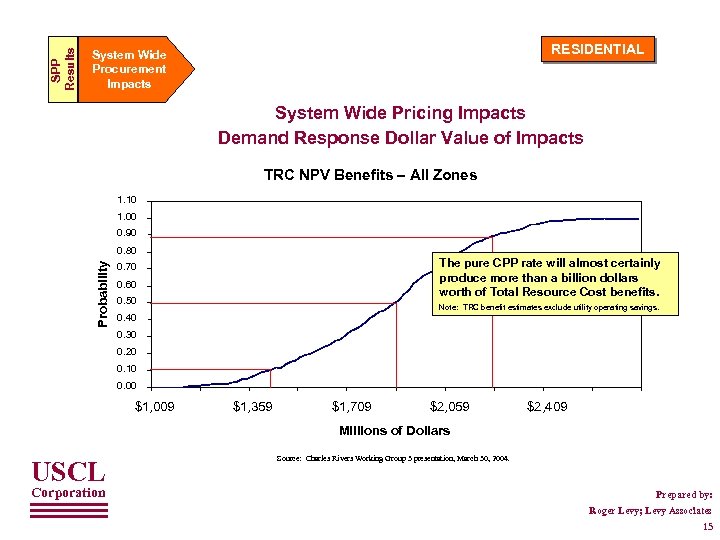 SPP Results RESIDENTIAL System Wide Procurement Impacts System Wide Pricing Impacts Demand Response Dollar Value of Impacts TRC NPV Benefits – All Zones 1. 10 1. 00 0. 90 Probability 0. 80 The pure CPP rate will almost certainly produce more than a billion dollars worth of Total Resource Cost benefits. 0. 70 0. 60 0. 50 Note: TRC benefit estimates exclude utility operating savings. 0. 40 0. 30 0. 20 0. 10 0. 00 $1, 009 $1, 359 $1, 709 $2, 059 $2, 409 Millions of Dollars USCL Corporation Source: Charles Rivers Working Group 3 presentation, March 30, 2004. Prepared by: Roger Levy; Levy Associates 15
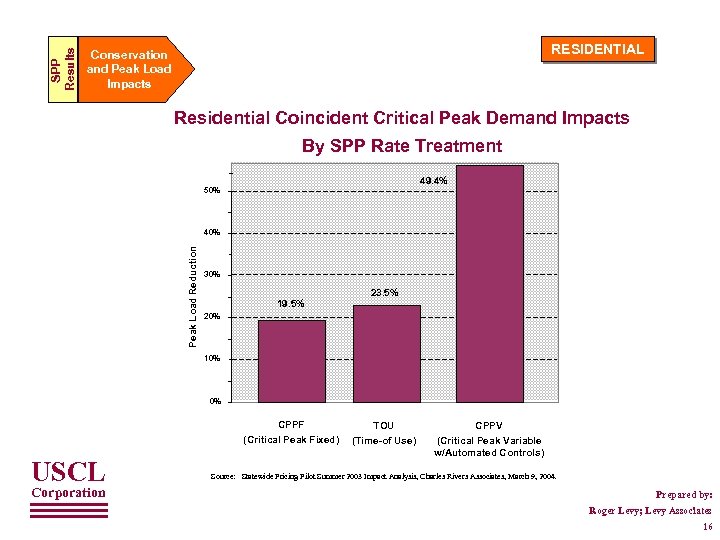 SPP Results RESIDENTIAL Conservation and Peak Load Impacts Residential Coincident Critical Peak Demand Impacts By SPP Rate Treatment 49. 4% 50% Peak Load Reduction 40% 30% 19. 5% 23. 5% 20% 10% 0% CPPF (Critical Peak Fixed) USCL Corporation TOU (Time-of Use) CPPV (Critical Peak Variable w/Automated Controls) Source: Statewide Pricing Pilot Summer 2003 Impact Analysis, Charles Rivers Associates, March 9, 2004. Prepared by: Roger Levy; Levy Associates 16
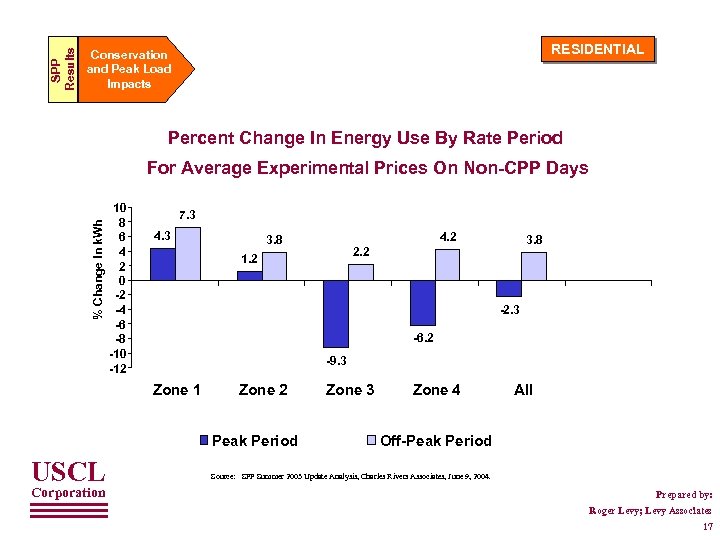 SPP Results RESIDENTIAL Conservation and Peak Load Impacts Percent Change In Energy Use By Rate Period % Change In k. Wh For Average Experimental Prices On Non-CPP Days 10 8 6 4 2 0 -2 -4 -6 -8 -10 -12 7. 3 4. 3 -2. 3 -6. 2 -9. 3 Zone 2 Peak Period Corporation 3. 8 2. 2 1. 2 Zone 1 USCL 4. 2 3. 8 Zone 3 Zone 4 All Off-Peak Period Source: SPP Summer 2003 Update Analysis, Charles Rivers Associates, June 9, 2004. Prepared by: Roger Levy; Levy Associates 17
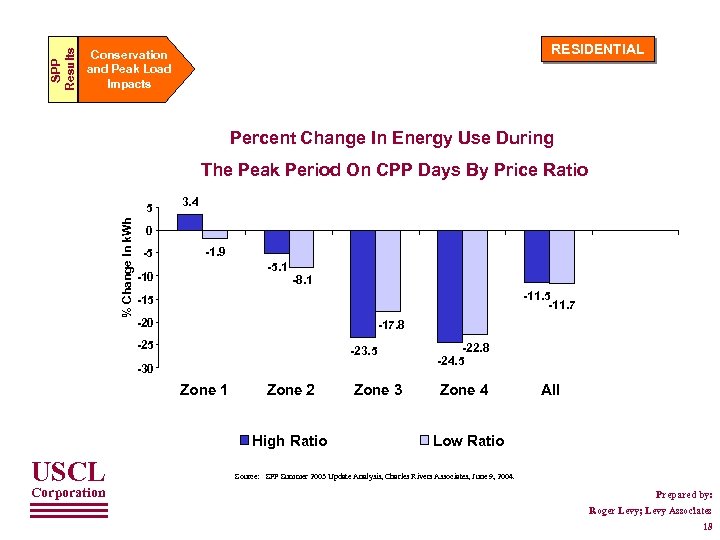 SPP Results RESIDENTIAL Conservation and Peak Load Impacts Percent Change In Energy Use During The Peak Period On CPP Days By Price Ratio % Change In k. Wh 5 3. 4 0 -5 -1. 9 -5. 1 -10 -8. 1 -11. 5 -11. 7 -15 -20 -17. 8 -25 -23. 5 -30 Zone 1 Zone 2 High Ratio USCL Corporation Zone 3 -22. 8 -24. 5 Zone 4 All Low Ratio Source: SPP Summer 2003 Update Analysis, Charles Rivers Associates, June 9, 2004. Prepared by: Roger Levy; Levy Associates 18
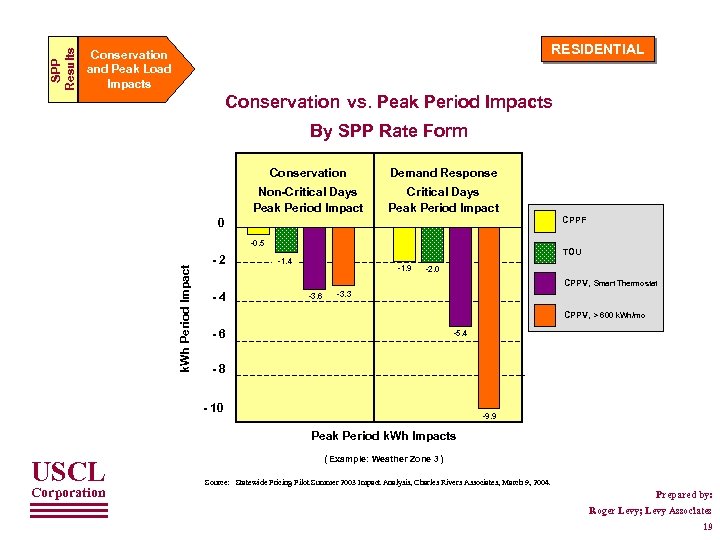 SPP Results RESIDENTIAL Conservation and Peak Load Impacts Conservation vs. Peak Period Impacts By SPP Rate Form Conservation Demand Response Non-Critical Days Peak Period Impact CPPF 0 k. Wh Period Impact -0. 5 -2 TOU -1. 4 -1. 9 -2. 0 CPPV, Smart Thermostat -4 -3. 6 -3. 3 CPPV, > 600 k. Wh/mo -6 -5. 4 -8 - 10 -9. 9 Peak Period k. Wh Impacts USCL Corporation ( Example: Weather Zone 3 ) Source: Statewide Pricing Pilot Summer 2003 Impact Analysis, Charles Rivers Associates, March 9, 2004. Prepared by: Roger Levy; Levy Associates 19
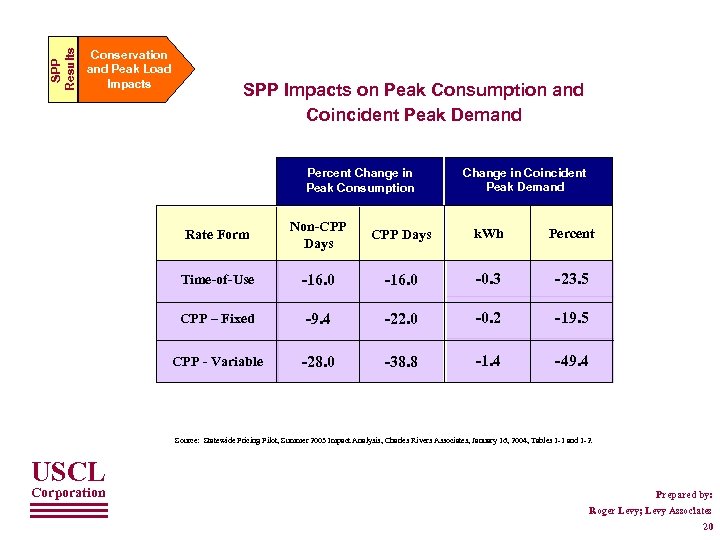 SPP Results Conservation and Peak Load Impacts SPP Impacts on Peak Consumption and Coincident Peak Demand Percent Change in Peak Consumption ` Change in Coincident Peak Demand Rate Form Non-CPP Days k. Wh Percent Time-of-Use -16. 0 -0. 3 -23. 5 CPP – Fixed -9. 4 -22. 0 -0. 2 -19. 5 CPP - Variable -28. 0 -38. 8 -1. 4 -49. 4 Source: Statewide Pricing Pilot, Summer 2003 Impact Analysis, Charles Rivers Associates, January 16, 2004, Tables 1 -1 and 1 -2. USCL Corporation Prepared by: Roger Levy; Levy Associates 20
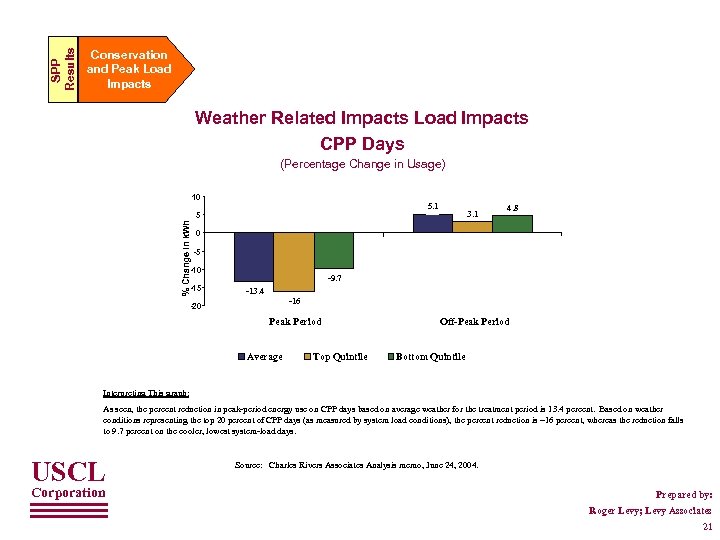 SPP Results Conservation and Peak Load Impacts Weather Related Impacts Load Impacts CPP Days (Percentage Change in Usage) 10 5. 1 % Change In k. Wh 5 3. 1 4. 8 0 -5 -10 -15 -9. 7 -13. 4 -16 -20 Peak Period Average Top Quintile Off-Peak Period Bottom Quintile Interpreting This graph: As seen, the percent reduction in peak-period energy use on CPP days based on average weather for the treatment period is 13. 4 percent. Based on weather conditions representing the top 20 percent of CPP days (as measured by system load conditions), the percent reduction is – 16 percent, whereas the reduction falls to 9. 7 percent on the cooler, lowest system-load days. USCL Corporation Source: Charles Rivers Associates Analysis memo, June 24, 2004. Prepared by: Roger Levy; Levy Associates 21
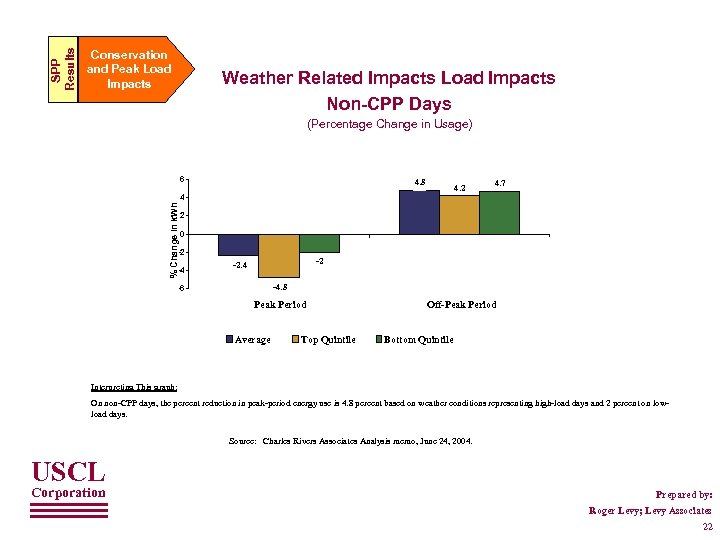 SPP Results Conservation and Peak Load Impacts Weather Related Impacts Load Impacts Non-CPP Days (Percentage Change in Usage) 6 4. 8 4. 2 4. 7 % Change In k. Wh 4 2 0 -2 -4 -2 -2. 4 -4. 8 -6 Peak Period Average Top Quintile Off-Peak Period Bottom Quintile Interpreting This graph: On non-CPP days, the percent reduction in peak-period energy use is 4. 8 percent based on weather conditions representing high-load days and 2 percent on lowload days. Source: Charles Rivers Associates Analysis memo, June 24, 2004. USCL Corporation Prepared by: Roger Levy; Levy Associates 22
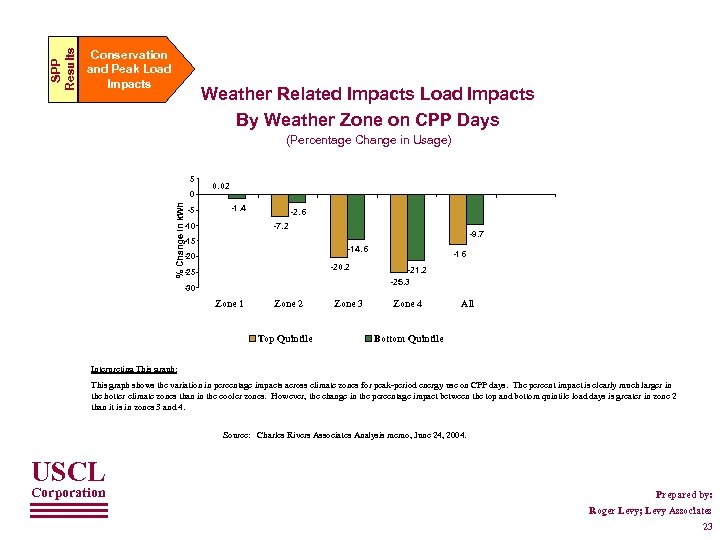 SPP Results Conservation and Peak Load Impacts Weather Related Impacts Load Impacts By Weather Zone on CPP Days (Percentage Change in Usage) 5 % Change In k. Wh 0 -5 0. 02 -1. 4 -2. 6 -7. 2 -10 -15 -9. 7 -14. 6 -20. 2 -25 -30 Zone 1 Zone 2 Top Quintile Zone 3 -16 -21. 2 -25. 3 Zone 4 All Bottom Quintile Interpreting This graph: This graph shows the variation in percentage impacts across climate zones for peak-period energy use on CPP days. The percent impact is clearly much larger in the hotter climate zones than in the cooler zones. However, the change in the percentage impact between the top and bottom quintile load days is greater in zone 2 than it is in zones 3 and 4. Source: Charles Rivers Associates Analysis memo, June 24, 2004. USCL Corporation Prepared by: Roger Levy; Levy Associates 23
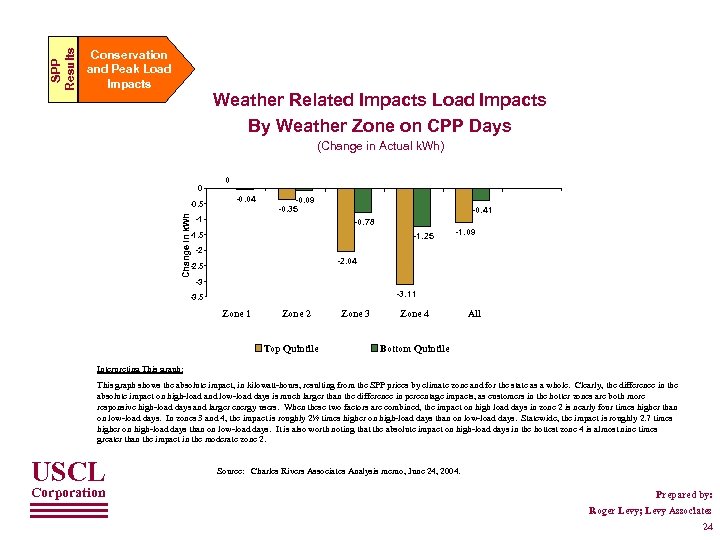 SPP Results Conservation and Peak Load Impacts Weather Related Impacts Load Impacts By Weather Zone on CPP Days (Change in Actual k. Wh) 0 Change In k. Wh -0. 5 0 -0. 04 -0. 09 -0. 35 -1 -0. 41 -0. 78 -1. 5 -1. 25 -1. 09 -2 -2. 04 -2. 5 -3 -3. 11 -3. 5 Zone 1 Zone 2 Top Quintile Zone 3 Zone 4 All Bottom Quintile Interpreting This graph: This graph shows the absolute impact, in kilowatt-hours, resulting from the SPP prices by climate zone and for the state as a whole. Clearly, the difference in the absolute impact on high-load and low-load days is much larger than the difference in percentage impacts, as customers in the hotter zones are both more responsive high-load days and larger energy users. When these two factors are combined, the impact on high load days in zone 2 is nearly four times higher than on low-load days. In zones 3 and 4, the impact is roughly 2½ times higher on high-load days than on low-load days. Statewide, the impact is roughly 2. 7 times higher on high-load days than on low-load days. It is also worth noting that the absolute impact on high-load days in the hottest zone 4 is almost nine times greater than the impact in the moderate zone 2. USCL Corporation Source: Charles Rivers Associates Analysis memo, June 24, 2004. Prepared by: Roger Levy; Levy Associates 24
 California Vision – The Results COMMERCIAL / INDUSTRIAL CUSTOMERS USCL Corporation Prepared by: Roger Levy; Levy Associates 25
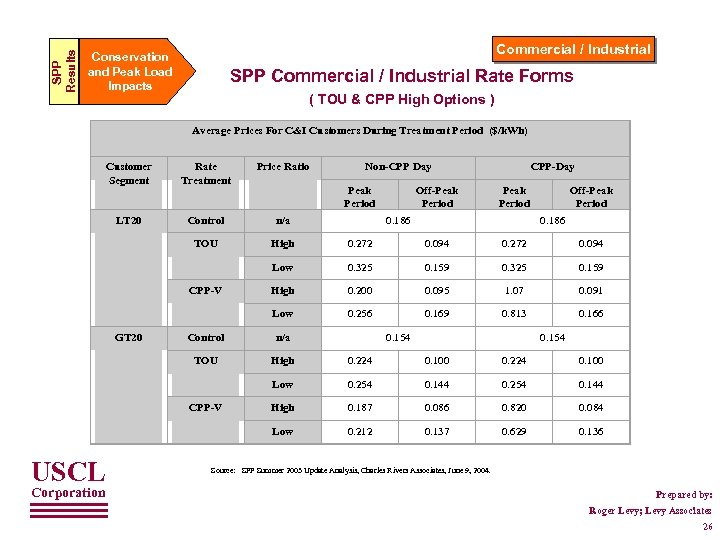 SPP Results Commercial / Industrial Conservation and Peak Load Impacts SPP Commercial / Industrial Rate Forms ( TOU & CPP High Options ) Average Prices For C&I Customers During Treatment Period ($/k. Wh) Customer Segment Rate Treatment Price Ratio LT 20 Control n/a TOU High 0. 272 0. 094 Low 0. 325 0. 159 High 0. 200 0. 095 1. 07 0. 091 Low 0. 256 0. 169 0. 813 0. 166 CPP-V GT 20 Non-CPP Day Peak Period Off-Peak Period CPP-Day Peak Period 0. 186 Off-Peak Period 0. 186 Control n/a TOU High 0. 224 0. 100 Low 0. 254 0. 144 High 0. 187 0. 086 0. 820 0. 084 Low 0. 212 0. 137 0. 629 0. 136 CPP-V USCL Corporation 0. 154 Source: SPP Summer 2003 Update Analysis, Charles Rivers Associates, June 9, 2004. Prepared by: Roger Levy; Levy Associates 26
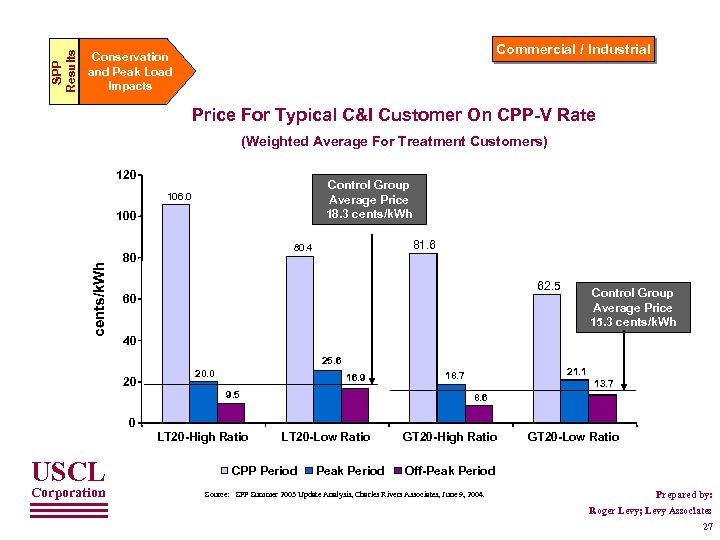 SPP Results Commercial / Industrial Conservation and Peak Load Impacts Price For Typical C&I Customer On CPP-V Rate (Weighted Average For Treatment Customers) 120 Control Group Average Price 18. 3 cents/k. Wh 106. 0 cents/k. Wh 100 81. 6 80. 4 80 62. 5 60 Control Group Average Price 15. 3 cents/k. Wh 40 25. 6 20 20. 0 16. 9 9. 5 21. 1 18. 7 13. 7 8. 6 0 LT 20 -High Ratio USCL Corporation LT 20 -Low Ratio CPP Period Peak Period GT 20 -High Ratio GT 20 -Low Ratio Off-Peak Period Source: SPP Summer 2003 Update Analysis, Charles Rivers Associates, June 9, 2004. Prepared by: Roger Levy; Levy Associates 27
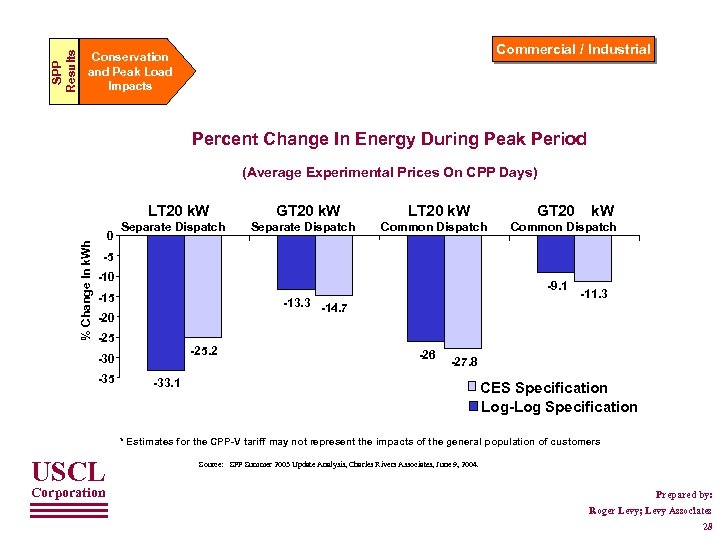 SPP Results Commercial / Industrial Conservation and Peak Load Impacts Percent Change In Energy During Peak Period (Average Experimental Prices On CPP Days) % Change In k. Wh LT 20 k. W 0 Separate Dispatch GT 20 k. W Separate Dispatch LT 20 k. W GT 20 Common Dispatch k. W Common Dispatch -5 -10 -9. 1 -15 -13. 3 -14. 7 -20 -25. 2 -30 -35 -26 -11. 3 -27. 8 -33. 1 CES Specification Log-Log Specification * Estimates for the CPP-V tariff may not represent the impacts of the general population of customers USCL Corporation Source: SPP Summer 2003 Update Analysis, Charles Rivers Associates, June 9, 2004. Prepared by: Roger Levy; Levy Associates 28
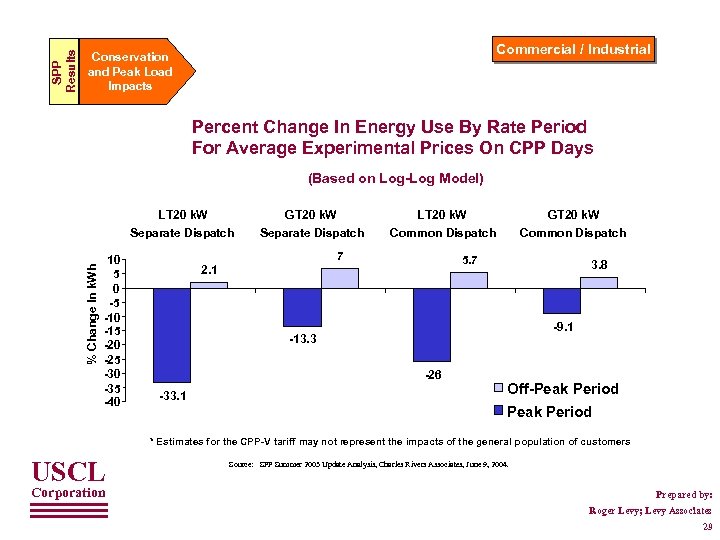 SPP Results Commercial / Industrial Conservation and Peak Load Impacts Percent Change In Energy Use By Rate Period For Average Experimental Prices On CPP Days (Based on Log-Log Model) 10 5 0 -5 -10 -15 -20 -25 -30 -35 -40 GT 20 k. W LT 20 k. W GT 20 k. W Separate Dispatch % Change In k. Wh LT 20 k. W Separate Dispatch Common Dispatch 7 5. 7 2. 1 3. 8 -9. 1 -13. 3 -26 -33. 1 Off-Peak Period * Estimates for the CPP-V tariff may not represent the impacts of the general population of customers USCL Corporation Source: SPP Summer 2003 Update Analysis, Charles Rivers Associates, June 9, 2004. Prepared by: Roger Levy; Levy Associates 29
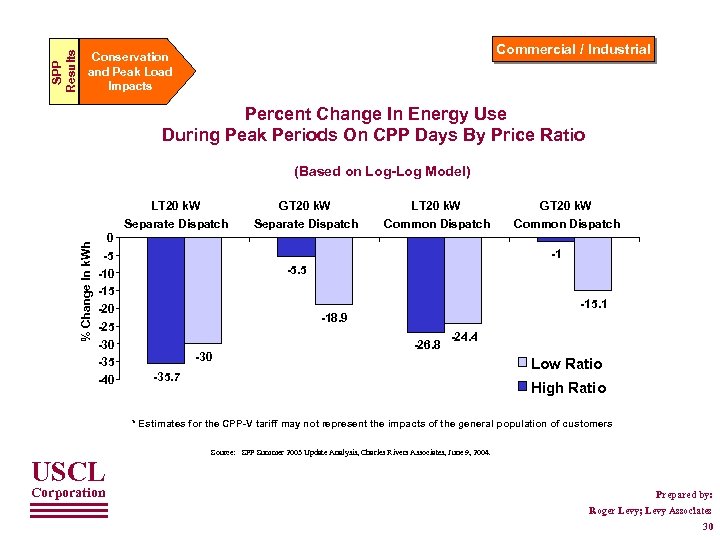 SPP Results Commercial / Industrial Conservation and Peak Load Impacts Percent Change In Energy Use During Peak Periods On CPP Days By Price Ratio (Based on Log-Log Model) 0 -5 -10 -15 -20 -25 -30 -35 -40 GT 20 k. W LT 20 k. W GT 20 k. W Separate Dispatch % Change In k. Wh LT 20 k. W Separate Dispatch Common Dispatch -1 -5. 5 -15. 1 -18. 9 -30 -26. 8 -24. 4 -35. 7 Low Ratio High Ratio * Estimates for the CPP-V tariff may not represent the impacts of the general population of customers USCL Corporation Source: SPP Summer 2003 Update Analysis, Charles Rivers Associates, June 9, 2004. Prepared by: Roger Levy; Levy Associates 30
 California Vision – The Results INDUSTRY WIDE EXPERIENCE USCL Corporation Prepared by: Roger Levy; Levy Associates 31
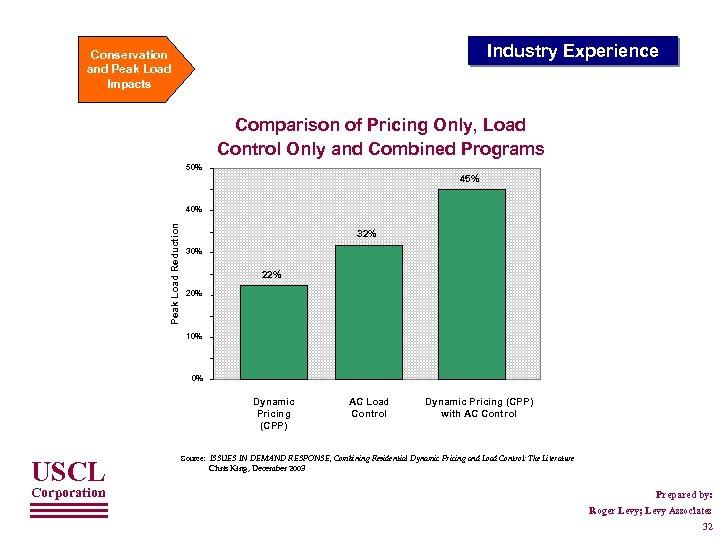 Industry Experience Conservation and Peak Load Impacts Comparison of Pricing Only, Load Control Only and Combined Programs 50% 45% Peak Load Reduction 40% 32% 30% 22% 20% 10% 0% Dynamic Pricing (CPP) USCL Corporation AC Load Control Dynamic Pricing (CPP) with AC Control Source: ISSUES IN DEMAND RESPONSE, Combining Residential Dynamic Pricing and Load Control: The Literature Chris King, December 2003 Prepared by: Roger Levy; Levy Associates 32
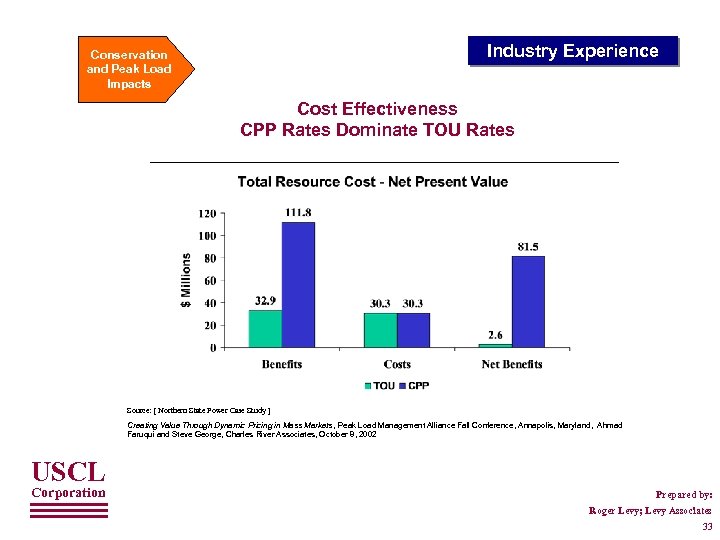 Industry Experience Conservation and Peak Load Impacts Cost Effectiveness CPP Rates Dominate TOU Rates Source: [ Northern State Power Case Study ] Creating Value Through Dynamic Pricing in Mass Markets , Peak Load Management Alliance Fall Conference, Annapolis, Maryland, Ahmad Faruqui and Steve George, Charles River Associates, October 8, 2002 USCL Corporation Prepared by: Roger Levy; Levy Associates 33
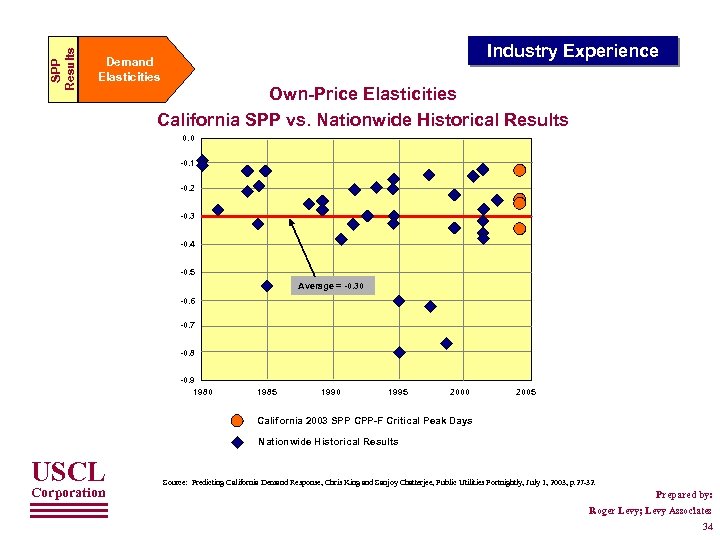 SPP Results Industry Experience Demand Elasticities Own-Price Elasticities California SPP vs. Nationwide Historical Results 0. 0 -0. 1 -0. 2 -0. 3 -0. 4 -0. 5 Average = -0. 30 -0. 6 -0. 7 -0. 8 -0. 9 1980 1985 1990 1995 2000 2005 California 2003 SPP CPP-F Critical Peak Days Nationwide Historical Results USCL Corporation Source: Predicting California Demand Response, Chris King and Sanjoy Chatterjee, Public Utilities Fortnightly, July 1, 2003, p. 27 -32. Prepared by: Roger Levy; Levy Associates 34
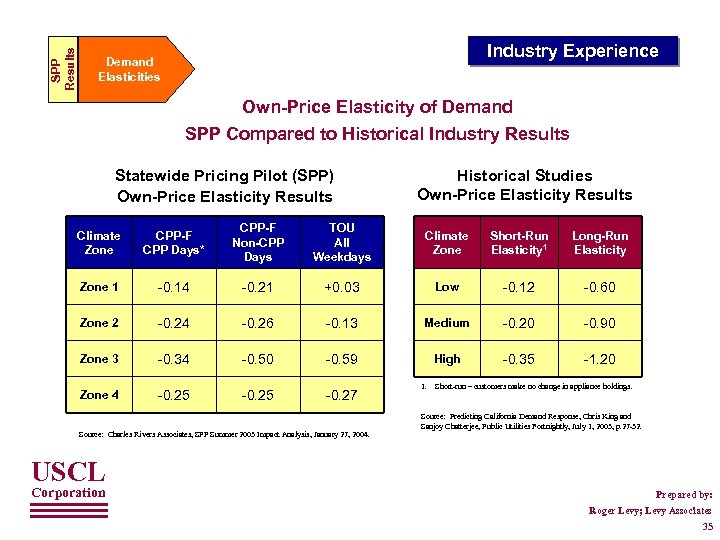 SPP Results Industry Experience Demand Elasticities Own-Price Elasticity of Demand SPP Compared to Historical Industry Results Statewide Pricing Pilot (SPP) Own-Price Elasticity Results Historical Studies Own-Price Elasticity Results Climate Zone CPP-F CPP Days* CPP-F Non-CPP Days TOU All Weekdays Climate Zone Short-Run Elasticity 1 Long-Run Elasticity Zone 1 -0. 14 -0. 21 +0. 03 Low -0. 12 -0. 60 Zone 2 -0. 24 -0. 26 -0. 13 Medium -0. 20 -0. 90 Zone 3 -0. 34 -0. 50 -0. 59 High -0. 35 -1. 20 Zone 4 -0. 25 -0. 27 Source: Charles Rivers Associates, SPP Summer 2003 Impact Analysis, January 27, 2004. 1. Short-run – customers make no change in appliance holdings. Source: Predicting California Demand Response, Chris King and Sanjoy Chatterjee, Public Utilities Fortnightly, July 1, 2003, p. 27 -32. USCL Corporation Prepared by: Roger Levy; Levy Associates 35
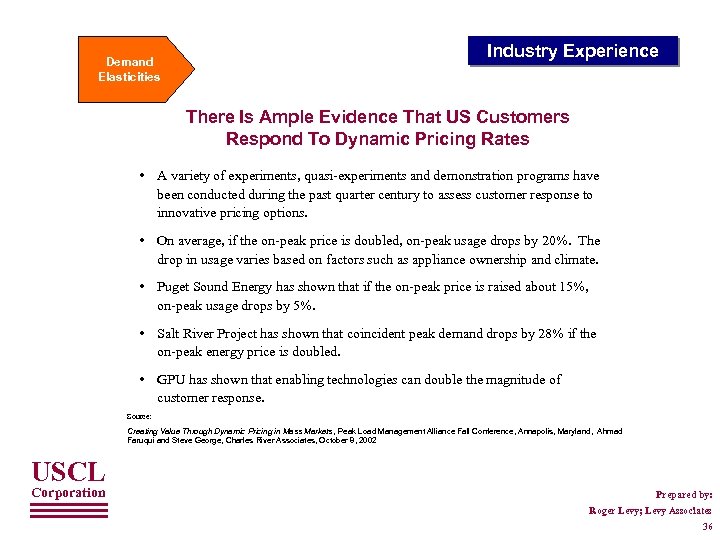 Demand Elasticities Industry Experience There Is Ample Evidence That US Customers Respond To Dynamic Pricing Rates • A variety of experiments, quasi-experiments and demonstration programs have been conducted during the past quarter century to assess customer response to innovative pricing options. • On average, if the on-peak price is doubled, on-peak usage drops by 20%. The drop in usage varies based on factors such as appliance ownership and climate. • Puget Sound Energy has shown that if the on-peak price is raised about 15%, on-peak usage drops by 5%. • Salt River Project has shown that coincident peak demand drops by 28% if the on-peak energy price is doubled. • GPU has shown that enabling technologies can double the magnitude of customer response. Source: Creating Value Through Dynamic Pricing in Mass Markets , Peak Load Management Alliance Fall Conference, Annapolis, Maryland, Ahmad Faruqui and Steve George, Charles River Associates, October 8, 2002 USCL Corporation Prepared by: Roger Levy; Levy Associates 36
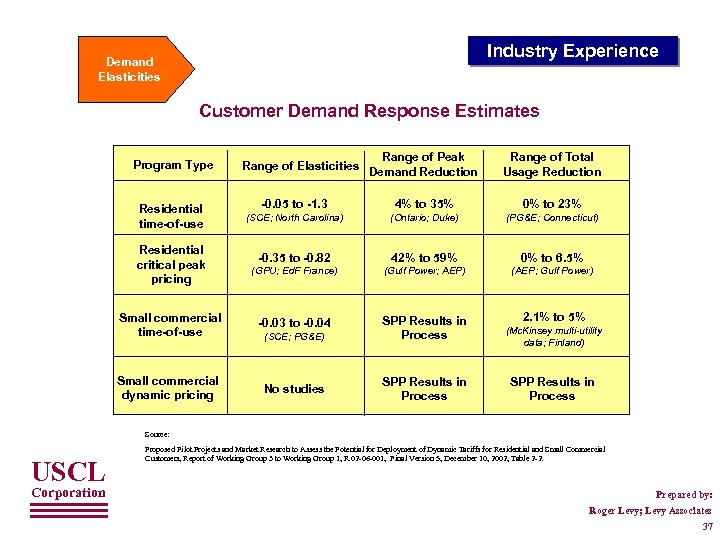 Industry Experience Demand Elasticities Customer Demand Response Estimates Program Type Residential time-of-use Residential critical peak pricing Range of Peak Range of Elasticities Demand Reduction Range of Total Usage Reduction -0. 05 to -1. 3 4% to 35% 0% to 23% (SCE; North Carolina) (Ontario; Duke) (PG&E; Connecticut) -0. 35 to -0. 82 42% to 59% 0% to 6. 5% (GPU; Ed. F France) (Gulf Power; AEP) (AEP; Gulf Power) Small commercial time-of-use -0. 03 to -0. 04 SPP Results in Process Small commercial dynamic pricing No studies (SCE; PG&E) SPP Results in Process 2. 1% to 5% (Mc. Kinsey multi-utility data; Finland) SPP Results in Process Source: USCL Corporation Proposed Pilot Projects and Market Research to Assess the Potential for Deployment of Dynamic Tariffs for Residential and Small Commercial Customers, Report of Working Group 3 to Working Group 1, R. 02 -06 -001, Final Version 5, December 10, 2002, Table 2 -2. Prepared by: Roger Levy; Levy Associates 37
 California Vision – The Results CUSTOMER KNOWLEDGE, PREFERENCES and BILL IMPACTS USCL Corporation Prepared by: Roger Levy; Levy Associates 38
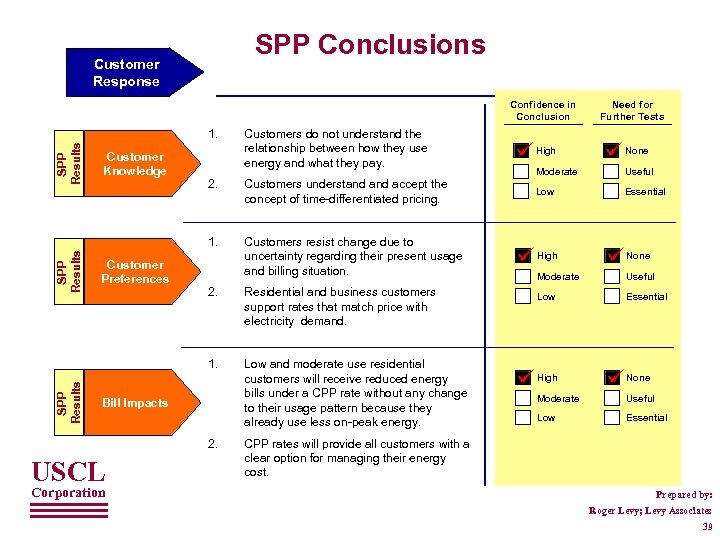 SPP Conclusions Customer Response Confidence in Conclusion 1. Need for Further Tests SPP Results Customer Preferences High None 2. Moderate Useful Customers understand accept the concept of time-differentiated pricing. Low Essential 1. Customer Knowledge Customers do not understand the relationship between how they use energy and what they pay. Customers resist change due to uncertainty regarding their present usage and billing situation. High None Moderate Useful Low Essential Residential and business customers support rates that match price with electricity demand. 1. SPP Results 2. Low and moderate use residential customers will receive reduced energy bills under a CPP rate without any change to their usage pattern because they already use less on-peak energy. Bill Impacts 2. USCL Corporation CPP rates will provide all customers with a clear option for managing their energy cost. Prepared by: Roger Levy; Levy Associates 39
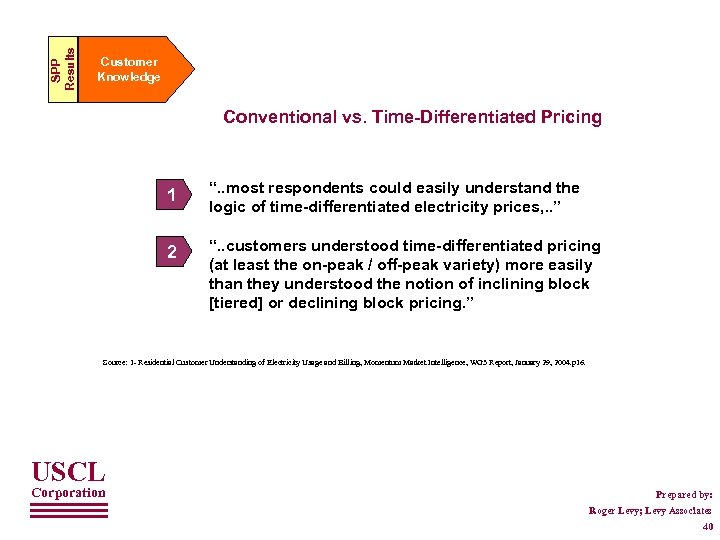 SPP Results Customer Knowledge Conventional vs. Time-Differentiated Pricing 1 “. . most respondents could easily understand the logic of time-differentiated electricity prices, . . ” 2 “. . customers understood time-differentiated pricing (at least the on-peak / off-peak variety) more easily than they understood the notion of inclining block [tiered] or declining block pricing. ” Source: 1 - Residential Customer Understanding of Electricity Usage and Billing, Momentum Market Intelligence, WG 3 Report, January 29, 2004. p 16. USCL Corporation Prepared by: Roger Levy; Levy Associates 40
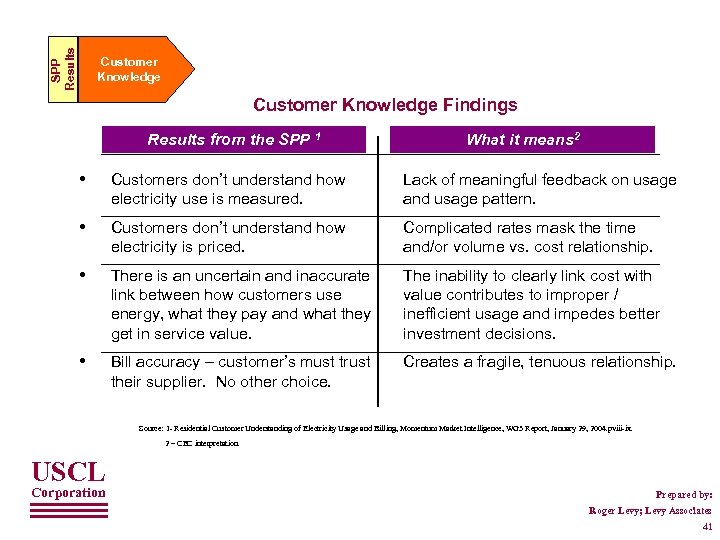 SPP Results Customer Knowledge Findings Results from the SPP 1 What it means 2 • Customers don’t understand how electricity use is measured. Lack of meaningful feedback on usage and usage pattern. • Customers don’t understand how electricity is priced. Complicated rates mask the time and/or volume vs. cost relationship. • There is an uncertain and inaccurate link between how customers use energy, what they pay and what they get in service value. The inability to clearly link cost with value contributes to improper / inefficient usage and impedes better investment decisions. • Bill accuracy – customer’s must trust their supplier. No other choice. Creates a fragile, tenuous relationship. Source: 1 - Residential Customer Understanding of Electricity Usage and Billing, Momentum Market Intelligence, WG 3 Report, January 29, 2004. pviii-ix. 2 – CEC interpretation. USCL Corporation Prepared by: Roger Levy; Levy Associates 41
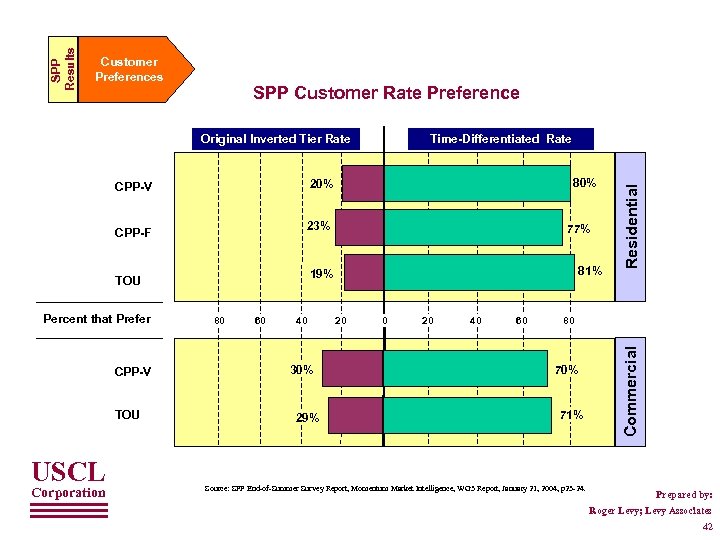 SPP Customer Rate Preference 23% CPP-F TOU USCL Corporation 77% 81% 19% TOU CPP-V 80% 20% CPP-V Percent that Prefer Time-Differentiated Rate 80 60 40 30% 29% 20 0 20 40 60 Residential Original Inverted Tier Rate 80 70% 71% Source: SPP End-of-Summer Survey Report, Momentum Market Intelligence, WG 3 Report, January 21, 2004, p 23 -24. Commercial SPP Results Customer Preferences Prepared by: Roger Levy; Levy Associates 42
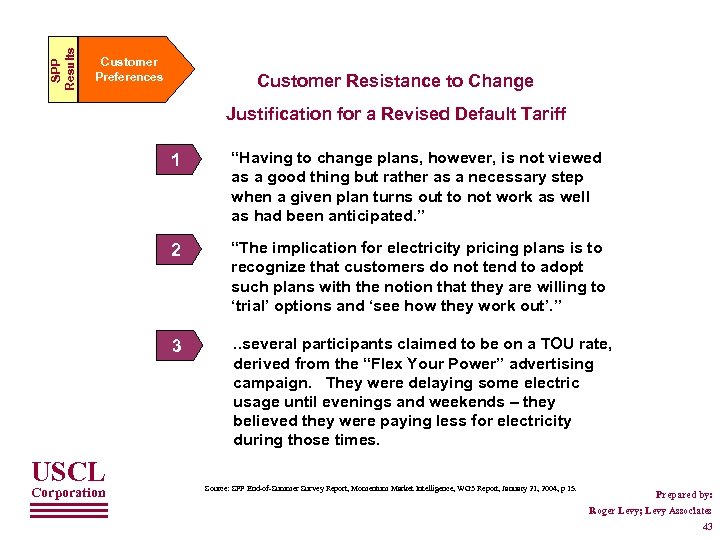 SPP Results Customer Preferences Customer Resistance to Change Justification for a Revised Default Tariff 1 2 Corporation “The implication for electricity pricing plans is to recognize that customers do not tend to adopt such plans with the notion that they are willing to ‘trial’ options and ‘see how they work out’. ” 3 USCL “Having to change plans, however, is not viewed as a good thing but rather as a necessary step when a given plan turns out to not work as well as had been anticipated. ” . . several participants claimed to be on a TOU rate, derived from the “Flex Your Power” advertising campaign. They were delaying some electric usage until evenings and weekends – they believed they were paying less for electricity during those times. Source: SPP End-of-Summer Survey Report, Momentum Market Intelligence, WG 3 Report, January 21, 2004, p 15. Prepared by: Roger Levy; Levy Associates 43
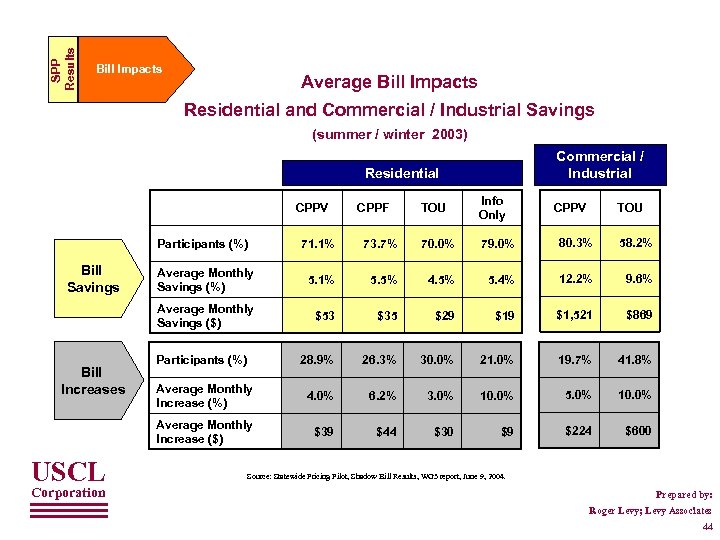 SPP Results Bill Impacts Average Bill Impacts Residential and Commercial / Industrial Savings (summer / winter 2003) Commercial / Industrial Residential CPPV CPPF TOU Info Only CPPV TOU Participants (%) USCL Corporation 70. 0% 79. 0% 80. 3% 58. 2% Average Monthly Savings (%) 5. 1% 5. 5% 4. 5% 5. 4% 12. 2% 9. 6% $53 $35 $29 $1, 521 $869 Participants (%) 28. 9% 26. 3% 30. 0% 21. 0% 19. 7% 41. 8% Average Monthly Increase (%) 4. 0% 6. 2% 3. 0% 10. 0% 5. 0% 10. 0% Average Monthly Increase ($) Bill Increases 73. 7% Average Monthly Savings ($) Bill Savings 71. 1% $39 $44 $30 $9 $224 $600 Source: Statewide Pricing Pilot, Shadow Bill Results, WG 3 report, June 9, 2004. Prepared by: Roger Levy; Levy Associates 44
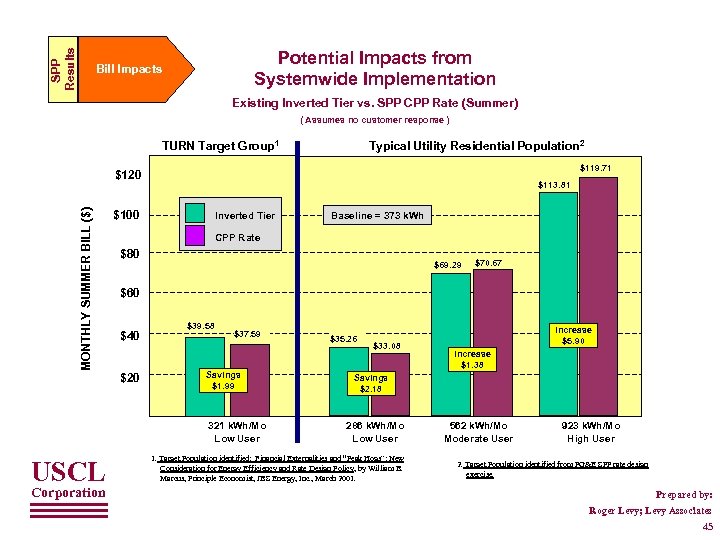 SPP Results Potential Impacts from Systemwide Implementation Bill Impacts Existing Inverted Tier vs. SPP CPP Rate (Summer) ( Assumes no customer response ) TURN Target Group 1 Typical Utility Residential Population 2 $119. 71 MONTHLY SUMMER BILL ($) $120 $113. 81 $100 Inverted Tier CPP Rate $80 $69. 29 Corporation $70. 67 $60 $40 $20 $39. 58 $37. 59 Savings $1. 99 321 k. Wh/Mo Low User USCL Baseline = 373 k. Wh $35. 26 $33. 08 Increase $5. 90 Increase $1. 38 Savings $2. 18 286 k. Wh/Mo Low User 1. Target Population identified: Financial Externalities and “Peak Hogs”: New Consideration for Energy Efficiency and Rate Design Policy, by William B. Marcus, Principle Economist, JBS Energy, Inc. , March 2001. 562 k. Wh/Mo Moderate User 923 k. Wh/Mo High User 2. Target Population identified from PG&E SPP rate design exercise. Prepared by: Roger Levy; Levy Associates 45
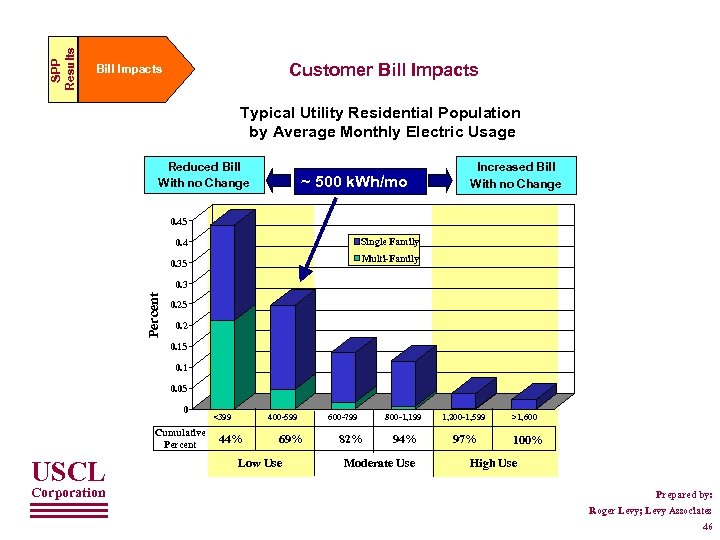 SPP Results Customer Bill Impacts Typical Utility Residential Population by Average Monthly Electric Usage Reduced Bill With no Change ~ 500 k. Wh/mo Increased Bill With no Change 0. 45 Single Family 0. 4 Multi-Family 0. 35 Percent 0. 3 0. 25 0. 2 0. 15 0. 1 0. 05 0 Cumulative Percent USCL Corporation <399 400 -599 44% 69% Low Use 600 -799 82% 800 -1, 199 1, 200 -1, 599 94% 97% Moderate Use >1, 600 100% High Use Prepared by: Roger Levy; Levy Associates 46
 California Vision – The Results Cost Benefit Issues USCL Corporation Prepared by: Roger Levy; Levy Associates 47
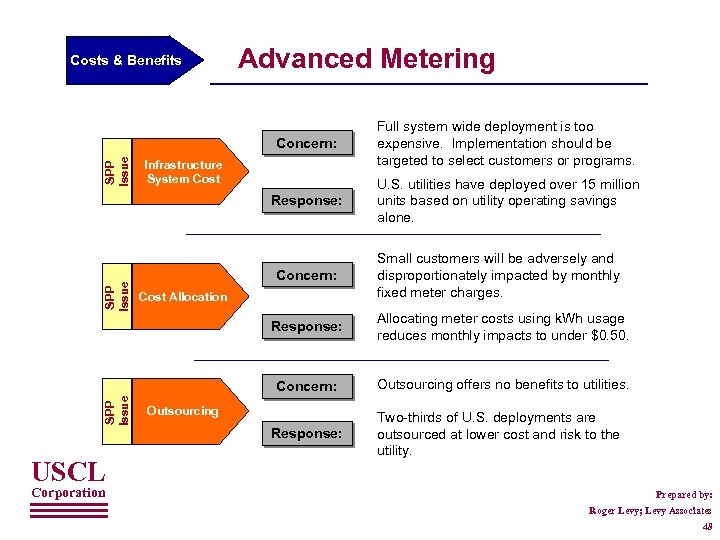 Costs & Benefits Advanced Metering Response: SPP Issue Concern: Full system wide deployment is too expensive. Implementation should be targeted to select customers or programs. U. S. utilities have deployed over 15 million units based on utility operating savings alone. Infrastructure System Cost Concern: Cost Allocation Small customers will be adversely and disproportionately impacted by monthly fixed meter charges. USCL Corporation Allocating meter costs using k. Wh usage reduces monthly impacts to under $0. 50. Concern: SPP Issue Response: Outsourcing offers no benefits to utilities. Outsourcing Response: Two-thirds of U. S. deployments are outsourced at lower cost and risk to the utility. Prepared by: Roger Levy; Levy Associates 48
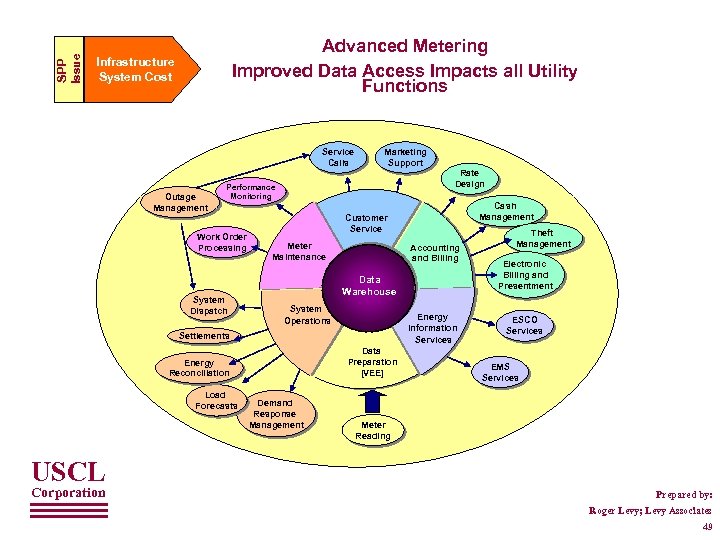 SPP Issue Advanced Metering Improved Data Access Impacts all Utility Functions Infrastructure System Cost Service Calls Outage Management Marketing Support Rate Design Performance Monitoring Work Order Processing System Dispatch Meter Maintenance Accounting and Billing Data Warehouse System Operations Energy Information Services Settlements Data Preparation [VEE] Energy Reconciliation Load Forecasts Cash Management Customer Service Demand Response Management Theft Management Electronic Billing and Presentment ESCO Services EMS Services Meter Reading USCL Corporation Prepared by: Roger Levy; Levy Associates 49
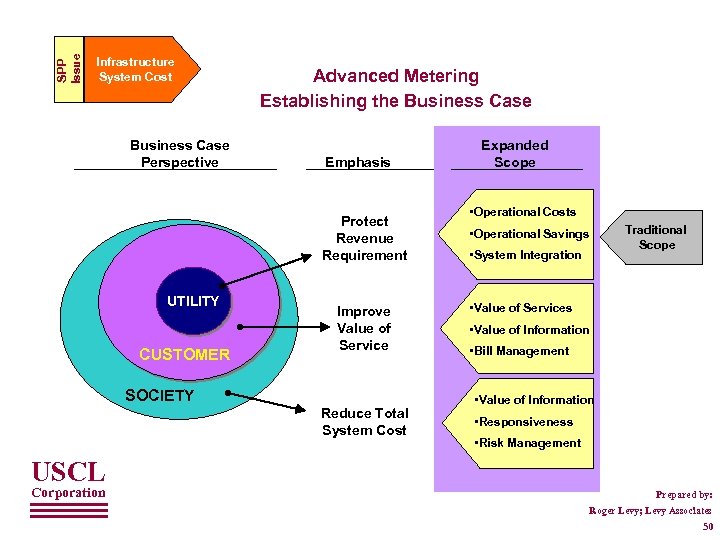 SPP Issue Infrastructure System Cost Business Case Perspective Advanced Metering Establishing the Business Case Emphasis Protect Revenue Requirement UTILITY CUSTOMER Improve Value of Service SOCIETY Reduce Total System Cost Expanded Scope • Operational Costs • Operational Savings • System Integration Traditional Scope • Value of Services • Value of Information • Bill Management • Value of Information • Responsiveness • Risk Management USCL Corporation Prepared by: Roger Levy; Levy Associates 50
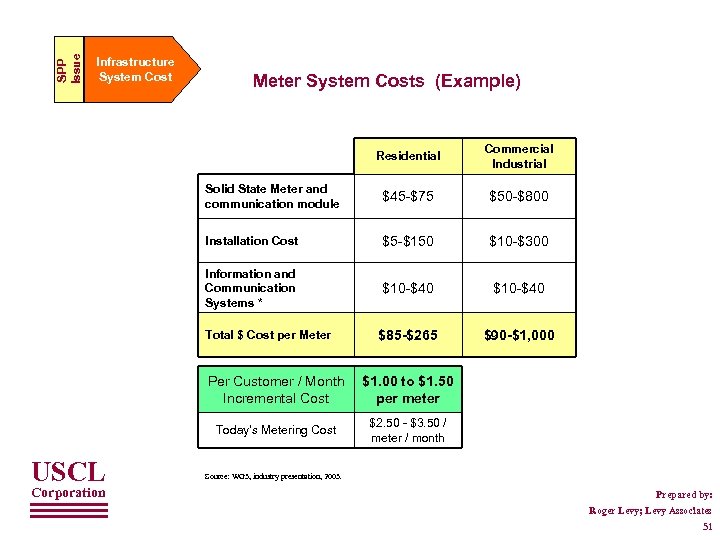 SPP Issue Infrastructure System Cost Meter System Costs (Example) Residential Commercial Industrial Solid State Meter and communication module $45 -$75 $50 -$800 Installation Cost $5 -$150 $10 -$300 Information and Communication Systems * $10 -$40 $85 -$265 $90 -$1, 000 Total $ Cost per Meter Per Customer / Month Incremental Cost Today’s Metering Cost USCL Corporation $1. 00 to $1. 50 per meter $2. 50 - $3. 50 / meter / month Source: WG 3, industry presentation, 2003. Prepared by: Roger Levy; Levy Associates 51
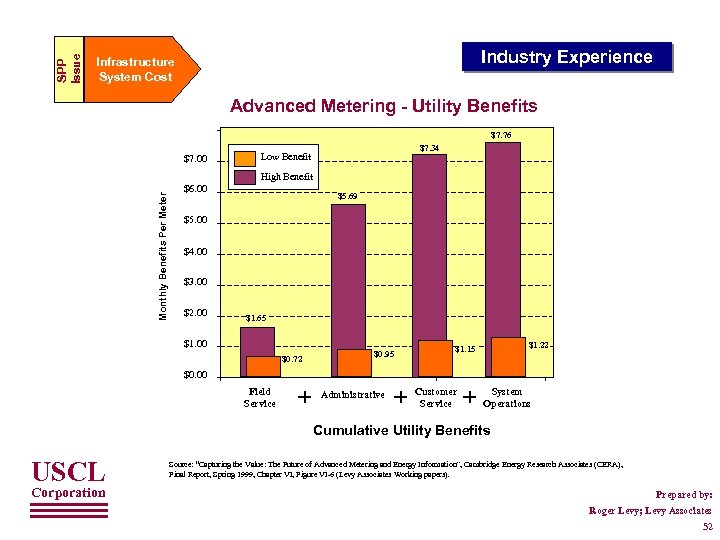 SPP Issue Industry Experience Infrastructure System Cost Advanced Metering - Utility Benefits $7. 76 $7. 00 $7. 34 Low Benefit Monthly Benefits Per Meter High Benefit $6. 00 $5. 69 $5. 00 $4. 00 $3. 00 $2. 00 $1. 65 $1. 00 $0. 72 $0. 95 $1. 15 $1. 22 $0. 00 Field Service + Administrative + Customer Service System + Operations Cumulative Utility Benefits USCL Corporation Source: “Capturing the Value: The Future of Advanced Metering and Energy Information”, Cambridge Energy Research Associates (CERA), Final Report, Spring 1999, Chapter VI, Figure VI-6 (Levy Associates Working papers). Prepared by: Roger Levy; Levy Associates 52
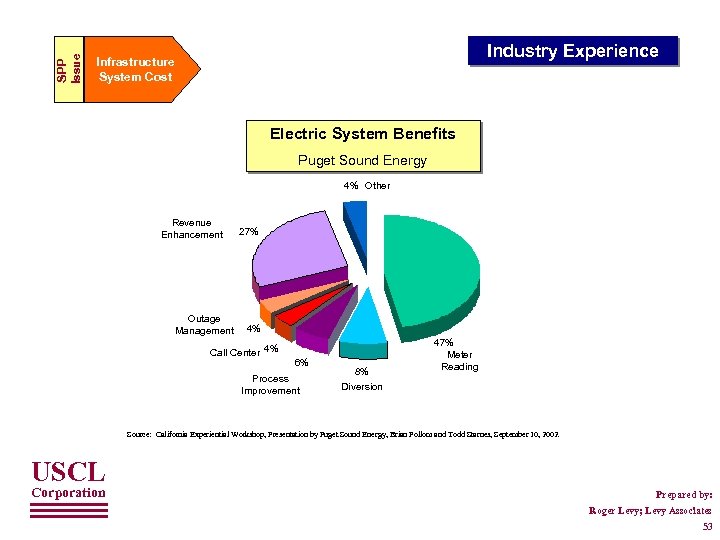 SPP Issue Industry Experience Infrastructure System Cost Electric System Benefits Puget Sound Energy 4% Other Revenue Enhancement Outage Management 27% 4% Call Center 4% 6% Process Improvement 8% Diversion 47% Meter Reading Source: California Experiential Workshop, Presentation by Puget Sound Energy, Brian Pollom and Todd Starnes, September 10, 2002. USCL Corporation Prepared by: Roger Levy; Levy Associates 53
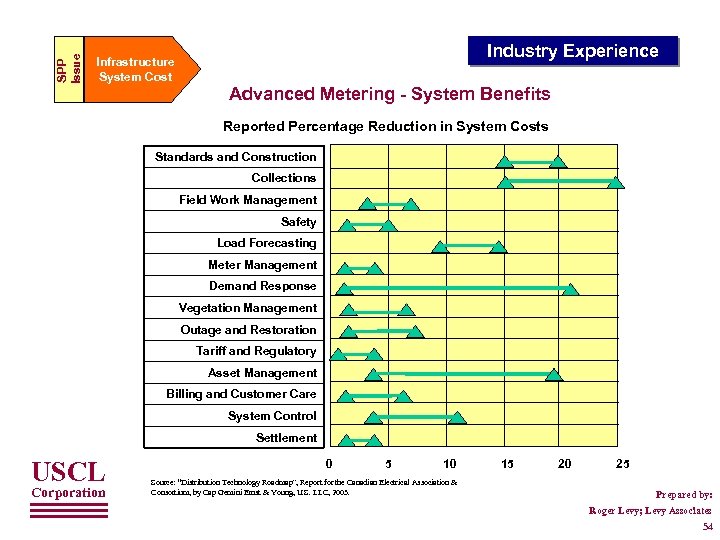 SPP Issue Industry Experience Infrastructure System Cost Advanced Metering - System Benefits Reported Percentage Reduction in System Costs Standards and Construction Collections Field Work Management Safety Load Forecasting Meter Management Demand Response Vegetation Management Outage and Restoration Tariff and Regulatory Asset Management Billing and Customer Care System Control Settlement USCL Corporation 0 5 10 Source: “Distribution Technology Roadmap”, Report for the Canadian Electrical Association & Consortium, by Cap Gemini Ernst & Young, U. S. LLC, 2003. 15 20 25 Prepared by: Roger Levy; Levy Associates 54
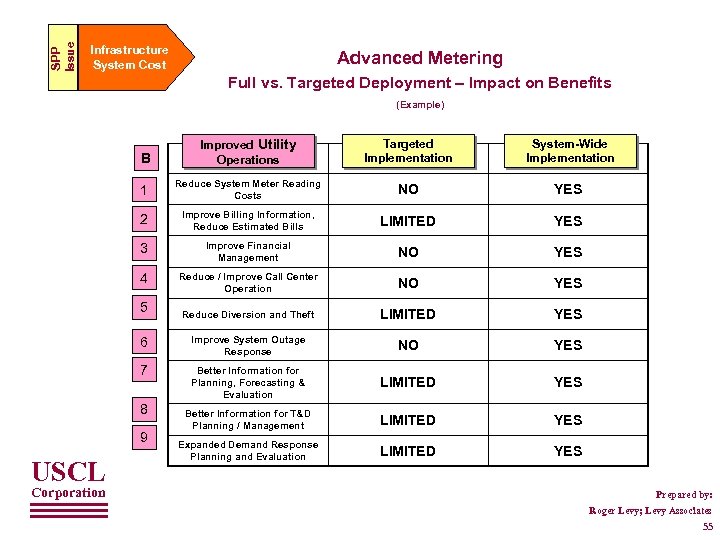 SPP Issue Infrastructure System Cost Advanced Metering Full vs. Targeted Deployment – Impact on Benefits (Example) B Improved Utility Operations Targeted Implementation System-Wide Implementation 1 Reduce System Meter Reading Costs NO YES 2 Improve Billing Information, Reduce Estimated Bills LIMITED YES 3 Improve Financial Management NO YES 4 Reduce / Improve Call Center Operation NO YES Reduce Diversion and Theft LIMITED YES 6 Improve System Outage Response NO YES 7 Better Information for Planning, Forecasting & Evaluation LIMITED YES Better Information for T&D Planning / Management LIMITED YES Expanded Demand Response Planning and Evaluation LIMITED YES 5 8 9 USCL Corporation Prepared by: Roger Levy; Levy Associates 55
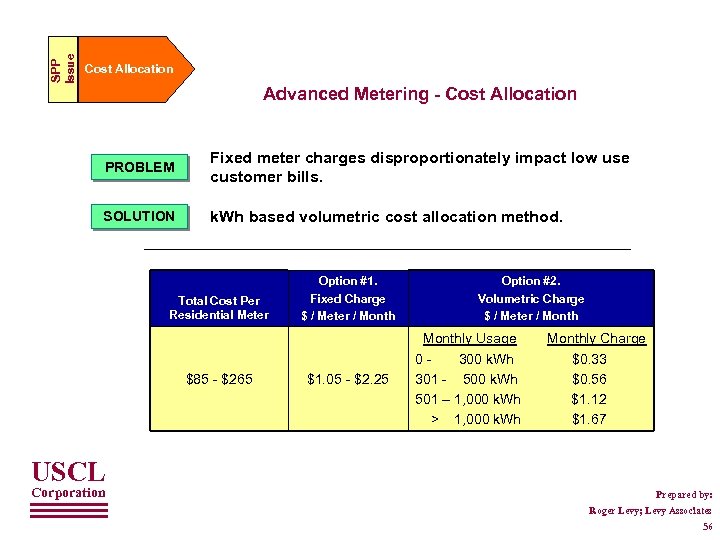 SPP Issue Cost Allocation Advanced Metering - Cost Allocation PROBLEM Fixed meter charges disproportionately impact low use customer bills. SOLUTION k. Wh based volumetric cost allocation method. Total Cost Per Residential Meter $85 - $265 Option #1. Fixed Charge $ / Meter / Month $1. 05 - $2. 25 Option #2. Volumetric Charge $ / Meter / Monthly Usage 0300 k. Wh 301 - 500 k. Wh 501 – 1, 000 k. Wh > 1, 000 k. Wh Monthly Charge $0. 33 $0. 56 $1. 12 $1. 67 USCL Corporation Prepared by: Roger Levy; Levy Associates 56
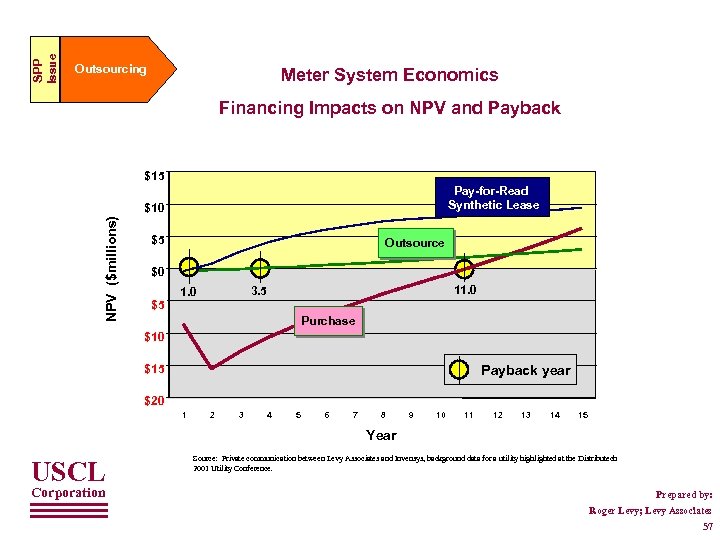 SPP Issue Outsourcing Meter System Economics Financing Impacts on NPV and Payback $15 Pay-for-Read Synthetic Lease NPV ($millions) $10 $5 Outsource $0 $5 11. 0 3. 5 1. 0 Purchase $10 Payback year $15 $20 1 2 3 4 5 6 7 8 9 10 11 12 13 14 15 Year USCL Corporation Source: Private communication between Levy Associates and Invensys, background data for a utility highlighted at the Distributech 2001 Utility Conference. Prepared by: Roger Levy; Levy Associates 57
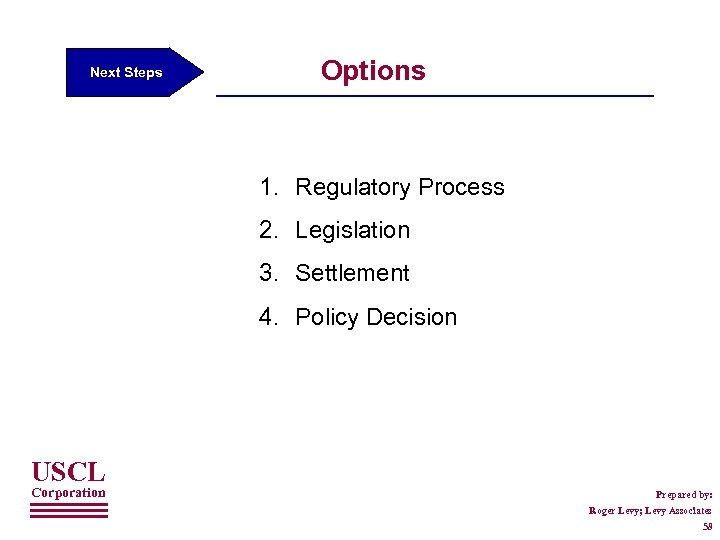 Next Steps Options 1. Regulatory Process 2. Legislation 3. Settlement 4. Policy Decision USCL Corporation Prepared by: Roger Levy; Levy Associates 58