


 Скачать презентацию California s Statewide Pricing Pilot Larsh Johnson President
be9201c9080343384509f23d402542c1.ppt
- Количество слайдов: 19
 California’s Statewide Pricing Pilot Larsh Johnson – President and Chief Technical Officer, e. Meter March 25, 2004
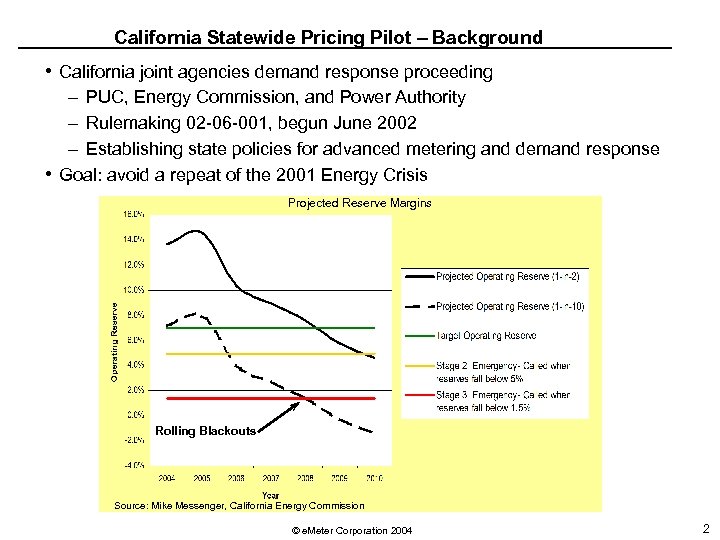 California Statewide Pricing Pilot – Background • California joint agencies demand response proceeding – PUC, Energy Commission, and Power Authority – Rulemaking 02 -06 -001, begun June 2002 – Establishing state policies for advanced metering and demand response • Goal: avoid a repeat of the 2001 Energy Crisis Projected Reserve Margins Rolling Blackouts Source: Mike Messenger, California Energy Commission © e. Meter Corporation 2004 2
 Status of Proceeding State Vision Adopted in 2003 (D. 03 -06 -032) • Utilities to meet 5% of system peak demand via dynamic pricing by 2007 • All customers should be provided advanced metering system capable of • supporting a time-of-use (TOU) tariff or better Customers should have at least the following tariff options: – Over 200 k. W: hourly real-time pricing (RTP), critical peak pricing (CPP) or TOU – Under 200 k. W (residential and small commercial): CPP, TOU, or flat rate with hedge for risk protection Major Activities • Advanced metering and CPP/TOU tariffs in place for >200 k. W customers • CPUC determining business case methodology for metering for <200 k. W • • customers now and will issue deployment decision in about a year Utilities file March 31, 2004 on plans to meet 2007 goal Statewide Pilot Program © e. Meter Corporation 2004 3
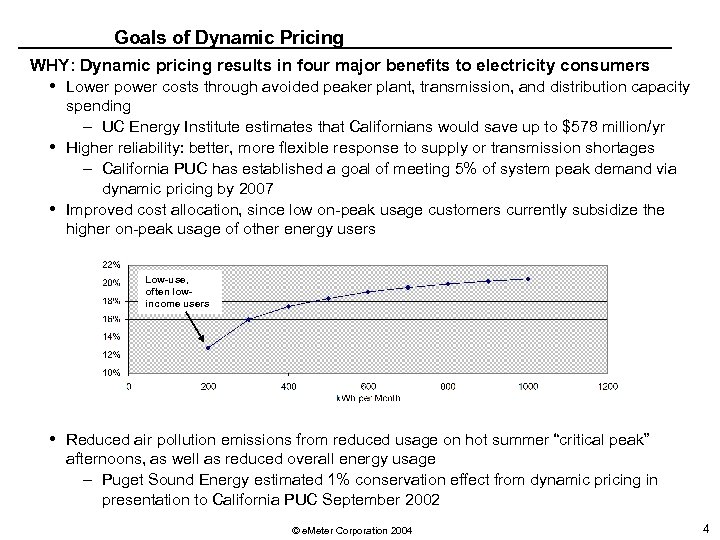 Goals of Dynamic Pricing WHY: Dynamic pricing results in four major benefits to electricity consumers • Lower power costs through avoided peaker plant, transmission, and distribution capacity • • spending – UC Energy Institute estimates that Californians would save up to $578 million/yr Higher reliability: better, more flexible response to supply or transmission shortages – California PUC has established a goal of meeting 5% of system peak demand via dynamic pricing by 2007 Improved cost allocation, since low on-peak usage customers currently subsidize the higher on-peak usage of other energy users Low-use, often lowincome users • Reduced air pollution emissions from reduced usage on hot summer “critical peak” afternoons, as well as reduced overall energy usage – Puget Sound Energy estimated 1% conservation effect from dynamic pricing in presentation to California PUC September 2002 © e. Meter Corporation 2004 4
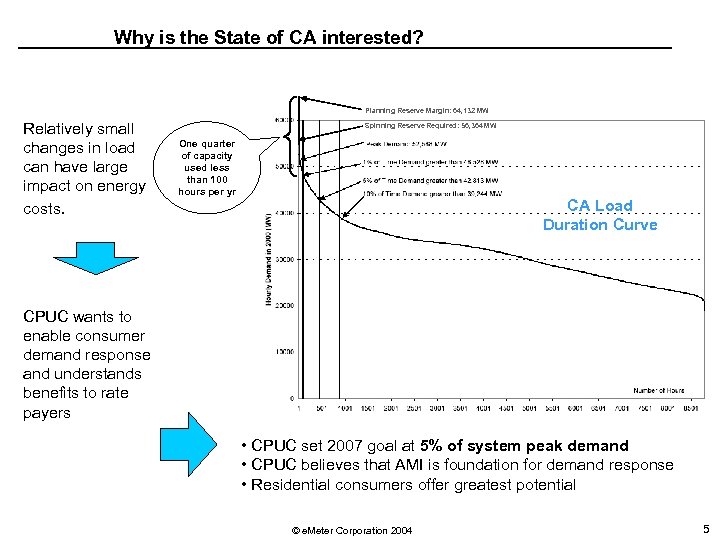 Why is the State of CA interested? Planning Reserve Margin: 64, 132 MW Relatively small changes in load can have large impact on energy costs. Spinning Reserve Required: 56, 364 MW One quarter of capacity used less than 100 hours per yr CA Load Duration Curve CPUC wants to enable consumer demand response and understands benefits to rate payers • CPUC set 2007 goal at 5% of system peak demand • CPUC believes that AMI is foundation for demand response • Residential consumers offer greatest potential © e. Meter Corporation 2004 5
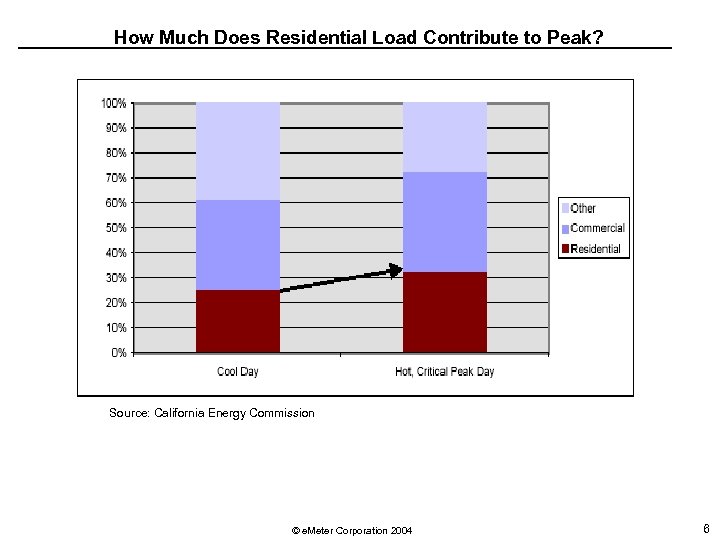 How Much Does Residential Load Contribute to Peak? Source: California Energy Commission © e. Meter Corporation 2004 6
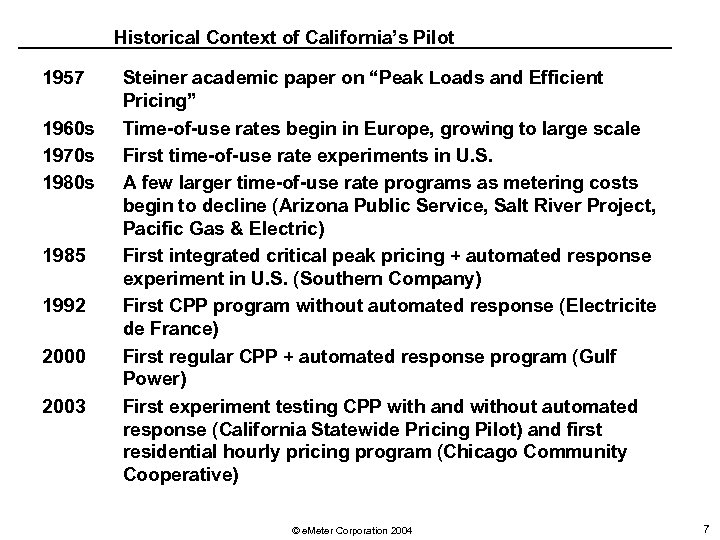 Historical Context of California’s Pilot 1957 1960 s 1970 s 1985 1992 2000 2003 Steiner academic paper on “Peak Loads and Efficient Pricing” Time-of-use rates begin in Europe, growing to large scale First time-of-use rate experiments in U. S. A few larger time-of-use rate programs as metering costs begin to decline (Arizona Public Service, Salt River Project, Pacific Gas & Electric) First integrated critical peak pricing + automated response experiment in U. S. (Southern Company) First CPP program without automated response (Electricite de France) First regular CPP + automated response program (Gulf Power) First experiment testing CPP with and without automated response (California Statewide Pricing Pilot) and first residential hourly pricing program (Chicago Community Cooperative) © e. Meter Corporation 2004 7
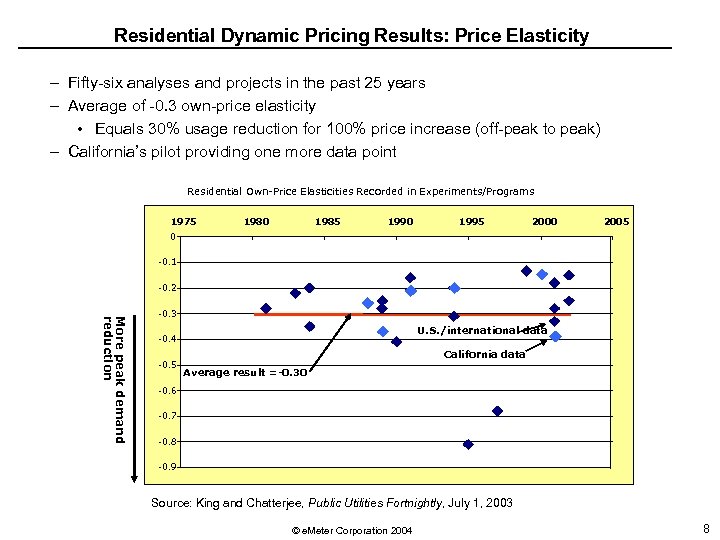 Residential Dynamic Pricing Results: Price Elasticity – Fifty-six analyses and projects in the past 25 years – Average of -0. 3 own-price elasticity • Equals 30% usage reduction for 100% price increase (off-peak to peak) – California’s pilot providing one more data point Residential Own-Price Elasticities Recorded in Experiments/Programs 1975 1980 1985 1990 1995 2000 2005 0 -0. 1 -0. 2 More peak demand reduction -0. 3 U. S. /international data -0. 4 -0. 5 California data Average result =-0. 30 -0. 6 -0. 7 -0. 8 -0. 9 Source: King and Chatterjee, Public Utilities Fortnightly, July 1, 2003 © e. Meter Corporation 2004 8
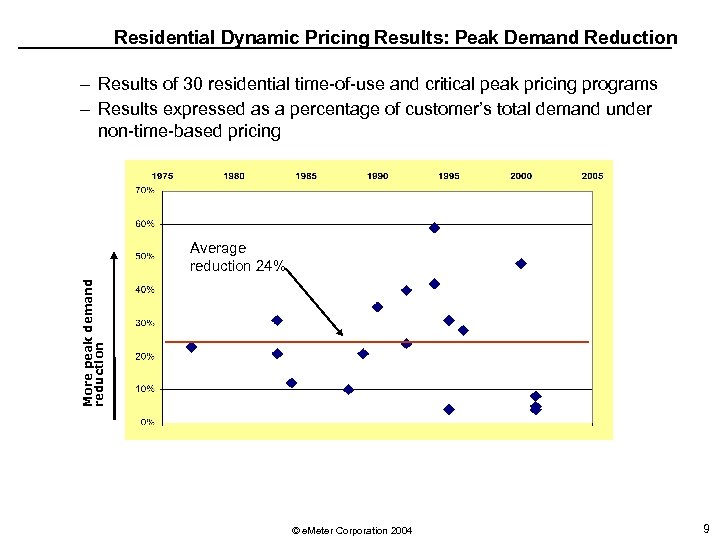 Residential Dynamic Pricing Results: Peak Demand Reduction – Results of 30 residential time-of-use and critical peak pricing programs – Results expressed as a percentage of customer’s total demand under non-time-based pricing More peak demand reduction Average reduction 24% © e. Meter Corporation 2004 9
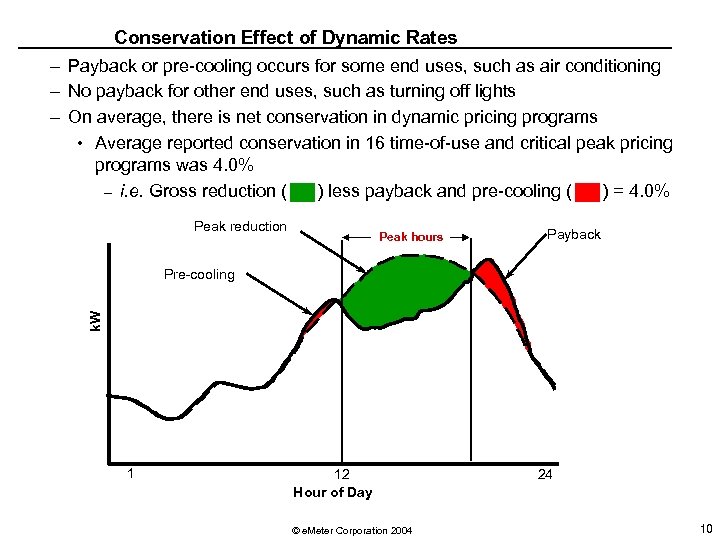 Conservation Effect of Dynamic Rates – Payback or pre-cooling occurs for some end uses, such as air conditioning – No payback for other end uses, such as turning off lights – On average, there is net conservation in dynamic pricing programs • Average reported conservation in 16 time-of-use and critical peak pricing programs was 4. 0% – i. e. Gross reduction ( ) less payback and pre-cooling ( ) = 4. 0% Peak reduction Peak hours Payback k. W Pre-cooling 1 12 Hour of Day © e. Meter Corporation 2004 24 10
 Statewide Pricing Pilot Overview • Statewide – Pacific Gas & Electric, San Diego Gas & Electric, and Southern California Edison – Sample of 2, 500 customers statistically representative of the entire state – Residential and small commercial customers • Goals – Measure peak demand reductions – Measure total consumption reductions – Assess customer preferences via participant experiences and market surveys • Customers put in three primary treatment groups – Time-of-Use (TOU) Peak (2 -7 pm weekdays) and off-peak • Peak to off-peak price ratio about 2: 1 • – Critical Peak Pricing-Fixed (CPP-F) Peak (2 -7 pm weekdays) and off-peak • Much higher price – about 5 x higher – during critical peak period (2 -7 pm) on up to 15 days a year, with day-ahead notification • – Critical Peak Pricing-Variable (CPP-V) • Three differences from CPP-F – Critical peak period varies from 1 to 5 hours from 2 -7 pm – Notification varies from day ahead to 4 hours ahead – All customers have smart thermostat programmed for automated response © e. Meter Corporation 2004 11
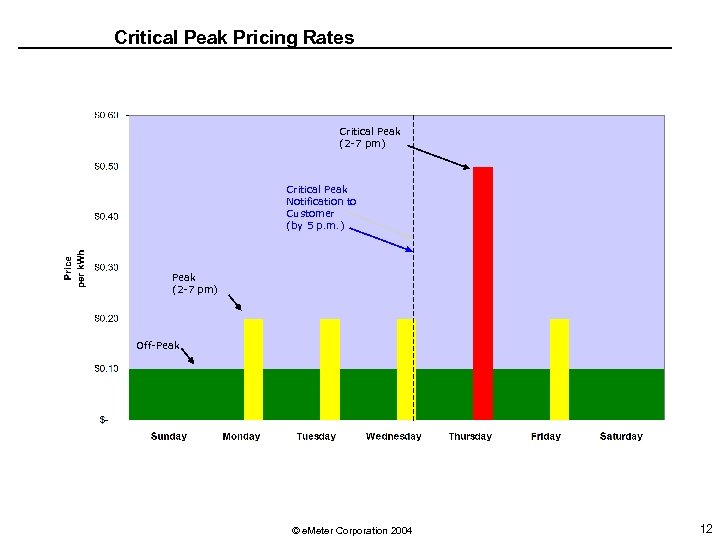 Critical Peak Pricing Rates Critical Peak (2 -7 pm) Critical Peak Notification to Customer (by 5 p. m. ) Peak (2 -7 pm) Off-Peak © e. Meter Corporation 2004 12
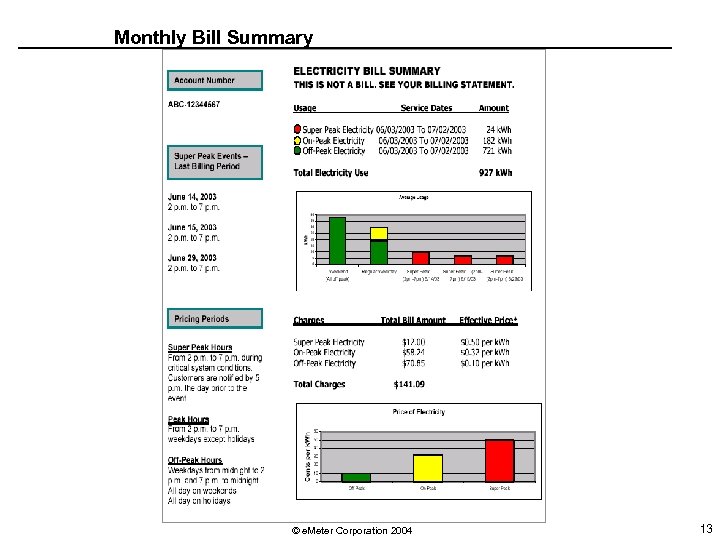 Monthly Bill Summary © e. Meter Corporation 2004 13
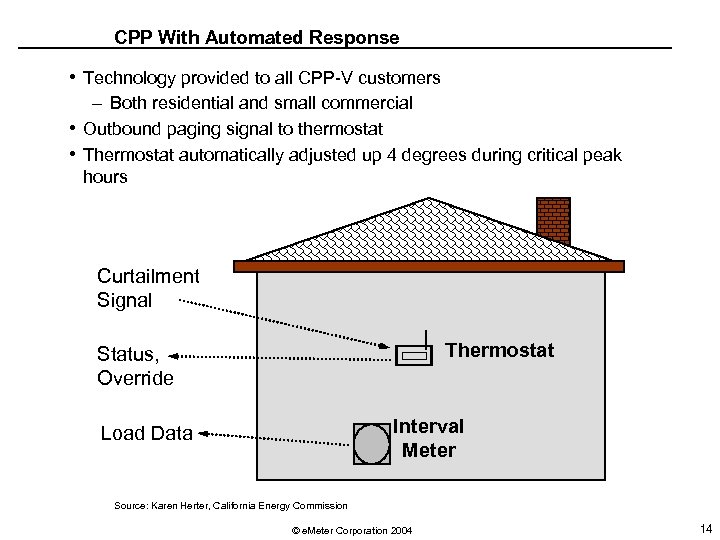 CPP With Automated Response • Technology provided to all CPP-V customers – Both residential and small commercial • Outbound paging signal to thermostat • Thermostat automatically adjusted up 4 degrees during critical peak hours Curtailment Signal Thermostat Status, Override Interval Meter Load Data Source: Karen Herter, California Energy Commission © e. Meter Corporation 2004 14
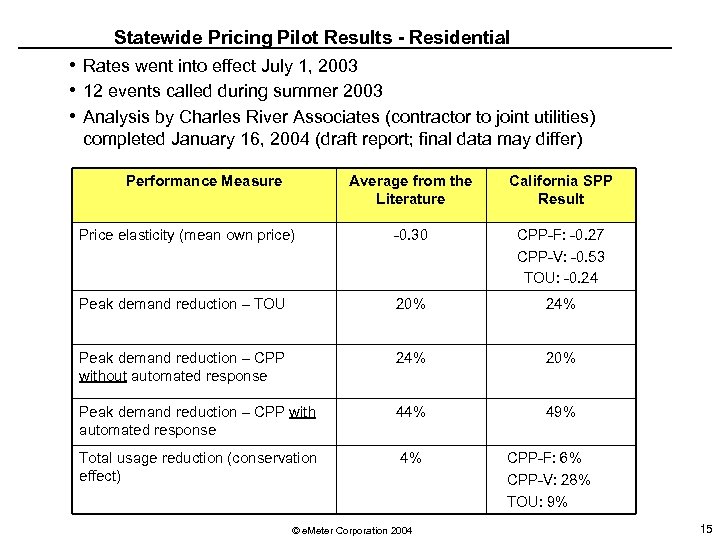 Statewide Pricing Pilot Results - Residential • Rates went into effect July 1, 2003 • 12 events called during summer 2003 • Analysis by Charles River Associates (contractor to joint utilities) completed January 16, 2004 (draft report; final data may differ) Performance Measure Average from the Literature California SPP Result Price elasticity (mean own price) -0. 30 CPP-F: -0. 27 CPP-V: -0. 53 TOU: -0. 24 Peak demand reduction – TOU 20% 24% Peak demand reduction – CPP without automated response 24% 20% Peak demand reduction – CPP with automated response 44% 49% Total usage reduction (conservation effect) 4% © e. Meter Corporation 2004 CPP-F: 6% CPP-V: 28% TOU: 9% 15
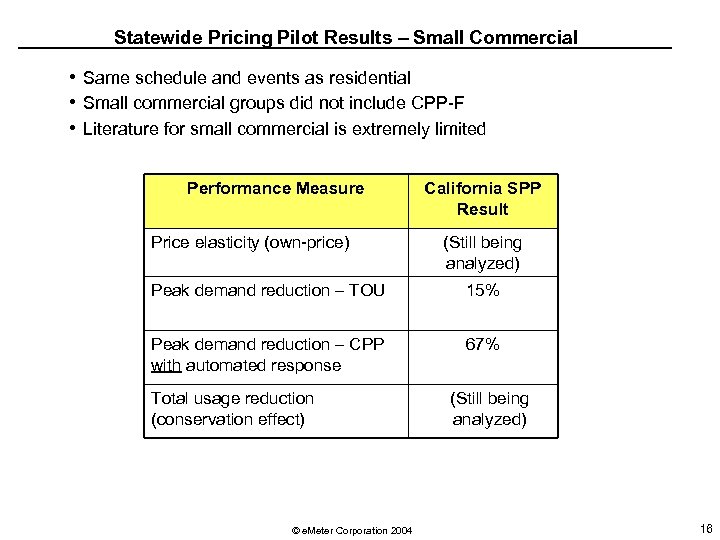 Statewide Pricing Pilot Results – Small Commercial • Same schedule and events as residential • Small commercial groups did not include CPP-F • Literature for small commercial is extremely limited Performance Measure Price elasticity (own-price) California SPP Result (Still being analyzed) Peak demand reduction – TOU 15% Peak demand reduction – CPP with automated response 67% Total usage reduction (conservation effect) © e. Meter Corporation 2004 (Still being analyzed) 16
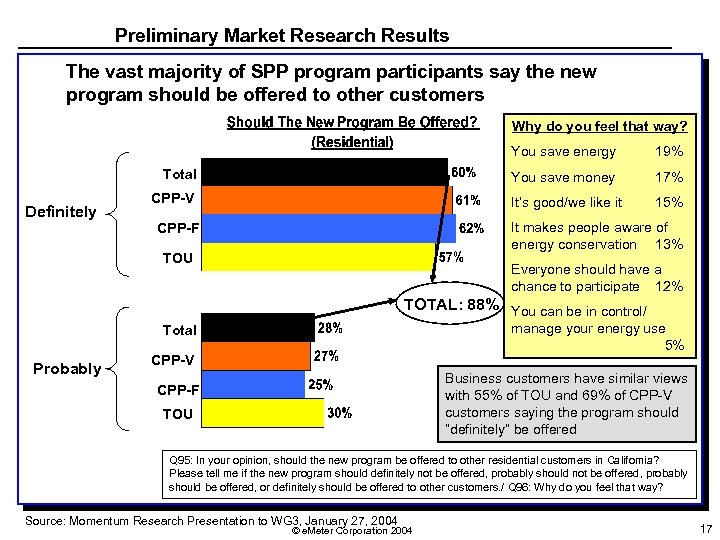 Preliminary Market Research Results The vast majority of SPP program participants say the new program should be offered to other customers Why do you feel that way? You save energy You save money Definitely CPP-V 17% It’s good/we like it Total 19% 15% It makes people aware of energy conservation 13% CPP-F TOU Everyone should have a chance to participate 12% TOTAL: 88% You can be in control/ manage your energy use 5% Total Probably CPP-V Business customers have similar views with 55% of TOU and 69% of CPP-V customers saying the program should “definitely” be offered CPP-F TOU Q 95: In your opinion, should the new program be offered to other residential customers in California? Please tell me if the new program should definitely not be offered, probably should be offered, or definitely should be offered to other customers. / Q 96: Why do you feel that way? Source: Momentum Research Presentation to WG 3, January 27, 2004 © e. Meter Corporation 2004 17
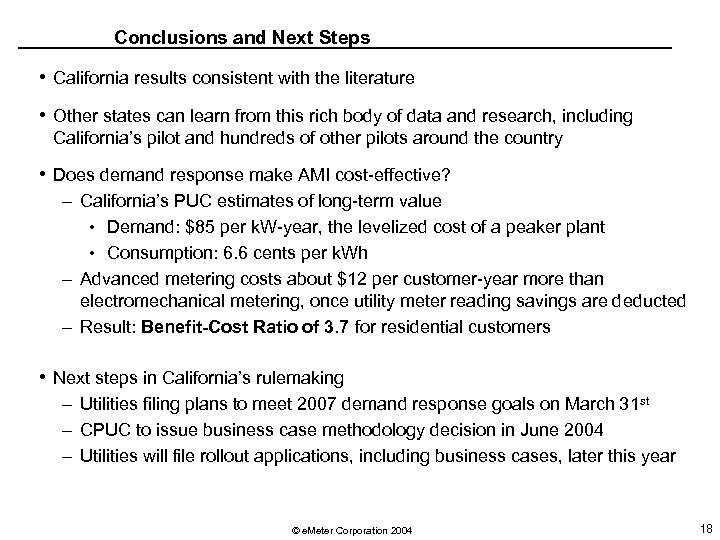 Conclusions and Next Steps • California results consistent with the literature • Other states can learn from this rich body of data and research, including California’s pilot and hundreds of other pilots around the country • Does demand response make AMI cost-effective? – California’s PUC estimates of long-term value • Demand: $85 per k. W-year, the levelized cost of a peaker plant • Consumption: 6. 6 cents per k. Wh – Advanced metering costs about $12 per customer-year more than electromechanical metering, once utility meter reading savings are deducted – Result: Benefit-Cost Ratio of 3. 7 for residential customers • Next steps in California’s rulemaking – Utilities filing plans to meet 2007 demand response goals on March 31 st – CPUC to issue business case methodology decision in June 2004 – Utilities will file rollout applications, including business cases, later this year © e. Meter Corporation 2004 18
 Epilogue “The essence of knowledge is, having it, to apply it. ” – Confucius © e. Meter Corporation 2004 19