


 Скачать презентацию California Conference on Self-Represented Litigants June 10 2011
1a65c9dee9198e8de41ac44cf54dff33.ppt
- Количество слайдов: 31
 California Conference on Self-Represented Litigants June 10, 2011 San Francisco, CA Carrey Wong, Neighborhood Legal Services of Los Angeles Betsy Lee, ACCESS Center, Superior Ct of CA, San Francisco Malea Chavez, ACCESS Center, Superior Ct of CA, San Francisco Joann Lee, Legal Aid Foundation of Los Angeles Non-English Speakers: how to reach them, how to serve them.
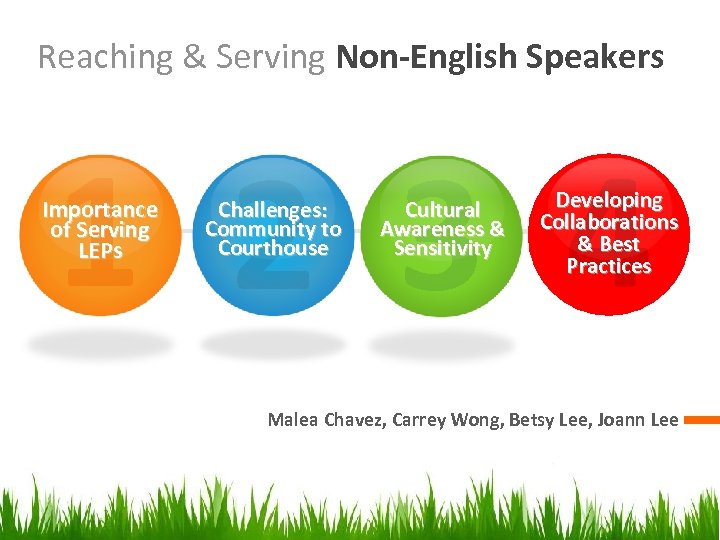 Reaching & Serving Non-English Speakers 1 2 3 4 Importance of Serving LEPs Challenges: Community to Courthouse Cultural Awareness & Sensitivity Developing Collaborations & Best Practices Malea Chavez, Carrey Wong, Betsy Lee, Joann Lee
 1 IMPORTANCE OF SERVING LEPS language & poverty, legal mandates & obligations, local LEP plan
 Importance of Outreach to LEP Communities ØCA Legislature recognized need for language services in courts to provide equal access to justice for all § Cal. Gov’t Code § 68560(e) ØCA demographics show need to outreach to LEP communities
 The Need For Serving LEPs “ 7 million Californians cannot access the courts without significant language assistance, cannot understand pleadings, forms or other legal documents, and cannot participate meaningfully in court proceedings without a qualified interpreter. ” – Language Barriers to Justice in California; California Commission on Access to Justice; September 2005.
 California Demographics Ø 20% (approx. 7 million) of population is LEP* • *Speak English less than “very well” • LEP: Limited English Proficiency v Over 200 languages spoken in CA v 44% of Latinos and 62% of Asians are foreign born
 California vs. United States • Large % of immigrants in CA vs. U. S. – 12. 5% Asian (US: 4. 5%) – 36. 6% Hispanic/Latinos (US: 15. 4%) – 26. 2% Foreign born persons (US: 11. 1%) • Over 40% of CA’s population speak a language other than English at home – US: 17. 9% • www. census. gov - population finder
 • Legal Service Corporation (LSC) Federal Mandates • Title VI – Prohibits discrimination by federal fund recipients based on race, color, or national origin • “National origin” covers limited English proficiency • Executive Order 13166 –“Improving Access to Services for Persons with Limited English Proficiency”
 Federal Enforcement Efforts • Title VI Q & A, March 16, 2011 – http: //www. lep. gov/faqs/FAQ_About_LEP_ Title_VI_and_Title_VI_Regs. pdf • AG Eric Holder Memo re: Obligations under EO 13166, February 17, 2011 – http: //www. lep. gov/13166/AG_021711_EO _13166_Memo_to_Agencies_with_Supple ment. pdf • AAG Thomas Perez, State Courts Letter, August 16, 2010 – http: //www. lep. gov/final_courts_ltr_08161 0. pdf
 Statutory & Other Obligations § Federal Agency Guidance (DOJ, HHS, etc. ) (www. lep. gov) § ABA – Standards for the Provision of Civil Legal Aid; Model Rules of Professional Responsibility § State Statutes – CA: Dymally-Alatorre Bilingual Services Act; Gov’t Code §§ 11135 – 11139. 8
 Superior Court of California, San Francisco LEP Plan • Language Barriers to Justice in California; California Commission on Access to Justice; September 2005 • Action Plan for Justice; California Commission on Access to Justice; April 2007 • LEP Plan enacted to ensure meaningful access to court services for LEP individuals – Compliance with Title VI, Civil Rights Act of 1964 – Enhance and increase bilingual services inside and outside of the courtroom • LEP Plan Task Force Annual Review and Evaluation of the LEP Plan
 Superior Court of California, San Francisco LEP Plan (cont. ) • Court was already committed to addressing needs of LEPs prior to LEP plan • Multilingual/Multicultural Self-Help Center: – Bilingual staff to help LEPs understand complete necessary forms • • • Self-help services Volunteers in the courtroom Workshops/ Community outreach Language calendars Language 411 – certified interpreters
 Superior Court of California, San Francisco LEP Plan (cont. ) • Public outreach and education: – Collaboration with CBOs (Community Based Organization) serving LEP populations • Legal clinics at La Raza and Cameron House – Written informational and educational materials in multiple languages – Legal articles in Spanish language Newspapers • LEP Plan: http: //sfsuperiorcourt. org/Modules/Show. Document. aspx? docu mentid=1188
 2 MEETING THE CHALLENGE FROM COMMUNITY TO COURTHOUSE Courthouse & Community-Based Clinics
 In the Courthouse & In the Community IN THE COURTHOUSE • Increasing usage of self-help services at the courthouse by LEPs IN THE COMMUNITY • Increase outreach in the community, providing same self-help services in a culturally friendly/secure environment
 Community Clinics Donaldina Cameron House: multi-service agency in San Francisco Chinatown La Raza: a bilingual CBO in area with large Latino population LAFLA Community Clinics: Koreatown, Cambodian Clinics in Long Beach & court-based, Little Tokyo, LA Chinatown, SCCLA (San Gabriel Valley)
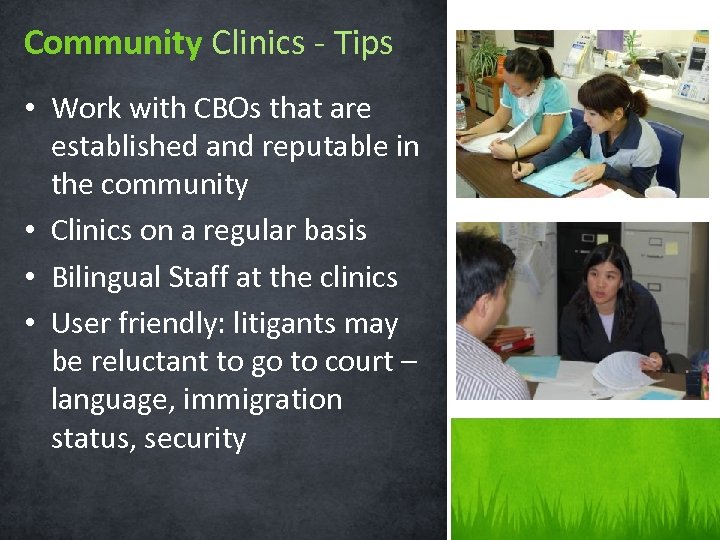 Community Clinics - Tips • Work with CBOs that are established and reputable in the community • Clinics on a regular basis • Bilingual Staff at the clinics • User friendly: litigants may be reluctant to go to court – language, immigration status, security
 Courthouse Workshops • Increasing number of courthouse Self Help Centers recognized the need to provide services in other languages – In California – SPANISH is needed in nearly all courthouses, but other language needs also increasing – March 2009 – LA County opened Pasadena Self Help Center to focus on serving APIs from a grant from the State Bar of LA’s Equal Access Fund Partnership Grant • July 2009 – began Chinese language workshops
 Courthouse Workshops - Benefits • Convenience for litigants – can file paperwork right after it’s complete • Guide them through the court process • Work closely with the court staff / clerk’s office FROM COMMUNITY TO COURTHOUSE • Can meet litigants in the community clinics, establish relationship/trust, and continue helping them in the courthouse
 3 CULTURAL AWARENESS & SENSITIVITY Historical Overview, Cultural Overview, Etiquette, Traditions & Rituals, Relationships, Language & Communication
 Cultural Awareness • Historical Overview – Mistrust of government – Unwritten Rules • Cultural Overview – Beliefs, customs, religion, understanding of laws & legal authority – New immigrants vs 1 st generation vs American born • Etiquette – Vocal pitch, body language – Mannerisms: humbleness/modesty – Formality: introductions, credentials, etc.
 Cultural Awareness (cont. ) • Traditions and Rituals – “Saving Face” – Taboos • Relationships – Values family vs. individual – Patriarchal: consulting elders • Language and Communication – Same language, many dialects (regional) – Requesting interpreters – “Lost in Translation”
 Deaf Community • Deaf communities have their own culture and their own language • Must assess preferred form of communication • American Sign Language (ASL) – not used by all – Some come from another country and use a different sign language (may need to do relay interpretation) – Signed English – Informal signage – Reading lips or writing notes are preferred by some
 4 DEVELOPING COLLABORATIONS & BEST PRACTICES Developing, Building, Maintaining Collaborations
 Developing Collaborations • Identifying Community Issues – What’s needed? • Prevalent issues/hot topics – What’s important? • Talk to community agencies/CBO staff • Identifying Potential Collaborations – Which agencies your community utilize? • Supplement CBO services with outreach – Which agencies your community trust? • Reputation • User-friendly
 Building Collaborative Relationships • Networking with Agencies/CBOs – Cross-trainings – Open House • Exposure: being visible in community – Bilingual materials – Participate in community events – Visiting partner agencies
 Maintaining Collaborative Relationships • Constant communication with partners – Current and update information – Find out from CBO what works? • Word of mouth – Customers tell their friends/family – CBOs tell their partner agencies • Media – Newspaper – Radio Shows – Internet • Collaboration/Non-competition for funding
 Sharing Best Practices • What has worked in the communities you worked with? • What about communities that have been underserved? – Armenian Community – Southeast Asian Community
 Q & A / Discussion What are some ideas for your organization or court? .
 CONTACT US! Carrey Wong, Attorney Neighborhood Legal Services of Los Angeles County (626) 356 -5003 carreywong@nls-la. org Malea Chavez, Attorney San Francisco Superior Court ACCESS Center (415) 551 -5914 mchavez@sftc. org Joann Lee, Attorney Legal Aid Foundation of Los Angeles (323) 801 -7976 jlee@lafla. org Betsy Lee, Attorney San Francisco Superior Court ACCESS Center (415) 551 -5926 blee@sftc. org
 California Conference on Self-Represented Litigants June 10, 2011 San Francisco, CA Carrey Wong, Neighborhood Legal Services of Los Angeles Betsy Lee, ACCESS Center, Superior Ct of CA, San Francisco Malea Chavez, ACCESS Center, Superior Ct of CA, San Francisco Joann Lee, Legal Aid Foundation of Los Angeles Non-English Speakers: how to reach them, how to serve them.