


 Скачать презентацию CALICE Calorimetry for LC Motivation Calice
62c25a74767bdf3fc25389315a26bc23.ppt
- Количество слайдов: 41
 CALICE Calorimetry for LC < Motivation < Calice and data < UK programme < Summary Recent additions Canada (Mc. Gill, Regina) France (Annecy, Grenoble, Lyon) Korea (Ewha) USA (Boston) ~180 physicists 28 institutes 8 countries UK: Birmingham, Cambridge, Imperial Manchester, RAL, RHUL, UCL Nigel Watson / Birmingham LCUK, UCL, 05 -Oct-2005
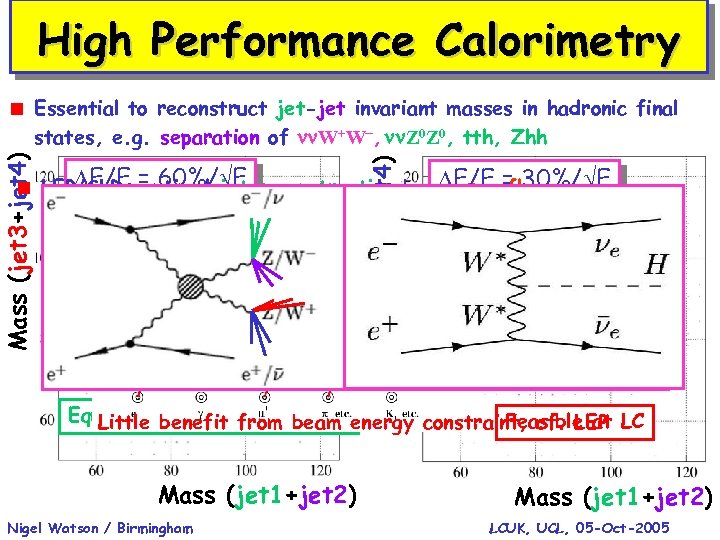 High Performance Calorimetry Mass (jet 3+jet 4) < Essential to reconstruct jet-jet invariant masses in hadronic final states, e. g. separation of W+W , Z 0 Z 0, tth, Zhh E/E optimal jet E/E flow < LEP/SLD: = 60%/ E reconstruction by energy = 30%/ E } Explicit association of tracks/clusters } Replace poor calorimeter measurements with tracker measurements – no “double counting” Equivalent best LEP detectorenergy constraint, cf. LEP LC Feasible at Little benefit from beam Mass (jet 1+jet 2) Nigel Watson / Birmingham Mass (jet 1+jet 2) LCUK, UCL, 05 -Oct-2005
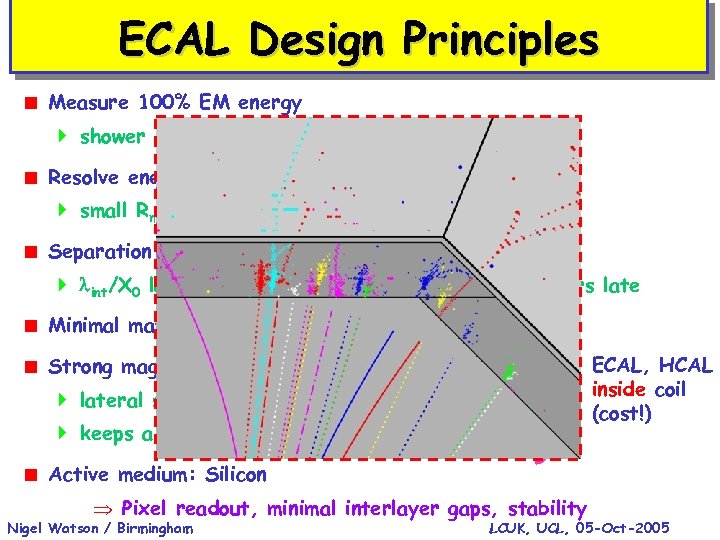 ECAL Design Principles < Measure 100% EM energy } shower containment in ECAL, X 0 large < Resolve energy deposited by individual particles } small Rmoliere and X 0 – compact and narrow showers < Separation of hadronic/EM showers } int/X 0 large, EM showers early, hadronic showers late < Minimal material in front of calorimeters < Strong magnetic field } lateral separation of neutral/charged particles } keeps a lot of background inside beampipe ECAL, HCAL inside coil (cost!) < Active medium: Silicon Þ Pixel readout, minimal interlayer gaps, stability Nigel Watson / Birmingham LCUK, UCL, 05 -Oct-2005
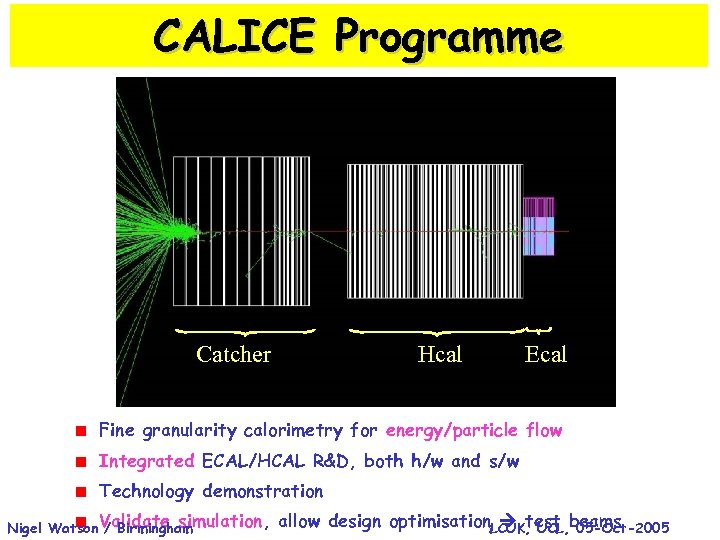 CALICE Programme Catcher Hcal Ecal < Fine granularity calorimetry for energy/particle flow < Integrated ECAL/HCAL R&D, both h/w and s/w < Technology demonstration < / Birmingham Nigel Watson Validate simulation, allow design optimisation. LCUK, UCL, beams test 05 -Oct-2005
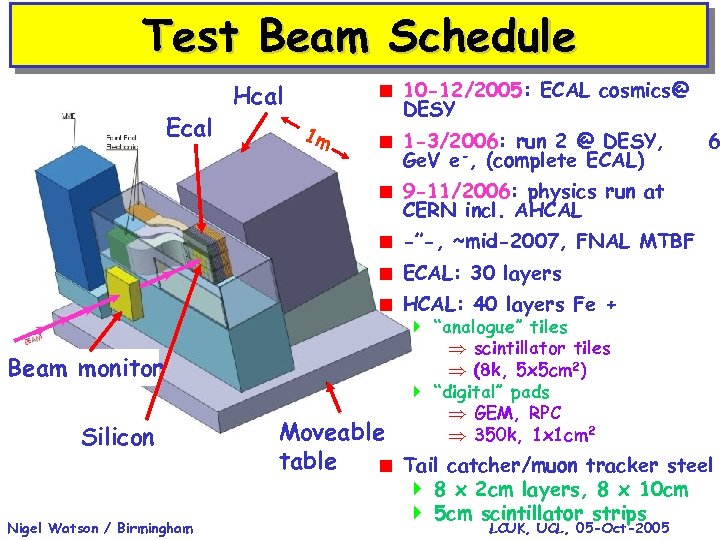 Test Beam Schedule Ecal Hcal 1 m < 10 -12/2005: ECAL cosmics@ DESY < 1 -3/2006: run 2 @ DESY, Ge. V e-, (complete ECAL) 6 < 9 -11/2006: physics run at CERN incl. AHCAL < -”-, ~mid-2007, FNAL MTBF < ECAL: 30 layers < HCAL: 40 layers Fe + Beam monitor Silicon Nigel Watson / Birmingham } “analogue” tiles Þ scintillator tiles Þ (8 k, 5 x 5 cm 2) } “digital” pads Þ GEM, RPC Þ 350 k, 1 x 1 cm 2 Moveable table < Tail catcher/muon tracker steel } 8 x 2 cm layers, 8 x 10 cm } 5 cm scintillator strips LCUK, UCL, 05 -Oct-2005
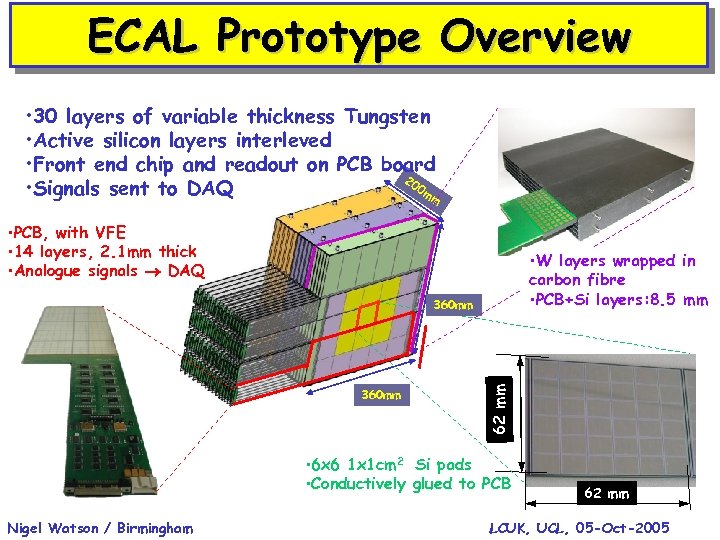 ECAL Prototype Overview • 30 layers of variable thickness Tungsten • Active silicon layers interleved • Front end chip and readout on PCB board 20 0 m • Signals sent to DAQ m • PCB, with VFE • 14 layers, 2. 1 mm thick • Analogue signals DAQ • W layers wrapped in carbon fibre • PCB+Si layers: 8. 5 mm 360 mm 62 mm 360 mm • 6 x 6 1 x 1 cm 2 Si pads • Conductively glued to PCB Nigel Watson / Birmingham 62 mm LCUK, UCL, 05 -Oct-2005
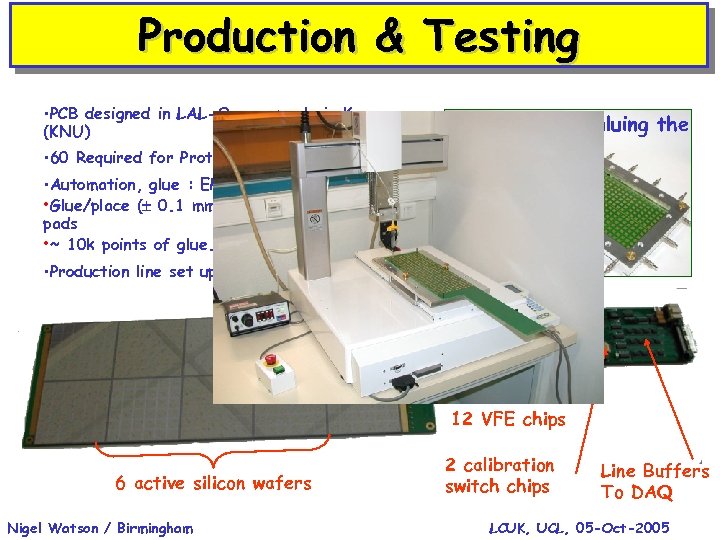 Production & Testing • PCB designed in LAL-Orsay, made in Korea (KNU) • 60 Required for Prototype • Automation, glue : EPO-TEK® EE 129 -4 • Glue/place ( 0. 1 mm) of 270 wafers with 6× 6 pads • ~ 10 k points of glue. • Production line set up at LLR Mounting/gluing the wafers Using a frame of tungsten wires 12 VFE chips 6 active silicon wafers Nigel Watson / Birmingham 2 calibration switch chips Line Buffers To DAQ LCUK, UCL, 05 -Oct-2005
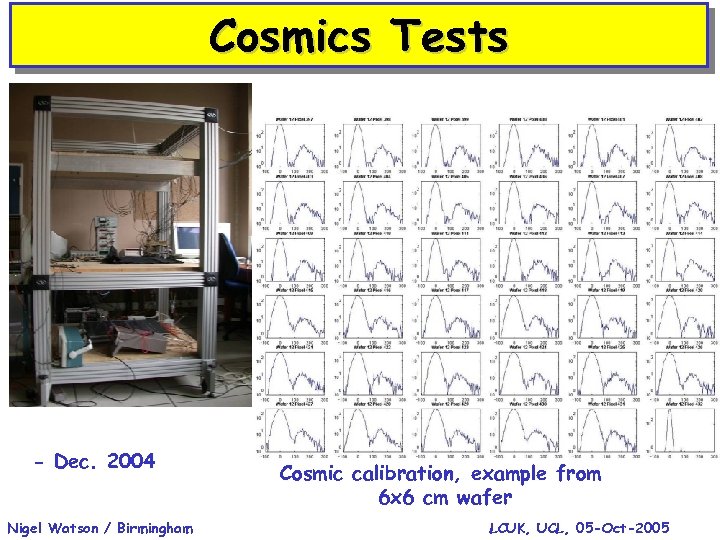 Cosmics Tests - Dec. 2004 Nigel Watson / Birmingham Cosmic calibration, example from 6 x 6 cm wafer LCUK, UCL, 05 -Oct-2005
![[G. Mavromanolakis] Nigel Watson / Birmingham LCUK, UCL, 05 -Oct-2005](https://present5.com/presentation/62c25a74767bdf3fc25389315a26bc23/image-9.jpg "[G. Mavromanolakis] Nigel Watson / Birmingham LCUK, UCL, 05 -Oct-2005") [G. Mavromanolakis] Nigel Watson / Birmingham LCUK, UCL, 05 -Oct-2005
[G. Mavromanolakis] Nigel Watson / Birmingham LCUK, UCL, 05 -Oct-2005
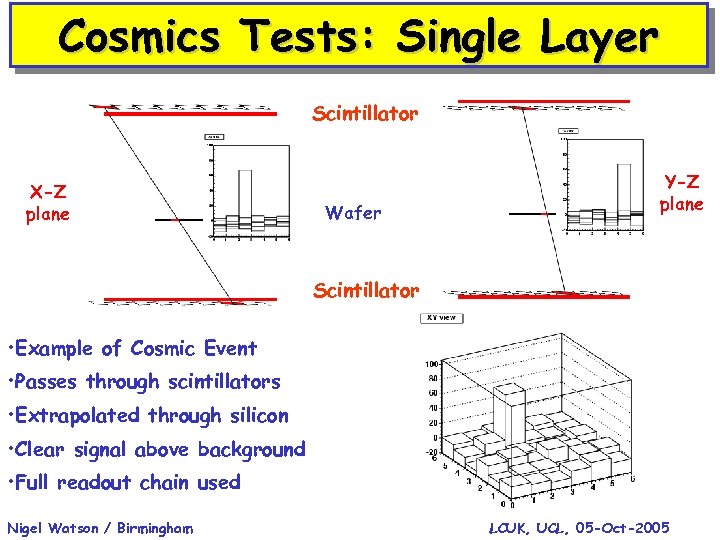 Cosmics Tests: Single Layer Scintillator X-Z plane Wafer Y-Z plane Scintillator • Example of Cosmic Event • Passes through scintillators • Extrapolated through silicon • Clear signal above background • Full readout chain used Nigel Watson / Birmingham LCUK, UCL, 05 -Oct-2005
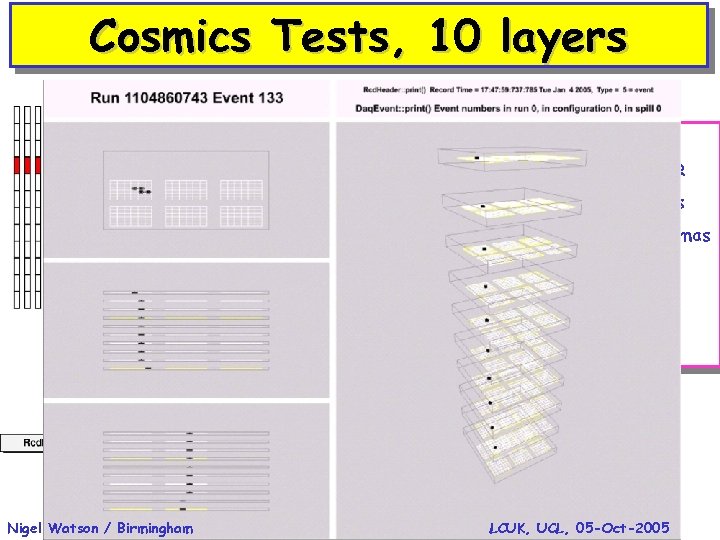 Cosmics Tests, 10 layers Dec. 2004 10 layers assembled LLR 2 production CRC boards >106 events over Christmas S/N ~ 9 This event, Jan. 4 Nigel Watson / Birmingham LCUK, UCL, 05 -Oct-2005
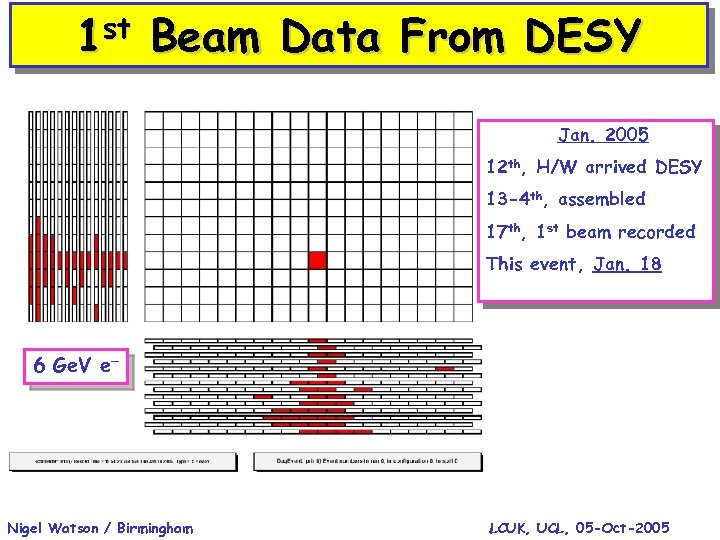 1 st Beam Data From DESY Jan. 2005 12 th, H/W arrived DESY 13 -4 th, assembled 17 th, 1 st beam recorded This event, Jan. 18 6 Ge. V e Nigel Watson / Birmingham LCUK, UCL, 05 -Oct-2005
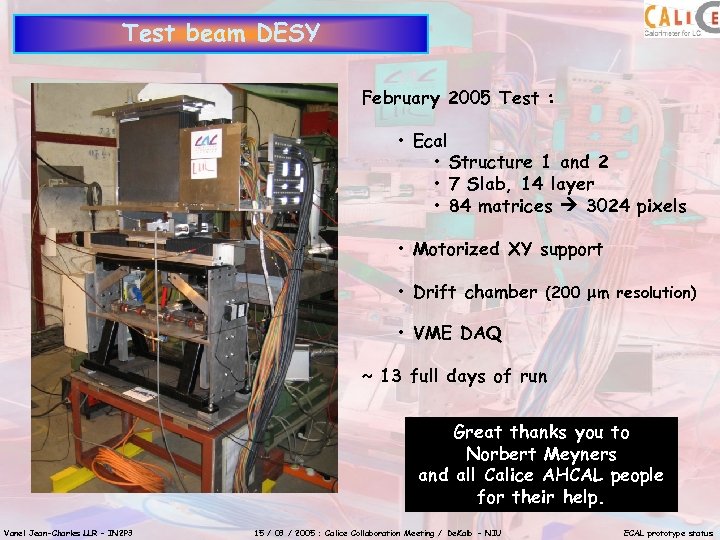 Test beam DESY February 2005 Test : • Ecal • Structure 1 and 2 • 7 Slab, 14 layer • 84 matrices 3024 pixels • Motorized XY support • Drift chamber (200 m resolution) • VME DAQ ~ 13 full days of run Great thanks you to Norbert Meyners and all Calice AHCAL people for their help. Vanel Jean-Charles LLR – IN 2 P 3 15 / 03 / 2005 : Calice Collaboration Meeting / De. Kalb - NIU ECAL prototype status
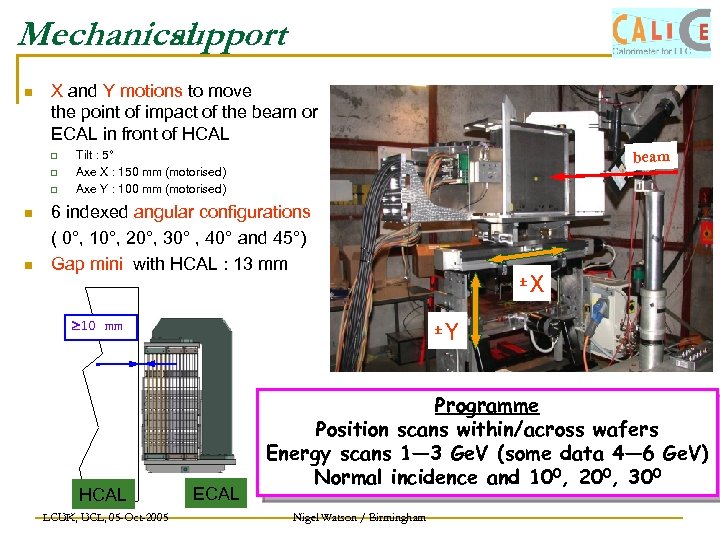 Mechanical support n X and Y motions to move the point of impact of the beam or ECAL in front of HCAL q q q n n beam Tilt : 5° Axe X : 150 mm (motorised) Axe Y : 100 mm (motorised) 6 indexed angular configurations ( 0°, 10°, 20°, 30° , 40° and 45°) Gap mini with HCAL : 13 mm 10 mm HCAL LCUK, UCL, 05 -Oct-2005 ECAL X Y Programme Position scans within/across wafers Energy scans 1— 3 Ge. V (some data 4— 6 Ge. V) Normal incidence and 100, 200, 300 Nigel Watson / Birmingham
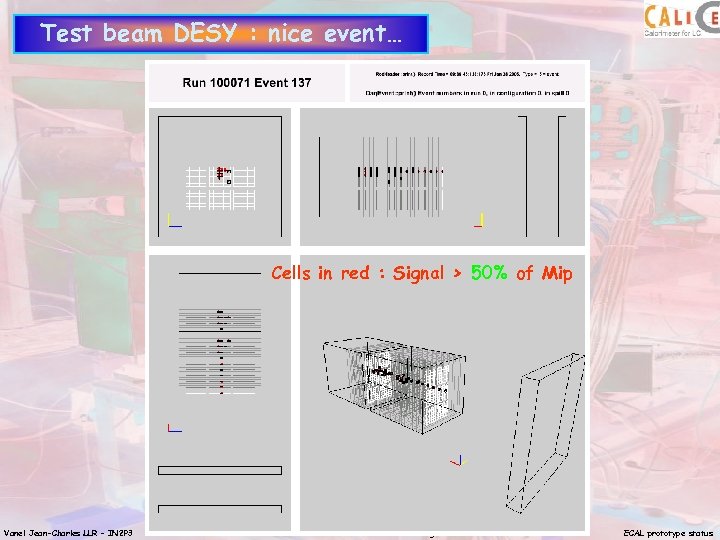 Test beam DESY : nice event… 50% Cells in red : Signal > 20% of Mip Vanel Jean-Charles LLR – IN 2 P 3 15 / 03 / 2005 : Calice Collaboration Meeting / De. Kalb - NIU ECAL prototype status
![[G. Mavromanolakis] Nigel Watson / Birmingham LCUK, UCL, 05 -Oct-2005](https://present5.com/presentation/62c25a74767bdf3fc25389315a26bc23/image-16.jpg "[G. Mavromanolakis] Nigel Watson / Birmingham LCUK, UCL, 05 -Oct-2005") [G. Mavromanolakis] Nigel Watson / Birmingham LCUK, UCL, 05 -Oct-2005
[G. Mavromanolakis] Nigel Watson / Birmingham LCUK, UCL, 05 -Oct-2005
![[G. Mavromanolakis] Nigel Watson / Birmingham LCUK, UCL, 05 -Oct-2005](https://present5.com/presentation/62c25a74767bdf3fc25389315a26bc23/image-17.jpg "[G. Mavromanolakis] Nigel Watson / Birmingham LCUK, UCL, 05 -Oct-2005") [G. Mavromanolakis] Nigel Watson / Birmingham LCUK, UCL, 05 -Oct-2005
[G. Mavromanolakis] Nigel Watson / Birmingham LCUK, UCL, 05 -Oct-2005
![[G. Mavromanolakis] Nigel Watson / Birmingham LCUK, UCL, 05 -Oct-2005](https://present5.com/presentation/62c25a74767bdf3fc25389315a26bc23/image-18.jpg "[G. Mavromanolakis] Nigel Watson / Birmingham LCUK, UCL, 05 -Oct-2005") [G. Mavromanolakis] Nigel Watson / Birmingham LCUK, UCL, 05 -Oct-2005
[G. Mavromanolakis] Nigel Watson / Birmingham LCUK, UCL, 05 -Oct-2005
![[G. Mavromanolakis] Nigel Watson / Birmingham LCUK, UCL, 05 -Oct-2005](https://present5.com/presentation/62c25a74767bdf3fc25389315a26bc23/image-19.jpg "[G. Mavromanolakis] Nigel Watson / Birmingham LCUK, UCL, 05 -Oct-2005") [G. Mavromanolakis] Nigel Watson / Birmingham LCUK, UCL, 05 -Oct-2005
[G. Mavromanolakis] Nigel Watson / Birmingham LCUK, UCL, 05 -Oct-2005
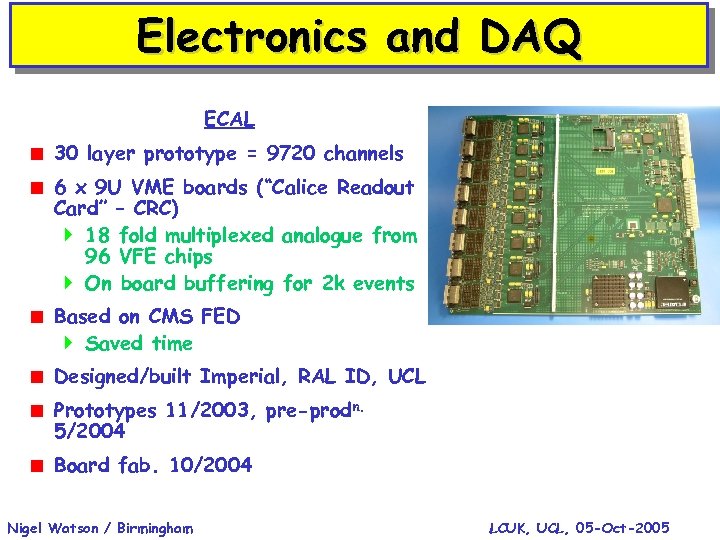 Electronics and DAQ ECAL < 30 layer prototype = 9720 channels < 6 x 9 U VME boards (“Calice Readout Card” – CRC) } 18 fold multiplexed analogue from 96 VFE chips } On board buffering for 2 k events < Based on CMS FED } Saved time < Designed/built Imperial, RAL ID, UCL < Prototypes 11/2003, pre-prodn. 5/2004 < Board fab. 10/2004 Nigel Watson / Birmingham LCUK, UCL, 05 -Oct-2005
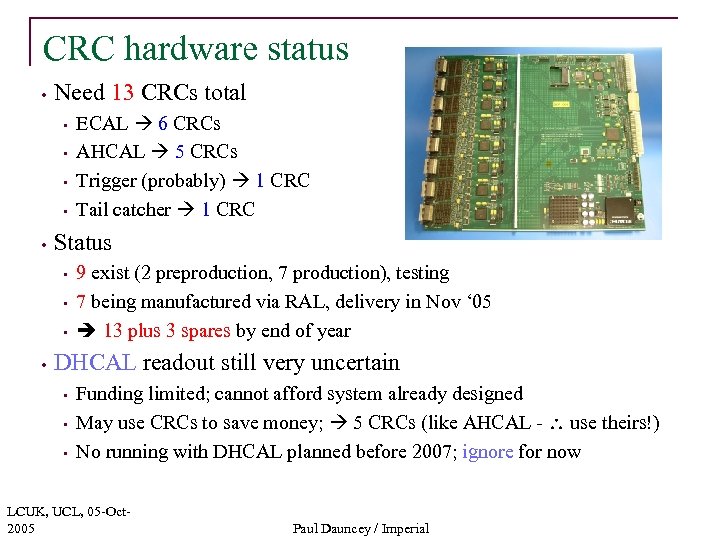 CRC hardware status • Need 13 CRCs total • • • Status • • ECAL 6 CRCs AHCAL 5 CRCs Trigger (probably) 1 CRC Tail catcher 1 CRC 9 exist (2 preproduction, 7 production), testing 7 being manufactured via RAL, delivery in Nov ‘ 05 13 plus 3 spares by end of year DHCAL readout still very uncertain • • • Funding limited; cannot afford system already designed May use CRCs to save money; 5 CRCs (like AHCAL - use theirs!) No running with DHCAL planned before 2007; ignore for now LCUK, UCL, 05 -Oct 2005 Paul Dauncey / Imperial
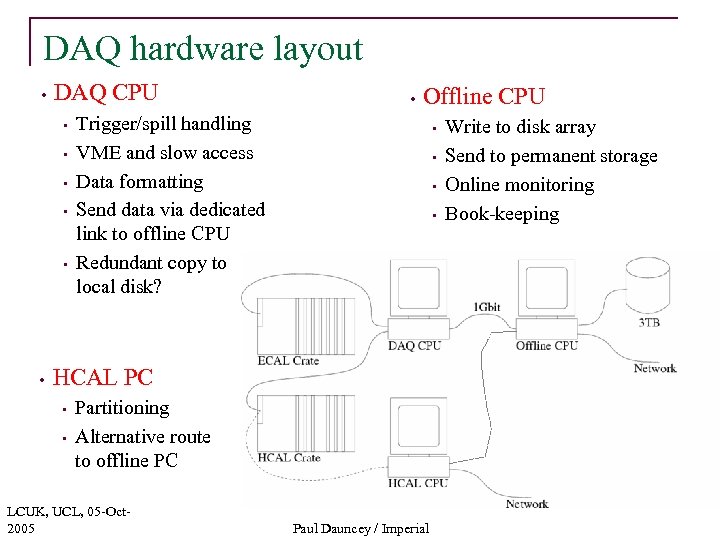 DAQ hardware layout • DAQ CPU • • Offline CPU Trigger/spill handling VME and slow access Data formatting Send data via dedicated link to offline CPU Redundant copy to local disk? • • HCAL PC • • Partitioning Alternative route to offline PC LCUK, UCL, 05 -Oct 2005 Paul Dauncey / Imperial Write to disk array Send to permanent storage Online monitoring Book-keeping
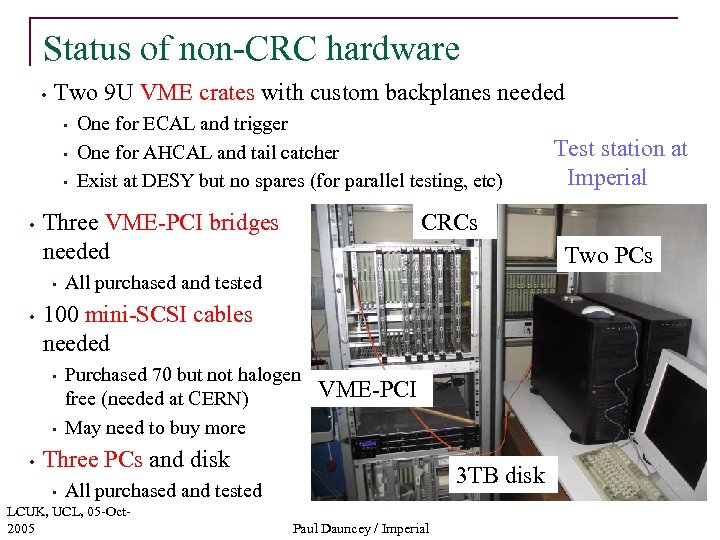 Status of non-CRC hardware • Two 9 U VME crates with custom backplanes needed • • • Two PCs All purchased and tested 100 mini-SCSI cables needed • Purchased 70 but not halogen free (needed at CERN) May need to buy more VME-PCI Three PCs and disk • 3 TB disk All purchased and tested LCUK, UCL, 05 -Oct 2005 Test station at Imperial CRCs Three VME-PCI bridges needed • • One for ECAL and trigger One for AHCAL and tail catcher Exist at DESY but no spares (for parallel testing, etc) Paul Dauncey / Imperial
![DAQ R&D [M. Wing] Nigel Watson / Birmingham LCUK, UCL, 05 -Oct-2005](https://present5.com/presentation/62c25a74767bdf3fc25389315a26bc23/image-24.jpg "DAQ R&D [M. Wing] Nigel Watson / Birmingham LCUK, UCL, 05 -Oct-2005") DAQ R&D [M. Wing] Nigel Watson / Birmingham LCUK, UCL, 05 -Oct-2005
DAQ R&D [M. Wing] Nigel Watson / Birmingham LCUK, UCL, 05 -Oct-2005
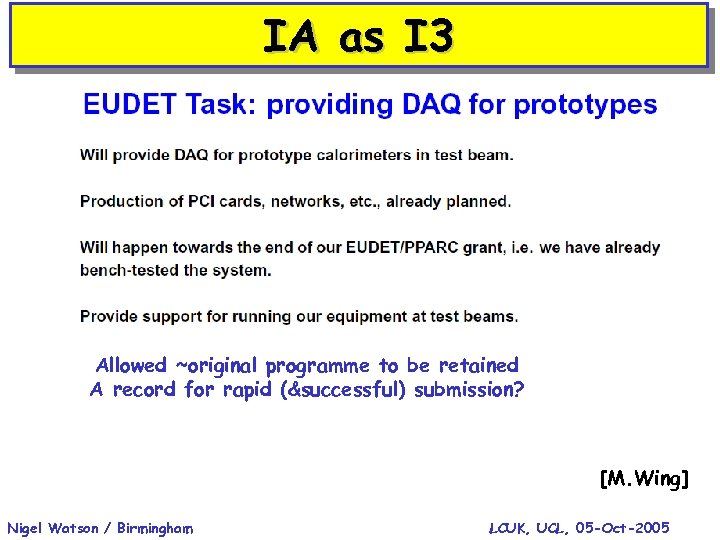 IA as I 3 Allowed ~original programme to be retained A record for rapid (&successful) submission? [M. Wing] Nigel Watson / Birmingham LCUK, UCL, 05 -Oct-2005
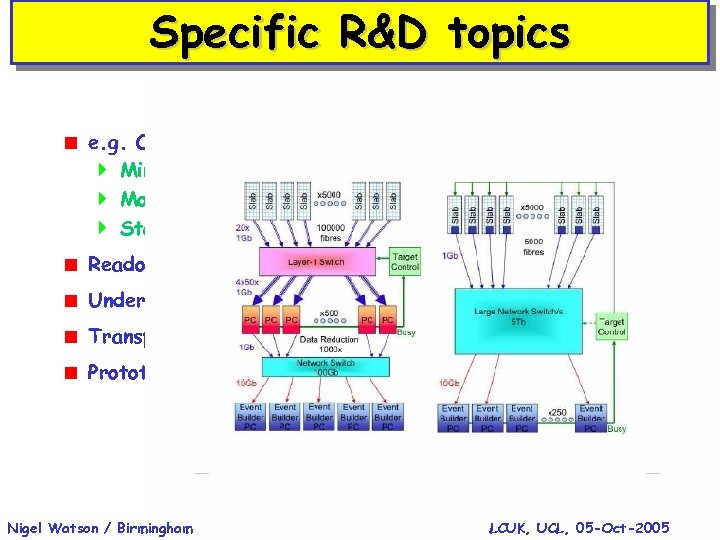 Specific R&D topics < e. g. Options for network switching } Minimise space reqd. on detector } Model/test data rates in small/fast networks } Standard or optical? Multiple layers? < Readout multiple VFE ASICs < Understand data transfer of GByte/s on 1. 5 m PCB < Transport of configuration, clock and control data < Prototype off-detector receiver Nigel Watson / Birmingham LCUK, UCL, 05 -Oct-2005
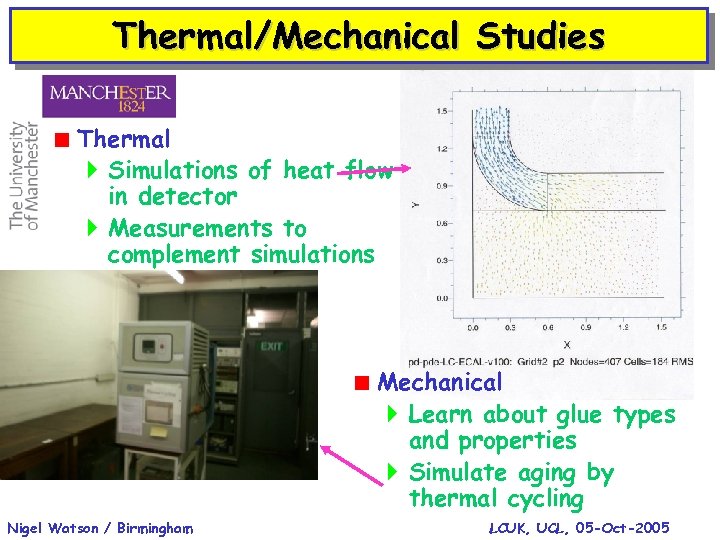 Thermal/Mechanical Studies < Thermal } Simulations of heat flow in detector } Measurements to complement simulations < Mechanical } Learn about glue types and properties } Simulate aging by thermal cycling Nigel Watson / Birmingham LCUK, UCL, 05 -Oct-2005
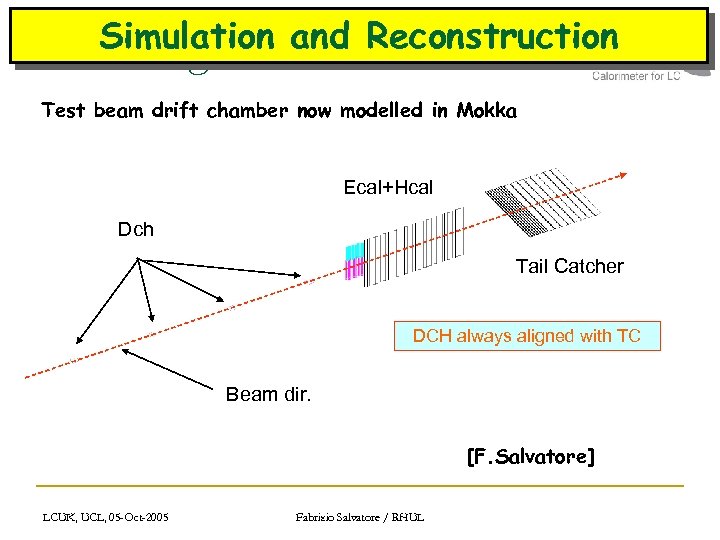 o Simulation and Reconstruction TB configuration with q=30 Test beam drift chamber now modelled in Mokka Ecal+Hcal Dch Tail Catcher DCH always aligned with TC Beam dir. [F. Salvatore] LCUK, UCL, 05 -Oct-2005 Fabrizio Salvatore / RHUL
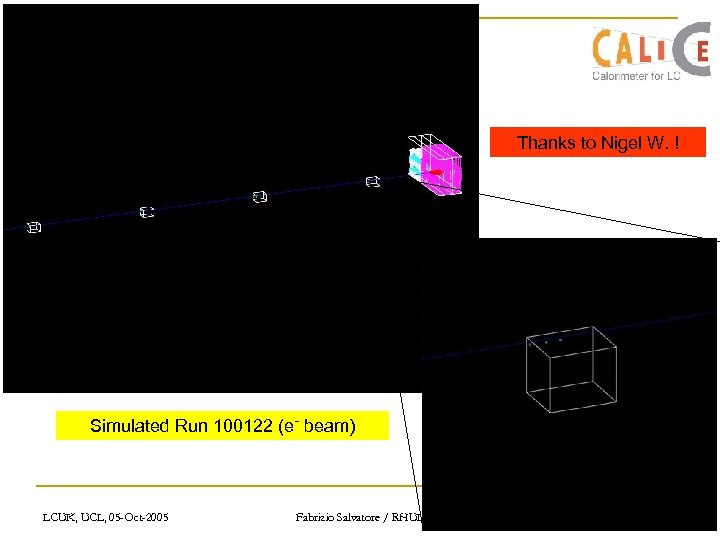 Thanks to Nigel W. ! Simulated Run 100122 (e- beam) LCUK, UCL, 05 -Oct-2005 Fabrizio Salvatore / RHUL
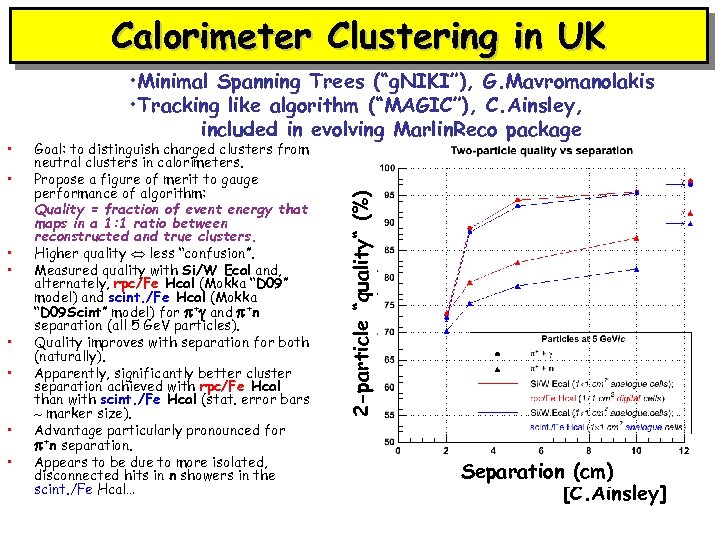 Calorimeter Clustering in UK Testing the performance of the algorithm (2) • • Goal: to distinguish charged clusters from neutral clusters in calorimeters. Propose a figure of merit to gauge performance of algorithm: Quality = fraction of event energy that maps in a 1: 1 ratio between reconstructed and true clusters. Higher quality less “confusion”. Measured quality with Si/W Ecal and, alternately, rpc/Fe Hcal (Mokka “D 09” model) and scint. /Fe Hcal (Mokka “D 09 Scint” model) for +g and +n separation (all 5 Ge. V particles). Quality improves with separation for both (naturally). Apparently, significantly better cluster separation achieved with rpc/Fe Hcal than with scint. /Fe Hcal (stat. error bars marker size). Advantage particularly pronounced for +n separation. Appears to be due to more isolated, disconnected hits in n showers in the scint. /Fe Hcal… 2 -particle “quality“ (%) • • Minimal Spanning Trees (“g. NIKI”), G. Mavromanolakis • Tracking like algorithm (“MAGIC”), C. Ainsley, included in evolving Marlin. Reco package Separation (cm) [C. Ainsley]
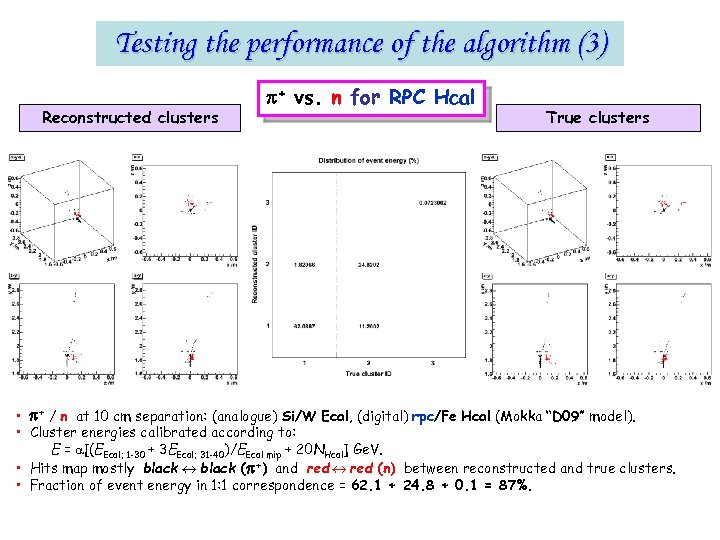 Testing the performance of the algorithm (3) Reconstructed clusters • • • + vs. n for RPC Hcal True clusters + / n at 10 cm separation: (analogue) Si/W Ecal, (digital) rpc/Fe Hcal (Mokka “D 09” model). Cluster energies calibrated according to: E = [(EEcal; 1 -30 + 3 EEcal; 31 -40)/EEcal mip + 20 NHcal] Ge. V. Hits map mostly black ( +) and red (n) between reconstructed and true clusters. Fraction of event energy in 1: 1 correspondence = 62. 1 + 24. 8 + 0. 1 = 87%.
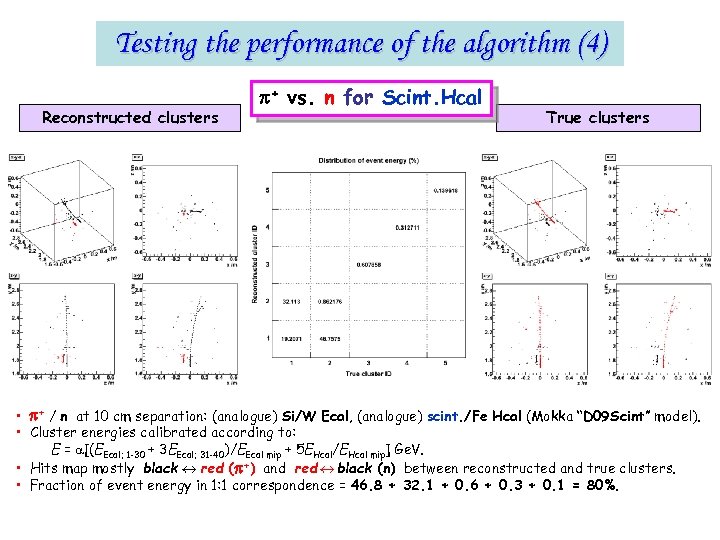 Testing the performance of the algorithm (4) Reconstructed clusters • • • + vs. n for Scint. Hcal True clusters + / n at 10 cm separation: (analogue) Si/W Ecal, (analogue) scint. /Fe Hcal (Mokka “D 09 Scint” model). Cluster energies calibrated according to: E = [(EEcal; 1 -30 + 3 EEcal; 31 -40)/EEcal mip + 5 EHcal/EHcal mip] Ge. V. Hits map mostly black red ( +) and red black (n) between reconstructed and true clusters. Fraction of event energy in 1: 1 correspondence = 46. 8 + 32. 1 + 0. 6 + 0. 3 + 0. 1 = 80%.
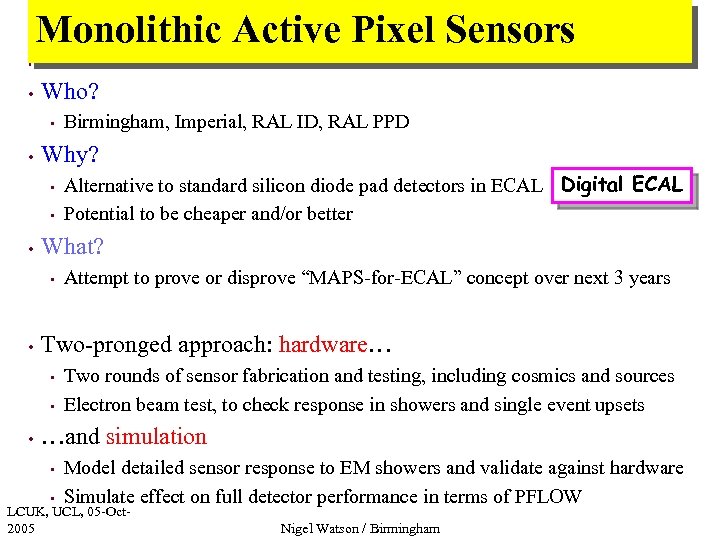 Monolithic Active Pixel Sensors • Who? • • Why? • • • Attempt to prove or disprove “MAPS-for-ECAL” concept over next 3 years Two-pronged approach: hardware… • • • Alternative to standard silicon diode pad detectors in ECAL Digital ECAL Potential to be cheaper and/or better What? • • Birmingham, Imperial, RAL ID, RAL PPD Two rounds of sensor fabrication and testing, including cosmics and sources Electron beam test, to check response in showers and single event upsets …and simulation • • Model detailed sensor response to EM showers and validate against hardware Simulate effect on full detector performance in terms of PFLOW LCUK, UCL, 05 -Oct 2005 Nigel Watson / Birmingham
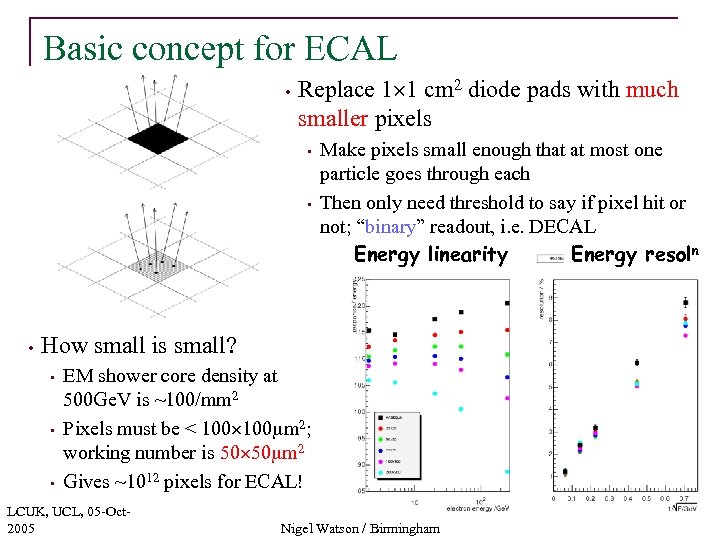 Basic concept for ECAL • Replace 1 1 cm 2 diode pads with much smaller pixels • • • Make pixels small enough that at most one particle goes through each Then only need threshold to say if pixel hit or not; “binary” readout, i. e. DECAL Energy linearity Energy resoln How small is small? • • • EM shower core density at 500 Ge. V is ~100/mm 2 Pixels must be < 100 mm 2; working number is 50 50 mm 2 Gives ~1012 pixels for ECAL! LCUK, UCL, 05 -Oct 2005 Nigel Watson / Birmingham
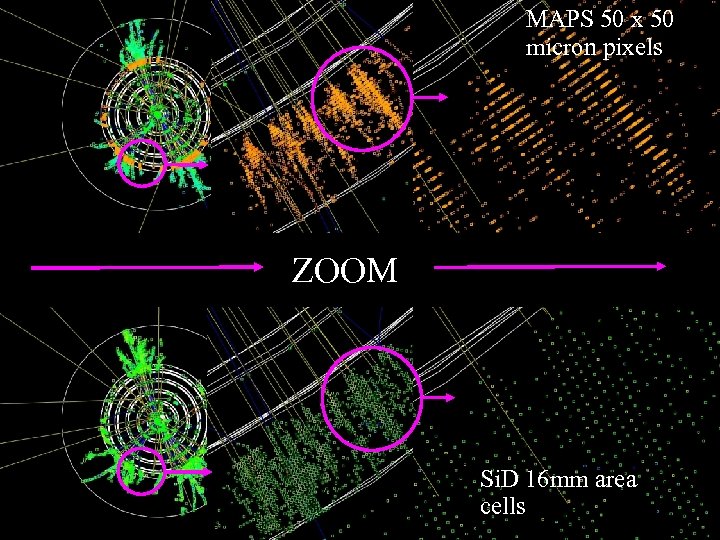 MAPS 50 x 50 micron pixels ZOOM Si. D 16 mm area cells
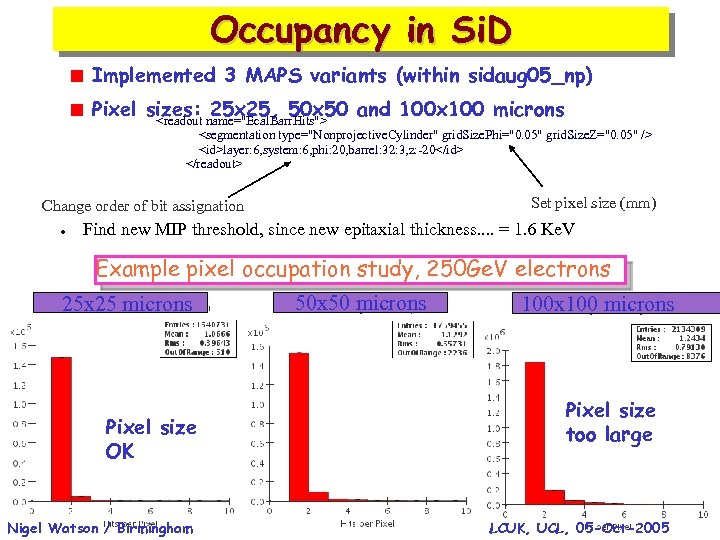 Occupancy in Si. D < Implemented 3 MAPS variants (within sidaug 05_np) < Pixel sizes: name="Ecal. Barr. Hits"> and 100 x 100 microns 25 x 25, 50 x 50
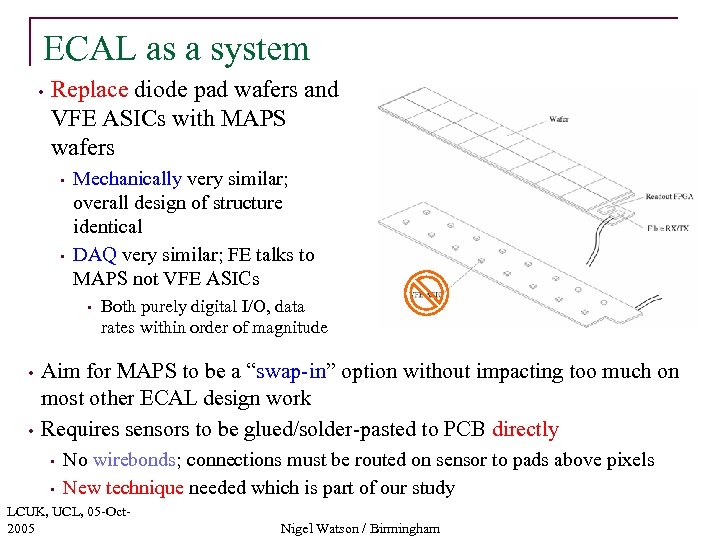 ECAL as a system • Replace diode pad wafers and VFE ASICs with MAPS wafers • • Mechanically very similar; overall design of structure identical DAQ very similar; FE talks to MAPS not VFE ASICs • • • Both purely digital I/O, data rates within order of magnitude Aim for MAPS to be a “swap-in” option without impacting too much on most other ECAL design work Requires sensors to be glued/solder-pasted to PCB directly • • No wirebonds; connections must be routed on sensor to pads above pixels New technique needed which is part of our study LCUK, UCL, 05 -Oct 2005 Nigel Watson / Birmingham
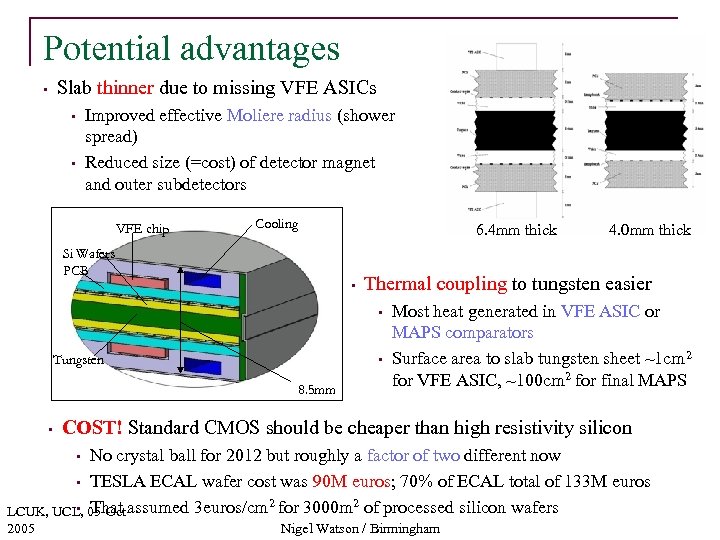 Potential advantages Slab thinner due to missing VFE ASICs • Improved effective Moliere radius (shower spread) Reduced size (=cost) of detector magnet and outer subdetectors • • VFE chip Cooling 6. 4 mm thick Si Wafers PCB • Thermal coupling to tungsten easier • Tungsten • 8. 5 mm • 4. 0 mm thick Most heat generated in VFE ASIC or MAPS comparators Surface area to slab tungsten sheet ~1 cm 2 for VFE ASIC, ~100 cm 2 for final MAPS COST! Standard CMOS should be cheaper than high resistivity silicon No crystal ball for 2012 but roughly a factor of two different now • TESLA ECAL wafer cost was 90 M euros; 70% of ECAL total of 133 M euros • That assumed 3 euros/cm 2 for 3000 m 2 of processed silicon wafers LCUK, UCL, 05 -Oct • 2005 Nigel Watson / Birmingham
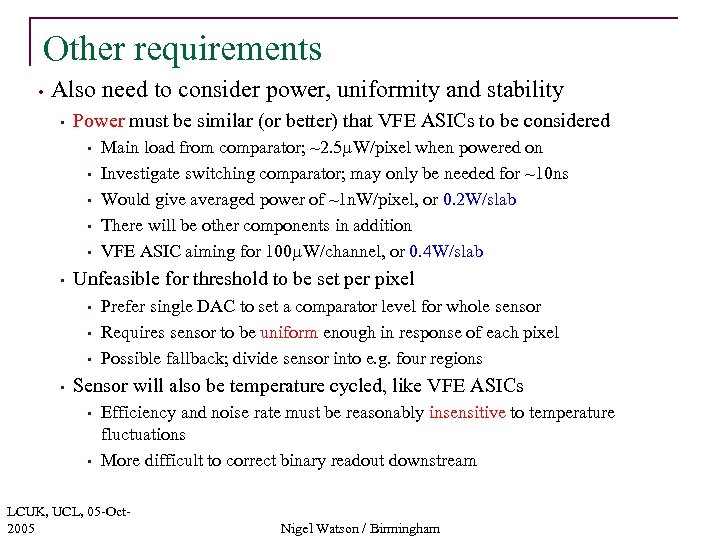 Other requirements • Also need to consider power, uniformity and stability • Power must be similar (or better) that VFE ASICs to be considered • • • Unfeasible for threshold to be set per pixel • • Main load from comparator; ~2. 5 m. W/pixel when powered on Investigate switching comparator; may only be needed for ~10 ns Would give averaged power of ~1 n. W/pixel, or 0. 2 W/slab There will be other components in addition VFE ASIC aiming for 100 m. W/channel, or 0. 4 W/slab Prefer single DAC to set a comparator level for whole sensor Requires sensor to be uniform enough in response of each pixel Possible fallback; divide sensor into e. g. four regions Sensor will also be temperature cycled, like VFE ASICs • • Efficiency and noise rate must be reasonably insensitive to temperature fluctuations More difficult to correct binary readout downstream LCUK, UCL, 05 -Oct 2005 Nigel Watson / Birmingham
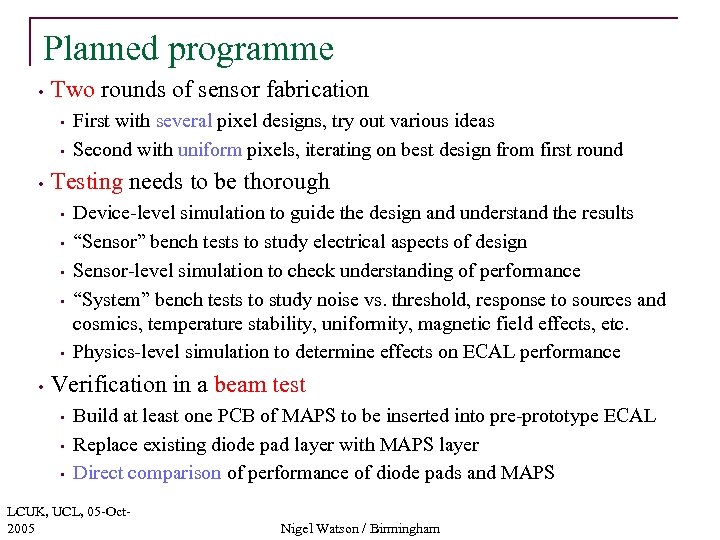 Planned programme • Two rounds of sensor fabrication • • • Testing needs to be thorough • • • First with several pixel designs, try out various ideas Second with uniform pixels, iterating on best design from first round Device-level simulation to guide the design and understand the results “Sensor” bench tests to study electrical aspects of design Sensor-level simulation to check understanding of performance “System” bench tests to study noise vs. threshold, response to sources and cosmics, temperature stability, uniformity, magnetic field effects, etc. Physics-level simulation to determine effects on ECAL performance Verification in a beam test • • • Build at least one PCB of MAPS to be inserted into pre-prototype ECAL Replace existing diode pad layer with MAPS layer Direct comparison of performance of diode pads and MAPS LCUK, UCL, 05 -Oct 2005 Nigel Watson / Birmingham
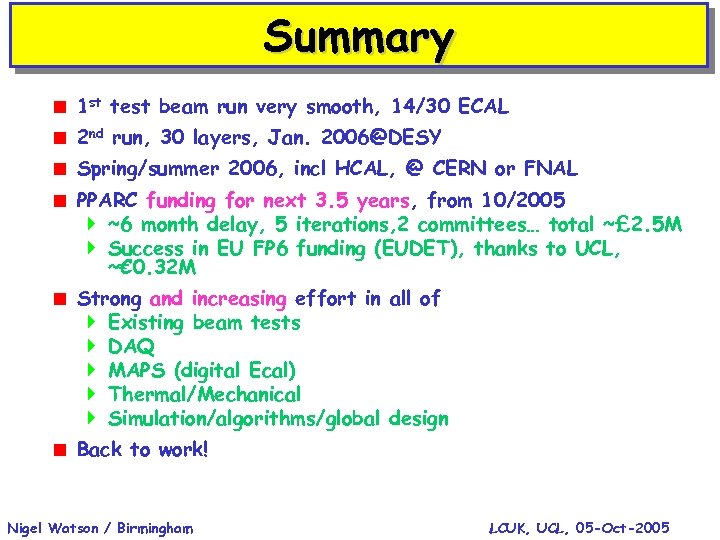 Summary < 1 st test beam run very smooth, 14/30 ECAL < 2 nd run, 30 layers, Jan. 2006@DESY < Spring/summer 2006, incl HCAL, @ CERN or FNAL < PPARC funding for next 3. 5 years, from 10/2005 } ~6 month delay, 5 iterations, 2 committees… total ~£ 2. 5 M } Success in EU FP 6 funding (EUDET), thanks to UCL, ~€ 0. 32 M < Strong and increasing effort in all of } Existing beam tests } DAQ } MAPS (digital Ecal) } Thermal/Mechanical } Simulation/algorithms/global design < Back to work! Nigel Watson / Birmingham LCUK, UCL, 05 -Oct-2005