 Скачать презентацию Calibration of Stopwatch by Using High Speed Video
42bdf91344fd18b13df90b37e18d5648.ppt
- Количество слайдов: 30



Calibration of Stopwatch by Using High Speed Video Recording and an In-house Designed Synchronous Counter Speaker: C. M. Tsui The Government of the Hong Kong Special Administrative Region Standards and Calibration Laboratory 36/F Immigration Tower, 7 Gloucester Road, Wanchai, Hong Kong Phone: (852) 2829 4850, Fax: (852) 2824 1302, Email: cmtsui@itc. gov. hk Authors: C. M. Tsui, Y. K. Yan, H. M. Chan The Government of the Hong Kong Special Administrative Region Standards and Calibration Laboratory
Methods for Calibrating Stopwatch can be calibrated using three methods : n The direct comparison method n The totalize method n The time base method has the smallest measurement uncertainty. The direct comparison method has the largest.
The Direct Comparison Method The time interval measured by the stopwatch is compared to that of a traceable time interval reference which usually is an audio signal broadcast by the official timekeeper of a region. An example is the WWVH in the USA.
The Time Base Method n The frequency of the time base of the stopwatch, which is likely to be a quartz oscillator, is pickup by either ultrasonic acoustic sensor or inductive sensor and measured directly. n This method is very fast. The measurement can be completed in a few seconds. n Since only the time base is tested, the functionality of the stopwatch is not checked. In addition, the relationship between the time interval readings of the stopwatch and its time base is not known.
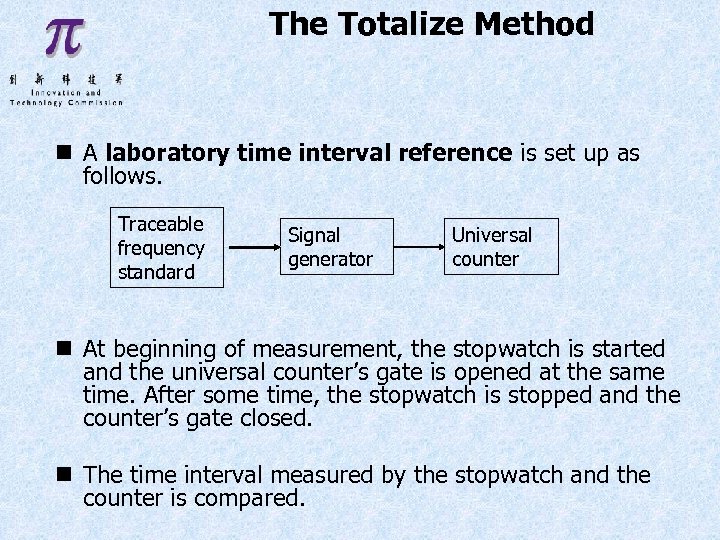
The Totalize Method n A laboratory time interval reference is set up as follows. Traceable frequency standard Signal generator Universal counter n At beginning of measurement, the stopwatch is started and the universal counter’s gate is opened at the same time. After some time, the stopwatch is stopped and the counter’s gate closed. n The time interval measured by the stopwatch and the counter is compared.
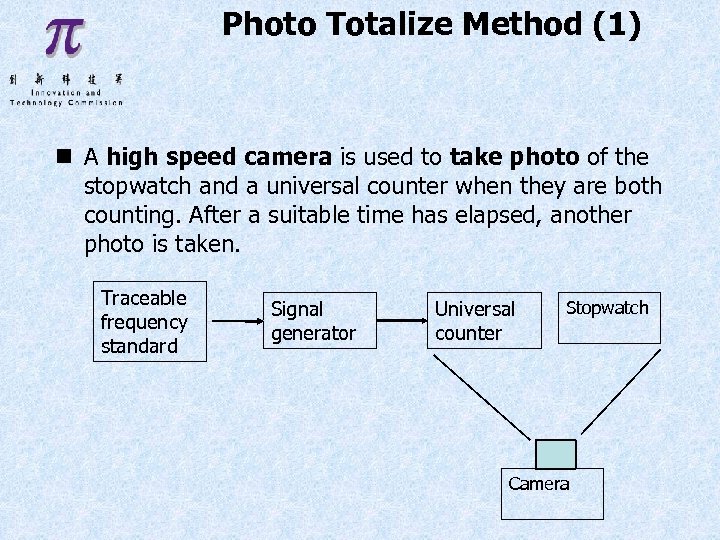
Photo Totalize Method (1) n A high speed camera is used to take photo of the stopwatch and a universal counter when they are both counting. After a suitable time has elapsed, another photo is taken. Traceable frequency standard Signal generator Universal counter Stopwatch Camera
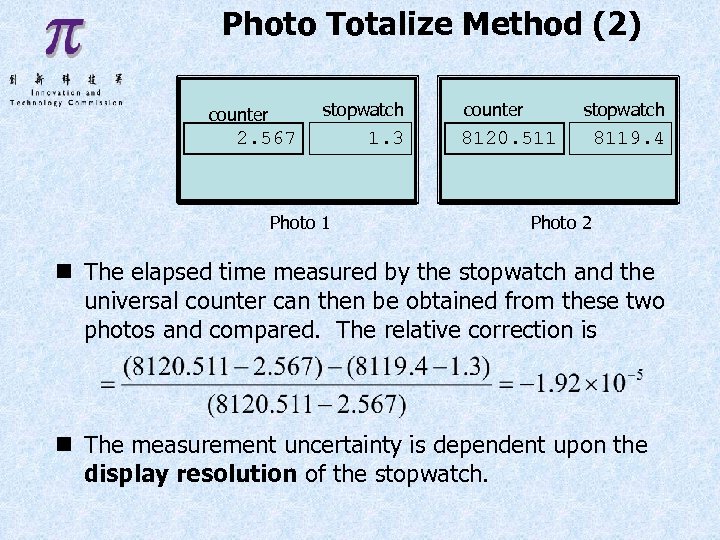
Photo Totalize Method (2) stopwatch counter 2. 567 Photo 1 1. 3 counter stopwatch 8120. 511 8119. 4 Photo 2 n The elapsed time measured by the stopwatch and the universal counter can then be obtained from these two photos and compared. The relative correction is n The measurement uncertainty is dependent upon the display resolution of the stopwatch.
Video Totalize Method (1) n We has modified this method by utilizing video recordings instead of photographs to obtain readings of the stopwatch. n The instant when the reading of the stopwatch display changes is found by examining the recorded video frame-by-frame. n The measurement uncertainty is limited by the frame rate of the video recording rather than the display resolution of the stopwatch.
Video Totalize Method (2) n Digital cameras that can record high speed video at 240 fps or 420 fps are commercially available. Using such cameras, the measurement uncertainty can be reduced significantly. n At high frame rates, the display of a normal universal counter cannot keep up and does not update at uniform intervals. n To overcome these problems, we has designed and built a synchronous counter that allows its count to be easily read from a recorded video with a resolution as small as 1 millisecond
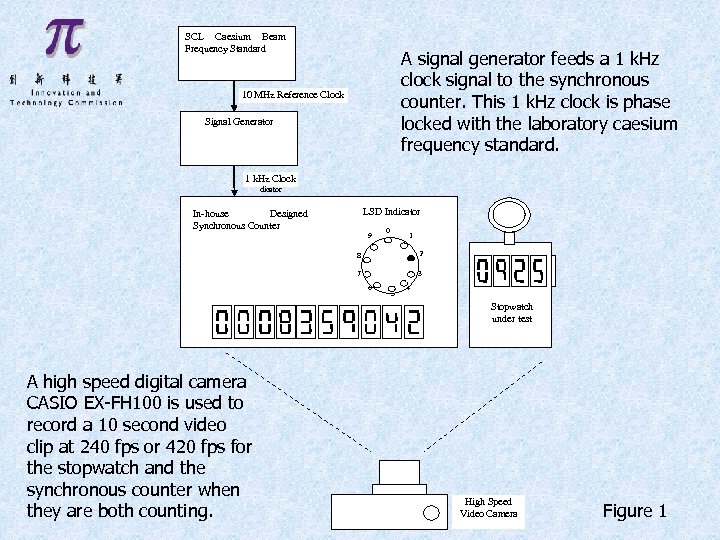
SCL Caesium Beam Frequency Standard A signal generator feeds a 1 k. Hz clock signal to the synchronous counter. This 1 k. Hz clock is phase locked with the laboratory caesium frequency standard. 10 MHz Reference Clock Signal Generator 1 k. Hz Clock dicator LSD Indicator In-house Designed Synchronous Counter 9 0 1 8 2 7 3 6 5 4 Stopwatch under test A high speed digital camera CASIO EX-FH 100 is used to record a 10 second video clip at 240 fps or 420 fps for the stopwatch and the synchronous counter when they are both counting. High Speed Video Camera Figure 1
The Calibration Method n The recorded video is viewed frame-by-frame to search for a frame at which the display of the stopwatch starts to change to a new value. n The readings of the stopwatch Tuut_start and that for the synchronous counter Tref_start are then taken from the frame immediately preceding this frame. n The least-significant-digit (LSD) of the synchronous counter is indicated by a circular LED display. The value corresponds to the LED which lights up at the most clockwise position.
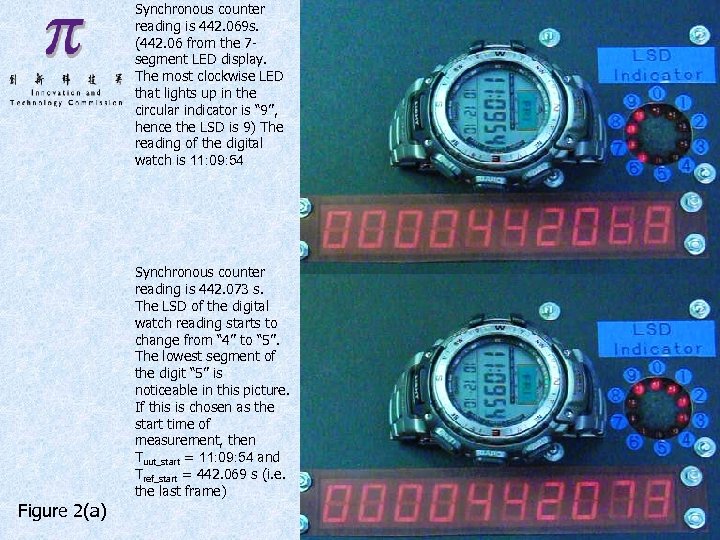
Synchronous counter reading is 442. 069 s. (442. 06 from the 7 segment LED display. The most clockwise LED that lights up in the circular indicator is “ 9”, hence the LSD is 9) The reading of the digital watch is 11: 09: 54 Figure 2(a) Synchronous counter reading is 442. 073 s. The LSD of the digital watch reading starts to change from “ 4” to “ 5”. The lowest segment of the digit “ 5” is noticeable in this picture. If this is chosen as the start time of measurement, then Tuut_start = 11: 09: 54 and Tref_start = 442. 069 s (i. e. the last frame)
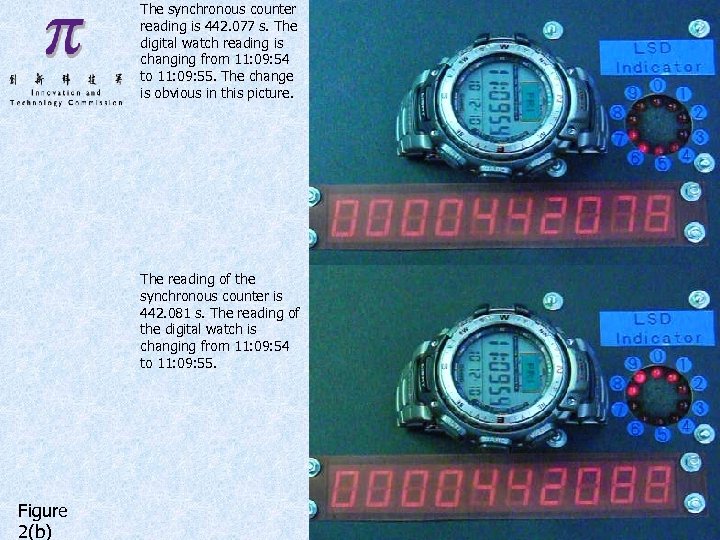
The synchronous counter reading is 442. 077 s. The digital watch reading is changing from 11: 09: 54 to 11: 09: 55. The change is obvious in this picture. The reading of the synchronous counter is 442. 081 s. The reading of the digital watch is changing from 11: 09: 54 to 11: 09: 55. Figure 2(b)
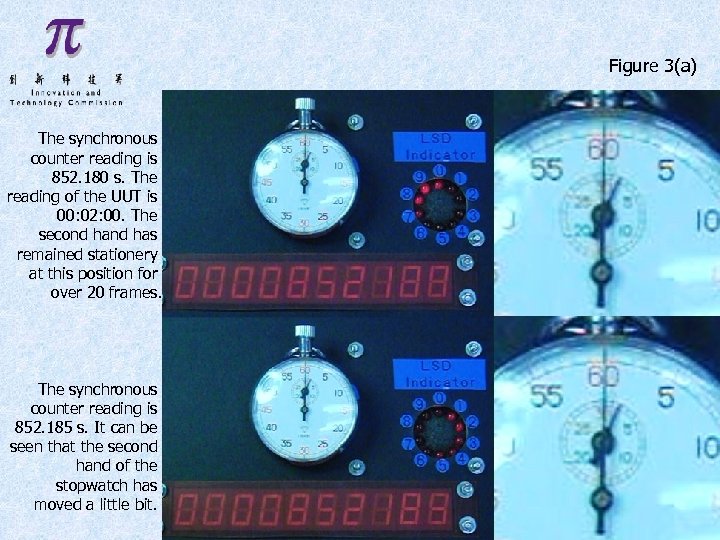
Figure 3(a) The synchronous counter reading is 852. 180 s. The reading of the UUT is 00: 02: 00. The second has remained stationery at this position for over 20 frames. The synchronous counter reading is 852. 185 s. It can be seen that the second hand of the stopwatch has moved a little bit.
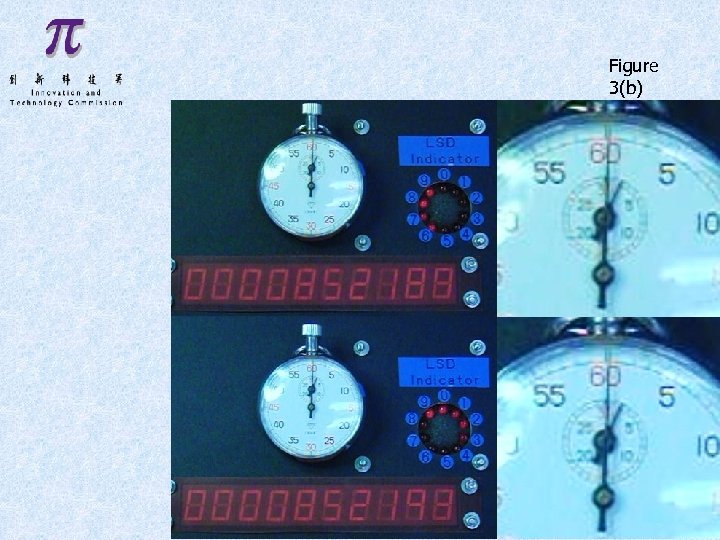
Figure 3(b)
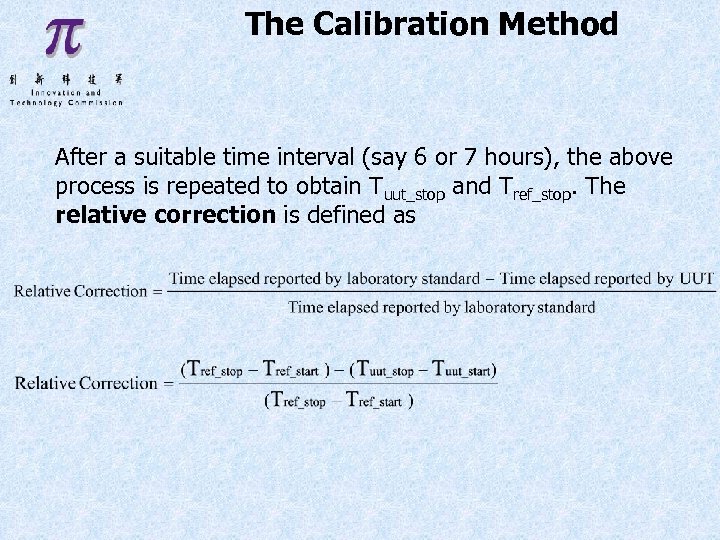
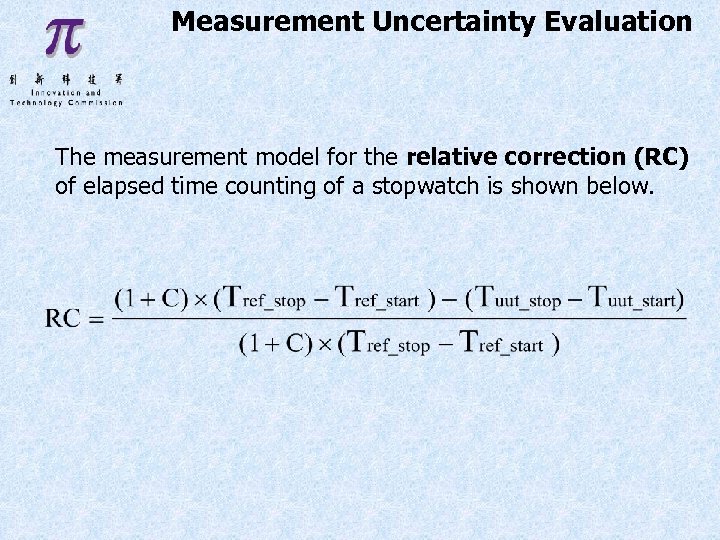
The Calibration Method After a suitable time interval (say 6 or 7 hours), the above process is repeated to obtain Tuut_stop and Tref_stop. The relative correction is defined as
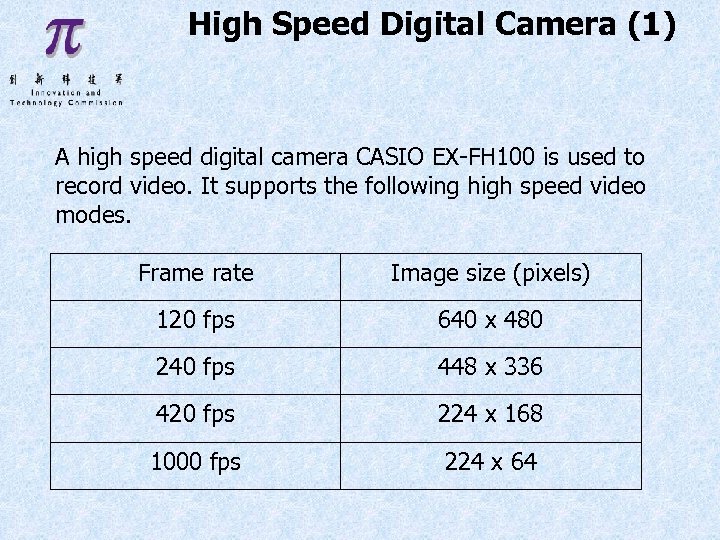
High Speed Digital Camera (1) A high speed digital camera CASIO EX-FH 100 is used to record video. It supports the following high speed video modes. Frame rate Image size (pixels) 120 fps 640 x 480 240 fps 448 x 336 420 fps 224 x 168 1000 fps 224 x 64
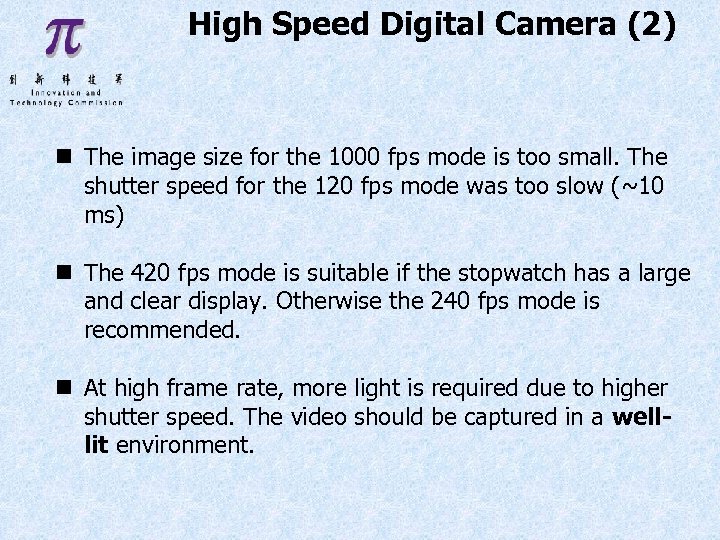
High Speed Digital Camera (2) n The image size for the 1000 fps mode is too small. The shutter speed for the 120 fps mode was too slow (~10 ms) n The 420 fps mode is suitable if the stopwatch has a large and clear display. Otherwise the 240 fps mode is recommended. n At high frame rate, more light is required due to higher shutter speed. The video should be captured in a welllit environment.
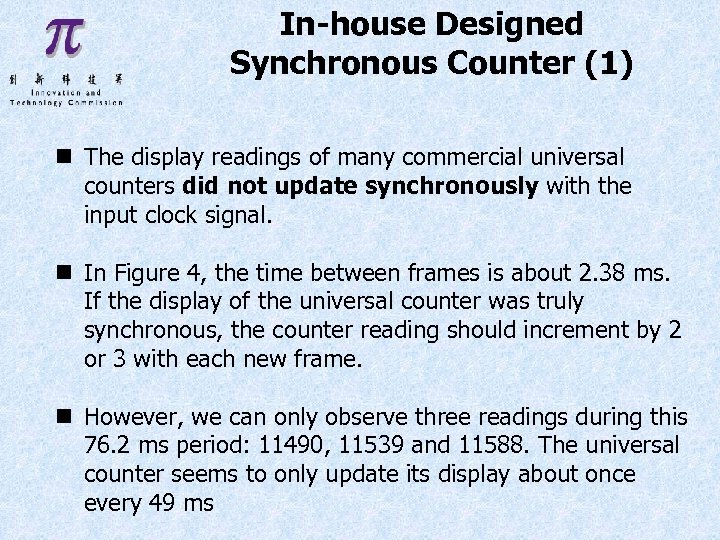
In-house Designed Synchronous Counter (1) n The display readings of many commercial universal counters did not update synchronously with the input clock signal. n In Figure 4, the time between frames is about 2. 38 ms. If the display of the universal counter was truly synchronous, the counter reading should increment by 2 or 3 with each new frame. n However, we can only observe three readings during this 76. 2 ms period: 11490, 11539 and 11588. The universal counter seems to only update its display about once every 49 ms
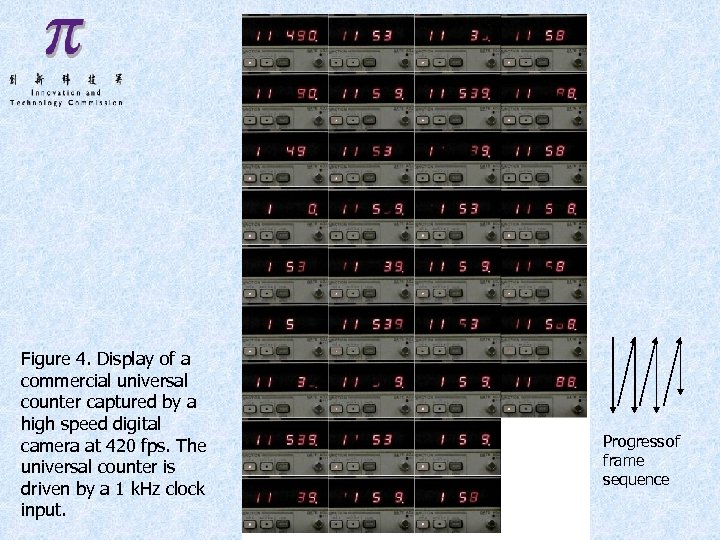
Figure 4. Display of a commercial universal counter captured by a high speed digital camera at 420 fps. The universal counter is driven by a 1 k. Hz clock input. Progress of frame sequence
In-house Designed Synchronous Counter (2) n There are severe limitations when the video totalize method is employed with some commercial universal counters. n The synchronous counter designed by SCL was built with logic circuits that ensure its 10 -digit LED display will be updated synchronously with the input clock. n It is driven by a 1 k. Hz clock generated by a signal generator phase locked to the laboratory cesium frequency standard. It has a resolution of 1 ms.
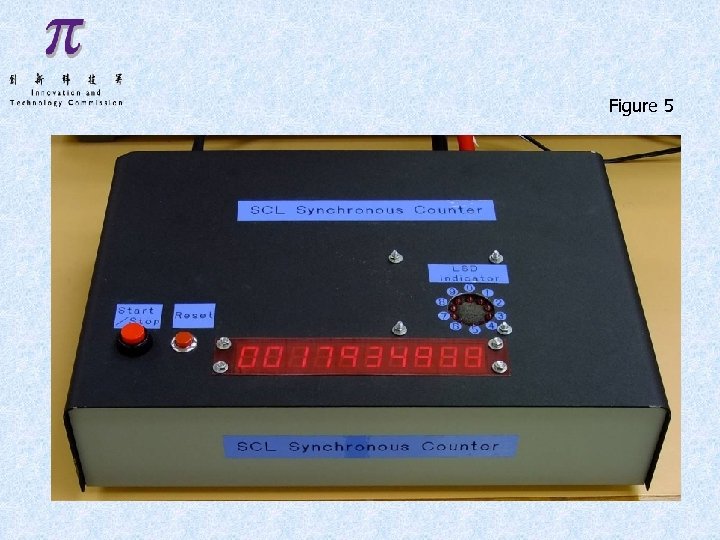
Figure 5
In-house Designed Synchronous Counter (3) n At 420 fps and 240 fps, the shutter speeds were 2 ms and 4 ms respectively. The LSD of the counter updates every millisecond, it is not possible to read its value from the 7 -segment LED display in the recorded video. n To overcome this problem, a special LSD indicator was designed which consists of 10 LED arranged in a circle. Each LED corresponds to a decimal value and will light up individually for about 1 ms in every 10 ms period. n When recorded at a shutter speed of 4 ms, 4 to 5 consecutive LEDs will be illuminated in the recorded image. The LED which lights up at the most clockwise position is the correct value of the LSD, and allows the counter to be read with a resolution of 1 ms.
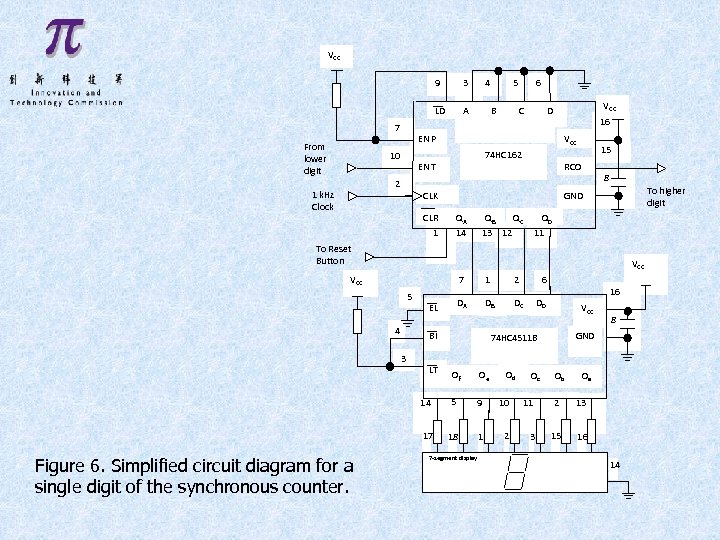
VCC 9 LD 7 From lower digit A 5 4 B 6 C VCC D 16 EN P VCC 15 74 HC 162 10 EN T RCO CLK 2 1 k. Hz Clock 3 GND CLR 1 QA 14 QB QC 13 12 8 To higher digit QD 11 To Reset Button VCC 7 5 4 2 DA EL 1 DB DC BI 3 LT Og 6 16 DD VCC GND 74 HC 4511 B Of Oe Od Oc Ob Oa 14 15 9 10 11 12 13 17 Figure 6. Simplified circuit diagram for a single digit of the synchronous counter. 8 18 1 2 3 15 16 7 -segment display 14
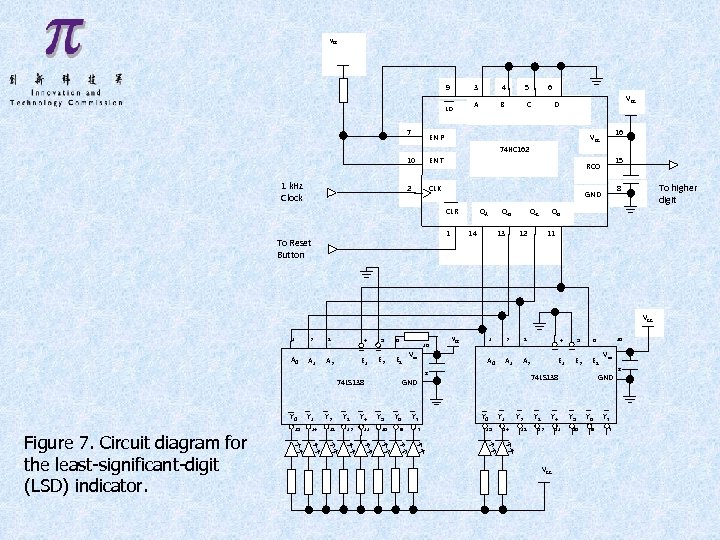
VCC 9 3 LD 7 4 5 A B C 6 VCC D EN P 16 VCC 74 HC 162 10 2 1 k. Hz Clock EN T CLK 1 QA QB 14 13 QC To higher digit 8 GND CLR To Reset Button 15 RCO QD 12 11 VCC 1 2 3 4 5 6 A 0 A 1 A 2 E 1 E 2 E 3 VCC Vcc 2 3 4 5 6 A 1 A 2 E 1 E 2 E 3 8 Y 0 Figure 7. Circuit diagram for the least-significant-digit (LSD) indicator. 15 Y 1 14 Y 2 13 Y 3 12 Y 4 11 74 LS 138 GND 74 LS 138 Y 5 10 Y 6 9 16 1 A 0 16 Y 7 7 Y 0 15 Y 1 14 Y 2 13 Y 4 12 VCC 11 Vcc GND Y 5 10 Y 6 9 Y 7 7 8
Measurement Uncertainty Evaluation The measurement model for the relative correction (RC) of elapsed time counting of a stopwatch is shown below.
Measurement Uncertainty Evaluation C Measurement Uncertainty Components Relative correction of the 1 k. Hz clock input to the synchronous counter Remarks The 1 k. Hz clock input is phase locked to the laboratory reference frequency. It is assumed to have a normal distribution with zero mean. The standard measurement uncertainty is taken as : Tref_start , Reading of synchronous Due to limited resolution of the synchronous Tref_stop counter at start and stop counter. It is taken to have a rectangular time of elapsed time distribution with semi-range of ± 1 ms. counting. Tuut_start , Reading of UUT at start Due to time interval between successive Tuut_stop and stop time of elapsed frames of the video recording. It is taken to time counting. have a rectangular distribution with semirange equals to the time interval between two frames.
Measurement Uncertainty Evaluation n There are two methods to derive the combined standard measurement uncertainty for the final measurand n GUM Uncertainty Framework (GUF) n Monte Carlo Method (MCM) n GUF is easier and faster to compute than MCM. However, the domain of validity of GUF is narrower than MCM. n Supplement 1 to the GUM describes a validation procedure for GUF was found not valid for this measurement model. n The reason is that there are two dominant uncertainty components u(Tuut_start) and u(Tuut_stop) with rectangular probability distribution, violating the condition for valid application of GUF.
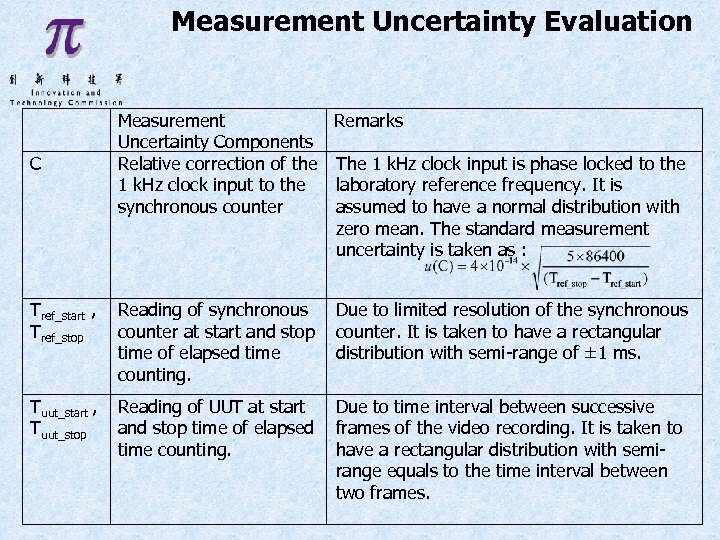
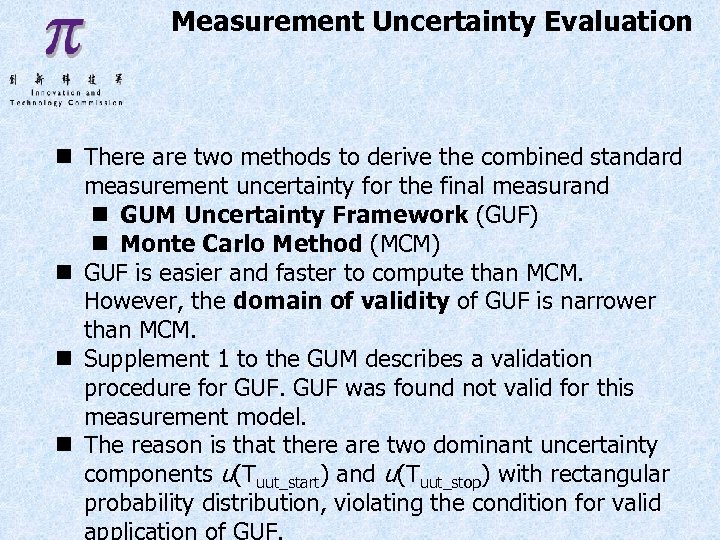
Measurement Uncertainty Evaluation n Assuming elapsed time of 7 hours between Tref_start and Tref_stop, the estimated measurement uncertainties of the relative correction RC for a 95% coverage interval, calculated using MCM, are listed on next slide. n For comparison, the estimated measurement uncertainties for the photo totalise method are listed in the same table. If commercial counter is used in the photo totalise method, the counter reading taken from the photo is assumed to have an accuracy of 0. 1 s.
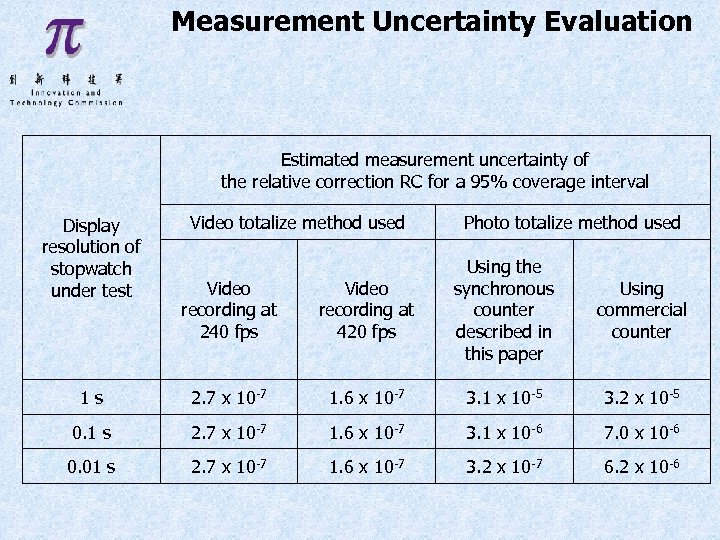
Measurement Uncertainty Evaluation Estimated measurement uncertainty of the relative correction RC for a 95% coverage interval Display resolution of stopwatch under test Video totalize method used Photo totalize method used Video recording at 240 fps Video recording at 420 fps Using the synchronous counter described in this paper 1 s 2. 7 x 10 -7 1. 6 x 10 -7 3. 1 x 10 -5 3. 2 x 10 -5 0. 1 s 2. 7 x 10 -7 1. 6 x 10 -7 3. 1 x 10 -6 7. 0 x 10 -6 0. 01 s 2. 7 x 10 -7 1. 6 x 10 -7 3. 2 x 10 -7 6. 2 x 10 -6 Using commercial counter
Скачать презентацию Calibration of Stopwatch by Using High Speed Video
42bdf91344fd18b13df90b37e18d5648.ppt