


 Скачать презентацию Calendar Cross-cultural study Polytheistic approach Sumerian names
Calendar.ppt
- Количество слайдов: 25
 Calendar Cross-cultural study
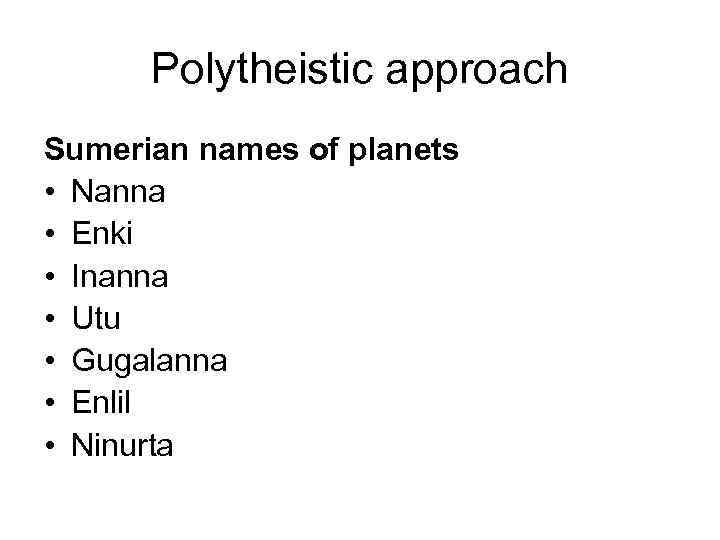 Polytheistic approach Sumerian names of planets • Nanna • Enki • Inanna • Utu • Gugalanna • Enlil • Ninurta
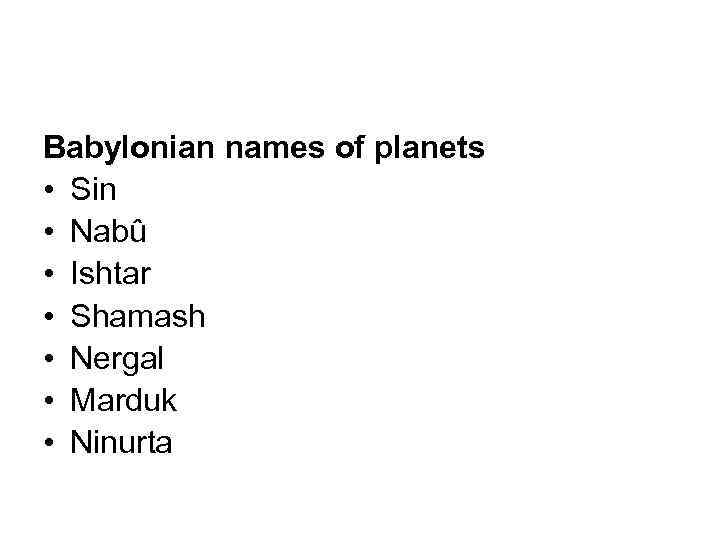 Babylonian names of planets • Sin • Nabû • Ishtar • Shamash • Nergal • Marduk • Ninurta
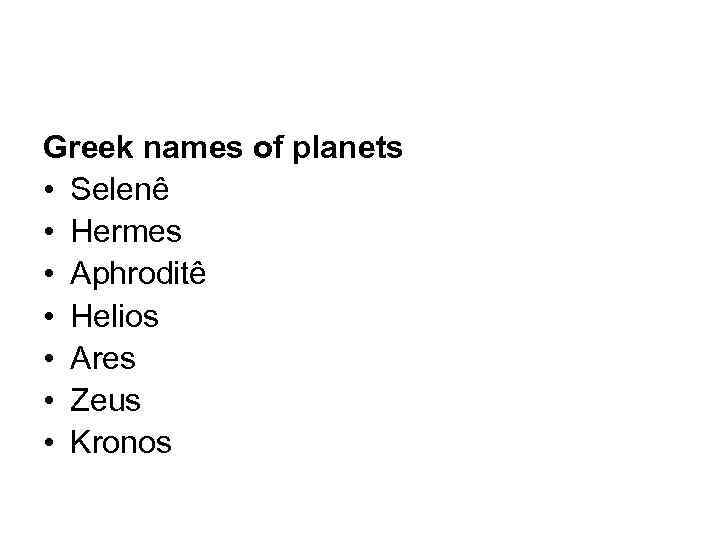 Greek names of planets • Selenê • Hermes • Aphroditê • Helios • Ares • Zeus • Kronos
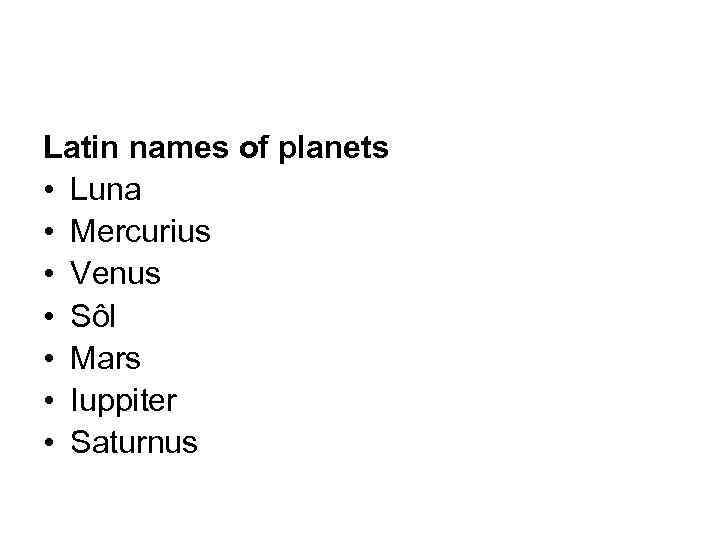 Latin names of planets • Luna • Mercurius • Venus • Sôl • Mars • Iuppiter • Saturnus
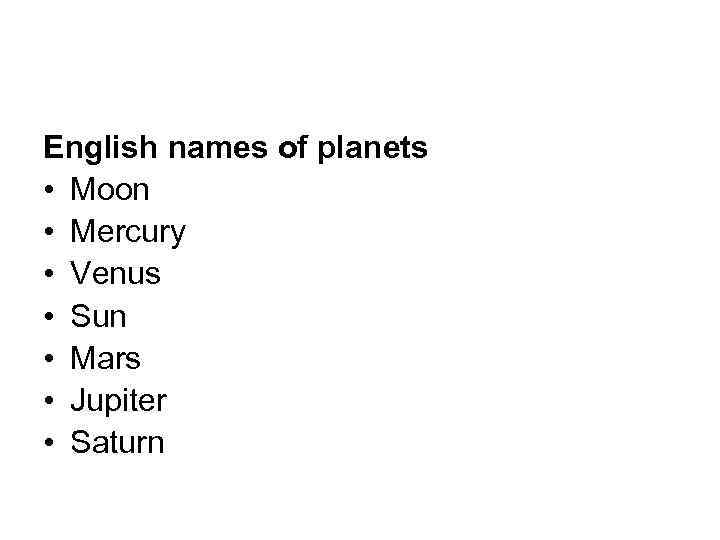 English names of planets • Moon • Mercury • Venus • Sun • Mars • Jupiter • Saturn
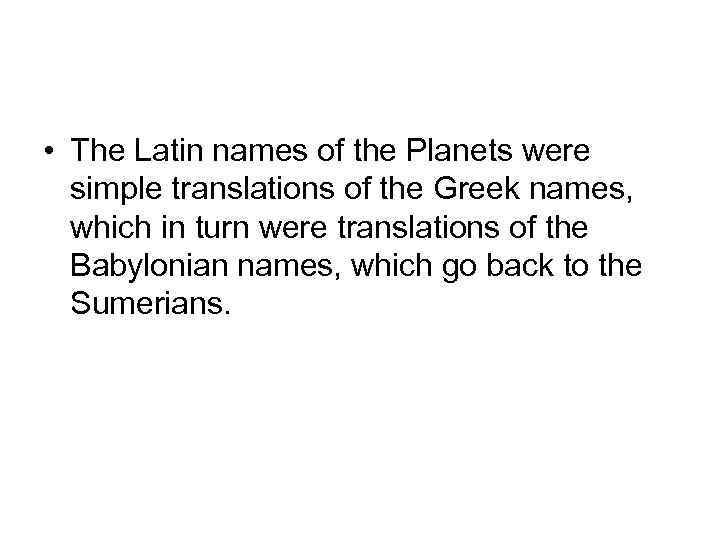 • The Latin names of the Planets were simple translations of the Greek names, which in turn were translations of the Babylonian names, which go back to the Sumerians.
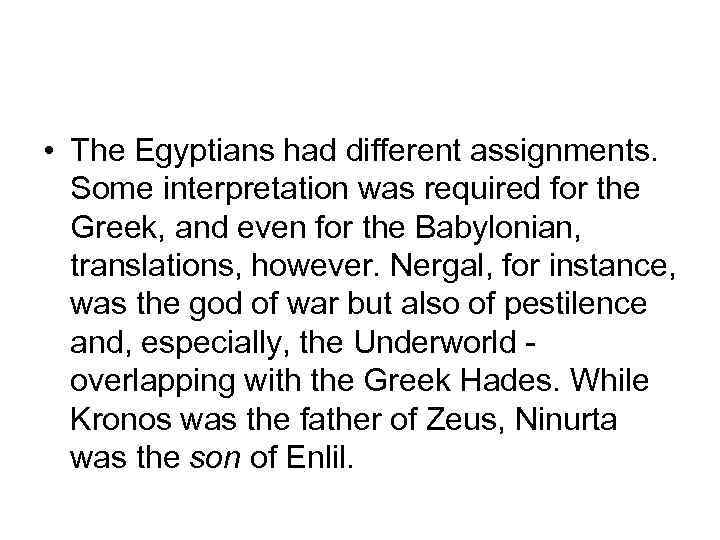 • The Egyptians had different assignments. Some interpretation was required for the Greek, and even for the Babylonian, translations, however. Nergal, for instance, was the god of war but also of pestilence and, especially, the Underworld overlapping with the Greek Hades. While Kronos was the father of Zeus, Ninurta was the son of Enlil.
 • The Babylonians replaced the Sumerian national gods Enlil and Enki with the patron god of Babylon, Marduk, and his son, Nabû - though Marduk was actually taken to be the son of Enki (called "Ea" in Babylonian). Ninurta, an obscure god inherited by the Babylonians, may have been identified with Saturn, the slowest moving planet, because, at least in one story, he was identified with the turtle.
 Monotheistic approach • In Hebrew, the days of the week are simply numbered, except for the 7 th, which is the Sabbath (Shabbat).
 • In Arabic, the days of the week are also numbered, and the 7 th day is still the Sabbath (as. Sabt), but the 6 th day is now al. Jum'ah, the day of "gathering" (jum'), when Muslims pray at the mosque (jâmi').
 • In Modern Greek, the days are also numbered, and the 7 th is still the Sabbath (Savvato), but the 1 st day is now Kyriakê, the Lord's day. Interestingly, the 6 th day in Greek is Paraskeuê, the "Preparation. " This is actually the Jewish term, as preparation is made on the 6 th day for the Sabbath -- preserved in a language today almost entirely of Christians, but formerly of many Jews in the Hellenistic and Roman periods.
 • In Russian the days are numered. • In Church Slavonic the 7 th day is ‘nedelya’ (‘not working day’) – in Russian “voskresenye”; the 1 st day – “po-nedelnik” • The 2 nd – “vtornik”, the 3 rd –”sreda” (middle), the 4 th and 5 th – numbers, the 6 th – “subbota” means Sabbat.
 • the languages of Western Europe all (except Portuguese) reflect names based on the names of the naked eye planets, which included the Sun and the Moon, either in a Latin version or a corresponding Germanic version.
 • • Monday (Moon), Wednesday (Mercury), Friday (Venus), Sunday (Sun), Tuesday (Mars), Thursday (Jupiter), and Saturday (Saturn).
 • The Germanic version of the Latin day names has some correspondences and some differences. In English, the 1 st, 2 nd, and 7 th days are still named after the Sun, Moon, and Saturn, respectively. • The 6 th day, Friday, looks like the name (Fria or Freya) of a Germanic love goddess, which would correspond to Venus (fri-, as in "friend, " is a cognate of philein, "to love, " in Greek), though the day is also said to be named after the goddess Frigg, who is also a goddess of love, and of the hearth (which would be Vesta rather than Venus in Rome).
 • The 5 th day, Thursday, named after Jupiter, who is a thunder god, in Latin, is named after a Germanic thunder god, well known as "Thor" in Norse mythology. • Tuesday is named after Tiw, a god of law, but also said to be a god of war, which would match up to Mars. • Wednesday is named after the king of the gods, who was Wotan in ancient German and Odin in Norse mythology. This has no obvious correspondence to Mercury, though Odin as a god of wisdom might suggest the role of Mercury in association with learning, and in Late Antiquity with esoteric knowledge.
 • The 1 st day in Latin is named after the Sun (Solis dies), but Christians also consider that the Lord's day (Dominicus dies), as in Greek. The 2 nd day is named after the Moon (Lunae dies). The 3 rd day is named after Mars (Martis dies).
 • The 4 th day is named after Mercury (Mercurii dies). • The 5 th day is named after Jupiter, or Jove (Jovis dies). • The 6 th day is named after Venus (Veneris dies). • And the 7 th day is named after Saturn (Saturni dies), though it can still be called the Sabbath (Sabbatum or Sabbati dies).
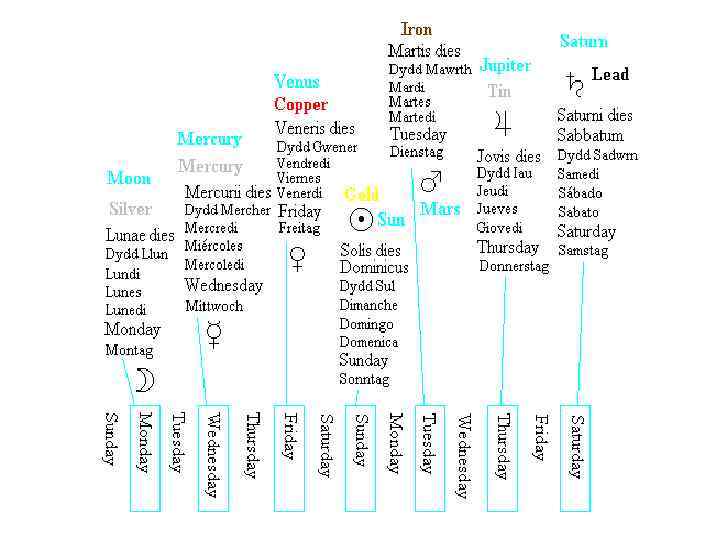
 • The chart at right illustrates the two week period that counts off the classic ascending order of the planets, from left to right. • It gives the names of the planets, in light blue, the names of the metals that alchemy associated with each of the planets (in roughly the appropriate color), the symbols for the planets and metals used in alchemy and still in astronomy, and the names of the days of the week, from top to bottom, in Latin, Welsh, French, Spanish, Italian, English, and German.
 • The Welsh names are of great interest, since Welsh is the remaining language of Roman Britain. It preserves the Latin names of the planets more faithfully than even the Romance languages, which are actually descended from Latin, as Welsh is not.
 • The name of Saturday in Spanish and Italian is clearly derived from Sabbatum. The French name, Samedi, has the same origin. In Old French it was Sambedi, from Vulgar Latin Sambati dies. There are many cases where a b has become an m in "Sabbath, " including Romanian Sambata, Hungarian Szombat, and even Persian Shambe (written Shanbe).
 • In French, we have the interesting development that the final t has become confused with the -di (for dies) ending of all the other days of the week. The German name of Saturday, Samstag then looks like nothing less than a transformation of the French name into German, with German Tag, "day, " substituted for the -di element, and a genitive -s added to the root.
 • In German, however, the -s may not be a genitive but a remnant of the final t, since the word in Old High German was Sambaz tac (compare English that, ending in t, with German das, ending in s). In the oldest attested Germanic language, Gothic, Saturday was Sabbato dags [Winfred P. Lehmann, A Gothic Etymological Dictionary, E. J. Brill, Leiden, 1986, p. 289 -290].