Скачать презентацию Calculation of the Ecological Footprint Print of the
272599f565732b4c33f9a8dcaf0d80c5.ppt
- Количество слайдов: 15
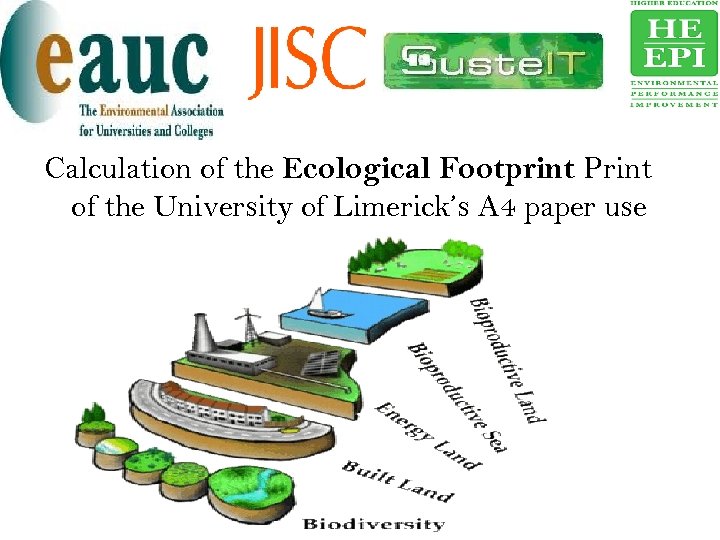 Calculation of the Ecological Footprint Print of the University of Limerick’s A 4 paper use
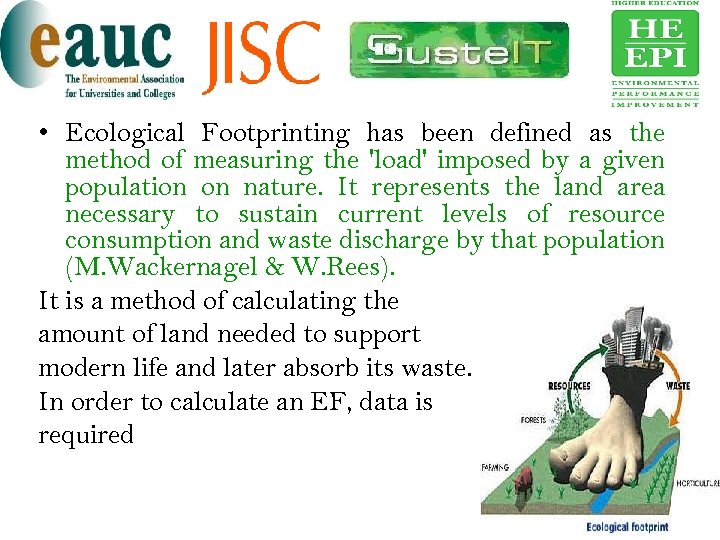 • Ecological Footprinting has been defined as the method of measuring the 'load' imposed by a given population on nature. It represents the land area necessary to sustain current levels of resource consumption and waste discharge by that population (M. Wackernagel & W. Rees). It is a method of calculating the amount of land needed to support modern life and later absorb its waste. In order to calculate an EF, data is required
 Various environmental factors are considered when calculating the Ecological Footprint of a product or service … they include… • Type of land used to supply raw materials and to later sequester CO 2, • Source of energy used in production, (sustainable or non sustainable) • chemicals used in manufacture, (biodegradable or non biodegradable) • other toxic emissions created • Go with the data available
 • UL used 2 EF formulae’s • Energy Footprint • Forest Footprint • Also included a Total Tree Usage. . using formulas & metrics already available. Main piece of data required was the amount (kgs) of A 4 paper coming into UL.
 • Weight of paper consumed (kg) * the embodied energy of paper manufacture (7. 24 k. Wh) • * the carbon dioxide conversion factor for Ireland (0. 000624) • * the recycling factor of 0. 3 (excluded) • * the conversion factor for land area sequestration for a tonne of CO 2 in hectares (0. 19) • * global hectare equivalence factor (1. 17). Sharing Natures Interest by Craig Simmons.
 There is approximately 125, 000 kg of paper coming into the university each year. (50, 000 reams x 2. 5 kgs) 125, 000 kgs x 7. 24 = 905, 000 k. Wh/Kg ; “Embodied Energy” This is how much energy k. Wh, was used in the manufacturing of 50, 000 kg of A 4 paper 905, 000 k. Wh/Kg of “embodied energy” translates into 565 tonnes of CO 2 produced. (905, 000 k. Wh/Kg *0. 00062 Irish energy / CO 2 equivalence factor (ESB website). aka carbon footprint
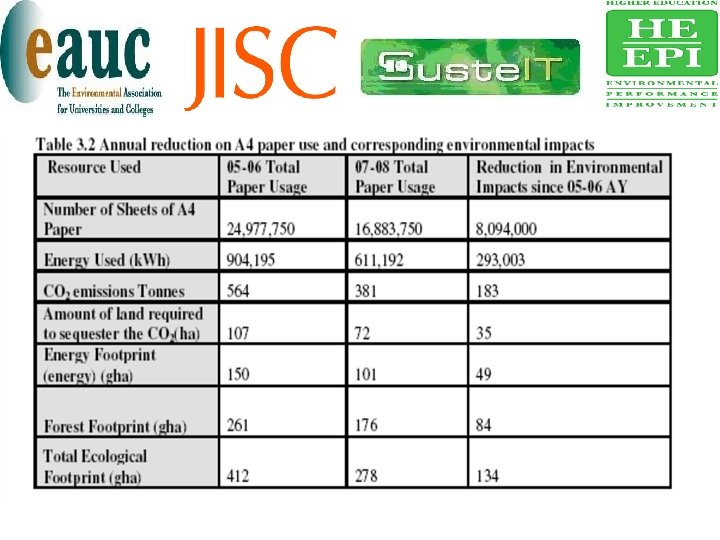
 • Ecological Footprinting is quantified in terms of “hectares of land required to absorb CO 2” and has a land sequestration conversion factor of 0. 19. . so. This 565 tonnes of CO 2 produced * land sequestration conversion factor (565*0. 19) = 107 acres • There is a “Land Equivalency Factor” of 1. 4. This is basically a “world average” of the various different types of land that exists on the planet. It is a combination of forest land, grassland, ocean bed, desert land, etc. and it amounts to 107*1. 4= 149. 8 • 150 global hectares which is UL’s A 4 paper uses energy footprint …
 • Doesn’t stop there. . • It estimated that 10 reams of 100% virgin copier paper uses 0. 6 of a tree, therefore one ream of paper requires approximately 0. 06 of a tree. • As UL consumed 50, 000 reams of A 4 virgin paper in the 05 -06 AY, it follows that approximately 3, 000 trees were felled to create that much paper. (1 ream of paper = 0. 06 of a tree x 50, 000 =3, 000)
 • Again this figure is somewhat “general”, it depends on • the species of tree, (thousands) • its age, (1 to 20 years old) • its heights and diameter at both stem and top points, • it’s location of growth, • the type of wood i. e. softwood or hardwood. etc • Final note : Ecological Footprinting is a subjective science, there are no set rules only guidelines, • data can be manipulated is often immeasurable
 Forest Footprint The 3, 000 tree value is an estimation of the number of trees required to supply UL with A 4 paper for a single academic year. The formulae did not include the forests 1. Sustainable Yield factor (of 2. 34(how sustainable is the forest) or 2. the Raw Wood Material Value (RWMV) of paper (which was 3. 5: 1), Both were then factored into a more sustainable Forest EF formula.
 • 125, 000 kg * 3. 5 kg/kg equates to a raw wood material equivalent (RWMV) of 437, 000 kg of RWMV = 125, 000 kgs of A 4 Paper • As each ream of A 4 paper weighs 8. 75 (3. 5 x 2. 5) kg/kg of raw wood material, it uses 0. 06 of a tree, so the number of trees required to supply UL with its A 4 paper for the 05 -06 AY was in the region of 2, 879 trees. (8. 75 kg/kg = 0. 06 tree, therefore 1 kg/kg of raw wood = 0. 06/8. 75 = 0. 00685 of a tree, therefore 437, 000 kg (0. 00685*437, 000) = 2, 997 trees).
 Forests need to be sustained, therefore a sustainability or yield factor of 2. 34 needed to be included in the formulae. This estimated a more accurate and sustainable bio productive area required to supply the raw wood necessary to supply UL with their annual A 4 paper consumption while not reducing existing forest stocks.
 Thus the following forest EF formulae was determined: kg of raw wood material /global average forestry yield * equivalence factor. Calculation (05 -06 data) • 437, 000 kg of raw wood material. • 437 tonnes / 2. 34 = 187 hectares of bio-productive area * 1. 4 (land equivalency factor from energy EF) = 261. 75 global hectares. • The Forest EF of the University of Limerick’s ‘ 05 -’ 06 A 4 paper consumption is over 261 gha.
 So we had Energy EF (150 gha) and Forest EF of (261. 75 gha) ’ 05 -’ 06 = Total Ecological Footprint = 412 gha in ’ 07 -’ 08 UL had Energy EF (101. 44 gha) and Forest EF (176. 77 gha) for ’ 07 -’ 08 = Total EF (278. 21 gha) Subtract one from the other to show the total EF reduction 412. 04 gha – 278. 21 gha =134 gha 134 global hectares of sustainable forest saved due to paper saving initiatives.