


 Скачать презентацию Calculate Financial Position Principles of Cost Analysis and
77fb2ae6d5f96bb9bc2ac994830ed9b5.ppt
- Количество слайдов: 40
 Calculate Financial Position Principles of Cost Analysis and Management © Dale R. Geiger 2011 1
 Why is it useful to know an entity’s financial position? © Dale R. Geiger 2011 2
 Terminal Learning Objective • Action: Calculate Financial Position • Condition: You are a cost advisor technician with PCAM course handouts, readings, and spreadsheet tools and awareness of Operational Environment (OE)/Contemporary Operational Environment (COE) variables and actors. • Standard: With at least 80% accuracy: Define terminology used in basic accounting Classify assets & liabilities Assign value to assets Enter relevant report data to solve Assets, Liabilities, and Capital equation (using macros provided in Excel template) • Solve for missing variables in the balance sheet equation • • © Dale R. Geiger 2011 3
 Meet the Simmons Family • Gomer, Madge and kids: • Bert, Lacy and baby Maddie • Stunt doubles for a popular cartoon family • Task: Calculate the family’s Financial Position © Dale R. Geiger 2011 4
 What is Financial Position? • Financial position is represented by the equation: Assets – Liabilities = Financial Position Or Assets = Liabilities + Financial Position • Financial Position may also be called Equity or Net Assets © Dale R. Geiger 2011 5
 What’s an Asset? • An Asset is: • Something you OWN • Represents FUTURE BENEFIT • What kinds of assets might the Simmons family own? © Dale R. Geiger 2011 6
 What’s an Asset? • An Asset is: • Something you OWN • Represents FUTURE BENEFIT • What kinds of assets might the Simmons family own? © Dale R. Geiger 2011 7
 What’s an Asset? • An Asset is: • Something you OWN • Represents FUTURE BENEFIT • What kinds of assets might the Simmons family own? © Dale R. Geiger 2011 8
 What’s an Asset? • An Asset is: • Something you OWN • Represents FUTURE BENEFIT • What kinds of assets might the Simmons family own? © Dale R. Geiger 2011 9
 What’s a Liability? • A Liability is: • Something you OWE • Represents FUTURE SACRIFICE • A creditor’s CLAIM against your assets • What kinds of Liabilities might the Simmons family have? © Dale R. Geiger 2011 10
 What’s a Liability? • A Liability is: • Something you OWE • Represents FUTURE SACRIFICE • A creditor’s CLAIM against your assets • What kinds of Liabilities might the Simmons family have? © Dale R. Geiger 2011 11
 What’s a Liability? • A Liability is: • Something you OWE • Represents FUTURE SACRIFICE • A creditor’s CLAIM against your assets • What kinds of Liabilities might the Simmons family have? © Dale R. Geiger 2011 12
 What’s a Liability? • A Liability is: • Something you OWE • Represents FUTURE SACRIFICE • A CREDITOR’S CLAIM against your assets • What kinds of Liabilities might the Simmons family have? © Dale R. Geiger 2011 13
 What’s a Liability? • A Liability is: • Something you OWE • Represents FUTURE SACRIFICE • A CREDITOR’S CLAIM against your assets • What kinds of Liabilities might the Simmons family have? © Dale R. Geiger 2011 14
 Check on Learning • What is the equation to represent financial position? • Which element of the equation represents future benefits of the entity? © Dale R. Geiger 2011 15
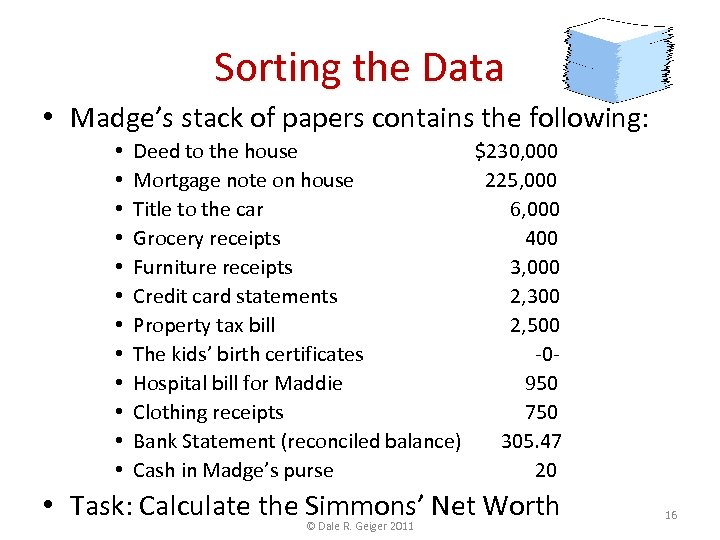 Sorting the Data • Madge’s stack of papers contains the following: • • • Deed to the house $230, 000 Mortgage note on house 225, 000 Title to the car 6, 000 Grocery receipts 400 Furniture receipts 3, 000 Credit card statements 2, 300 Property tax bill 2, 500 The kids’ birth certificates -0 Hospital bill for Maddie 950 Clothing receipts 750 Bank Statement (reconciled balance) 305. 47 Cash in Madge’s purse 20 • Task: Calculate the Simmons’ Net Worth © Dale R. Geiger 2011 16
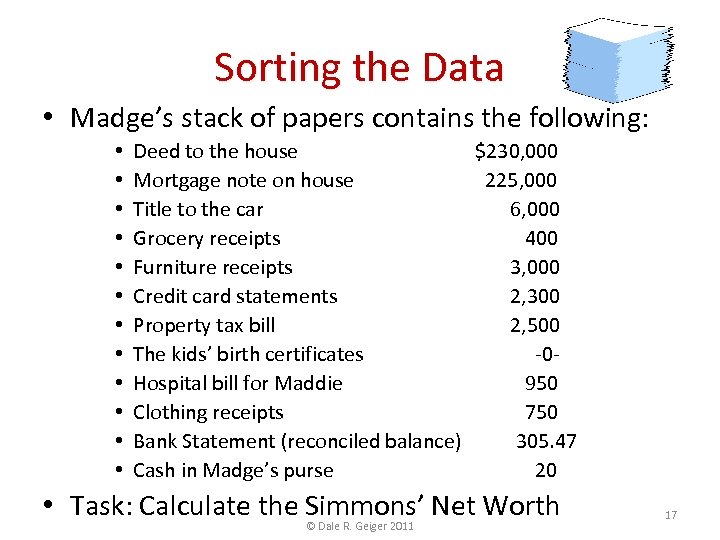 Sorting the Data • Madge’s stack of papers contains the following: • • • Deed to the house $230, 000 Mortgage note on house 225, 000 Title to the car 6, 000 Grocery receipts 400 Furniture receipts 3, 000 Credit card statements 2, 300 Property tax bill 2, 500 The kids’ birth certificates -0 Hospital bill for Maddie 950 Clothing receipts 750 Bank Statement (reconciled balance) 305. 47 Cash in Madge’s purse 20 • Task: Calculate the Simmons’ Net Worth © Dale R. Geiger 2011 17
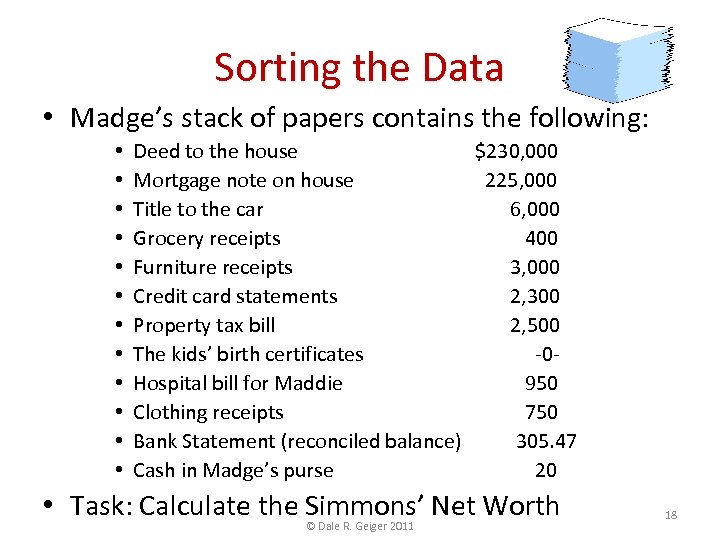 Sorting the Data • Madge’s stack of papers contains the following: • • • Deed to the house $230, 000 Mortgage note on house 225, 000 Title to the car 6, 000 Grocery receipts 400 Furniture receipts 3, 000 Credit card statements 2, 300 Property tax bill 2, 500 The kids’ birth certificates -0 Hospital bill for Maddie 950 Clothing receipts 750 Bank Statement (reconciled balance) 305. 47 Cash in Madge’s purse 20 • Task: Calculate the Simmons’ Net Worth © Dale R. Geiger 2011 18
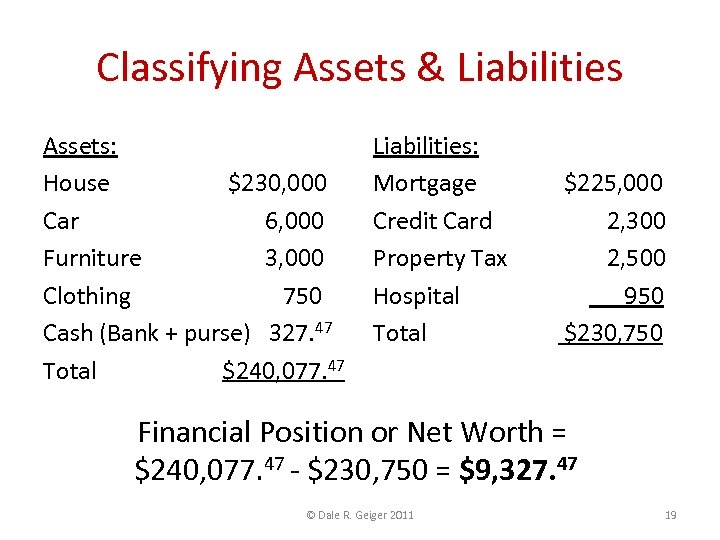 Classifying Assets & Liabilities Assets: House $230, 000 Car 6, 000 Furniture 3, 000 Clothing 750 Cash (Bank + purse) 327. 47 Total $240, 077. 47 Liabilities: Mortgage Credit Card Property Tax Hospital Total $225, 000 2, 300 2, 500 950 $230, 750 Financial Position or Net Worth = $240, 077. 47 - $230, 750 = $9, 327. 47 © Dale R. Geiger 2011 19
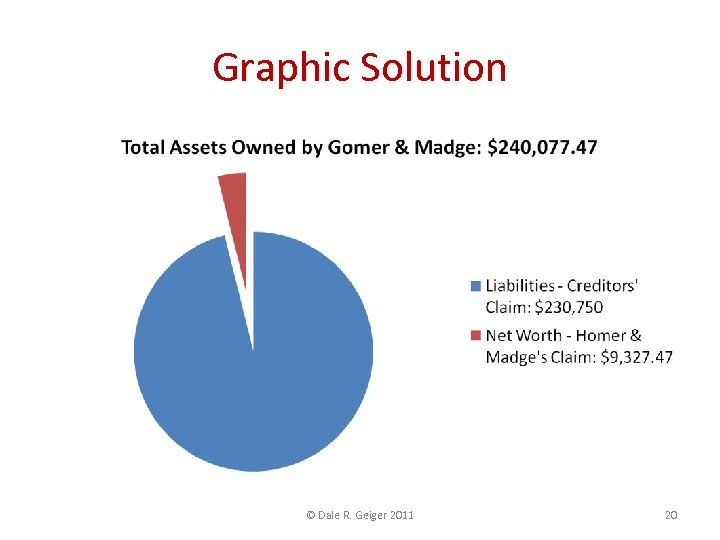 Graphic Solution © Dale R. Geiger 2011 20
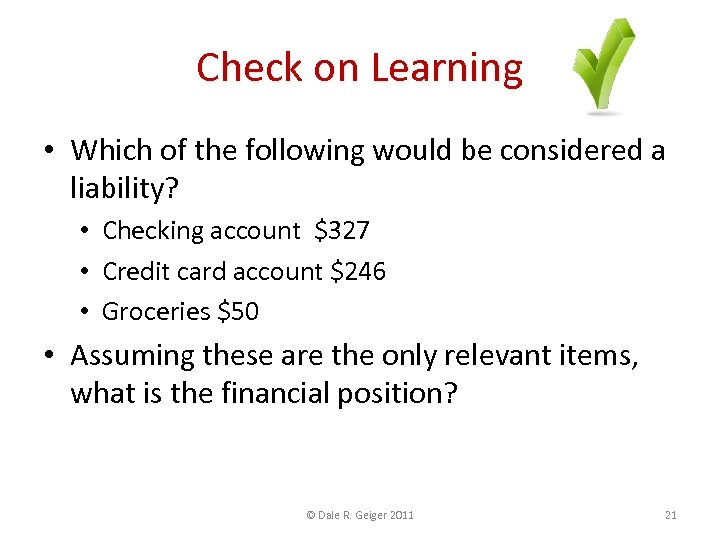 Check on Learning • Which of the following would be considered a liability? • Checking account $327 • Credit card account $246 • Groceries $50 • Assuming these are the only relevant items, what is the financial position? © Dale R. Geiger 2011 21
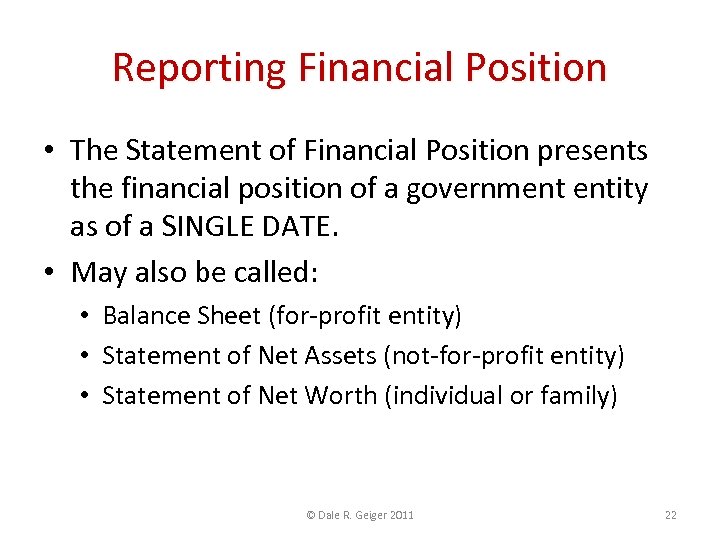 Reporting Financial Position • The Statement of Financial Position presents the financial position of a government entity as of a SINGLE DATE. • May also be called: • Balance Sheet (for-profit entity) • Statement of Net Assets (not-for-profit entity) • Statement of Net Worth (individual or family) © Dale R. Geiger 2011 22
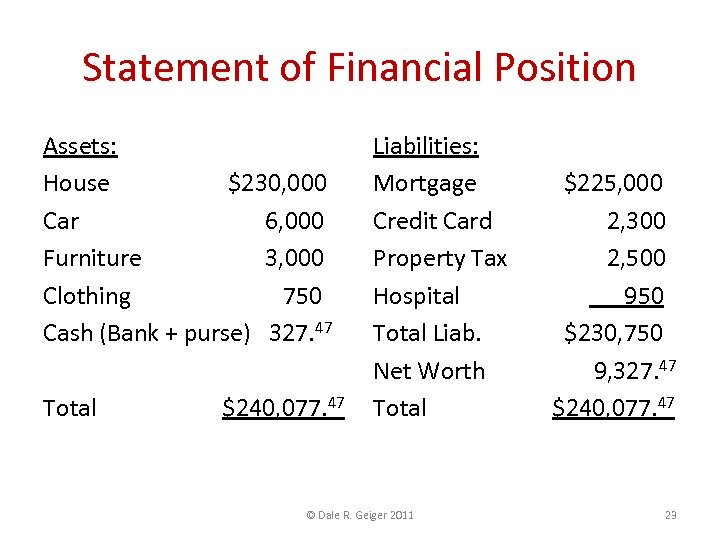 Statement of Financial Position Assets: House $230, 000 Car 6, 000 Furniture 3, 000 Clothing 750 Cash (Bank + purse) 327. 47 Total $240, 077. 47 Liabilities: Mortgage Credit Card Property Tax Hospital Total Liab. Net Worth Total © Dale R. Geiger 2011 $225, 000 2, 300 2, 500 950 $230, 750 9, 327. 47 $240, 077. 47 23
 Check on Learning • What is the name of the report that presents a government organization’s financial position? An individual’s? • What is the time frame of this report? © Dale R. Geiger 2011 24
 Questions • What about the groceries? • Items that will be consumed during the current month are considered Expenses • What about the kids? • First, would they be assets or liabilities? • Second, they aren’t “owned” • Third, their value cannot be quantified monetarily • Monetary Unit Assumption: • Financial information must be measured and reported in a monetary unit such as U. S. Dollars © Dale R. Geiger 2011 25
 Questions • What about the groceries? • Items purchased and consumed during the current period are considered Expenses • What about the kids? • First, would they be assets or liabilities? • Second, they aren’t “owned” • Third, their value cannot be quantified monetarily • Monetary Unit Assumption: • Financial information must be measured and reported in a monetary unit such as U. S. Dollars © Dale R. Geiger 2011 26
 Questions • What about the groceries? • Items purchased and consumed during the current period are considered Expenses • What about the kids? • First, would they be assets or liabilities? • Second, they aren’t “owned” • Third, their value cannot be quantified monetarily • Monetary Unit Assumption: • Financial information must be measured and reported in a monetary unit such as U. S. Dollars © Dale R. Geiger 2011 27
 Questions • What about the groceries? • Items purchased and consumed during the current period are considered Expenses • What about the kids? • First, would they be assets or liabilities? • Second, they aren’t “owned” • Third, their value cannot be quantified monetarily • Monetary Unit Assumption: • Financial information must be measured and reported in a monetary unit such as U. S. Dollars © Dale R. Geiger 2011 28
 Questions • What about the groceries? • Items purchased and consumed during the current period are considered Expenses • What about the kids? • First, would they be assets or liabilities? • Second, they aren’t “owned” • Third, their value cannot be quantified monetarily • Monetary Unit Assumption: • Financial information must be measured and reported in a monetary unit such as U. S. Dollars © Dale R. Geiger 2011 29
 Questions • What about the groceries? • Items purchased and consumed during the current period are considered Expenses • What about the kids? • First, would they be assets or liabilities? • Second, they aren’t “owned” • Third, their value cannot be quantified monetarily • Monetary Unit Assumption: • Financial information must be measured and reported in a monetary unit such as U. S. Dollars © Dale R. Geiger 2011 30
 Questions • Isn’t the house worth more now than when they bought it? • Possibly, but it’s difficult to objectively determine its value • Cost Principle: • The most objective measure of an asset’s value is its HISTORICAL COST: the price paid for it in an arm’s length transaction • Is it necessary to report the 47₵ from the bank account? • Materiality Constraint: • Report only the level of detail that will affect a user’s decision © Dale R. Geiger 2011 31
 Questions • Isn’t the house worth more now than when they bought it? • Possibly, but it’s difficult to objectively determine its value • Cost Principle: • The most objective measure of an asset’s value is its HISTORICAL COST: the price paid for it in an arm’s length transaction • Is it necessary to report the 47₵ from the bank account? • Materiality Constraint: • Report only the level of detail that will affect a user’s decision © Dale R. Geiger 2011 32
 Questions • Isn’t the house worth more now than when they bought it? • Possibly, but it’s difficult to objectively determine its value • Cost Principle: • The most objective measure of an asset’s value is its HISTORICAL COST: the price paid for it in an arm’s length transaction • Is it necessary to report the 47₵ from the bank account? • Materiality Constraint: • Report only the level of detail that will affect a user’s decision © Dale R. Geiger 2011 33
 Questions • Isn’t the house worth more now than when they bought it? • Possibly, but it’s difficult to objectively determine its value • Cost Principle: • The most objective measure of an asset’s value is its HISTORICAL COST: the price paid for it in an arm’s length transaction • Is it necessary to report the 47₵ from the bank account? • Materiality Constraint: • Report only the level of detail that will affect a user’s decision © Dale R. Geiger 2011 34
 Check on Learning • What principle defines the value that should be reported for an asset on the Statement of Financial Position? • What constraint prevents reporting insignificant amounts that will not affect a user’s decision? © Dale R. Geiger 2011 35
 Practical Exercise © Dale R. Geiger 2011 36
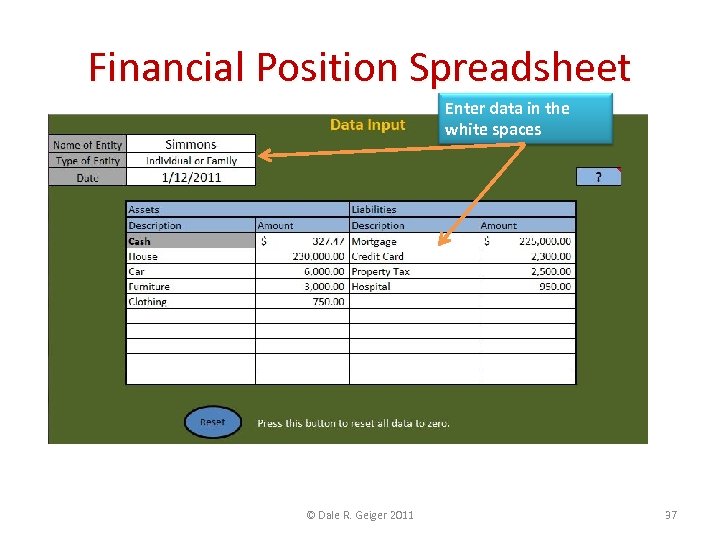 Financial Position Spreadsheet Enter data in the white spaces © Dale R. Geiger 2011 37
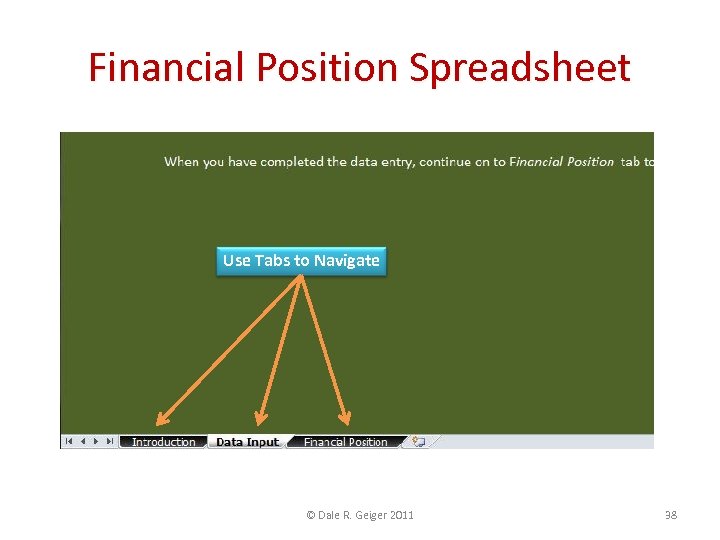 Financial Position Spreadsheet Use Tabs to Navigate © Dale R. Geiger 2011 38
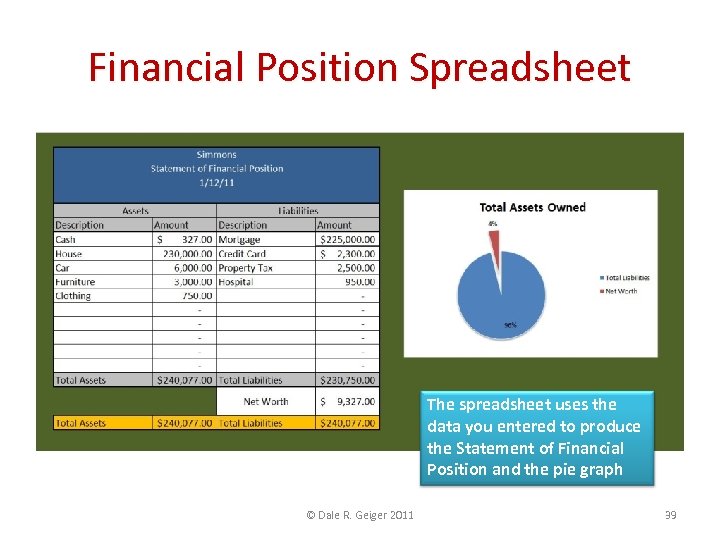 Financial Position Spreadsheet The spreadsheet uses the data you entered to produce the Statement of Financial Position and the pie graph © Dale R. Geiger 2011 39
 Practical Exercise © Dale R. Geiger 2011 40