 Скачать презентацию CALCASA Webinar Series Achieving Minimum Standards for OVW
86493a1da5db6d08e6ae81c74b1550ed.ppt
- Количество слайдов: 74



CALCASA Webinar Series Achieving Minimum Standards for OVW Campus Grant Programs August 31, 2009
CALCASA Staff • Dan Esparza, Campus Program Manager • Althea Hart, Training & Resource Coordinator • Livia Rojas, Training & Resource Coordinator
August Webinar I. CALCASA Announcements II. Technical Instructions III. Discussion with OVW Program Managers IV. Discussion with Campus Grantees
Announcements • Next Campus Webinar is set for Tuesday, September 29, 2009 @ 11. 00 a. m. PST on “Working with Underserved Communities” • Check listserv for updates on next Campus TTI in Orlando on January 20 & 21

How To Use The Technology Raise Hand Q & A Text Chat Power. Point Slides
Achieving the Minimum Standards Are we achieving the minimum campus grant standards? Use chat to answer
Achieving Minimum Standards for OVW Campus Grant Programs Department of Justice Office on Violence Against Women Campus Grant Program Managers
Grants to Reduce Domestic Violence, Dating Violence, Sexual Assault and Stalking on Campus Program Standards
The Campus Standards l The Campus Standards are offered as means to guide schools in comprehensively and collaboratively responding to issues of violence against women on college campuses.
The Campus Standards l The following adaptation of these guidelines and standards is not intended to limit a campus’ ability to develop programming appropriate for their school.
The Campus Standards l OVW strongly recommends that the proposed activities outlined in the Campus Standards be expanded upon as an individual campus deems appropriate or tailored specifically to meet the needs of an individual campus.
Minimum Standards for Creating a Coordinated Community Response to Violence Against Women on Campus
Creating a Coordinated Community Response Team l a coordinated community response to violence against women on campuses should be a multi -disciplinary response and involve the entire campus as well as the larger community in which the campus is located. ”
Creating a Coordinated Community Response Team l As we all know, as part of this program, all campuses must develop partnerships with at least one local nonprofit, nongovernmental victim services organization within the community which the institution is located and one or more of the following criminal justice or civil legal agencies: external law enforcement, prosecution, civil legal assistance providers, systems-based victim services units, or judiciary and court personnel. An applicant who is partnering with campus law enforcement or campus security must still partner with a criminal justice or civil legal agency. ”
Creating a Coordinated Community Response Team l Coordinated community response teams and task forces should reflect the wide variety of organizations that are involved in campus life in order to involve all the different entities who have a role in meeting the needs of victims of violence against women on campus and holding offenders accountable.
Creating a Coordinated Community Response Team l Coordinated campus and community response teams or tasks forces should review protocols, policies and procedures of member organizations and provide cross-training on their individual missions and roles.
Creating a Coordinated Community Response Team l Coordinated response teams should work together on a consistent basis with scheduled meetings to develop formal policies and protocols for responding to violent crimes against women when they occur.
Creating a Coordinated Community Response Team l The goal of ongoing meetings should be to develop and enhance a response to violence against women on campus that is timely, appropriate, sensitive, and respectful to victims needs and that holds offenders accountable.
Creating a Coordinated Community Response Team l Involving partners in program planning, training and curriculum development and event sponsorship is critical to a successful coordinated community response.
Creating a Coordinated Community Response Team l First and foremost, campuses should work in close collaboration with experts on addressing violence against women issues. l OVW recommends that campuses incorporate as many of the Campus Standard guidelines when forming and building coordinated community response teams or taskforces.
Minimum Standards of Training for Campus Security Personnel
Training for Campus Security Personnel l The Campus Program requires that all campus police be trained to respond effectively in domestic violence, dating violence, sexual assault, and stalking cases. ”
Training for Campus Security Personnel l Training programs should be developed in collaboration with campus or community-based victim advocacy programs.
Training for Campus Security Personnel l Training programs should include information about relevant federal and state laws and arrest protocols; information on enforcement of orders of protection; and instruction on making primary aggressor determinations.
Training for Campus Security Personnel l Campuses should carefully coordinate and plan training sessions for campus security personnel, and should design all trainings in close collaboration with experts on violence against women issues.
Training for Campus Security Personnel l Programs should work closely with campus security personnel to schedule convenient events to ensure attendance by the maximum number of officers.
Training for Campus Security Personnel l Again, the emphasis of the trainings should be that the response to victims needs to be timely, appropriate, sensitive, and respectful.
Training for Campus Security Personnel l The Campus Standards for Training campus law enforcement offers both general topics to be incorporated into a training program for officers as well as providing unique training considerations when focusing specifically on cases of sexual assault, or dating and domestic violence, or stalking.
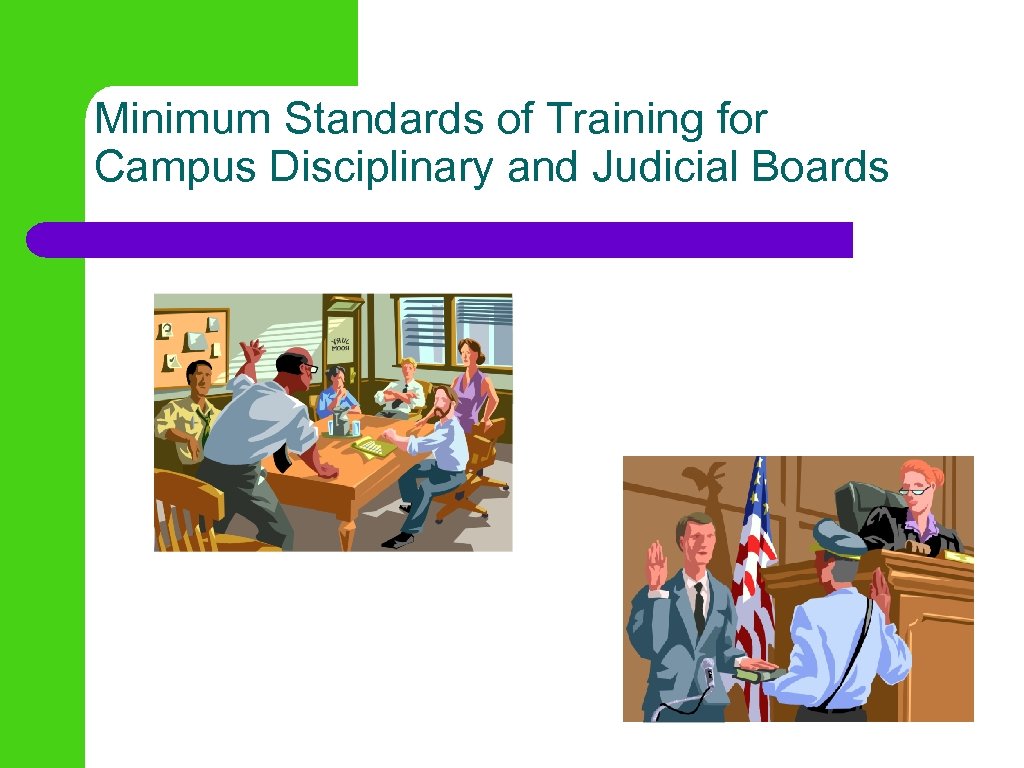
Minimum Standards of Training for Campus Disciplinary and Judicial Boards
Training for Campus Disciplinary and Judicial Boards l The Campus Program requires that all applicants establish or strengthen programs to train members of campus disciplinary boards to respond effectively to charges of domestic violence, dating violence, sexual assault, and stalking.
Training for Campus Disciplinary and Judicial Boards l All members of campus disciplinary boards, including faculty, staff, students, and administrators should receive expert training on these crimes.
Training for Campus Disciplinary and Judicial Boards l The structure of campus disciplinary boards or judicial boards varies widely. Some boards are made up of faculty and administration officials while others are comprised of student representatives. Campuses should design all trainings in close collaboration with experts on violence against women issues.
Training for Campus Disciplinary and Judicial Boards l Prior to conducting training for campus disciplinary or judicial boards, a campus should review the current code of student conduct.
Training for Campus Disciplinary and Judicial Boards l Training topics could include information about the causes and effects of violence against women.
Training for Campus Disciplinary and Judicial Boards l The Campus Standards for Training Campus Disciplinary and Judicial Boards offers both general topics to be incorporated into a training program for board members as well as providing specific training considerations.
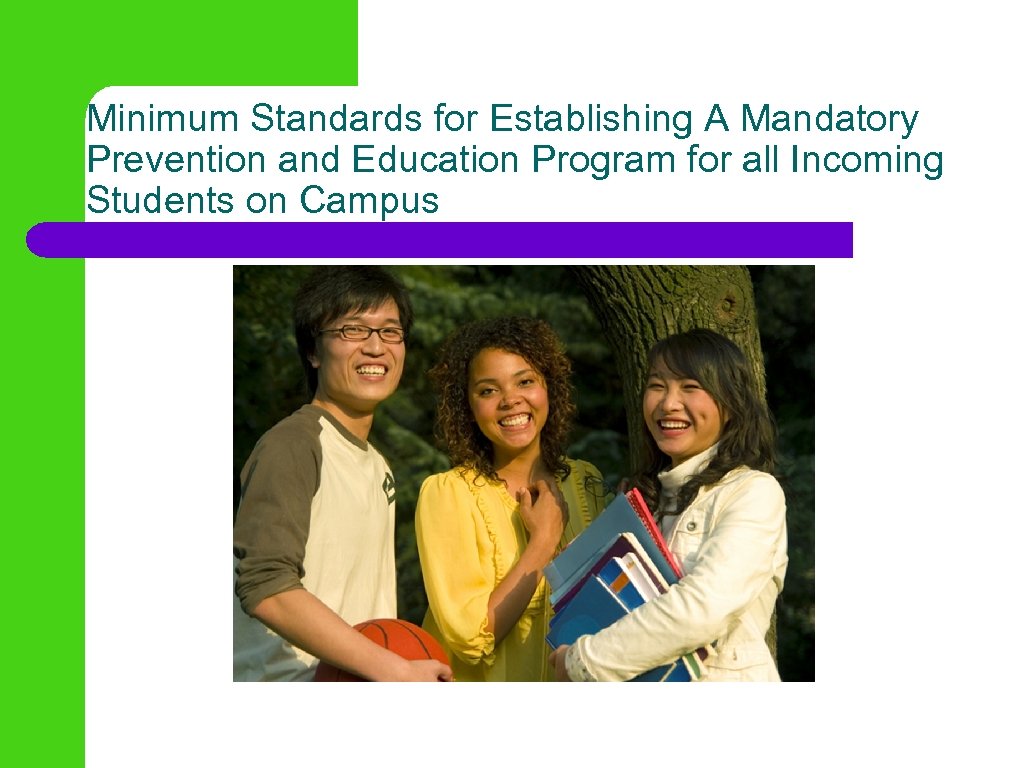
Minimum Standards for Establishing A Mandatory Prevention and Education Program for all Incoming Students on Campus
Mandatory Prevention and Education Program Standards l The Campus Program requires that all campuses establish a mandatory prevention and education program about domestic violence, dating violence, sexual assault, and stalking for all incoming students (first year students, transfer students, etc. ), working in collaboration with campus and community-based victim advocacy organizations.
Mandatory Prevention and Education Program Standards l Campuses should carefully consider how to ensure that all incoming (first year students, transfer students, etc. ) students will receive the mandatory orientation.
Mandatory Prevention and Education Program Standards l It is essential for campuses to have a mechanism established to fully account for the participation of each student in the program.
Mandatory Prevention and Education Program Standards l The prevention and education program can and should include a variety of methods –website, courses, presentations, seminars, theater discussions, letters, etc.
Mandatory Prevention and Education Program Standards l The program should include information about domestic violence, dating violence, sexual assault, and stalking. The campuses’ policies and protocols, student code of conduct, local and national resources, hotlines, legal, medical, mental, and other assistance should all be addressed in configuring a program. Information provided in the program curriculum should cover a spectrum of topics.
Mandatory Prevention and Education Program Standards l OVW recommends that campuses consider the prevention and education program for incoming students to be established in three stages in order to maximize the number of incoming students reached and engage the students in as effective a way as possible.
Mandatory Prevention and Education Program Standards l A three-stage program configured as: pre-orientation/arrival, – orientation/arrival, and – on-going – This gives students access to relevant information as they progress in their campus experience.
Mandatory Prevention and Education Program Standards l Given the different types of campuses and their various orientation policies, there is no one size fits all solution. OVW recognizes that what a large public university schedules for incoming students will be vastly different from what a small rural community college schedules. Programs should be creative and use all of the campus resources available to reach the entire population of incoming students.
Mandatory Prevention and Education Program Standards l Be conscientious and encompass all different orientation sessions held on campus. Incoming students enter the campus every quarter, semester, and in addition, some unique groups may have their own separate orientations: (such as athletes, specific residence halls, foreign students).
Mandatory Prevention and Education Program Standards l Within the Orientation training, each program should consider employing two or more distinct formats to reach students in different ways. It is recommended that one of the strategies involve peer involvement such as men’s groups, peer theatre or peer education.
Mandatory Prevention and Education Program Standards l Please note, OVW does not consider the creation and distribution of CD-rom and print media alone to be sufficient to complete this program requirement.
Mandatory Prevention and Education Program Standards l After the initial “arrival” of incoming students, campuses should continue to schedule activities (semester/quarter beginning) connected to different campus events and located at a variety of campus venues.
Mandatory Prevention and Education Program Standards l Campuses should not consider adopting a single recommendation from those identified as meeting this program requirement. l The recommendations are made so that campuses might consider a multi-stage approach to meet the program requirement.
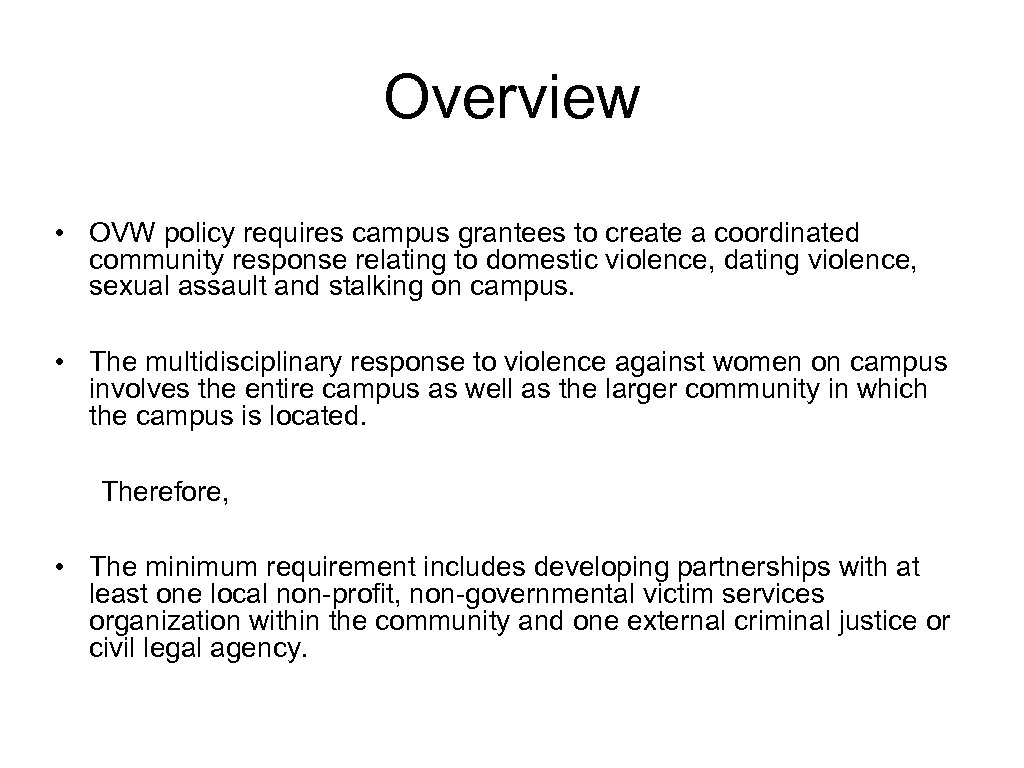
Overview • OVW policy requires campus grantees to create a coordinated community response relating to domestic violence, dating violence, sexual assault and stalking on campus. • The multidisciplinary response to violence against women on campus involves the entire campus as well as the larger community in which the campus is located. Therefore, • The minimum requirement includes developing partnerships with at least one local non-profit, non-governmental victim services organization within the community and one external criminal justice or civil legal agency.
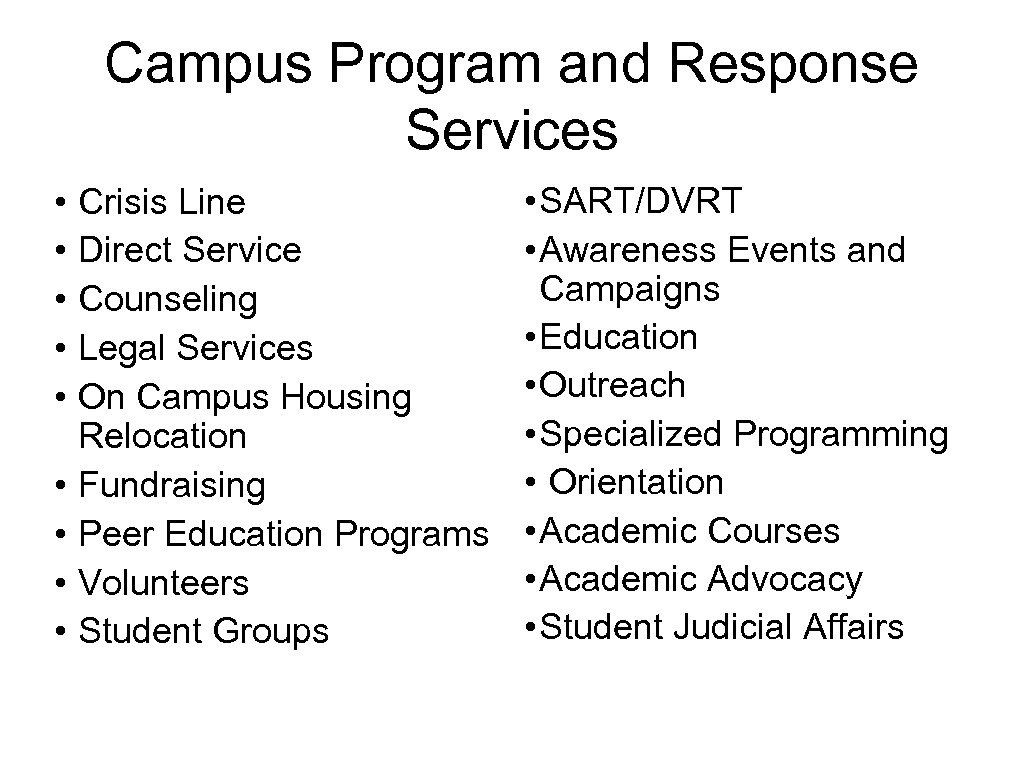
Campus Program and Response Services • • • Crisis Line Direct Service Counseling Legal Services On Campus Housing Relocation Fundraising Peer Education Programs Volunteers Student Groups • SART/DVRT • Awareness Events and Campaigns • Education • Outreach • Specialized Programming • Orientation • Academic Courses • Academic Advocacy • Student Judicial Affairs
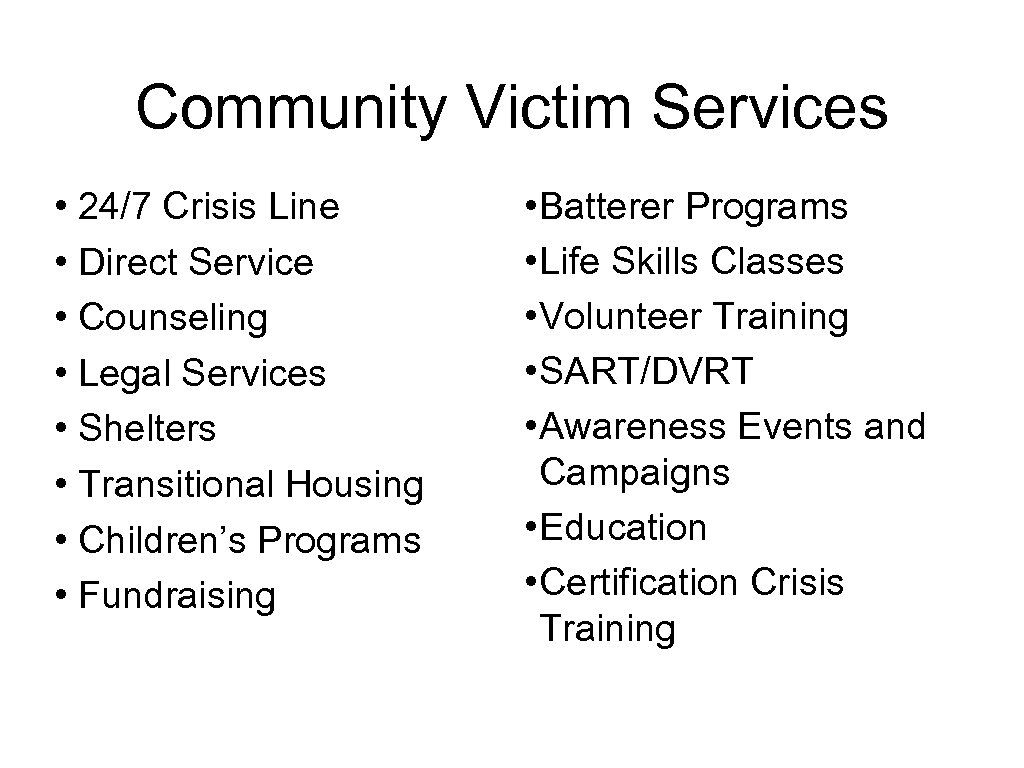
Community Victim Services • 24/7 Crisis Line • Direct Service • Counseling • Legal Services • Shelters • Transitional Housing • Children’s Programs • Fundraising • Batterer Programs • Life Skills Classes • Volunteer Training • SART/DVRT • Awareness Events and Campaigns • Education • Certification Crisis Training
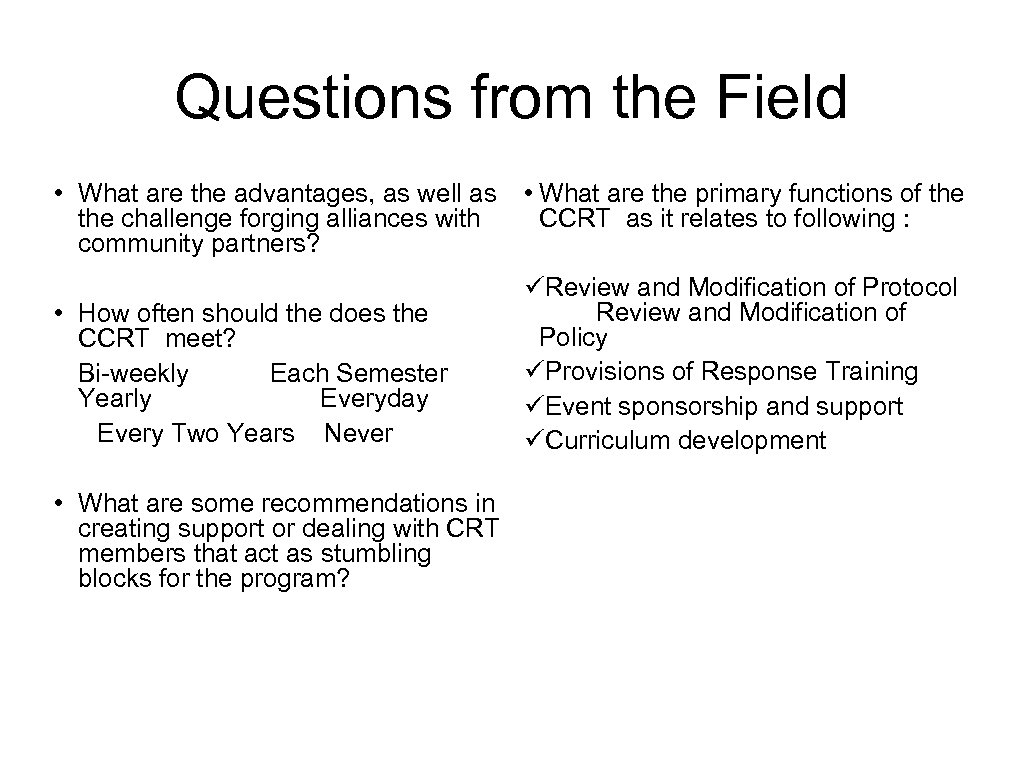
Questions from the Field • What are the advantages, as well as the challenge forging alliances with community partners? • How often should the does the CCRT meet? Bi-weekly Each Semester Yearly Everyday Every Two Years Never • What are some recommendations in creating support or dealing with CRT members that act as stumbling blocks for the program? • What are the primary functions of the CCRT as it relates to following : üReview and Modification of Protocol Review and Modification of Policy üProvisions of Response Training üEvent sponsorship and support üCurriculum development
Mandatory Orientation Annette Lynch University of Northern Iowa
Iowa Regent Universities Campus Violence Prevention Project Iowa Flagship Grant University of Northern Iowa University of Iowa State University Iowa Coalition Against Sexual Assault
Mandatory Sexual Misconduct Education at The University of Iowa Student Success. TM Sexual Assault Prevention (nformd. net) This project is supported by Grant No. 2007 -WA-0015 awarded to the University of Northern Iowa by the Violence Against Women Office, Office of Justice Programs, U. S. Department of Justice
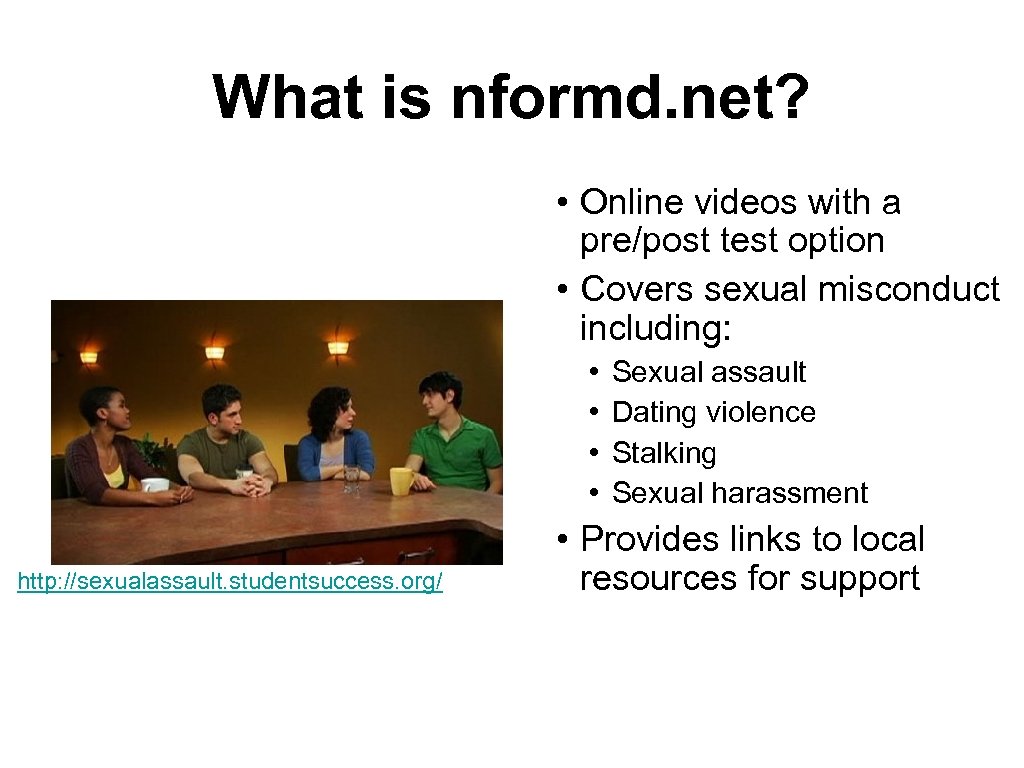
What is nformd. net? • Online videos with a pre/post test option • Covers sexual misconduct including: • • http: //sexualassault. studentsuccess. org/ Sexual assault Dating violence Stalking Sexual harassment • Provides links to local resources for support
Why nformd. net @UI? • Positive campus experience with other online learning tools • Online course allows student access • OVW funding leveraged additional institutional financial support • Timing • Compliments other campus education strategies
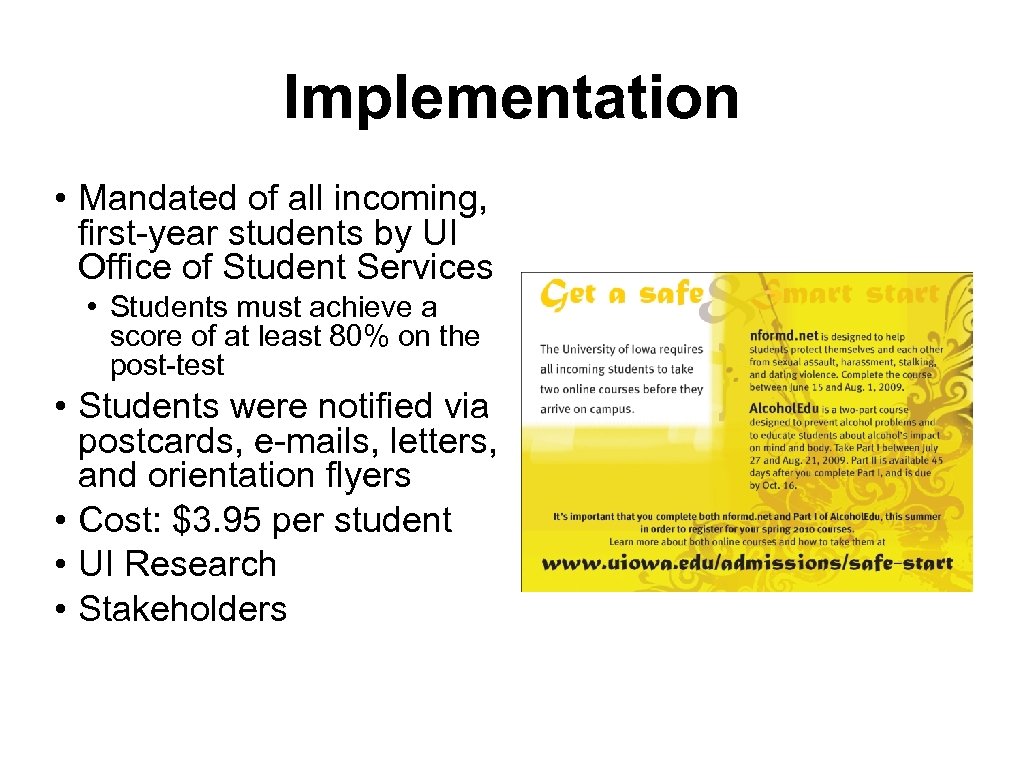
Implementation • Mandated of all incoming, first-year students by UI Office of Student Services • Students must achieve a score of at least 80% on the post-test • Students were notified via postcards, e-mails, letters, and orientation flyers • Cost: $3. 95 per student • UI Research • Stakeholders
Accessibility • International students • Program coordinator worked closely with the UI Office of International Students and Scholars • International students took the course once they arrived on campus • Pre and post-discussions were available to students • Students with disabilities • Accommodations available: closed captioning, full program script, in-person meetings • Students who are victim/survivors • There is a separate protocol
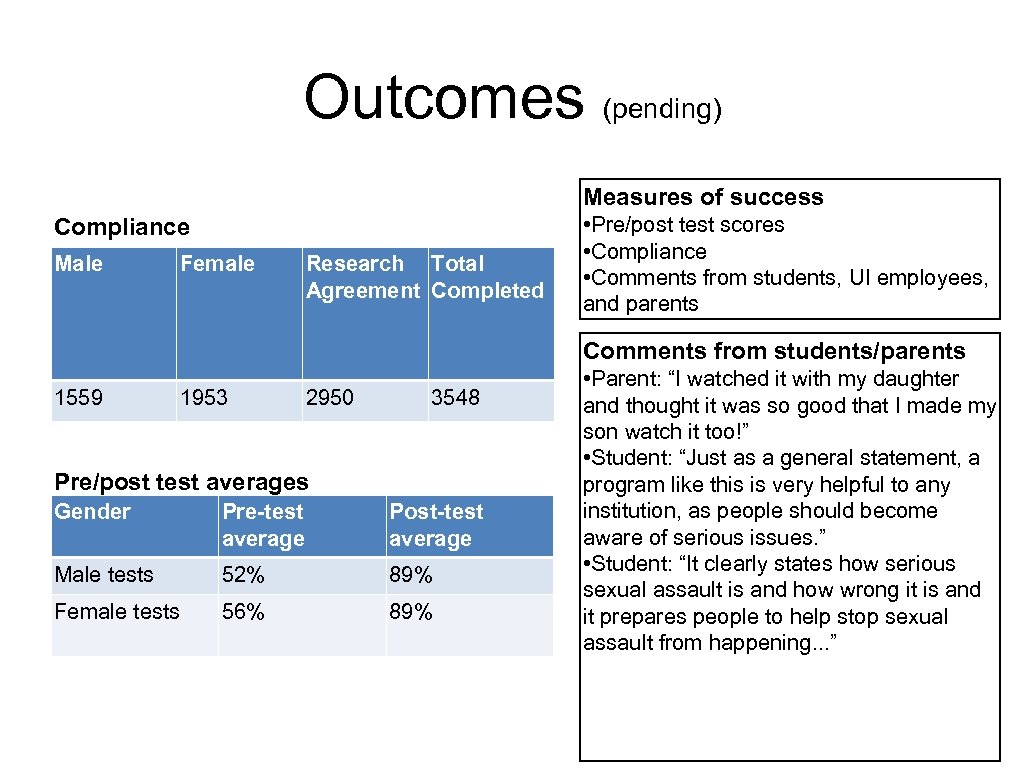
Outcomes (pending) Measures of success Compliance Male Female Research Total Agreement Completed • Pre/post test scores • Compliance • Comments from students, UI employees, and parents Comments from students/parents 1559 1953 2950 3548 Pre/post test averages Gender Pre-test average Post-test average Male tests 52% 89% Female tests 56% 89% • Parent: “I watched it with my daughter and thought it was so good that I made my son watch it too!” • Student: “Just as a general statement, a program like this is very helpful to any institution, as people should become aware of serious issues. ” • Student: “It clearly states how serious sexual assault is and how wrong it is and it prepares people to help stop sexual assault from happening. . . ”
Forum Theatre Performances: ISU Expansion of Students to Students Peer Education Program • Catalyst Theatre Co. Performances • You are invited to take action in the Catalyst Theatre Co. (CTC) production "Scene on Campus" at Iowa State University. CTC is a campus movement to end sexual assault, relationship violence, and stalking. By taking action you will: • Connect with peers about these issues • Examine what you think you know • Discover some things you do not know • Give voice to how we can exist peacefully and respectfully in our community • CTC will present "Scene on Campus" six times during Destination Iowa State: • Thursday, Aug 20, 1 pm in 2055 Hoover • Thursday, Aug 20, 3 pm in 2055 Hoover • Friday, Aug 21, 5 pm in 1148 Gerdin • Saturday, Aug 22, 5 pm in 2055 Hoover • Sunday, Aug 23, 4 pm in Memorial Union Sun Room • Sunday, Aug 23, 6 pm in Memorial Union Sun Room • Attendees will be entered in a drawing to win a gift certificate donated by the Iowa State University Book Store! • Questions or want to get involved? • Contact Ray at ctc@iastate. edu or 515 -294 -2722 • Take Action… Violence Affects Everyone “Get a Yes” Promotional Campaign
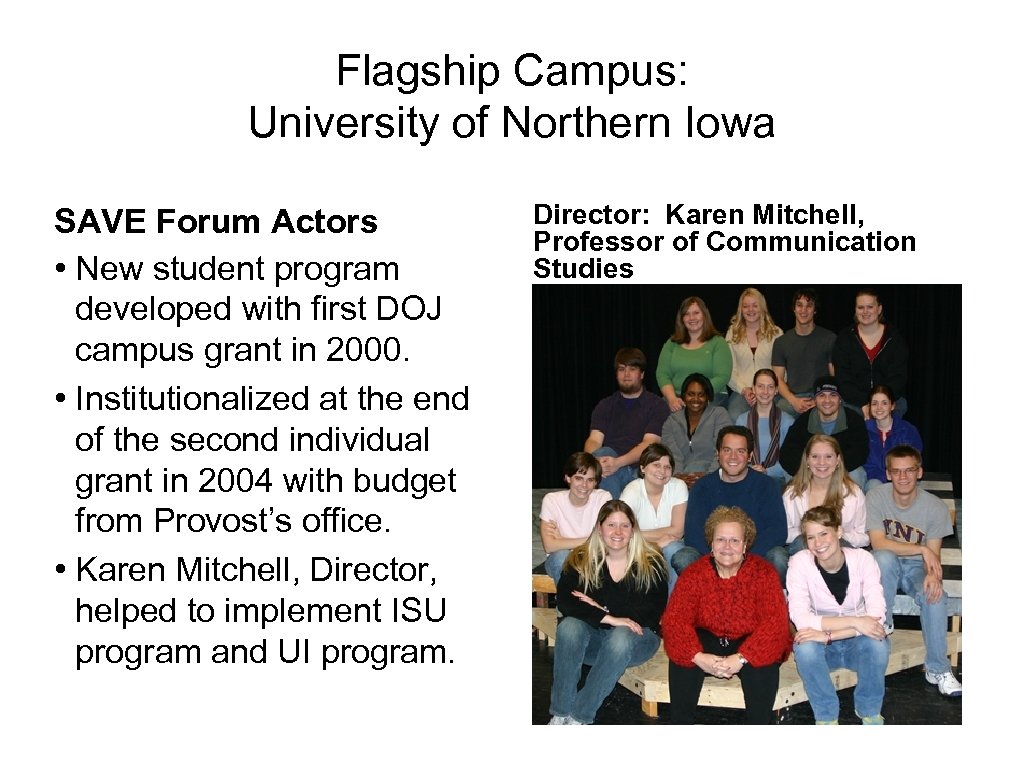
Flagship Campus: University of Northern Iowa SAVE Forum Actors • New student program developed with first DOJ campus grant in 2000. • Institutionalized at the end of the second individual grant in 2004 with budget from Provost’s office. • Karen Mitchell, Director, helped to implement ISU program and UI program. Director: Karen Mitchell, Professor of Communication Studies
Law Enforcement Training Leah Lyon East Central University
Developing Relationships 5 Tips to Develop Working Relationship with campus/local law enforcement • Early Buy-In from administrators/partners • Lay the Foundation Law Enforcement Depts (prior to submitting application/shortly after award) • Top-Down Approach * Build on existing buy-in to expand support network * Arrange meetings that bring supporting administrators in direct contact with officers/chief * Positive Peer Pressure (works with campus & local dept) * Invitations to events (let them know the peers that will attend) • Training & Assistance * CLEET hours, referrals, collaboration, case coordination
Developing Relationships Communication • Face to face meetings, often including administrators • Knock on doors, discuss the issues and emphasize the benefits to officers and the department. • One place to send/refer victims seeking help (questions, assistance • Develop relationship with Criminal Justice Dept & professors at your campus.
Law Enforcement Training & Education: Comprehensive Approach Level 1: Phone, email, and interpersonal communications (frequent) - changes in laws, policies, recommended practices. Level 2: Case Coordination Meetings (bi-weekly or monthly) - Opportunity to discuss appropriate practices and effective response. Level 3: CERT Meetings (Quarterly) - Review issues, appropriate responses, resources. Level 4: Campus education and training events (various programs throughout the year) Level 5: Yearly Law Enforcement Training Events
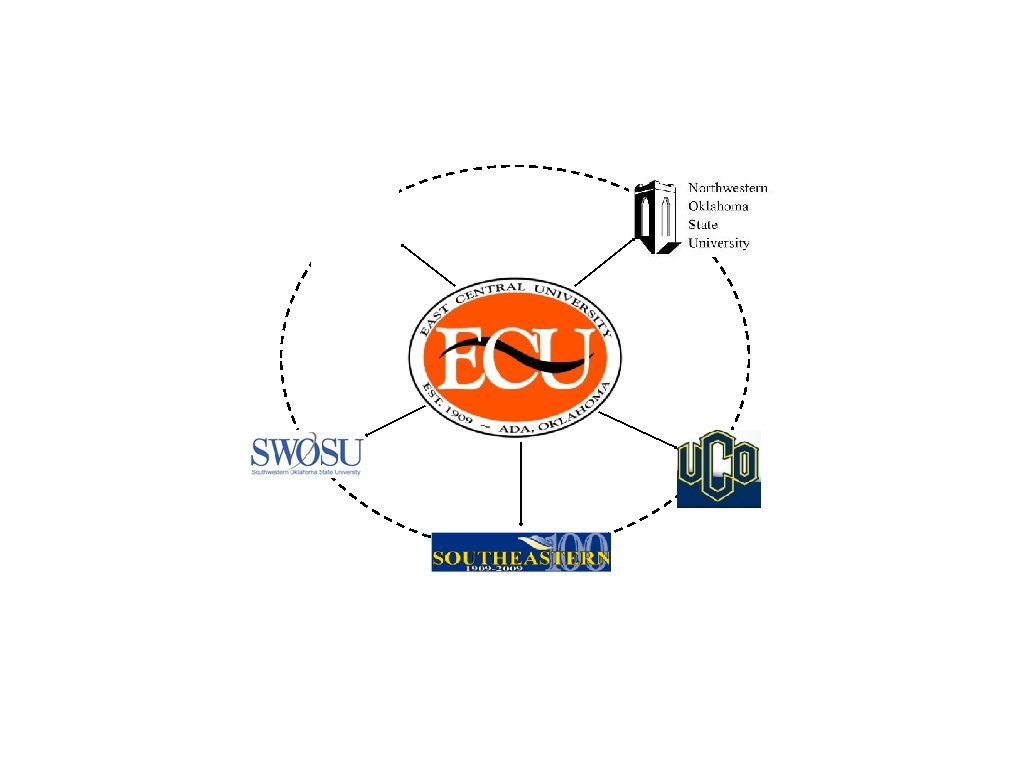
Comprehensive Approach CIRCAW Co-Sponsored with ECU’s Tribal Police Training Program (TPTP), a training event on Sexual Assault Drugs, Cyberstalking, and Domestic Violence in Indian Country. National experts and Oklahoma Legal Professionals served as trainers. CLEET and ECU Credit was offered. RUSO-VPP Co-sponsored, with CIRCAW and Tribal Police Training Program, a staff member to complete a Domestic Violence Train the Trainer Certification course. The course is certified by Federal Law Enforcement Training Center (FLETC) and is endorsed and used by the Oklahoma Coalition Against Domestic Violence and Sexual Assault (OCADVSA). Now ECU and RUSO has an internal trainer. ECU applied for and was recently approved as a FLETC Domestic Violence/Sexual Assault Train the Trainer Venue for 2010. Campus program coordinators, local advocates, and officers will complete the course.
Annual Training • RUSO-VPP has hosted two very successful 2 -day Training events in April 2008, and April 2009 at CLEET. • Featured Co-Instructors from ECU, both certified in FLETC Train the Trainer DV and SA, and from Oklahoma Coalition Against Domestic Violence and Sexual Assault. ECU Chief of Police also served as trainer for a session. • The events included two officers from each university, various Tribal Law Enforcement officers, ECU Chief of Police and other ECU Officers, Family Crisis Center Staff, CIRCAW Coordinator, RUSO-VPP Director, ECU Peer Educator/Student Advocate, and ECU Vice President.
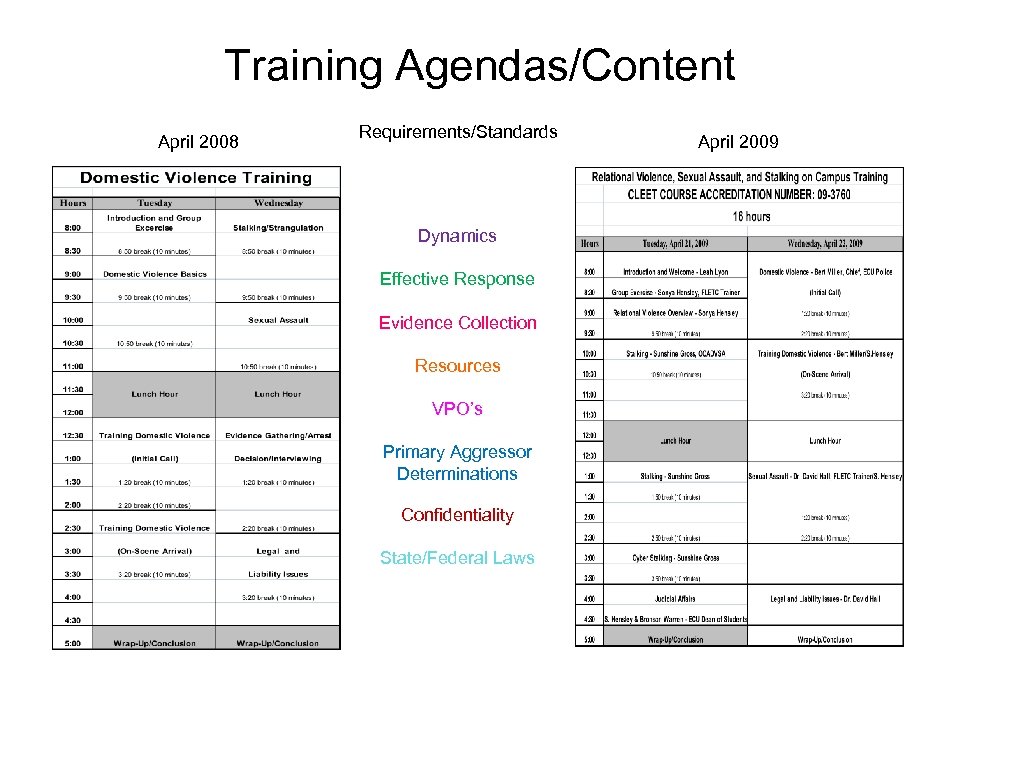
Training Agendas/Content April 2008 Requirements/Standards Dynamics Effective Response Evidence Collection Resources VPO’s Primary Aggressor Determinations Confidentiality State/Federal Laws April 2009
Annual Training • Officers receive CLEET continuing education credit hours for participation and successful completion of the course • Includes Pre-Test and Post Test (must past Post Test to receive credit) • Evaluations of the training are administered. Both events received very high scores: around 96 -97
Effective & Successful Relationships • Communication • Collaboration • Comprehensive Approach
Acknowledgements • • • Office on Violence Against Women Campus Program Managers Annette Lynch, College of New Jersey Leah Lyon, Eastern Oklahoma State College • Grantees • CALCASA Staff
Скачать презентацию CALCASA Webinar Series Achieving Minimum Standards for OVW
86493a1da5db6d08e6ae81c74b1550ed.ppt