


 Скачать презентацию Cal Val Portal EO Cal Val Portal Philippe
b2db559761e0cc5dc7e48ff93a8f01b3.ppt
- Количество слайдов: 28
 Cal. Val Portal EO Cal. Val Portal Philippe Goryl ESA/ESRIN INTER-COMPARISON DATA, PROTOCOLS & GUIDE LINES FOR CAL &VAL
 Cal. Val Portal CEOS WGCV Recommendation • Cal/Val portal is the ESA response to the CEOS recommendation • Initiate an activity – – document reference methodology to predict Top of Atmosphere (TOA) radiance for intercomparison of currently flying and planned wide swath sensors create a standard for traceability • Create and maintain a fully accessible web page – – instrument characteristics database of instrument data specific vicarious calibration sites common format CEOS Working Group on Calibration and Validation, 18 th Plenary Meeting, Beijing, November 2004, Doc No: 12. 1
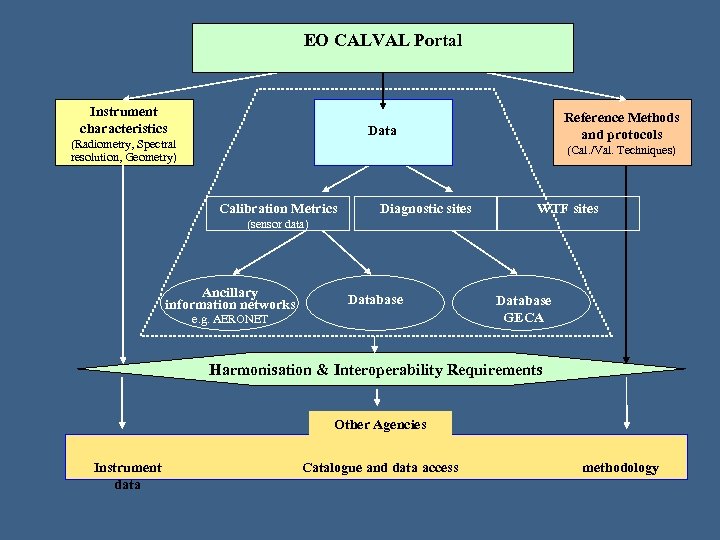 EO CALVAL Portal Instrument characteristics Reference Methods and protocols Data (Radiometry, Spectral resolution, Geometry) (Cal. /Val. Techniques) Calibration Metrics Diagnostic sites WTF sites (sensor data) Ancillary information networks Database e. g. AERONET Database GECA Harmonisation & Interoperability Requirements Other Agencies Instrument data Catalogue and data access methodology
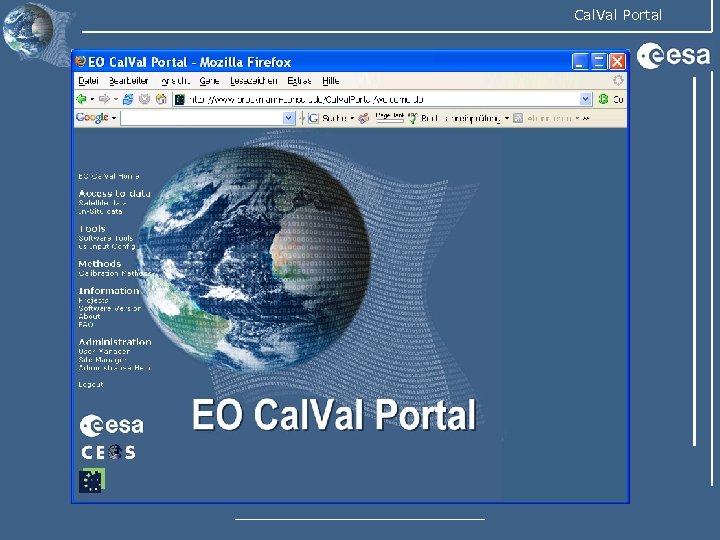
 Cal. Val Portal Project Elements • Web Portal – Description of methodologies (IVOS for the 1 st release) – Description of instrument characteristics (Sensor. ML) • All GMES sensors will be supported (optical, radar, atm. Chem. ) – Access to EO data • Designed to support all GMES sensors • Version 1: MERIS FR and RR, AATSR, ALOS PRISM and AVNIR 2 • Version 2: additional Chris/Proba, Vegetation, … – Access to in-situ data • Local database • Access to Nilu, Aeronet, external database (GECA) – Access to tools – Cal. Val Results – User management, Forum, Help
 Cal. Val Portal Plan for 2007 • WTF continuation • AATSR: full archive reprocessing and rolling archive metric (MERIS calibration site) extraction • Integration and extension to other IVOS • Integration of geometry validation – methodology, GCP, reference data Proposed standardisation for the geometric validation • Evolution to non optical sensors – SMOS / SAR • Strengthen the link with validation DB • Access to other catalogues/dataset (international cooperation) • Fill the cal/val portal with documentation/project. • Automatise cal/val procedures (reciprocity method over Bolivian site)
 Cal. Val Portal Plan for 2007 WTF Continuation • • • Target A major effort stated in the extension contract of the Cal. Val. Portal shall focus on the seamless continuation of the data services provided by USGS covering sensor calibration datasets. This project is known as the WGISS Test Facility (WTF core test sites). The service shall be integrated into the Cal. Val. Portal web-interface software. To reduce duplication of data and to ensure that continuous updating of the content can be performed by the US partners, the datasets shall reside at their original location. A set of appropriate metadata shall be extracted from the existing archive datasets. This metadata shall be integrated into the Cal. Val. Portal database system to allow standard queries through the web-interface and streaming download of selected result products. The calibration sites stored at USGS shall be integrated into the Cal. Val. Portal as regular sites, eventually identified by a site group identifier.
 Cal. Val Portal Plan for 2007 WTF Continuation Suggested solution • Establish communication To ensure close collaboration with the USGS technical staff, communication channels shall be established. • Analyse existing datasets A thorough inventory of the content of the current WTF web system shall be performed. This study shall identify all data servers attached to the USGS system in terms of Accessibility (current set-up, possibilities to adapt access methods) Data content Static or dynamically growing source • Define of common metadata A set of metadata shall be defined that allows the integration of the continuation service into the Cal. Val. Portal system. Requirements for this task are: – – – A simple format Metadata fields are contained in the source products Metadata covers sufficient information to allow integration into Cal. Val. Portal system.
 Cal. Val Portal Plan for 2007 WTF Continuation Suggested solution • Generate metadata Once the metadata format and the image properties are defined, the WTF server content needs to be processed to generate metadata and image files. The results of this stage needs to be transferred to BC. • Integrate into Cal. Val. Portal The software and database schemata of the current Cal. Val. Portal system need to be updated to be able to handle injection of metadata files, automated storage of quicklook images and the retrieval of remote datasets. Metadata and image files resulting from 2. 4 must be ingested into the Cal. Val. Portal system. • Continuous updates Methods need to be defined to ensure that the WTF server data content is mirrored correctly in the Cal. Val. Portal. A change in server content can result from New data being ingested Obsolete data being removed Reprocessing of data requires updates
 Cal. Val Portal Plan for 2007 WTF Continuation Current status • Contact to has been successfully established. Primary contact persons are: John L. Dwyer at SAIC, Contractor to the USGS Center for Earth Resources Observation and Science, Jeffrey Morisette at NASA's Goddard Space Flight Center, Terrestrial Information Systems Branch • • A thorough analysis of existing datasets server content has been performed and the result has been distributed to the partners. The WTF data content has be analyzed according to the following criteria – – Number of datasets per product type/sensor Availability of metadata Availability of quicklook images Web-address and access mode of the servers • Software “spikes” to validate the feasibility of the solution planned have been implemented and successfully tested. • A metadata format has been defined by Brockmann Consult that covers all the needs expressed. This format has been proposed to the partners at USGS/DAAC and has been accepted in general. A detailed analysis is currently taking place.
 Cal. Val Portal Plan for 2007 WTF Continuation Current status • Partners at USGS are analysing the efforts needed to generate the metadata and quicklook images. For most of the data stored at WTF, metadata does not exist and has to be generated from the satellite products. Software needs to be written to realise this target. It has been agreed that USGS partners re-use existing software with the capability of reading all data formats to generate metadata. • Metadata and quicklook images should be prepared and be made available for download in a suitable way, which needs to be discussed. A major obstacle seems to be that USGS has not enough human resources at their disposal to realise the metadata generation task. • • Actions John Dwyer is currently discussing wit the USGS/DAAC technical staff about possibilities to generate metadata and quicklook-images. This discussion shall result in a rough estimate on the manpower needed for realisation. A tele-conference is been planned after WGISS meeting to iterate further steps.
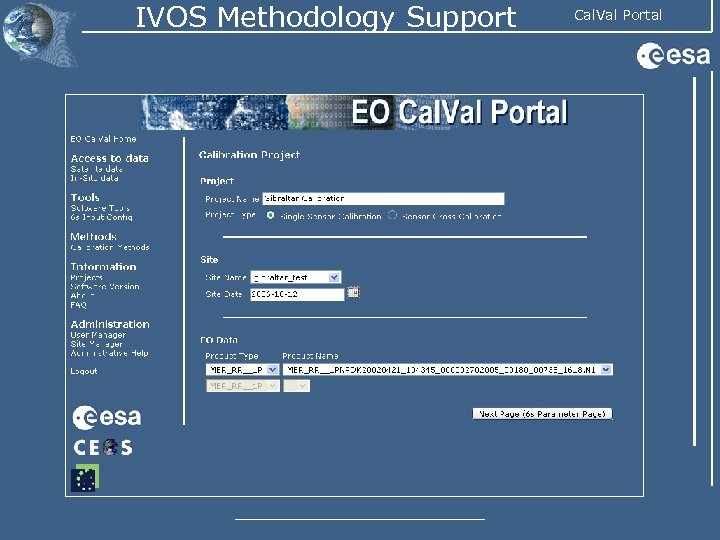
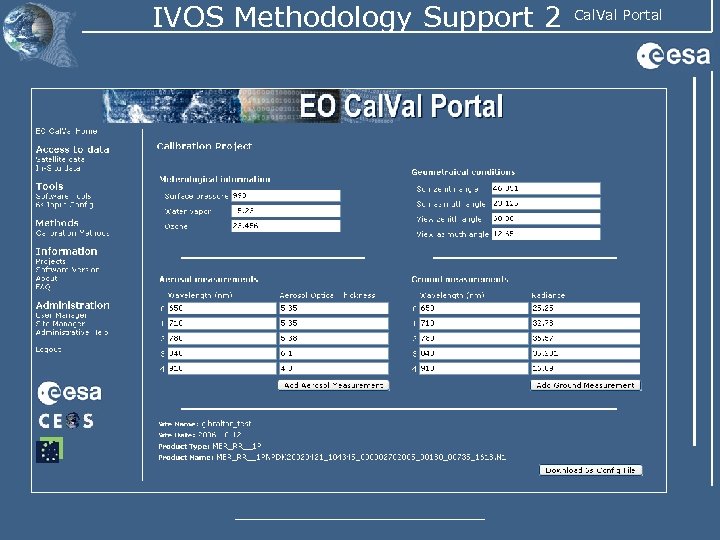
 Cal. Val Portal Calibration Support • The Cal. Val Portal will support calibration by – – Supplying Satellite Data from multiple Sensors Supplying in-situ Measurements Supply Sensor Parameters Prepare input files for 6 S given Sensor Parameters, Atmospheric Conditions, … – Supply a platform to exchange results – Give access to calibration tools • • BEAM 6 S input file generation 6 S RTT …
 Cal. Val Portal
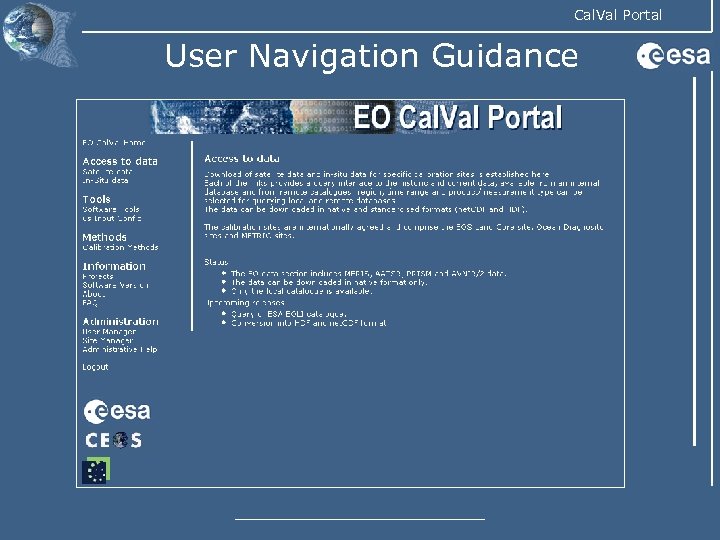 Cal. Val Portal User Navigation Guidance
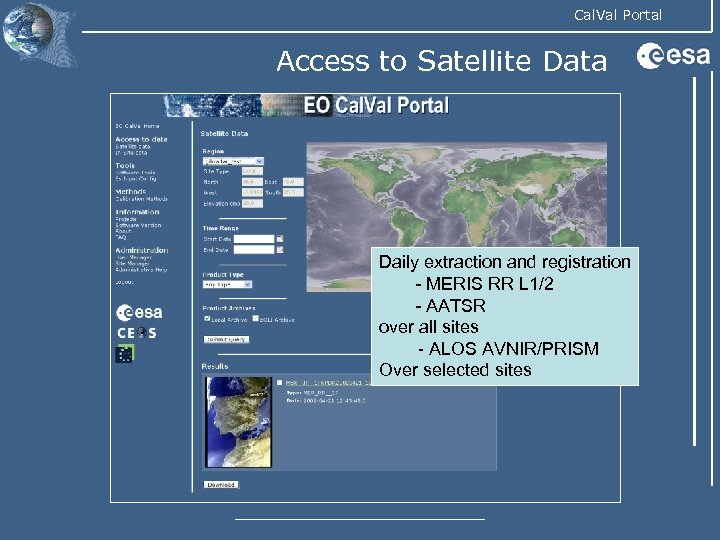 Cal. Val Portal Access to Satellite Data Daily extraction and registration - MERIS RR L 1/2 - AATSR over all sites - ALOS AVNIR/PRISM Over selected sites
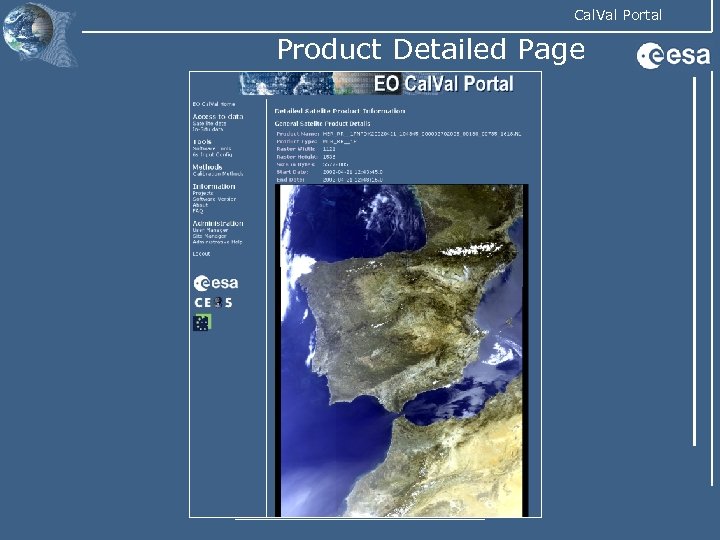 Cal. Val Portal Product Detailed Page
 Cal. Val Portal Methodology • Reference methodology for optical sensors – Vicarious calibration: a reflectance based method – Applicable to • Visible • NIR • Available as a document for download from the Portal – Scientific background – General approach – Cook-book like step-by-step description • Supported by interactive tools and links to SW tools • Future extension: Reference methodologies for – Geometry – Radar instruments – Atmospheric chemistry
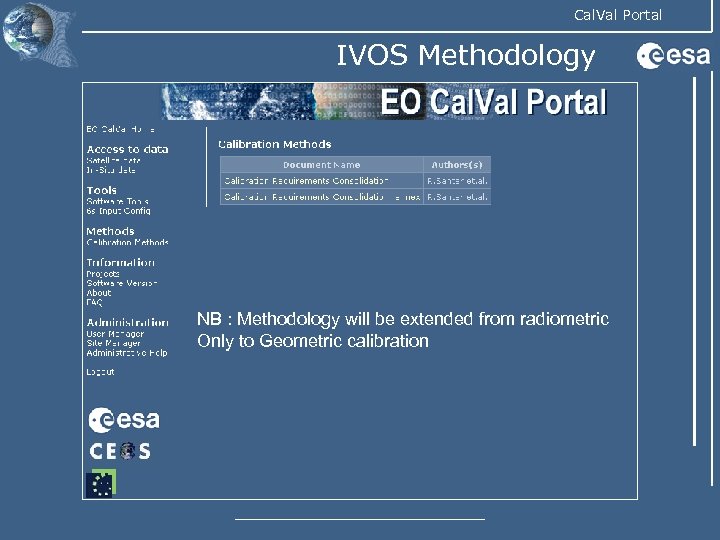 Cal. Val Portal IVOS Methodology NB : Methodology will be extended from radiometric Only to Geometric calibration
 Cal. Val Portal Structure of the Method Description • Introduction, Applicability, Scope • Physical / mathematical description • Technical Description – Overview – Detailed description of Modules • • Preparation, Campaign planning EO data retrieval EO data extraction Meteorological data Aerosol model Surface reflectance (in-situ data) Radiative transfer model Calibration • Application Example (La Crau) • Recommendations of in-situ measurements • Numerical models – 6 S – SOS code
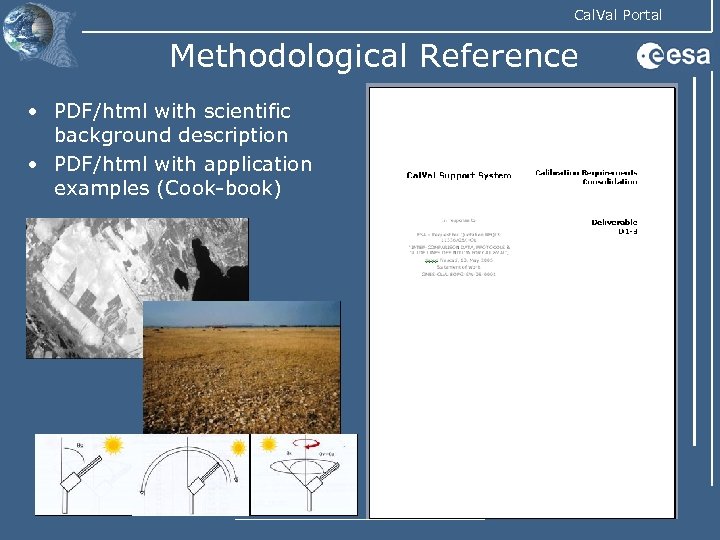 Cal. Val Portal Methodological Reference • PDF/html with scientific background description • PDF/html with application examples (Cook-book)
 Cal. Val Portal Methodological Reference • html/PDF with scientific background description • html/PDF with application examples (Cook-book) ready – Vicarious calibration in the solar domain using bright land test sites - Methodology – Vicarious calibration in the solar domain using bright land test sites: The La Crau site • Detailed description of current technology – The Acqua Alta Oceanographic Platform (AAOT) Site (Zibordi & Berthon) – The Sea. PRISM CIMEL radiometer (Zibordi, Berton & Melin) – Measurements for calibration in the solar domain: The automatic CIMEL radiometer (R. Santer) – RTC for calibration in the solar domain; the Successive Order of Scattering code (R. Santer) – Second Simulation of a Satellite Signal in the Solar Spectrum (Eric Vermote)
 IVOS Methodology Support Cal. Val Portal
 IVOS Methodology Support 2 Cal. Val Portal
 Cal. Val Portal Example: use of the cal/val portal for: Cross calibration: ALOS and MERIS over land • MERIS: a reference! – Strong requirements for ocean colour – On board calibration • Clear sky conditions • Two types of sensors: – Spatial resolution=> homogeneous site – Spectral features Ø ALOS and MERIS extracted over the same stable sites available in the cal/val portal
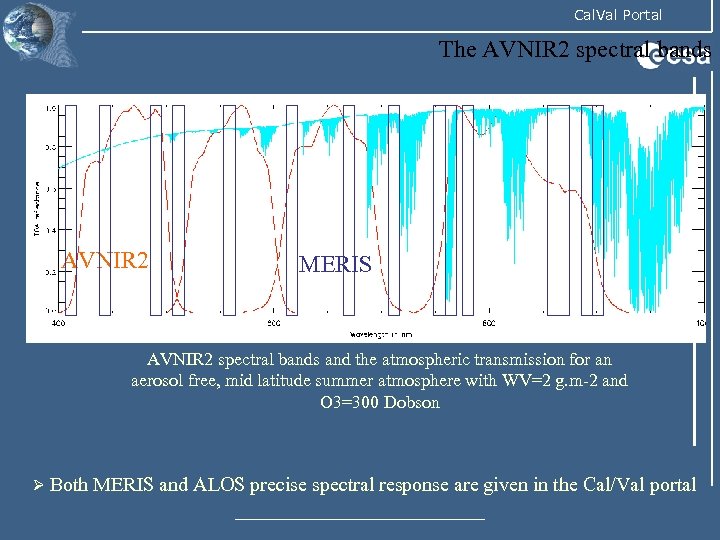 Cal. Val Portal The AVNIR 2 spectral bands AVNIR 2 MERIS AVNIR 2 spectral bands and the atmospheric transmission for an aerosol free, mid latitude summer atmosphere with WV=2 g. m-2 and O 3=300 Dobson Ø Both MERIS and ALOS precise spectral response are given in the Cal/Val portal
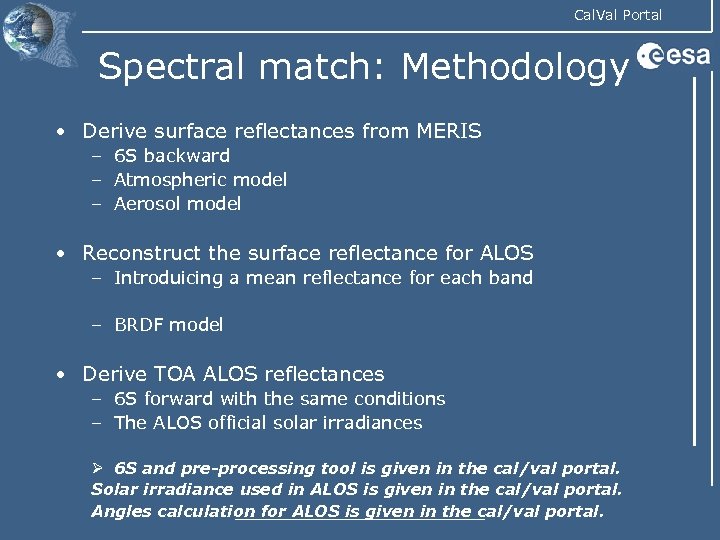 Cal. Val Portal Spectral match: Methodology • Derive surface reflectances from MERIS – 6 S backward – Atmospheric model – Aerosol model • Reconstruct the surface reflectance for ALOS – Introduicing a mean reflectance for each band – BRDF model • Derive TOA ALOS reflectances – 6 S forward with the same conditions – The ALOS official solar irradiances Ø 6 S and pre-processing tool is given in the cal/val portal. Solar irradiance used in ALOS is given in the cal/val portal. Angles calculation for ALOS is given in the cal/val portal.
 Cal. Val Portal Second order terms • BRDF correction – Using BRDF model of the site (POLDER-PARASOL) • Aerosol model – Proximity of AERONET station (access via Cal/Val portal)
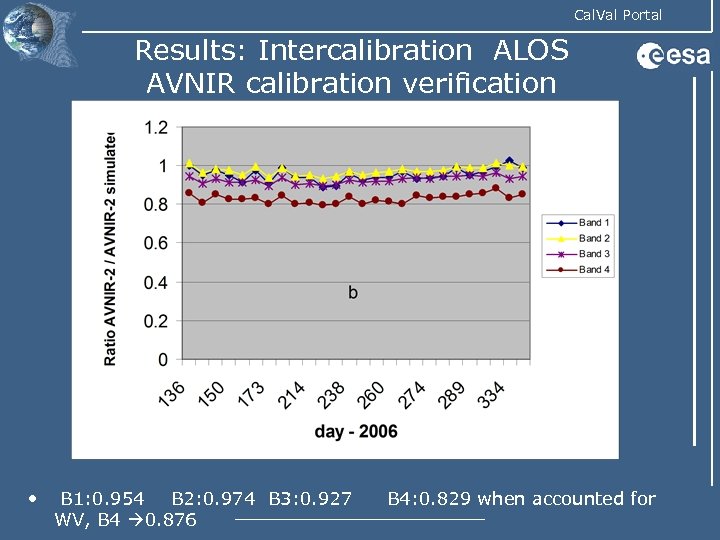 Cal. Val Portal Results: Intercalibration ALOS AVNIR calibration verification • B 1: 0. 954 B 2: 0. 974 B 3: 0. 927 WV, B 4 0. 876 B 4: 0. 829 when accounted for
 Cal. Val Portal Summary • EO Cal. Val. Portal provides data, instrument description and methodologies for Calibration and Validation – Version 1 supports calibration of IVOS sensors • www. brockmann-consult. de/Cal. Val. Portal – Version 2 (2007) • • extension to geometric calibration validation support extension to other types of sensors incorporation of the functionality of the CEOS WGISS Testfacility • Cal. Val projects can link into share data and results – Globcolour, MAVT/MQWG, ALOS are currently using the portal • Work in accordance with and supported by CEOS • GEOSS is interested in taking on board the Cal. Val Portal