 Скачать презентацию C Michael Gibson M S M D
ecb1e10a9aecbd77ea6ddca1b3c0c2f7.ppt
- Количество слайдов: 25



C. Michael Gibson, M. S. , M. D. Achieving Balanced Pharmacotherapy: Simultaneously Reducing Stroke and Bleeding with Dabigatran Chief, Clinical Research, Beth Israel Deaconess CV Division Chairman, PERFUSE Study Group Senior Trialist TIMI Study Group, Brigham and Women’s Hospital Senior Trialist Duke Clinical Research Institute Chairman of the Board of Wiki. Doc Foundation, www. wikidoc. org The World’s Largest Textbook of Medicine with 6, 700 contributors Harvard Medical School
C. Michael Gibson, MD Consulting: Bristol-Myers Squibb Daiichi Sankyo Eli Lilly and Company Portola Pharmaceuticals, Inc. St. Jude Medical, Inc. Cytori Therapeutics The Medicines Company
C. Michael Gibson, MD Grant Support: Bayer Corporation, Angel Medical Systems, Inc. , Atrium Medical Corporation, Ikaria, Inc. , Lantheus Medical Imaging, Portola Pharmaceuticals, Inc. , St. Jude Medical, Inc. , Genentech, Inc. , Stealth Peptides, Inc. , Volcano Therapeutics, Inc, Johnson and Johnson, Walk Vascular, Merck and Company, Inc. and Sanofi-Aventis
C. Michael Gibson, MD Honoraria: Merck and Company, Inc. Regado Bio-Sciences Baxter International, Inc. Sanofi-Aventis Cardiovascular Research Foundation Consensus Medical Communications
Randomized Evaluation of Longterm anticoagulant therap. Y Dabigatran Compared to Warfarin in 18, 113 Patients with Atrial Fibrillation at Risk of Stroke
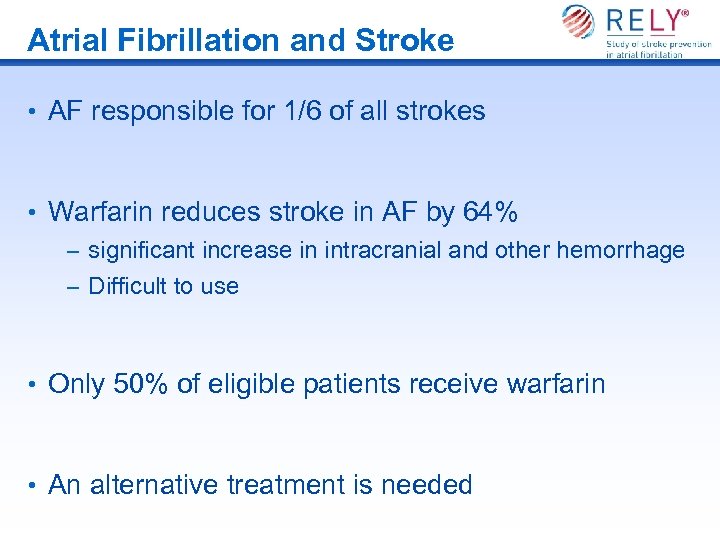
Atrial Fibrillation and Stroke • AF responsible for 1/6 of all strokes • Warfarin reduces stroke in AF by 64% – significant increase in intracranial and other hemorrhage – Difficult to use • Only 50% of eligible patients receive warfarin • An alternative treatment is needed
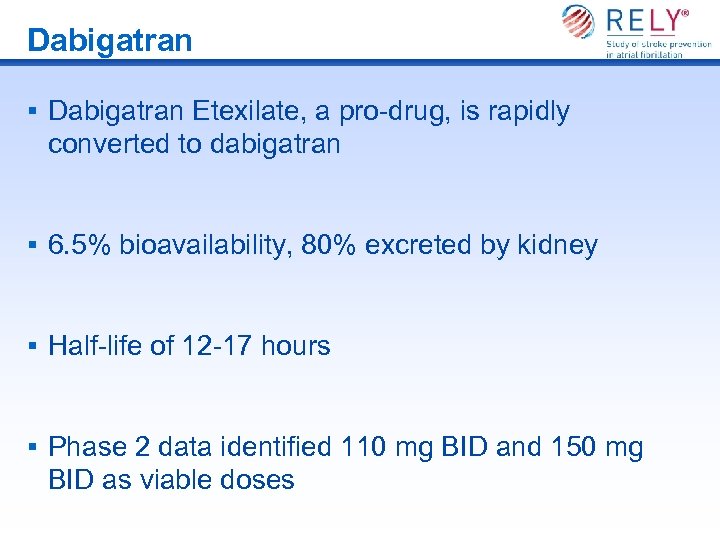
Dabigatran § Dabigatran Etexilate, a pro-drug, is rapidly converted to dabigatran § 6. 5% bioavailability, 80% excreted by kidney § Half-life of 12 -17 hours § Phase 2 data identified 110 mg BID and 150 mg BID as viable doses
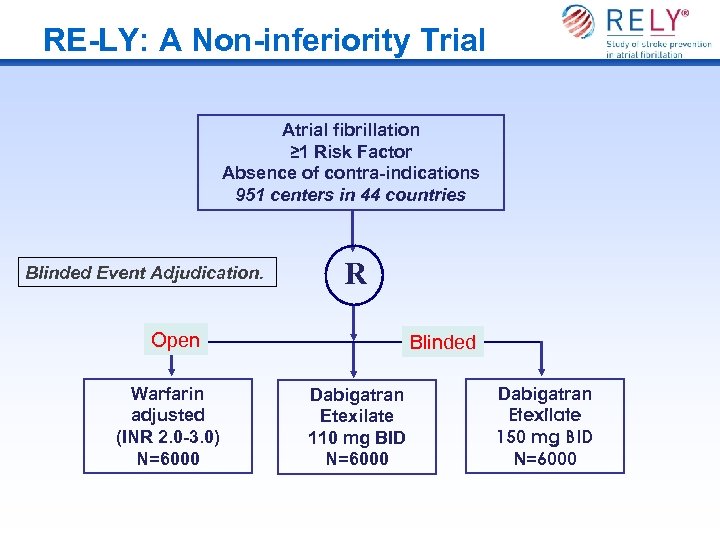
RE-LY: A Non-inferiority Trial Atrial fibrillation ≥ 1 Risk Factor Absence of contra-indications 951 centers in 44 countries Blinded Event Adjudication. R Open Warfarin adjusted (INR 2. 0 -3. 0) N=6000 Blinded Dabigatran Etexilate 110 mg BID N=6000 Dabigatran Etexilate 150 mg BID N=6000
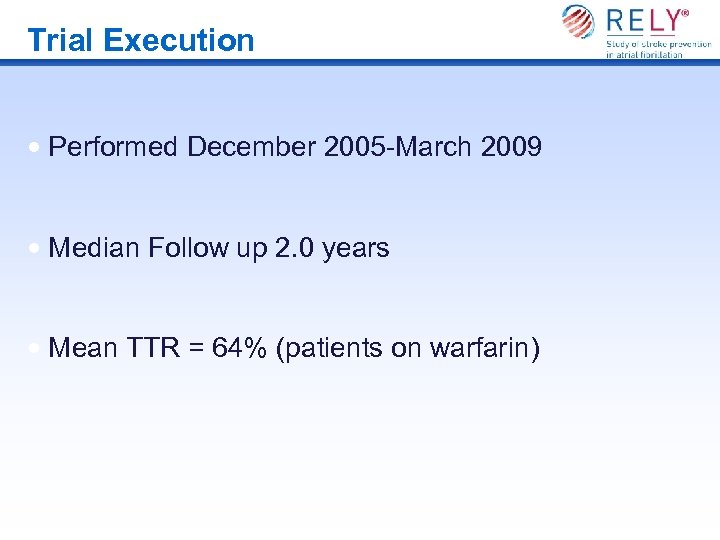
Trial Execution Performed December 2005 -March 2009 Median Follow up 2. 0 years Mean TTR = 64% (patients on warfarin)
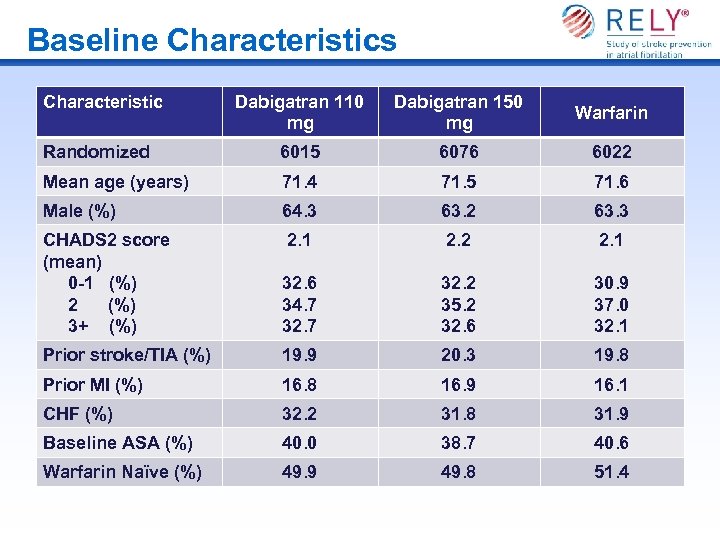
Baseline Characteristics Characteristic Dabigatran 110 mg Dabigatran 150 mg Warfarin Randomized 6015 6076 6022 Mean age (years) 71. 4 71. 5 71. 6 Male (%) 64. 3 63. 2 63. 3 CHADS 2 score (mean) 0 -1 (%) 2 (%) 3+ (%) 2. 1 2. 2 2. 1 32. 6 34. 7 32. 2 35. 2 32. 6 30. 9 37. 0 32. 1 Prior stroke/TIA (%) 19. 9 20. 3 19. 8 Prior MI (%) 16. 8 16. 9 16. 1 CHF (%) 32. 2 31. 8 31. 9 Baseline ASA (%) 40. 0 38. 7 40. 6 Warfarin Naïve (%) 49. 9 49. 8 51. 4
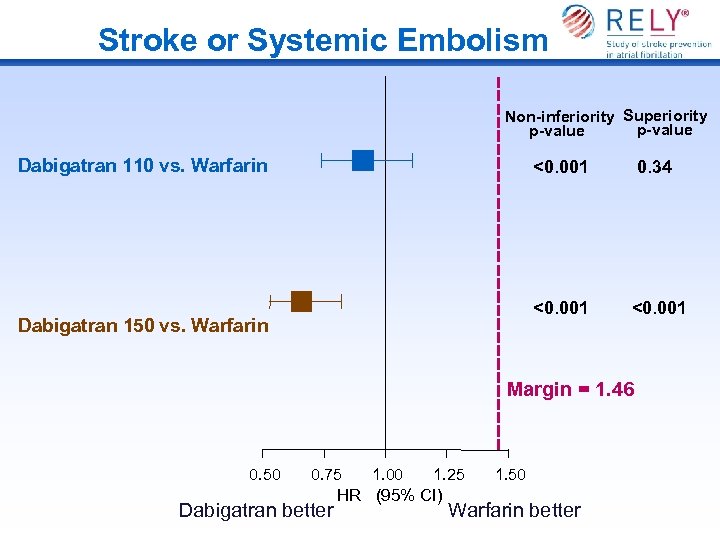
Stroke or Systemic Embolism Non-inferiority Superiority p-value Dabigatran 110 vs. Warfarin <0. 001 Dabigatran 150 vs. Warfarin 0. 34 <0. 001 Margin = 1. 46 0. 50 0. 75 Dabigatran better 1. 00 1. 25 HR (95% CI) 1. 50 Warfarin better
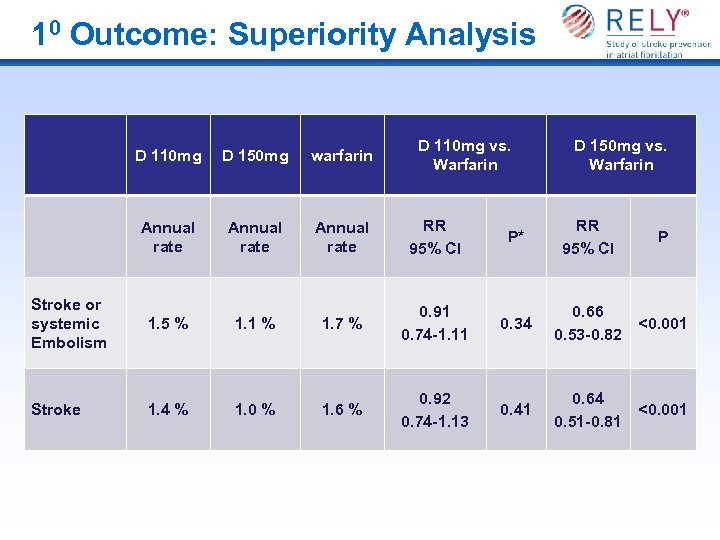
10 Outcome: Superiority Analysis D 110 mg vs. Warfarin D 150 mg vs. Warfarin D 110 mg D 150 mg warfarin Annual rate RR 95% CI P* RR 95% CI P Stroke or systemic Embolism 1. 5 % 1. 1 % 1. 7 % 0. 91 0. 74 -1. 11 0. 34 0. 66 0. 53 -0. 82 <0. 001 Stroke 1. 4 % 1. 0 % 1. 6 % 0. 92 0. 74 -1. 13 0. 41 0. 64 0. 51 -0. 81 <0. 001
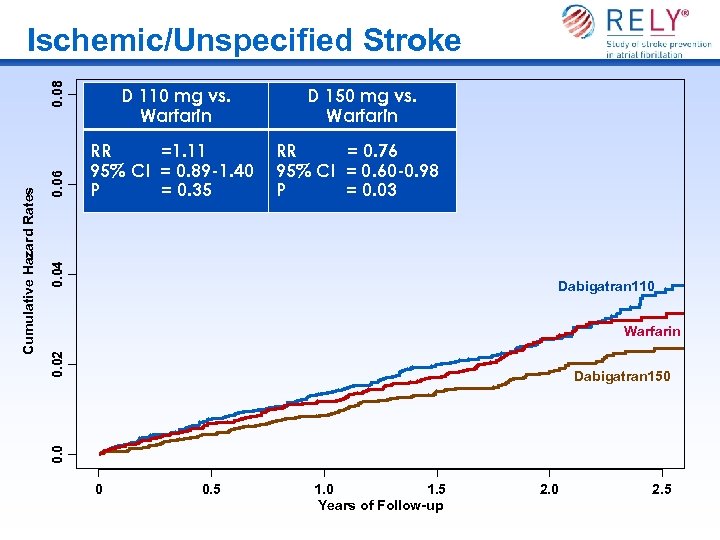
0. 06 D 150 mg vs. Warfarin RR =1. 11 95% CI = 0. 89 -1. 40 P = 0. 35 RR = 0. 76 95% CI = 0. 60 -0. 98 P = 0. 03 0. 04 D 110 mg vs. Warfarin Dabigatran 110 0. 02 Warfarin Dabigatran 150 0. 0 Cumulative Hazard Rates 0. 08 Ischemic/Unspecified Stroke 0 0. 5 1. 0 1. 5 Years of Follow-up 2. 0 2. 5
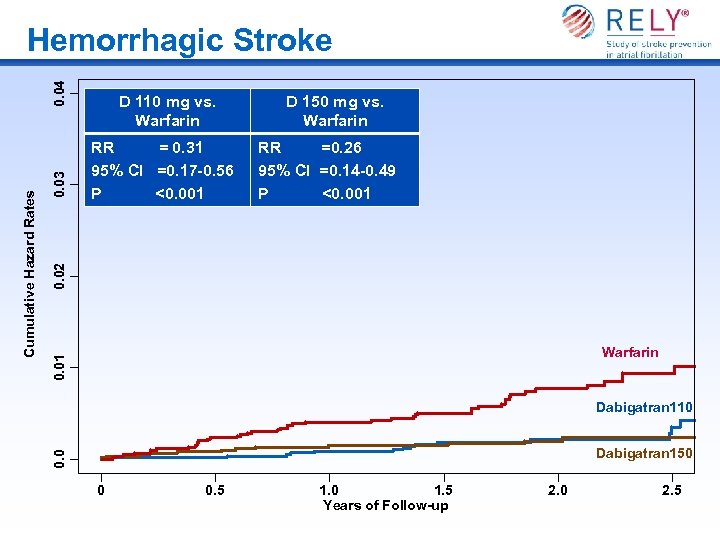
RR = 0. 31 95% CI =0. 17 -0. 56 P <0. 001 D 150 mg vs. Warfarin RR =0. 26 95% CI =0. 14 -0. 49 P <0. 001 0. 02 0. 03 D 110 mg vs. Warfarin 0. 01 Warfarin Dabigatran 110 Dabigatran 150 0. 0 Cumulative Hazard Rates 0. 04 Hemorrhagic Stroke 0 0. 5 1. 0 1. 5 Years of Follow-up 2. 0 2. 5
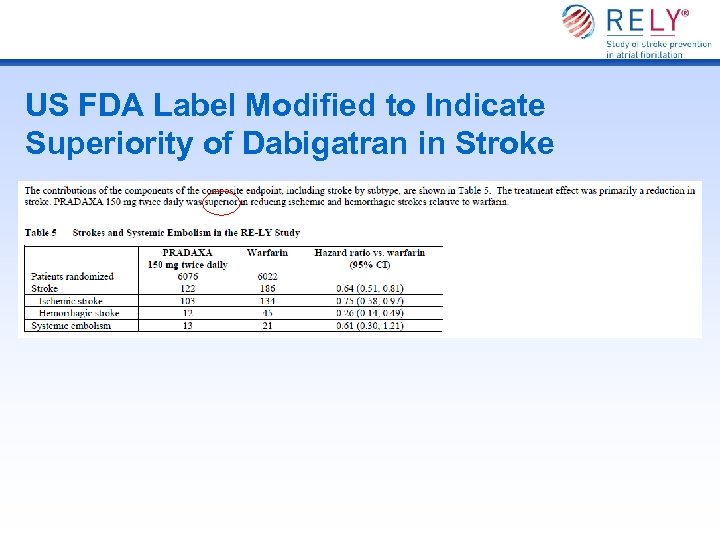
US FDA Label Modified to Indicate Superiority of Dabigatran in Stroke
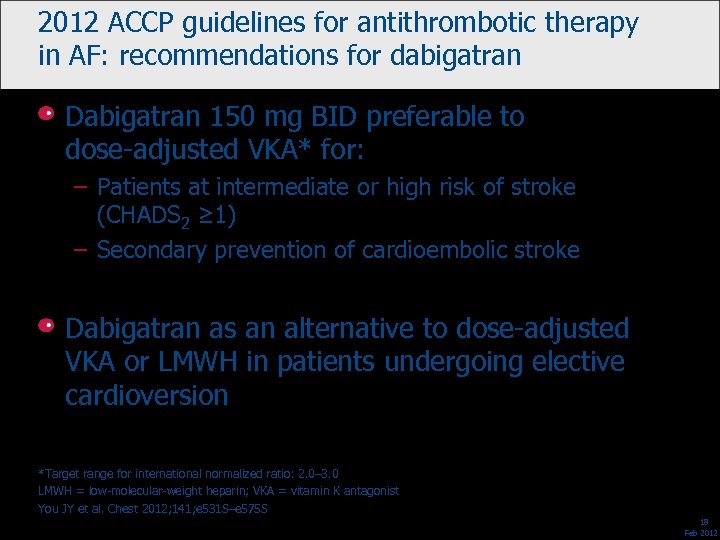
2012 ACCP guidelines for antithrombotic therapy in AF: recommendations for dabigatran Dabigatran 150 mg BID preferable to dose-adjusted VKA* for: – Patients at intermediate or high risk of stroke (CHADS 2 ≥ 1) – Secondary prevention of cardioembolic stroke Dabigatran as an alternative to dose-adjusted VKA or LMWH in patients undergoing elective cardioversion *Target range for international normalized ratio: 2. 0– 3. 0 LMWH = low-molecular-weight heparin; VKA = vitamin K antagonist You JY et al. Chest 2012; 141; e 531 S–e 575 S 18 Feb 2012
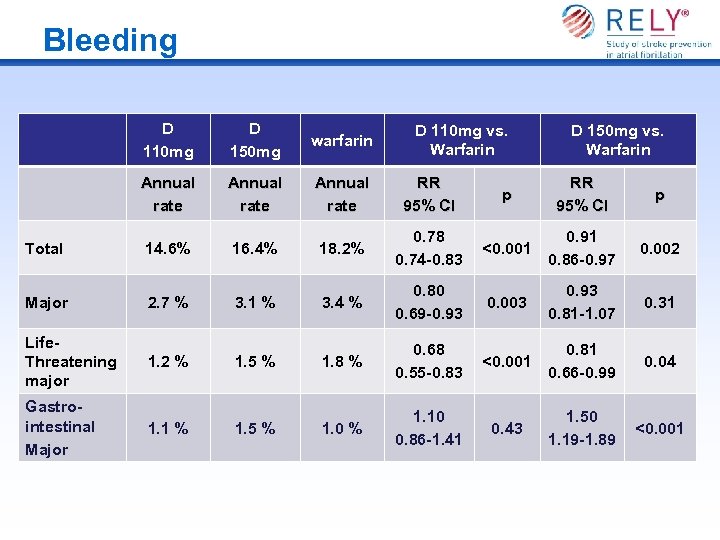
Bleeding D 110 mg D 150 mg warfarin Annual rate RR 95% CI p Total 14. 6% 16. 4% 18. 2% 0. 78 0. 74 -0. 83 <0. 001 0. 91 0. 86 -0. 97 0. 002 Major 2. 7 % 3. 1 % 3. 4 % 0. 80 0. 69 -0. 93 0. 003 0. 93 0. 81 -1. 07 0. 31 Life. Threatening major 1. 2 % 1. 5 % 1. 8 % 0. 68 0. 55 -0. 83 <0. 001 0. 81 0. 66 -0. 99 0. 04 Gastrointestinal Major 1. 1 % 1. 5 % 1. 0 % 1. 10 0. 86 -1. 41 0. 43 1. 50 1. 19 -1. 89 <0. 001 D 110 mg vs. Warfarin D 150 mg vs. Warfarin
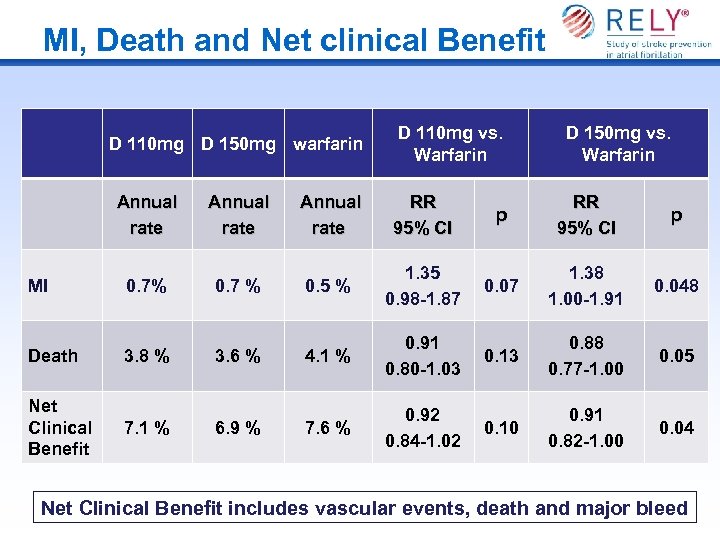
MI, Death and Net clinical Benefit D 110 mg D 150 mg warfarin D 110 mg vs. Warfarin Annual rate RR 95% CI MI 0. 7% 0. 7 % 0. 5 % Death 3. 8 % 3. 6 % Net Clinical Benefit 7. 1 % 6. 9 % D 150 mg vs. Warfarin p RR 95% CI p 1. 35 0. 98 -1. 87 0. 07 1. 38 1. 00 -1. 91 0. 048 4. 1 % 0. 91 0. 80 -1. 03 0. 13 0. 88 0. 77 -1. 00 0. 05 7. 6 % 0. 92 0. 84 -1. 02 0. 10 0. 91 0. 82 -1. 00 0. 04 Net Clinical Benefit includes vascular events, death and major bleed
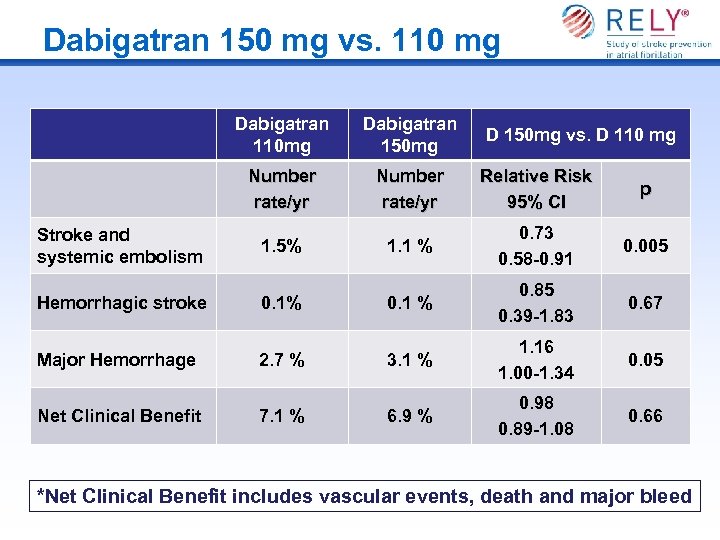
Dabigatran 150 mg vs. 110 mg Dabigatran 110 mg Number rate/yr Stroke and systemic embolism Dabigatran 150 mg Number rate/yr Relative Risk 95% CI p 1. 1 % 0. 73 0. 58 -0. 91 0. 005 0. 67 1. 5% D 150 mg vs. D 110 mg Hemorrhagic stroke 0. 1% 0. 1 % 0. 85 0. 39 -1. 83 Major Hemorrhage 2. 7 % 3. 1 % 1. 16 1. 00 -1. 34 0. 05 Net Clinical Benefit 7. 1 % 6. 9 % 0. 98 0. 89 -1. 08 0. 66 *Net Clinical Benefit includes vascular events, death and major bleed
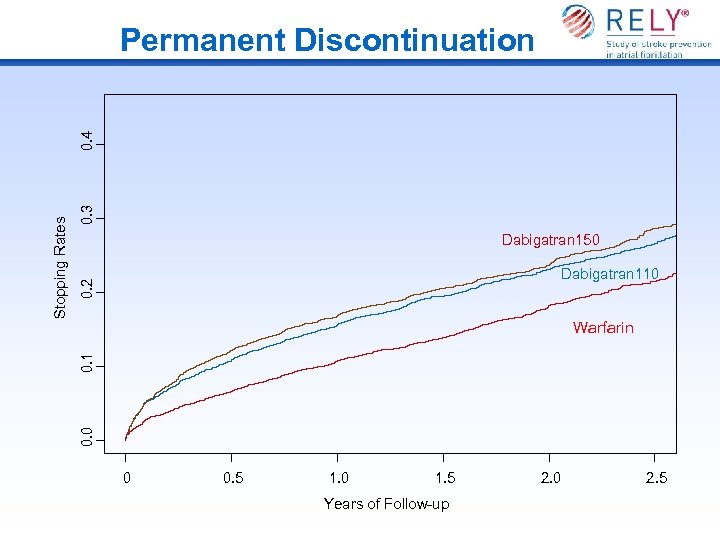
0. 3 Dabigatran 150 0. 2 Dabigatran 110 0. 1 Warfarin 0. 0 Stopping Rates 0. 4 Permanent Discontinuation 0 0. 5 1. 0 1. 5 Years of Follow-up 2. 0 2. 5
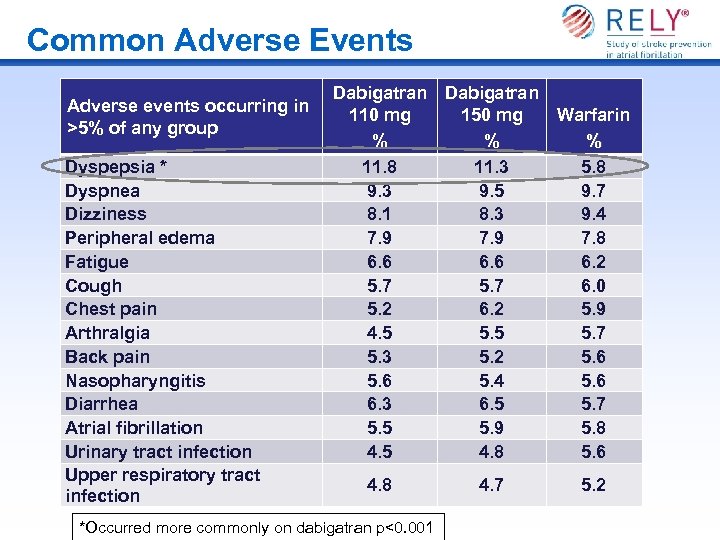
Common Adverse Events Adverse events occurring in >5% of any group Dyspepsia * Dyspnea Dizziness Peripheral edema Fatigue Cough Chest pain Arthralgia Back pain Nasopharyngitis Diarrhea Atrial fibrillation Urinary tract infection Upper respiratory tract infection Dabigatran 110 mg 150 mg % % 11. 8 11. 3 9. 5 8. 1 8. 3 7. 9 6. 6 5. 7 5. 2 6. 2 4. 5 5. 3 5. 2 5. 6 5. 4 6. 3 6. 5 5. 9 4. 5 4. 8 *Occurred more commonly on dabigatran p<0. 001 4. 7 Warfarin % 5. 8 9. 7 9. 4 7. 8 6. 2 6. 0 5. 9 5. 7 5. 6 5. 7 5. 8 5. 6 5. 2
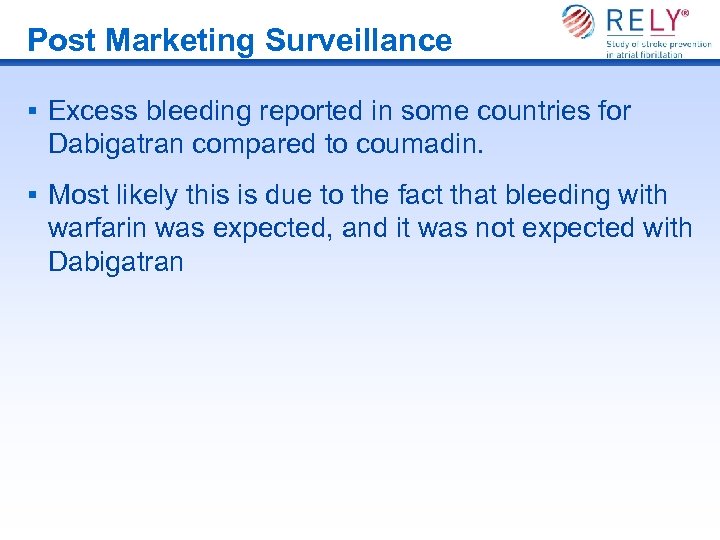
Post Marketing Surveillance § Excess bleeding reported in some countries for Dabigatran compared to coumadin. § Most likely this is due to the fact that bleeding with warfarin was expected, and it was not expected with Dabigatran
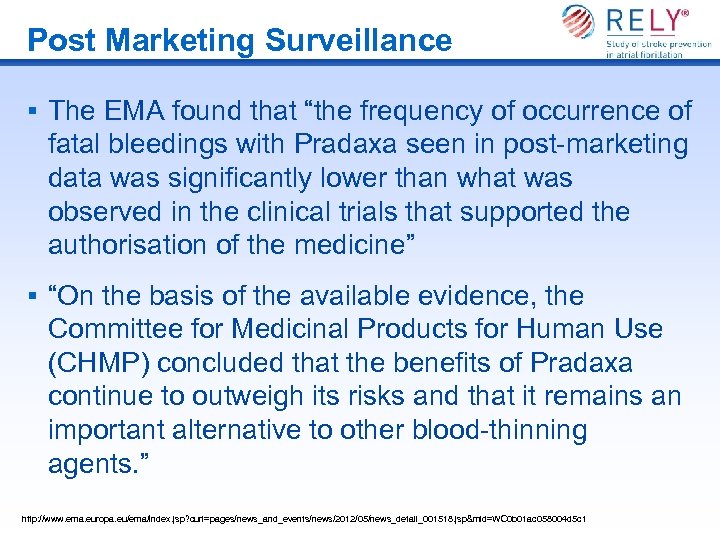
Post Marketing Surveillance § The EMA found that “the frequency of occurrence of fatal bleedings with Pradaxa seen in post-marketing data was significantly lower than what was observed in the clinical trials that supported the authorisation of the medicine” § “On the basis of the available evidence, the Committee for Medicinal Products for Human Use (CHMP) concluded that the benefits of Pradaxa continue to outweigh its risks and that it remains an important alternative to other blood-thinning agents. ” http: //www. ema. europa. eu/ema/index. jsp? curl=pages/news_and_events/news/2012/05/news_detail_001518. jsp&mid=WC 0 b 01 ac 058004 d 5 c 1
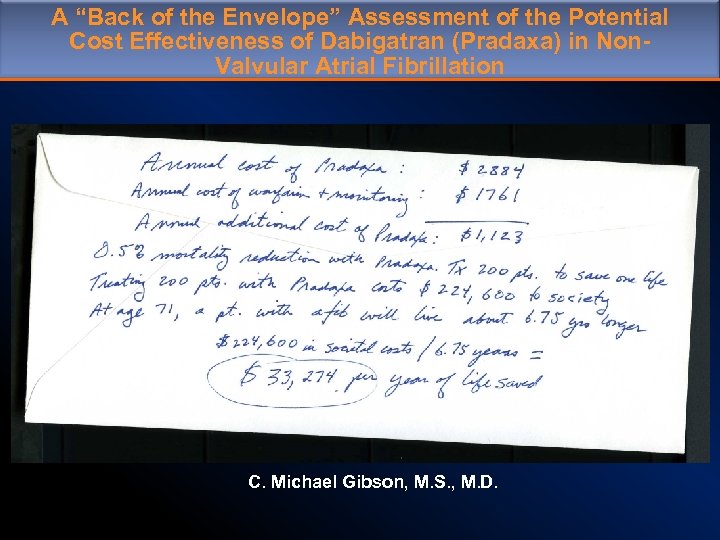
A “Back of the Envelope” Assessment of the Potential Cost Effectiveness of Dabigatran (Pradaxa) in Non. Valvular Atrial Fibrillation C. Michael Gibson, M. S. , M. D.
Скачать презентацию C Michael Gibson M S M D
ecb1e10a9aecbd77ea6ddca1b3c0c2f7.ppt