


 Скачать презентацию C Government Role Market Failure IF A
0c163ba6becf070583ba2c22b083c68d.ppt
- Количество слайдов: 27
 C. Government Role – Market Failure IF A market is a perfectly competitive (in buyers and sellers) THEN The market maximizes efficiency THEREFORE The government should NOT intervene
 C. Market Failure BUT Markets are often NOT Perfectly Competitive; there is often Market Failure: 1) Market Power 2) Public Goods 3) Asymmetric Information 4) Externalities
 C. 3 Asymmetric Information Full Information – buyers and sellers know everything about a product or service Example: erasers: Buyers and sellers know what an eraser is. Buyers can easily test and understand the quality and effect of an eraser. Ø No need for government intervention.
 C. 3 Asymmetric Information – one party (usually the seller) has full information about the product; the other party does not Example: healthcare: Doctors have better information about patient health and treatment. Since they are selling the treatment, there is an incentive to take advantage of the buyer’s lack of knowledge Ø Government intervention is needed.
 C. 3 Externalties IF Externalities Exist, THEN Social marginal cost ≠ private marginal cost, AND THEREFORE Government could intervene 5
 C. 3 Externalties An EXTERNALITY occurs when: 1) The activity of one agent directly affects the welfare of another agent And 2) This affect is not transmitted by market prices 6
 C. 3 Externalties Externalities: -A firm pollutes the air through production -A dorm student uses up all the bandwidth downloading So You Think You Can Dance -neighborhood dogs make your house safer Not Externalities: -A store with noisy country music must reduce price to keep customers -Subway has a sale, forcing Mr. Sub to have a 7 sale also
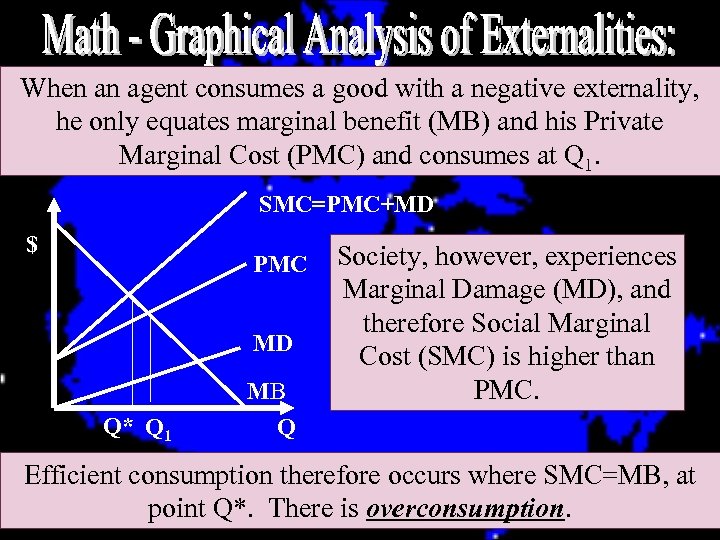 When an agent consumes a good with a negative externality, he only equates marginal benefit (MB) and his Private Marginal Cost (PMC) and consumes at Q 1. SMC=PMC+MD $ PMC MD Q* Q 1 MB Q Society, however, experiences Marginal Damage (MD), and therefore Social Marginal Cost (SMC) is higher than PMC. Efficient consumption therefore occurs where SMC=MB, at 8 point Q*. There is overconsumption.
 C. 3 Externalties -Private markets will overproduce when negative externalities exist -without a market for externalities, this is a RATIONAL action -Note that optimal amount of the externality IS NOT ZERO (ie: pollution is a cost, but some level is acceptable for the benefit) 9
 Benefit of reducing output If we were to move from our individual optimum to our social optimum: 1) Society would gain area A+B, (which is equal to area C). 2) The individual would lose profits or utility equal to area B 3) Therefore, assuming everyone is equal in society the net gain is area A 10
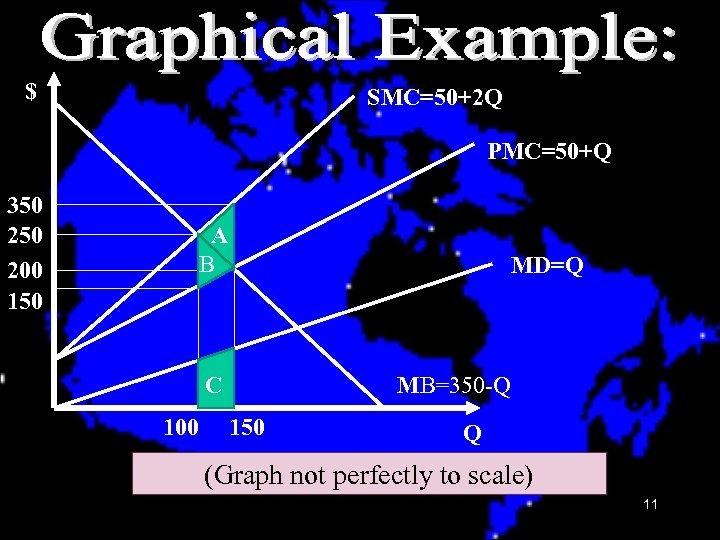 $ SMC=50+2 Q PMC=50+Q 350 200 150 A B MD=Q C 100 MB=350 -Q 150 Q (Graph not perfectly to scale) 11
 Public Responses to Externalities If private responses to externalities don’t work or don’t occur, there a variety of ways the government can intervene, including: 1) 2) 3) 4) Taxes Subsidies Creating a Market Regulation 12
 1) Public Response: Taxes Since actions with externalities have SMC>PMC, one way to raise PMC is through taxation -a PIGOUVIAN TAX is a per-unit tax on output equal to the marginal damage at the efficient level of output, Q* -If administrated correctly, the can move production to the efficient level of output: 13
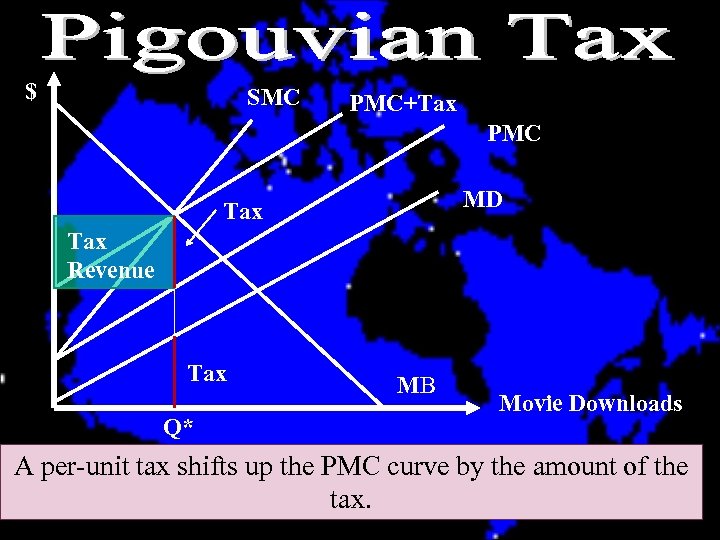 $ SMC PMC+Tax PMC MD Tax Revenue Tax Q* MB Movie Downloads A per-unit tax shifts up the PMC curve by the amount of the tax. 14
 1) Public Response: Taxes -The Pigouvian tax also yields tax revenue -It may be tempting to give this tax revenue to the victims of the externality, but this distorts the market, and encourages others to experience the negative externality in order to get the payment Pigouvian Taxes have 2 concerns: 1) Estimation – one needs to know the exact MD in order to place the tax 2) Efficiency – sometimes a similar tax is more 15 efficient (tax on cars vs. tax on kilometers)
 2) Public Response: Subsidies Since actions with externalities have SMC>PMC, another way to raise PMC is through subsidy -a PIGOUVIAN SUBSIDY is a per-unit subsidy on REDUCED output equal to the marginal damage at the efficient level of output, Q* -Therefore choosing to produce has the added PMC of giving up the subsidy -If administrated correctly, the can move production to the efficient level of output: 16
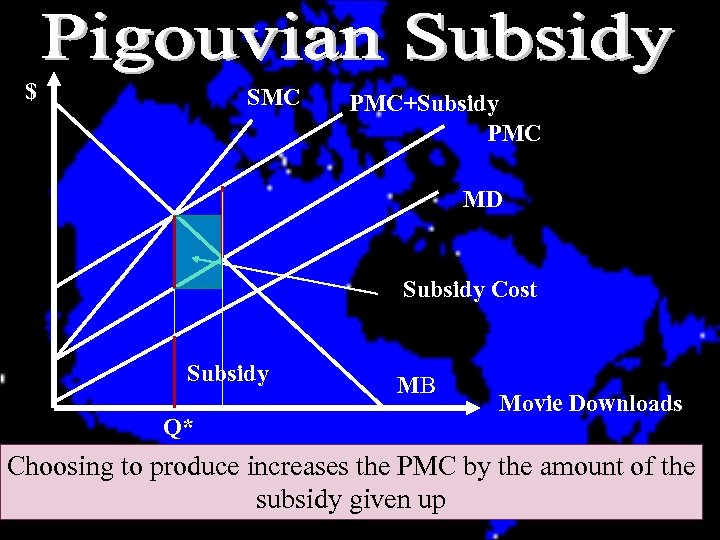 $ SMC PMC+Subsidy PMC MD Subsidy Cost Subsidy Q* MB Movie Downloads Choosing to produce increases the PMC by the amount of the subsidy given up 17
 2) Public Response: Subsidies In addition to the Pigouvian Tax issues, the Pigouvian Subsidy has 3 additional problems: 1) The subsidy raises profits, encouraging other firms to join the market and produce externalities 2) The financing of the subsidy cost often comes from additional distortionary taxation that further restricts the economy -The externality may be less costly 3) Paying a firm not to pollute is often regarded as 18 unappealing
 3) Public Response: Creating a Market Another way for the government to control externalities (ie: pollution) is to sell a set supply of externality permits -A competitive auction will automatically find an equilibrium price for these permits -An EFFLUENT FEE is the price charged for the right to pollute -Note that alternately, the government could freely distribute these permits. The equilibrium price would arise from trading 19 among firms, only equity would be affected
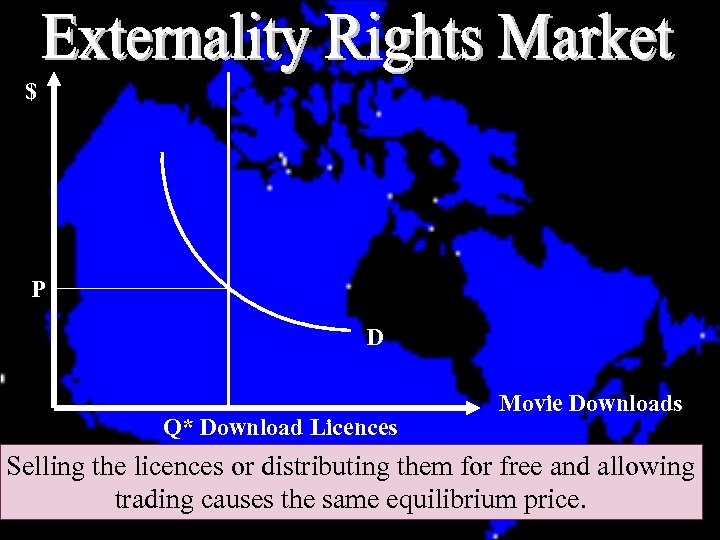 $ P D Q* Download Licences Movie Downloads Selling the licences or distributing them for free and allowing trading causes the same equilibrium price. 20
 3) Public Response: Creating a Market Like Pigouvian taxes, we need information on optimal MD and pollution to accurately issue permits. Permits do, however, have advantages over Pigouvian taxes: 1) Permits directly chose the amount of pollution, instead of indirectly (and possibly incorrectly) determining it with taxes 2) Permit prices automatically move with inflation, whereas a tax needs to be constatly 21 re-assessed
 4) Public Response: Regulation The government can force a firm to produce at Q* or face legal sanctions. Unfortunately, regulation is likely to be inefficient in a market with more than one firm. -Firms have different sizes and curves -Can one production level satisfy all firms? -Can one production reduction amount satisfy all firms? -Examine the simple case where two firms (A and B) differ only in MB schedules: 22
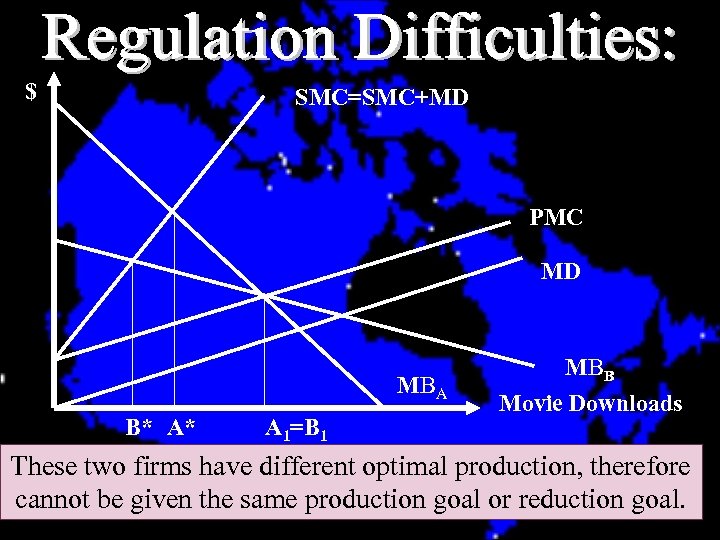 $ SMC=SMC+MD PMC MD MBA B* A* A 1=B 1 MBB Movie Downloads These two firms have different optimal production, therefore cannot be given the same production goal or reduction goal. 23
 Public Response Issues Externalities also differ across locations. A driver in the middle of the wilderness has less effect than an Edmontonian driver, who may have less effect than a driver in Toronto -should Edmontonian drivers be punished according to Toronto standards? -Differing standards increases administration costs 24
 Public Response Issues -Typically, economic incentives (tax, subsidy, permits) to reduce pollution have the best impact, as they encourage greener practices -Efficiency typically puts taxes and permits above subsidies and regulations Preference order is therefore: 1) Taxes and Permits 2) Subsidies 3) Regulation 25
 Topic 9 Summary Ø Governments are Responsible for 1) Maintaining law and order 2) Income Redistribution 3) Intervening when the market fails i) Market Power ii) Public Goods iii) Asymmetric Information iv) Externalities 26
 Topic 9 Summary Ø Public Goods should be provided where ΣMB=MC Ø 4 Methods of dealing with externalities (ie: pollution) are: Ø Taxes (provides revenue, but hard to pick the right tax) Ø Subsidies (decreases revenue, hard to pick the right subsidy, and unappealing to society) Ø Permits (uses supply and demand to find the right price, plus directly limits externalities) Ø Regulation (difficult to fairly use in a dynamic industry; costly to implement) 27