



 C a n a d a
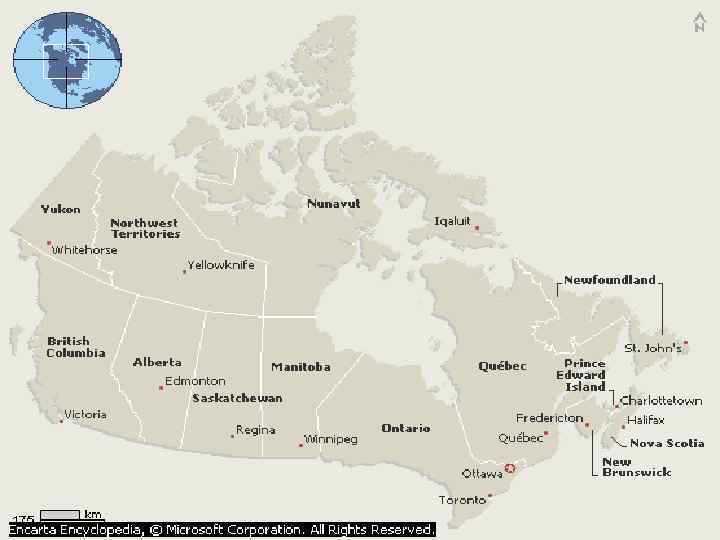
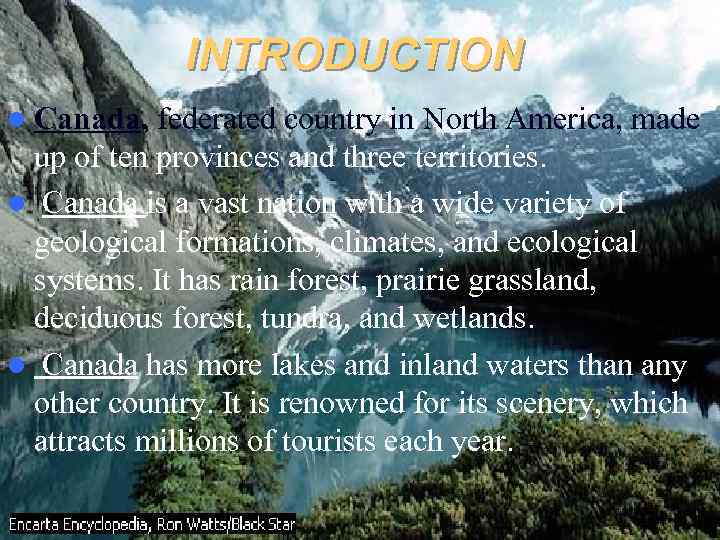 INTRODUCTION l Canada, federated country in North America, made up of ten provinces and three territories. l Canada is a vast nation with a wide variety of geological formations, climates, and ecological systems. It has rain forest, prairie grassland, deciduous forest, tundra, and wetlands. l Canada has more lakes and inland waters than any other country. It is renowned for its scenery, which attracts millions of tourists each year.
 § Canada is the second largest country in the world but has about the same population as the state of California, which is one-25 th its size. This is because the north of Canada, with its harsh Arctic and sub-Arctic climates, is sparsely inhabited. § Most Canadians live in the southern part of the country. More than three-quarters of them live in metropolitan areas, the largest of which are Toronto, Ontario; Montréal, Québec; Vancouver, British Columbia; Ottawa, Ontario; Hull, Québec; and Edmonton, Alberta. § French and English are the official languages, and at one time most Canadians were of French or English descent. § However, diversity increased with a wave of immigration in the late 19 th and early 20 th centuries that brought in people from many other European nations. Canada is one of the few countries in the world that still has significant immigration programs.
 Geography Canada has an area of nearly ten million square kilometres. Its western coast is washed by the Pacific Ocean and its eastern coast by the Atlantic Ocean. The are many islands in the north of Canada has mountains, high plains and low plains. The Rocky Mountains run parallel to the Pacific coast. Canada is a country of lakes, for example: Great Bear Lake, Great Seave Lake and Lake Winning. Canada also has large rivers: the Mackenzie, the Yukon, the St. Lawrence River. The Niagara Falls are one of the most splendid sights in the world. Canada has several climatic regions. Winter in Canada lasts from 4 to 5 months with heavy snowfalls. There is much rain in the east and west, but less in the centre.
 The population of Canada is over 25 million people. In the country there are 300, 000 Indians, and 18, 000 Eskimos, who live mostly in the North. Today more than 45% of the people of Canada came originally from Britain, about 30% from France and 20% from other countries. The capital of Canada is Ottawa. Canada is rich in metal ores, oil and gas. The metal machine-building, motor-car and shipbuilding, industries are highly developed. The hydro-electric industry is highly developed, in main centres are in the provinces of Quebec and Ontario. There is very large hydro-electric station at the Niagara Falls. The provinces of Quebec, Ontario and British Columbia, with their great forest, produce wood for paper-making and building. Many of the lakes and rivers are polluted today and few of them have fish now But Canada s fishing industry is still important on both the Pacific and Atlantic coast.
 l Canada’s prosperity and diversity have encouraged a variety of artistic pursuits. Most major cities have symphony orchestras, opera companies, classical and modern dance groups, and live theater. l Canadian writers have also gained worldwide recognition, as have painters, sculptors, filmmakers, and architects.
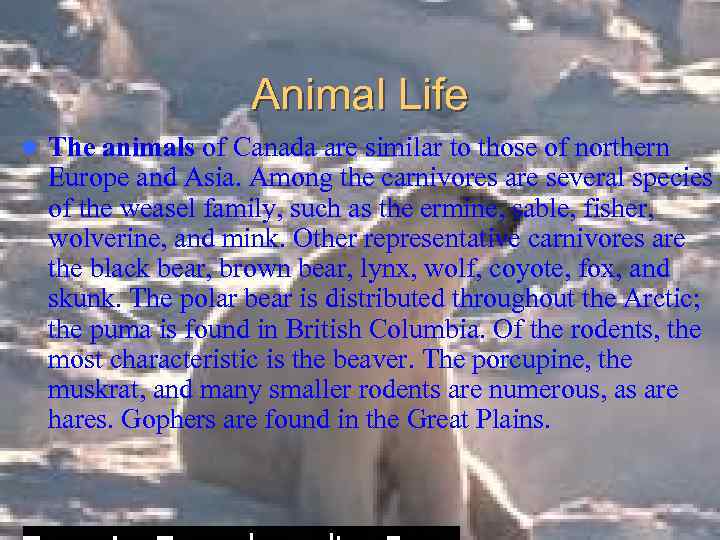 Animal Life l The animals of Canada are similar to those of northern Europe and Asia. Among the carnivores are several species of the weasel family, such as the ermine, sable, fisher, wolverine, and mink. Other representative carnivores are the black bear, brown bear, lynx, wolf, coyote, fox, and skunk. The polar bear is distributed throughout the Arctic; the puma is found in British Columbia. Of the rodents, the most characteristic is the beaver. The porcupine, the muskrat, and many smaller rodents are numerous, as are hares. Gophers are found in the Great Plains.
 Forest Management l The federal government owns about 95 million hectares (about 235 million acres) of forest, but most of this land is in the Yukon Territory, the Nunavut Territory, or the Northwest Territories and is unsuitable for commercial timber production. The provinces own 296 million hectares (731 million acres) or 87 percent of the forests south of latitude 60° north (the northern border of British Columbia, Alberta, Saskatchewan, and Manitoba). The remaining 13 percent is reserved for national parks or held privately. The provinces are responsible for managing their public lands and the timber on those lands.
 Fisheries Management l Licenses for sport fishing are usually distributed by the provincial or territorial governments, which retain the revenue collected. Many provinces put these revenues into fish conservation projects. The federal Department of Fisheries and Oceans is responsible for regulating, developing, and conserving Canada’s commercial fisheries, although it delegates part of the management of freshwater fisheries to the provinces through federal-provincial agreements. The department also conducts research and represents Canada in international agreements on fisheries management and marine research. There are management problems involving other countries on both the Atlantic and Pacific coasts.
 Religion u u Most Canadians are Christians , although a rapidly growing number have no religious affiliation. The remainder practice non-Christian Eastern religions, Judaism, indigenous traditions, or other forms of belief such as the New Age Movement. The Roman Catholic Church is by far the largest single denomination, representing 45. 2 percent of the Canadian population in the 1991 census; approximately half of Roman Catholics live in Québec. The great majority of French Canadians are Roman Catholics. The next two largest denominations in 1991 were the United Church of Canada, formed in the 1920 s through a merger of Methodists, Congregationalists, and most Presbyterians (11. 5 percent), and the Anglican Church (8. 1 percent).
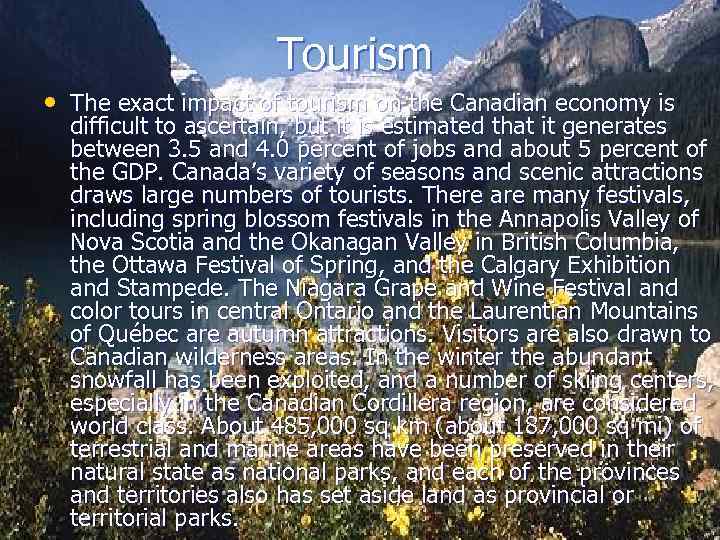 Tourism • The exact impact of tourism on the Canadian economy is difficult to ascertain, but it is estimated that it generates between 3. 5 and 4. 0 percent of jobs and about 5 percent of the GDP. Canada’s variety of seasons and scenic attractions draws large numbers of tourists. There are many festivals, including spring blossom festivals in the Annapolis Valley of Nova Scotia and the Okanagan Valley in British Columbia, the Ottawa Festival of Spring, and the Calgary Exhibition and Stampede. The Niagara Grape and Wine Festival and color tours in central Ontario and the Laurentian Mountains of Québec are autumn attractions. Visitors are also drawn to Canadian wilderness areas. In the winter the abundant snowfall has been exploited, and a number of skiing centers, especially in the Canadian Cordillera region, are considered world class. About 485, 000 sq km (about 187, 000 sq mi) of terrestrial and marine areas have been preserved in their natural state as national parks, and each of the provinces and territories also has set aside land as provincial or territorial parks.
 The end.