


 Скачать презентацию C 3 Curriculum Learning for Life not for
f67b8eed11a1abbfc1058a89a6e63038.ppt
- Количество слайдов: 28
 C 3 Curriculum ‘Learning for Life, not for School’
 ‘Learning for life, not for school’ n Take care of yourself n Take care of each other n Take care of this place
 Glossopdale’s Context n n n 11 -18 comprehensive school with 1, 900 students including Post-16 of 349 We became a specialist arts college in September 2005 On 3 sites – site designations changed as from September 2006 Glossop and Talbot Sites; yr 9, KS 4 & Post-16. Talbot Site is a Post-16 Centre Hadfield Site: Years 7 & 8 – Foundation Curriculum
 n n n Big logistical problems created an opportunity to develop new curriculum models The introduction of a Foundation Curriculum gave the opportunity to develop a distinctive ethos for years 7 & 8 on the Hadfield Site From the start we involved a creative partner – Debbie Hedderwick from ‘Learning Through Arts’ in helping us develop our Foundation Curriculum
 “Only Connect” – working with creative partners • Research question: How can the connections made between the school and creative practitioners support development of creative teaching and learning in the instigation of the Opening Minds curriculum?
 Aims of the partnership • for Learning Through Arts to support Glossopdale Community College in their preparations for and implementation of an Opening Minds creative curriculum. • for practitioners to gain experience and knowledge in the application of a Opening Minds curriculum within structure of a secondary school timetable.
 RSA Opening Minds • A creative approach to teaching and learning. • Core competences at the heart of the work. • Cross curricular approach through topic based learning. • Integration of arts in the process seen as fundamental. • Opportunities for extended work, including partnerships with visiting practitioners. • Engagement, enjoyment - students and teachers.
 Core competences • Competences for: – – – Learning Citizenship Relating to people Managing situations Managing information • Project based learning: – Identity – Culture – Business and Enterprise – Past and Present – Future Worlds – Environment
 C 3 • C 3 represents the integrated delivery of: Arts (visual and performing) Humanities & Citizenship, and Technology (Design and Food Technology) • A core team of staff works together to implement the C 3 curriculum • RSA ‘Opening Minds’ flows across all curricular areas, including English, Science and Maths. These core subjects identify specific ‘OM’ competences and link in with six projects over the school year
 Thinking skills and creative teaching skills • Thinking skills • The creative teacher • Myself: my strengths and interests • VAK learning • Group work - team building • Planning for projects
 New approaches to teaching • Game playing • Using visual and performing arts • Who am I - Identity project activities • Partnership working • Planning input to Identity project
 Evaluation with Carol Brown • • • Integral to process Built into fabric of day Student voice Creative processes Thinking skills
 6 staff CPD workshops with creative practitioners • focusing on using the arts as vehicle for creative teaching and learning • experience new ways of working • models of successful practice in other partnership projects • specific planning for each C 3 project area incorporating arts processes
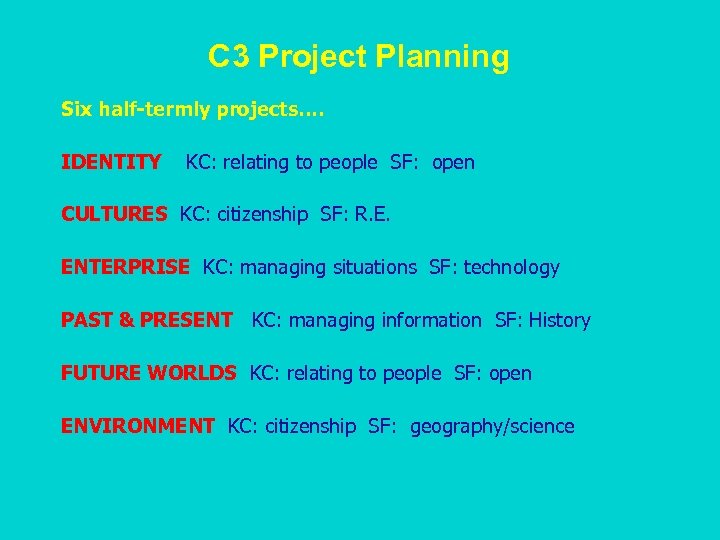 C 3 Project Planning Six half-termly projects…. IDENTITY KC: relating to people SF: open CULTURES KC: citizenship SF: R. E. ENTERPRISE KC: managing situations SF: technology PAST & PRESENT KC: managing information SF: History FUTURE WORLDS KC: relating to people SF: open ENVIRONMENT KC: citizenship SF: geography/science
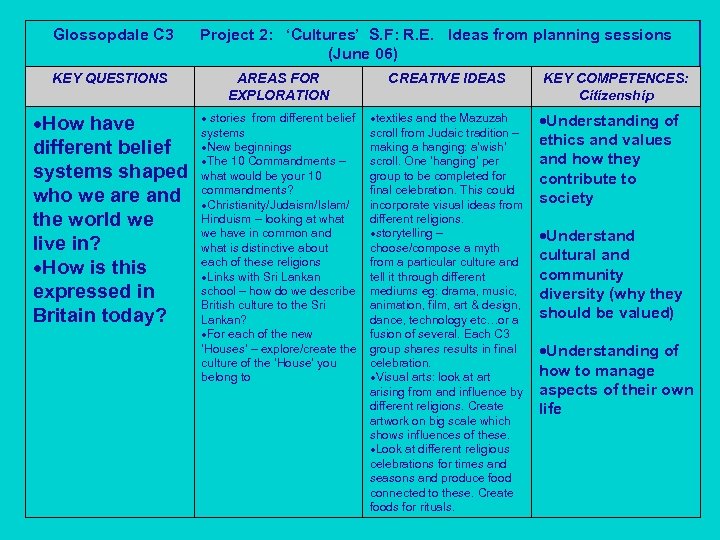 Glossopdale C 3 Project 2: ‘Cultures’ S. F: R. E. Ideas from planning sessions (June 06) KEY QUESTIONS AREAS FOR EXPLORATION CREATIVE IDEAS How have different belief systems shaped who we are and the world we live in? How is this expressed in Britain today? stories from different belief systems New beginnings The 10 Commandments – what would be your 10 commandments? Christianity/Judaism/Islam/ Hinduism – looking at what we have in common and what is distinctive about each of these religions Links with Sri Lankan school – how do we describe British culture to the Sri Lankan? For each of the new ‘Houses’ – explore/create the culture of the ‘House’ you belong to textiles and the Mazuzah scroll from Judaic tradition – making a hanging: a’wish’ scroll. One ‘hanging’ per group to be completed for final celebration. This could incorporate visual ideas from different religions. storytelling – choose/compose a myth from a particular culture and tell it through different mediums eg: drama, music, animation, film, art & design, dance, technology etc…or a fusion of several. Each C 3 group shares results in final celebration. Visual arts: look at arising from and influence by different religions. Create artwork on big scale which shows influences of these. Look at different religious celebrations for times and seasons and produce food connected to these. Create foods for rituals. KEY COMPETENCES: Citizenship Understanding of ethics and values and how they contribute to society Understand cultural and community diversity (why they should be valued) Understanding of how to manage aspects of their own life
 Project 1 – ‘Identity/New Beginnings’ • 8 creative practitioners working with all students for two days over the 6 week project • explore ideas and create work on theme of Identity at the beginning and towards the completion of their project. • CP’s from outside and within school
 Creative practitioners exploring ideas about identity through variety of different arts processes • • Textiles, banner making Recycled materials Hat making Mosaic Ceramics and plaster casting Film-making and animation Drama Dance
 The process: Wendy Johnson, ceramicist • The process of using arts activity to explore ideas, let them grow, work together, conquer disappointment, and achieve a result as a team.
 What did the students learn • • • They learnt about: process, developing ideas/making work each other disappointment/problem solving different people handling different situations differently • working together as a team • whatever contribution you make, it is part of the whole • group identity: overview of everyone’s thoughts
 How is the ‘C 3’ Curriculum organised?
 • Duration: 6 x half-term projects • Each project has key questions as a starting point and prescribed outcomes. • Each project has a ’launch’ and a ‘celebration’ to conclude. • Input from creative partners and specialist staff at various stages during each project.
 Outcomes n n n Subject specific outcomes – most projects have a subject focus Competences visited – each project also focusses on a key competence Record of work completed (inc. digital record, images, artefacts etc…)
 Logistics n n n 8 Yr 7 C 3 groups Each C 3 teacher to have a ‘base group’ whom they will meet at least once a week throughout the year, but more at the beginning of the year. Each C 3 group will ‘visit’ other teachers and creative partners during a project. This pattern is flexible according to the learning opportunities being delivered.
 n n n Monday – C 3 day for Year 8 Tuesday – C 3 day for Year 7 Additionally each year group has two halfday slots during the week Students work with their base group tutor for part of C 3 and visit subject areas on a rota basis for the rest. Additional learning activities ‘float’ above this eg: film and animation, some drama sessions, sessions delivered by creative practitioners
 n n n The planning group for each project determines the dynamic of curriculum delivery in consultation with subject specialists. A core planning/review team meets weekly for 1 hour Home Study during each project supports the outcomes and the C 3 base group tutor monitors this. Subject specialist teachers may require students to complete additional tasks.
 Project 4: ‘Chatsworth’ – History subject focus Drama: exploring through role play, hot-seating etc…life of the estate workers in 17 thcentury – 19 th. century Dance: fusion of tudor and street dance styles Music: Programme music – promenade through gardens Visual Arts: portraiture & costume Media Arts: creating & editing film footage to convey messages to different audiences A day visit to Chatsworth is included in the project
 Additional Staffing n n n Full-time technician also as instructor film/animation creation Dance animateur Graduate teacher trainee in drama Specialist staff giving ‘masterclasses’ eg: in drama and entire arts faculty used as staff pool as appropriate on whole-day arts sessions Post-16 students
 Contact us…. johnh 34@glossopdale. derbyshire. sch. uk christopher. ohara@tesco. net Glossopdale phone: 01457862336