 Скачать презентацию Byzantine fault tolerance Jinyang Li With PBFT slides
465ecb56cf5b25771052f7e7c0cda6ea.ppt
- Количество слайдов: 29



Byzantine fault tolerance Jinyang Li With PBFT slides from Liskov
What we’ve learnt so far: tolerate fail-stop failures • Traditional RSM tolerates benign failures – Node crashes – Network partitions • A RSM w/ 2 f+1 replicas can tolerate f simultaneous crashes
Byzantine faults • Nodes fail arbitrarily – Failed node performs incorrect computation – Failed nodes collude • Causes: attacks, software/hardware errors • Examples: – Client asks bank to deposit $100, a Byzantine bank server substracts $100 instead. – Client asks file system to store f 1=“aaa”. A Byzantine server returns f 1=“bbb” to clients.
Strawman defense • Clients sign inputs. • Clients verify computation based on signed inputs. • Example: C stores signed file f 1=“aaa” with server. C verifies that returned f 1 is signed correctly. • Problems: – Byzantine node can return stale/correct computation • E. g. Client stores signed f 1=“aaa” and later stores signed f 1=“bbb”, a Byzantine node can always return f 1=“aaa”. – Inefficient: clients have to perform computations!
PBFT ideas • PBFT, “Practical Byzantine Fault Tolerance”, M. Castro and B. Liskov, SOSP 1999 • Replicate service across many nodes – Assumption: only a small fraction of nodes are Byzantine – Rely on a super-majority of votes to decide on correct computation. • PBFT property: tolerates <=f failures using a RSM with 3 f+1 replicas
Why doesn’t traditional RSM work with Byzantine nodes? • Cannot rely on the primary to assign seqno – Malicious primary can assign the same seqno to different requests! • Cannot use Paxos for view change – Paxos uses a majority accept-quorum to tolerate f benign faults out of 2 f+1 nodes – Does the intersection of two quorums always contain one honest node? – Bad node tells different things to different quorums! • E. g. tell N 1 accept=val 1 and tell N 2 accept=val 2
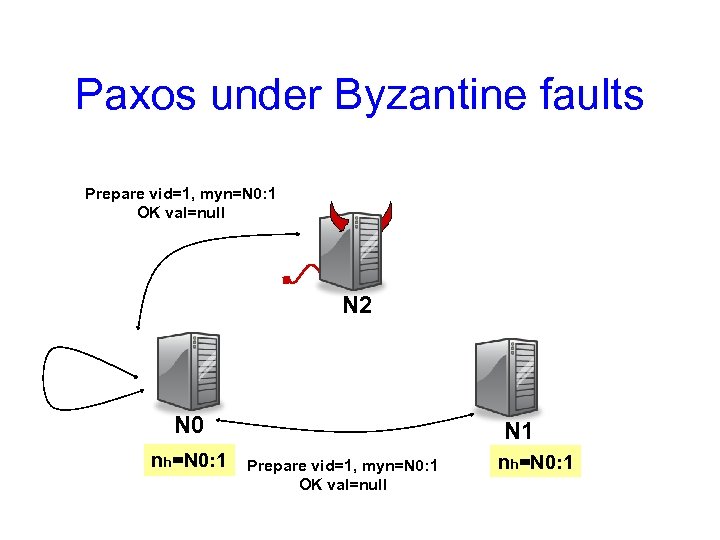
Paxos under Byzantine faults Prepare vid=1, myn=N 0: 1 OK val=null N 2 N 0 nh=N 0: 1 N 1 Prepare vid=1, myn=N 0: 1 OK val=null nh=N 0: 1
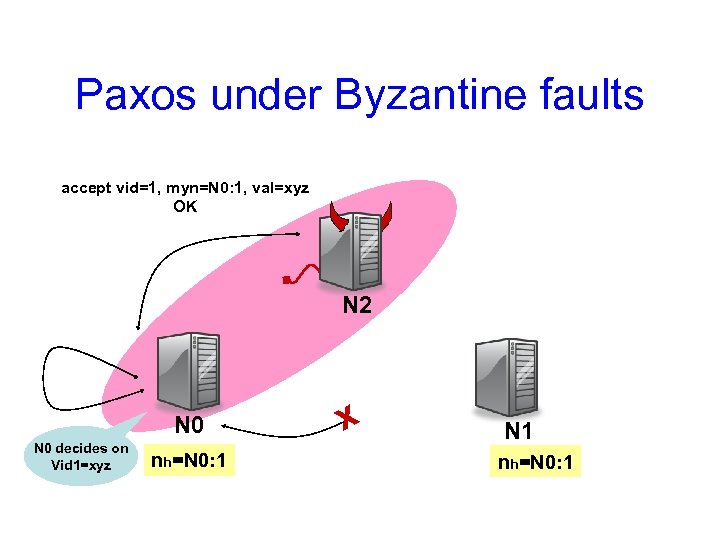
Paxos under Byzantine faults accept vid=1, myn=N 0: 1, val=xyz OK N 2 N 0 decides on Vid 1=xyz nh=N 0: 1 X N 1 nh=N 0: 1
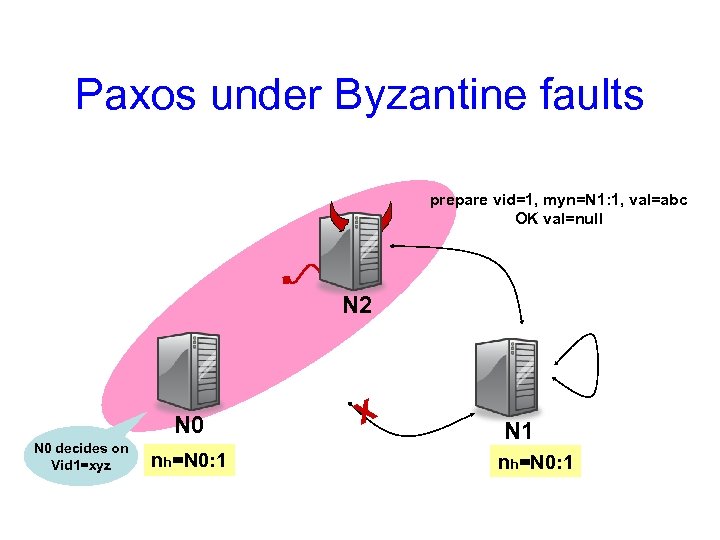
Paxos under Byzantine faults prepare vid=1, myn=N 1: 1, val=abc OK val=null N 2 N 0 decides on Vid 1=xyz nh=N 0: 1 X N 1 nh=N 0: 1
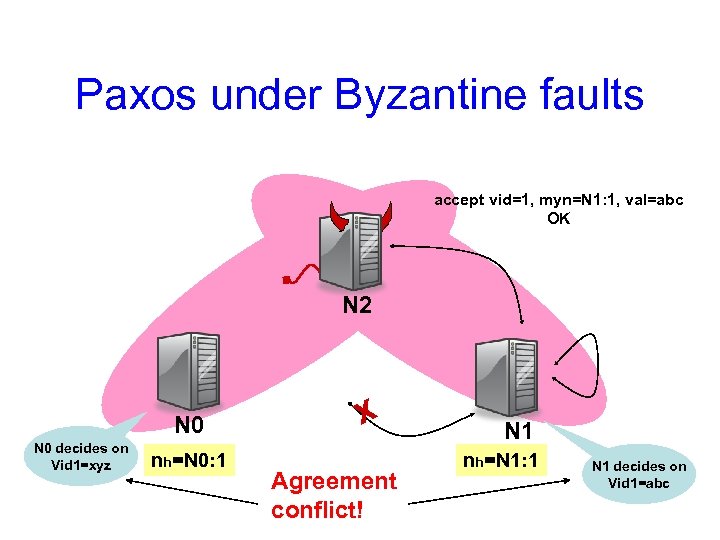
Paxos under Byzantine faults accept vid=1, myn=N 1: 1, val=abc OK N 2 N 0 decides on Vid 1=xyz nh=N 0: 1 X Agreement conflict! N 1 nh=N 1: 1 N 1 decides on Vid 1=abc
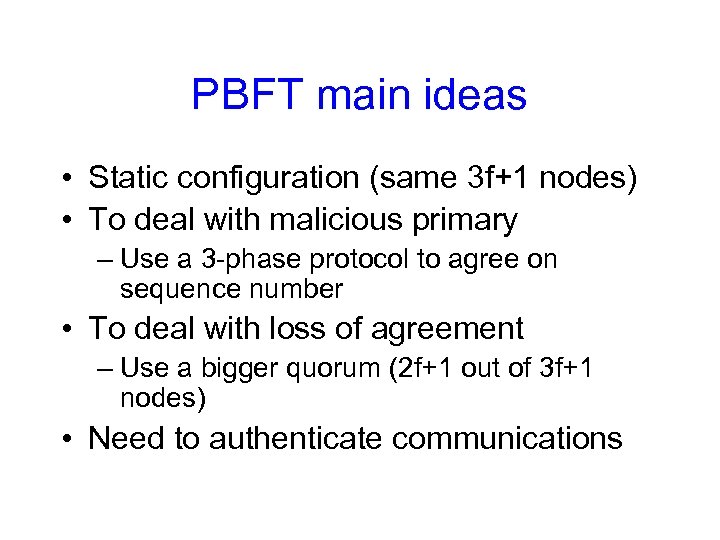
PBFT main ideas • Static configuration (same 3 f+1 nodes) • To deal with malicious primary – Use a 3 -phase protocol to agree on sequence number • To deal with loss of agreement – Use a bigger quorum (2 f+1 out of 3 f+1 nodes) • Need to authenticate communications
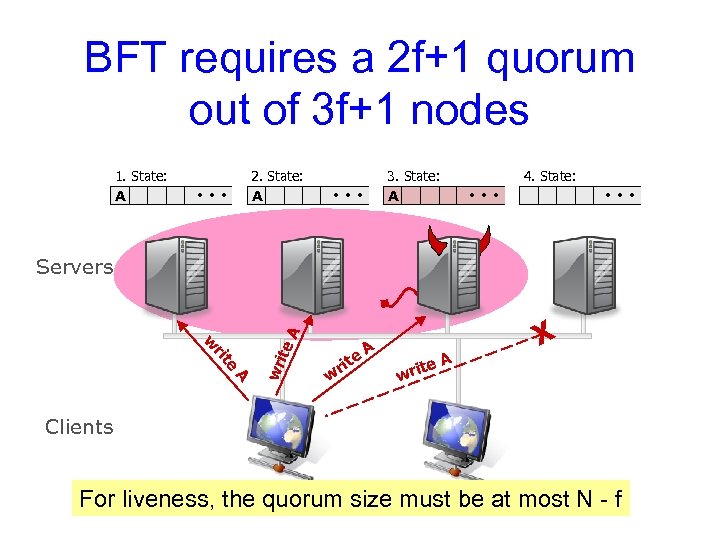
BFT requires a 2 f+1 quorum out of 3 f+1 nodes 1. State: A … 2. State: A … … 3. State: A 4. State: … w e rit A wr ite A Servers e w rit A te wri A X Clients For liveness, the quorum size must be at most N - f
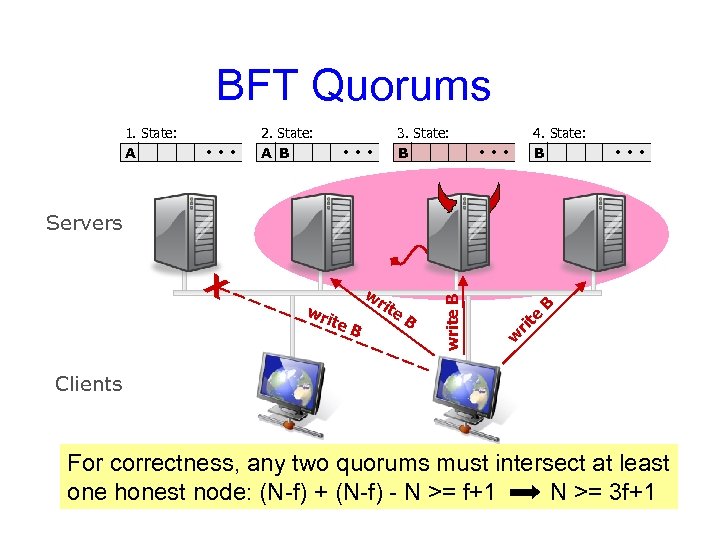
BFT Quorums 1. State: A … … 2. State: A B 3. State: B … 4. State: B … B B te te B ri wr ite w X write B Servers Clients For correctness, any two quorums must intersect at least one honest node: (N-f) + (N-f) - N >= f+1 N >= 3 f+1
PBFT Strategy • Primary runs the protocol in the normal case • Replicas watch the primary and do a view change if it fails
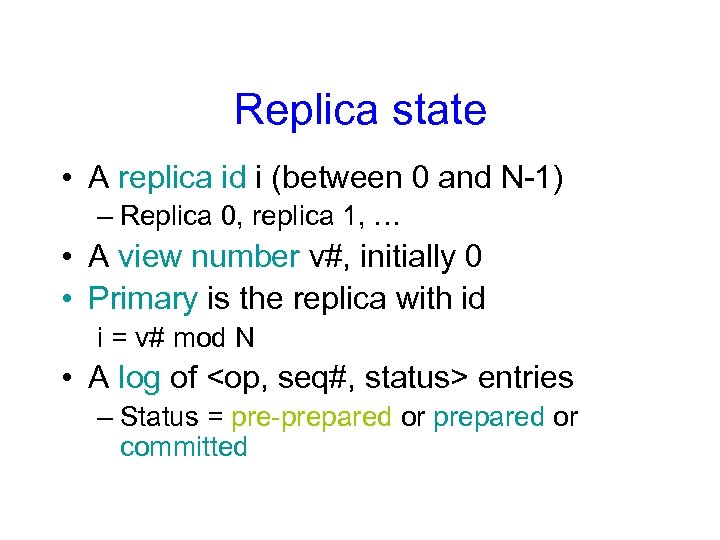
Replica state • A replica id i (between 0 and N-1) – Replica 0, replica 1, … • A view number v#, initially 0 • Primary is the replica with id i = v# mod N • A log of <op, seq#, status> entries – Status = pre-prepared or committed
Normal Case • Client sends request to primary – or to all
Normal Case • Primary sends pre-prepare message to all • Pre-prepare contains <v#, seq#, op> – Records operation in log as pre-prepared – Keep in mind that primary might be malicious • Send different seq# for the same op to different replicas • Use a duplicate seq# for op
Normal Case • Replicas check the pre-prepare and if it is ok: – Record operation in log as pre-prepared – Send prepare messages to all – Prepare contains <i, v#, seq#, op> • All to all communication
Normal Case: • Replicas wait for 2 f+1 matching prepares – Record operation in log as prepared – Send commit message to all – Commit contains <i, v#, seq#, op> • What does this stage achieve: – All honest nodes that are prepared prepare the same value
Normal Case: • Replicas wait for 2 f+1 matching commits – Record operation in log as committed – Execute the operation – Send result to the client
Normal Case • Client waits for f+1 matching replies
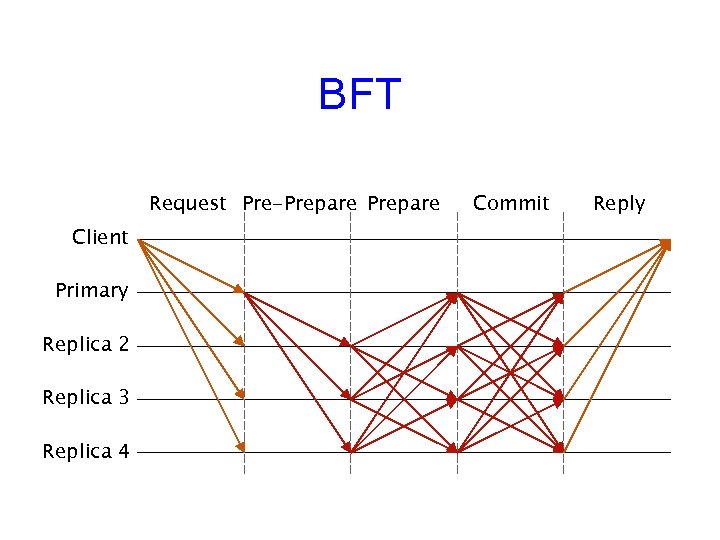
BFT Request Pre-Prepare Client Primary Replica 2 Replica 3 Replica 4 Commit Reply
View Change • Replicas watch the primary • Request a view change • Commit point: when 2 f+1 replicas have prepared
View Change • Replicas watch the primary • Request a view change – send a do-viewchange request to all – new primary requires 2 f+1 requests – sends new-view with this certificate • Rest is similar
Additional Issues • State transfer • Checkpoints (garbage collection of the log) • Selection of the primary • Timing of view changes
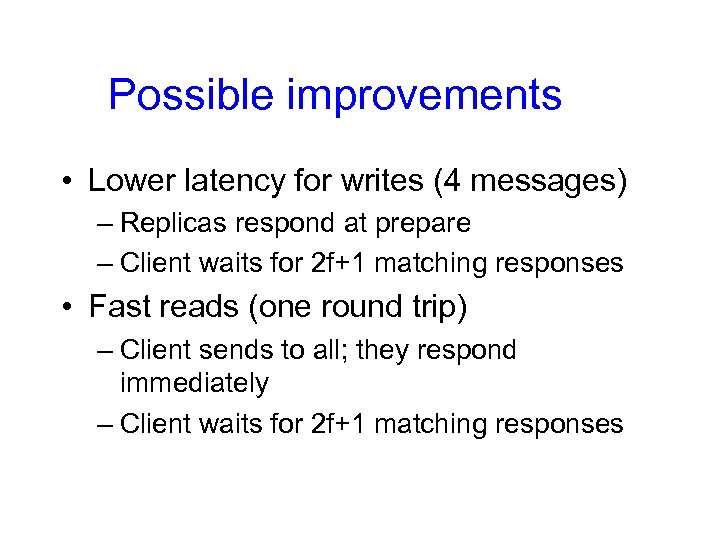
Possible improvements • Lower latency for writes (4 messages) – Replicas respond at prepare – Client waits for 2 f+1 matching responses • Fast reads (one round trip) – Client sends to all; they respond immediately – Client waits for 2 f+1 matching responses
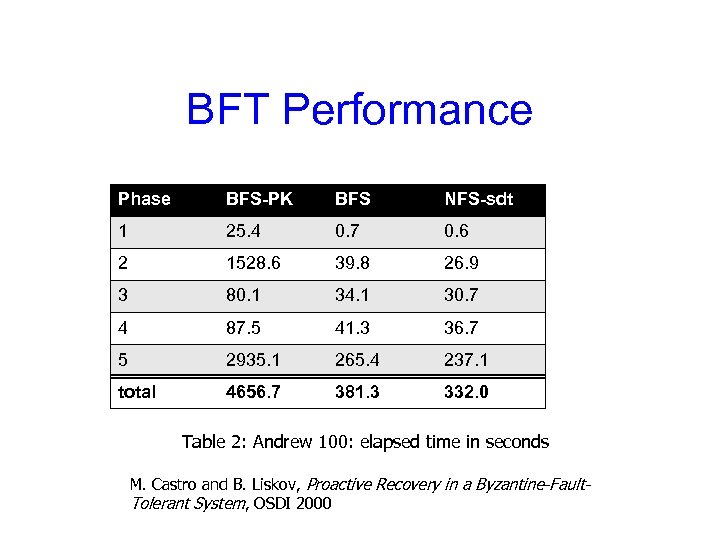
BFT Performance Phase BFS-PK BFS NFS-sdt 1 25. 4 0. 7 0. 6 2 1528. 6 39. 8 26. 9 3 80. 1 34. 1 30. 7 4 87. 5 41. 3 36. 7 5 2935. 1 265. 4 237. 1 total 4656. 7 381. 3 332. 0 Table 2: Andrew 100: elapsed time in seconds M. Castro and B. Liskov, Proactive Recovery in a Byzantine-Fault. Tolerant System, OSDI 2000
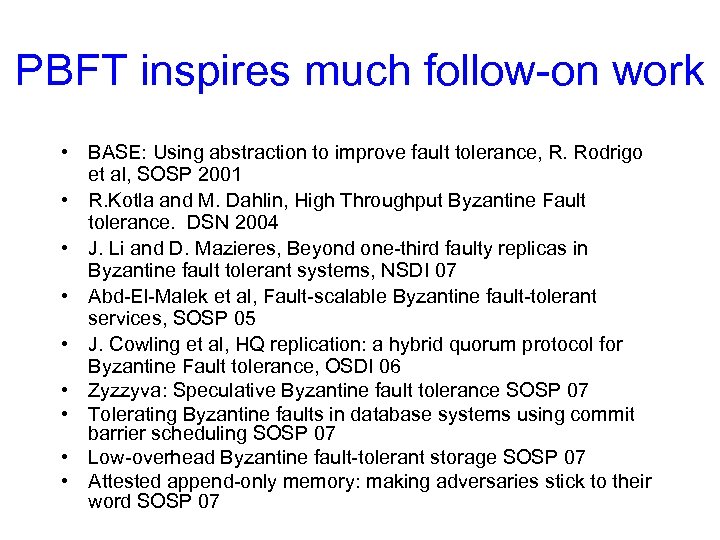
PBFT inspires much follow-on work • BASE: Using abstraction to improve fault tolerance, R. Rodrigo et al, SOSP 2001 • R. Kotla and M. Dahlin, High Throughput Byzantine Fault tolerance. DSN 2004 • J. Li and D. Mazieres, Beyond one-third faulty replicas in Byzantine fault tolerant systems, NSDI 07 • Abd-El-Malek et al, Fault-scalable Byzantine fault-tolerant services, SOSP 05 • J. Cowling et al, HQ replication: a hybrid quorum protocol for Byzantine Fault tolerance, OSDI 06 • Zyzzyva: Speculative Byzantine fault tolerance SOSP 07 • Tolerating Byzantine faults in database systems using commit barrier scheduling SOSP 07 • Low-overhead Byzantine fault-tolerant storage SOSP 07 • Attested append-only memory: making adversaries stick to their word SOSP 07
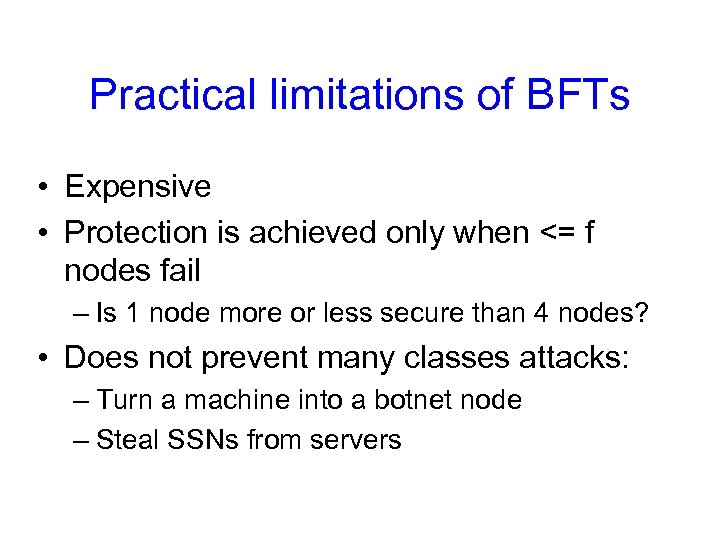
Practical limitations of BFTs • Expensive • Protection is achieved only when <= f nodes fail – Is 1 node more or less secure than 4 nodes? • Does not prevent many classes attacks: – Turn a machine into a botnet node – Steal SSNs from servers
Скачать презентацию Byzantine fault tolerance Jinyang Li With PBFT slides
465ecb56cf5b25771052f7e7c0cda6ea.ppt