 Скачать презентацию By The Numbers The Public Costs of Teen
f81b3b3a7acbf2043443a4edef77fa50.ppt
- Количество слайдов: 20



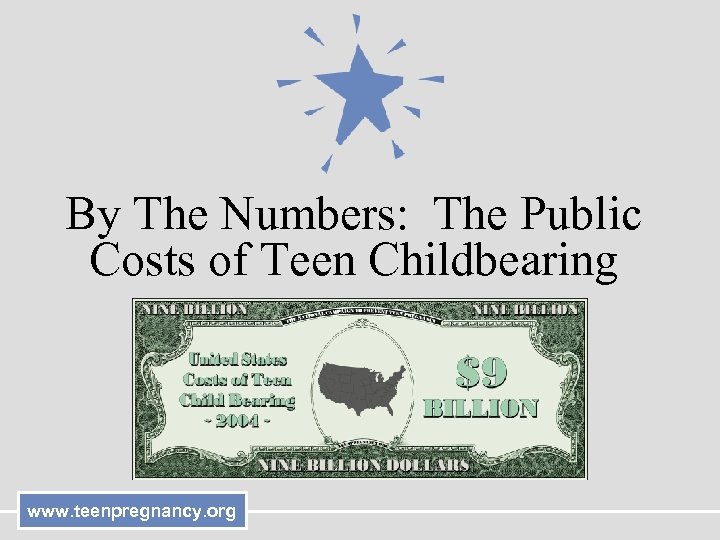
By The Numbers: The Public Costs of Teen Childbearing www. teenpregnancy. org
This Presentation Will Cover: Why Care? The Costs of Teen Childbearing www. teenpregnancy. org 2

Why Care? www. teenpregnancy. org
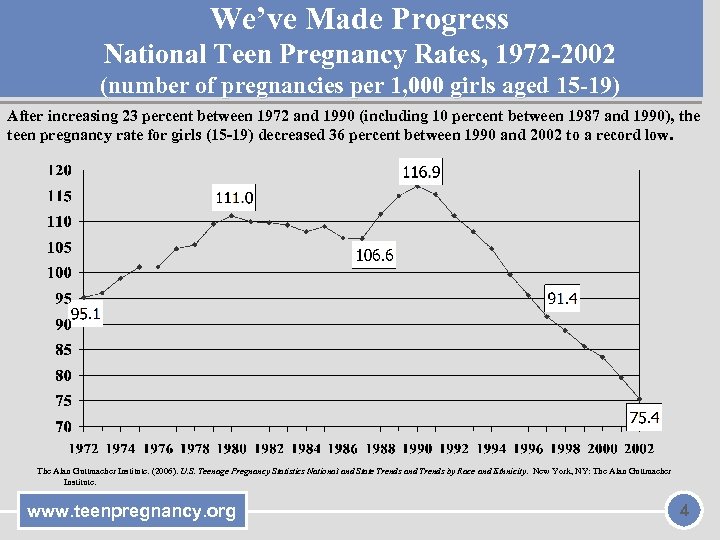
We’ve Made Progress National Teen Pregnancy Rates, 1972 -2002 (number of pregnancies per 1, 000 girls aged 15 -19) After increasing 23 percent between 1972 and 1990 (including 10 percent between 1987 and 1990), the teen pregnancy rate for girls (15 -19) decreased 36 percent between 1990 and 2002 to a record low. The Alan Guttmacher Institute. (2006). U. S. Teenage Pregnancy Statistics National and State Trends and Trends by Race and Ethnicity. New York, NY: The Alan Guttmacher Institute. www. teenpregnancy. org 4
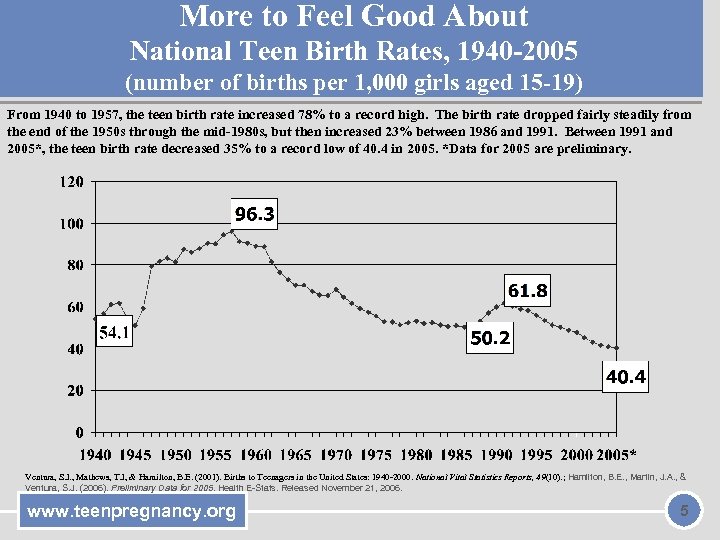
More to Feel Good About National Teen Birth Rates, 1940 -2005 (number of births per 1, 000 girls aged 15 -19) From 1940 to 1957, the teen birth rate increased 78% to a record high. The birth rate dropped fairly steadily from the end of the 1950 s through the mid-1980 s, but then increased 23% between 1986 and 1991. Between 1991 and 2005*, the teen birth rate decreased 35% to a record low of 40. 4 in 2005. *Data for 2005 are preliminary. Ventura, S. J. , Mathews, T. J, & Hamilton, B. E. (2001). Births to Teenagers in the United States: 1940 -2000. National Vital Statistics Reports, 49(10). ; Hamilton, B. E. , Martin, J. A. , & Ventura, S. J. (2006). Preliminary Data for 2005. Health E-Stats. Released November 21, 2006. www. teenpregnancy. org 5
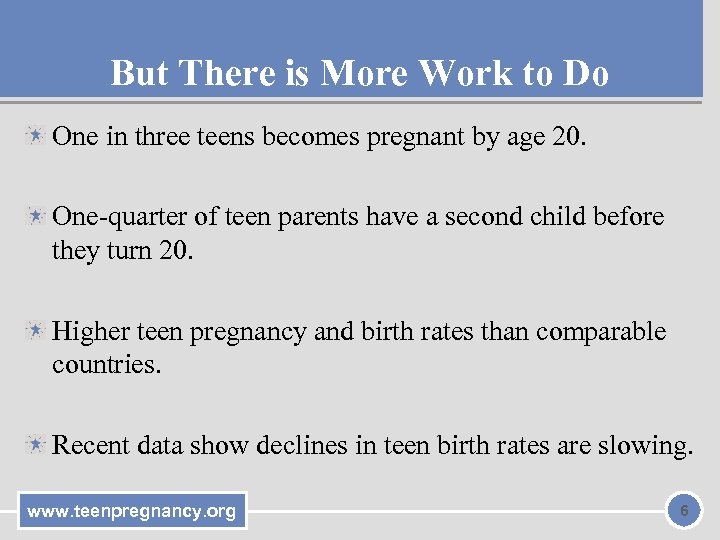
But There is More Work to Do One in three teens becomes pregnant by age 20. One-quarter of teen parents have a second child before they turn 20. Higher teen pregnancy and birth rates than comparable countries. Recent data show declines in teen birth rates are slowing. www. teenpregnancy. org 6
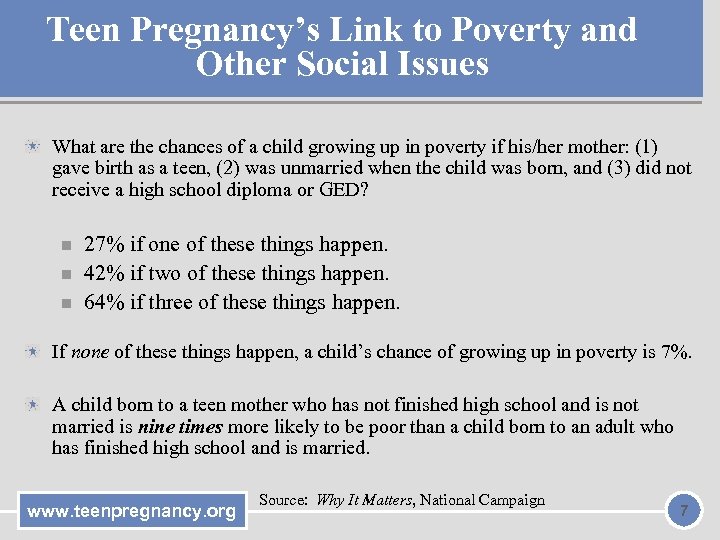
Teen Pregnancy’s Link to Poverty and Other Social Issues What are the chances of a child growing up in poverty if his/her mother: (1) gave birth as a teen, (2) was unmarried when the child was born, and (3) did not receive a high school diploma or GED? n n n 27% if one of these things happen. 42% if two of these things happen. 64% if three of these things happen. If none of these things happen, a child’s chance of growing up in poverty is 7%. A child born to a teen mother who has not finished high school and is not married is nine times more likely to be poor than a child born to an adult who has finished high school and is married. www. teenpregnancy. org Source: Why It Matters, National Campaign 7
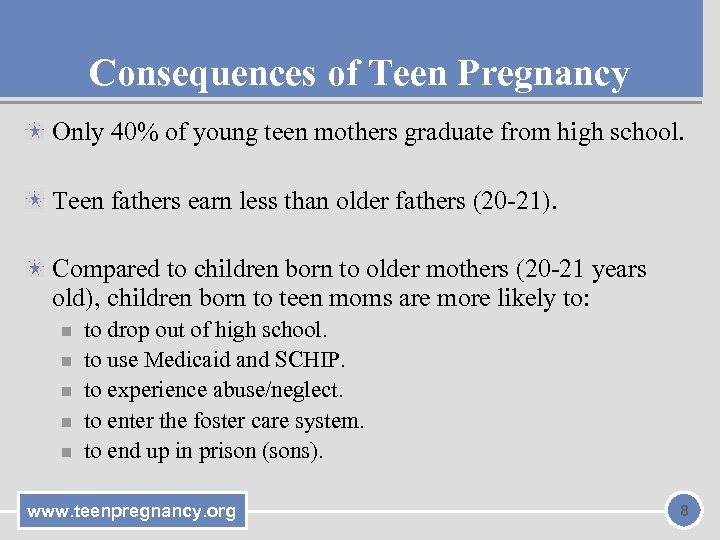
Consequences of Teen Pregnancy Only 40% of young teen mothers graduate from high school. Teen fathers earn less than older fathers (20 -21). Compared to children born to older mothers (20 -21 years old), children born to teen moms are more likely to: n n n to drop out of high school. to use Medicaid and SCHIP. to experience abuse/neglect. to enter the foster care system. to end up in prison (sons). www. teenpregnancy. org 8

The Costs of Teen Childbearing www. teenpregnancy. org
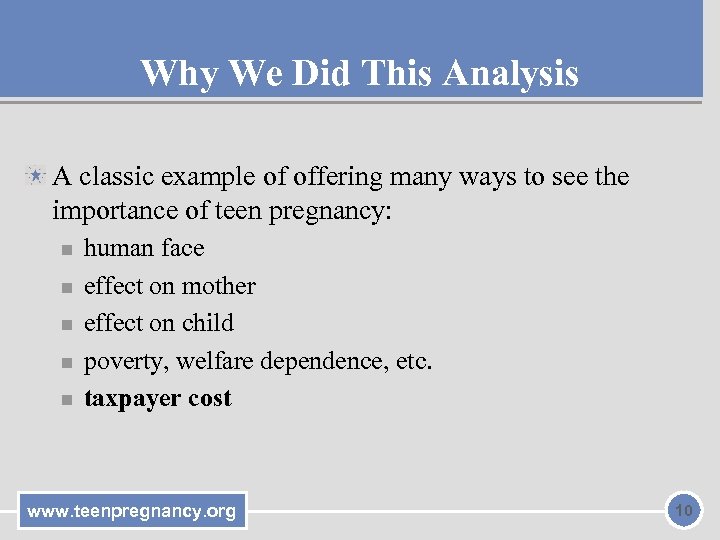
Why We Did This Analysis A classic example of offering many ways to see the importance of teen pregnancy: n n n human face effect on mother effect on child poverty, welfare dependence, etc. taxpayer cost www. teenpregnancy. org 10
An Overview By The Numbers: The Public Costs of Teen Childbearing Project goal: Measure the costs that could be averted if teen mothers, 19 and younger, delay their first birth to 20 -21 years old. n What is the impact on the young mother and her child’s subsequent life outcomes and what does this cost taxpayers? Both national and state-specific cost estimates have been measured. www. teenpregnancy. org 11
Costs Included in the Analysis Costs linked to teen moms n n Public assistance Lost tax revenue Costs linked to the children of teen parents n n Lost tax revenue Public Health Care Incarceration of sons Child welfare Costs linked to teen fathers n Lost tax revenue www. teenpregnancy. org 12
National Findings Teen childbearing costs taxpayers at least $9. 1 billion annually. n Total cost breakdown is $8. 6 billion for 17 and younger and $0. 5 billion for 18 -19 year olds. Average annual public sector cost associated with a child born to a mother aged 17 and younger is $4, 080. www. teenpregnancy. org 13
National Findings Most of the costs of teen childbearing are associated with negative consequences for the children of teen mothers and include: n n $1. 9 billion for increased public sector health care costs $2. 3 billion for increased child welfare costs $2. 1 billion for increased costs for state prison systems (among adult sons of teen mothers) $2. 9 billion in lost tax revenue due to lower taxes paid by the children of teen mothers over their own adult lifetimes. www. teenpregnancy. org 14
National Findings: Cumulative Costs and Savings Between 1991 and 2004, there have been more than 6. 7 million teen births in the US. n This cost taxpayers a total of $161 billion between 1991 and 2004. The one-third decline in the teen birth rate between 1991 and 2004 yielded substantial cost savings. n Taxpayers saved $6. 7 billion in 2004 alone. www. teenpregnancy. org 15
National Findings: Cumulative Costs and Savings There were approximately 6. 8 million teen births in the United States between 1991 and 2004. The estimated cumulative public costs of teen childbearing during this time period are $161 billion. www. teenpregnancy. org 16
Costs for the Children of Teen Mothers Children of teen mothers are more likely to: n n n n Have decreased educational attainment Earn less money Suffer high rates of child abuse and neglect Grow up poor Live in single-parent households Enter the child-welfare system Become teen mothers themselves www. teenpregnancy. org 17
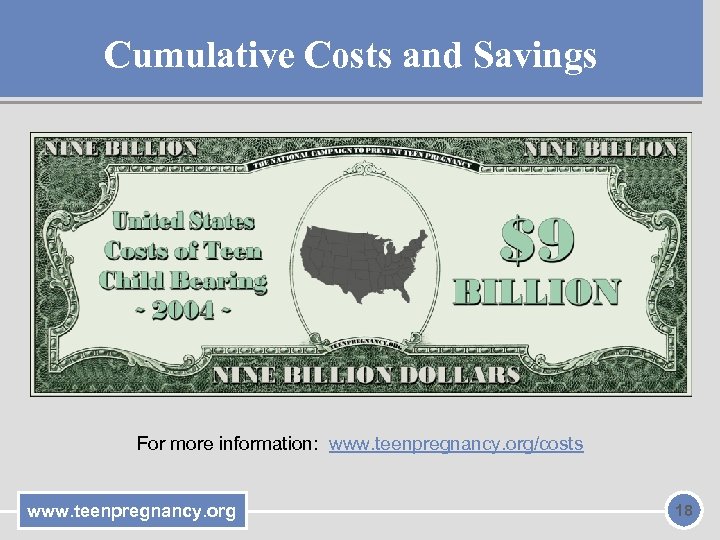
Cumulative Costs and Savings For more information: www. teenpregnancy. org/costs www. teenpregnancy. org 18
What Can You Do? Recognize the problem isn’t solved. Help parents. Support proven teen pregnancy interventions. Support youth programs more broadly. Set a goal. www. teenpregnancy. org 19

Thank You! Please visit our website at www. teenpregnancy. org 20
Скачать презентацию By The Numbers The Public Costs of Teen
f81b3b3a7acbf2043443a4edef77fa50.ppt