 Скачать презентацию By results of the last years Kazcom bank
слайды к DIP.pptx
- Количество слайдов: 10



By results of the last years Kazcom bank is the leader of the banking sector on the volume of assets: its share in the market makes 19, 4%, it also is leading bank on crediting and deposits, the share on the volume of a loan portfolio made 20, 9%, and on deposits of clients 17, 7%.
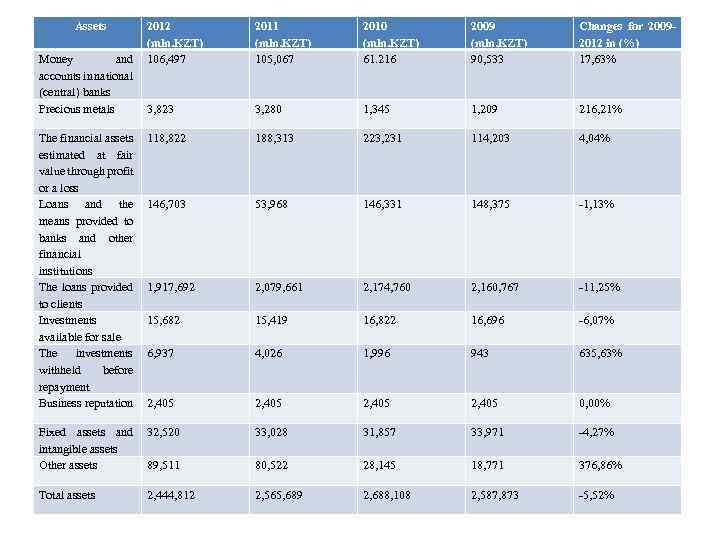
Assets 2012 (mln. KZT) 106, 497 2011 (mln. KZT) 105, 067 2010 (mln. KZT) 61. 216 2009 (mln. KZT) 90, 533 Changes for 20092012 in (%) 17, 63% 3, 823 3, 280 1, 345 1, 209 216, 21% The financial assets estimated at fair value through profit or a loss Loans and the means provided to banks and other financial institutions The loans provided to clients Investments available for sale The investments withheld before repayment Business reputation 118, 822 188, 313 223, 231 114, 203 4, 04% 146, 703 53, 968 146, 331 148, 375 -1, 13% 1, 917, 692 2, 079, 661 2, 174, 760 2, 160, 767 -11, 25% 15, 682 15, 419 16, 822 16, 696 -6, 07% 6, 937 4, 026 1, 996 943 635, 63% 2, 405 0, 00% Fixed assets and intangible assets Other assets 32, 520 33, 028 31, 857 33, 971 -4, 27% 89, 511 80, 522 28, 145 18, 771 376, 86% Total assets 2, 444, 812 2, 565, 689 2, 688, 108 2, 587, 873 -5, 52% Money and accounts in national (central) banks Precious metals
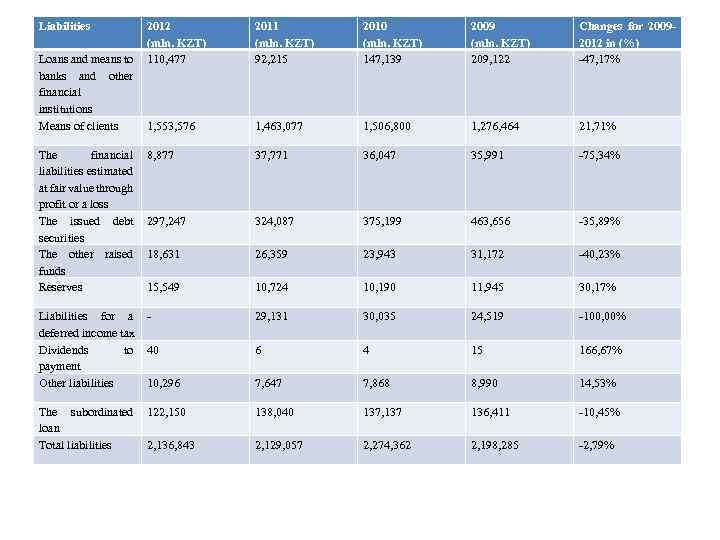
Liabilities 2012 (mln. KZT) 110, 477 2011 (mln. KZT) 92, 215 2010 (mln. KZT) 147, 139 2009 (mln. KZT) 209, 122 Changes for 20092012 in (%) -47, 17% 1, 553, 576 1, 463, 077 1, 506, 800 1, 276, 464 21, 71% The financial liabilities estimated at fair value through profit or a loss The issued debt securities The other raised funds Reserves 8, 877 37, 771 36, 047 35, 991 -75, 34% 297, 247 324, 087 375, 199 463, 656 -35, 89% 18, 631 26, 359 23, 943 31, 172 -40, 23% 15, 549 10, 724 10, 190 11, 945 30, 17% Liabilities for a deferred income tax Dividends to payment Other liabilities - 29, 131 30, 035 24, 519 -100, 00% 40 6 4 15 166, 67% 10, 296 7, 647 7, 868 8, 990 14, 53% The subordinated loan Total liabilities 122, 150 138, 040 137, 137 136, 411 -10, 45% 2, 136, 843 2, 129, 057 2, 274, 362 2, 198, 285 -2, 79% Loans and means to banks and other financial institutions Means of clients
• According to the analysis of deposit and non-depository sources, we can see that the volume of deposit sources is equal to 1. 5 trillion tenge or 74% from all sources, while the volume of non-depository sources is equal to 548 billion tenge or 26%. On the basis of analyzes, we identified that the depositis the main source of funding. In comparison with 2010 (69%) and 2011 (72%) Kaz. Com attracts more depository sources of funding. The cost of deposits 4, 2% for 2012, average cost of non -depository sources 7, 041. On the basis of this statistic we can say that deposits are cheaper sources than nondepository sources.
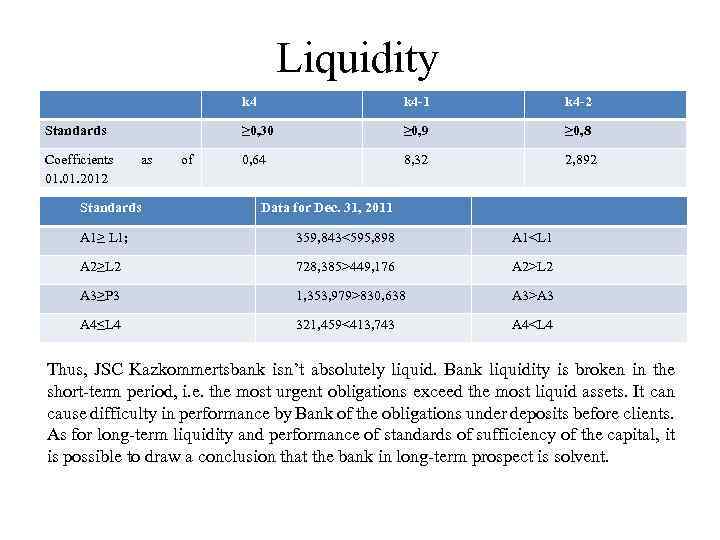
Liquidity k 4 Coefficients 01. 2012 as Standards of k 4 -2 ≥ 0, 30 Standards k 4 -1 ≥ 0, 9 ≥ 0, 8 0, 64 8, 32 2, 892 Data for Dec. 31, 2011 A 1≥ L 1; 359, 843<595, 898 A 1<L 1 A 2≥L 2 728, 385>449, 176 A 2>L 2 A 3≥P 3 1, 353, 979>830, 638 A 3>A 3 A 4≤L 4 321, 459<413, 743 A 4<L 4 Thus, JSC Kazkommertsbank isn’t absolutely liquid. Bank liquidity is broken in the short-term period, i. e. the most urgent obligations exceed the most liquid assets. It can cause difficulty in performance by Bank of the obligations under deposits before clients. As for long-term liquidity and performance of standards of sufficiency of the capital, it is possible to draw a conclusion that the bank in long-term prospect is solvent.
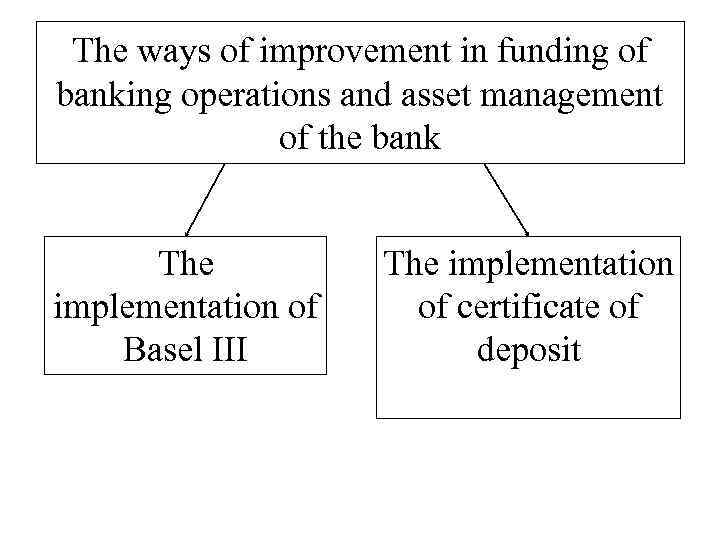
The ways of improvement in funding of banking operations and asset management of the bank The implementation of Basel III The implementation of certificate of deposit
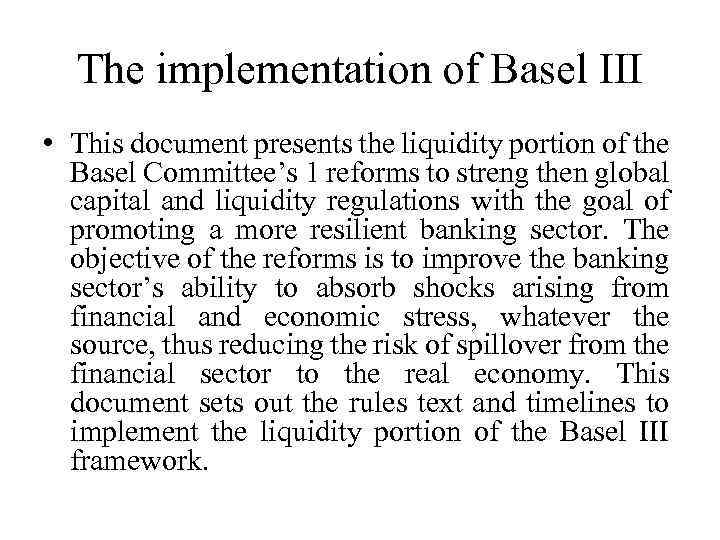
The implementation of Basel III • This document presents the liquidity portion of the Basel Committee’s 1 reforms to streng then global capital and liquidity regulations with the goal of promoting a more resilient banking sector. The objective of the reforms is to improve the banking sector’s ability to absorb shocks arising from financial and economic stress, whatever the source, thus reducing the risk of spillover from the financial sector to the real economy. This document sets out the rules text and timelines to implement the liquidity portion of the Basel III framework.
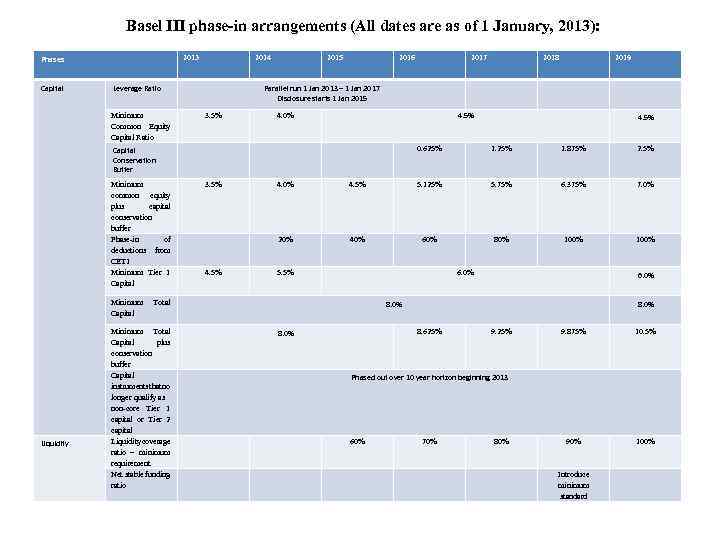
Basel III phase-in arrangements (All dates are as of 1 January, 2013): 2013 Phases Capital 2014 Leverage Ratio Minimum Common Equity Capital Ratio 2015 2016 Minimum Capital 3. 5% Liquidity 2019 4. 5% 4. 0% 4. 5% 0. 625% 3. 5% 1. 25% 1. 875% 2. 5% 4. 5% 5. 125% 5. 75% 6. 375% 7. 0% 20% 4. 5% 4. 0% 40% 60% 80% 100% 5. 5% 6. 0% Total Minimum Total Capital plus conservation buffer Capital instruments that no longer qualify as non-core Tier 1 capital or Tier 2 capital Liquidity coverage ratio – minimum requirement Net stable funding ratio 2018 Parallel run 1 Jan 2013 – 1 Jan 2017 Disclosure starts 1 Jan 2015 Capital Conservation Buffer Minimum common equity plus capital conservation buffer Phase-in of deductions from CET 1 Minimum Tier 1 Capital 2017 6. 0% 8. 625% 8. 0% 9. 25% 9. 875% 10. 5% 90% 100% Phased out over 10 year horizon beginning 2013 60% 70% 80% Introduce minimum standard
Current progress • On January 1, 2013 in Kazakhstan was planned to start a phased introduction of the new version of the document - Basel III - with the full transition to the new standards in 2015. However, it was postponed indefinitely. • According to the consolidated financial statements for 2012, the bank increased its profit before deductions for reserves and taxes by 28% (to 125 billion tenge). • But in the end the bank's net loss reached 130. 9 billion tenge (against a net profit of 23. 5 billion tenge a year earlier). Net interest margin increased from 3. 3% to 3. 9%, while corporate lending is partly offset by the growth of retail. • In the board was told that the net loss associated with the formation of onetime additional specific provisions for IFRS (International Financial Reporting Standards). Bank's capital reserve has reached 196 billion tenge. This was done in order to reduce the potential negative consequences for the bank in respect of regulatory capital, the volume of foreign exchange exposure and the amount of liquid assets. • Regulatory requirements for banks to part of the capital was increased in connection with the transition to the third "Basel“.
At the same time implementation of Basel III has both strengths and weaknesses. • Advantage of Basel III is the creation of additional capital. But it is impossible to ensure economic growth and stability of the banking system only by a single parameter - the capital. Also Basel directed towards the reduction of operational risk and liquidity risk. Weaknesses are that the banks will have to not only reduce the current minimum lending period exceeding one year, but also encourage customers to repay previously issued the medium and long term loans for balancing their assets and liabilities as soon as possible. Obviously, it will have negative impact on the domestic business. The second disadvantage is that it reduces competition and leads to the increase in number of the various micro-credit organizations.
Скачать презентацию By results of the last years Kazcom bank
слайды к DIP.pptx