 Скачать презентацию By Rahul Karangutkar 0951826 Parag Jain Atoosa
Ikea_case_study_2.pptx
- Количество слайдов: 18



By Rahul Karangutkar (0951826) Parag Jain () Atoosa Zand (0) Trung Seun Fayemiwo (0) Amanda (0)
Outline Introduction Vision And Mission Growth Geographical Scope Strategy Attractiveness Of Market Strategic Competencies Strategy
Introduction Ingvar Kamprad Elmtaryd Agunnaryd Founded: 1943 in Almhult, Smaland, Sweden Founder: Ingvar Kamprad Headquarters: The Netherlands Parent Company: INGKA Holding Industry: Retail Product: Self Assembly Furniture Chain of Product: Restaurant, Manufacturing, Housing, Revenue: € 23. 1 billion (2009) Employees: 127, 000 (2009) Area Served: Multinational 316 stores (2010) 699 million visitors (2010)
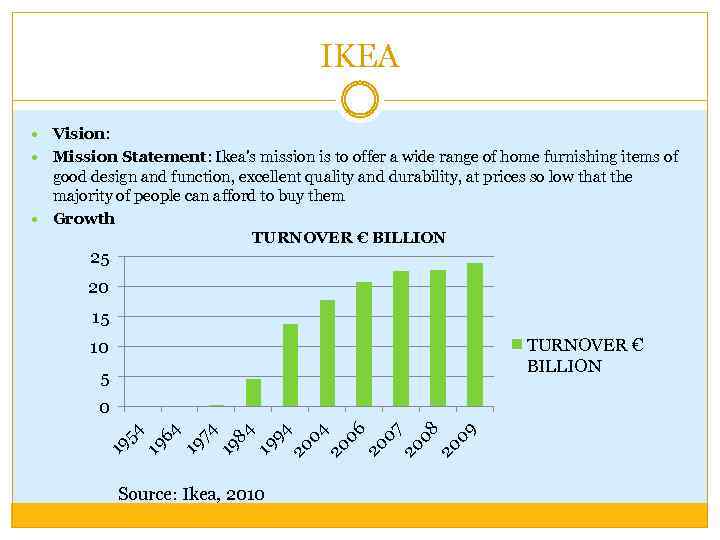
IKEA Vision: Mission Statement: Ikea's mission is to offer a wide range of home furnishing items of good design and function, excellent quality and durability, at prices so low that the majority of people can afford to buy them Growth TURNOVER € BILLION 25 20 15 TURNOVER € BILLION 10 5 Source: Ikea, 2010 09 20 08 20 07 20 06 20 04 20 94 19 84 19 74 19 64 19 19 54 0
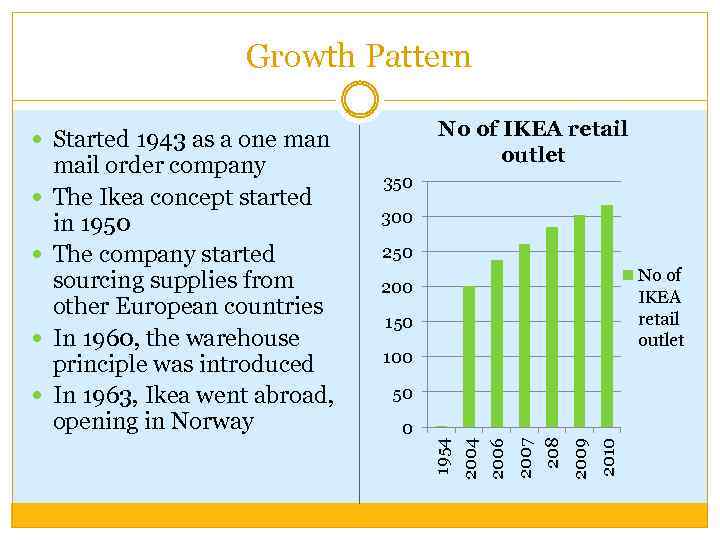
Growth Pattern No of IKEA retail outlet Started 1943 as a one man No of IKEA retail outlet 200 150 100 2010 2009 0 208 50 2007 250 2006 300 2004 350 1954 mail order company The Ikea concept started in 1950 The company started sourcing supplies from other European countries In 1960, the warehouse principle was introduced In 1963, Ikea went abroad, opening in Norway
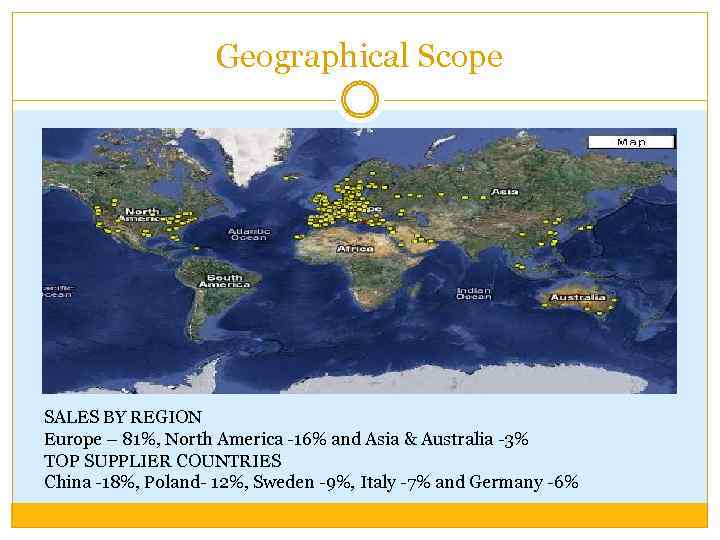
Geographical Scope SALES BY REGION Europe – 81%, North America -16% and Asia & Australia -3% TOP SUPPLIER COUNTRIES China -18%, Poland- 12%, Sweden -9%, Italy -7% and Germany -6%
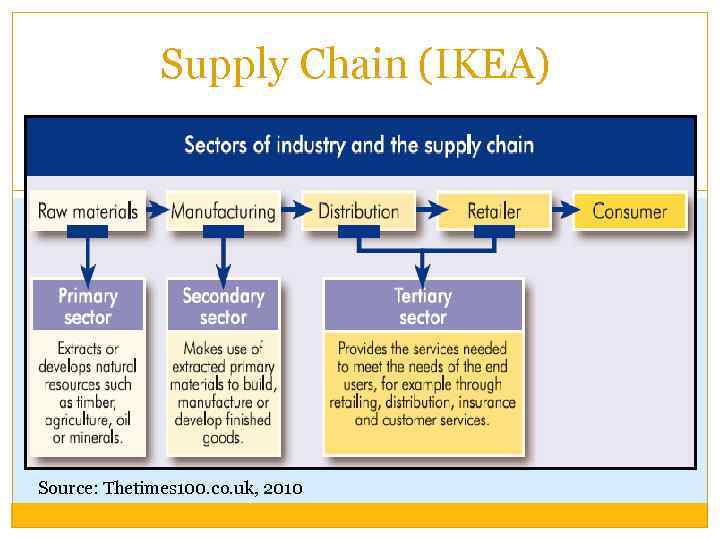
Supply Chain (IKEA) Source: Thetimes 100. co. uk, 2010
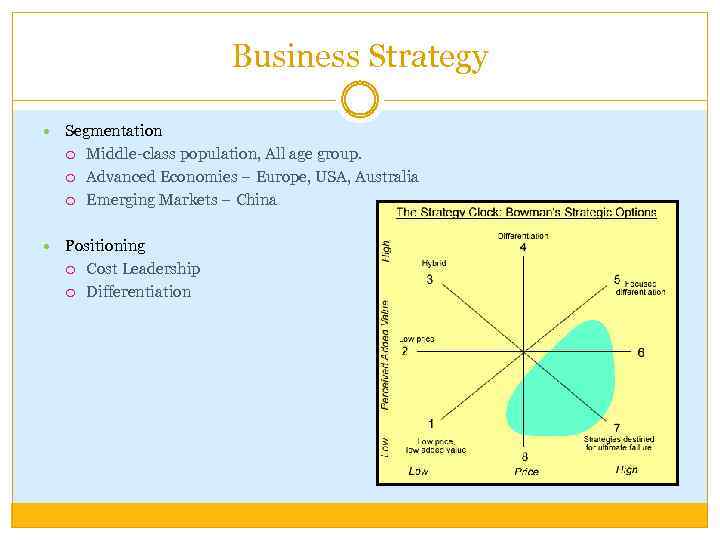
Business Strategy Segmentation Middle-class population, All age group. Advanced Economies – Europe, USA, Australia Emerging Markets – China Positioning Cost Leadership Differentiation
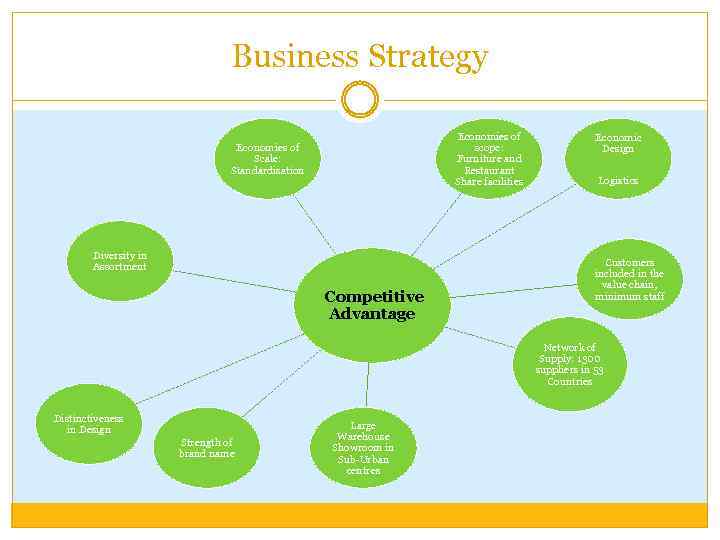
Business Strategy Economies of scope: Furniture and Restaurant Share facilities Economies of Scale: Standardisation Diversity in Assortment Competitive Advantage Economic Design Logistics Customers included in the value chain, minimum staff Network of Supply: 1300 suppliers in 53 Countries Distinctiveness in Design Strength of brand name Large Warehouse Showroom in Sub-Urban centres
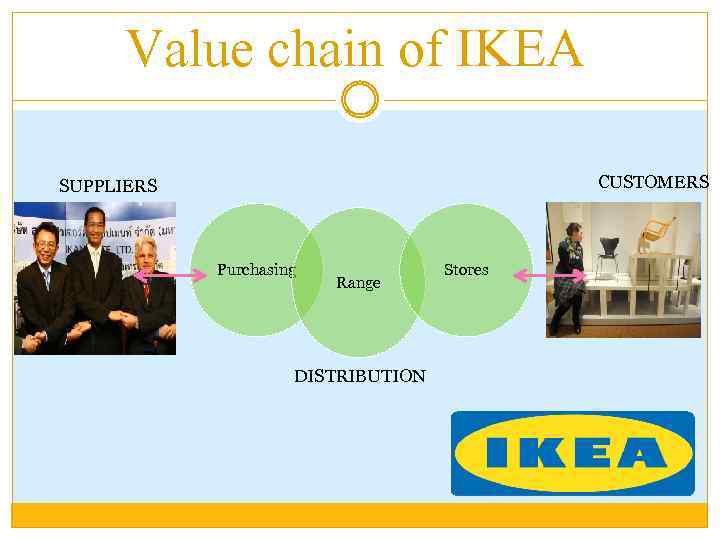
Value chain of IKEA CUSTOMERS SUPPLIERS Purchasing Range DISTRIBUTION Stores
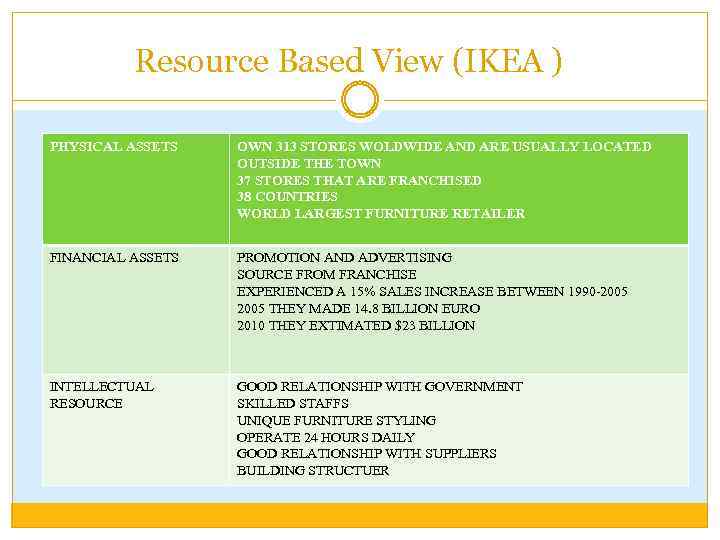
Resource Based View (IKEA ) PHYSICAL ASSETS OWN 313 STORES WOLDWIDE AND ARE USUALLY LOCATED OUTSIDE THE TOWN 37 STORES THAT ARE FRANCHISED 38 COUNTRIES WORLD LARGEST FURNITURE RETAILER FINANCIAL ASSETS PROMOTION AND ADVERTISING SOURCE FROM FRANCHISE EXPERIENCED A 15% SALES INCREASE BETWEEN 1990 -2005 THEY MADE 14. 8 BILLION EURO 2010 THEY EXTIMATED $23 BILLION INTELLECTUAL RESOURCE GOOD RELATIONSHIP WITH GOVERNMENT SKILLED STAFFS UNIQUE FURNITURE STYLING OPERATE 24 HOURS DAILY GOOD RELATIONSHIP WITH SUPPLIERS BUILDING STRUCTUER
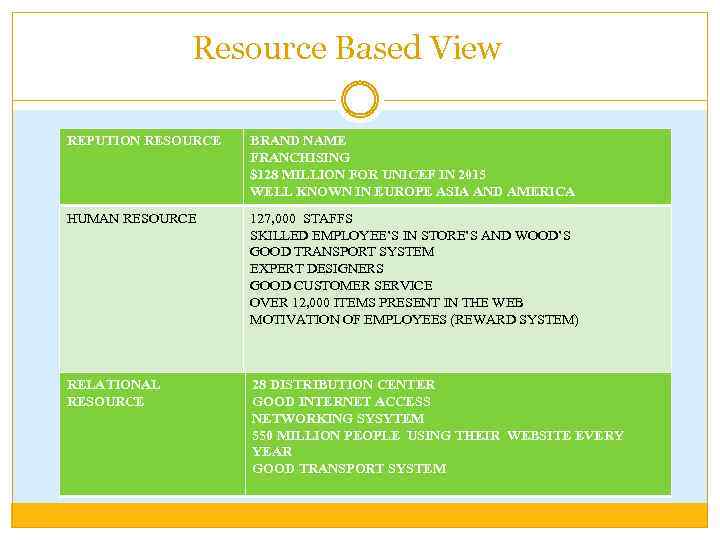
Resource Based View REPUTION RESOURCE BRAND NAME FRANCHISING $128 MILLION FOR UNICEF IN 2015 WELL KNOWN IN EUROPE ASIA AND AMERICA HUMAN RESOURCE 127, 000 STAFFS SKILLED EMPLOYEE’S IN STORE’S AND WOOD’S GOOD TRANSPORT SYSTEM EXPERT DESIGNERS GOOD CUSTOMER SERVICE OVER 12, 000 ITEMS PRESENT IN THE WEB MOTIVATION OF EMPLOYEES (REWARD SYSTEM) RELATIONAL RESOURCE 28 DISTRIBUTION CENTER GOOD INTERNET ACCESS NETWORKING SYSYTEM 550 MILLION PEOPLE USING THEIR WEBSITE EVERY YEAR GOOD TRANSPORT SYSTEM
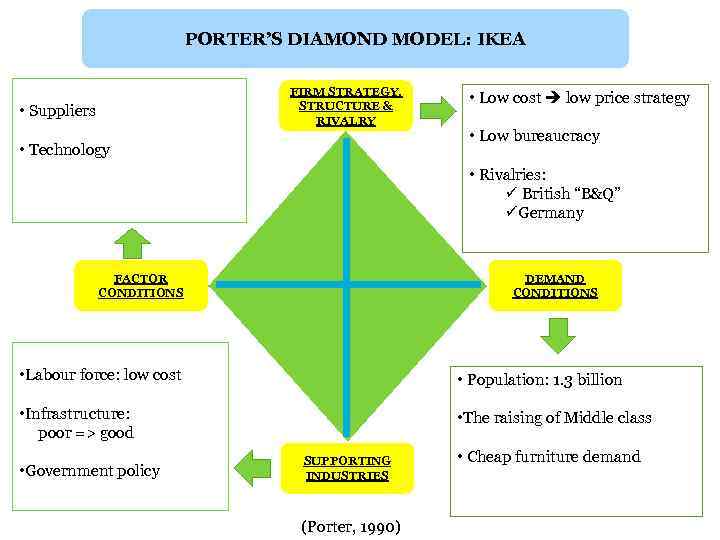
PORTER’S DIAMOND MODEL: IKEA FIRM STRATEGY, STRUCTURE & RIVALRY • Suppliers • Technology • Low cost low price strategy • Low bureaucracy • Rivalries: ü British “B&Q” üGermany DEMAND CONDITIONS FACTOR CONDITIONS • Labour force: low cost • Population: 1. 3 billion • Infrastructure: poor => good • The raising of Middle class • Government policy SUPPORTING INDUSTRIES • Cheap furniture demand INTERNATIONAL (Porter, 1990) BUSINESS STRATEGY (SMM 206) PRESENTATION
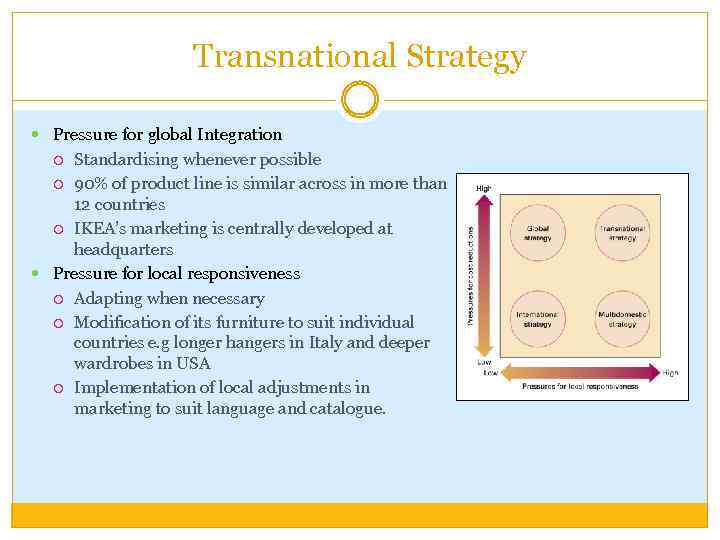
Transnational Strategy Pressure for global Integration Standardising whenever possible 90% of product line is similar across in more than 12 countries IKEA’s marketing is centrally developed at headquarters Pressure for local responsiveness Adapting when necessary Modification of its furniture to suit individual countries e. g longer hangers in Italy and deeper wardrobes in USA Implementation of local adjustments in marketing to suit language and catalogue.
Comparative Advantage Supply from China Low cost labour Labour skill Raw material accessibility Sales in EU, North America Very Large middle class group
Conclusion Since IKEA’s target consumers are the middle-class, they should extend their retail services to Emerging Market Economies where Middle class population is rapidly increasing. IKEA should increase sourcing its supply from emerging markets, which are characterised by low cost labour to sustain its competitive advantage.
REFERENCES Baraldi, E. (2008) “Strategy in Industrial Networks: Experiences from Ikea” Carlifonia Management Review, 50(4), 99 – 126. Beard, B. (2006) “IKEA facing competition on furniture row” Arizona Business Gazettes, available online at: http: //www. azcentral. com/abgnews/articles/0824 abg -tr-emerald 0824. html , accessed 01/12/2010 Boscor, D. , and Bratucu, G. (2009). “Transnational strategies adopted by furniture manufactures- case study: IKEA” Pro. Ligno, 5(3): 55 – 61. Datamonitor (2008). “Ikea Group”

Thank You !
Скачать презентацию By Rahul Karangutkar 0951826 Parag Jain Atoosa
Ikea_case_study_2.pptx