 Скачать презентацию By Inetha Sheffield Online Education Trends Opportunities and
7086df9679c6f2e3bc00d165e1c4381f.ppt
- Количество слайдов: 13



By Inetha Sheffield Online Education: Trends, Opportunities and Challenges
What is Online Education? Online Education – The use of the Internet to access learning materials; to interact with the content, instructor, and other learners; and to obtain support during the learning process, in order to acquire knowledge, to construct personal meaning, and to grow from the learning experience.
Models of Distance Education – Past & Present • First Generation – The Correspondence Model • Second Generation – The Multimedia Model • Third Generation – The Telelearning Model • Fourth Generation – The Flexible Learning Model • Fifth Generation – The Intelligent Flexible Learning Model
Fourth Generation – The Flexible Learning Model §Interactive Multimedia §Internet – based access to WWW resources § Computer Mediated communication
Fifth Generation – The Intelligent Flexible Learning Model §Interactive Multimedia (IMM) online §Internet-based access to WWW resources §Computer mediated communication, using automated response system §Campus portal access to institutional processes and resources
Today’s Adult Learner • Higher –education learner profiles are changing • Online students are becoming an entirely new subpopulation • Multitasking is a way of life • Staying Connected is essential • Zero tolerance for delays • Motivated by professional advancement, external expectations, subject interest • They have time, scheduling, money, and long term commitment constraints.
Current Trends • Flexibility and Global reach • Instructional diversity • Emphasis on student responsibility • Increase demands for accountability • Advancement of technology
Online Advantages/Opportunities Learner Advantages ü Learning material available at anytime üAccess to up-to-date and relevant learning material üCommunication with experts in the field Instructor Opportunities üTutoring can be done at anytime üDetermine learners’ needs and current level of expertise
Strategies for effective Online Learning Design • Important information should be placed in the center of the screen for reading • Information critical for learning should be highlighted to focus learners attention. • Learner objectives should be stated • Level of material difficulty should match the cognitive level of the learner. • Use advance organizers to activate an existing cognitive structure. • Use pre-instructional questions to set expectations and to activate the learners existing knowledge. • Information should be chunked to prevent overload during processing.
Strategies for effective Online Learning Design Continue • Online learning materials should include activities for the different learning styles • Information should be presented in different modes to accommodate individual differences in processing
Challenges for effective learning v. Learners must be self-motivated v. Crucial course-management systems v. Time dedication away from office
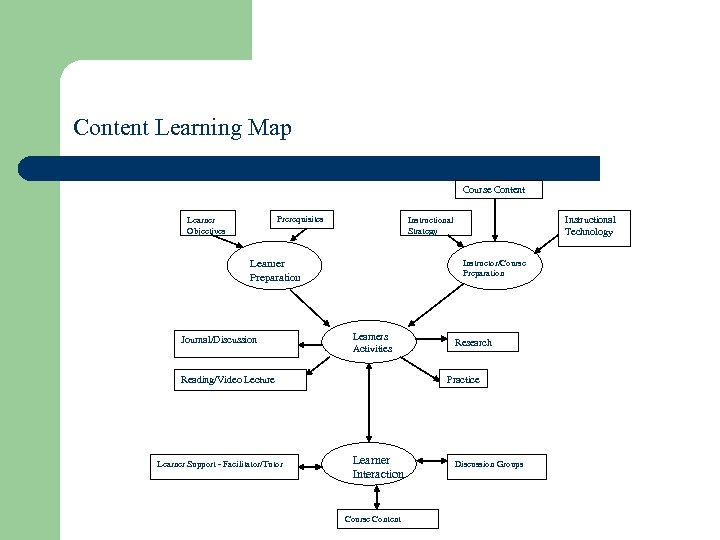
Content Learning Map Course Content Prerequisites Learner Objectives Instructor/Course Preparation Learner Preparation Journal/Discussion Learners Activities Reading/Video Lecture Learner Support - Facilitator/Tutor Instructional Technology Instructional Strategy Research Practice Learner Interaction Course Content Discussion Groups
References Ally, M. (2004). Toward a Theory of Online Learning. T. Anderson & F. Elloumi (Eds. ), Theory and Practice of Online Learning (Ch. 2) Athabasca University Anderson, T. (2004). Toward a Theory of Online Learning. T. Anderson & F. Elloumi (Eds. ), Theory and Practice of Online Learning (Ch. 2) Athabasca University Centron, M. J. , & Daview, O. (2003) 50 trends shaping the future. Special Report Published by the World Future Society. Crawford, G. , Rudy, J. A. , & the EDUCAUSE Current Issues Committee. (2003, November). Fourth annual EDUCAUSE survey identifies current IT issues. 12 -26. Howell, S. L. , Lindsay, N. K. , & Williams, P. B. (2003). Thirty-Two Trends Affecting Distance Education: An Informed Foundation for Strategic Planning. Online Journal of Distance learning Administration, Vol. VI (Issue III)
Скачать презентацию By Inetha Sheffield Online Education Trends Opportunities and
7086df9679c6f2e3bc00d165e1c4381f.ppt