 Скачать презентацию Buy Responsibly Campaign International Organization for Migration Ms
0bce5a0d820fab2c0059555672f65aed.ppt
- Количество слайдов: 15



Buy Responsibly Campaign International Organization for Migration Ms Anastasia Saglam IOM Turkey
ADDRESSING DEMAND According to the recent studies: • 7. 4 mln. persons worldwide are employed in situation of forced and exploited labour • 1. 1 mln. of this people have been trafficked • Trafficking in persons remains the World’s most profitable criminal activity. • No reason to believe that human trafficking is any less prevalent than it was nearly two decades ago *including 76 global and regional IGOs and NGOs and 17 countries
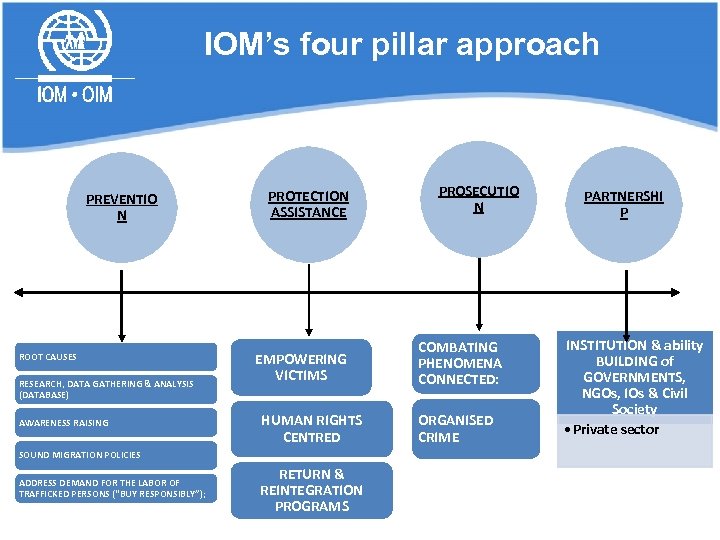
IOM’s four pillar approach PREVENTIO N ROOT CAUSES RESEARCH, DATA GATHERING & ANALYSIS (DATABASE) AWARENESS RAISING PROTECTION ASSISTANCE EMPOWERING VICTIMS HUMAN RIGHTS CENTRED SOUND MIGRATION POLICIES ADDRESS DEMAND FOR THE LABOR OF TRAFFICKED PERSONS (“BUY RESPONSIBLY”); RETURN & REINTEGRATION PROGRAMS PROSECUTIO N COMBATING PHENOMENA CONNECTED: ORGANISED CRIME PARTNERSHI P INSTITUTION & ability BUILDING of GOVERNMENTS, NGOs, IOs & Civil Society • Private sector
ADDRESSING DEMAND IOM has successfully partnered with such companies as: • MTV- awareness raising in the run-up to the World Cup in Germany 2006 • Saatchi&Saatchi – information campaign in Southern Africa, Europe and South America • In south Asia IOM worked with Tata, Taj hotel Group and Lanco to provide trafficked people with skills training, work opportunities and financial support • IOM is also working directly with private recruitment agencies to establish standards that prevent abuse at all stages of migration
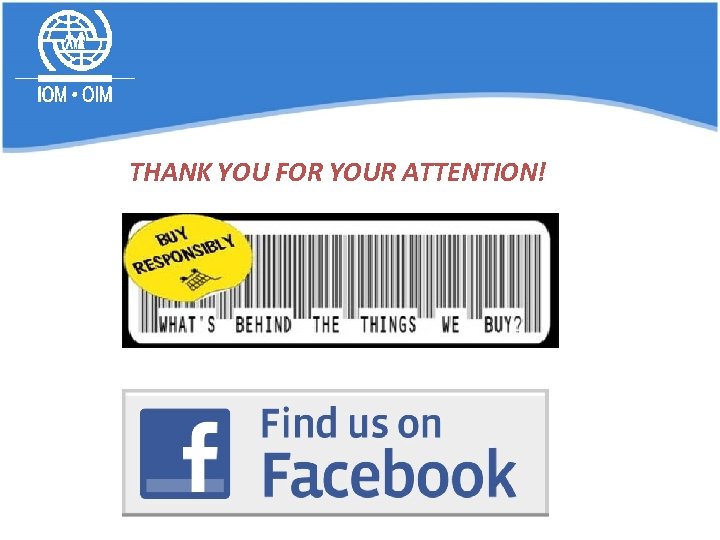
ADDRESSING DEMAND Buy Responsibly Campaign aims : • To change consumer behaviour by urging ask“ What’s behind the things we buy? ” and discover the link between everyday products and the exploitative conditions under which these may have been produced by persons being potentially trafficked. • Indirectly, it seeks to get business understand that it’s in its best interest to salf-regulate supply chain. *including 76 global and regional IGOs and NGOs and 17 countries
ADDRESSING DEMAND The campaign launch: • 1 st launch in Brussels on October 19, 2009 • Geneva- on December 18, 2009 • Then launched by IOM Vienna, Warsaw, London • IOM Helsinki, Oslo, Lisbon and Athens are promoting the campaign • IOM Turkey, Istanbul office plans to launch the campaign by the end of this year *including 76 global and regional IGOs and NGOs and 17 countries
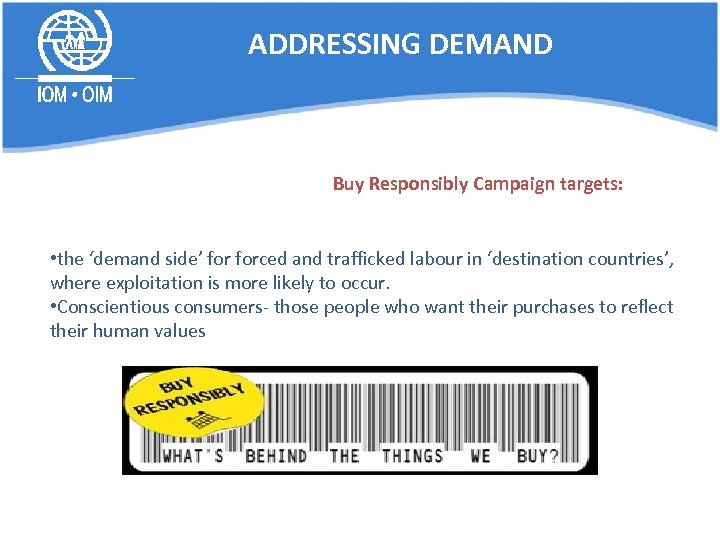
ADDRESSING DEMAND Buy Responsibly Campaign targets: • the ‘demand side’ forced and trafficked labour in ‘destination countries’, where exploitation is more likely to occur. • Conscientious consumers- those people who want their purchases to reflect their human values
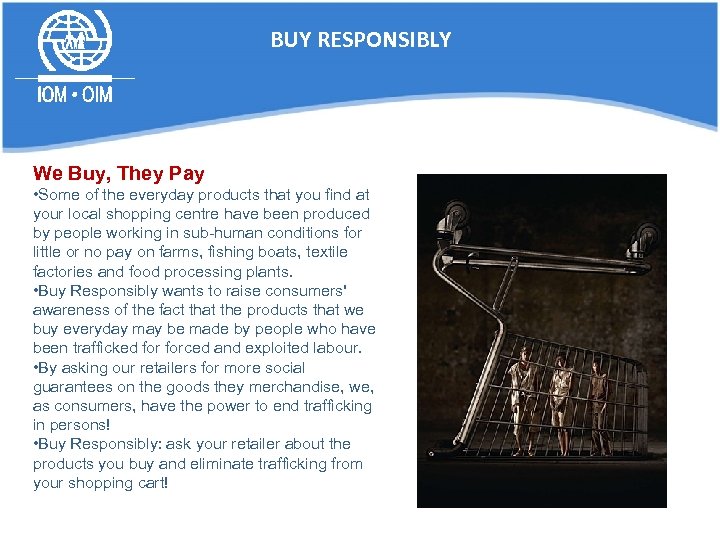
BUY RESPONSIBLY We Buy, They Pay • Some of the everyday products that you find at your local shopping centre have been produced by people working in sub-human conditions for little or no pay on farms, fishing boats, textile factories and food processing plants. • Buy Responsibly wants to raise consumers' awareness of the fact that the products that we buy everyday may be made by people who have been trafficked forced and exploited labour. • By asking our retailers for more social guarantees on the goods they merchandise, we, as consumers, have the power to end trafficking in persons! • Buy Responsibly: ask your retailer about the products you buy and eliminate trafficking from your shopping cart!
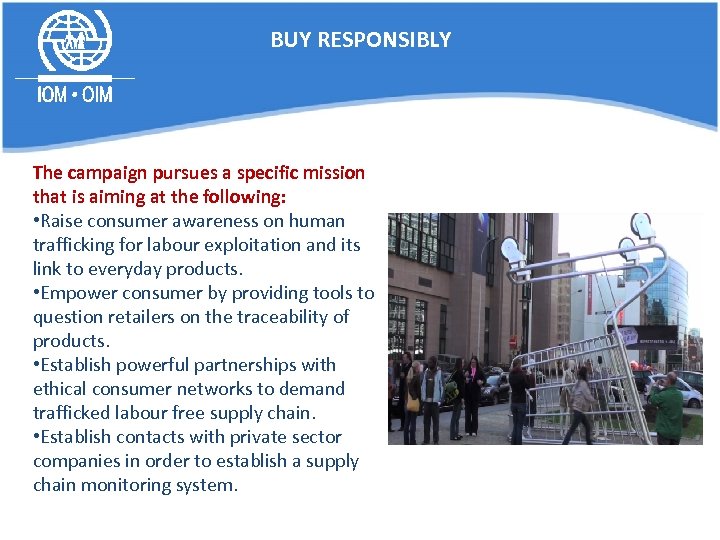
BUY RESPONSIBLY The campaign pursues a specific mission that is aiming at the following: • Raise consumer awareness on human trafficking for labour exploitation and its link to everyday products. • Empower consumer by providing tools to question retailers on the traceability of products. • Establish powerful partnerships with ethical consumer networks to demand trafficked labour free supply chain. • Establish contacts with private sector companies in order to establish a supply chain monitoring system.
Public-Private Sector Collaboration No universally agreed definition of demand but essentially it takes two forms: • That of the traffickers (particularly the end exploiters) whose greed motivates the victimization of vulnerable individuals; and • The demand of the consumer whose demand determines profitability, including companies that buy products from those further down the supply chain.
Public-Private Sector Collaboration With increased economic pressure migrant workers: • Become most vulnerable category of working population • more likely to be subjected to non-payment of wages • less likely to be unionized • Overrepresented in jobs that are dirty, dangerous and difficult • Females workers are disproportionally affected by all these realities
Public-Private Sector Collaboration The following factors make our goal of eradicating trafficking more difficult : • More limited channels for legal migration • Increased xenophobia • Cost sensitive consumers and business
Public-Private Sector Collaboration Four main key areas of action to limit degree to which traffickers are able to exploit migrants’ vulnerability: • Establishing more legal channels of migration • Addressing the demand side of the problem • Importance of public private sector collaboration • Strengthening protection for all migrants
The EU Strategy towards the Eradications of Trafficking in Human Beings 2012 -2016 PRIORITY B: Stepping up the prevention of trafficking in human beings: • Action 1: Understand Reducing Demand • In 2013 Commission will fund research on reducing the demand for and supply of services and goods by victims of trafficking in human beings • Action 2: Promote the establishment of a Private Sector Platform • A European Business Coalition against trafficking in human beings will be established in 2014 • In 2016 the Commission together with Coalition will develop models and guidelines on reducing the demand for services provided by trafficked victims.
THANK YOU FOR YOUR ATTENTION!
Скачать презентацию Buy Responsibly Campaign International Organization for Migration Ms
0bce5a0d820fab2c0059555672f65aed.ppt