 Скачать презентацию Buy-and-Hold Returns of American Depository Receipts ADRs of
7566c488599f2d46691a3bdad2adec03.ppt
- Количество слайдов: 20



Buy-and-Hold Returns of American Depository Receipts (ADRs) of Pharmaceutical Companies: Are these Returns Comparable to the Returns of US Pharmaceuticals and S&P 500 Index? Subhashis Nandy Fiona Sussan School of Advanced Studies University of Phoenix Presented at: FINECON 2017 IMI Kolkata, India
Background of the research • Pharmaceutical industry is global in nature. • In the US in 2015, 25% of pharmaceutical products were imported from Ireland, India, Germany and Switzerland. • USA - large market place for global pharmaceutical companies • Issuing American Depository Receipts (ADRs) on NYSE also allows pharmaceutical companies to access the US capital market
Why Invest in ADRs? • From the investors’ perspective, investing in ADRs is one way to diversify a portfolio (Arnold, Nail, and Nixon, 2004; Schaub, 2012) • Another motivation to invest in ADRs is the possibility of higher returns than domestic stocks or stock indices (e. g. , Elliot and Schaub, 2009; Schaub, 2012). • However, mixed results were reported in literature with ADRs shown to both out-perform and under-perform when compared to S&P 500 or NASDAQ index, depending on the investment time period, and developed versus developing market ADRs.
Research Question • Is there a similarity in the median risk-adjusted buy-andhold returns of ADRs of pharmaceutical companies, S&P 500 index, and the securities of US pharmaceutical companies listed on New York Stock Exchange (NYSE) from 2000 through 2016?
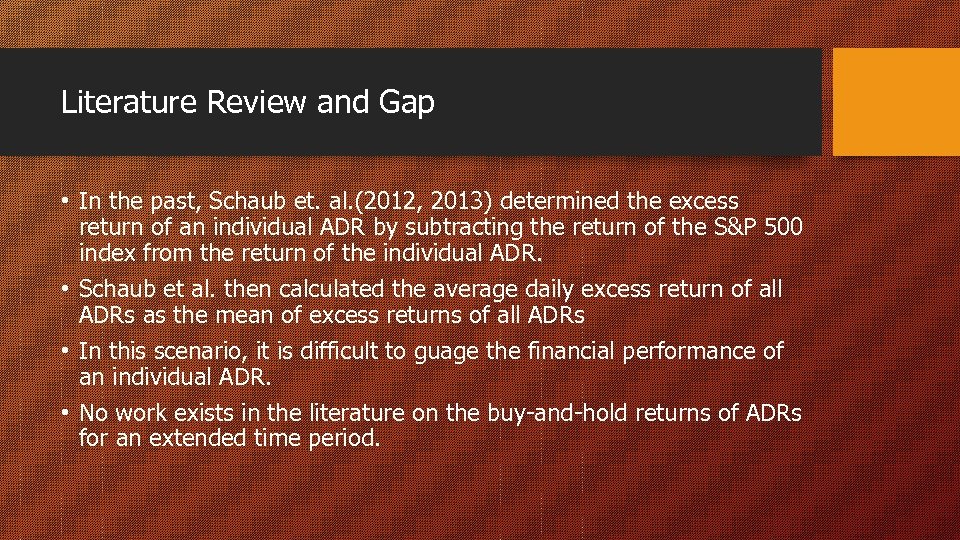
Literature Review and Gap • In the past, Schaub et. al. (2012, 2013) determined the excess return of an individual ADR by subtracting the return of the S&P 500 index from the return of the individual ADR. • Schaub et al. then calculated the average daily excess return of all ADRs as the mean of excess returns of all ADRs • In this scenario, it is difficult to guage the financial performance of an individual ADR. • No work exists in the literature on the buy-and-hold returns of ADRs for an extended time period.
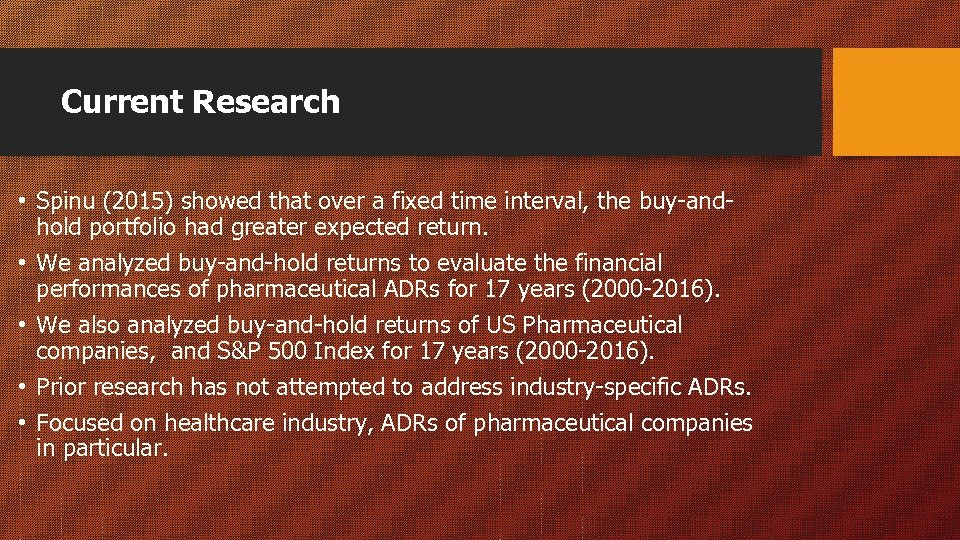
Current Research • Spinu (2015) showed that over a fixed time interval, the buy-andhold portfolio had greater expected return. • We analyzed buy-and-hold returns to evaluate the financial performances of pharmaceutical ADRs for 17 years (2000 -2016). • We also analyzed buy-and-hold returns of US Pharmaceutical companies, and S&P 500 Index for 17 years (2000 -2016). • Prior research has not attempted to address industry-specific ADRs. • Focused on healthcare industry, ADRs of pharmaceutical companies in particular.
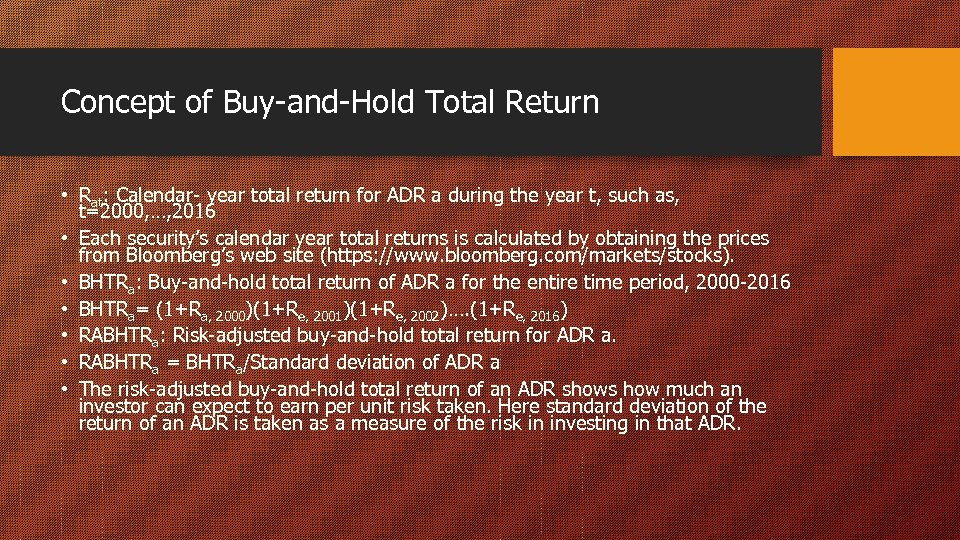
Concept of Buy-and-Hold Total Return • Rat: Calendar- year total return for ADR a during the year t, such as, t=2000, …, 2016 • Each security’s calendar year total returns is calculated by obtaining the prices from Bloomberg’s web site (https: //www. bloomberg. com/markets/stocks). • BHTRa: Buy-and-hold total return of ADR a for the entire time period, 2000 -2016 • BHTRa= (1+Ra, 2000)(1+Re, 2001)(1+Re, 2002)…. (1+Re, 2016) • RABHTRa: Risk-adjusted buy-and-hold total return for ADR a. • RABHTRa = BHTRa/Standard deviation of ADR a • The risk-adjusted buy-and-hold total return of an ADR shows how much an investor can expect to earn per unit risk taken. Here standard deviation of the return of an ADR is taken as a measure of the risk in investing in that ADR.
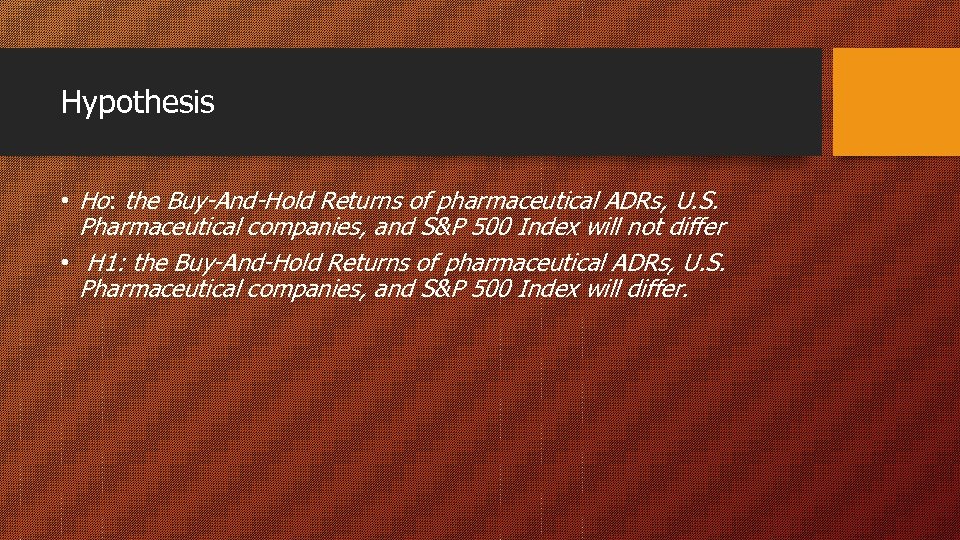
Hypothesis • Ho: the Buy-And-Hold Returns of pharmaceutical ADRs, U. S. Pharmaceutical companies, and S&P 500 Index will not differ • H 1: the Buy-And-Hold Returns of pharmaceutical ADRs, U. S. Pharmaceutical companies, and S&P 500 Index will differ.
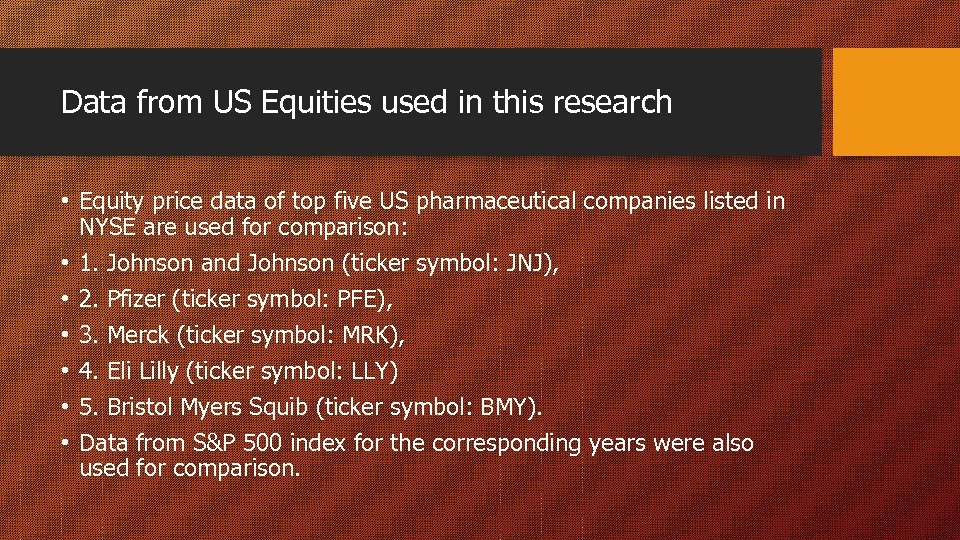
Data from US Equities used in this research • Equity price data of top five US pharmaceutical companies listed in NYSE are used for comparison: • 1. Johnson and Johnson (ticker symbol: JNJ), • 2. Pfizer (ticker symbol: PFE), • 3. Merck (ticker symbol: MRK), • 4. Eli Lilly (ticker symbol: LLY) • 5. Bristol Myers Squib (ticker symbol: BMY). • Data from S&P 500 index for the corresponding years were also used for comparison.
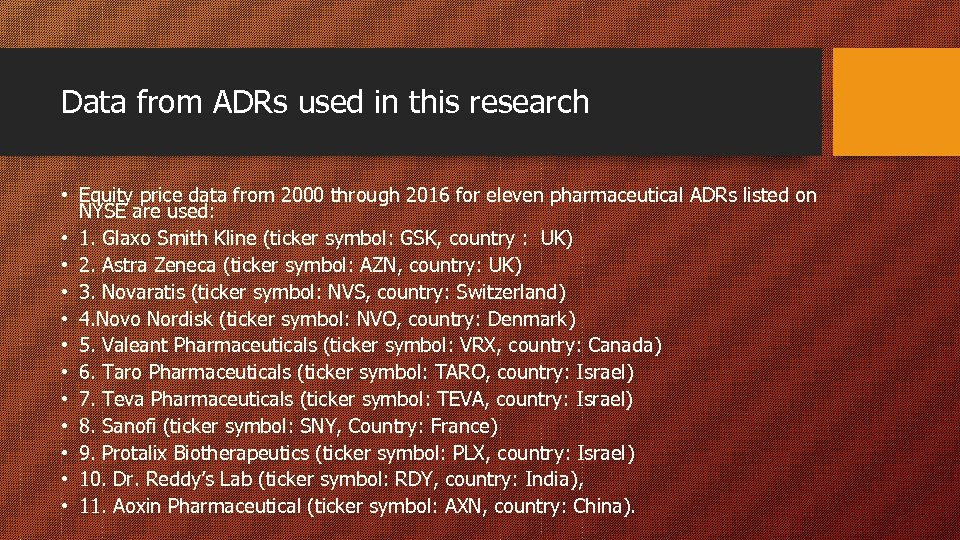
Data from ADRs used in this research • Equity price data from 2000 through 2016 for eleven pharmaceutical ADRs listed on NYSE are used: • 1. Glaxo Smith Kline (ticker symbol: GSK, country : UK) • 2. Astra Zeneca (ticker symbol: AZN, country: UK) • 3. Novaratis (ticker symbol: NVS, country: Switzerland) • 4. Novo Nordisk (ticker symbol: NVO, country: Denmark) • 5. Valeant Pharmaceuticals (ticker symbol: VRX, country: Canada) • 6. Taro Pharmaceuticals (ticker symbol: TARO, country: Israel) • 7. Teva Pharmaceuticals (ticker symbol: TEVA, country: Israel) • 8. Sanofi (ticker symbol: SNY, Country: France) • 9. Protalix Biotherapeutics (ticker symbol: PLX, country: Israel) • 10. Dr. Reddy’s Lab (ticker symbol: RDY, country: India), • 11. Aoxin Pharmaceutical (ticker symbol: AXN, country: China).
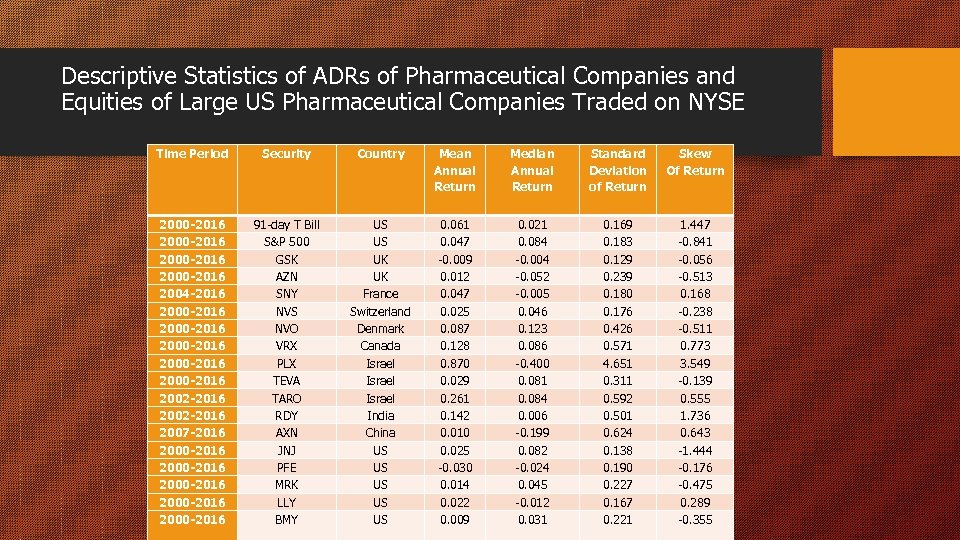
Descriptive Statistics of ADRs of Pharmaceutical Companies and Equities of Large US Pharmaceutical Companies Traded on NYSE Time Period Security Country Mean Annual Return Median Annual Return Standard Deviation of Return Skew Of Return 2000 -2016 2004 -2016 2000 -2016 2000 -2016 2002 -2016 2007 -2016 2000 -2016 2000 -2016 91 -day T Bill S&P 500 GSK AZN SNY NVS NVO VRX PLX TEVA TARO RDY AXN JNJ PFE MRK LLY BMY US US UK UK France Switzerland Denmark Canada Israel India China US US US 0. 061 0. 047 -0. 009 0. 012 0. 047 0. 025 0. 087 0. 128 0. 870 0. 029 0. 261 0. 142 0. 010 0. 025 -0. 030 0. 014 0. 022 0. 009 0. 021 0. 084 -0. 004 -0. 052 -0. 005 0. 046 0. 123 0. 086 -0. 400 0. 081 0. 084 0. 006 -0. 199 0. 082 -0. 024 0. 045 -0. 012 0. 031 0. 169 0. 183 0. 129 0. 239 0. 180 0. 176 0. 426 0. 571 4. 651 0. 311 0. 592 0. 501 0. 624 0. 138 0. 190 0. 227 0. 167 0. 221 1. 447 -0. 841 -0. 056 -0. 513 0. 168 -0. 238 -0. 511 0. 773 3. 549 -0. 139 0. 555 1. 736 0. 643 -1. 444 -0. 176 -0. 475 0. 289 -0. 355
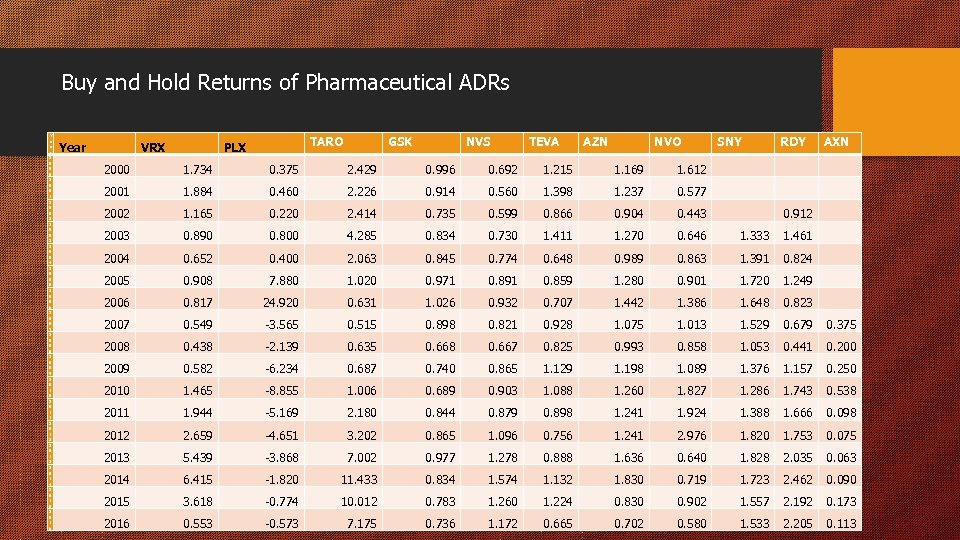
Buy and Hold Returns of Pharmaceutical ADRs Y e a r 2 0 0 0 2 0 0 1 2 0 0 2 2 0 0 3 2 0 0 4 2 0 0 5 2 0 0 6 2 0 0 7 2 0 0 8 2 0 0 9 2 0 1 0 2 0 1 1 2 0 1 2 2 0 1 3 2 0 1 4 2 0 1 5 2 0 1 6 Year VRX TARO PLX GSK NVS TEVA AZN NVO SNY RDY AXN 2000 1. 734 0. 375 2. 429 0. 996 0. 692 1. 215 1. 169 1. 612 2001 1. 884 0. 460 2. 226 0. 914 0. 560 1. 398 1. 237 0. 577 2002 1. 165 0. 220 2. 414 0. 735 0. 599 0. 866 0. 904 0. 443 0. 912 2003 0. 890 0. 800 4. 285 0. 834 0. 730 1. 411 1. 270 0. 646 1. 333 1. 461 2004 0. 652 0. 400 2. 063 0. 845 0. 774 0. 648 0. 989 0. 863 1. 391 0. 824 2005 0. 908 7. 880 1. 020 0. 971 0. 891 0. 859 1. 280 0. 901 1. 720 1. 249 2006 0. 817 24. 920 0. 631 1. 026 0. 932 0. 707 1. 442 1. 386 1. 648 0. 823 2007 0. 549 -3. 565 0. 515 0. 898 0. 821 0. 928 1. 075 1. 013 1. 529 0. 679 0. 375 2008 0. 438 -2. 139 0. 635 0. 668 0. 667 0. 825 0. 993 0. 858 1. 053 0. 441 0. 2009 0. 582 -6. 234 0. 687 0. 740 0. 865 1. 129 1. 198 1. 089 1. 376 1. 157 0. 250 2010 1. 465 -8. 855 1. 006 0. 689 0. 903 1. 088 1. 260 1. 827 1. 286 1. 743 0. 538 2011 1. 944 -5. 169 2. 180 0. 844 0. 879 0. 898 1. 241 1. 924 1. 388 1. 666 0. 098 2012 2. 659 -4. 651 3. 202 0. 865 1. 096 0. 756 1. 241 2. 976 1. 820 1. 753 0. 075 2013 5. 439 -3. 868 7. 002 0. 977 1. 278 0. 888 1. 636 0. 640 1. 828 2. 035 0. 063 2014 6. 415 -1. 820 11. 433 0. 834 1. 574 1. 132 1. 830 0. 719 1. 723 2. 462 0. 090 2015 3. 618 -0. 774 10. 012 0. 783 1. 260 1. 224 0. 830 0. 902 1. 557 2. 192 0. 173 2016 0. 553 -0. 573 7. 175 0. 736 1. 172 0. 665 0. 702 0. 580 1. 533 2. 205 0. 113
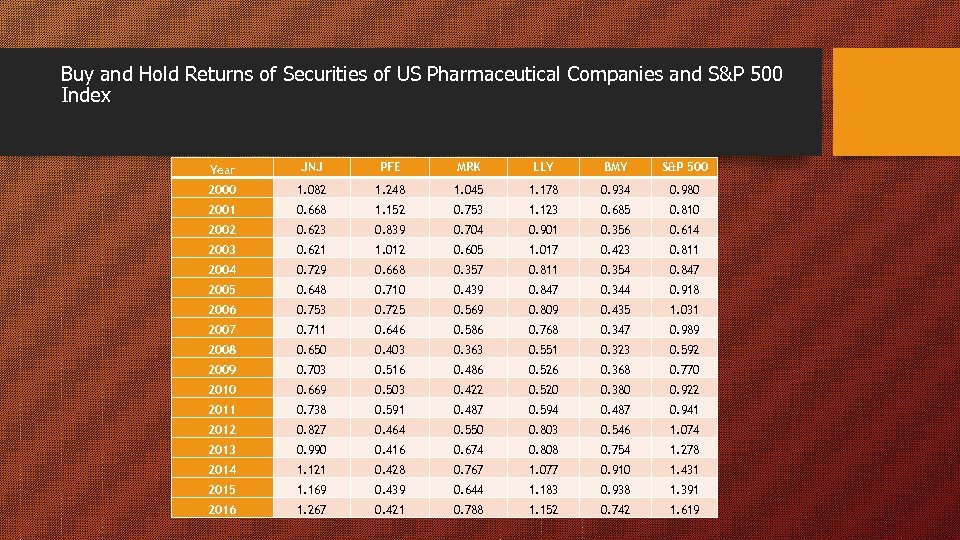
Buy and Hold Returns of Securities of US Pharmaceutical Companies and S&P 500 Index Year JNJ PFE MRK LLY BMY S&P 500 2000 1. 082 1. 248 1. 045 1. 178 0. 934 0. 980 2001 0. 668 1. 152 0. 753 1. 123 0. 685 0. 810 2002 0. 623 0. 839 0. 704 0. 901 0. 356 0. 614 2003 0. 621 1. 012 0. 605 1. 017 0. 423 0. 811 2004 0. 729 0. 668 0. 357 0. 811 0. 354 0. 847 2005 0. 648 0. 710 0. 439 0. 847 0. 344 0. 918 2006 0. 753 0. 725 0. 569 0. 809 0. 435 1. 031 2007 0. 711 0. 646 0. 586 0. 768 0. 347 0. 989 2008 0. 650 0. 403 0. 363 0. 551 0. 323 0. 592 2009 0. 703 0. 516 0. 486 0. 526 0. 368 0. 770 2010 0. 669 0. 503 0. 422 0. 520 0. 380 0. 922 2011 0. 738 0. 591 0. 487 0. 594 0. 487 0. 941 2012 0. 827 0. 464 0. 550 0. 803 0. 546 1. 074 2013 0. 990 0. 416 0. 674 0. 808 0. 754 1. 278 2014 1. 121 0. 428 0. 767 1. 077 0. 910 1. 431 2015 1. 169 0. 439 0. 644 1. 183 0. 938 1. 391 2016 1. 267 0. 421 0. 788 1. 152 0. 742 1. 619
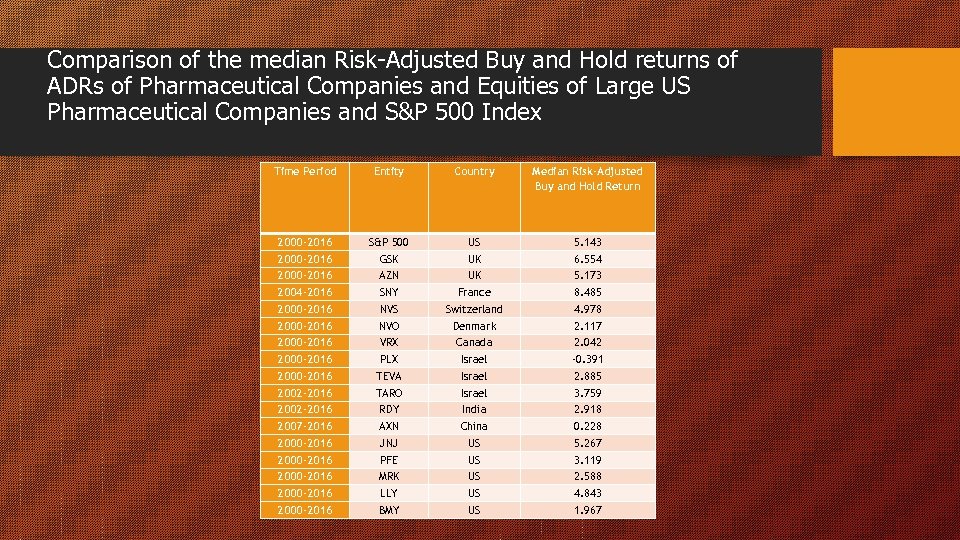
Comparison of the median Risk-Adjusted Buy and Hold returns of ADRs of Pharmaceutical Companies and Equities of Large US Pharmaceutical Companies and S&P 500 Index Time Period Entity Country Median Risk-Adjusted Buy and Hold Return 2000 -2016 S&P 500 US 5. 143 2000 -2016 GSK UK 6. 554 2000 -2016 AZN UK 5. 173 2004 -2016 SNY France 8. 485 2000 -2016 NVS Switzerland 4. 978 2000 -2016 NVO Denmark 2. 117 2000 -2016 VRX Canada 2. 042 2000 -2016 PLX Israel -0. 391 2000 -2016 TEVA Israel 2. 885 2002 -2016 TARO Israel 3. 759 2002 -2016 RDY India 2. 918 2007 -2016 AXN China 0. 228 2000 -2016 JNJ US 5. 267 2000 -2016 PFE US 3. 119 2000 -2016 MRK US 2. 588 2000 -2016 LLY US 4. 843 2000 -2016 BMY US 1. 967
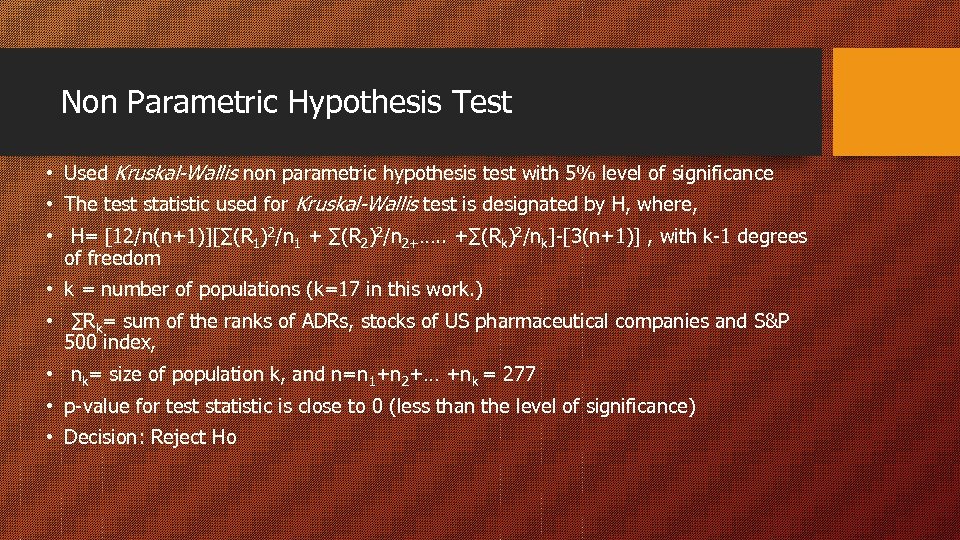
Non Parametric Hypothesis Test • Used Kruskal-Wallis non parametric hypothesis test with 5% level of significance • The test statistic used for Kruskal-Wallis test is designated by H, where, • H= [12/n(n+1)][∑(R 1)2/n 1 + ∑(R 2)2/n 2+…. . +∑(Rk)2/nk]-[3(n+1)] , with k-1 degrees of freedom • k = number of populations (k=17 in this work. ) • ∑Rk= sum of the ranks of ADRs, stocks of US pharmaceutical companies and S&P 500 index, • nk= size of population k, and n=n 1+n 2+… +nk = 277 • p-value for test statistic is close to 0 (less than the level of significance) • Decision: Reject Ho
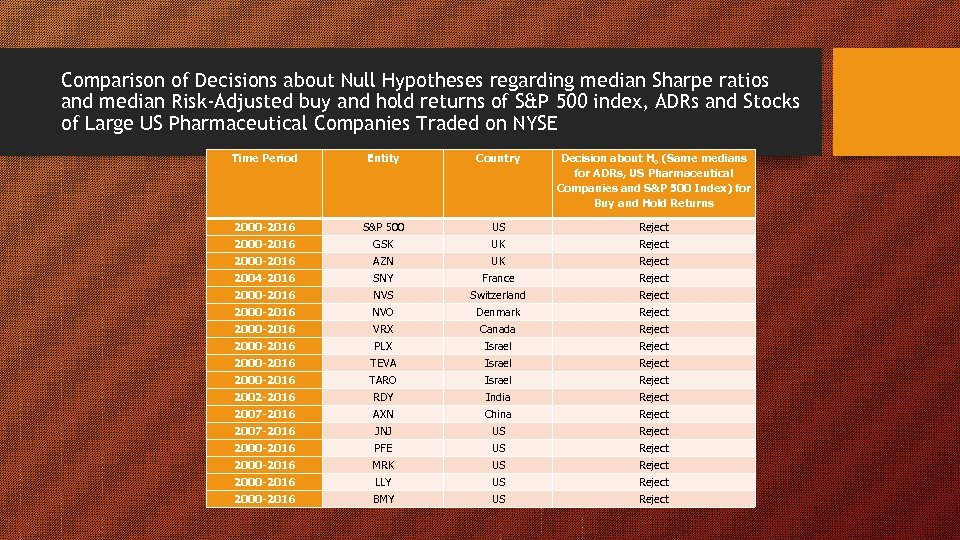
Comparison of Decisions about Null Hypotheses regarding median Sharpe ratios and median Risk-Adjusted buy and hold returns of S&P 500 index, ADRs and Stocks of Large US Pharmaceutical Companies Traded on NYSE Time Period Entity Country Decision about Ho (Same medians for ADRs, US Pharmaceutical Companies and S&P 500 Index) for Buy and Hold Returns 2000 -2016 S&P 500 US Reject 2000 -2016 GSK UK Reject 2000 -2016 AZN UK Reject 2004 -2016 SNY France Reject 2000 -2016 NVS Switzerland Reject 2000 -2016 NVO Denmark Reject 2000 -2016 VRX Canada Reject 2000 -2016 PLX Israel Reject 2000 -2016 TEVA Israel Reject 2000 -2016 TARO Israel Reject 2002 -2016 RDY India Reject 2007 -2016 AXN China Reject 2007 -2016 JNJ US Reject 2000 -2016 PFE US Reject 2000 -2016 MRK US Reject 2000 -2016 LLY US Reject 2000 -2016 BMY US Reject
Conclusion • The results of the hypothesis test indicated the null hypothesis that the risk-adjusted buy-and-hold returns are the same can be rejected. • 2016 Buy-and-Hold Returns of certain ADRs (TARO, RDY, SNY, and NVS) are greater than 100% • 2016 Buy-and-Hold Returns of two US pharmaceuticals(JNJ and LLY) are greater than 100% • 2016 Buy-and-Hold Return of S&P 500 Index is greater than 100% • The risk of investing in ADRs or U. S. companies in the pharmaceutical industry is similar as these companies are perceived as equally global. • Future research should consider a range of timeframe such as 5 -year, 10 -year, and 15 -year to add more nuanced time dimension to the performance of ADRs.
References • Arnold, T. , Nail, L. & Nixon, T. D. (2004). “Do ADRs enhance portfolio performance for a domestic portfolio? Evidence from the 1990 s. ” Research in International Business and Finance, 18, 341 -359. • Elliott, R. S. & Schaub, M. (2009). “A Reassessment of the Performance of American Depository Receipts: The Brazilian Experience. ” The Journal of Wealth Management, 12(3), 125 -131. • Espinosa, M. , Gietzmann, M. , & Raonic, I. (2009). “US Institutional Investors Response to the News of the Flow of Intangibles Intensive European Stocks: A Study of European Bio Tech and Pharma Stocks. ” European Accounting Review, 18(1), 63 -92. • Schaub, M. & Highfield M. (2004). “The short and long term performance of IPOs and SEOs traded as American Depository receipts: does timing matter? ” Journal of Asset Management, 5, 263 -271. • Schaub, M. (2009). NASDAQ-listed European and Asia Pacific ADRs: does market timing affect longterm performance? Applied Financial Economics. 19. 339 -345. • Schaub, M. (2012). “International equities listed on the New York stock exchange: does type of issue or date of issue matter? ” Financial Market Portfolio Management, 26, 429 -447. • Schaub, M. (2013). “Diversification Benefits of Investing in NYSE listed ADRs from Developed Economies: Evidence from 1990 through 2009. ” Journal of Investing, 22(3), 66 -73. • Spinu, F> (2015). Buy-and_hold versus constantly rebalanced portfolios: A theoretical comparison. Journal of Asset Management. 16(2). 70 -84.

Acknowledgement • This research has received funding in the form of a research grant from the Office of Scholarship Support, School of Advanced Studies, University of Phoenix.

Questions?
Скачать презентацию Buy-and-Hold Returns of American Depository Receipts ADRs of
7566c488599f2d46691a3bdad2adec03.ppt