 Скачать презентацию BUSINESS VALUE FRAMEWORK OF ELECTRONIC COMMERCE 1 Introduction
b13643ef643bf5b7e46f7977d7508d7e.ppt
- Количество слайдов: 34



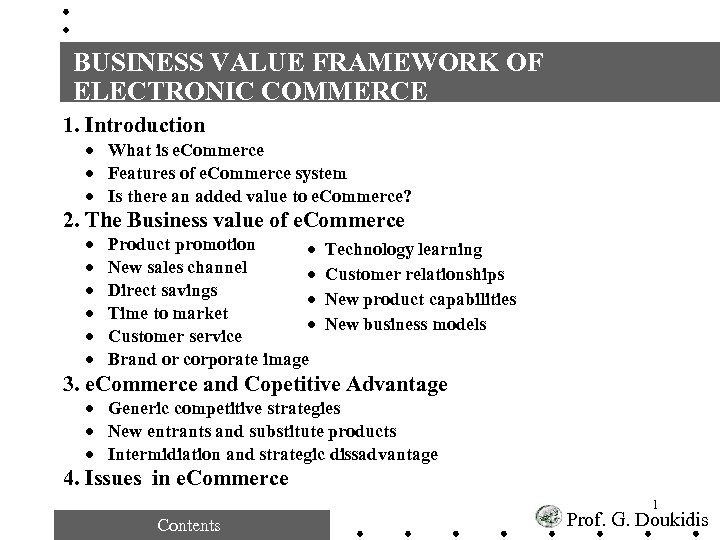
BUSINESS VALUE FRAMEWORK OF ELECTRONIC COMMERCE 1. Introduction · What is e. Commerce · Features of e. Commerce system · Is there an added value to e. Commerce? 2. The Business value of e. Commerce · · · Product promotion · Technology learning New sales channel · Customer relationships Direct savings · New product capabilities Time to market · New business models Customer service Brand or corporate image 3. e. Commerce and Copetitive Advantage · Generic competitive strategies · New entrants and substitute products · Intermidiation and strategic dissadvantage 4. Issues in e. Commerce 1 Contents Prof. G. Doukidis
WHAT IS ELECTRONIC COMMERCE 4 «buying and selling of information, products, and services via computer networks» 4 Extend the definition by including the «support for any kind of business transactions over a digital infrastructure» 4 Silicon Graphics uses e. Commerce in broader sense as : · a way to provide info to its customers (i. e. access to product brochures and price lists) · a marketing tool (i. e. allowing a customer to contact a sales office) · a sales channel (i. e. on-line ordering of software products) · a support line (i. e. making available software patches and frequently asked questions and answers). 2 1. Introduction Prof. G. Doukidis
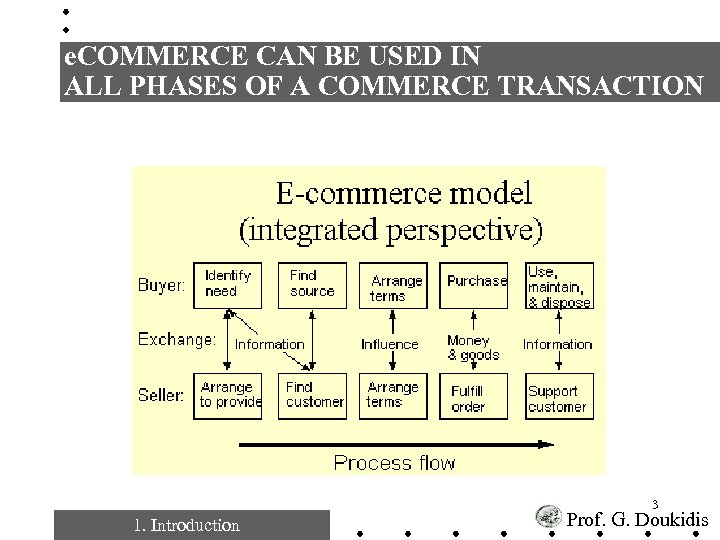
e. COMMERCE CAN BE USED IN ALL PHASES OF A COMMERCE TRANSACTION 3 1. Introduction Prof. G. Doukidis
FEATURES OF e. COMMERCE SYSTEMS 4 e. Commerce systems can be of significant value as a lever for new customer management strategies, mainly because they · directly connect buyers and sellers · support fully digital information exchange between them · suppress time and place limits · support interactivity and therefore can dynamically adapt to customer behavior · can be updated in real-time, therefore always up-to-date. 4 Is there an added value to e. Commerce? 4 The e. Commerce technologies are not limited to the Internet and the WWW but include all interactive media technologies connected to an open network (i. e. multimedia kiosks, digital TV, mobile phones etc. ) The e. Commerce drivers are both technological and business 4 1. Introduction Prof. G. Doukidis
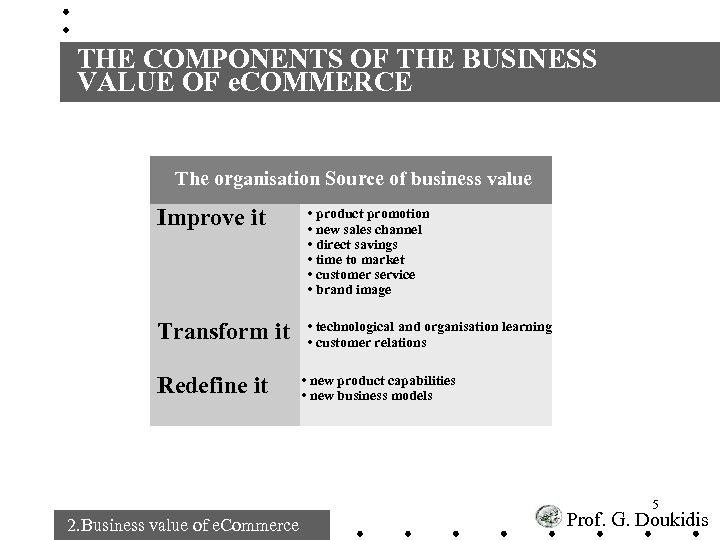
THE COMPONENTS OF THE BUSINESS VALUE OF e. COMMERCE The organisation Source of business value Improve it • product promotion • new sales channel • direct savings • time to market • customer service • brand image Transform it • technological and organisation learning • customer relations Redefine it • new product capabilities • new business models 5 2. Business value of e. Commerce Prof. G. Doukidis
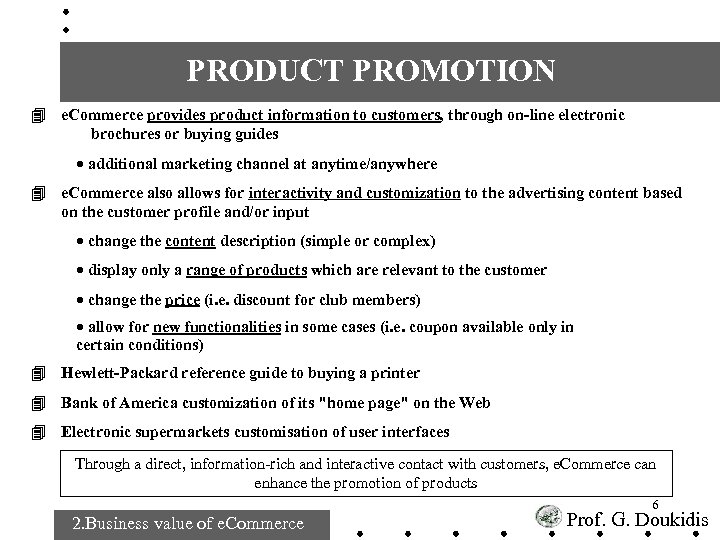
PRODUCT PROMOTION 4 e. Commerce provides product information to customers, through on-line electronic brochures or buying guides · additional marketing channel at anytime/anywhere 4 e. Commerce also allows for interactivity and customization to the advertising content based on the customer profile and/or input · change the content description (simple or complex) · display only a range of products which are relevant to the customer · change the price (i. e. discount for club members) · allow for new functionalities in some cases (i. e. coupon available only in certain conditions) 4 Hewlett-Packard reference guide to buying a printer 4 Bank of America customization of its "home page" on the Web 4 Electronic supermarkets customisation of user interfaces Through a direct, information-rich and interactive contact with customers, e. Commerce can enhance the promotion of products 6 2. Business value of e. Commerce Prof. G. Doukidis
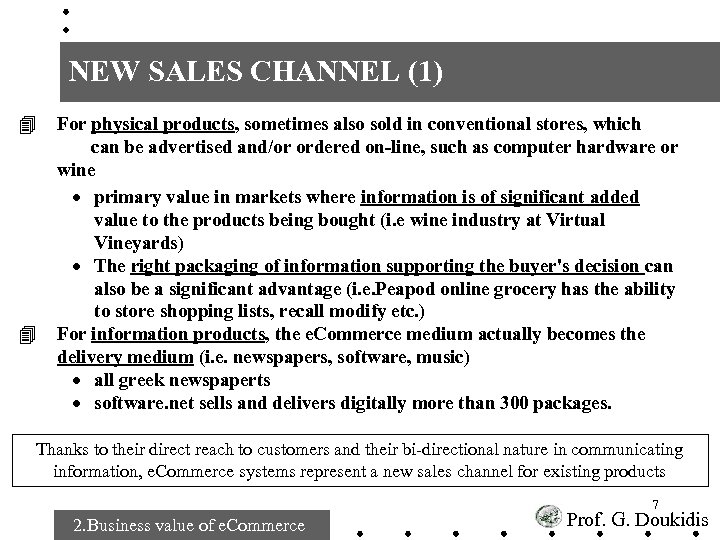
NEW SALES CHANNEL (1) 4 4 For physical products, sometimes also sold in conventional stores, which can be advertised and/or ordered on-line, such as computer hardware or wine · primary value in markets where information is of significant added value to the products being bought (i. e wine industry at Virtual Vineyards) · The right packaging of information supporting the buyer's decision can also be a significant advantage (i. e. Peapod online grocery has the ability to store shopping lists, recall modify etc. ) For information products, the e. Commerce medium actually becomes the delivery medium (i. e. newspapers, software, music) · all greek newspaperts · software. net sells and delivers digitally more than 300 packages. Thanks to their direct reach to customers and their bi-directional nature in communicating information, e. Commerce systems represent a new sales channel for existing products 7 2. Business value of e. Commerce Prof. G. Doukidis
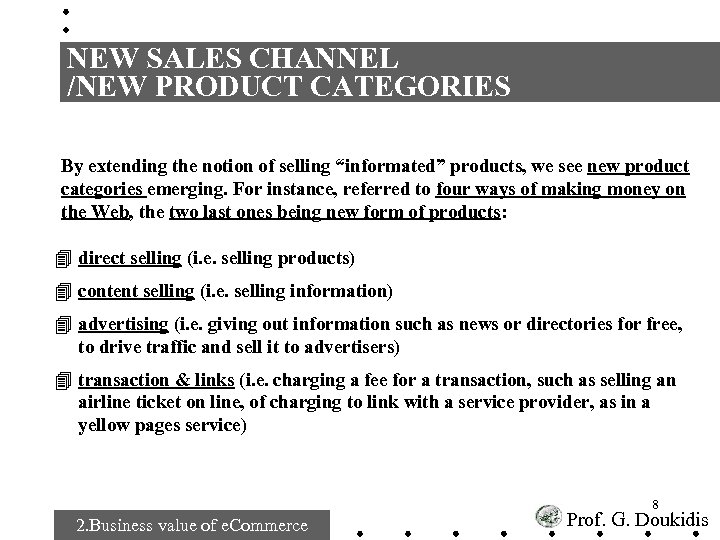
NEW SALES CHANNEL /NEW PRODUCT CATEGORIES By extending the notion of selling “informated” products, we see new product categories emerging. For instance, referred to four ways of making money on the Web, the two last ones being new form of products: 4 direct selling (i. e. selling products) 4 content selling (i. e. selling information) 4 advertising (i. e. giving out information such as news or directories for free, to drive traffic and sell it to advertisers) 4 transaction & links (i. e. charging a fee for a transaction, such as selling an airline ticket on line, of charging to link with a service provider, as in a yellow pages service) 8 2. Business value of e. Commerce Prof. G. Doukidis
DIRECT SAVINGS 4 By sharing a digital infrastructure such as the Internet compared to owning a physical one, marketing, distribution and customer service costs can be drastically reduced. • Banking services (physical store, ATM, PC, phone, Internet) • Sun. Solve saved Sun over $4 mil. / year 4 The importance for service industries where the cost of customer service usually exceeds the product costs (i. e. banks, credit card companies, telecommunications companies etc. ). 4 The customer value is also higher, through a quicker reporting, or through the added information value (e. g. delivering not only a statement, but also historical statistics or graphics, adding advice to reduce some of these costs, etc. ) By using a public shared infrastructure such as the Internet and digitally transmitting and reusing information, e. Commerce systems can lower the cost of delivering information to customers 9 2. Business value of e. Commerce Prof. G. Doukidis
T IME TO MARKET 4 In some markets or for some products, the ability to distribute or receive a product as soon as it's been created is of primary importance. This is obviously the case of information distribution. 4 A company such as Newspage, for instance, distributes information on hundreds of topics using electronic mail or the Web, to make sure it reaches its targets (usually decision makers in corporations) as soon as it is available. 4 In the financial market, which very often leads the way in terms of complexity of the environment, some financial products (usually derivatives contracts) have return on investment in a matter of hours. Their life-cycle is often not much longer. 4 It's in this type of environment, which will increasingly become routine for other industries, that the speed achieved by electronic commerce to quickly gather information on customer needs, assemble a product by adapting existing ones or assembling building blocks and distributing them will become critical. Due to their instantaneous nature, electronic commerce systems allow a reduction of the cycle time associated with producing and delivering information and services. 10 2. Business value of e. Commerce Prof. G. Doukidis
CUSTOMER SERVICE 4 The ability to provide on-line answers to problems, through resolution guides, archives of commonly encountered problems, electronic mail interaction (and in the future audio and video support), and all that 24 x 7, builds customer confidence and retention. 4 Monitoring how customers use this support information also provides insights on improvement areas in current products and the list of issues encountered with products can be a significant source of product feedback for the design of new products. 4 Wells Fargo and the Security First Network Bank are two examples of banks offering online statements and answering electronic mail queries on bank accounts. 4 Two likely developments in this area are · · products which diagnose themselves, and use an on-line connection to call a support specialist which can arrive on-site, either physically or electronically, with the full knowledge of the problem that needs fixing knowledge-based systems which assist customers in finding solutions for their problems. 4 Both have already been seen in specialized fields (such as high-end copiers from Xerox, mainframe computers from IBM or minicomputers assembly from Digital), but are likely to become accessible to a broader range of customers and for a wider range of products. Through intelligent built into systems and the extended availability of intelligent support systems, e. Commerce systems can enhance customers service 11 2. Business value of e. Commerce Prof. G. Doukidis
BRAND or CORPORATE IMAGE 4 Building a brand or corporate image is of prime interest in some industries, those with commodity products or high competition. · in the soft-drinks industry, Coca-Cola and Pepsi · companies like Levi Strauss in the fashion industry compete with others in being seen as young, fashionable 4 All of these brands use their Web presence as a way to affirm their corporate identity and their brand image, in addition to providing product information, etc. e. Commerce systems will become one of the components of a brand or corporate image, especially while targeting technology-friendly customer segments 12 2. Business value of e. Commerce Prof. G. Doukidis
TECHNOLOGY LEARNING & ORGANIZATIONAL LABORATORY 4 The learning curve of mastering such technologies, and understanding their power to reshape customer relationships, is steep and can't be achieved overnight. 4 It is often an iterative process, requiring organizations to try new offerings, and tweak them according to customer feedback. 4 New technologies require new organizational approaches · the structure of the group dealing with electronic commerce have to be probablly different in order to e more flexible and responsive · or new processes have to be put in place (i. e. deal with the authorization of publishing corporate info. on the Internet) Rapid progress in the area of e. Commerce will force companies to adapt quickly and offer them an opportunity to experiment with new products, services and processes 13 2. Business value of e. Commerce Prof. G. Doukidis
CUSTOMERS RELATIONSHIPS 4 The role of technology in learning about customers is its ability to record every event in the relationship · the needs of the customer are identified and will feed future marketing efforts · a travel agency, remembering customer habits 4 All these provides a switching barrier for competitors 4 Ability to understand the segment of customers · pecific marketing efforts can be targeted to similar individuals, (non customers, profitable customers etc. ) 4 Pro-activity is the ability to use the direct channel with the customer to inform him of specific offers which would match his/her needs and buying patterns. · AMAZON strategy to allows customers to program agents, which will send them relevant info e. Commerce systems will allow for more personalised relationships between suppliers and their customers, due to their ability to collect information on customers needs and behavioral patterns 14 2. Business value of e. Commerce Prof. G. Doukidis
NEW PRODUCT CAPABILITIES 4 Collect information which will be used to customize products. · The key is the ability to store customer preferences, use a flexible manufacturing technuque to adopt a product to their particualar needs and operate a network of suppliers which will join together to nanufacture and deliver a product ( the example of LEVIS) 4 Have the customer design part of the product himself. · watch manufacturer · credit card offering The information-based nature of the e. Commerce processes allows for new products to be created of existing products to be customised in innovative ways 15 2. Business value of e. Commerce Prof. G. Doukidis
NEW BUSINESS MODELS 4 Key among these new business models are new forms of intermediaries or information brokers 4 Although it is true that electronic commerce will disintermediate some industries, by directly connecting buyers and sellers, we envision new opportunities for actors repackaging information. 4 Early examples · directory providers or the search engines (Yahoo & Lycos) · Dealernet offers comparisons between any type of car, with pictures, product specifications and third-party reviews. Changing industry structures and e. Commerce systems allow for new business models, based on the wide availability of information and its direct distribution to end-customers 16 2. Business value of e. Commerce Prof. G. Doukidis
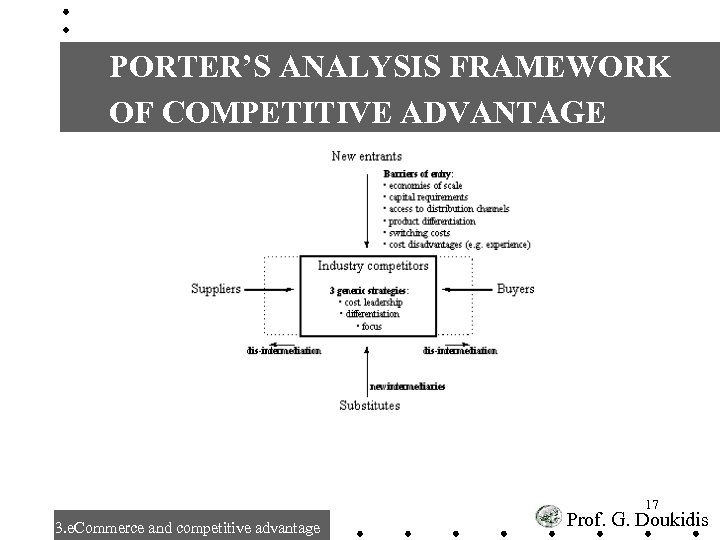
PORTER’S ANALYSIS FRAMEWORK OF COMPETITIVE ADVANTAGE 17 3. e. Commerce and competitive advantage Prof. G. Doukidis
GENERIC COMPETITIVE STRATEGIES 4 Porter's three generic strategies are cost advantage, product differentiation and focus. Focus means concentrating on one segment of the firm's customers and providing them with an extremely well-targeted set of products, excellent service, etc. Our three propositions show that electronic commerce can support such strategies. We refer here to our 10 business value propositions by naming them pn (e. g. p 1 is product promotion). Using electronic commerce systems on the Internet (or similar systems) … 4 proposition A 1: … offers a cost advantage through less expensive product promotion (p 1), cheaper distribution channels (p 2) and direct savings (p 3). This emphasizes how the Internet allows small companies to act as much larger ones, by using a "free" or very low-cost infrastructure to promote their products on a global basis. As such, the Web can be seen as a great equalizer, replacing an often costly distribution network by a public or widely shared infrastructure. 4 proposition A 2: … helps a company to differentiate itself not only through price but through product innovation (p 9), time to market (p 4) and customer service (p 5). 4 proposition A 3: … allows for customer focus strategies through better customer relationships (p 8). This is the idea on focusing on a specific set of customers and deliver the best service to them. Electronic commerce enables this strategy for a larger number of specific segments, by using information technology for personalized service on a larger scale and mass-customization of products. 18 3. e. Commerce and competitive advantage Prof. G. Doukidis
NEW ENTRANTS AND SUBSTITUTE PRODUCTS Using electronic commerce systems on the Internet (or similar systems) … 4 proposition B 1: … allows easier entry into traditionally hard to access markets, due to less expensive product promotion (p 1), new sales channels (p 2) and reduced capital requirements (p 3) 4 proposition B 2: … allows to raise the entry barriers in some markets through extensive customer learning (p 8) (which makes switching more expensive), product differentiation (p 4, p 5, p 9) and experience (p 7) 4 proposition B 3: … facilitates the introduction of substitute products in a market due to product innovation (p 6). 19 3. e. Commerce and competitive advantage Prof. G. Doukidis
INTERMEDIATION AND STRAGEGIC ADVANTAGE Using electronic commerce systems on the Internet (or similar systems) … 4 proposition C 1: …makes it easier to suppress an intermediary in a distribution network, due to direct customer contact (p 2) and the use of a publicly shared infrastructure 4 proposition C 2: …makes it easier to become a new intermediary in an industry, by providing an added-value service through information management, such as integrators or re-packagers of more basic services. 4 proposition C 3: …makes it possible to catch up with competitors thanks to the maturity of some technologies and learning experiences (p 7), and are critical in not losing ground as market dynamics shift. 20 3. e. Commerce and competitive advantage Prof. G. Doukidis
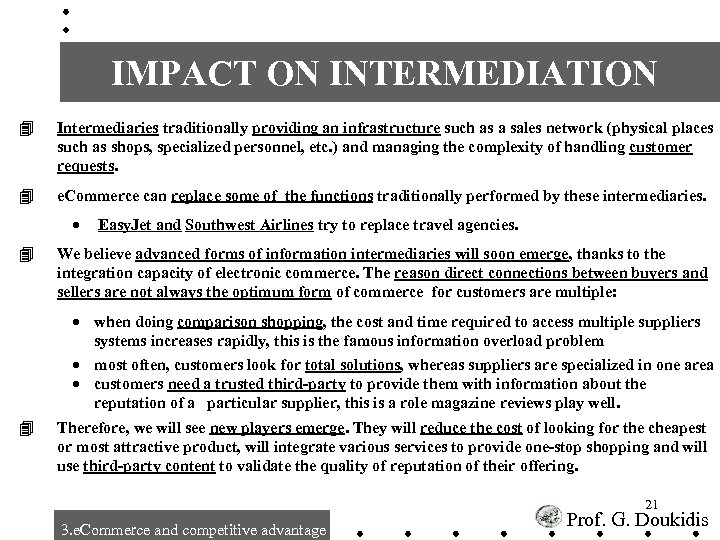
IMPACT ON INTERMEDIATION 4 Intermediaries traditionally providing an infrastructure such as a sales network (physical places such as shops, specialized personnel, etc. ) and managing the complexity of handling customer requests. 4 e. Commerce can replace some of the functions traditionally performed by these intermediaries. · Easy. Jet and Southwest Airlines try to replace travel agencies. 4 4 We believe advanced forms of information intermediaries will soon emerge, thanks to the integration capacity of electronic commerce. The reason direct connections between buyers and sellers are not always the optimum form of commerce for customers are multiple: · when doing comparison shopping, the cost and time required to access multiple suppliers systems increases rapidly, this is the famous information overload problem · most often, customers look for total solutions, whereas suppliers are specialized in one area · customers need a trusted third-party to provide them with information about the reputation of a particular supplier, this is a role magazine reviews play well. Therefore, we will see new players emerge. They will reduce the cost of looking for the cheapest or most attractive product, will integrate various services to provide one-stop shopping and will use third-party content to validate the quality of reputation of their offering. 21 3. e. Commerce and competitive advantage Prof. G. Doukidis
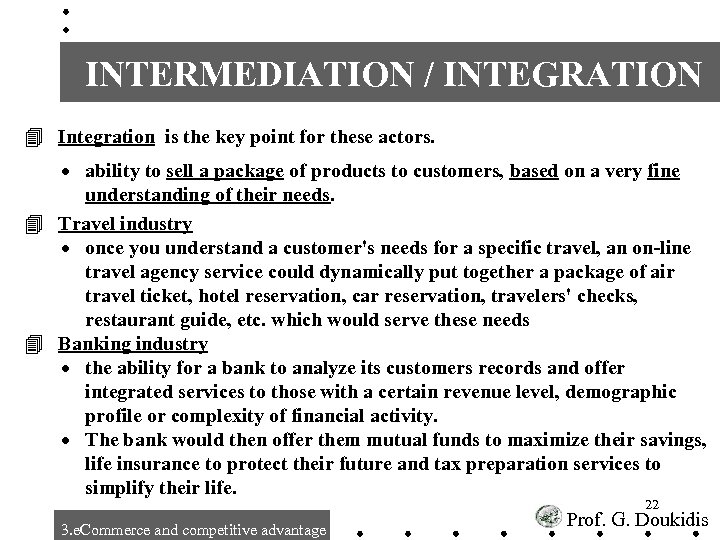
INTERMEDIATION / INTEGRATION 4 Integration is the key point for these actors. · ability to sell a package of products to customers, based on a very fine understanding of their needs. 4 Travel industry · once you understand a customer's needs for a specific travel, an on-line travel agency service could dynamically put together a package of air travel ticket, hotel reservation, car reservation, travelers' checks, restaurant guide, etc. which would serve these needs 4 Banking industry · the ability for a bank to analyze its customers records and offer integrated services to those with a certain revenue level, demographic profile or complexity of financial activity. · The bank would then offer them mutual funds to maximize their savings, life insurance to protect their future and tax preparation services to simplify their life. 22 3. e. Commerce and competitive advantage Prof. G. Doukidis
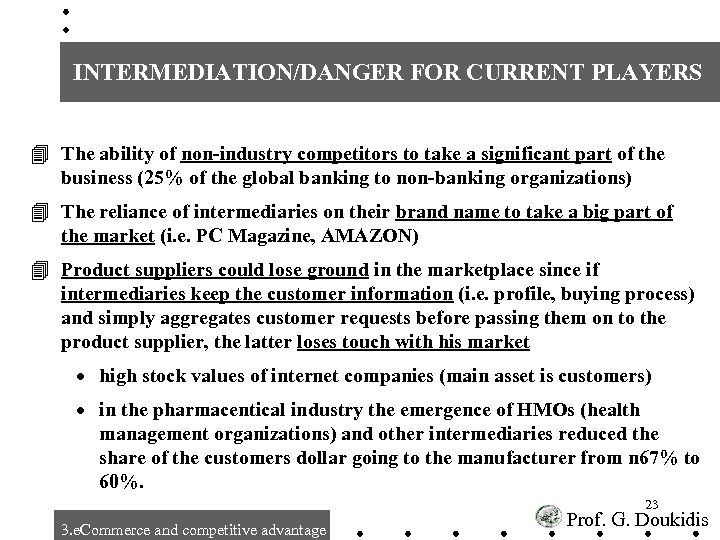
INTERMEDIATION/DANGER FOR CURRENT PLAYERS 4 The ability of non-industry competitors to take a significant part of the business (25% of the global banking to non-banking organizations) 4 The reliance of intermediaries on their brand name to take a big part of the market (i. e. PC Magazine, AMAZON) 4 Product suppliers could lose ground in the marketplace since if intermediaries keep the customer information (i. e. profile, buying process) and simply aggregates customer requests before passing them on to the product supplier, the latter loses touch with his market · high stock values of internet companies (main asset is customers) · in the pharmacentical industry the emergence of HMOs (health management organizations) and other intermediaries reduced the share of the customers dollar going to the manufacturer from n 67% to 60%. 23 3. e. Commerce and competitive advantage Prof. G. Doukidis
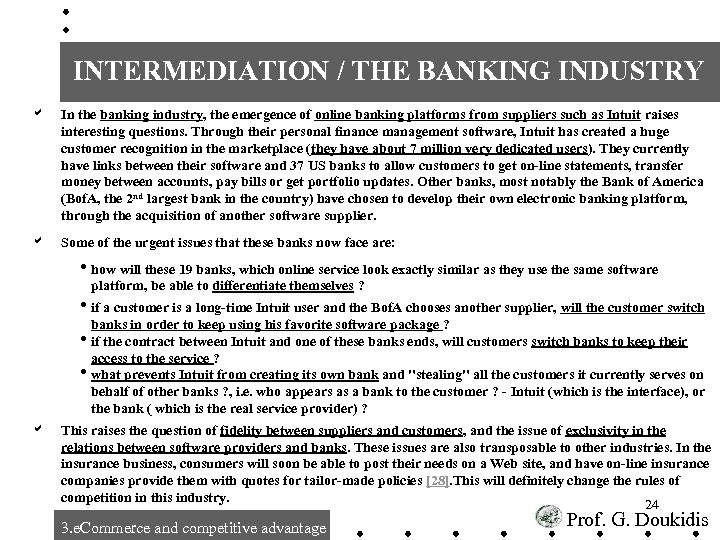
INTERMEDIATION / THE BANKING INDUSTRY a In the banking industry, the emergence of online banking platforms from suppliers such as Intuit raises interesting questions. Through their personal finance management software, Intuit has created a huge customer recognition in the marketplace (they have about 7 million very dedicated users). They currently have links between their software and 37 US banks to allow customers to get on-line statements, transfer money between accounts, pay bills or get portfolio updates. Other banks, most notably the Bank of America (Bof. A, the 2 nd largest bank in the country) have chosen to develop their own electronic banking platform, through the acquisition of another software supplier. a Some of the urgent issues that these banks now face are: h how will these 19 banks, which online service look exactly similar as they use the same software platform, be able to differentiate themselves ? h if a customer is a long-time Intuit user and the Bof. A chooses another supplier, will the customer switch banks in order to keep using his favorite software package ? h if the contract between Intuit and one of these banks ends, will customers switch banks to keep their access to the service ? h what prevents Intuit from creating its own bank and "stealing" all the customers it currently serves on behalf of other banks ? , i. e. who appears as a bank to the customer ? - Intuit (which is the interface), or the bank ( which is the real service provider) ? a This raises the question of fidelity between suppliers and customers, and the issue of exclusivity in the relations between software providers and banks. These issues are also transposable to other industries. In the insurance business, consumers will soon be able to post their needs on a Web site, and have on-line insurance companies provide them with quotes for tailor-made policies [28]. This will definitely change the rules of competition in this industry. 24 3. e. Commerce and competitive advantage Prof. G. Doukidis
PURE PRICE COMPETITION a This is a form of competition that will emerge in the electronic world with the emergence of the storefronts, offering similar products with various level of services. a Two different online travel agencies selling airline tickets through the Web h El Cheapo, provides a bare-bone service, offering very cheap tickets to customers who exactly know what they want. h MSDTA (Multi Service Digital Travel Agency) is much closer to our description in the previous section, i. e. it provides the customer with multi-media information on the various products it offers, offers a customized travel plan, etc. It has higher prices. a The issue is to prevent potential customers from getting information from MSDTA, for free, before buying from El Cheapo 25 3. e. Commerce and competitive advantage Prof. G. Doukidis
STRATEGIC DISADVANTAGE a New technologies allow an organisation to quickly catch up with its competition. However, if not used, they can become a potential source of strategic disadvantage. a If a company offers services or products through the Internet, and its competitors does not, customers might well switch suppliers, especially in industries where switching barriers are low. a An example of a sector h Federal Express (1994) UPS (1995) DHL(1996) a The value of the competitive advantage for the leader is unfortunately timelimited h Therefore need for technical and organisational infrastructure which allows continuous innovation 26 3. e. Commerce and competitive advantage Prof. G. Doukidis
ISSUES IN ELECTRONIC COMMERCE a. Customer relations a. Privacy and security a. Electronic payment systems a. Mass-market adoption a. Implementation issues a. Organisational commitment 27 4. Issues in e. Commerce Prof. G. Doukidis
CUSTOMER RELATIONS a The case of banking h. Customers interact with unsophisticated electronic interface h. The electronic channel has major difficulties with integration with the legacy systems, which presents them from selling additional products to customers h. The decrease in human interaction with customers could also lead to a less sophisticated understanding of their needs a Therefore design of e. Commerce systems which incorporate capabilities for customer understanding and for proactive selling of new products 28 4. Issues in e. Commerce Prof. G. Doukidis
PRIVACY AND SECURITY a Customers are probably reluctant to provide their suppliers with data on their demographic information, buying patterns or product needs h make consumers aware of the benefits of volunteering data (i. e. products suited to their needs, reduction of junk mail) h material incentives that can be offered to customers to attract them (i. e. Coupon offers) a A widely cited issue is security h many specialists consider it to be a matter of perception rather than reality h most security systems are good enough to be used for most commercial transactions and the evolving leg the islation in the held will allow the development of better systems (i. e. crypto-systems with longer keys) and their export worldwide 29 Prof. G. Doukidis 4. Issues in e. Commerce
ELECTRONIC PAYMENT SYSTEMS a Financial exchanges between buyers and sellers should occur in a simple, universally accepted, safe and cheap way a Various systems have been proposed hsome are based on traditional mechanisms (i. e. credit card account) hothers rely on new designs, such as electronic money a Find a few widely accepted mechanisms that can be used by most actors (i. e. agreement between Mastercard and Visa on one security standard) a Probably need for more specialised systems hmicro-transactions (the exchange of very small amounts of money in exchange of information or services) 30 4. Issues in e. Commerce Prof. G. Doukidis
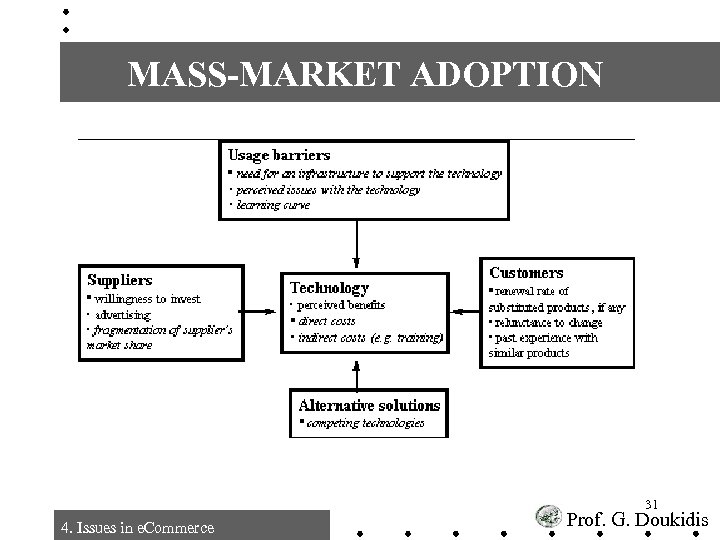
MASS-MARKET ADOPTION 31 4. Issues in e. Commerce Prof. G. Doukidis
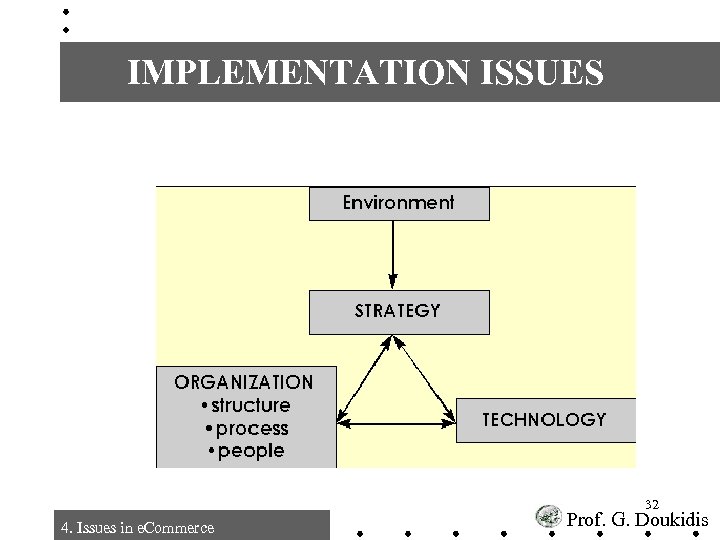
IMPLEMENTATION ISSUES 32 4. Issues in e. Commerce Prof. G. Doukidis
ALIGNMENT BETWEEN TECHNOLOGY AND ORGANISATIONAL PROCESSES a Redefine some processes after the introduction of e. Commerce systems, so that these systems become fully, integrated in the way an organisation does business • when a Web system is used to broadcast corporate information, there is a need to authorize each specific piece (or class of) information which becomes public. Therefore, the process handling corporate communications needs to be refined • the logistics processes (the back-end) need to be integrated with the on-line ordering systems (the front-end) to provide uniform and seamless service. There is little use for an on-line system if orders have to be manually re-keyed in another system before they can be processed. This often requires integration with legacy information systems • whenever customer contact becomes possible through an on-line media, the customer expectations of the company's reaction change. By using electronic mail, which is usually answered in a few hours, a day at the maximum, when dealing with a company, the customer expects a similar response time. But it often happen that questions/comments coming through e-mail take the same path (i. e. process) as written queries, traditionally answered in a matter of days. The advantages of on-line communications therefore disappear. a Use the technology to enable a redesign of the processes, thereby reducing the cost, time and number of errors associated with the process whilw increasing the service level (BPR) 33 4. Issues in e. Commerce Prof. G. Doukidis
ORGANISATIONAL COMMITMENT a Although the Internet represents a great way to test some commercial idieas with a low cost entry, a working system very soon requires additional resources in terms of technology and skills (i. e. professional design, integration of legacy systems, process integration etc. ) a A sustained presence in cyberspace requires a strong organisational commitment, to increase the resources devoted to it as success proves the validity at the business model 34 4. Issues in e. Commerce Prof. G. Doukidis
Скачать презентацию BUSINESS VALUE FRAMEWORK OF ELECTRONIC COMMERCE 1 Introduction
b13643ef643bf5b7e46f7977d7508d7e.ppt