 Скачать презентацию Business Strategy We aren t in the coffee business
4b4fab85be0b39914f9d2fed046a853d.ppt
- Количество слайдов: 31



Business Strategy “We aren’t in the coffee business, serving people. We are in the people business, serving coffee” Howard Schultz, Starbucks Chairman , Fortune Magazine, Vol. 149 No. 2 Professor : Spyros Lioukas Presentation: Yiouli Sapouna
Contents ØHistory ØIdentity ØMission ØObjectives Ø Strategy ØTactics
History of Starbucks 1971 Two teachers & a writer open the first Starbucks store in Seattle Starbucks – minor character in Moby Dick 1987 1992 1995 1996 Howard Schultz joins Starbucks (17 stores) 2000 Establishes licensing agreement with Trans. Fair USA to sell Fairtrade certified coffee in US & Canada 2011 Introduces VIA instant coffee 40 th Anniversary 2012 Introduces Verismo on-demand system Completes IPO (165 stores) Introduces Frappuccino (677 stores) First stores open outside North America – Japan & Singapore (2002 in Greece)
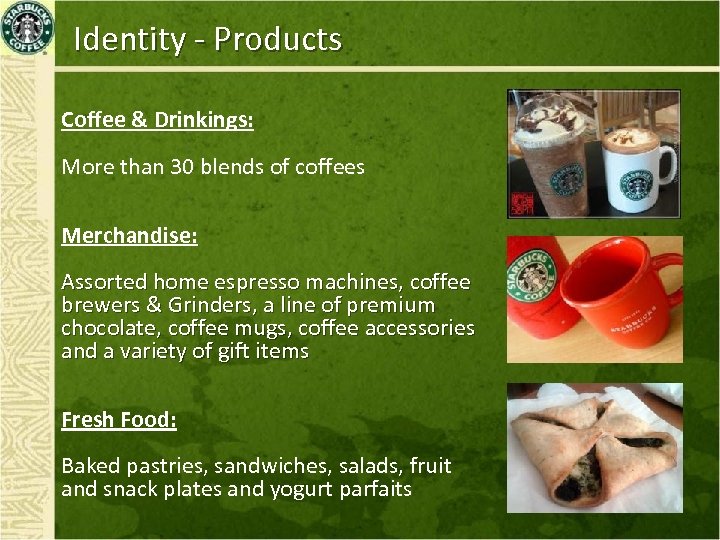
Identity - Products Coffee & Drinkings: More than 30 blends of coffees Merchandise: Assorted home espresso machines, coffee brewers & Grinders, a line of premium chocolate, coffee mugs, coffee accessories and a variety of gift items Fresh Food: Baked pastries, sandwiches, salads, fruit and snack plates and yogurt parfaits
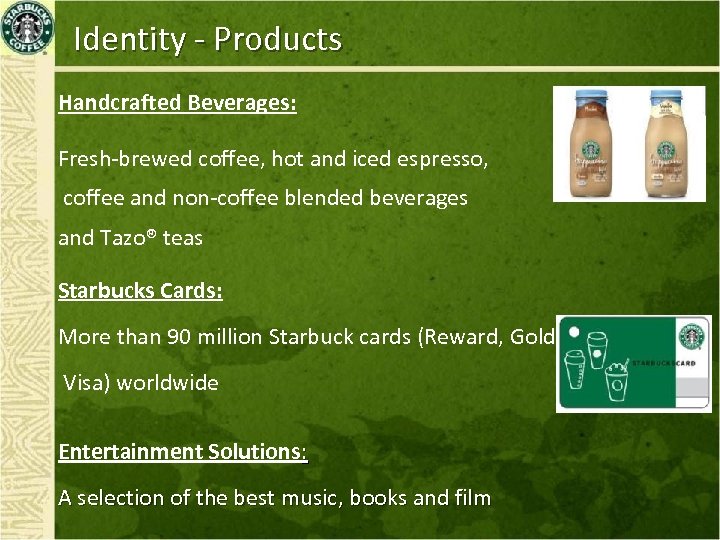
Identity - Products Handcrafted Beverages: Fresh-brewed coffee, hot and iced espresso, coffee and non-coffee blended beverages and Tazo® teas Starbucks Cards: More than 90 million Starbuck cards (Reward, Gold & Visa) worldwide Entertainment Solutions: A selection of the best music, books and film
Main Competitors Ø Second Cup ØCaribou Coffee (415 stores) Ø Mc. Donalds (14000 stores) Ø Dunkin’ Donuts (5000 stores) Ø Coffee People Ø Costa Coffee Ø Local (boutique) chains Ø Kraft Ø Procter & Gamble Ø Nestle
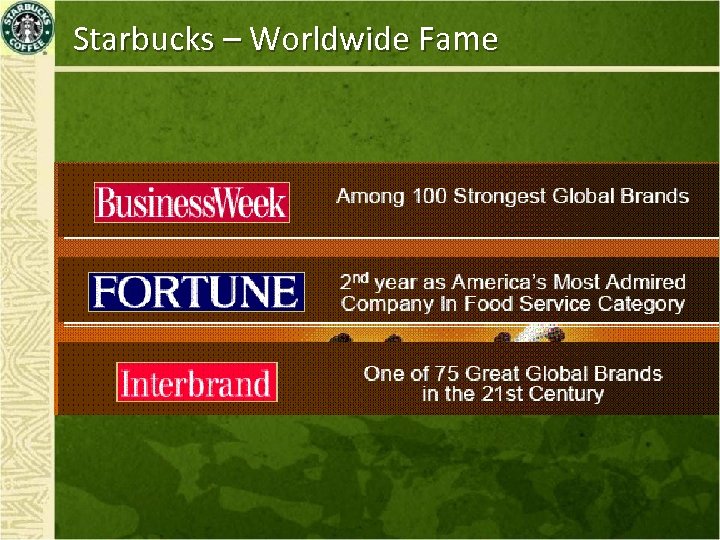
Starbucks – Worldwide Fame
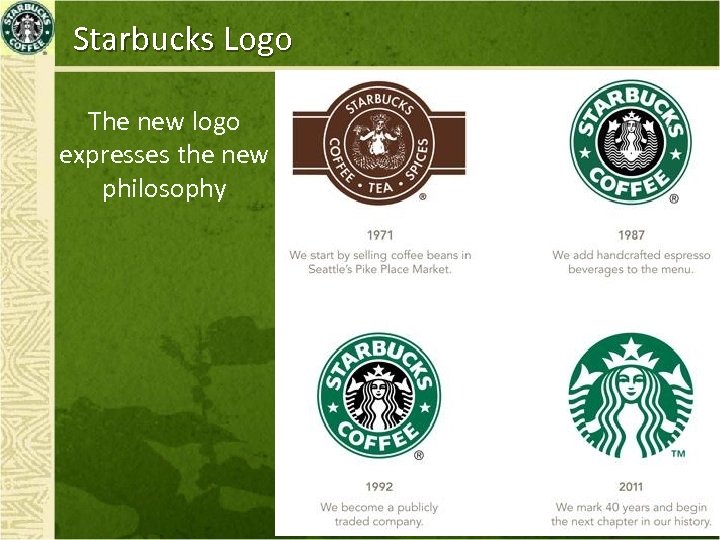
Starbucks Logo The new logo expresses the new philosophy
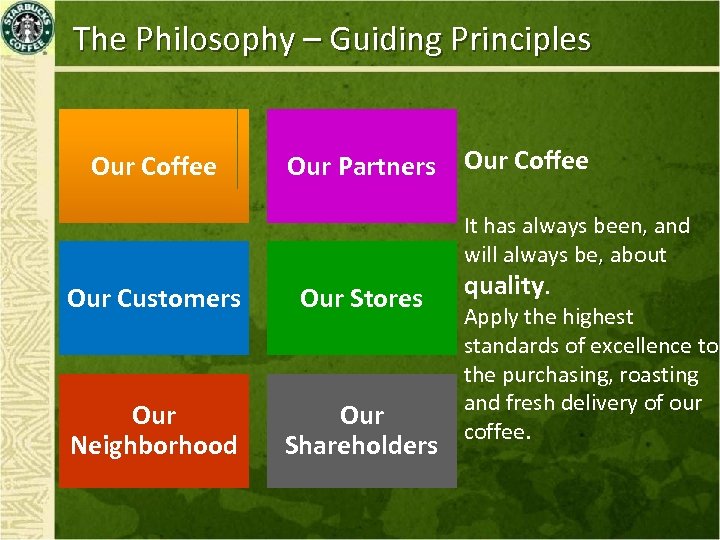
The Philosophy – Guiding Principles Our Coffee Our Partners Our Coffee Our Customers Our Stores Our Neighborhood Our Shareholders It has always been, and will always be, about quality. Apply the highest standards of excellence to the purchasing, roasting and fresh delivery of our coffee.
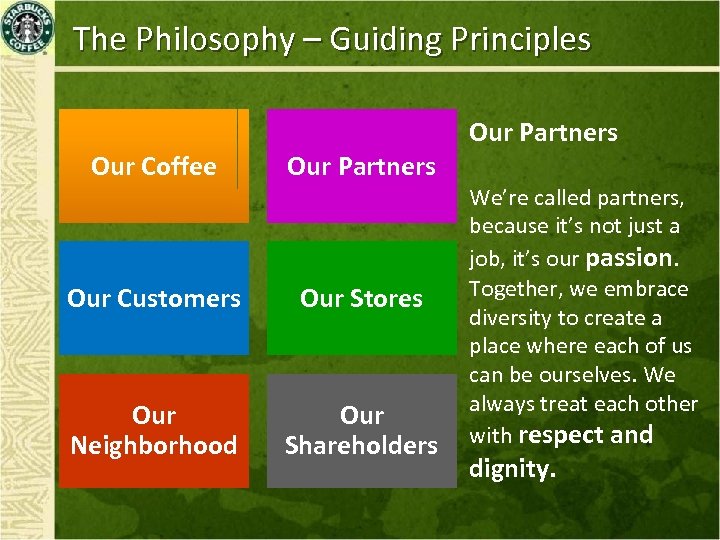
The Philosophy – Guiding Principles Our Coffee Our Partners Our Customers Our Stores Our Neighborhood Our Shareholders Our Partners We’re called partners, because it’s not just a job, it’s our passion. Together, we embrace diversity to create a place where each of us can be ourselves. We always treat each other with respect and dignity.
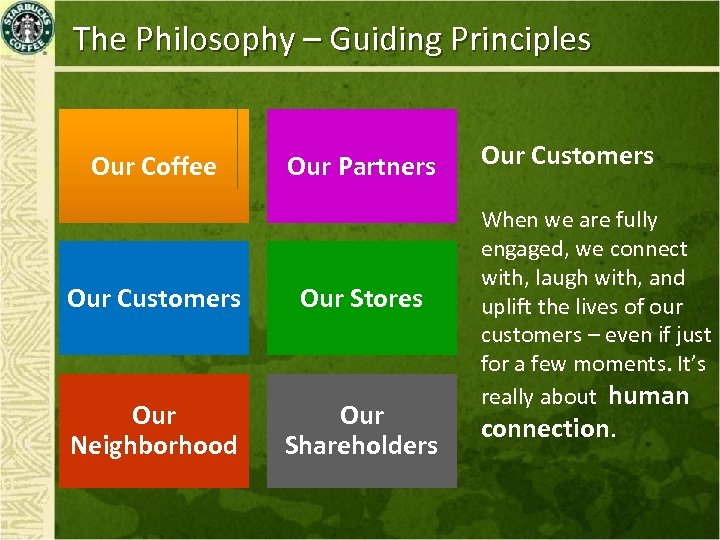
The Philosophy – Guiding Principles Our Coffee Our Partners Our Customers Our Stores Our Neighborhood Our Shareholders Our Customers When we are fully engaged, we connect with, laugh with, and uplift the lives of our customers – even if just for a few moments. It’s really about human connection.
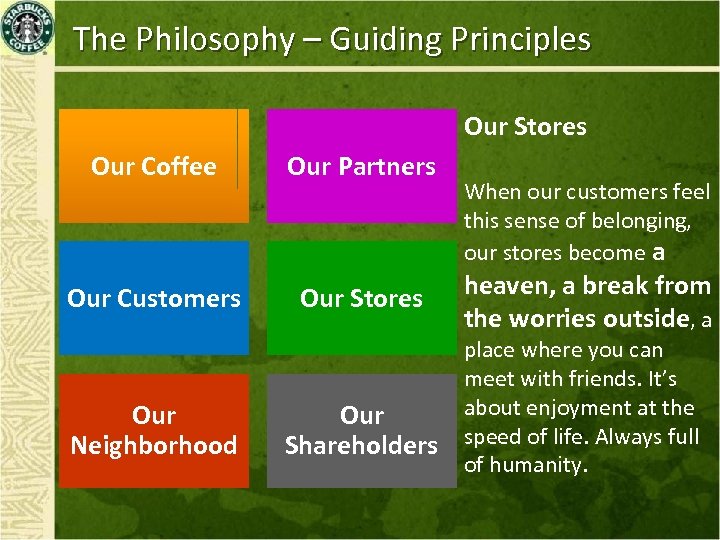
The Philosophy – Guiding Principles Our Stores Our Coffee Our Partners Our Customers Our Stores Our Neighborhood Our Shareholders When our customers feel this sense of belonging, our stores become a heaven, a break from the worries outside, a place where you can meet with friends. It’s about enjoyment at the speed of life. Always full of humanity.
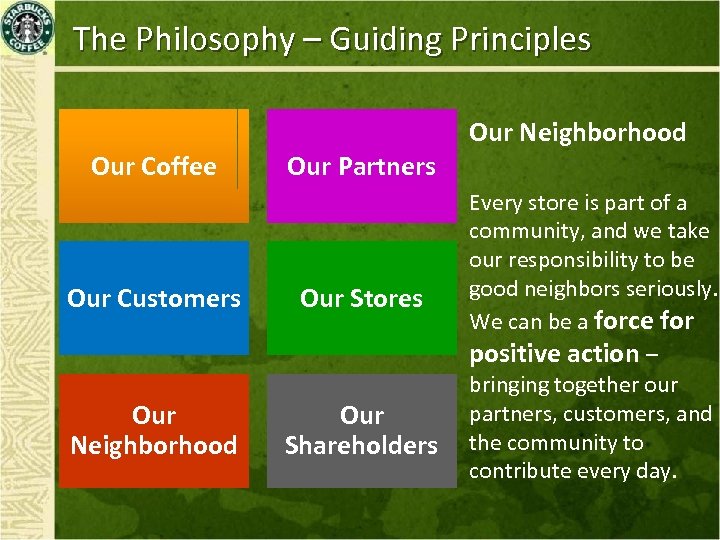
The Philosophy – Guiding Principles Our Coffee Our Partners Our Customers Our Stores Our Neighborhood Our Shareholders Our Neighborhood Every store is part of a community, and we take our responsibility to be good neighbors seriously. We can be a force for positive action – bringing together our partners, customers, and the community to contribute every day.
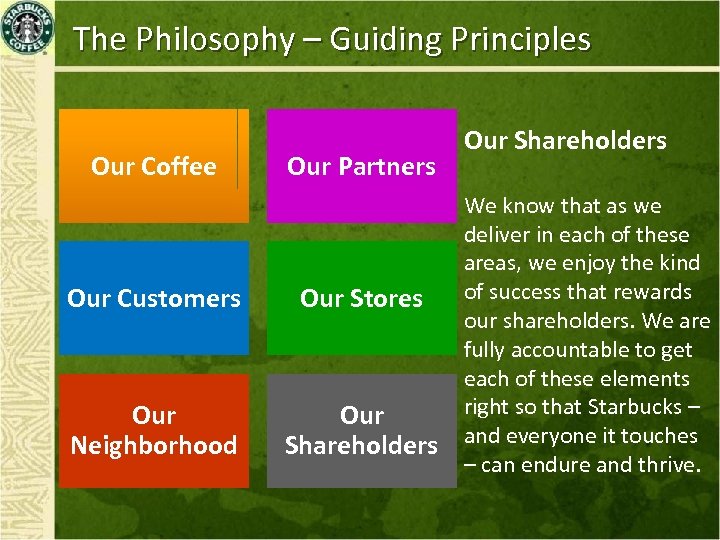
The Philosophy – Guiding Principles Our Coffee Our Partners Our Customers Our Stores Our Neighborhood Our Shareholders We know that as we deliver in each of these areas, we enjoy the kind of success that rewards our shareholders. We are fully accountable to get each of these elements right so that Starbucks – and everyone it touches – can endure and thrive.
Corporate Social Responsibility Commitment to Origins Investments that benefit coffee producers, their families and communities, and the natural environment. Commitment to Environment Promoting conservation in coffee-growing countries to in-store “Green Teams” and recycling programs. Commitment to Communities Strive to be a responsible neighbor and active contributor in the communities where their partners and customers live and work. Commitment to Partners Treating people with respect and dignity. This is especially true of the way we treat the people who work for Starbucks.
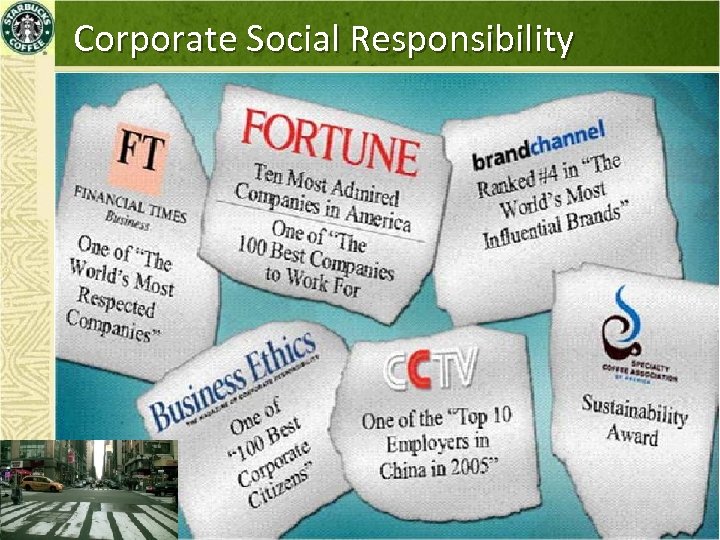
Corporate Social Responsibility
Mission Statement Old Starbucks Mission Statement "To establish Starbucks as the premier purveyor of the finest coffees in the world while maintaining our uncompromising principles as we grow. " New Starbucks Mission Statement "To inspire and nurture the human spirit. One person, One cup, and One Neighborhood at a time. "
Principles and values Howard Schultz: “Care more than others think wise. Risk more than others think safe. Dream more than others think practical. Expect more than others think possible. ”
Objectives “Establish Starbucks as a recognizable, successful and respectful brand name in the world”
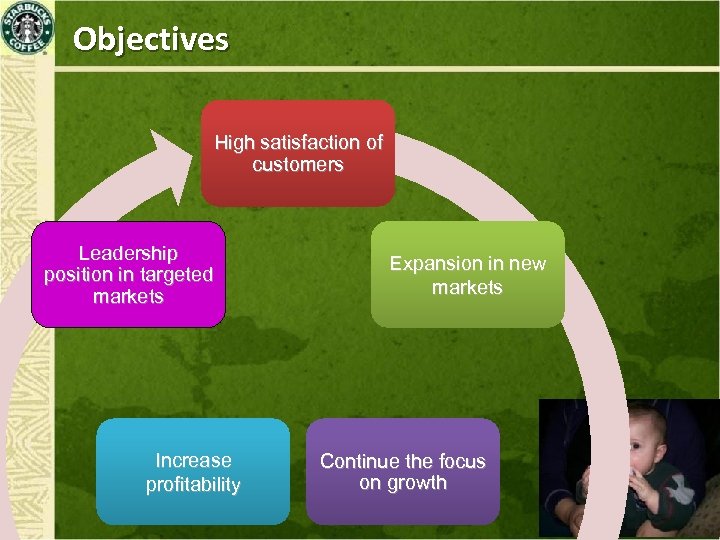
Objectives High satisfaction of customers Leadership position in targeted markets Increase profitability Expansion in new markets Continue the focus on growth
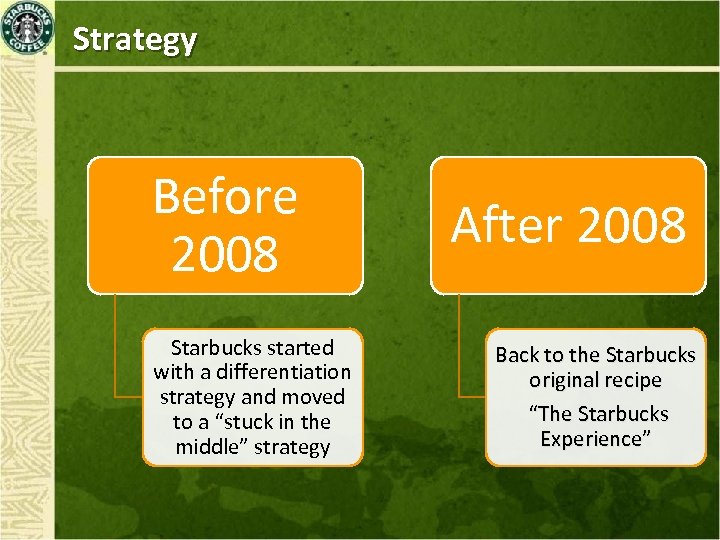
Strategy Before 2008 Starbucks started with a differentiation strategy and moved to a “stuck in the middle” strategy After 2008 Back to the Starbucks original recipe “The Starbucks Experience”
Before 2008… Stopped offering handmade Espresso – automatic machines producing coffee by pressing a button placed to its shops- loss of the "romance" of coffeemaking Line queues during morning hours Resembled Fast Food stores instead of Coffee corners -Starbucks started serving breakfast Missed its homeliness High competition
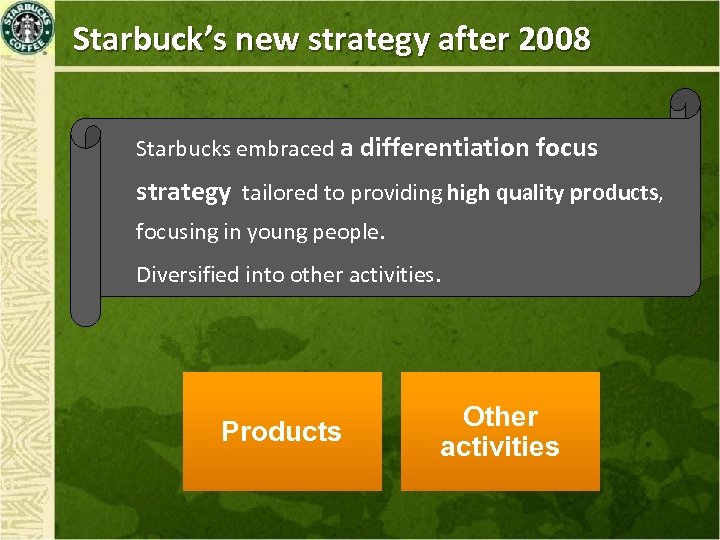
Starbuck’s new strategy after 2008 Starbucks embraced a differentiation focus strategy tailored to providing high quality products, focusing in young people. Diversified into other activities. Products Other activities
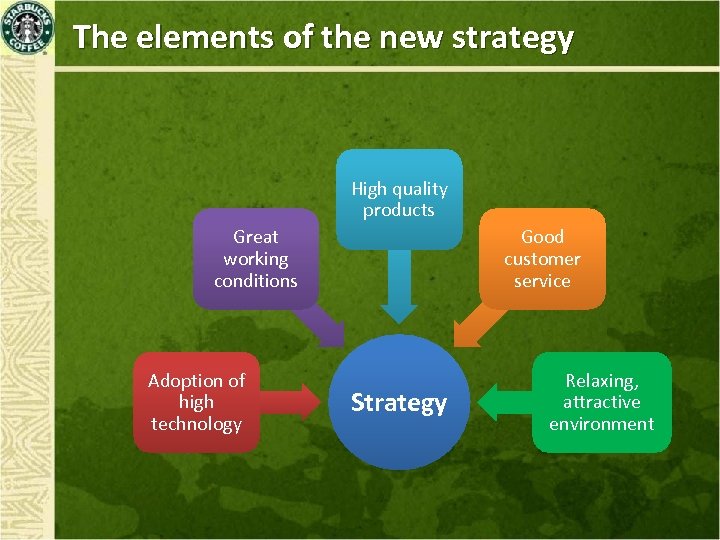
The elements of the new strategy High quality products Great working conditions Adoption of high technology Good customer service Strategy Relaxing, attractive environment
Operational strategies / tactics (1) Continuous improvements of coffee (new technology, quality) A proprietary and revolutionary in-store Clover brewing system Next generation espresso machine New unique coffee blend Installation of free wireless internet (Wi-Fi) at stores, rent out meeting space, CD burning Re-modelling of stores as local coffee houses – a differentiated environment of ambiance
Operational strategies / tactics (2) Reward programs instead of cutting coffee prices Adding rewards to Starbucks card (syrops, flavors, free refills Increase connection with customer, politeness of employees Millions of conversations every day, seek ideas and enable customers in shaping Starbucks future Launch of My. Starbucks. Idea, first online community Actions to become more environmentally friendly and socially responsible (enhanced Fair Trade program begun in early 2000 s).
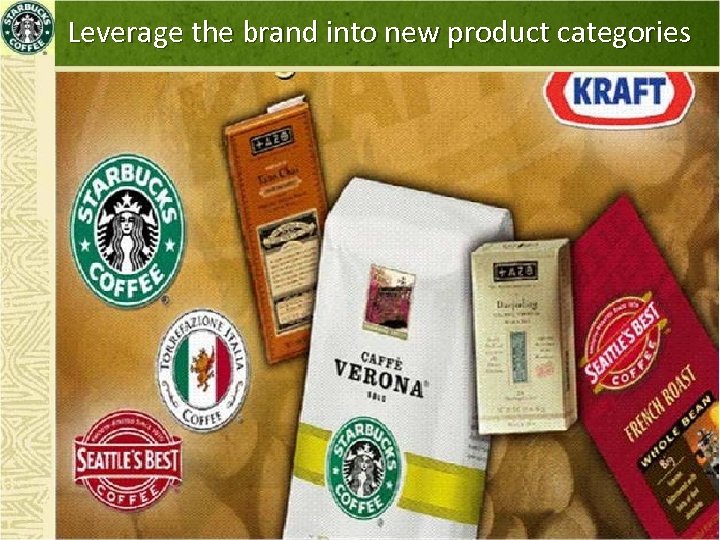
Leverage the brand into new product categories
Alliances Ø Pepsi-Cola Company, Dreyer’s Grand Ice Cream, Kraft Foods Inc. , CARE, Ø Horizon Air, HMSHost, Barnes & Noble, United Airlines, Starwood Hotel, Ø Chapters Inc. , Safeway Inc. , Marriott International Inc. , Hyatt Hotels Ø Corporation, Aramark, Compass, Sodexho, Trans. Fair USA, SYSCO, HP, Ø T-Mobile, Trans. Fair Canada, White Wave, Inc. , Chase VISA USA, Royal Ø Bank Canada, Hilton, Intrawest, Wyndham, Target, Kroger, Ahold, Fortune Ø Brands, XM Satellite Radio, Borders, Westin and Radisson
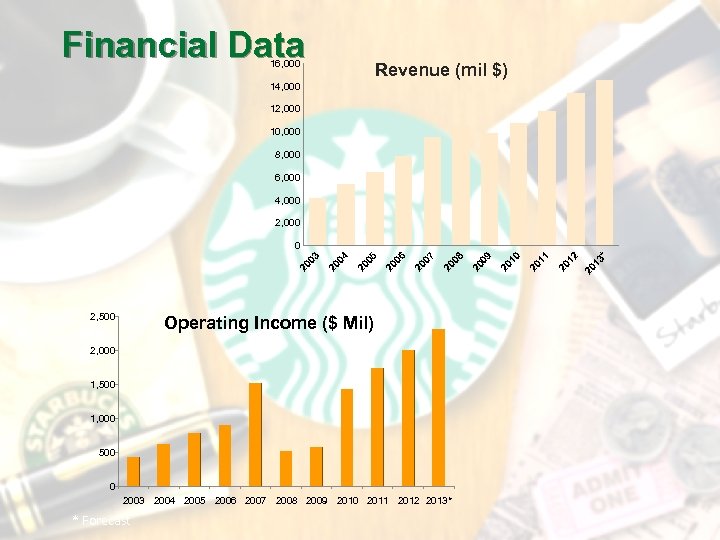
Financial Data 16, 000 Revenue (mil $) 14, 000 12, 000 10, 000 8, 000 6, 000 4, 000 2, 500 Operating Income ($ Mil) 2, 000 1, 500 1, 000 500 0 2003 2004 2005 2006 2007 2008 2009 2010 2011 2012 2013* * Forecast * 20 13 20 12 20 11 20 10 20 09 20 08 20 07 20 06 20 05 20 04 20 03 0
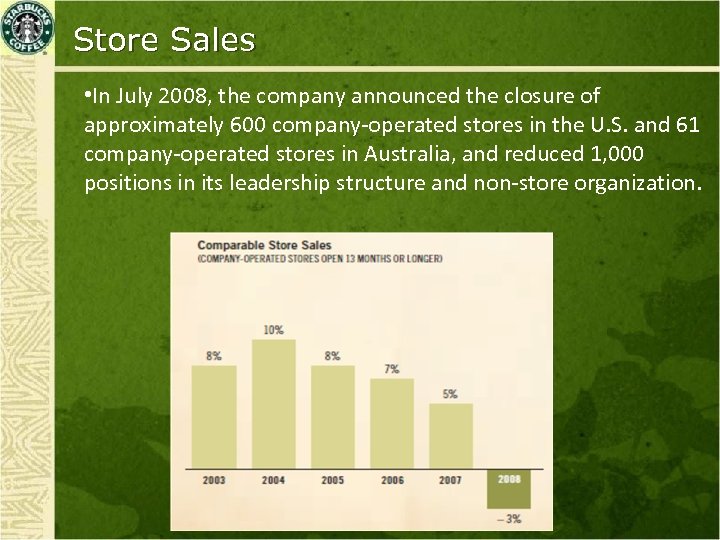
Store Sales • In July 2008, the company announced the closure of approximately 600 company-operated stores in the U. S. and 61 company-operated stores in Australia, and reduced 1, 000 positions in its leadership structure and non-store organization.
Questions Ø On strategy statements Ø Ø Ø How do you evaluate mission statement and values (principles) of Starbucks? Are they realistic or inflated? Are they of relevance to the competitive strategy? In what ways? Do they add value? Do you agree with the wider social components of MOST, such as people and CSR, in relation to performance? Ø On competitive strategy Ø Ø Why the differentiation advantage of Starbucks had eroded? Is “Starbucks’ experience” based on a distinctive elements which are recognized by consumers and differentiate it from competitors? Do they provide a sustainable competitive advantage? Is what ways innovation is important for the new competitive advantage?
Скачать презентацию Business Strategy We aren t in the coffee business
4b4fab85be0b39914f9d2fed046a853d.ppt