 Скачать презентацию Business Statistics QM 2113 — Spring 2002 Some
3e50c86567bfc490bdb0ceebed06cf56.ppt
- Количество слайдов: 10



Business Statistics QM 2113 - Spring 2002 Some Probability Essentials
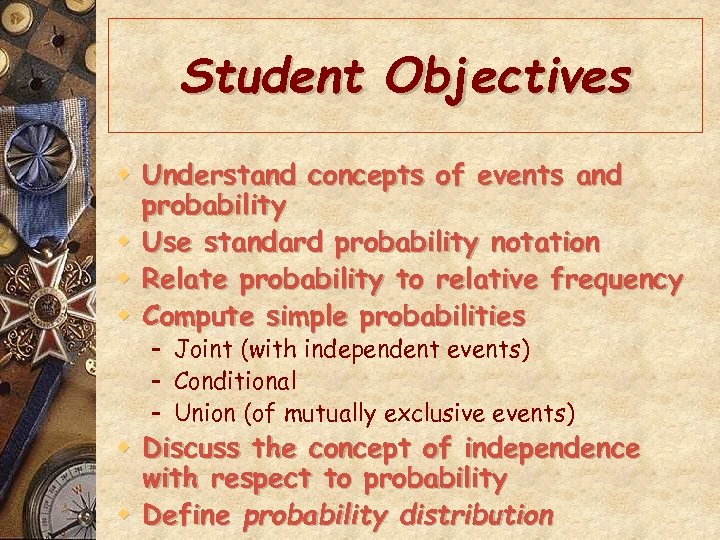
Student Objectives w Understand concepts of events and probability w Use standard probability notation w Relate probability to relative frequency w Compute simple probabilities – Joint (with independent events) – Conditional – Union (of mutually exclusive events) w Discuss the concept of independence with respect to probability w Define probability distribution
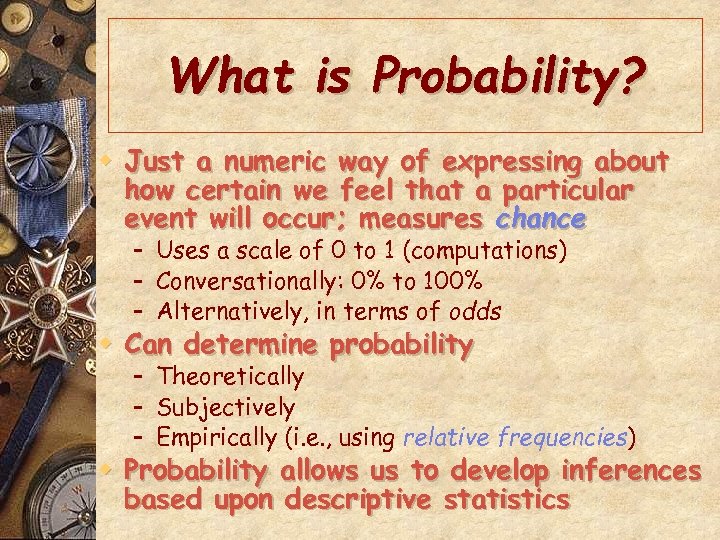
What is Probability? w Just a numeric way of expressing about how certain we feel that a particular event will occur; measures chance – Uses a scale of 0 to 1 (computations) – Conversationally: 0% to 100% – Alternatively, in terms of odds w Can determine probability – Theoretically – Subjectively – Empirically (i. e. , using relative frequencies) w Probability allows us to develop inferences based upon descriptive statistics
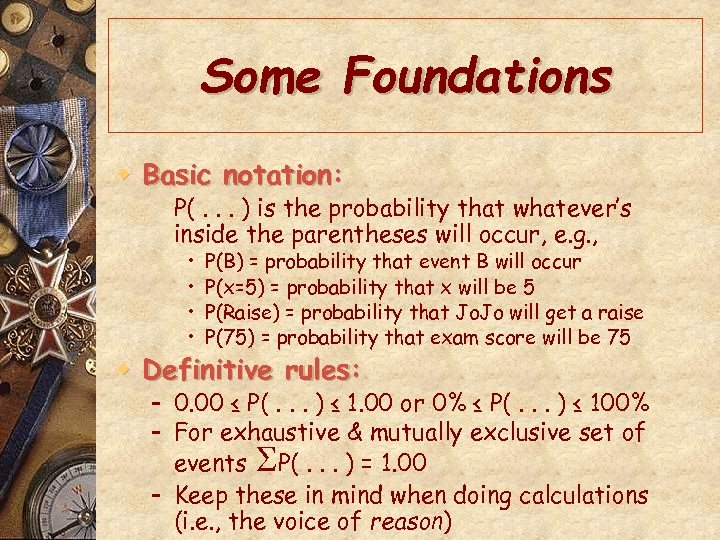
Some Foundations w Basic notation: P(. . . ) is the probability that whatever’s inside the parentheses will occur, e. g. , • • P(B) = probability that event B will occur P(x=5) = probability that x will be 5 P(Raise) = probability that Jo. Jo will get a raise P(75) = probability that exam score will be 75 w Definitive rules: – 0. 00 ≤ P(. . . ) ≤ 1. 00 or 0% ≤ P(. . . ) ≤ 100% – For exhaustive & mutually exclusive set of events SP(. . . ) = 1. 00 – Keep these in mind when doing calculations (i. e. , the voice of reason)
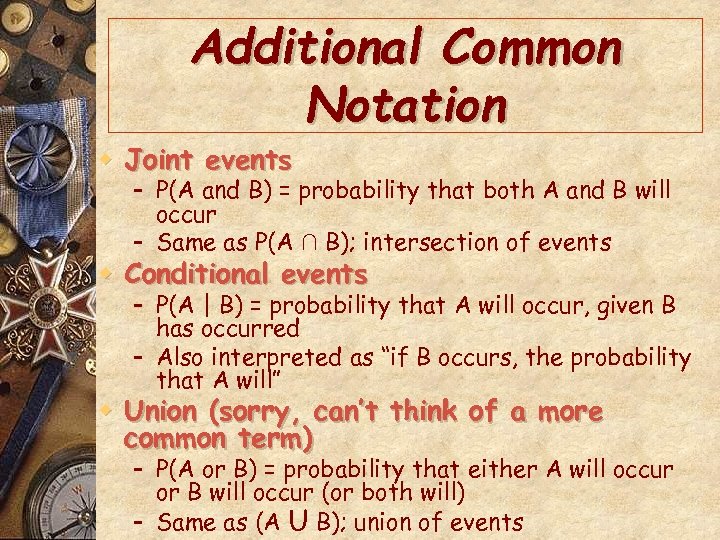
Additional Common Notation w Joint events – P(A and B) = probability that both A and B will occur – Same as P(A ∩ B); intersection of events w Conditional events – P(A | B) = probability that A will occur, given B has occurred – Also interpreted as “if B occurs, the probability that A will” w Union (sorry, can’t think of a more common term) – P(A or B) = probability that either A will occur or B will occur (or both will) – Same as (A U B); union of events
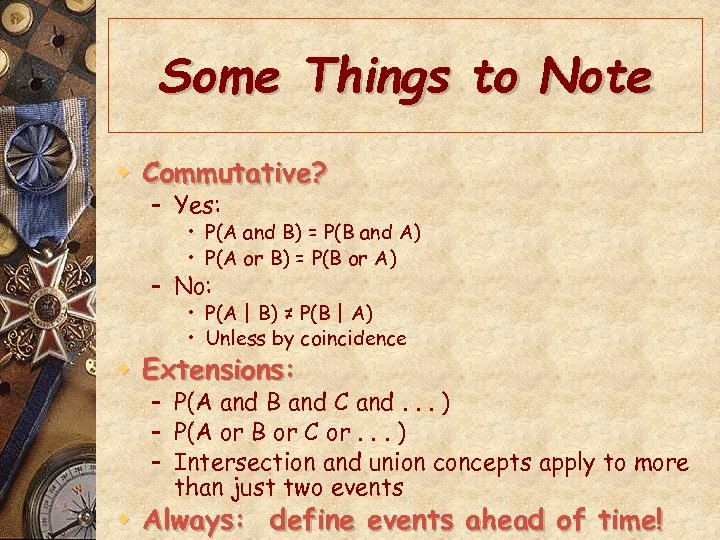
Some Things to Note w Commutative? – Yes: • P(A and B) = P(B and A) • P(A or B) = P(B or A) – No: • P(A | B) ≠ P(B | A) • Unless by coincidence w Extensions: – P(A and B and C and. . . ) – P(A or B or C or. . . ) – Intersection and union concepts apply to more than just two events w Always: define events ahead of time!
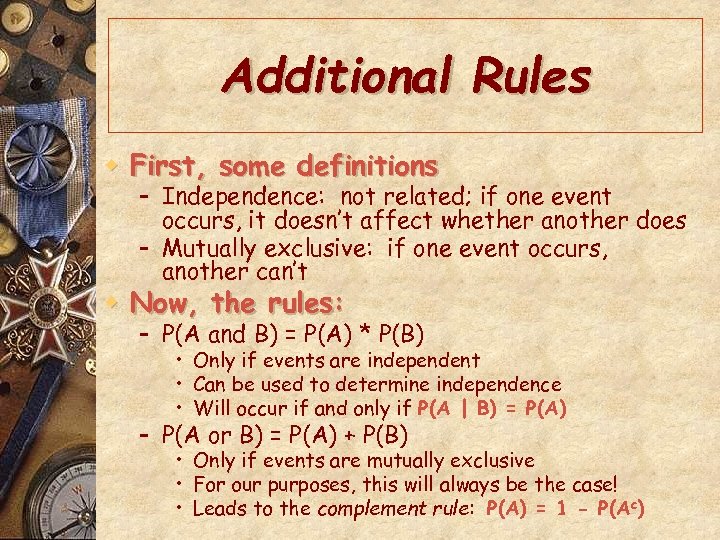
Additional Rules w First, some definitions – Independence: not related; if one event occurs, it doesn’t affect whether another does – Mutually exclusive: if one event occurs, another can’t w Now, the rules: – P(A and B) = P(A) * P(B) • Only if events are independent • Can be used to determine independence • Will occur if and only if P(A | B) = P(A) – P(A or B) = P(A) + P(B) • Only if events are mutually exclusive • For our purposes, this will always be the case! • Leads to the complement rule: P(A) = 1 - P(Ac)
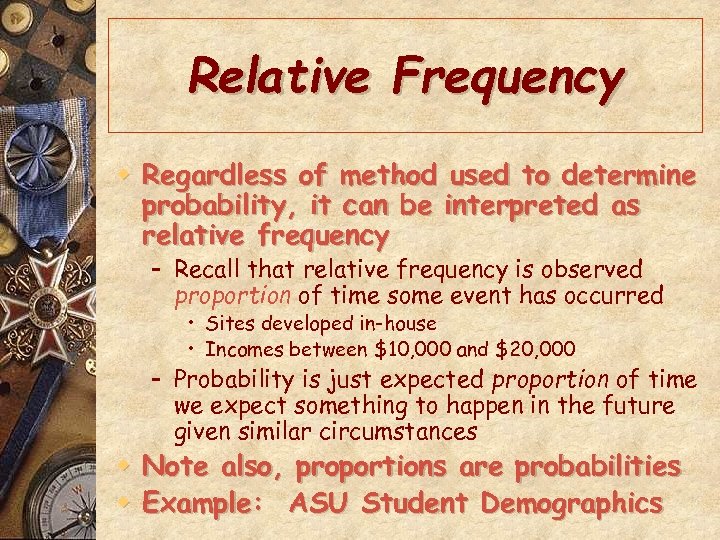
Relative Frequency w Regardless of method used to determine probability, it can be interpreted as relative frequency – Recall that relative frequency is observed proportion of time some event has occurred • Sites developed in-house • Incomes between $10, 000 and $20, 000 – Probability is just expected proportion of time we expect something to happen in the future given similar circumstances w w Note also, proportions are probabilities Example: ASU Student Demographics
Probability Applications w Statistical inference w Decision analysis w Reliability
Homework w Work probability exercises on handout w Read about discrete distributions (Section 4. 3) w Prepare for discussion and analysis of Case 4 -B
Скачать презентацию Business Statistics QM 2113 — Spring 2002 Some
3e50c86567bfc490bdb0ceebed06cf56.ppt