 Скачать презентацию Business Process Monitoring and Alignment An Approach Based
d889938bf7b43231052bb3d0c4285d85.ppt
- Количество слайдов: 25



Business Process Monitoring and Alignment An Approach Based on the User Requirements Notation and Business Intelligence Tools Alireza Pourshahid Daniel Amyot Pengfei Chen Michael Weiss (supervisor) SITE, University of Ottawa SCS, Carleton University Company LOGO Alan J. Forster Department of Medicine, University of Ottawa
Research context § How can we model and monitor business processes and determine how well they meet their business goals and performance requirements? § Can monitoring information be used to better align business processes and goals?
Agenda § Introduction Business Process Management (BPM) Business Activity Monitoring (BAM) Key Performance Indicator (KPI) URN & GRL § Methodology Overview Conceptual view Integrating KPI models with URN § KPI model definition in GRL § Connecting KPI and UCM models § Case Study § Conclusion and Future Work 3
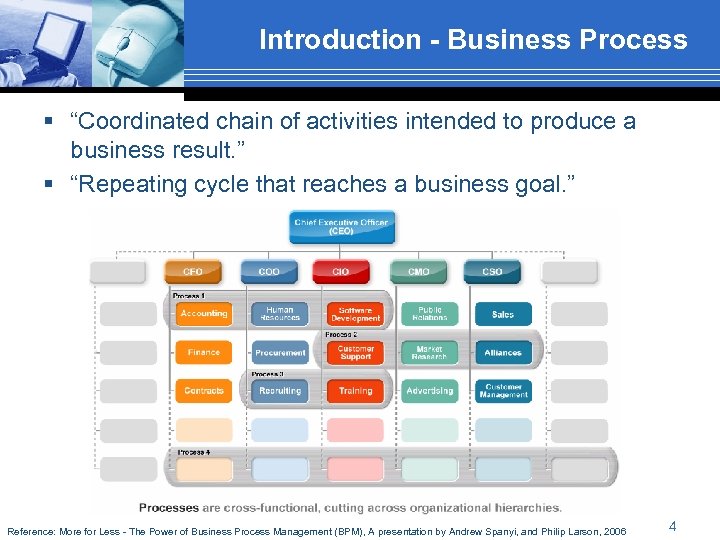
Introduction - Business Process § “Coordinated chain of activities intended to produce a business result. ” § “Repeating cycle that reaches a business goal. ” Reference: More for Less - The Power of Business Process Management (BPM), A presentation by Andrew Spanyi, and Philip Larson, 2006 4
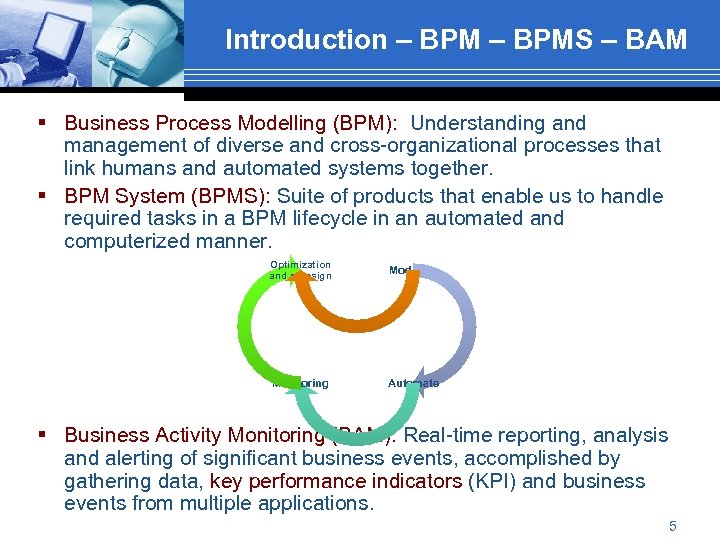
Introduction – BPMS – BAM § Business Process Modelling (BPM): Understanding and management of diverse and cross-organizational processes that link humans and automated systems together. § BPM System (BPMS): Suite of products that enable us to handle required tasks in a BPM lifecycle in an automated and computerized manner. Optimization and redesign Modeling Monitoring Automate § Business Activity Monitoring (BAM): Real-time reporting, analysis and alerting of significant business events, accomplished by gathering data, key performance indicators (KPI) and business events from multiple applications. 5
Introduction – URN & BPM § In a BPM tool we need to specify the W 5 questions. § URN, which integrates UCM and GRL, is able to answer Where, What, Who, When and Why. § Use Case Maps (UCM) Scenarios and causal sequences (When) Responsibilities and tasks (What) Components and actors (Who and Where) § Goal-oriented Requirement Language (GRL) Business or system goals and rationales (why) § GRL & UCM Link processes to business goals. 6
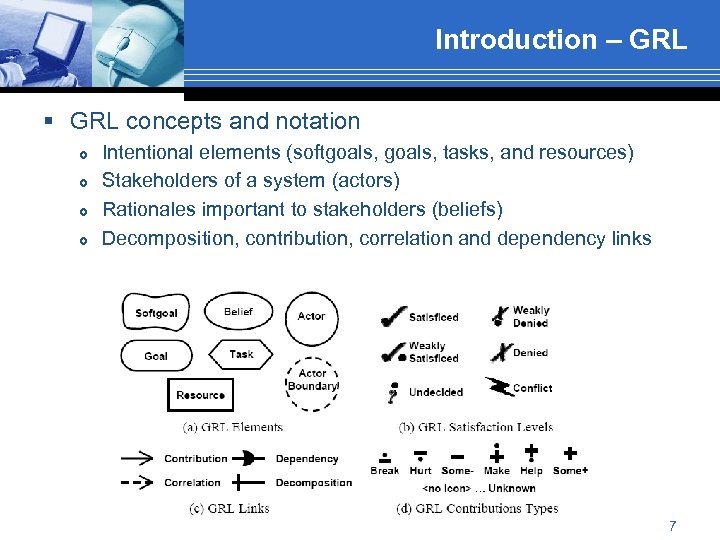
Introduction – GRL § GRL concepts and notation Intentional elements (softgoals, tasks, and resources) Stakeholders of a system (actors) Rationales important to stakeholders (beliefs) Decomposition, contribution, correlation and dependency links 7
Introduction – GRL (cont. ) § Combines concepts from i* and the NFR Framework § Enables the description of alternatives and the decomposition of high-level business goals down to the operational level § Offers an evaluation mechanism: Supports reasoning about goals & alternatives Assignment of initial satisfaction level to intentional elements (strategies) Propagation to other intentional elements via links (weighted contribution/correlations, dependencies…) and to actors. 8
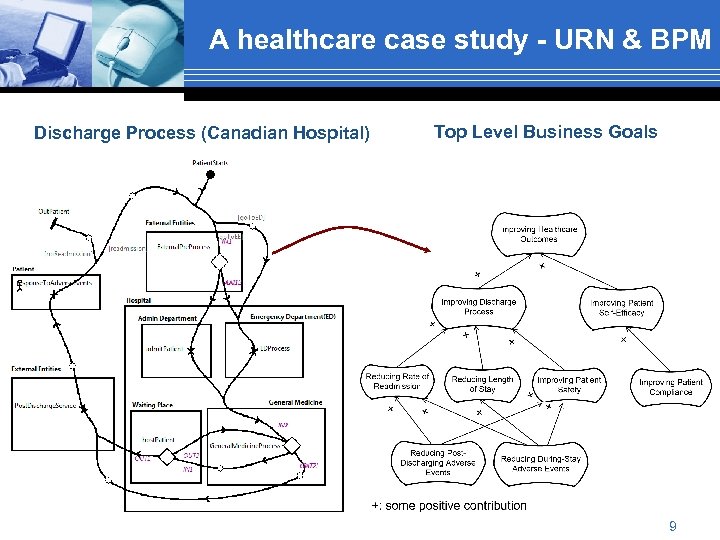
A healthcare case study - URN & BPM Discharge Process (Canadian Hospital) Top Level Business Goals 9
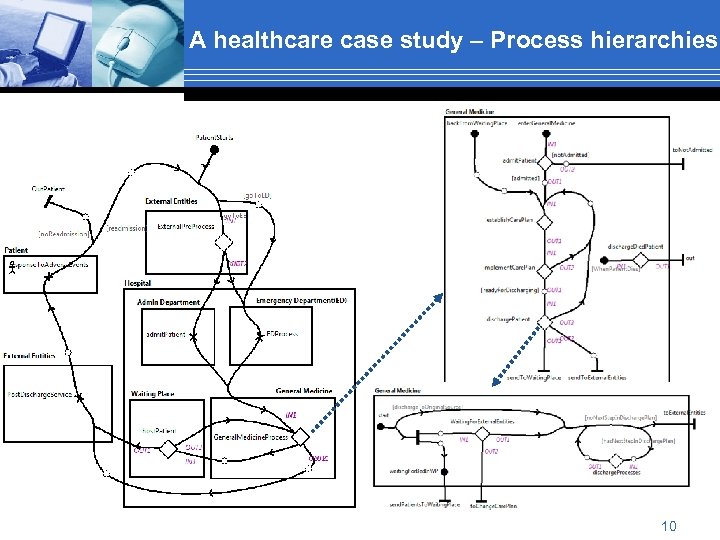
A healthcare case study – Process hierarchies 10
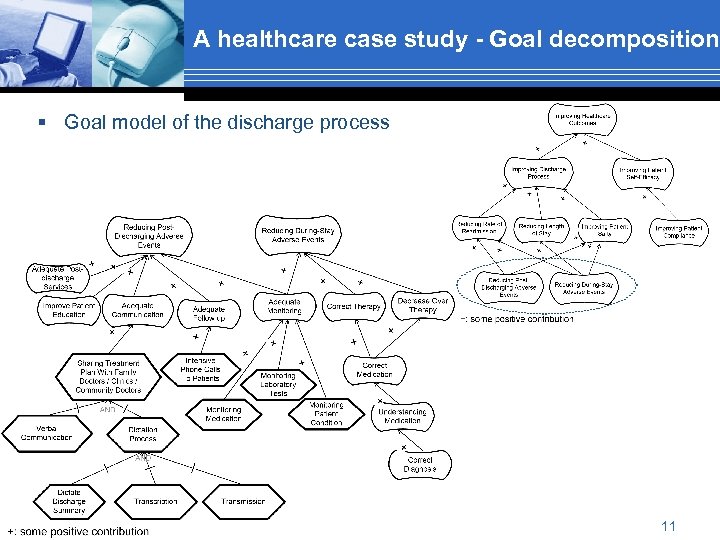
A healthcare case study - Goal decomposition § Goal model of the discharge process 11
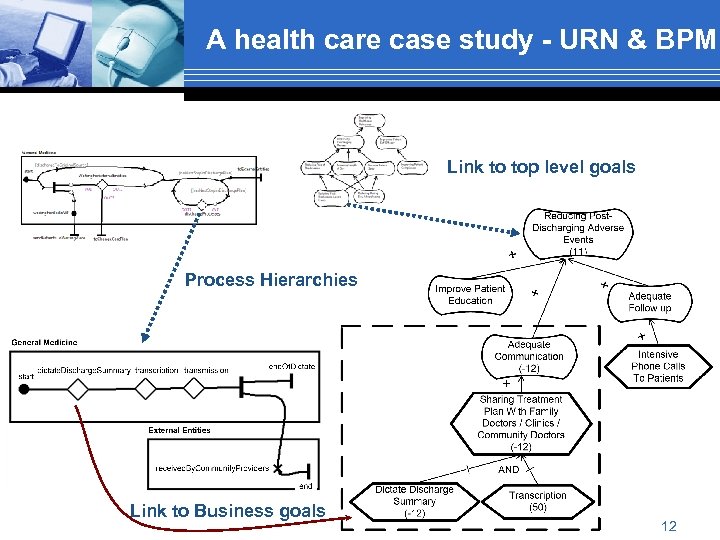
A health care case study - URN & BPM Link to top level goals Process Hierarchies Link to Business goals 12
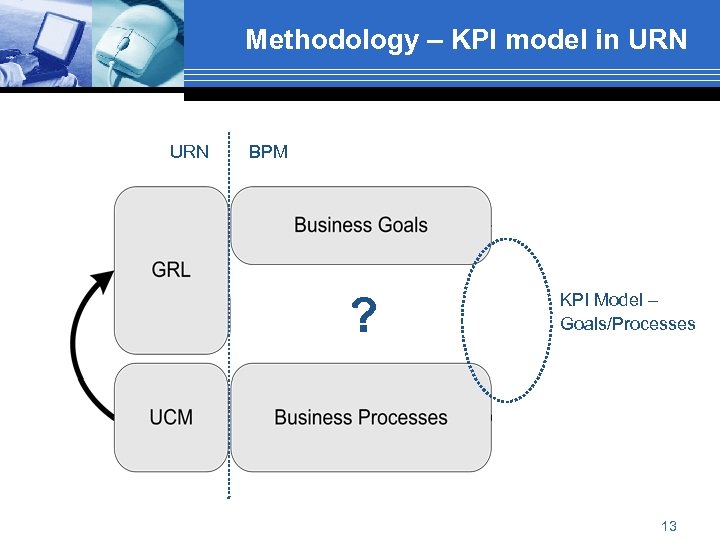
Methodology – KPI model in URN BPM ? KPI Model – Goals/Processes 13
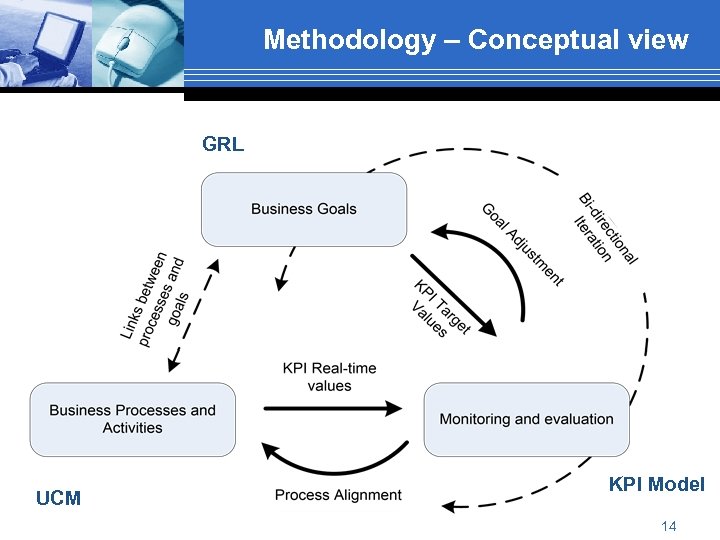
Methodology – Conceptual view GRL UCM KPI Model 14
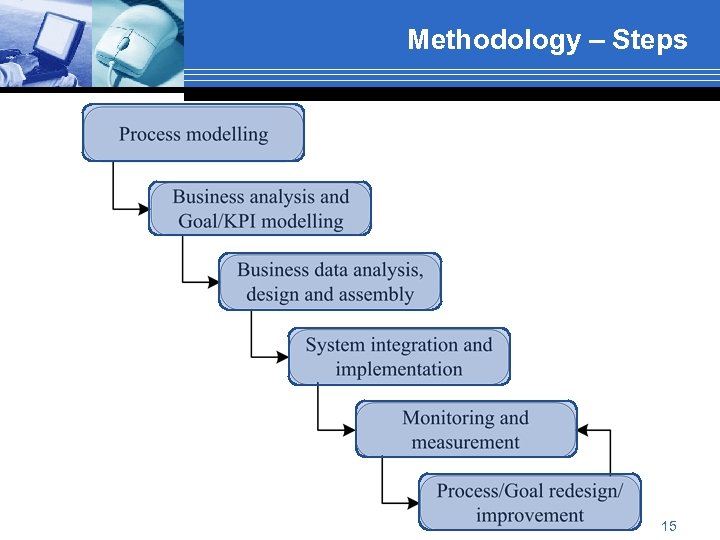
Methodology – Steps 15
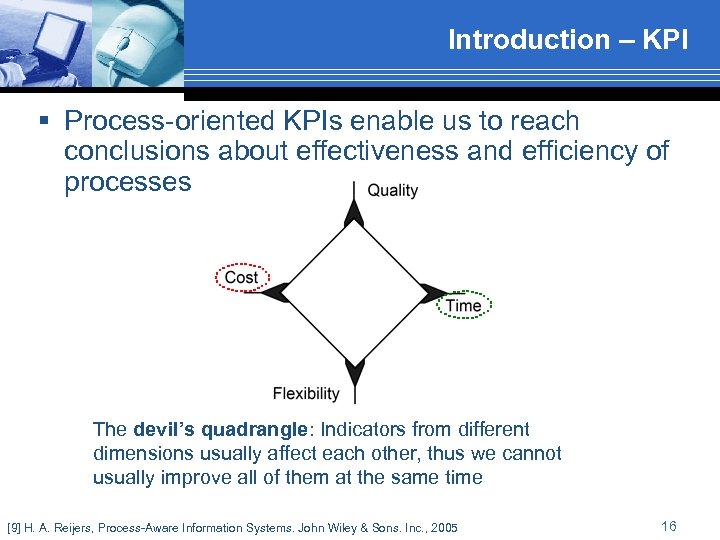
Introduction – KPI § Process-oriented KPIs enable us to reach conclusions about effectiveness and efficiency of processes The devil’s quadrangle: Indicators from different dimensions usually affect each other, thus we cannot usually improve all of them at the same time [9] H. A. Reijers, Process-Aware Information Systems. John Wiley & Sons. Inc. , 2005 16
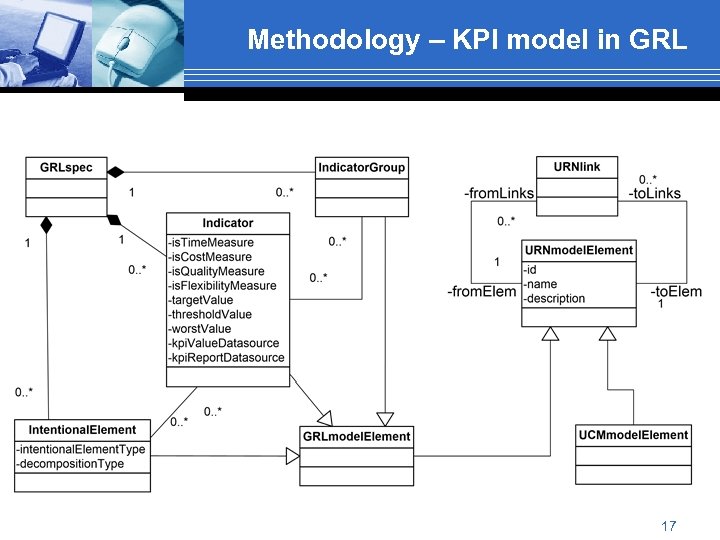
Methodology – KPI model in GRL 17
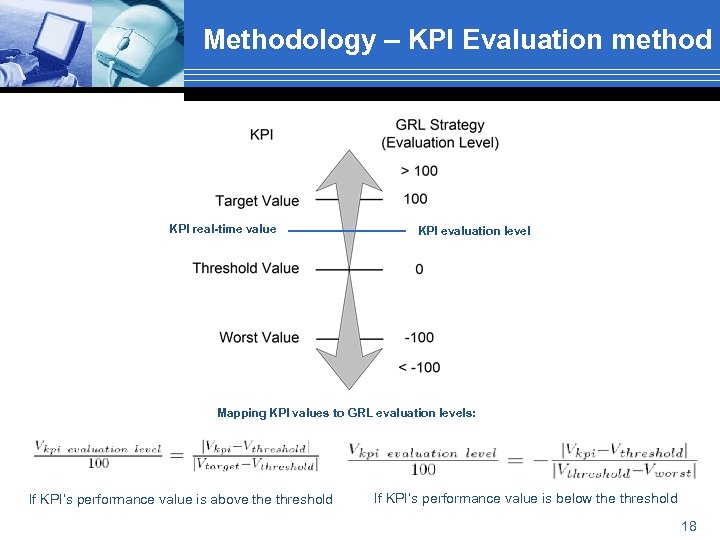
Methodology – KPI Evaluation method KPI real-time value KPI evaluation level Mapping KPI values to GRL evaluation levels: If KPI’s performance value is above threshold If KPI’s performance value is below the threshold 18
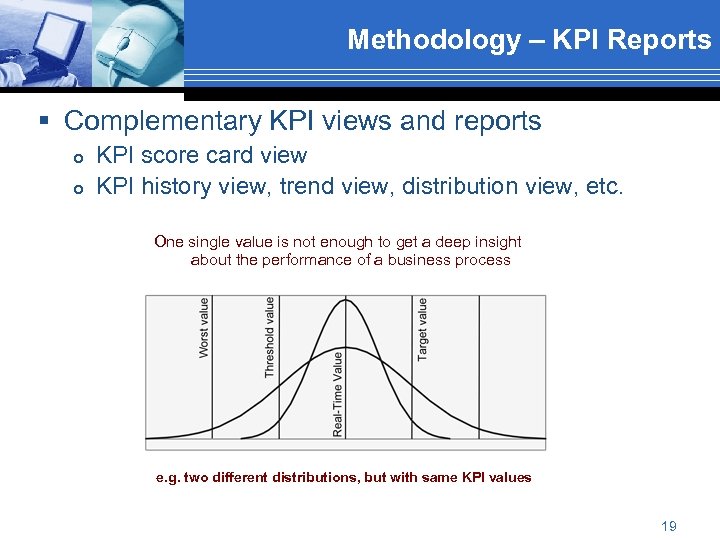
Methodology – KPI Reports § Complementary KPI views and reports KPI score card view KPI history view, trend view, distribution view, etc. One single value is not enough to get a deep insight about the performance of a business process e. g. two different distributions, but with same KPI values 19
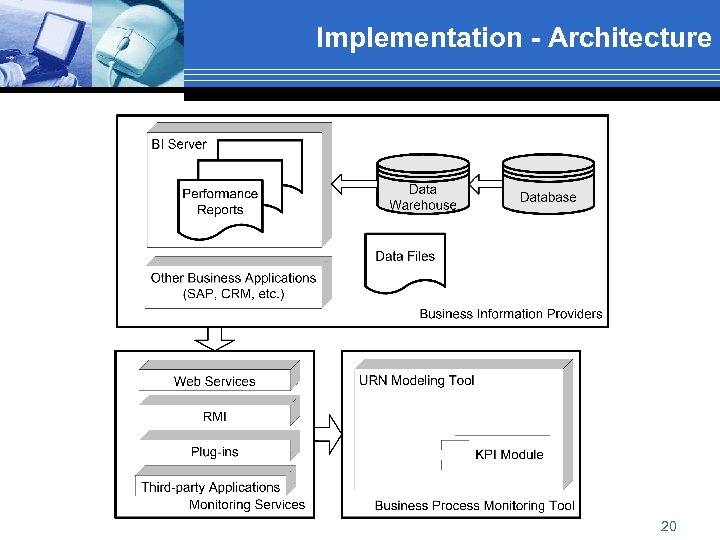
Implementation - Architecture 20
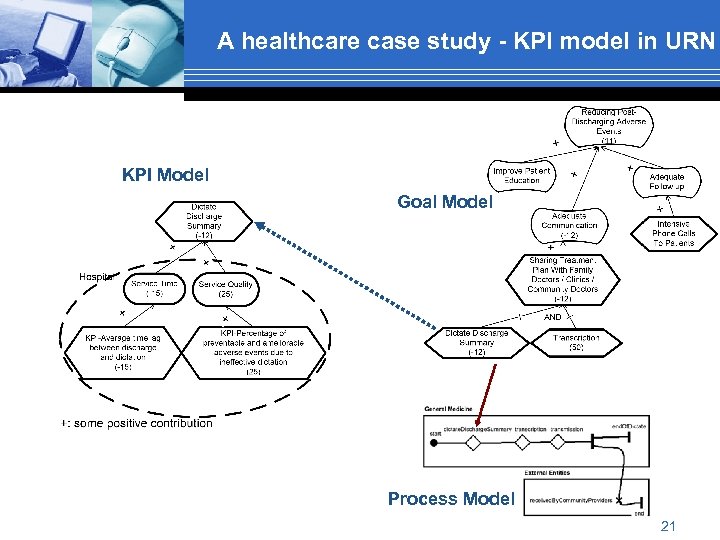
A healthcare case study - KPI model in URN KPI Model Goal Model Process Model 21
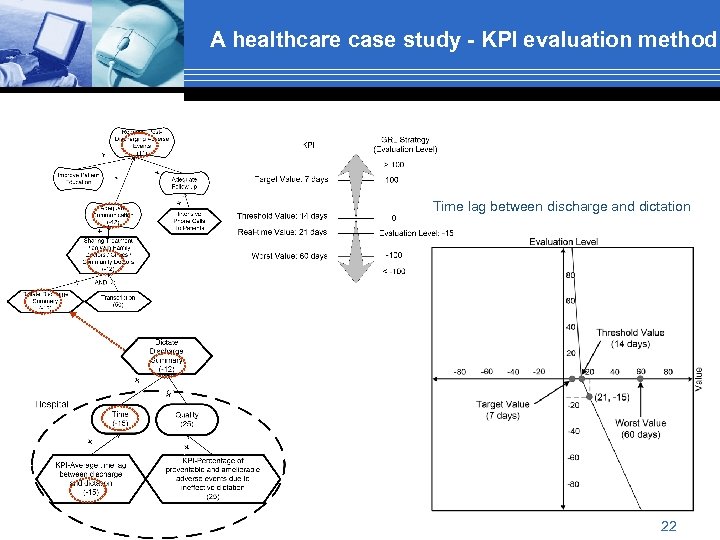
A healthcare case study - KPI evaluation method Time lag between discharge and dictation 22
Conclusion § The proposed method helps to evaluate and monitor the business process against performance requirements using KPI and show the effects of ongoing processes on business goals enabling improvements to both processes and goals while helping to prevent undesirable events § The method has been evaluated in a healthcare case study. 23
Future work § Use the results of the monitoring to prioritize the processes that need to be improved § Use redesign patterns to improve the processes based on the monitoring results § Create an alerting system to prevent unwanted events § Use scenarios to monitor a part of a process and show the effect of this part on the business goals § Integrate the monitoring system with a business process execution engine. 24
Questions & Comments Thank you / Merci / Gracias / Obrigado § Questions? § Comments? 25
Скачать презентацию Business Process Monitoring and Alignment An Approach Based
d889938bf7b43231052bb3d0c4285d85.ppt