 Скачать презентацию Business plans for FPAs Working out a strategy
92529a7336942cce4279d1be789158f8.ppt
- Количество слайдов: 19



Business plans for FPAs Working out a strategy for undertaking the duties of an FPA
Purpose of this presentation § To discuss the purpose of FPA business plans § To introduce the risk management approach to developing FPA business plans.
What is a business plan? n A business plan is required for an FPA to be registered. q q It is a strategic document which describes how the FPA will tackle its duties under section 5 of the Act. It is not an operational plan.
The Act requires FPAs to: n n n n n Apply a veldfire management strategy. Co-ordinate with neighbours and authorities. Make rules. Identify ecological conditions affecting fire danger. Communicate fire danger ratings. Organise and train members, and advise on equipment. Support communities in their veldfire management. Report to the Minister annually on veldfire activities. Exercise duties delegated by the Minister. Appoint an FPO.
Why does an FPA need a business plan (strategy)? n n n To demonstrate understanding of the veldfire problem in their area and the competencies necessary to deal with it. To illustrate that risks have been identified. To communicate the reasons for the rules that will be applied. To promote common standards and coordination. To provide information that will help DWAF develop a country-wide picture of veldfire risk.
Why follow a risk management approach? n n The purpose of risk management is to protect the community and its values (social, economic and environmental ) from the adverse effects of veldfire. Veldfire risk is the chance of a veldfire igniting, spreading and causing one or more assets, measured in terms of likelihood and consequence.
Risk management is a logical and systematic method for: n n establishing the veldfire situation (strategic context) identifying veldfire hazards identifying assets exposed to hazards identifying, evaluating, treating, monitoring and communicating risks to FPA members so that the FPA can minimise losses and maximise opportunities.
Risk management involves: n n n Informed judgement. Accommodating diverse and conflicting interests. Agreement regarding risk assessment and rules. Communication of these to all interested and affected parties. Building logical arguments to ensure stakeholders buy in.
Business plans, IDPs and stakeholder liaison n Your business plan should be compatible with the local government Integrated Development Plan (IDP) and its development should involve all relevant stakeholders.
Stakeholders include: n n n n n landowners and lessees community land representatives municipalities including fire services traditional leaders, if appropriate public utilities (for example, Eskom) provincial and national government catchment management agencies agricultural unions nature conservancies local disaster management structures.
Regular revision is required n Business plans are ‘living’ documents designed to assist FPAs to meet their objectives and must be revised regularly. They should be reviewed before the fire season begins.
Steps in veldfire risk management n n n Establish the current situation (strategic context). Identify and describe hazards. Do the following by asset type (social, economic and environmental): q list assets q identify hazards that assets are exposed to q assign ratings of the likelihood that an asset will be subject to a veldfire originating from a given hazard q access and rate the consequences to an asset should a veldfire associated with a hazard occur. Classify the levels of veldfire risk associated with exposure of the asset to the hazard using the ‘level of risk’ matrix. Rank each asset by the risk it is exposed to.
Access available resources § Institutional capacity. n n n Personnel. Equipment. Facilities. Communication networks. Support from umbrella FPAs. Do a gap analysis to assess whethere adequate resources to meet likely veldfire threats.
Develop veldfire risk management strategies (1) n Examine risk management options and assign to assets: q q q avoid the risk reduce hazard reduce ignitions reduce consequences transfer risk (for example, take out insurance) accept residual risk.
Develop veldfire management strategies (2) n Cluster management options into strategies: q General strategies (e. g. awareness campaigns and prescribed burning). q Integrated veldfire management plans (e. g. prevention, suppression and recovery plans). q Specific asset protection strategies (e. g. plantations, power lines and settlements).
Make operational plans n n n n Fire prevention plans. Fire preparedness. Fire suppression. Fire recovery. Co-ordination plan. Support from umbrella FPAs. Fire investigations, records and reporting. Maintenance and upgrading of resources.
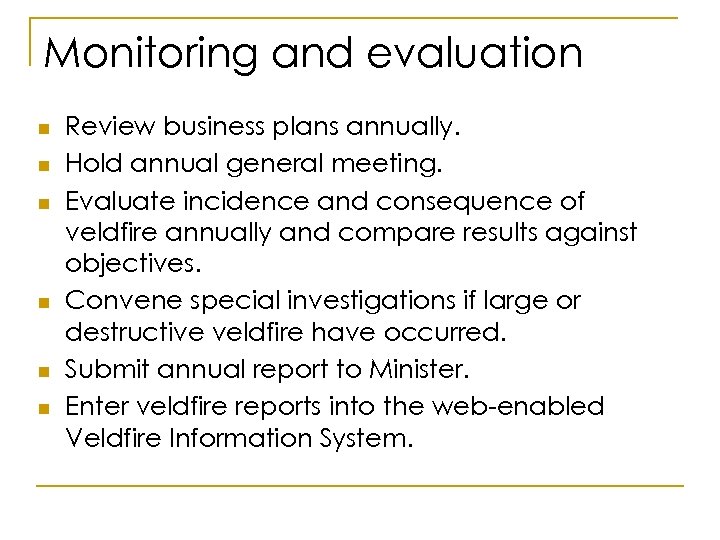
Monitoring and evaluation n n n Review business plans annually. Hold annual general meeting. Evaluate incidence and consequence of veldfire annually and compare results against objectives. Convene special investigations if large or destructive veldfire have occurred. Submit annual report to Minister. Enter veldfire reports into the web-enabled Veldfire Information System.
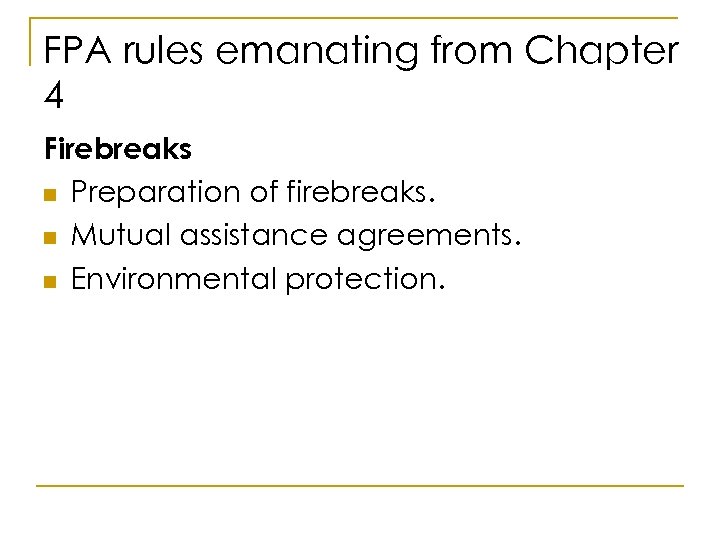
FPA rules emanating from Chapter 4 Firebreaks n Preparation of firebreaks. n Mutual assistance agreements. n Environmental protection.
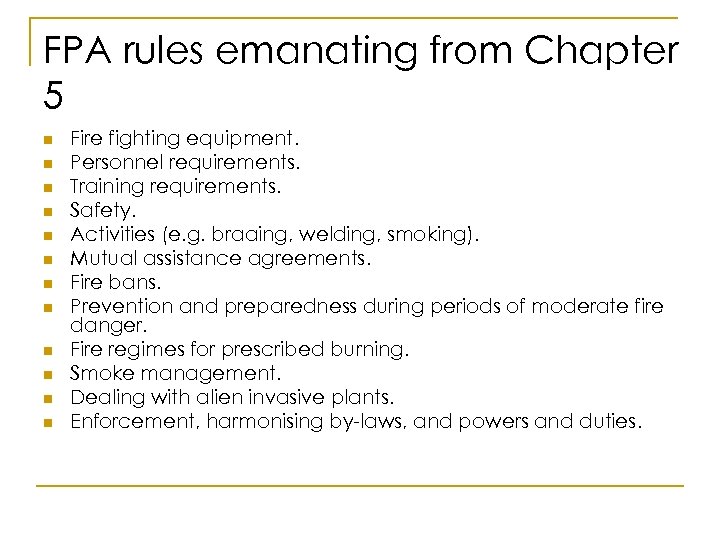
FPA rules emanating from Chapter 5 n n n Fire fighting equipment. Personnel requirements. Training requirements. Safety. Activities (e. g. braaing, welding, smoking). Mutual assistance agreements. Fire bans. Prevention and preparedness during periods of moderate fire danger. Fire regimes for prescribed burning. Smoke management. Dealing with alien invasive plants. Enforcement, harmonising by-laws, and powers and duties.
Скачать презентацию Business plans for FPAs Working out a strategy
92529a7336942cce4279d1be789158f8.ppt