 Скачать презентацию Business of Game Design Funding Self-Publishing Dr
e518fb7b81a1067729d9e651c8709fd9.ppt
- Количество слайдов: 22



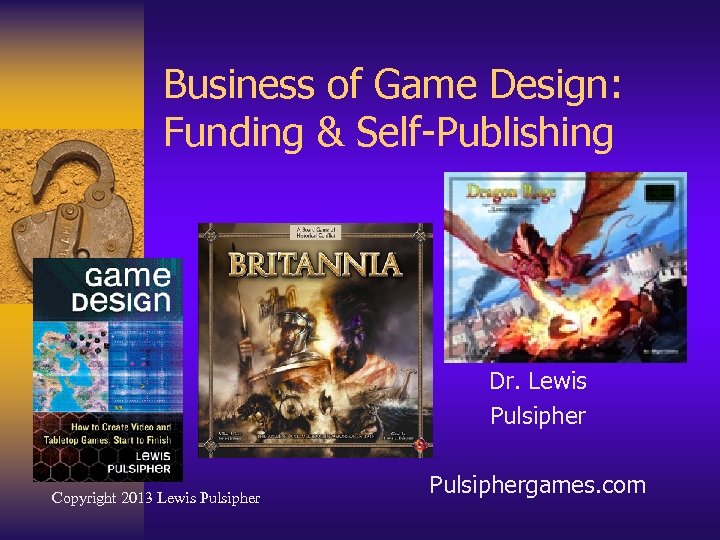
Business of Game Design: Funding & Self-Publishing Dr. Lewis Pulsipher Copyright 2013 Lewis Pulsiphergames. com
Note about the slides ¨ Slides are provided primarily for those who want detailed notes later, not as an accompaniment to the talk ¨ Consequently, they are “wordy” ¨ Available at http: //pulsipher. net/teaching 1. htm ¨ Or just go to pulsipher. net (not. com) or pulsiphergames. com and look for teaching material 17 March 2018
Who am I ¨ Designed my own games while a teenager ¨ Began playing commercial wargames in 1963 ¨ Played the original Atari 2600 and have played some PC games heavily, but rarely play any video games these days; never owned a game console ¨ My favorite game is “the game design game”
Who am I ¨ Designer of several commercially- published board wargames (most recently January 11), more games to come ¨ Active designer of board and card games (playtesters solicited!) ¨ Book “Game Design: How to create video and tabletop games, start to finish”, Mc. Farland (booth at Gen. Con) ¨ Wikipedia: Lewis Pulsipher; Britannia (board game); Archomental
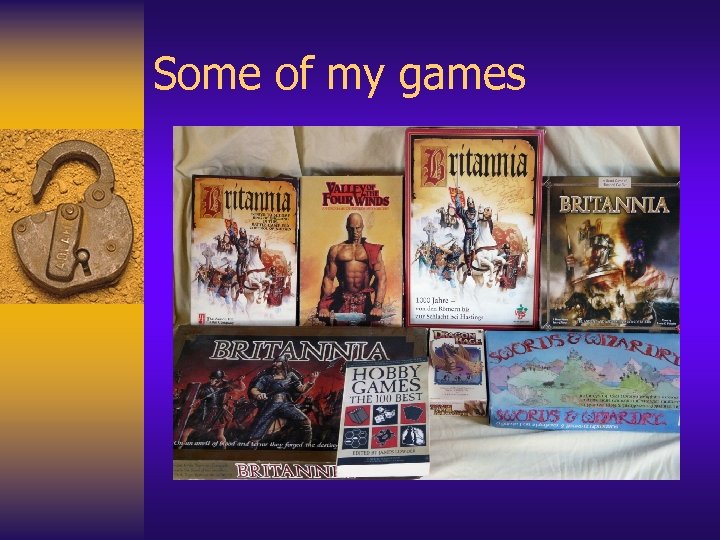
Some of my games
We’re talking about business, not about game design ¨ But if you want to make money, you have to know the business ¨ It’s hard to find a publisher these days – Many have in-house staff, others are self-publishers ¨ As a last resort, you may want to fund and publish your game yourself – But then you become a publisher, not a game designer!
Reality Check ¨ Almost no one makes a living designing (or selling) games ¨ Most who do, work for a game company, not freelance ¨ Publishing is risky – but that’s why publishers make a lot more from a successful game than the designer ¨ Many publishers began as self-publishers – Including Fantasy Flight (once they got out of the comic distribution business)
Reality Check 2
OK, How much do you make if you do find a publisher? ¨ In my experience, royalties are a percentage of the publisher’s actual revenue – 5% is most common, range 4 -8% ¨ Publisher sells to distributor at 40% of list price or less; distributor sells to retailer for 10% more ¨ Internet sales are becoming significant— then publisher makes 100% ¨ Shipping costs may be subtracted from revenue
Royalty example ¨ $40 list game, 5% of $16 = 80 cents ¨ Per 1, 000 copies, $800 ¨ $20 game, $400 per thousand ¨ Wargame typical print run is <= 2, 000 ¨ “Euro” games might go up to 10, 000 ¨ Most games sell poorly after first six months, most are not reprinted ¨ German “Game of the Year” might sell 250, 000 or more, after award ¨ It’s a hit-driven industry. How many hits a year, compared with hundreds of games published?
What about the biggies? ¨ In general, the really big companies have staff to design their games ¨ Many will not even accept outside submissions ¨ Virtually all will require you sign a statement relieving them of all liabilities ¨ At least one only works through agents ¨ In USA, Hasbro owns all the traditional boardgame publishers such as Milton Bradley, Parker Brothers, Avalon Hill
Publishing alternatives ¨ All these methods require considerable knowledge to put game together in correct format, to hire artists/editors ¨ Spend the money to self-publish traditionally – Expensive – Risky – Requires constant attention ¨ Use a third party to help self-publish traditionally – Fulfillment companies – Game. Salute no longer offers their more extensive service ¨ Self-publish through POD – The. Game. Crafter. com and others – Requires virtually no funding ¨ PDF/desktop publishing/Print n Play – Requires virtually no funding ¨ “P 500” – preorders – Generally only established publishers ¨ “Ransom”/crowdfunding model—kickstarter. com, Indiegogo
Distribution methods ¨ Traditional distribution/aggregator – You get only 33%-40% of list price ¨ Internet distribution through your own Web site – You get 100% of list, but will your target market buy this way – Not mass-market, for example ¨ ¨ Online PDF distribution sites such as RPGnow Thegamecrafter. com or other POD Sell at conventions Give it away and hope for a deal with a traditional publisher
Funding ¨ Self-funded – I’ve heard of people taking a second mortgage ¨ Friend/family funded ¨ Publisher funded – But then we’re not in self-publishing any more ¨ “Ransom”/crowdfunding model
“Ransom”/crowdfunding ¨ Ransom: If I get $X I’ll give this away to everyone – Originally for fiction ¨ Crowdfunding – Kickstarter – Indiegogo and others
Kickstarter ¨ Even traditional publishers use Kickstarter – For them it’s a “gauge the enthusiasm” and pre-order system ¨ Costs nothing to try it – Well, except for your time ¨ KS (and Amazon) take a chunk of the successful funds
Indiegogo ¨ Much newer than KS but may be available where KS is not ¨ Big difference: if a project is partially funded, you get the partial funds (KS: no money changes hands) ¨ Not as well known/frequented as KS
Creating the Look of the Game ¨ Hiring artists, unless you are one ¨ Hiring for editing and layout, unless you’re good at it
Creating files to be printed ¨ Requires both understanding and computer-technical skill ¨ Some programs are free, the best cost a lot of $$$$ ¨ Time-consuming to learn
Using traditional publishing methods ¨ Finding a suitable printer, arranging for shipping, arranging to house inventory (unless you have a BIG house…) ¨ Sales, shipping, promoting, customer support – “Discoverability” is a big problem now – people won’t buy your game if they don’t know anything about it ¨ Fulfillment house can take care of storing inventory, perhaps even of customer support
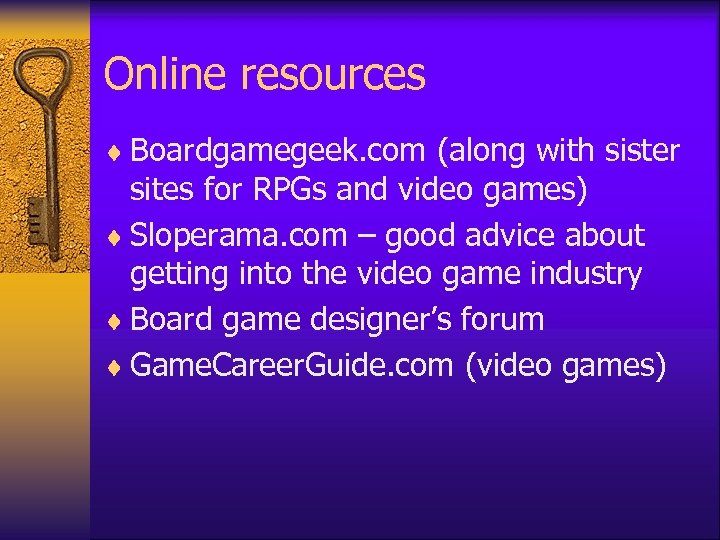
Online resources ¨ Boardgamegeek. com (along with sister sites for RPGs and video games) ¨ Sloperama. com – good advice about getting into the video game industry ¨ Board game designer’s forum ¨ Game. Career. Guide. com (video games)

Questions? Comments?
Скачать презентацию Business of Game Design Funding Self-Publishing Dr
e518fb7b81a1067729d9e651c8709fd9.ppt