 Скачать презентацию Business Models Generation Business Model Canvas Minder Chen
1acda98a5d70c57c34dcf184eac86d6f.ppt
- Количество слайдов: 121



Business Models Generation Business Model Canvas Minder Chen, Ph. D. Professor of Management Information Systems Martin V. Smith School of Business and Economics CSU Channel Islands E-Mail: minder. chen@csuci. edu Web site: http: //faculty. csuci. edu/minder. chen/
Resources • Alexander Osterwalder & Yves Pigneur, Business Model Generation, Wiley, 2010. (preview edition https: //assets. strategyzer. com/assets/resources/business-modelgeneration-book-preview-2010. pdf ) • **Business Model Canvas Poster (pdf file) • Johnson, Mark W. ; Christensen, Clayton M. ; Kagermann, Henning, "Reinventing Your Business Model, " Harvard Business Review, Dec 2008, Vol. 86 Issue 12, p 50 -59. – https: //cerpp. usc. edu/files/2015/08/HBR-Clay-Reinventing-Your. Business-Model-R 0812 C-PDF-ENG. pdf • Four Paths to Business Model Innovation – https: //hbr. org/2014/07/four-paths-to-business-modelinnovation © Minder Chen, 1996 -2016 Business Model - 2
Videos • **Business Model Canvas Explained (video, 2. 22 m) • Osterwalder explaining the Business Model Canvas (video 45 minutes) • **Alexander Osterwalder: Tools for Business Model Generation (video 53 m ) • Learn how to use Business Model Canvas to pitch your business idea and prototype (video). See the rest in the series Business Model Canvas (video series) • Webinar #4: Ways To Present The Business Model Canvas (video) HILTI Case using BMC started at 25 m; – Tool Fleet Management https: //www. us. hilti. com/fleet-casestudies © Minder Chen, 1996 -2016 Business Model - 3
A Starting Point of Innovation A customer friction is a (re)discovered of relevant and often unmet needs in a recognizable situation from a target group. – Adapted form http: //www. innovationexcellence. com/blog/201 1/07/08/solve-customer-frictions/ © Minder Chen, 1996 -2016 Business Model - 4
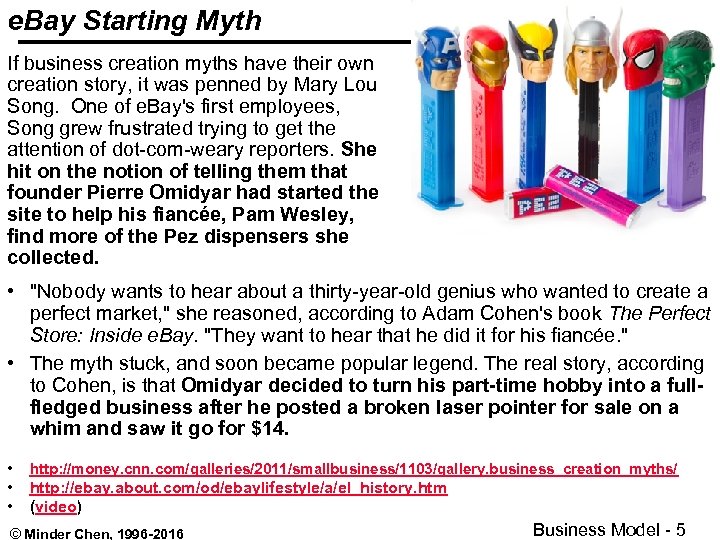
e. Bay Starting Myth If business creation myths have their own creation story, it was penned by Mary Lou Song. One of e. Bay's first employees, Song grew frustrated trying to get the attention of dot-com-weary reporters. She hit on the notion of telling them that founder Pierre Omidyar had started the site to help his fiancée, Pam Wesley, find more of the Pez dispensers she collected. • "Nobody wants to hear about a thirty-year-old genius who wanted to create a perfect market, " she reasoned, according to Adam Cohen's book The Perfect Store: Inside e. Bay. "They want to hear that he did it for his fiancée. " • The myth stuck, and soon became popular legend. The real story, according to Cohen, is that Omidyar decided to turn his part-time hobby into a fullfledged business after he posted a broken laser pointer for sale on a whim and saw it go for $14. • http: //money. cnn. com/galleries/2011/smallbusiness/1103/gallery. business_creation_myths/ • • http: //ebay. about. com/od/ebaylifestyle/a/el_history. htm (video) © Minder Chen, 1996 -2016 Business Model - 5
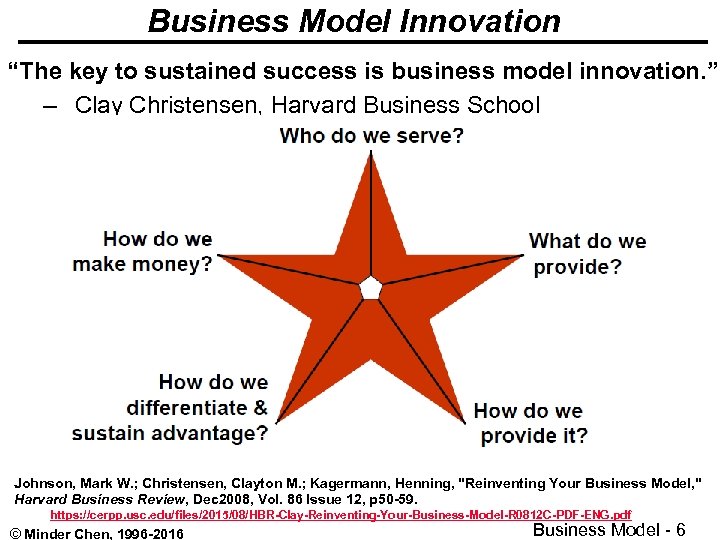
Business Model Innovation “The key to sustained success is business model innovation. ” – Clay Christensen, Harvard Business School Johnson, Mark W. ; Christensen, Clayton M. ; Kagermann, Henning, "Reinventing Your Business Model, " Harvard Business Review, Dec 2008, Vol. 86 Issue 12, p 50 -59. https: //cerpp. usc. edu/files/2015/08/HBR-Clay-Reinventing-Your-Business-Model-R 0812 C-PDF-ENG. pdf © Minder Chen, 1996 -2016 Business Model - 6
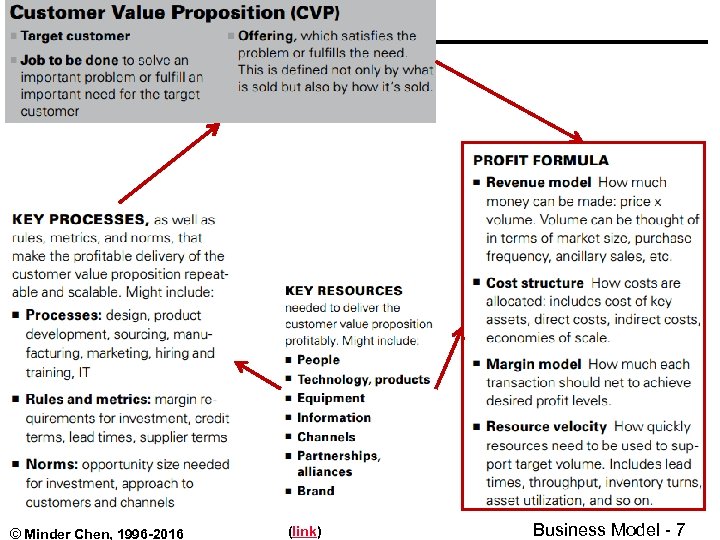
© Minder Chen, 1996 -2016 (link) Business Model - 7
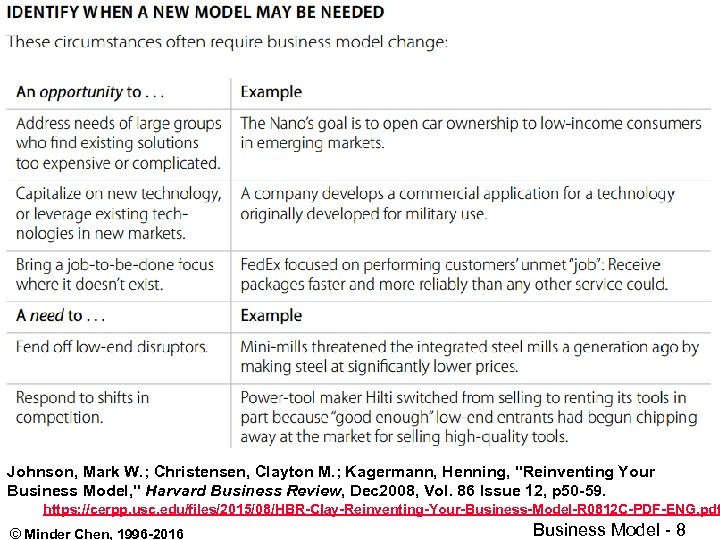
Johnson, Mark W. ; Christensen, Clayton M. ; Kagermann, Henning, "Reinventing Your Business Model, " Harvard Business Review, Dec 2008, Vol. 86 Issue 12, p 50 -59. https: //cerpp. usc. edu/files/2015/08/HBR-Clay-Reinventing-Your-Business-Model-R 0812 C-PDF-ENG. pdf © Minder Chen, 1996 -2016 Business Model - 8
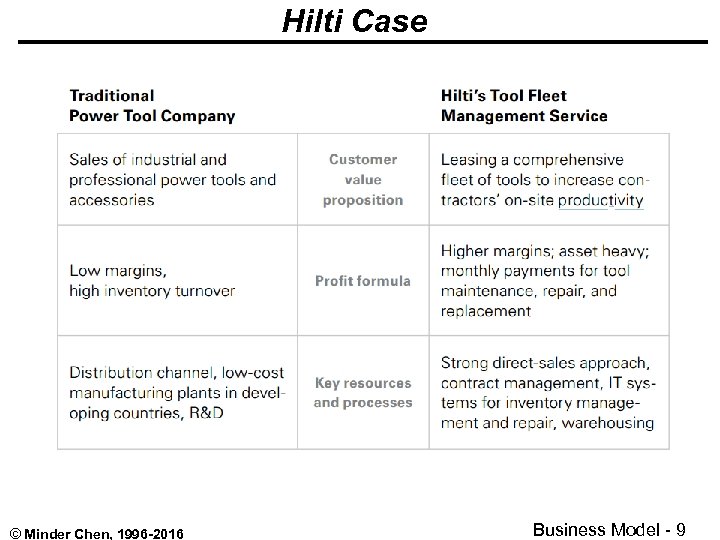
Hilti Case © Minder Chen, 1996 -2016 Business Model - 9
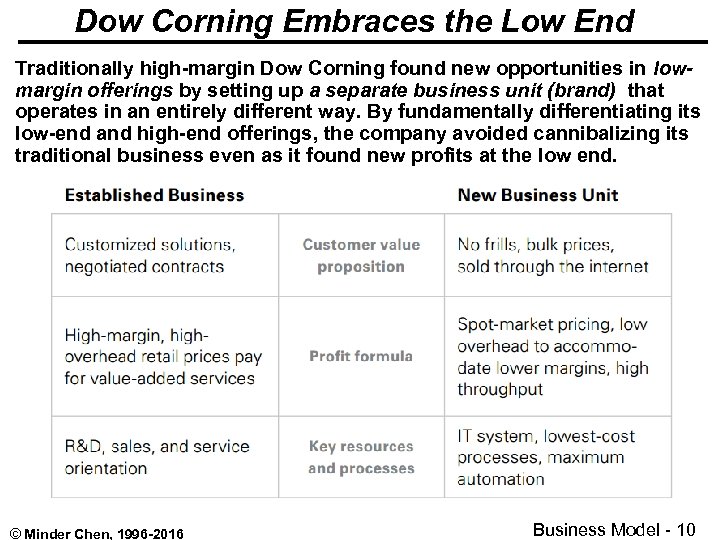
Dow Corning Embraces the Low End Traditionally high-margin Dow Corning found new opportunities in lowmargin offerings by setting up a separate business unit (brand) that operates in an entirely different way. By fundamentally differentiating its low-end and high-end offerings, the company avoided cannibalizing its traditional business even as it found new profits at the low end. © Minder Chen, 1996 -2016 Business Model - 10
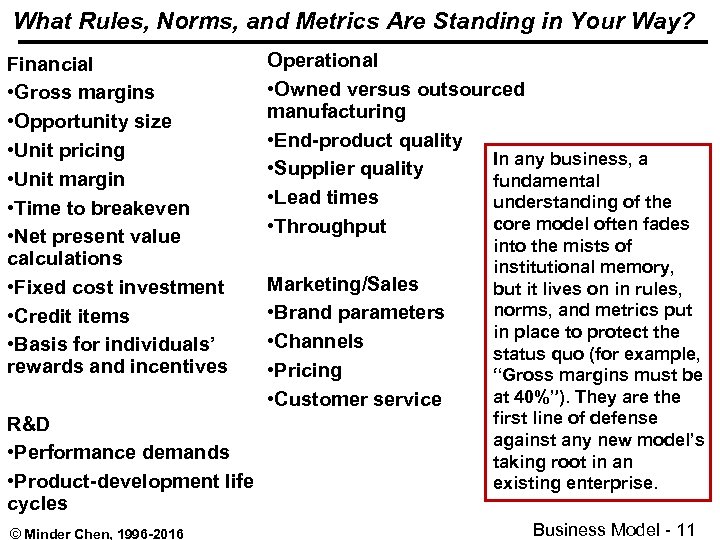
What Rules, Norms, and Metrics Are Standing in Your Way? Financial • Gross margins • Opportunity size • Unit pricing • Unit margin • Time to breakeven • Net present value calculations • Fixed cost investment • Credit items • Basis for individuals’ rewards and incentives R&D • Performance demands • Product-development life cycles © Minder Chen, 1996 -2016 Operational • Owned versus outsourced manufacturing • End-product quality In any business, a • Supplier quality fundamental • Lead times understanding of the core model often fades • Throughput Marketing/Sales • Brand parameters • Channels • Pricing • Customer service into the mists of institutional memory, but it lives on in rules, norms, and metrics put in place to protect the status quo (for example, “Gross margins must be at 40%”). They are the first line of defense against any new model’s taking root in an existing enterprise. Business Model - 11
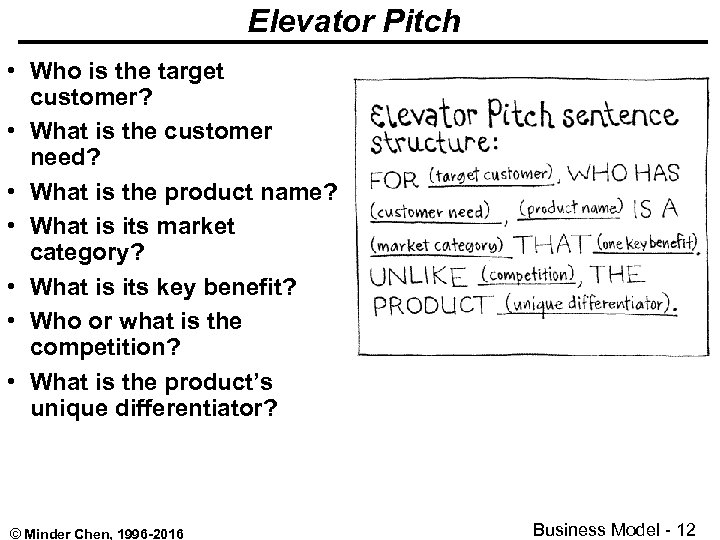
Elevator Pitch • Who is the target customer? • What is the customer need? • What is the product name? • What is its market category? • What is its key benefit? • Who or what is the competition? • What is the product’s unique differentiator? © Minder Chen, 1996 -2016 Business Model - 12
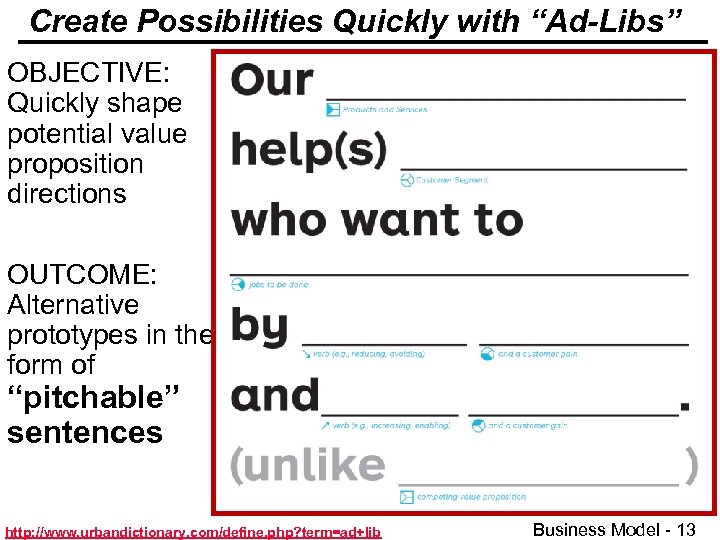
Create Possibilities Quickly with “Ad-Libs” OBJECTIVE: Quickly shape potential value proposition directions OUTCOME: Alternative prototypes in the form of “pitchable” sentences http: //www. urbandictionary. com/define. php? term=ad+lib © Minder Chen, 1996 -2016 Business Model - 13
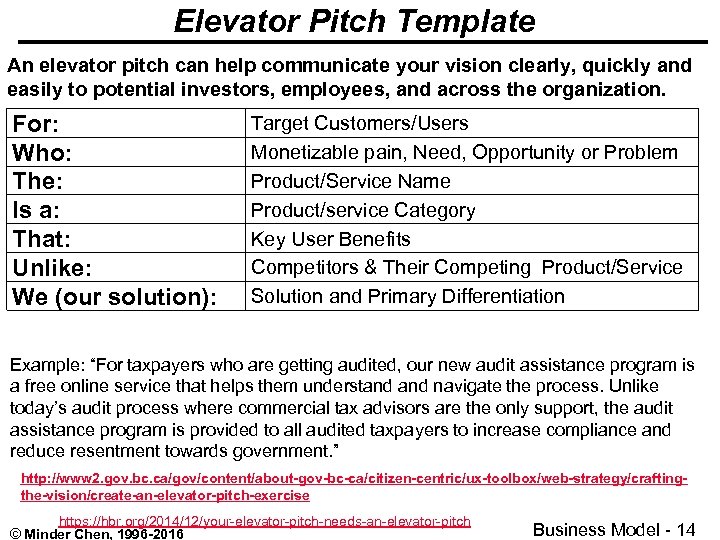
Elevator Pitch Template An elevator pitch can help communicate your vision clearly, quickly and easily to potential investors, employees, and across the organization. For: Who: The: Is a: That: Unlike: We (our solution): Target Customers/Users Monetizable pain, Need, Opportunity or Problem Product/Service Name Product/service Category Key User Benefits Competitors & Their Competing Product/Service Solution and Primary Differentiation Example: “For taxpayers who are getting audited, our new audit assistance program is a free online service that helps them understand navigate the process. Unlike today’s audit process where commercial tax advisors are the only support, the audit assistance program is provided to all audited taxpayers to increase compliance and reduce resentment towards government. ” http: //www 2. gov. bc. ca/gov/content/about-gov-bc-ca/citizen-centric/ux-toolbox/web-strategy/craftingthe-vision/create-an-elevator-pitch-exercise https: //hbr. org/2014/12/your-elevator-pitch-needs-an-elevator-pitch © Minder Chen, 1996 -2016 Business Model - 14
![Elevator Pitch Our business/product [name] will deliver [deliverables] to [target customers] to enable them](https://present5.com/presentation/1acda98a5d70c57c34dcf184eac86d6f/image-15.jpg "Elevator Pitch Our business/product [name] will deliver [deliverables] to [target customers] to enable them")
Elevator Pitch Our business/product [name] will deliver [deliverables] to [target customers] to enable them to [benefits]. The business is headed by [list founder and key executives, investors, and advisors] that have [list key background and qualifications]. The business [will launch/was launched] on [date] and we [will begin/began] delivering [first product or service] on [date]. We expect to prove our business model and achieve profitable growth on [date] and anticipate that the terminal value of the business will be [list anticipated value], which represents a [list return] to investors. The total cost to achieve this goal will be [total cost], which includes the following key cost categories [list]. We have currently received [list dollars of funding secured to date] from the following sources [list]. We anticipate receiving the remainder of the funding by [date] from [list sources]. The key risks for the project are [list risks]. These risks will be managed by [list key approached to managing each risk]. – Adapted from: Applegate and Saltrick, “Developing an Elevator Pitch for a New Venture. ” Elevator Pitch Builder http: //about. mjumbepoe. com/elevator-pitch-builder/ Business Model - 15 © Minder Chen, 1996 -2016
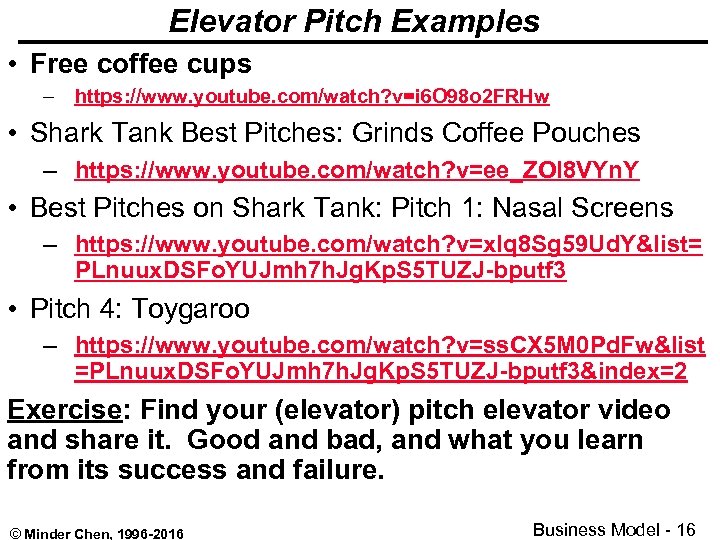
Elevator Pitch Examples • Free coffee cups – https: //www. youtube. com/watch? v=i 6 O 98 o 2 FRHw • Shark Tank Best Pitches: Grinds Coffee Pouches – https: //www. youtube. com/watch? v=ee_ZOl 8 VYn. Y • Best Pitches on Shark Tank: Pitch 1: Nasal Screens – https: //www. youtube. com/watch? v=x. Iq 8 Sg 59 Ud. Y&list= PLnuux. DSFo. YUJmh 7 h. Jg. Kp. S 5 TUZJ-bputf 3 • Pitch 4: Toygaroo – https: //www. youtube. com/watch? v=ss. CX 5 M 0 Pd. Fw&list =PLnuux. DSFo. YUJmh 7 h. Jg. Kp. S 5 TUZJ-bputf 3&index=2 Exercise: Find your (elevator) pitch elevator video and share it. Good and bad, and what you learn from its success and failure. © Minder Chen, 1996 -2016 Business Model - 16
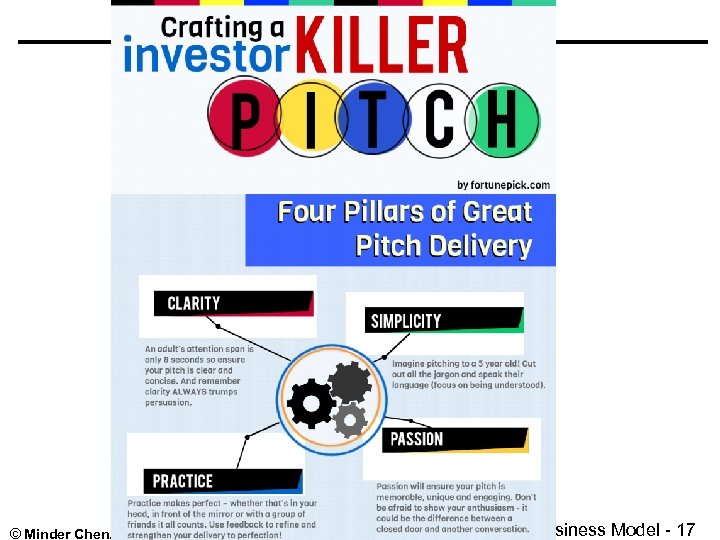
© Minder Chen, 1996 -2016 Business Model - 17
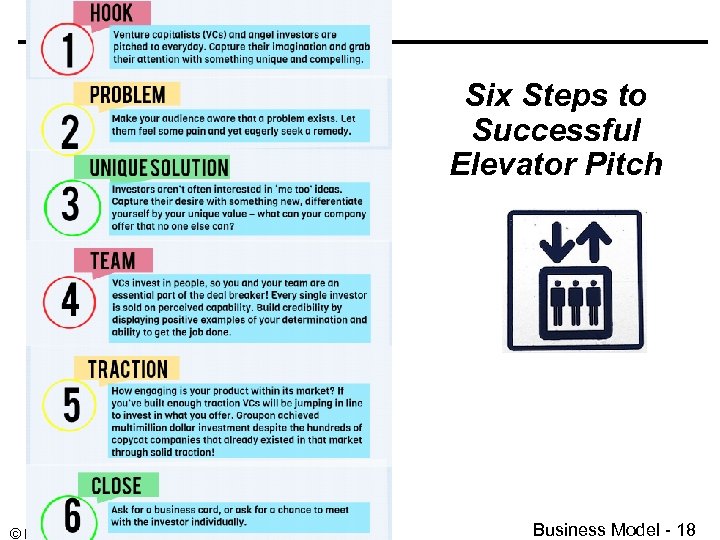
Six Steps to Successful Elevator Pitch © Minder Chen, 1996 -2016 Business Model - 18
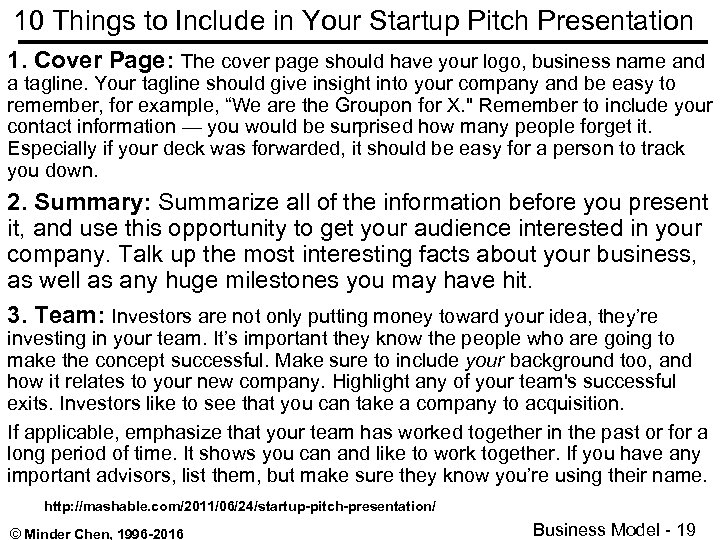
10 Things to Include in Your Startup Pitch Presentation 1. Cover Page: The cover page should have your logo, business name and a tagline. Your tagline should give insight into your company and be easy to remember, for example, “We are the Groupon for X. " Remember to include your contact information — you would be surprised how many people forget it. Especially if your deck was forwarded, it should be easy for a person to track you down. 2. Summary: Summarize all of the information before you present it, and use this opportunity to get your audience interested in your company. Talk up the most interesting facts about your business, as well as any huge milestones you may have hit. 3. Team: Investors are not only putting money toward your idea, they’re investing in your team. It’s important they know the people who are going to make the concept successful. Make sure to include your background too, and how it relates to your new company. Highlight any of your team's successful exits. Investors like to see that you can take a company to acquisition. If applicable, emphasize that your team has worked together in the past or for a long period of time. It shows you can and like to work together. If you have any important advisors, list them, but make sure they know you’re using their name. http: //mashable. com/2011/06/24/startup-pitch-presentation/ © Minder Chen, 1996 -2016 Business Model - 19
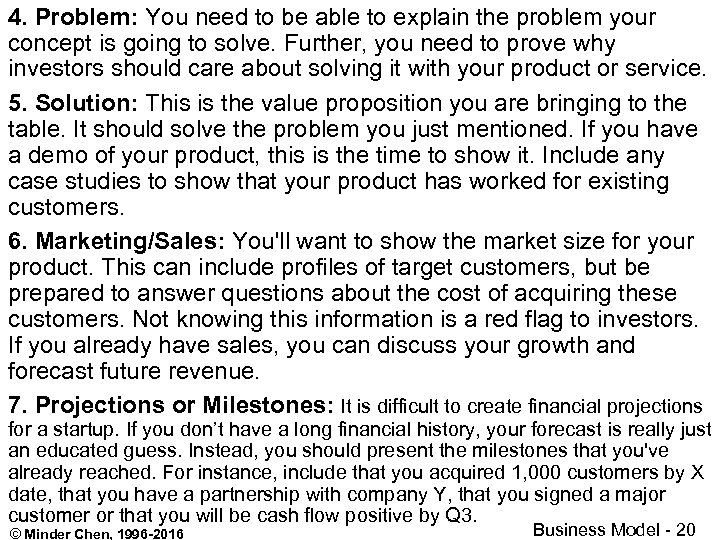
4. Problem: You need to be able to explain the problem your concept is going to solve. Further, you need to prove why investors should care about solving it with your product or service. 5. Solution: This is the value proposition you are bringing to the table. It should solve the problem you just mentioned. If you have a demo of your product, this is the time to show it. Include any case studies to show that your product has worked for existing customers. 6. Marketing/Sales: You'll want to show the market size for your product. This can include profiles of target customers, but be prepared to answer questions about the cost of acquiring these customers. Not knowing this information is a red flag to investors. If you already have sales, you can discuss your growth and forecast future revenue. 7. Projections or Milestones: It is difficult to create financial projections for a startup. If you don’t have a long financial history, your forecast is really just an educated guess. Instead, you should present the milestones that you've already reached. For instance, include that you acquired 1, 000 customers by X date, that you have a partnership with company Y, that you signed a major customer or that you will be cash flow positive by Q 3. © Minder Chen, 1996 -2016 Business Model - 20
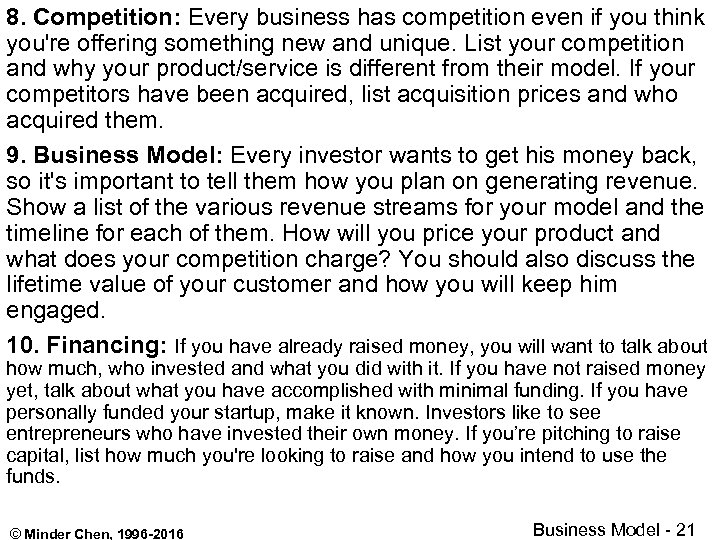
8. Competition: Every business has competition even if you think you're offering something new and unique. List your competition and why your product/service is different from their model. If your competitors have been acquired, list acquisition prices and who acquired them. 9. Business Model: Every investor wants to get his money back, so it's important to tell them how you plan on generating revenue. Show a list of the various revenue streams for your model and the timeline for each of them. How will you price your product and what does your competition charge? You should also discuss the lifetime value of your customer and how you will keep him engaged. 10. Financing: If you have already raised money, you will want to talk about how much, who invested and what you did with it. If you have not raised money yet, talk about what you have accomplished with minimal funding. If you have personally funded your startup, make it known. Investors like to see entrepreneurs who have invested their own money. If you’re pitching to raise capital, list how much you're looking to raise and how you intend to use the funds. © Minder Chen, 1996 -2016 Business Model - 21
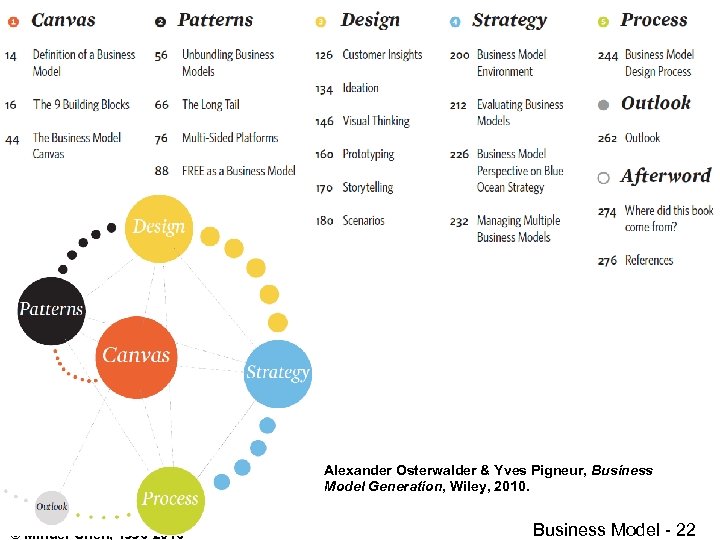
Alexander Osterwalder & Yves Pigneur, Business Model Generation, Wiley, 2010. © Minder Chen, 1996 -2016 Business Model - 22
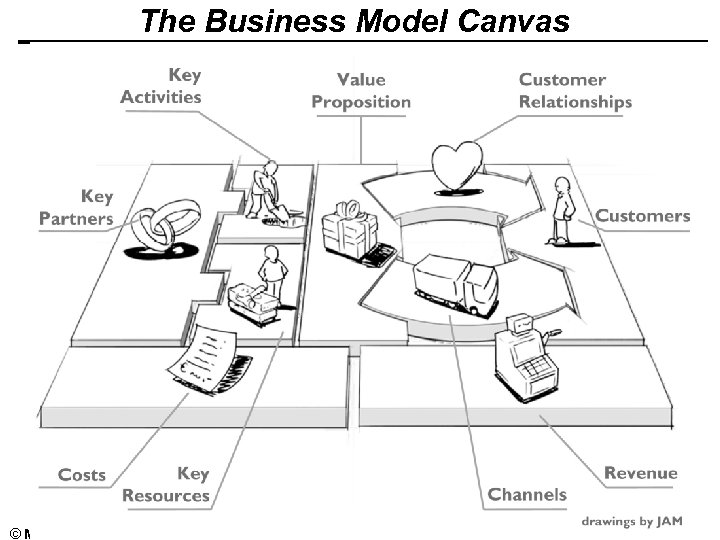
The Business Model Canvas © Minder Chen, 1996 -2016 Business Model - 23
Definition • A business model describes the rationale of how an organization creates, delivers, and captures value. • A business model can best be described through 9 basic building blocks that show the logic of how a company intends to make money. • The nine blocks cover the 4 main areas of a business: customers, offer, infrastructure, and financial viability. • The business model is like a blueprint for a strategy to be implemented through organizational structures, processes, and systems. © Minder Chen, 1996 -2016 Business Model - 24
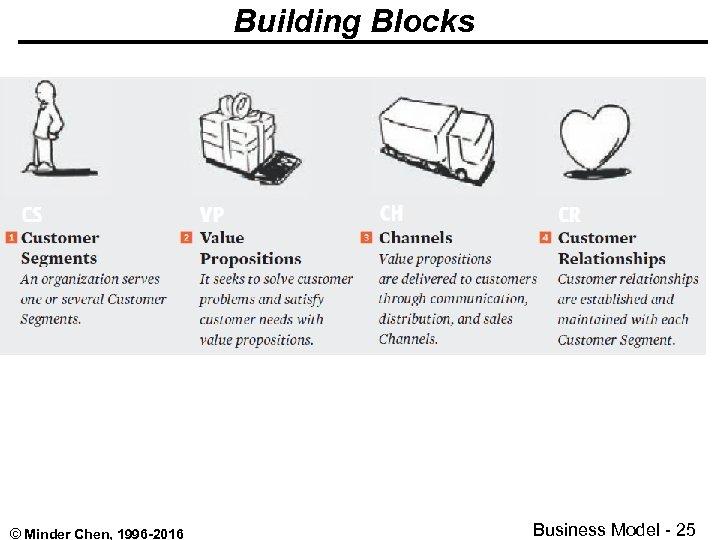
Building Blocks © Minder Chen, 1996 -2016 Business Model - 25
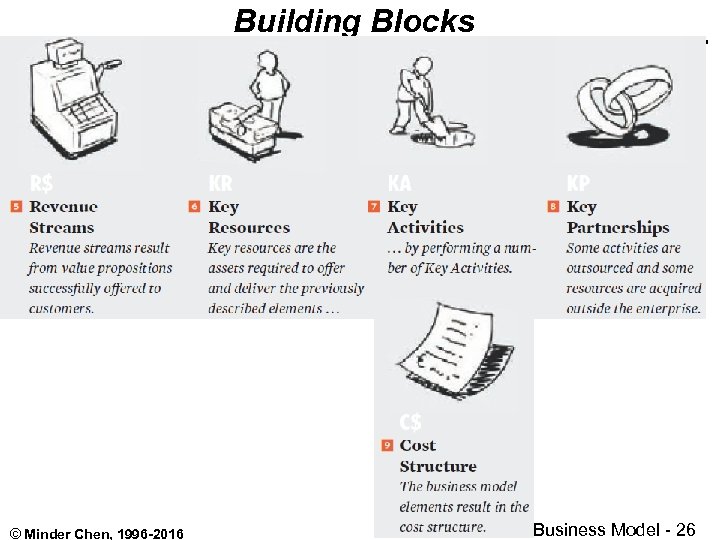
Building Blocks © Minder Chen, 1996 -2016 Business Model - 26
The Use of the Business Model Canvas • • • Describe Discuss Design Challenge Improve Innovate Invent Pivot Choose © Minder Chen, 1996 -2016 Your Business Model https: //www. youtube. com/watch? v=Qo. AOz. MTLP 5 s 2 minutes Alex Osterwalder - From Business Plan to Business Model Summer of Startups 2011. https: //www. youtube. com/watch? v=j. Mx. HApgcmo. U 1 hr long Business Model - 27
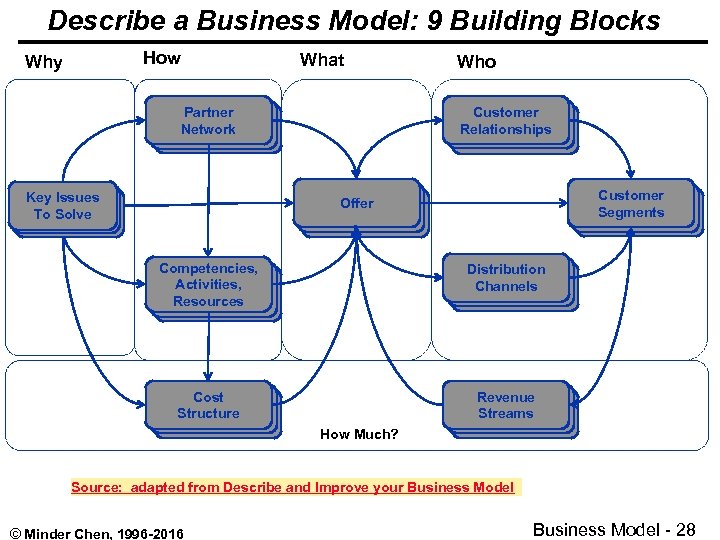
Describe a Business Model: 9 Building Blocks How Why What Partner CLIENT Network SEGMENTS Key Issues CLIENT To Solve SEGMENTS Who Customer CLIENT Relationships SEGMENTS Customer CLIENTS CLIENT Segments SEGMENTS CLIENT Offer CLIENT SEGMENTS Competencies, CLIENT Activities, CLIENT SEGMENTS Resources Cost CLIENT Structure SEGMENTS Distribution CLIENT Channels SEGMENTS Revenue CLIENT Streams SEGMENTS How Much? SEGMENTS Source: adapted from Describe and Improve your Business Model © Minder Chen, 1996 -2016 Business Model - 28
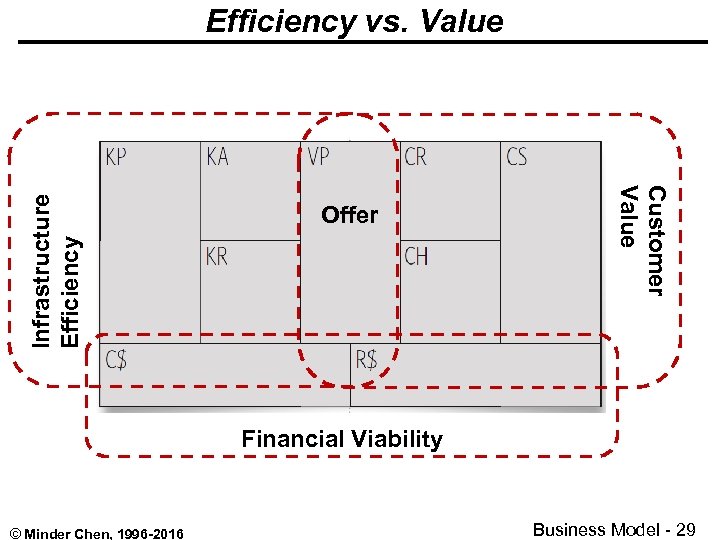
Offer Customer Value Infrastructure Efficiency vs. Value Financial Viability © Minder Chen, 1996 -2016 Business Model - 29
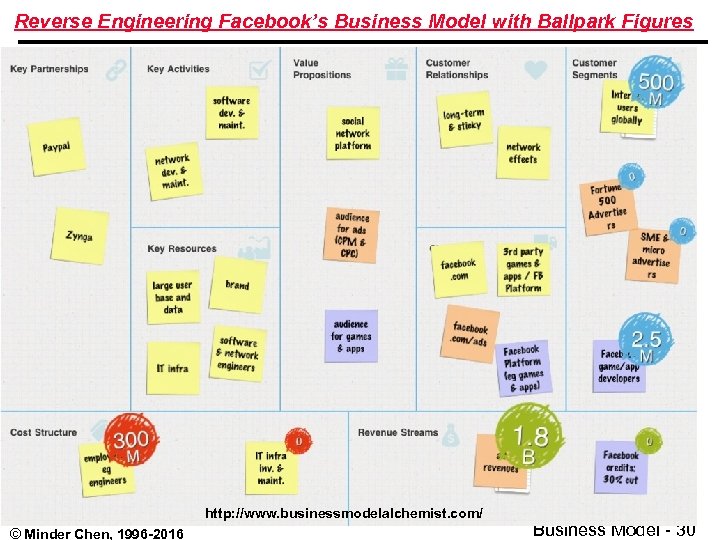
Reverse Engineering Facebook’s Business Model with Ballpark Figures http: //www. businessmodelalchemist. com/ © Minder Chen, 1996 -2016 Business Model - 30
Create a Business Model Canvas for RTR Exercise Watch the video *Rent the Runway: An inside look at the tech startup's success – https: //www. youtube. com/watch? v=cyvfsi 3 MX-M • Visit https: //www. renttherunway. com/ • Create the Business Model Canvas based on what you learn from the video and the visit of the company’s site. • Use the BMC template in the next slide. © Minder Chen, 1996 -2016 Business Model - 31
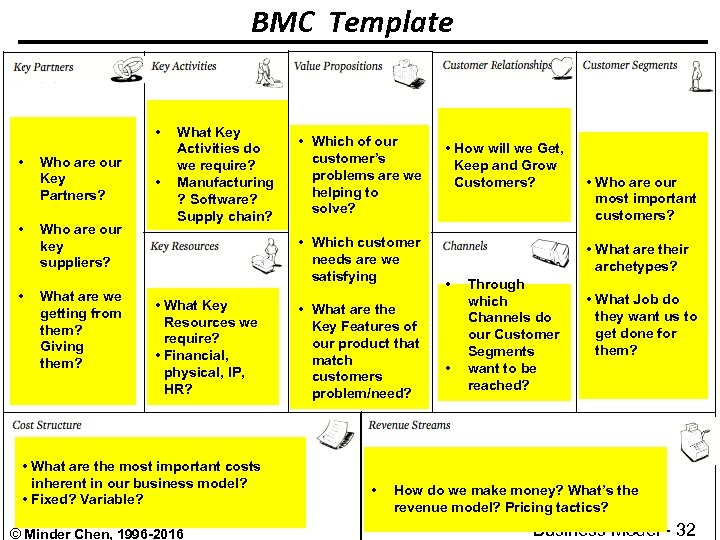
BMC Template • • Who are our Key Partners? Who are our key suppliers? What are we getting from them? Giving them? • What Key Activities do we require? Manufacturing ? Software? Supply chain? • Which of our customer’s problems are we helping to solve? • Which customer needs are we satisfying • What Key Resources we require? • Financial, physical, IP, HR? • What are the most important costs inherent in our business model? • Fixed? Variable? © Minder Chen, 1996 -2016 • What are the Key Features of our product that match customers problem/need? • • How will we Get, Keep and Grow Customers? • Who are our most important customers? • What are their archetypes? • • Through which Channels do our Customer Segments want to be reached? • What Job do they want us to get done for them? How do we make money? What’s the revenue model? Pricing tactics? Business Model - 32
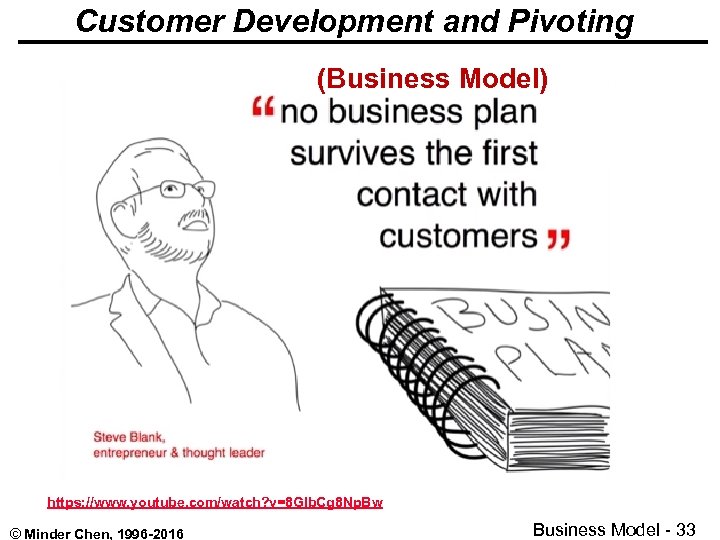
Customer Development and Pivoting (Business Model) https: //www. youtube. com/watch? v=8 GIb. Cg 8 Np. Bw © Minder Chen, 1996 -2016 Business Model - 33
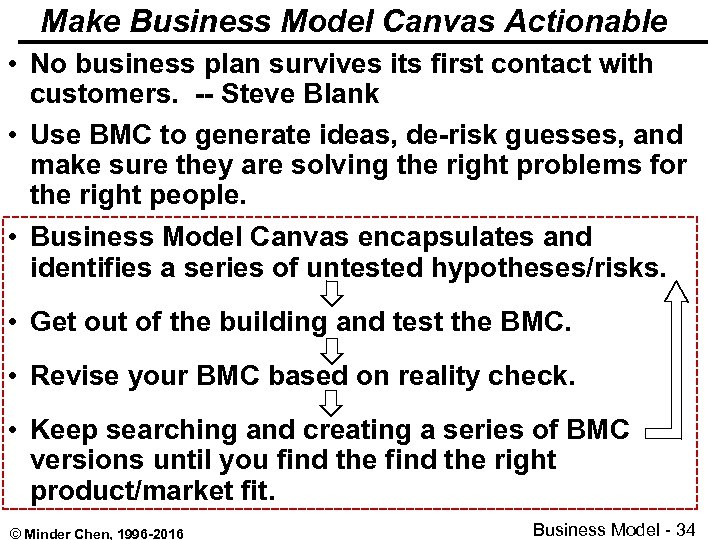
Make Business Model Canvas Actionable • No business plan survives its first contact with customers. -- Steve Blank • Use BMC to generate ideas, de-risk guesses, and make sure they are solving the right problems for the right people. • Business Model Canvas encapsulates and identifies a series of untested hypotheses/risks. • Get out of the building and test the BMC. • Revise your BMC based on reality check. • Keep searching and creating a series of BMC versions until you find the right product/market fit. © Minder Chen, 1996 -2016 Business Model - 34
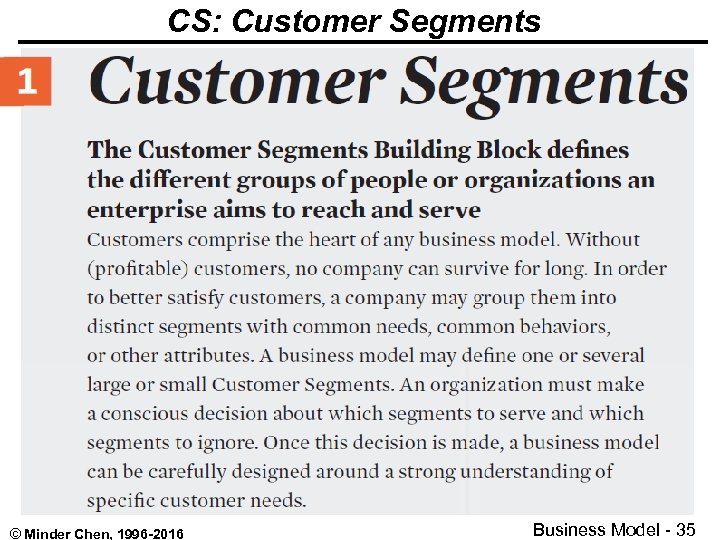
CS: Customer Segments © Minder Chen, 1996 -2016 Business Model - 35
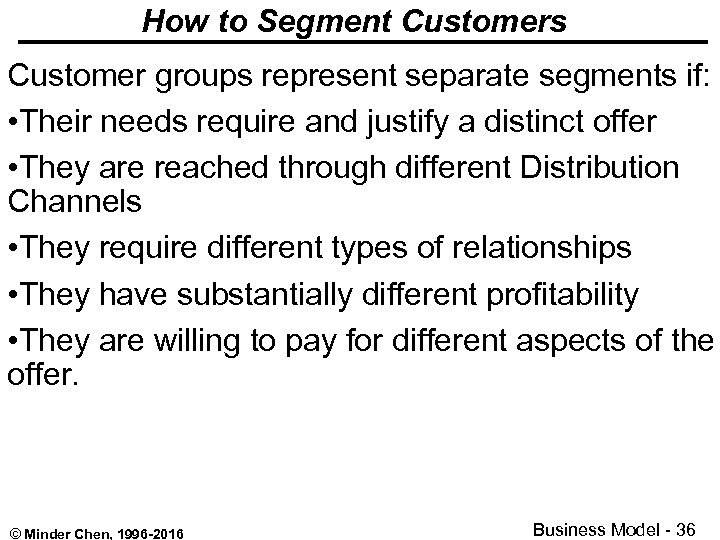
How to Segment Customers Customer groups represent separate segments if: • Their needs require and justify a distinct offer • They are reached through different Distribution Channels • They require different types of relationships • They have substantially different profitability • They are willing to pay for different aspects of the offer. © Minder Chen, 1996 -2016 Business Model - 36
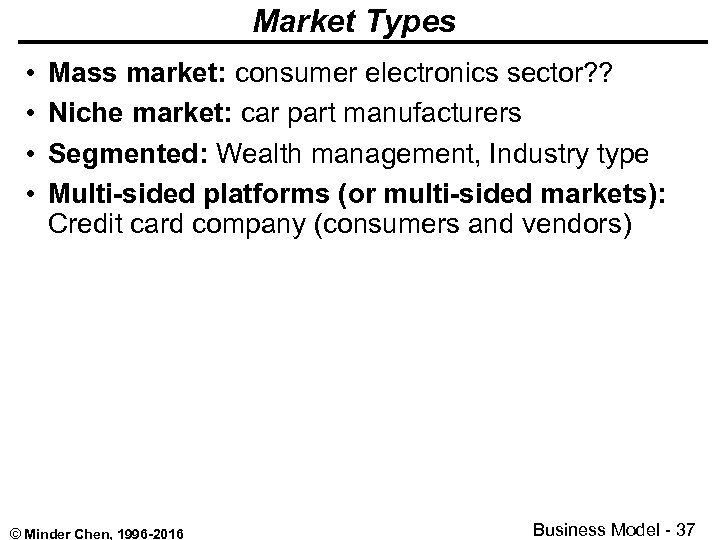
Market Types • • Mass market: consumer electronics sector? ? Niche market: car part manufacturers Segmented: Wealth management, Industry type Multi-sided platforms (or multi-sided markets): Credit card company (consumers and vendors) © Minder Chen, 1996 -2016 Business Model - 37
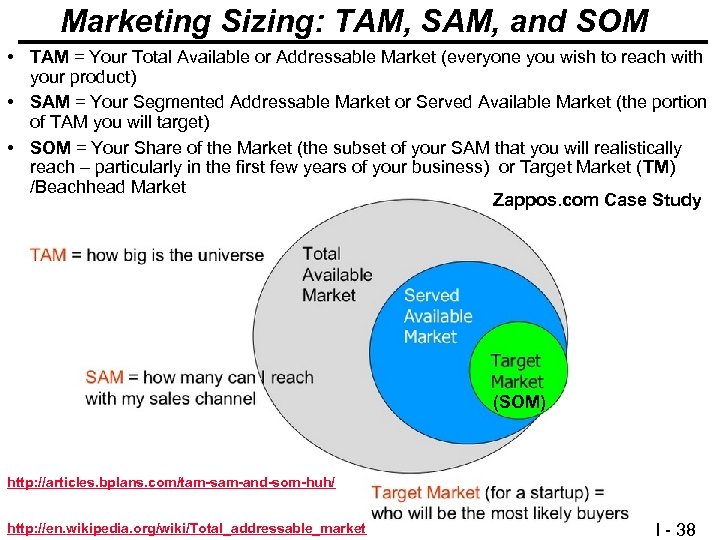
Marketing Sizing: TAM, SAM, and SOM • TAM = Your Total Available or Addressable Market (everyone you wish to reach with your product) • SAM = Your Segmented Addressable Market or Served Available Market (the portion of TAM you will target) • SOM = Your Share of the Market (the subset of your SAM that you will realistically reach – particularly in the first few years of your business) or Target Market (TM) /Beachhead Market Zappos. com Case Study (SOM) http: //articles. bplans. com/tam-sam-and-som-huh/ http: //en. wikipedia. org/wiki/Total_addressable_market © Minder Chen, 1996 -2016 Business Model - 38
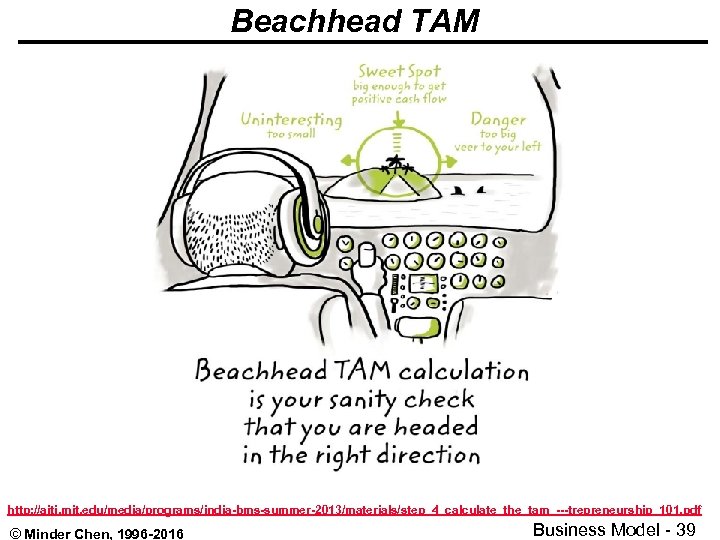
Beachhead TAM http: //aiti. mit. edu/media/programs/india-bms-summer-2013/materials/step_4_calculate_the_tam_---trepreneurship_101. pdf © Minder Chen, 1996 -2016 Business Model - 39
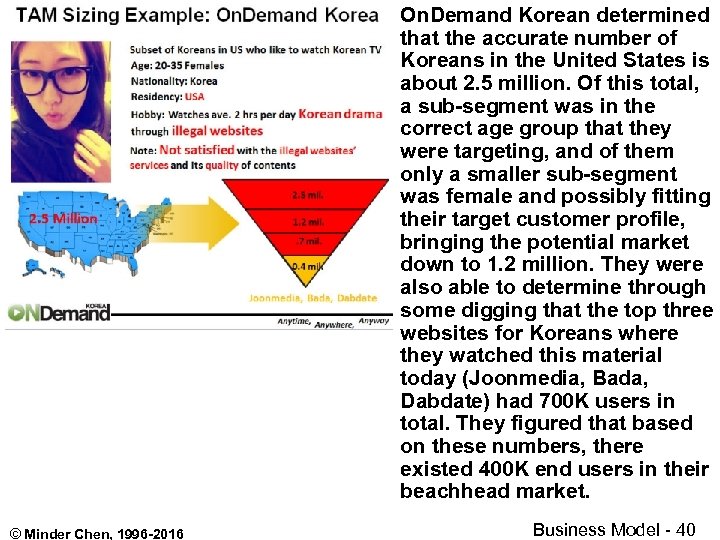
On. Demand Korean determined that the accurate number of Koreans in the United States is about 2. 5 million. Of this total, a sub-segment was in the correct age group that they were targeting, and of them only a smaller sub-segment was female and possibly fitting their target customer profile, bringing the potential market down to 1. 2 million. They were also able to determine through some digging that the top three websites for Koreans where they watched this material today (Joonmedia, Bada, Dabdate) had 700 K users in total. They figured that based on these numbers, there existed 400 K end users in their beachhead market. © Minder Chen, 1996 -2016 Business Model - 40
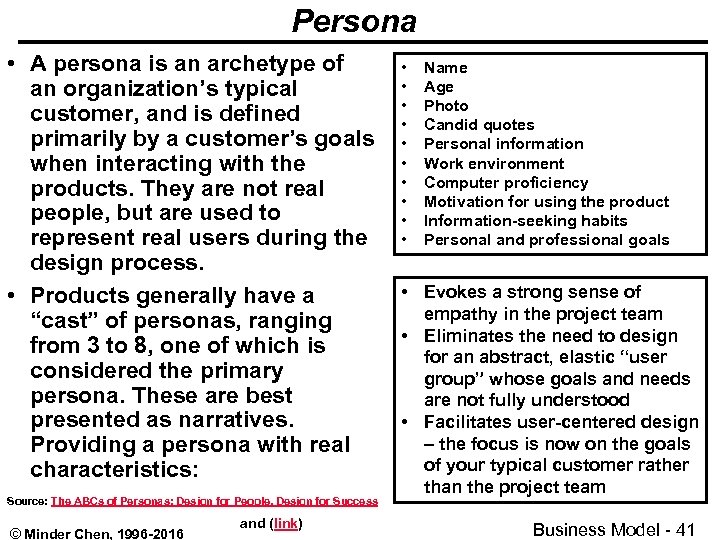
Persona • A persona is an archetype of an organization’s typical customer, and is defined primarily by a customer’s goals when interacting with the products. They are not real people, but are used to represent real users during the design process. • Products generally have a “cast” of personas, ranging from 3 to 8, one of which is considered the primary persona. These are best presented as narratives. Providing a persona with real characteristics: Source: The ABCs of Personas: Design for People, Design for Success © Minder Chen, 1996 -2016 and (link) • • • Name Age Photo Candid quotes Personal information Work environment Computer proficiency Motivation for using the product Information-seeking habits Personal and professional goals • Evokes a strong sense of empathy in the project team • Eliminates the need to design for an abstract, elastic “user group” whose goals and needs are not fully understood • Facilitates user-centered design – the focus is now on the goals of your typical customer rather than the project team Business Model - 41
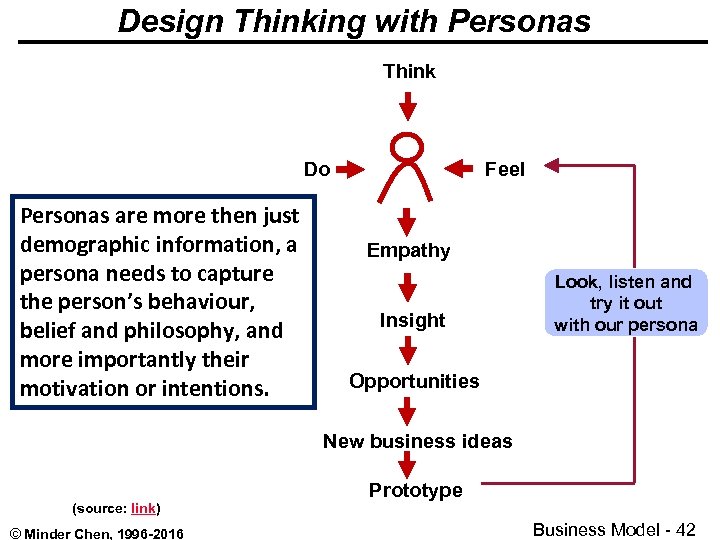
Design Thinking with Personas Think Do Personas are more then just demographic information, a persona needs to capture the person’s behaviour, belief and philosophy, and more importantly their motivation or intentions. Feel Empathy Insight Look, listen and try it out with our persona Opportunities New business ideas (source: link) © Minder Chen, 1996 -2016 Prototype Business Model - 42
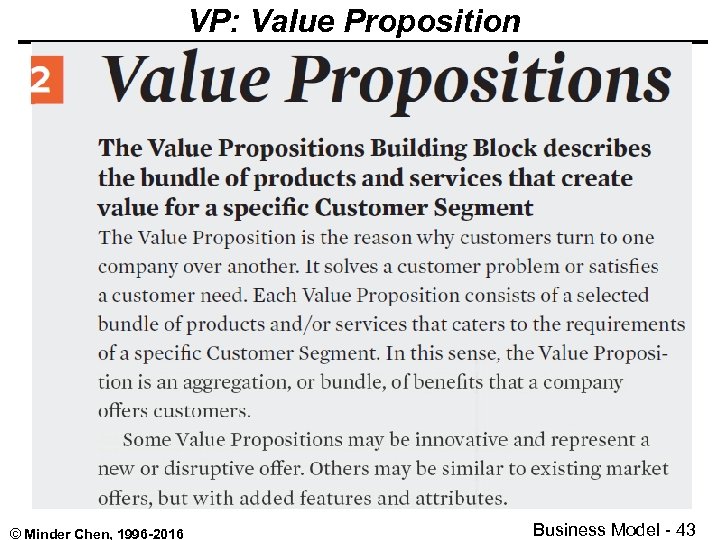
VP: Value Proposition © Minder Chen, 1996 -2016 Business Model - 43
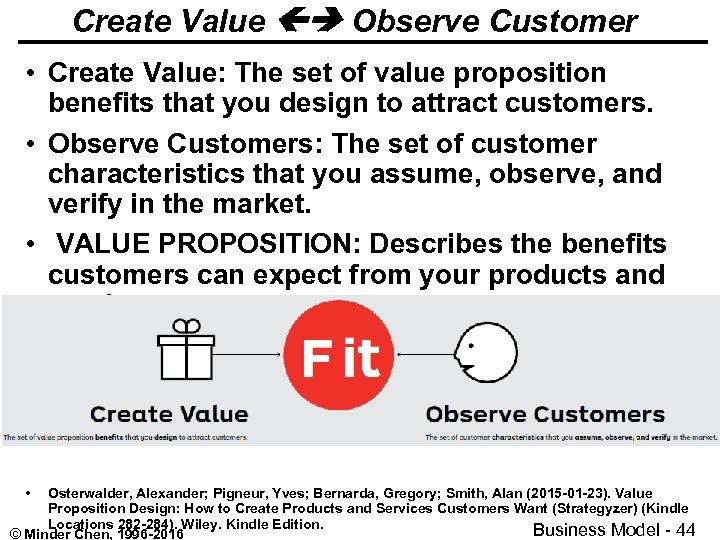
Create Value Observe Customer • Create Value: The set of value proposition benefits that you design to attract customers. • Observe Customers: The set of customer characteristics that you assume, observe, and verify in the market. • VALUE PROPOSITION: Describes the benefits customers can expect from your products and services. • Osterwalder, Alexander; Pigneur, Yves; Bernarda, Gregory; Smith, Alan (2015 -01 -23). Value Proposition Design: How to Create Products and Services Customers Want (Strategyzer) (Kindle Locations 282 -284). Wiley. Kindle Edition. Business Model - 44 © Minder Chen, 1996 -2016
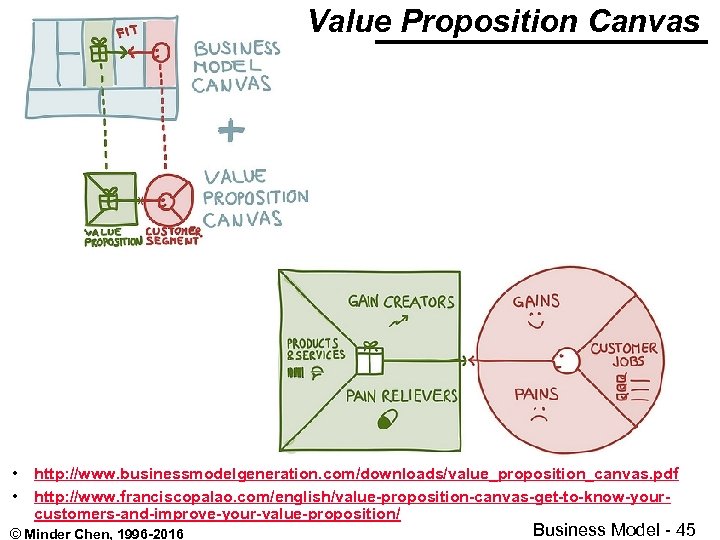
Value Proposition Canvas • • http: //www. businessmodelgeneration. com/downloads/value_proposition_canvas. pdf http: //www. franciscopalao. com/english/value-proposition-canvas-get-to-know-yourcustomers-and-improve-your-value-proposition/ © Minder Chen, 1996 -2016 Business Model - 45
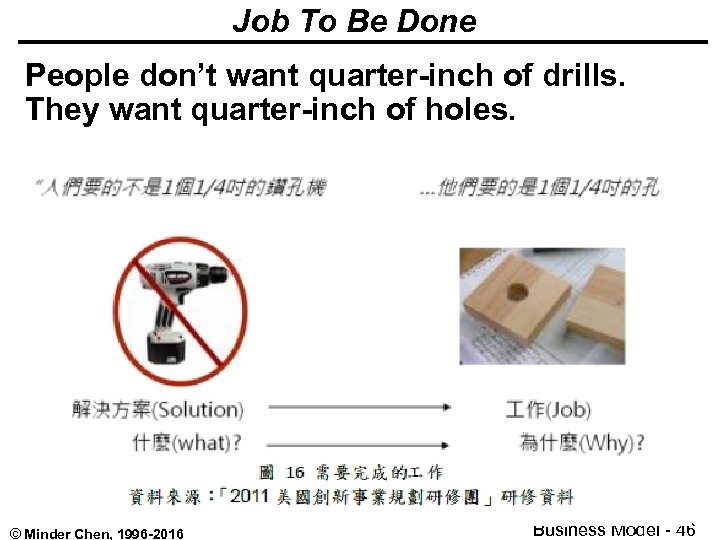
Job To Be Done People don’t want quarter-inch of drills. They want quarter-inch of holes. © Minder Chen, 1996 -2016 Business Model - 46
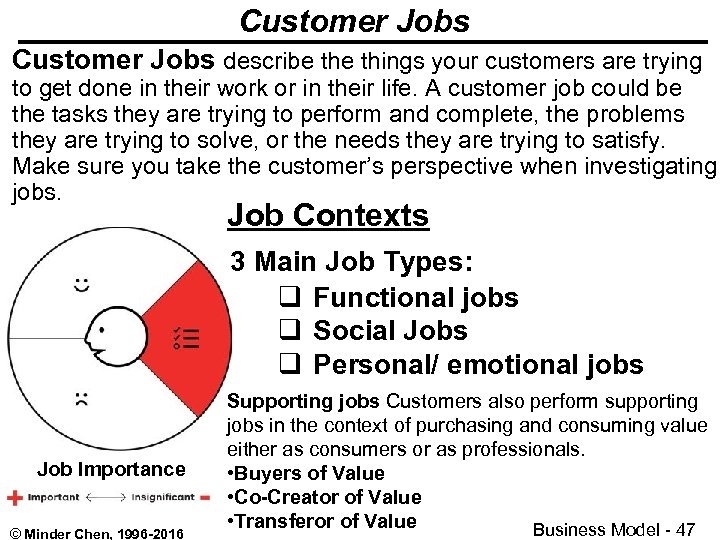
Customer Jobs describe things your customers are trying to get done in their work or in their life. A customer job could be the tasks they are trying to perform and complete, the problems they are trying to solve, or the needs they are trying to satisfy. Make sure you take the customer’s perspective when investigating jobs. Job Contexts 3 Main Job Types: q Functional jobs q Social Jobs q Personal/ emotional jobs Job Importance © Minder Chen, 1996 -2016 Supporting jobs Customers also perform supporting jobs in the context of purchasing and consuming value either as consumers or as professionals. • Buyers of Value • Co-Creator of Value • Transferor of Value Business Model - 47
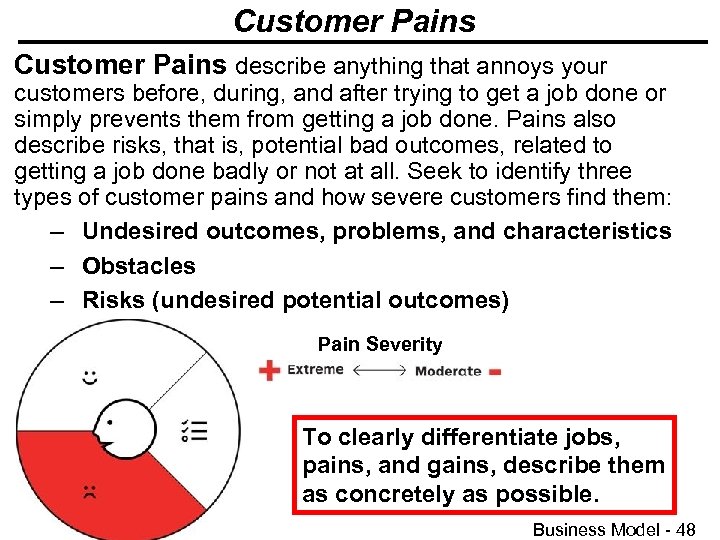
Customer Pains describe anything that annoys your customers before, during, and after trying to get a job done or simply prevents them from getting a job done. Pains also describe risks, that is, potential bad outcomes, related to getting a job done badly or not at all. Seek to identify three types of customer pains and how severe customers find them: – Undesired outcomes, problems, and characteristics – Obstacles – Risks (undesired potential outcomes) Pain Severity To clearly differentiate jobs, pains, and gains, describe them as concretely as possible. © Minder Chen, 1996 -2016 Business Model - 48
© Minder Chen, 1996 -2016 Business Model - 49
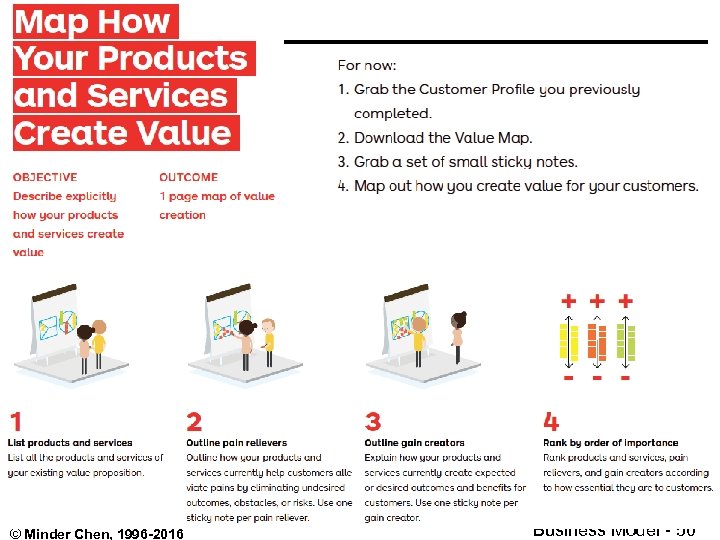
© Minder Chen, 1996 -2016 Business Model - 50
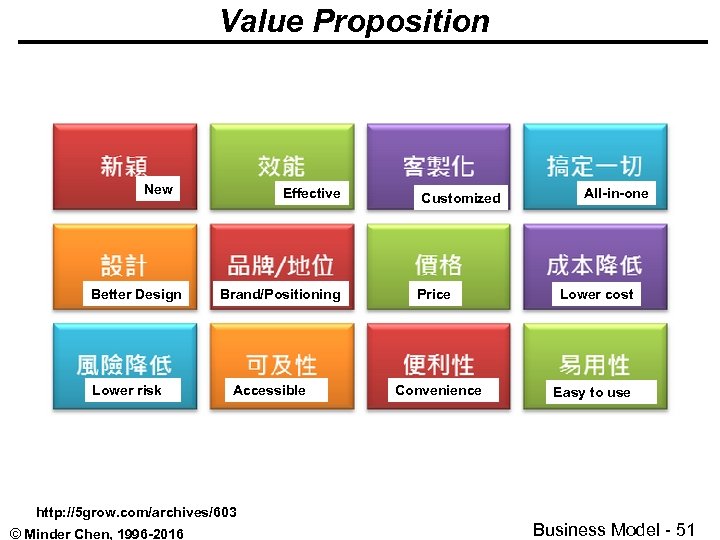
Value Proposition New Better Design Lower risk Effective Brand/Positioning Accessible http: //5 grow. com/archives/603 © Minder Chen, 1996 -2016 Customized Price Convenience All-in-one Lower cost Easy to use Business Model - 51
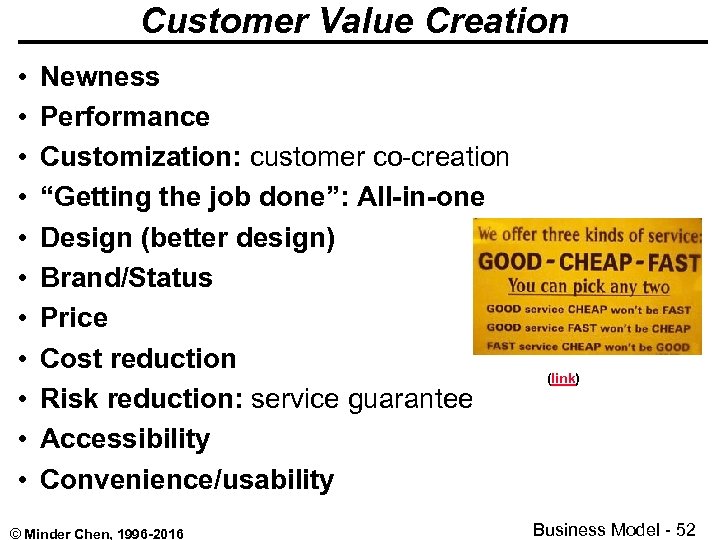
Customer Value Creation • • • Newness Performance Customization: customer co-creation “Getting the job done”: All-in-one Design (better design) Brand/Status Price Cost reduction Risk reduction: service guarantee Accessibility Convenience/usability © Minder Chen, 1996 -2016 (link) Business Model - 52
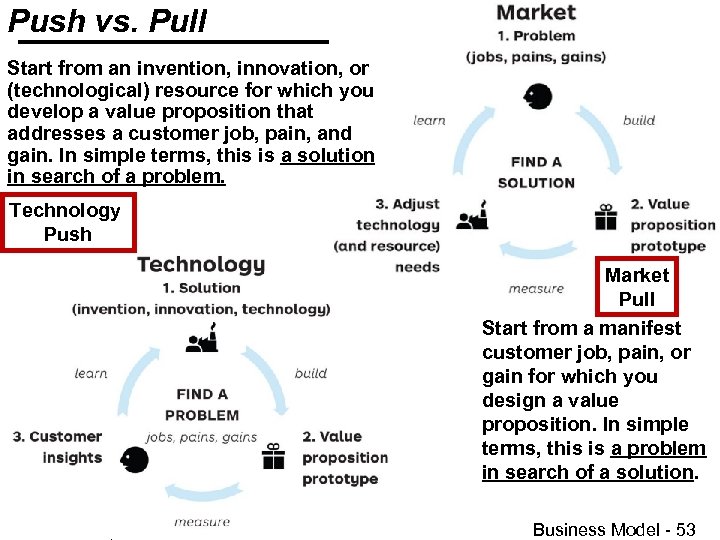
Push vs. Pull Start from an invention, innovation, or (technological) resource for which you develop a value proposition that addresses a customer job, pain, and gain. In simple terms, this is a solution in search of a problem. Technology Push Market Pull Start from a manifest customer job, pain, or gain for which you design a value proposition. In simple terms, this is a problem in search of a solution. © Minder Chen, 1996 -2016 Business Model - 53
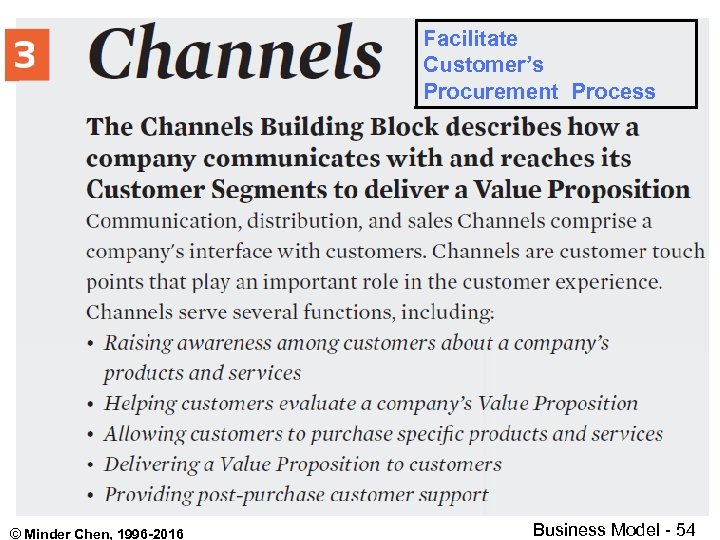
Facilitate Customer’s Procurement Process © Minder Chen, 1996 -2016 Business Model - 54
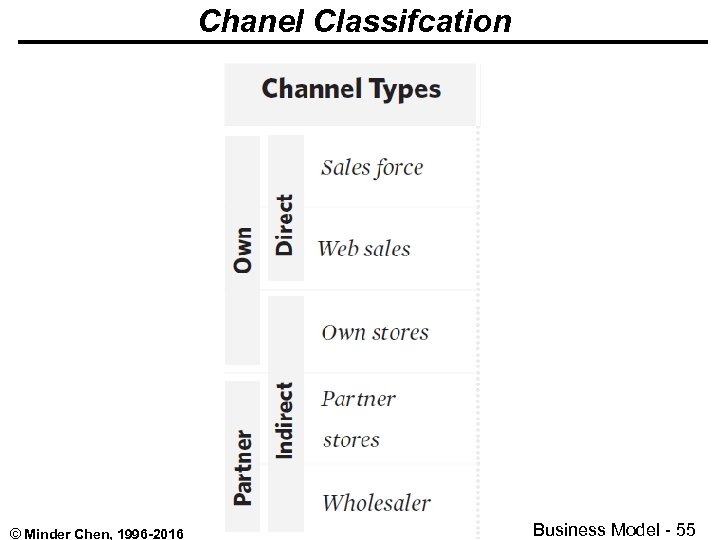
Chanel Classifcation © Minder Chen, 1996 -2016 Business Model - 55
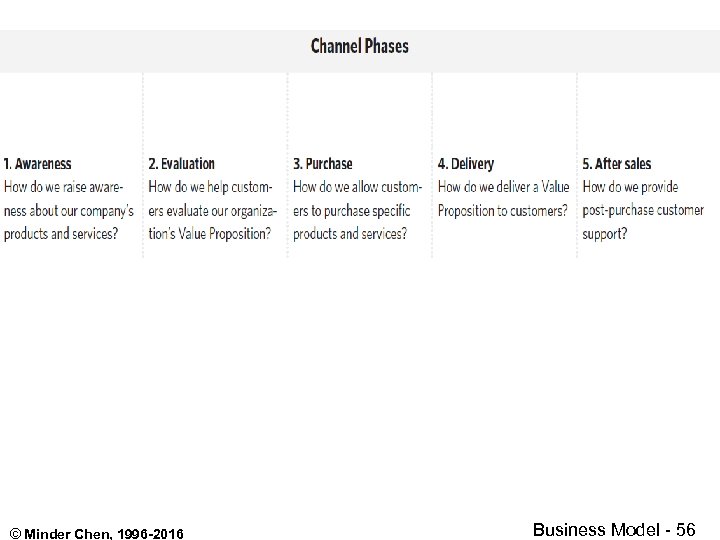
© Minder Chen, 1996 -2016 Business Model - 56
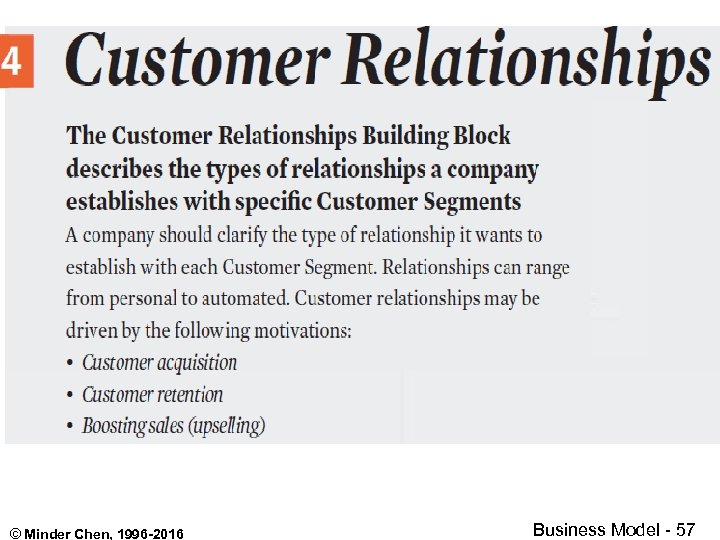
© Minder Chen, 1996 -2016 Business Model - 57
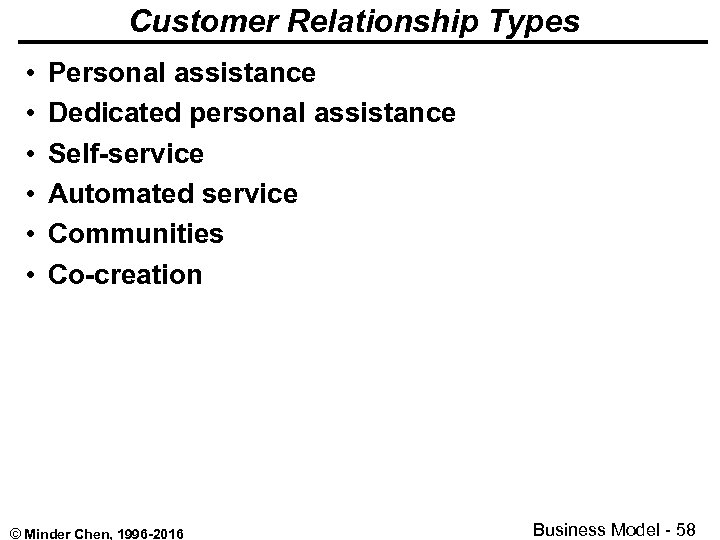
Customer Relationship Types • • • Personal assistance Dedicated personal assistance Self-service Automated service Communities Co-creation © Minder Chen, 1996 -2016 Business Model - 58
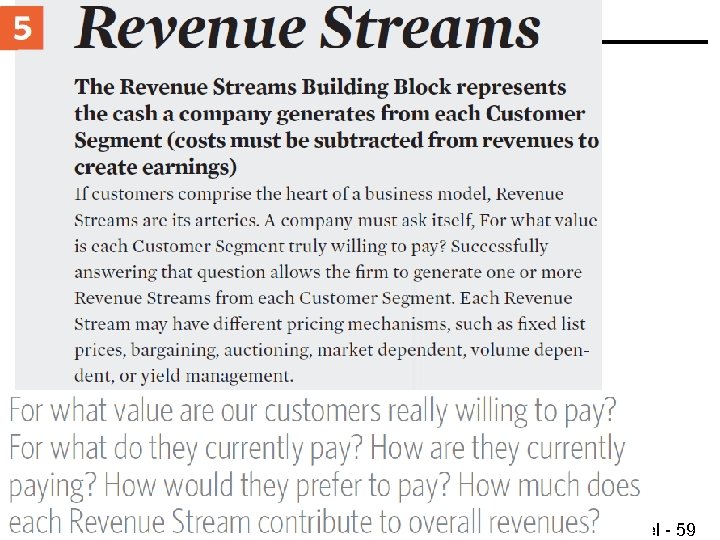
© Minder Chen, 1996 -2016 Business Model - 59
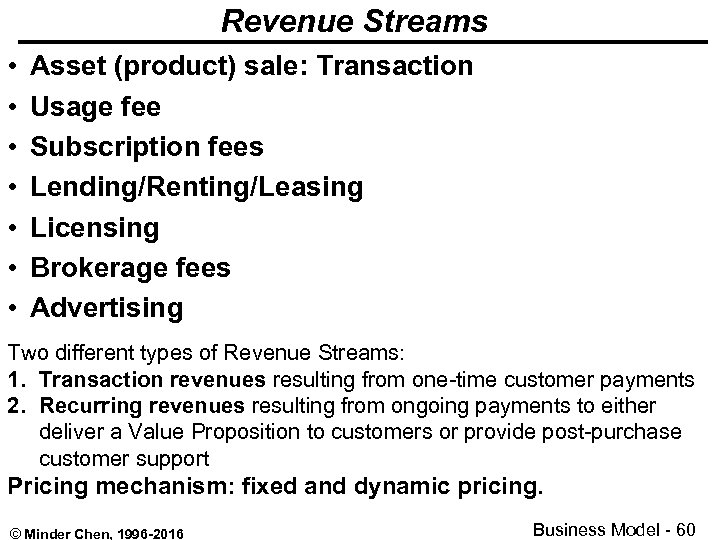
Revenue Streams • • Asset (product) sale: Transaction Usage fee Subscription fees Lending/Renting/Leasing Licensing Brokerage fees Advertising Two different types of Revenue Streams: 1. Transaction revenues resulting from one-time customer payments 2. Recurring revenues resulting from ongoing payments to either deliver a Value Proposition to customers or provide post-purchase customer support Pricing mechanism: fixed and dynamic pricing. © Minder Chen, 1996 -2016 Business Model - 60
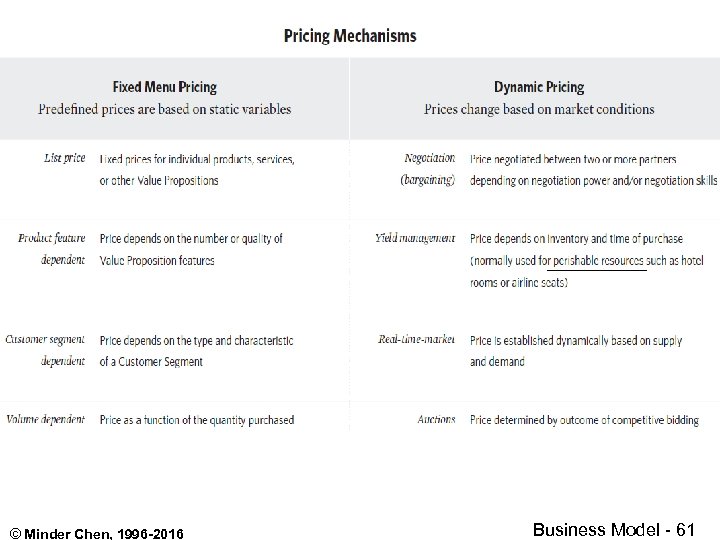
xxxxxx © Minder Chen, 1996 -2016 Business Model - 61
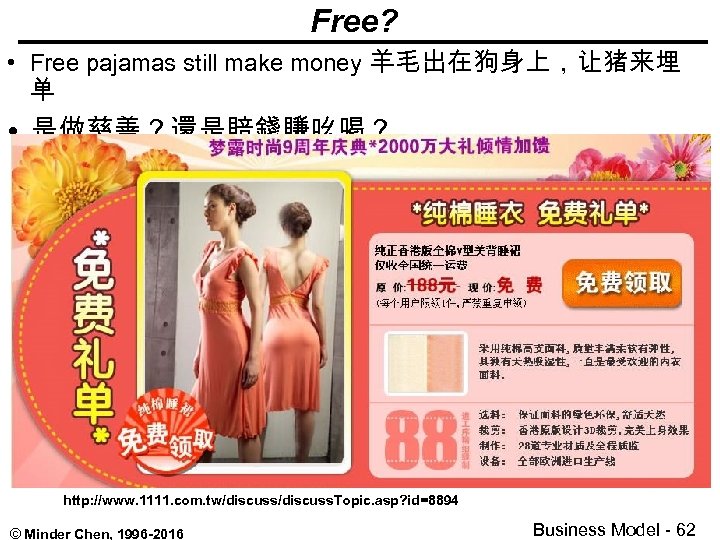
Free? • Free pajamas still make money 羊毛出在狗身上,让猪来埋 单 • 是做慈善?還是賠錢賺吆喝? http: //www. 1111. com. tw/discuss. Topic. asp? id=8894 © Minder Chen, 1996 -2016 Business Model - 62
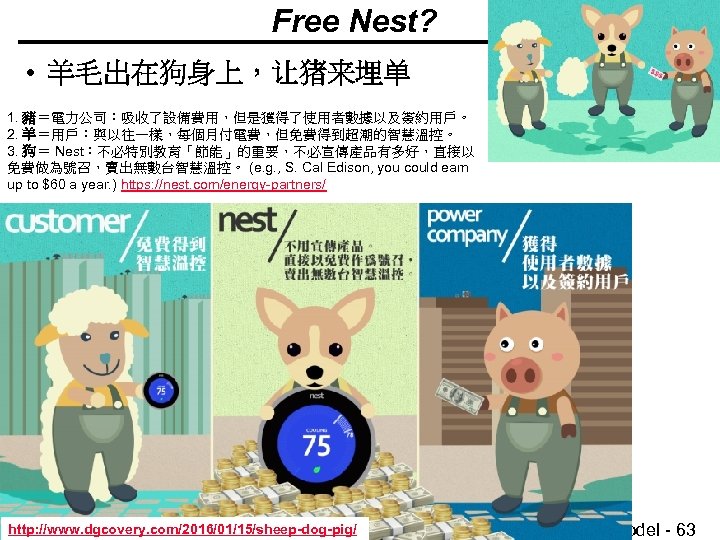
Free Nest? • 羊毛出在狗身上,让猪来埋单 1. 豬=電力公司:吸收了設備費用,但是獲得了使用者數據以及簽約用戶。 2. 羊=用戶:與以往一樣,每個月付電費,但免費得到超潮的智慧溫控。 3. 狗= Nest:不必特別教育「節能」的重要,不必宣傳產品有多好,直接以 免費做為號召,賣出無數台智慧溫控。 (e. g. , S. Cal Edison, you could earn up to $60 a year. ) https: //nest. com/energy-partners/ http: //www. dgcovery. com/2016/01/15/sheep-dog-pig/ © Minder Chen, 1996 -2016 Business Model - 63
© Minder Chen, 1996 -2016 Business Model - 64
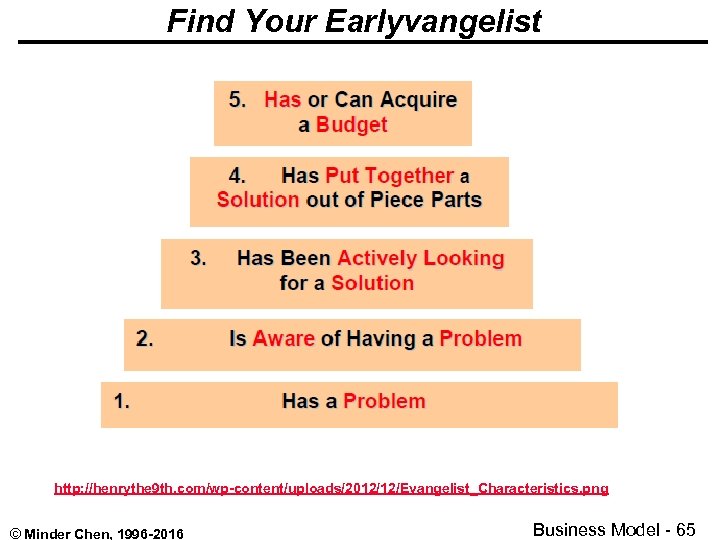
Find Your Earlyvangelist http: //henrythe 9 th. com/wp-content/uploads/2012/12/Evangelist_Characteristics. png © Minder Chen, 1996 -2016 Business Model - 65
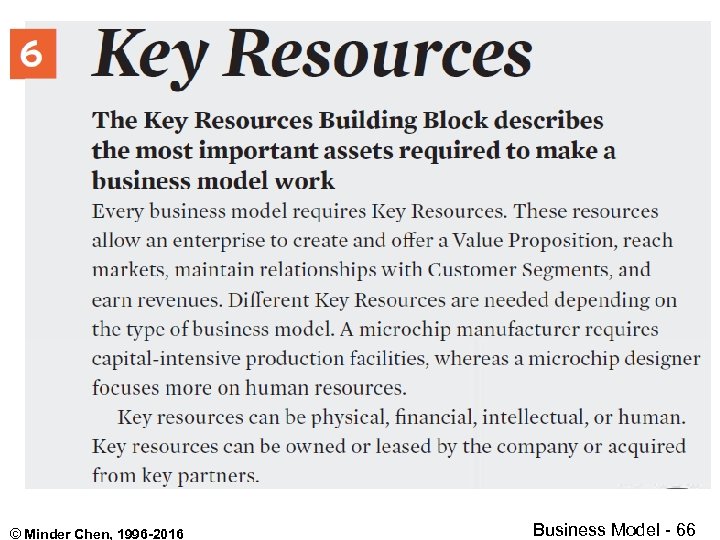
© Minder Chen, 1996 -2016 Business Model - 66
Key Resources Categorization • Physical • Intellectual: brands, proprietary knowledge, patents and copyrights, partnerships, and customer databases. • Human – Members of Founding Team • Financial © Minder Chen, 1996 -2016 Business Model - 67
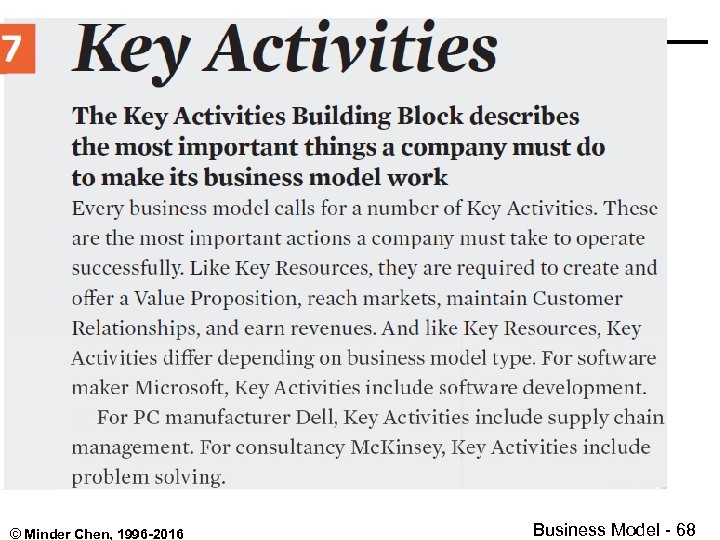
© Minder Chen, 1996 -2016 Business Model - 68
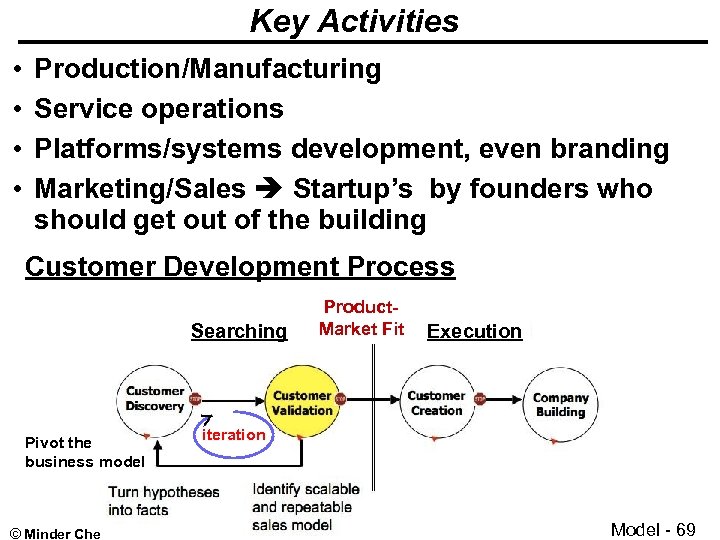
Key Activities • • Production/Manufacturing Service operations Platforms/systems development, even branding Marketing/Sales Startup’s by founders who should get out of the building Customer Development Process Searching Pivot the business model © Minder Chen, 1996 -2016 Product. Market Fit Execution iteration Business Model - 69
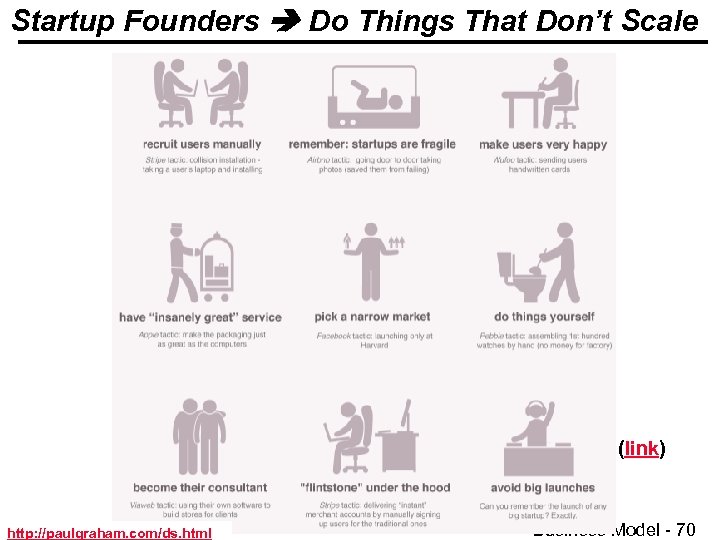
Startup Founders Do Things That Don’t Scale (link) http: //paulgraham. com/ds. html © Minder Chen, 1996 -2016 Business Model - 70
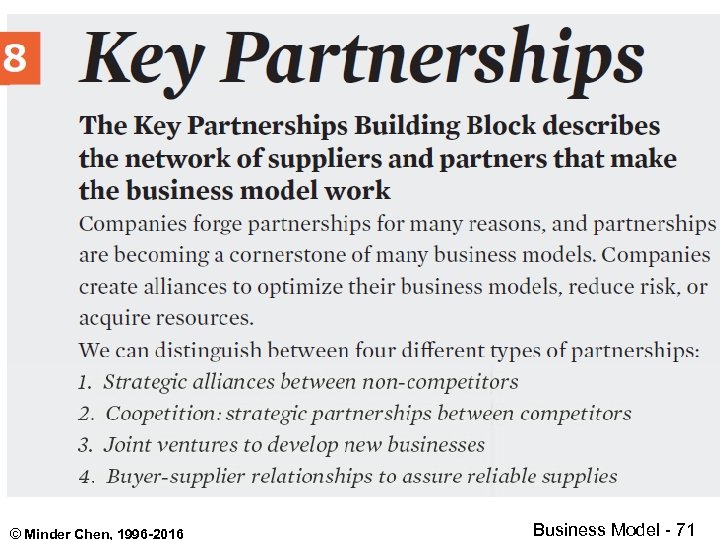
© Minder Chen, 1996 -2016 Business Model - 71
Reasons for Partnership • Optimization and economy of scale • Reduction of risk and uncertainty • Acquisition of particular resources and activities Crowdsourcing © Minder Chen, 1996 -2016 Business Model - 72
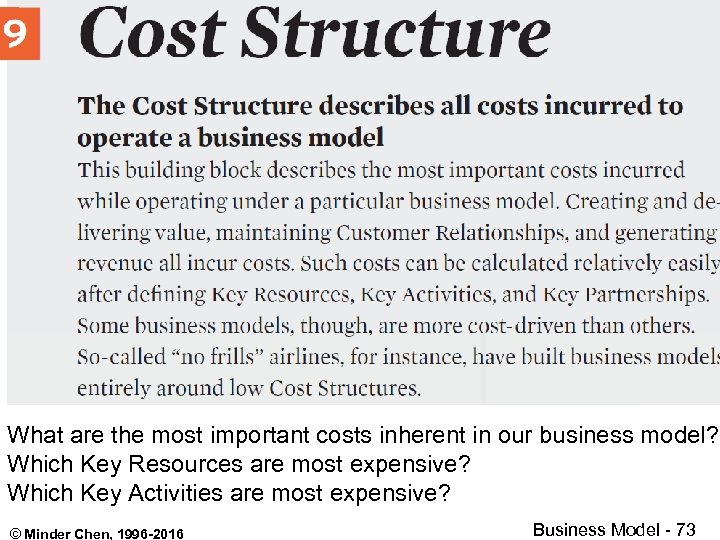
What are the most important costs inherent in our business model? Which Key Resources are most expensive? Which Key Activities are most expensive? © Minder Chen, 1996 -2016 Business Model - 73
Costs Structures • Cost-driven vs. Value-driven • Fixed costs vs. Variable costs • Economies of scale vs. Economies of scope © Minder Chen, 1996 -2016 Business Model - 74
Case Study: Business Model Competition Presentation • Owlet Baby Care: New Way to Work Final Pitch ** https: //www. youtube. com/watch? v=Dl. GULe 9 WBm. E https: //vimeo. com/132213520 **https: //vimeo. com/84423056 or https: //www. youtube. com/watch? v=f -8 v_Rgw. Ge 0 pivot IBMC 2014: Veritas Medical - 1 st Place Rollins Center for Entrepreneurship & Technology at BYU https: //www. youtube. com/watch? v=-FGTTFMEDHU © Minder Chen, 1996 -2016 Business Model - 75
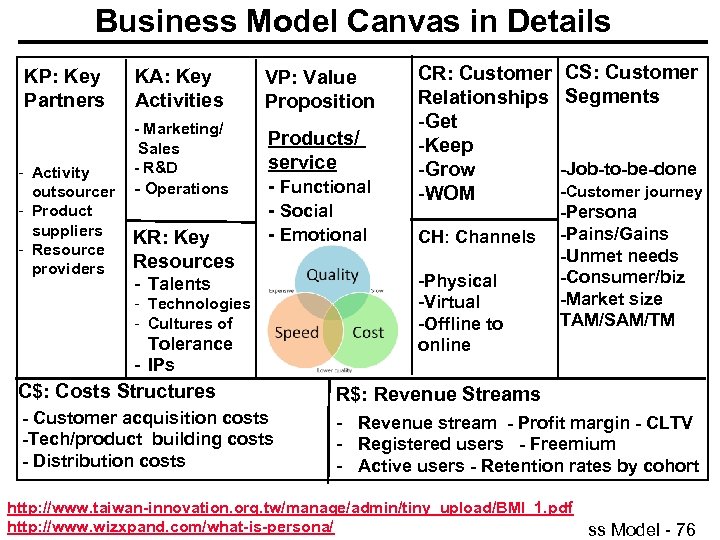
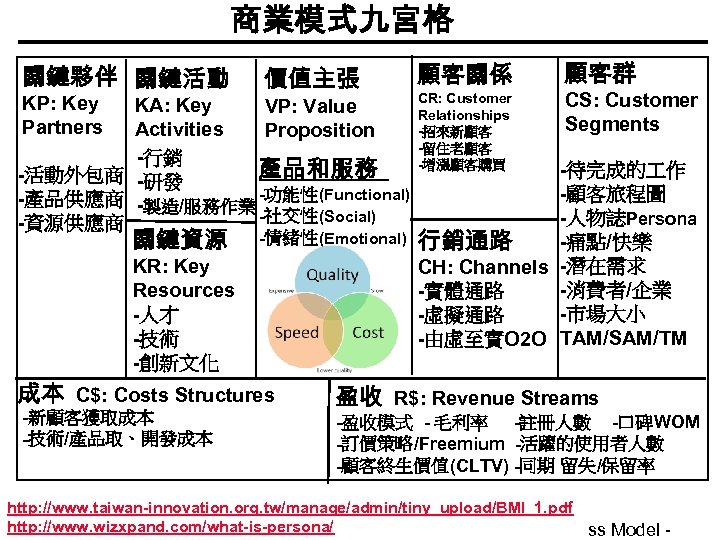
Business Model Canvas in Details KP: Key Partners - Activity outsourcer - Product suppliers - Resource providers KA: Key Activities VP: Value Proposition - Marketing/ Sales - R&D - Operations Products/ service - Functional - Social - Emotional KR: Key Resources - Talents - Technologies - Cultures of Tolerance - IPs CR: Customer Relationships -Get -Keep -Grow -WOM CH: Channels -Physical -Virtual -Offline to online CS: Customer Segments -Job-to-be-done -Customer journey -Persona -Pains/Gains -Unmet needs -Consumer/biz -Market size TAM/SAM/TM C$: Costs Structures R$: Revenue Streams - Customer acquisition costs -Tech/product building costs - Distribution costs - Revenue stream - Profit margin - CLTV - Registered users - Freemium - Active users - Retention rates by cohort http: //www. taiwan-innovation. org. tw/manage/admin/tiny_upload/BMI_1. pdf http: //www. wizxpand. com/what-is-persona/ Business Model - 76 © Minder Chen, 1996 -2016
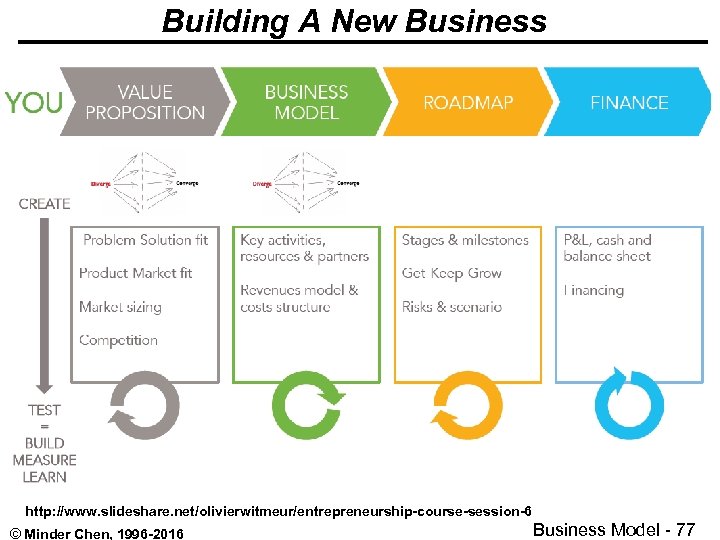
Building A New Business http: //www. slideshare. net/olivierwitmeur/entrepreneurship-course-session-6 © Minder Chen, 1996 -2016 Business Model - 77
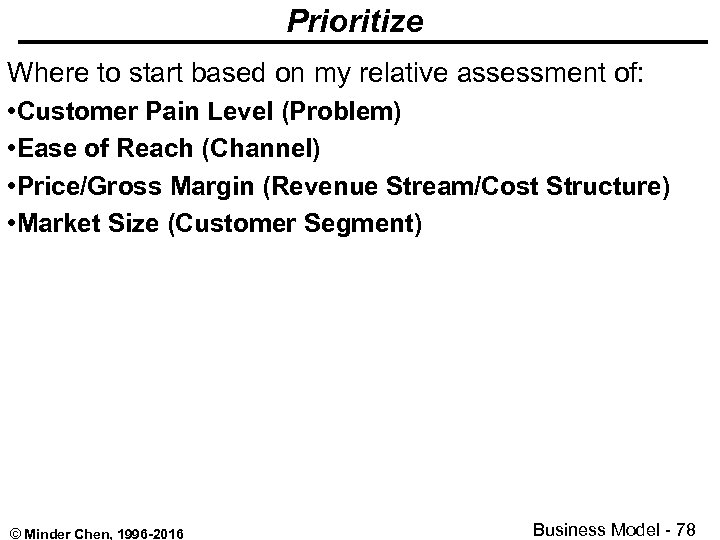
Prioritize Where to start based on my relative assessment of: • Customer Pain Level (Problem) • Ease of Reach (Channel) • Price/Gross Margin (Revenue Stream/Cost Structure) • Market Size (Customer Segment) © Minder Chen, 1996 -2016 Business Model - 78
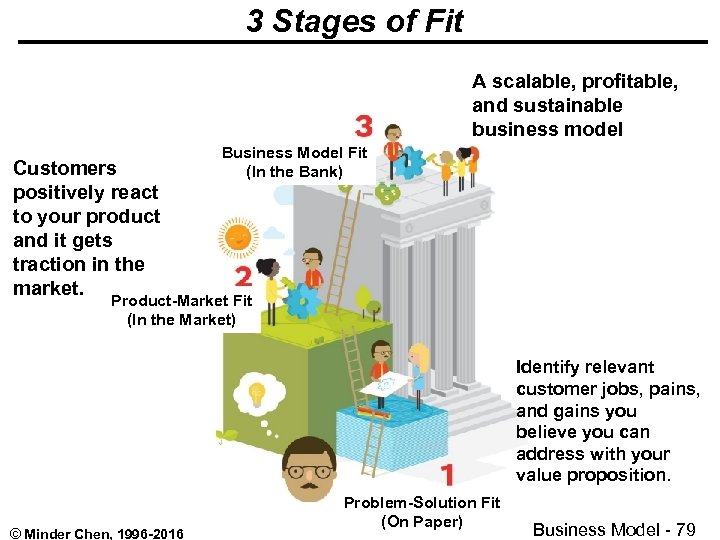
3 Stages of Fit A scalable, profitable, and sustainable business model Customers positively react to your product and it gets traction in the market. Business Model Fit (In the Bank) Product-Market Fit (In the Market) Identify relevant customer jobs, pains, and gains you believe you can address with your value proposition. © Minder Chen, 1996 -2016 Problem-Solution Fit (On Paper) Business Model - 79
Product Market Fit • Product/market fit means being in a good market with a product that can satisfy that market. • You can always feel when product/market fit isn't happening. The customers aren't quite getting value out of the product, word of mouth isn't spreading, usage isn't growing that fast, press reviews are kind of "blah", the sales cycle takes too long, and lots of deals never close. • I believe that the life of any startup can be divided into two parts: before product/market fit (call this "BPMF") and after product/market fit("APMF"). – Marc Andreessen ***(link) http: //andrewchen. co/when-has-a-consumer-startup-hit-productmarket-fit/ © Minder Chen, 1996 -2016 Business Model - 80
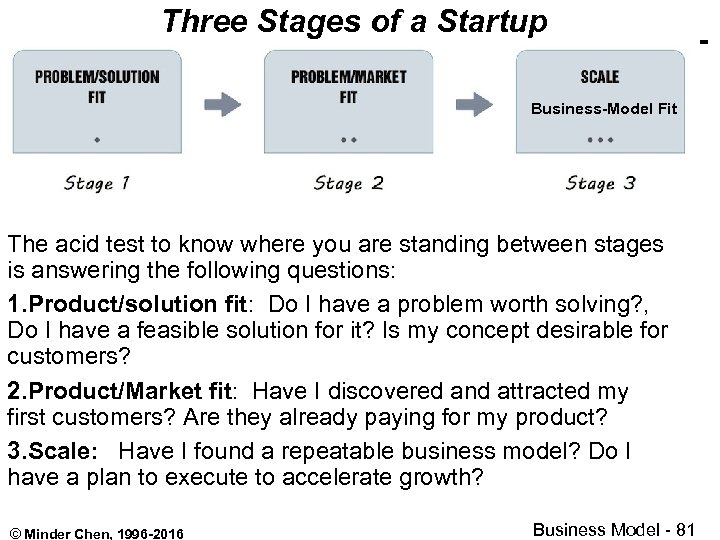
Three Stages of a Startup Business-Model Fit The acid test to know where you are standing between stages is answering the following questions: 1. Product/solution fit: Do I have a problem worth solving? , Do I have a feasible solution for it? Is my concept desirable for customers? 2. Product/Market fit: Have I discovered and attracted my first customers? Are they already paying for my product? 3. Scale: Have I found a repeatable business model? Do I have a plan to execute to accelerate growth? © Minder Chen, 1996 -2016 Business Model - 81
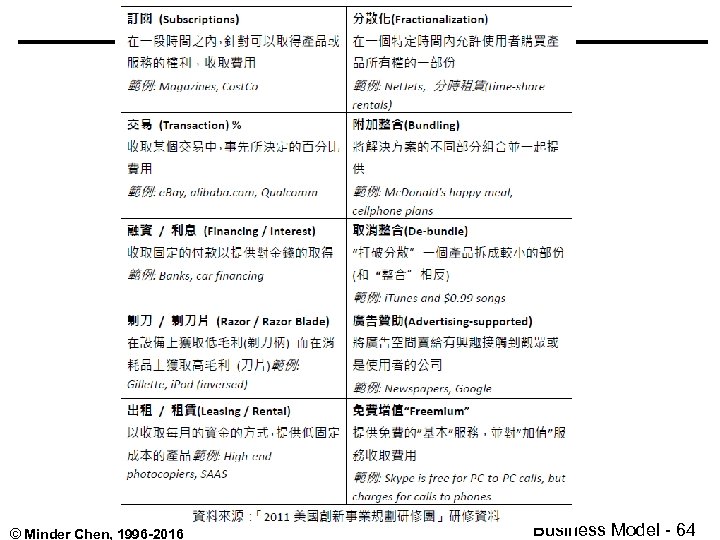
Design Pattern • • Unbundling Business Models The Long Tail Multi-Sided Platforms FREE as a Business Model / Freemium / Bait & Hook • Open Business Models (Open Innovation) “Pattern in architecture is the idea of capturing architectural design ideas as archetypal and reusable descriptions. ” - Christopher Alexander, Architect © Minder Chen, 1996 -2016 Business Model - 82
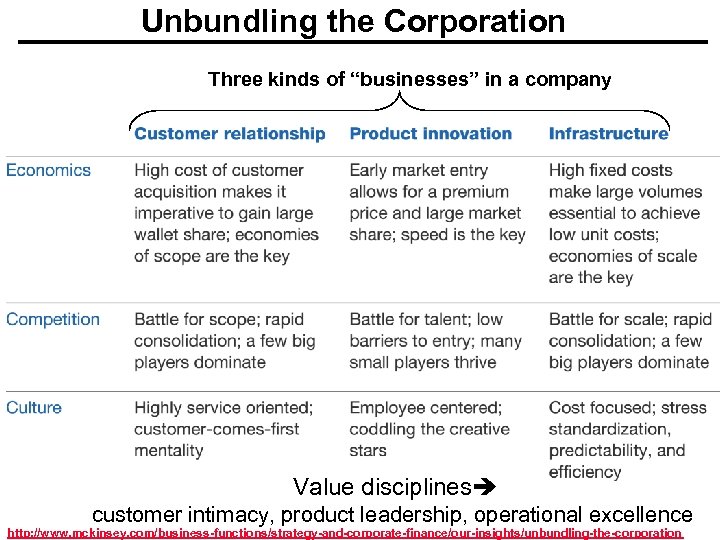
Unbundling the Corporation Three kinds of “businesses” in a company Value disciplines customer intimacy, product leadership, operational excellence Business Model - 83 http: //www. mckinsey. com/business-functions/strategy-and-corporate-finance/our-insights/unbundling-the-corporation © Minder Chen, 1996 -2016
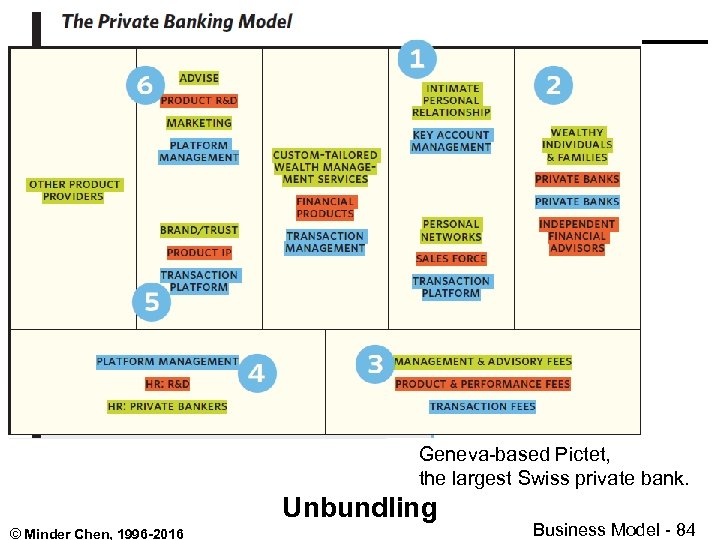
Geneva-based Pictet, the largest Swiss private bank. Unbundling © Minder Chen, 1996 -2016 Business Model - 84
Multi-sided-platforms The platform’s value for a particular user group depends substantially on the number of users on the platform’s “other sides. ” A video game console will only attract buyers if enough games are available for the platform. On the other hand, game developers will develop games for a new video console only if a substantial number of gamers already use it. Hence multi-sided platforms often face a “chicken and egg” dilemma. © Minder Chen, 1996 -2016 Business Model - 85
Who Pay? One way multi-sided platforms solve this problem is by subsidizing a Customer Segment. Though a platform operator incurs costs by serving all customer groups, it often decides to lure one segment to the platform with an inexpensive or free Value Proposition in order to subsequently attract users of the platform’s “other side. ” One difficulty multi-sided platform operators face is understanding which side to subsidize and how to price correctly to attract customers. Operators of multi-sided platforms must ask them- selves several key questions: Can we attract sufficient numbers of customers for each side of the platform? Which side is more price sensitive? Can that side be enticed by a subsidized offer? Will the other side of the platform generate sufficient revenues to cover the subsidies? © Minder Chen, 1996 -2016 Business Model - 86
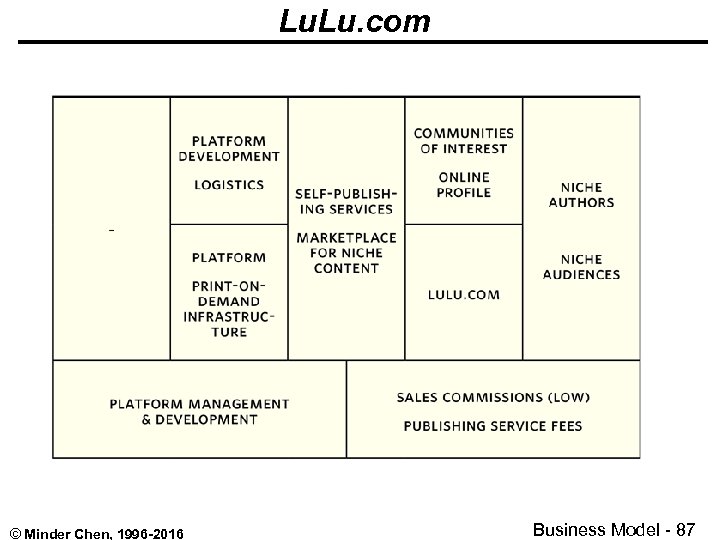
Lu. com © Minder Chen, 1996 -2016 Business Model - 87
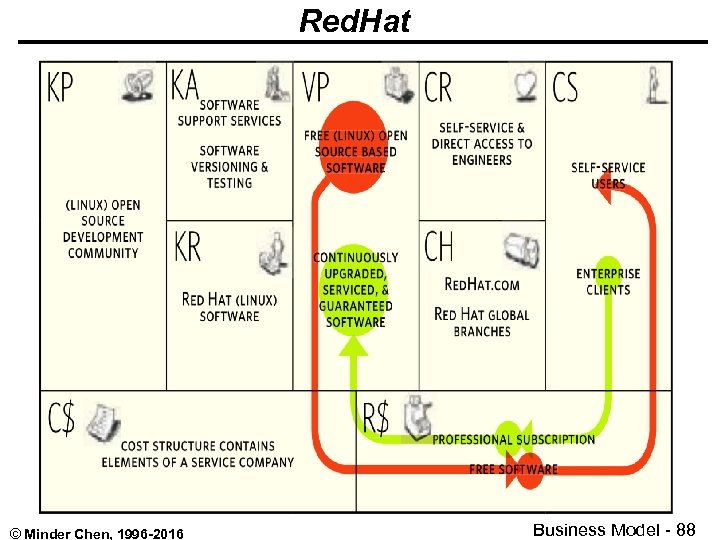
Red. Hat © Minder Chen, 1996 -2016 Business Model - 88
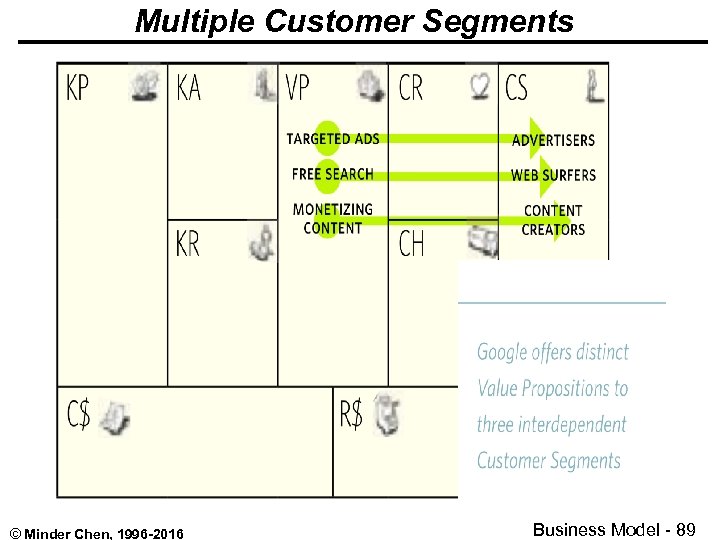
Multiple Customer Segments © Minder Chen, 1996 -2016 Business Model - 89
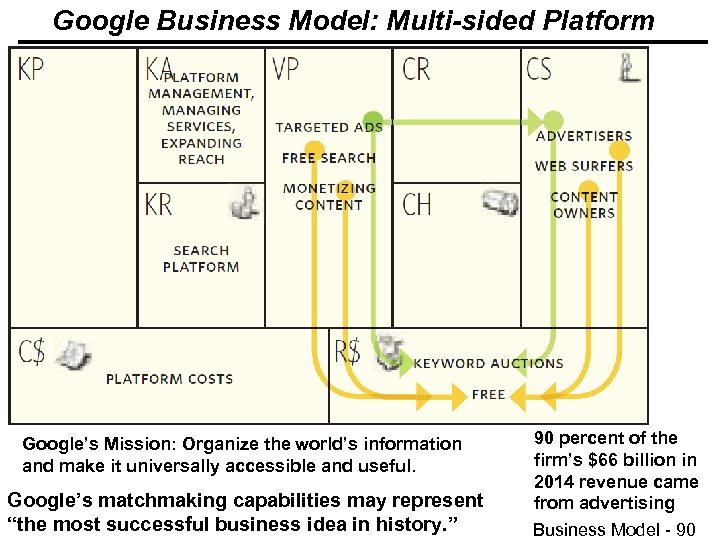
Google Business Model: Multi-sided Platform Google’s Mission: Organize the world’s information and make it universally accessible and useful. Google’s matchmaking capabilities may represent “the most successful business idea in history. ” © Minder Chen, 1996 -2016 90 percent of the firm’s $66 billion in 2014 revenue came from advertising Business Model - 90
Google Expansion • Google free services have propelled Google into a wide-ranging, multifront war that includes mobile, browsers, cloud infrastructure, e-mail, office apps, social media, maps, e-commerce, payments, and more. • Google intends to extend the platform to PC, TV, car, home automation, and accessories such as Google Glass smart watches, virtual reality, more. • The current list includes driverless cars, smart contact lenses, and world-wrapping satellite and balloon-delivered wireless networks. Google bought 11 robotics firms in a single year. • Google is now organized under a holding company named Alphabet https: //abc. xyz/ © Minder Chen, 1996 -2016 Business Model - 91
20% Time • Google “encourage our employees, in addition to their regular projects, to spend 20% of their time working on what they think will most benefit Google, ” …“This empowers them to be more creative and innovative. Many of our significant advances have happened in this manner. ” • In 2012 the firm began requiring engineers who wished to work on individual projects to run their proposals by their managers first. This was a significant change from the firm’s previous policy. This is more ‘top down’ framing of focus areas rather than the ‘bottom up’ ‘scattergun’ innovation approach that was epitomised by Google ‘ 20% time’. • Google management will need to monitor its innovation metrics covering both ‘output’ (e. g. new products and new ways of working) and ‘pipeline’ (e. g. new ideas) of the firm’s innovation system. • "If you're not failing enough, you're not trying hard enough…. If it doesn't work, move on. ” © Minder Chen, 1996 -2016 (link) Business Model - 92
Google Market Cap • Google’s market cap was greater than that of News Corp (which includes all of the Fox Networks, and the Wall Street Journal), Disney (including ABC, ESPN, theme parks, and Pixar), Time Warner (Fortune, Time, Sports Illustrated, CNN, and Warner Bros. ), Viacom (MTV, VH 1, and Nickelodeon), CBS, and the New York Times—combined! • Just six years after its IPO, Google had become one of the twenty most profitable firms in the United States and was the youngest firm on the list—by far. • Aug. 19, 2014, the stock has risen 1, 294% since it went public on Aug. 19, 2004. © Minder Chen, 1996 -2016 Business Model - 93
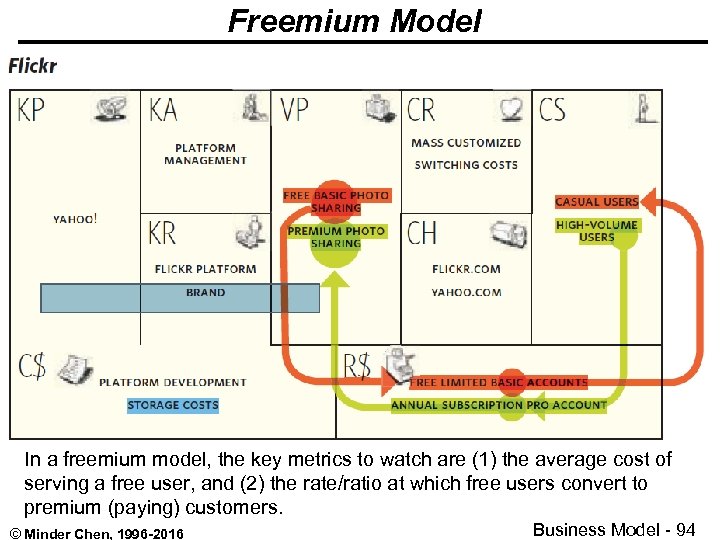
Freemium Model In a freemium model, the key metrics to watch are (1) the average cost of serving a free user, and (2) the rate/ratio at which free users convert to premium (paying) customers. © Minder Chen, 1996 -2016 Business Model - 94
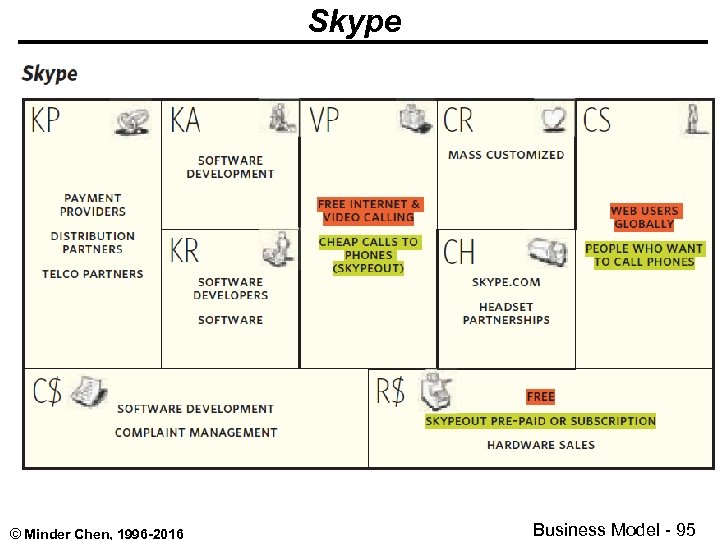
Skype © Minder Chen, 1996 -2016 Business Model - 95
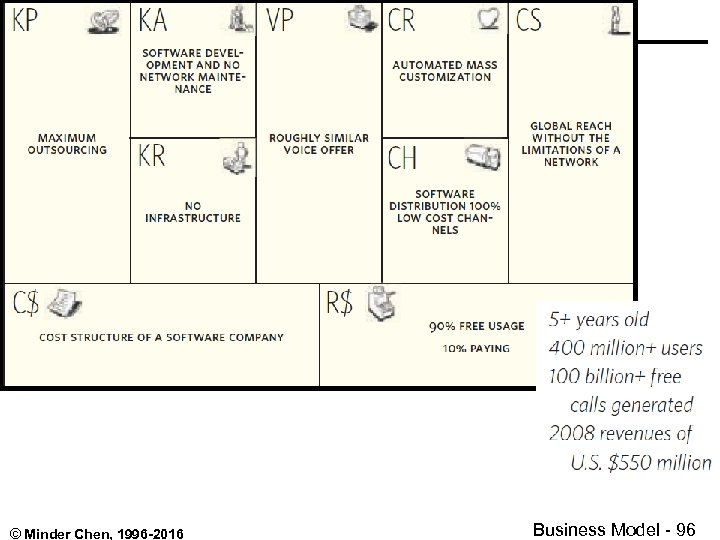
© Minder Chen, 1996 -2016 Business Model - 96
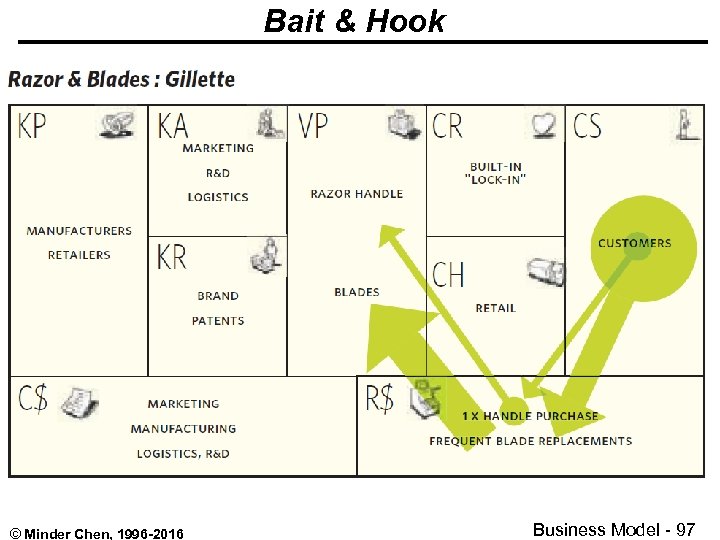
Bait & Hook © Minder Chen, 1996 -2016 Business Model - 97
© Minder Chen, 1996 -2016 Business Model - 98
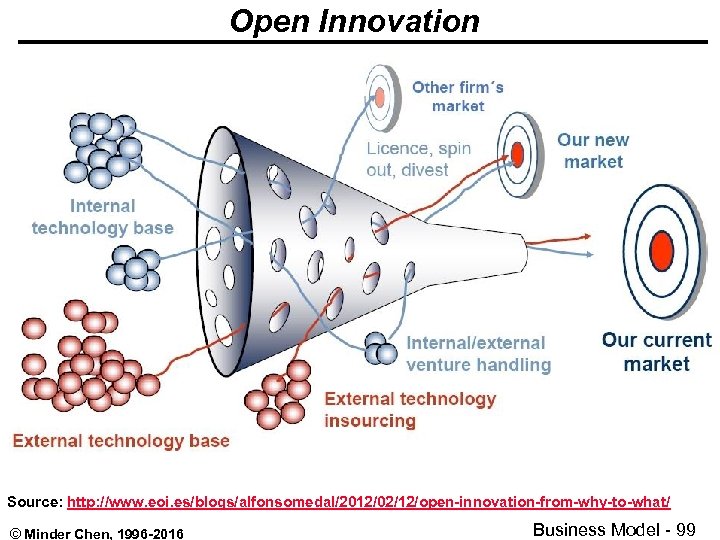
Open Innovation Source: http: //www. eoi. es/blogs/alfonsomedal/2012/02/12/open-innovation-from-why-to-what/ © Minder Chen, 1996 -2016 Business Model - 99
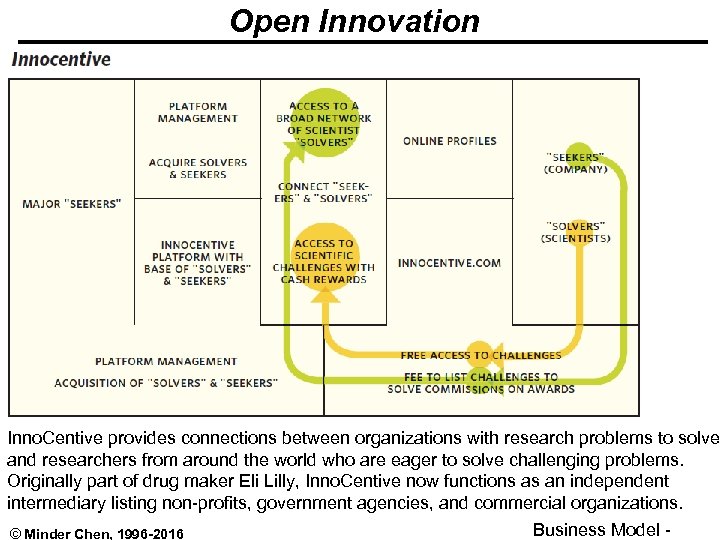
Open Innovation Inno. Centive provides connections between organizations with research problems to solve and researchers from around the world who are eager to solve challenging problems. Originally part of drug maker Eli Lilly, Inno. Centive now functions as an independent intermediary listing non-profits, government agencies, and commercial organizations. Business Model - © Minder Chen, 1996 -2016
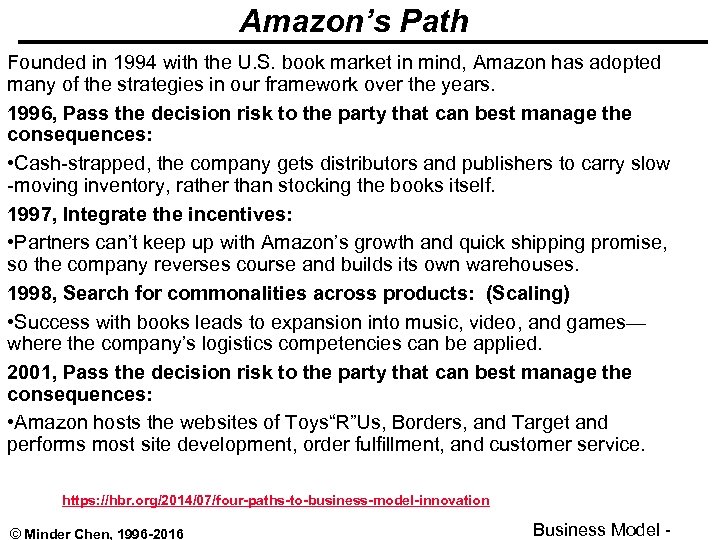
Amazon’s Path Founded in 1994 with the U. S. book market in mind, Amazon has adopted many of the strategies in our framework over the years. 1996, Pass the decision risk to the party that can best manage the consequences: • Cash-strapped, the company gets distributors and publishers to carry slow -moving inventory, rather than stocking the books itself. 1997, Integrate the incentives: • Partners can’t keep up with Amazon’s growth and quick shipping promise, so the company reverses course and builds its own warehouses. 1998, Search for commonalities across products: (Scaling) • Success with books leads to expansion into music, video, and games— where the company’s logistics competencies can be applied. 2001, Pass the decision risk to the party that can best manage the consequences: • Amazon hosts the websites of Toys“R”Us, Borders, and Target and performs most site development, order fulfillment, and customer service. https: //hbr. org/2014/07/four-paths-to-business-model-innovation © Minder Chen, 1996 -2016 Business Model -
2005, Change the revenue stream: • Per-item shipping costs deter many customers, so Amazon offers Amazon Prime: Customers buy a shipping subscription rather than paying for individual shipments. This also encourages impulse purchases. • Postpone the decision: • The acquisition of Book. Surge (on-demand book publishing) and Create. Space (self-publishing of books, CDs, DVDs, and video) allows Amazon to delay publication decisions until customer tastes are known. 2006, Appoint a better-informed decision maker: • Amazon takes over retailers’ A-to-Z fulfillment function—a logical extension of its third-party services. • Create a hedged portfolio: • Amazon expands into computing services including storage, simple queue service (SQS), cloud computing, and electronic data systems. • 2008– 2010, Focus narrowly: • Amazon realizes efficiencies by acquiring focused verticals: Diapers. com (baby consumables) and Zappos (shoes). Acquired retailers operate independently to maintain these efficiencies. © Minder Chen, 1996 -2016 Business Model -
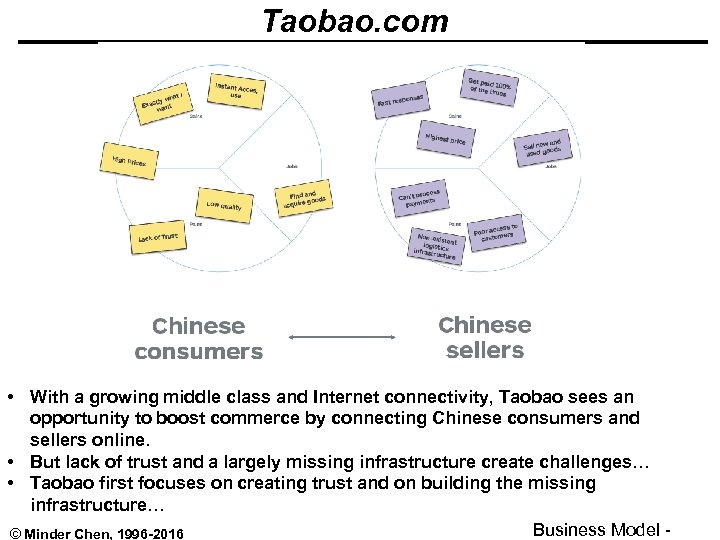
Taobao. com • With a growing middle class and Internet connectivity, Taobao sees an opportunity to boost commerce by connecting Chinese consumers and sellers online. • But lack of trust and a largely missing infrastructure create challenges… • Taobao first focuses on creating trust and on building the missing infrastructure… Business Model - © Minder Chen, 1996 -2016
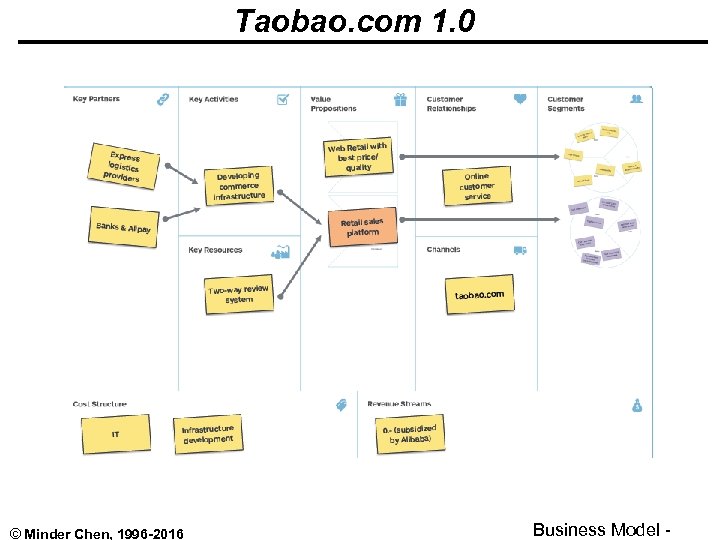
Taobao. com 1. 0 © Minder Chen, 1996 -2016 Business Model -
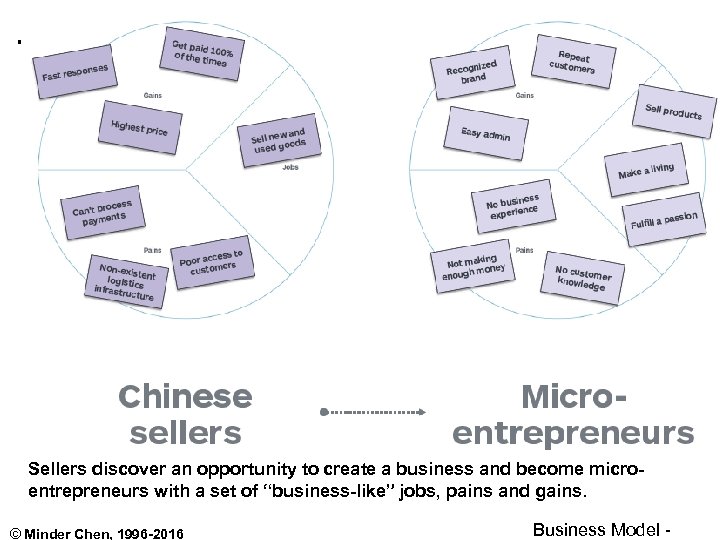
Sellers discover an opportunity to create a business and become microentrepreneurs with a set of “business-like” jobs, pains and gains. © Minder Chen, 1996 -2016 Business Model -
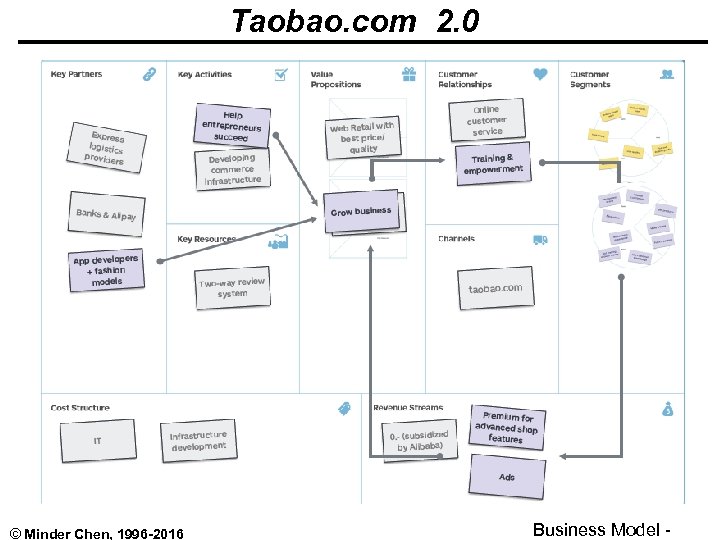
Taobao. com 2. 0 © Minder Chen, 1996 -2016 Business Model -
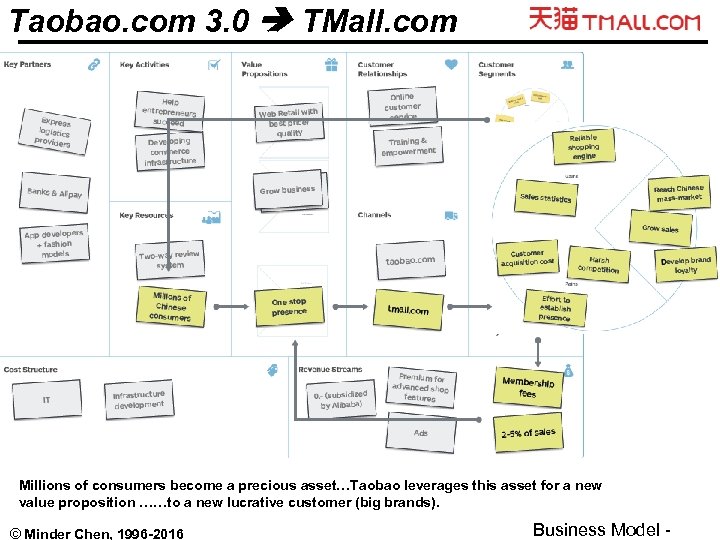
Taobao. com 3. 0 TMall. com Millions of consumers become a precious asset…Taobao leverages this asset for a new value proposition ……to a new lucrative customer (big brands). © Minder Chen, 1996 -2016 Business Model -
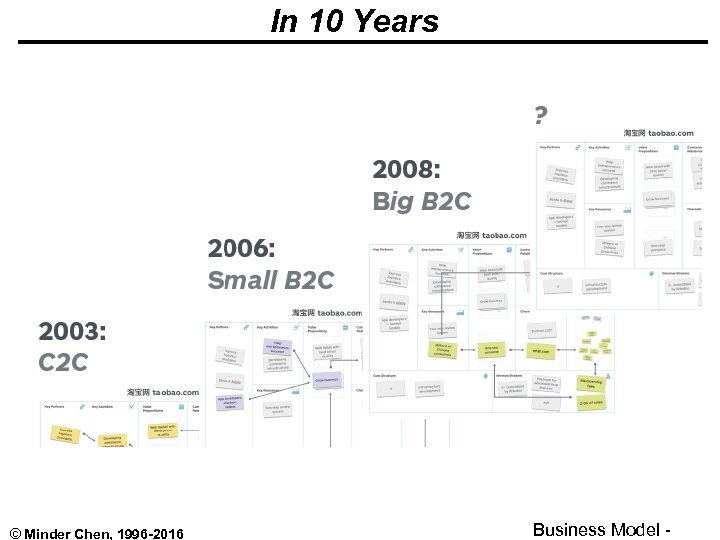
In 10 Years © Minder Chen, 1996 -2016 Business Model -
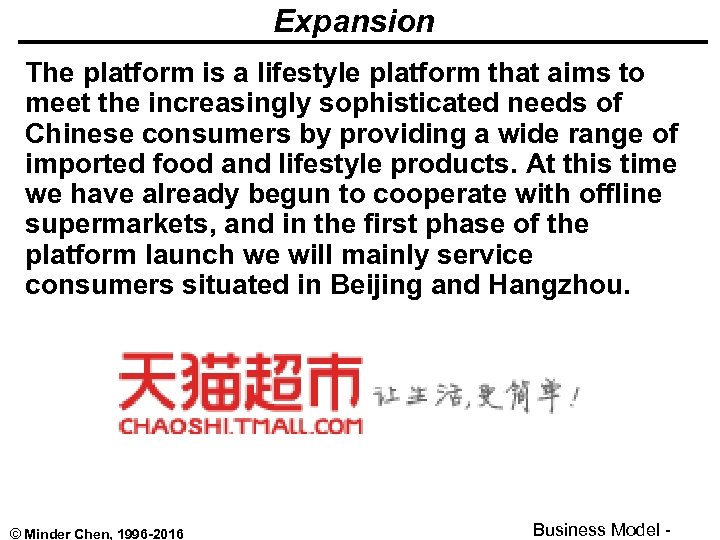
Expansion The platform is a lifestyle platform that aims to meet the increasingly sophisticated needs of Chinese consumers by providing a wide range of imported food and lifestyle products. At this time we have already begun to cooperate with offline supermarkets, and in the first phase of the platform launch we will mainly service consumers situated in Beijing and Hangzhou. © Minder Chen, 1996 -2016 Business Model -
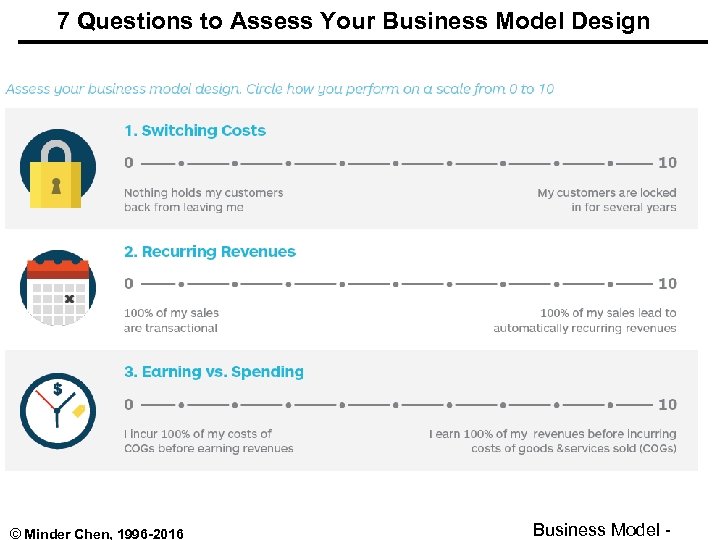
7 Questions to Assess Your Business Model Design © Minder Chen, 1996 -2016 Business Model -
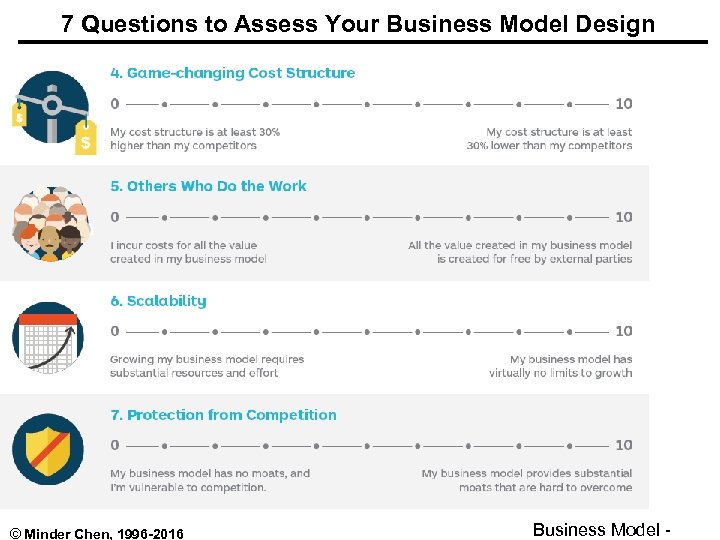
7 Questions to Assess Your Business Model Design © Minder Chen, 1996 -2016 Business Model -
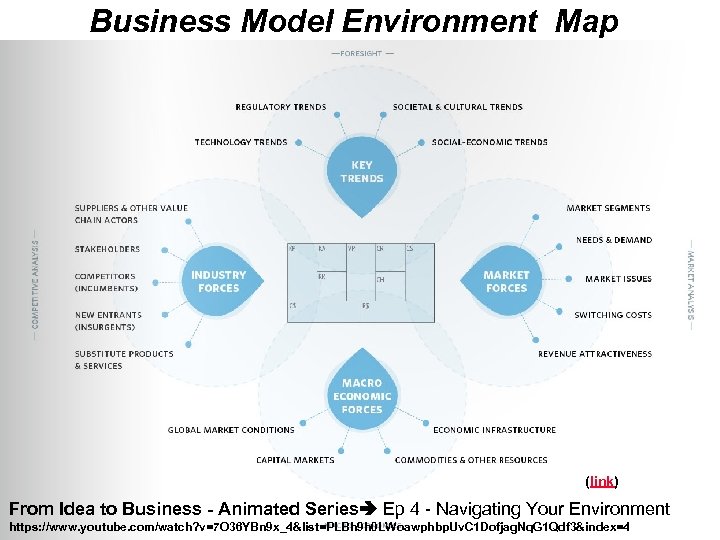
Business Model Environment Map (link) From Idea to Business - Animated Series Ep 4 - Navigating Your Environment https: //www. youtube. com/watch? v=7 O 36 YBn 9 x_4&list=PLBh 9 h 0 LWoawphbp. Uv. C 1 Dofjag. Nq. G 1 Qdf 3&index=4 Business Model - © Minder Chen, 1996 -2016
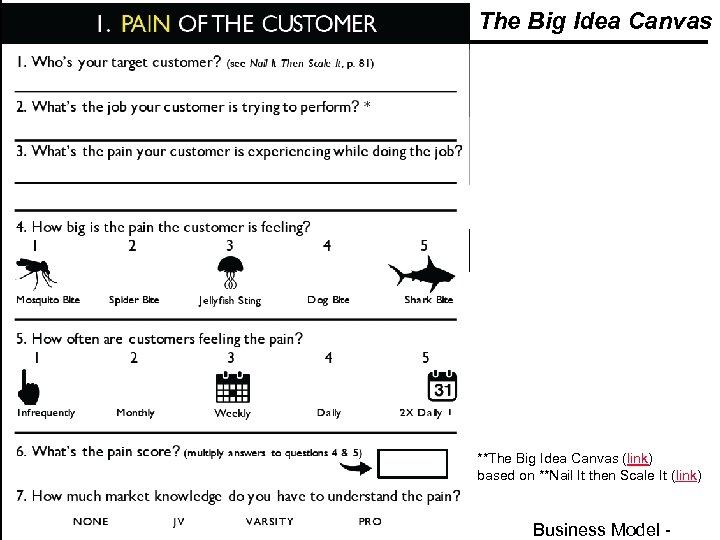
The Big Idea Canvas **The Big Idea Canvas (link) based on **Nail It then Scale It (link) © Minder Chen, 1996 -2016 Business Model -
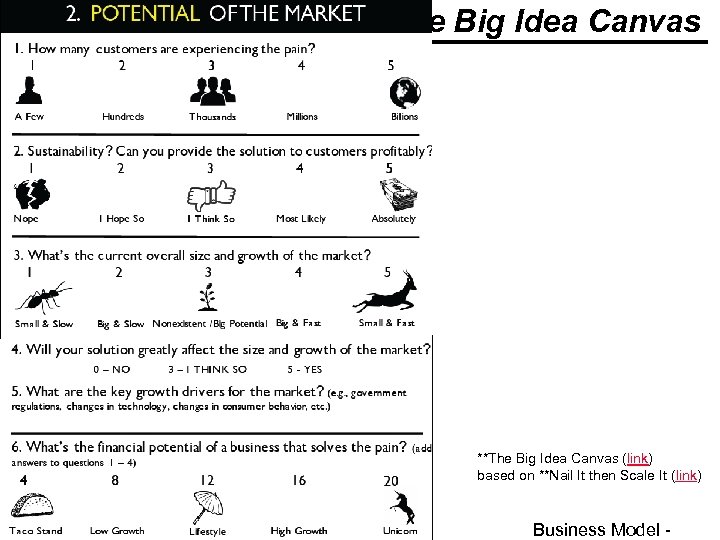
The Big Idea Canvas **The Big Idea Canvas (link) based on **Nail It then Scale It (link) © Minder Chen, 1996 -2016 Business Model -
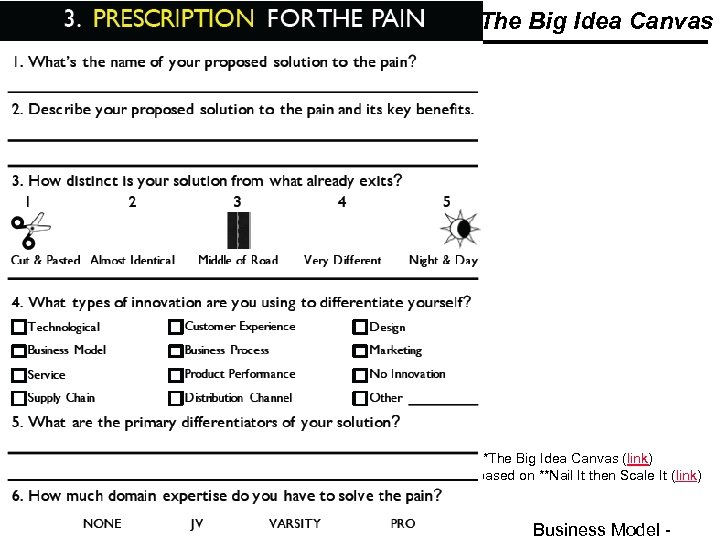
The Big Idea Canvas **The Big Idea Canvas (link) based on **Nail It then Scale It (link) © Minder Chen, 1996 -2016 Business Model -
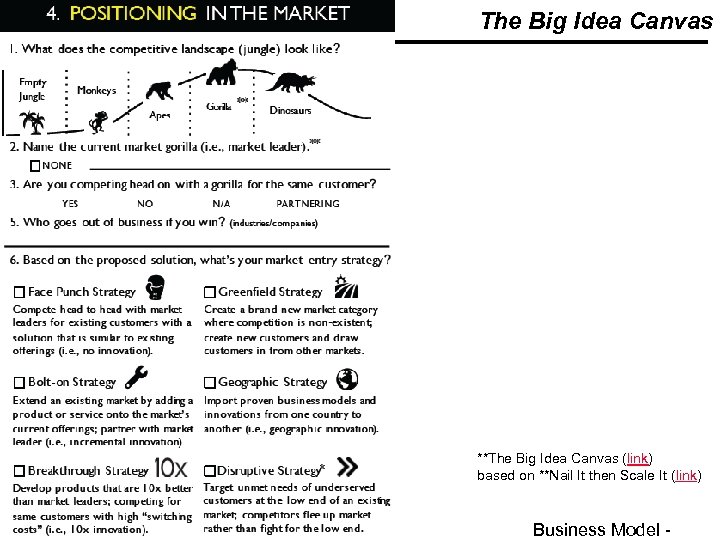
The Big Idea Canvas **The Big Idea Canvas (link) based on **Nail It then Scale It (link) © Minder Chen, 1996 -2016 Business Model -
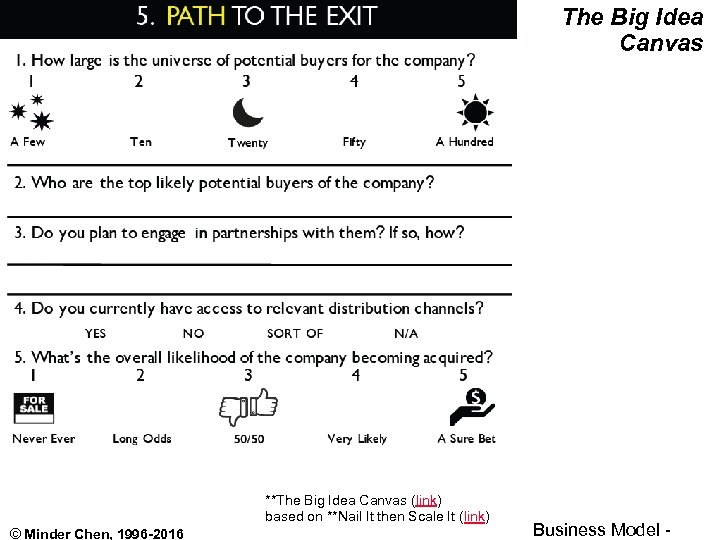
The Big Idea Canvas **The Big Idea Canvas (link) based on **Nail It then Scale It (link) © Minder Chen, 1996 -2016 Business Model -
Backup Slides © Minder Chen, 1996 -2016 Business Model -
商業模式九宮格 關鍵夥伴 關鍵活動 KP: Key Partners 價值主張 KA: Key VP: Value Activities Proposition -行銷 產品和服務 -活動外包商 -研發 -產品供應商 -製造/服務作業 -功能性(Functional) -社交性(Social) -資源供應商 關鍵資源 -情緒性(Emotional) KR: Key Resources -人才 -技術 -創新文化 成本 C$: Costs Structures -新顧客獲取成本 -技術/產品取、開發成本 顧客關係 CR: Customer Relationships -招來新顧客 -留住老顧客 -增漲顧客購買 顧客群 CS: Customer Segments -待完成的 作 -顧客旅程圖 -人物誌Persona -痛點/快樂 行銷通路 CH: Channels -潛在需求 -消費者/企業 -實體通路 -巿場大小 -虛擬通路 -由虛至實O 2 O TAM/SAM/TM 盈收 R$: Revenue Streams -盈收模式 - 毛利率 -註冊人數 -口碑WOM -訂價策略/Freemium -活躍的使用者人數 -顧客終生價值(CLTV) -同期 留失/保留率 http: //www. taiwan-innovation. org. tw/manage/admin/tiny_upload/BMI_1. pdf http: //www. wizxpand. com/what-is-persona/ Business Model - © Minder Chen, 1996 -2016
Rent the Runway Case Study Rent the Runway 的不同做法是深刻觀察到現代女性時尚 的需求及困擾,加上分享經濟 (Shared Economy)已被廣受 歡迎,才發展為成功的創新公司。創辦人在創業過中以一 系列的實際試驗來驗証企業模式中的「假設」,以行動代替 企業計劃書的撰寫。因觀而得創業之靈感,由試而悟商道 之途,為觀卦及精實創業的最佳實例 ! • Rent the Runway (*case *link - read the case and introduction chapter; website; about; Aanalytics; press coverage) • *Rent the Runway: An inside look at the tech startup's success https: //www. youtube. com/watch? v=cyvfsi 3 MX-M • *** The Business of Rentable Fashion https: //www. youtube. com/watch? v=8 ZLYWDx. Dv. QI • ***The Supply & Demand of Rent the Runway https: //www. youtube. com/watch? v=JYFWp. Jvq 6 DU (about testing business ideas) • ***Working with Venture Capitalists as a Fashion Company https: //www. youtube. com/watch? v=Al. L 32 GUOqm. I © Minder Chen, 1996 -2016 Business Model -
Associative Thinking: Connecting the Dots Rent The Runway Net. Flix of High Fashion © Minder Chen, 1996 -2016 Business Model -
Скачать презентацию Business Models Generation Business Model Canvas Minder Chen
1acda98a5d70c57c34dcf184eac86d6f.ppt