 Скачать презентацию Business Mathematics www uni-corvinus hu u 2 w 6
59caaa77ca3d977147818ad0d657ffdc.ppt
- Количество слайдов: 40



Business Mathematics www. uni-corvinus. hu/~u 2 w 6 ol Rétallér Orsi
Graphical solution
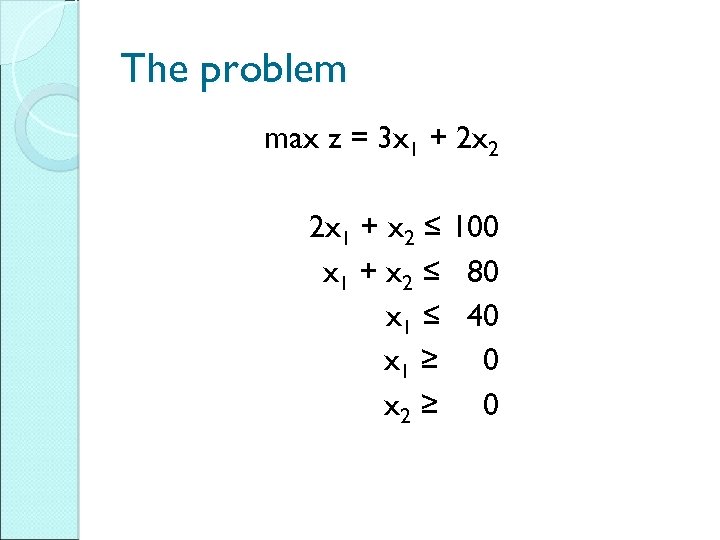
The problem max z = 3 x 1 + 2 x 2 2 x 1 + x 2 ≤ 100 x 1 + x 2 ≤ 80 x 1 ≤ 40 x 1 ≥ 0 x 2 ≥ 0
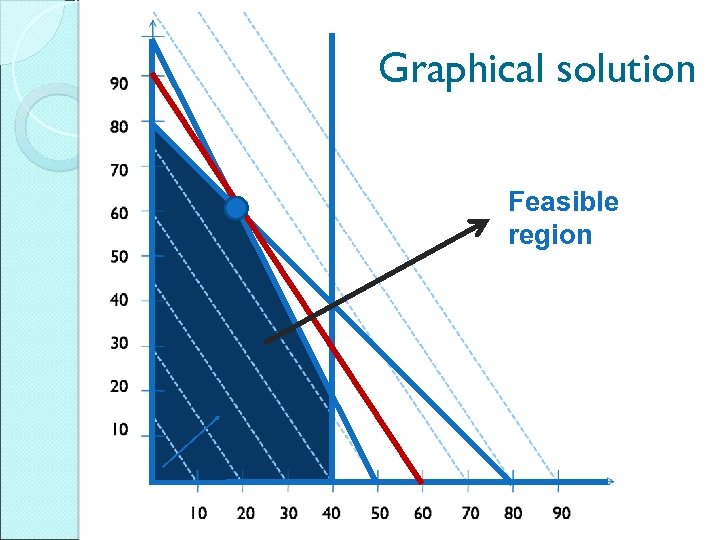
Graphical solution Feasible region
Is there always one solution?
Possible LP solutions One optimum Alternative optimums (Infinite solutions) Infeasibility Unboundedness
Possible LP solutions One optimum Alternative optimums (Infinite solutions) Infeasibility Unboundedness
Possible LP solutions One optimum Alternative optimums (Infinite solutions) Infeasibility Unboundedness
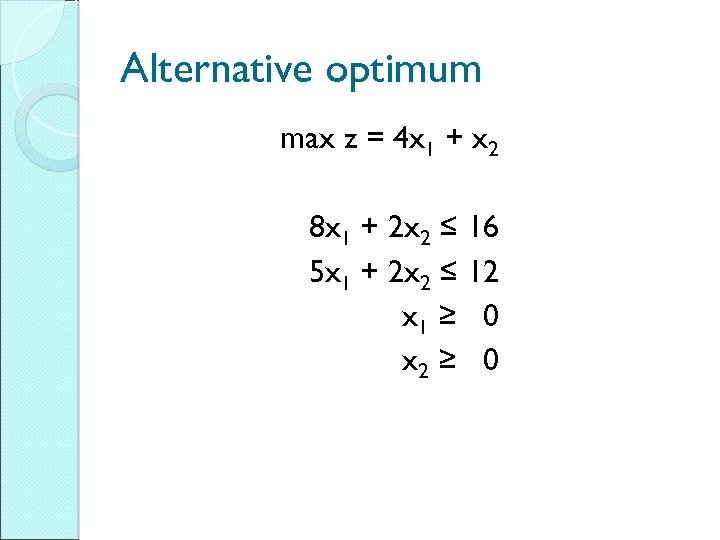
Alternative optimum max z = 4 x 1 + x 2 8 x 1 + 2 x 2 ≤ 16 5 x 1 + 2 x 2 ≤ 12 x 1 ≥ 0 x 2 ≥ 0
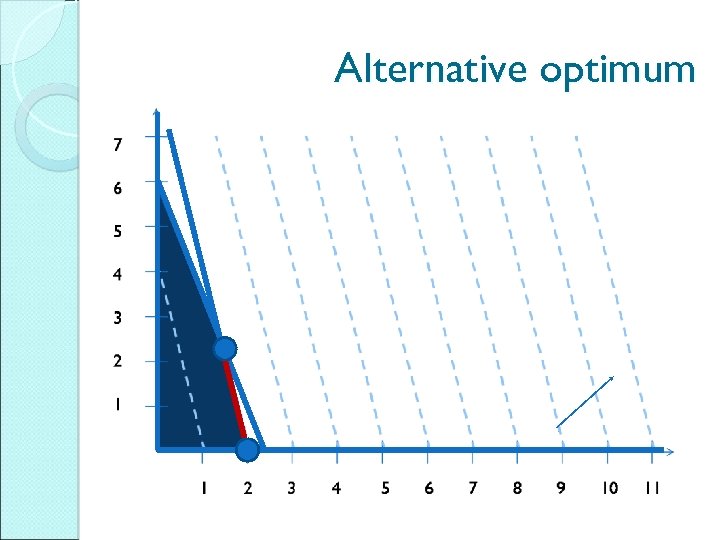
Alternative optimum
Possible LP solutions One optimum Alternative optimums (Infinite solutions) Infeasibility Unboundedness
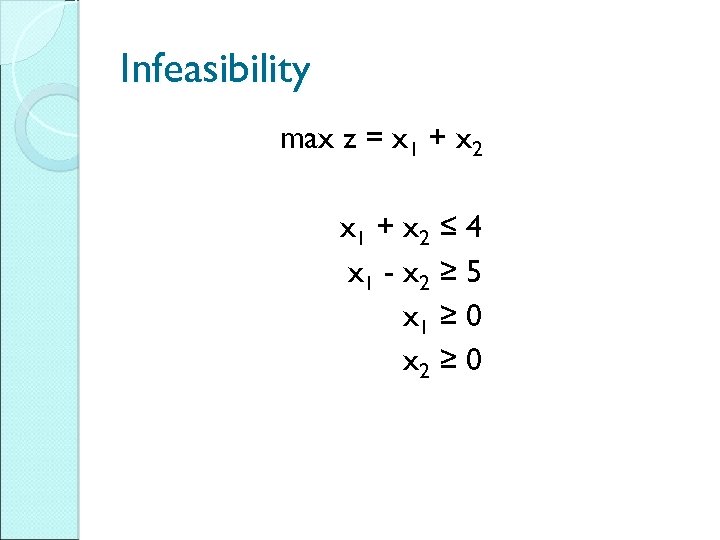
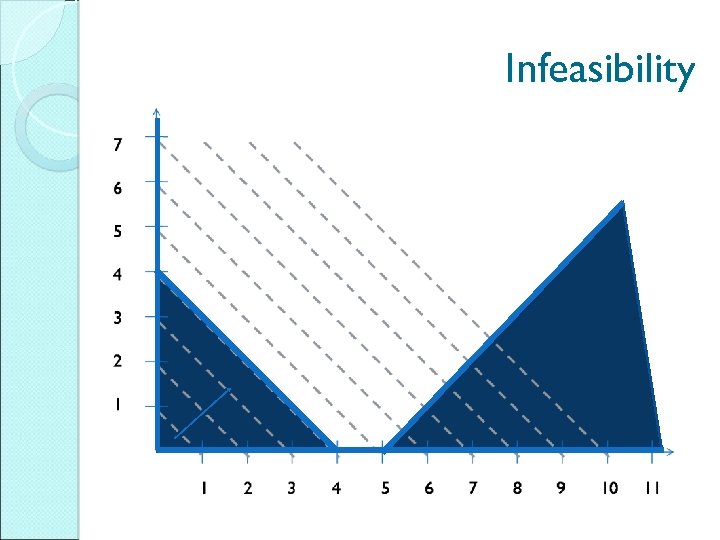
Infeasibility max z = x 1 + x 2 ≤ 4 x 1 - x 2 ≥ 5 x 1 ≥ 0 x 2 ≥ 0
Infeasibility
Possible LP solutions One optimum Alternative optimums (Infinite solutions) Infeasibility Unboundedness
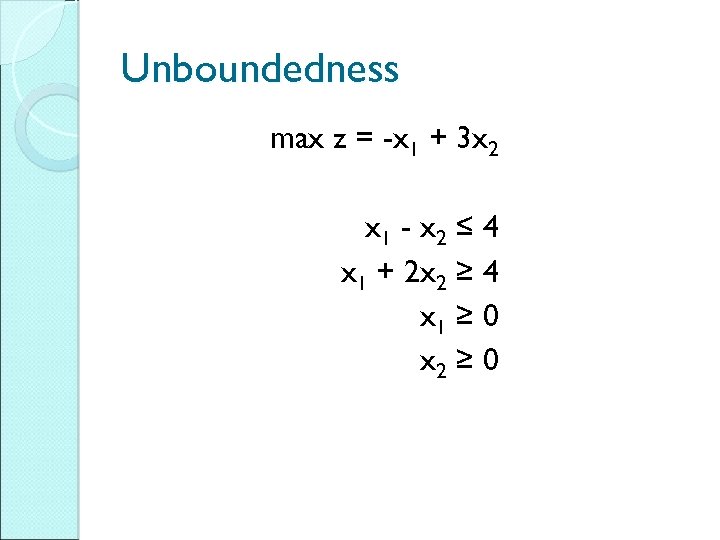
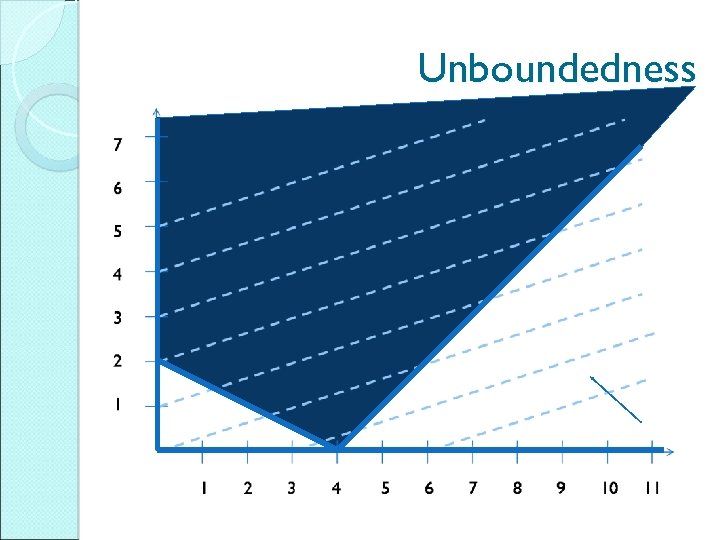
Unboundedness max z = -x 1 + 3 x 2 x 1 - x 2 ≤ 4 x 1 + 2 x 2 ≥ 4 x 1 ≥ 0 x 2 ≥ 0
Unboundedness
Sensitivity analysis
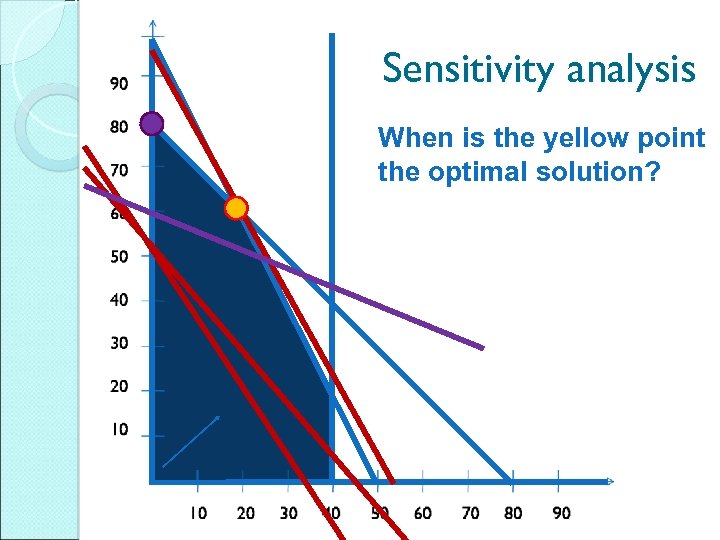
Sensitivity analysis When is the yellow point the optimal solution?
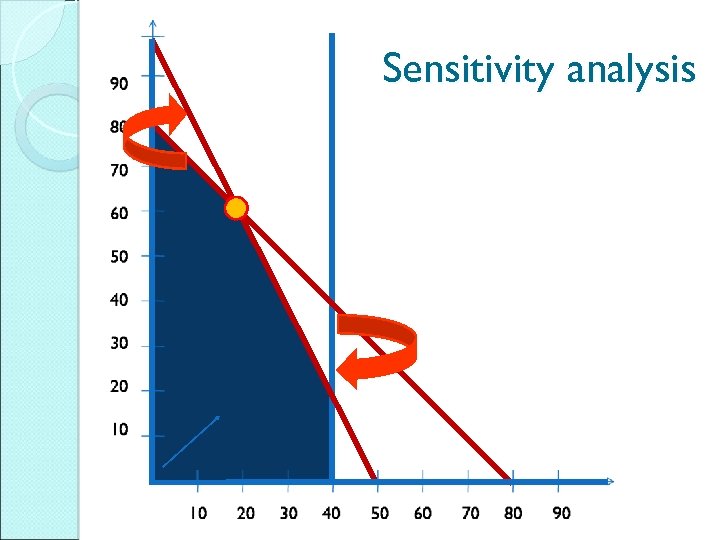
Sensitivity analysis
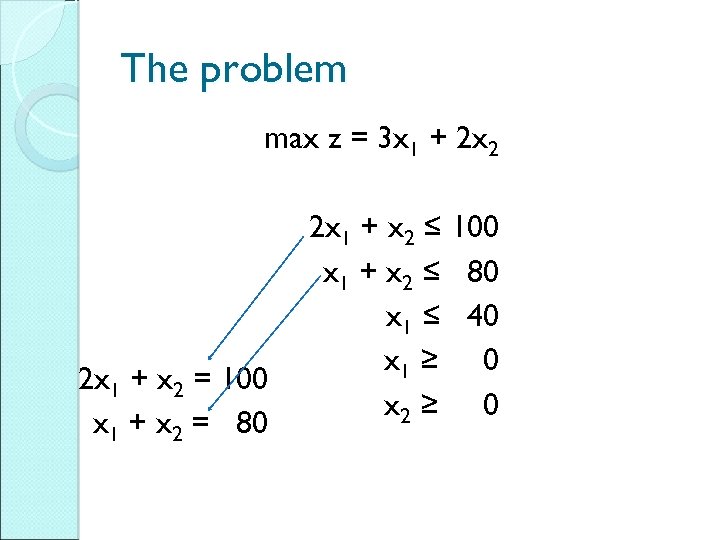
The problem max z = 3 x 1 + 2 x 2 2 x 1 + x 2 = 100 x 1 + x 2 = 80 2 x 1 + x 2 ≤ 100 x 1 + x 2 ≤ 80 x 1 ≤ 40 x 1 ≥ 0 x 2 ≥ 0
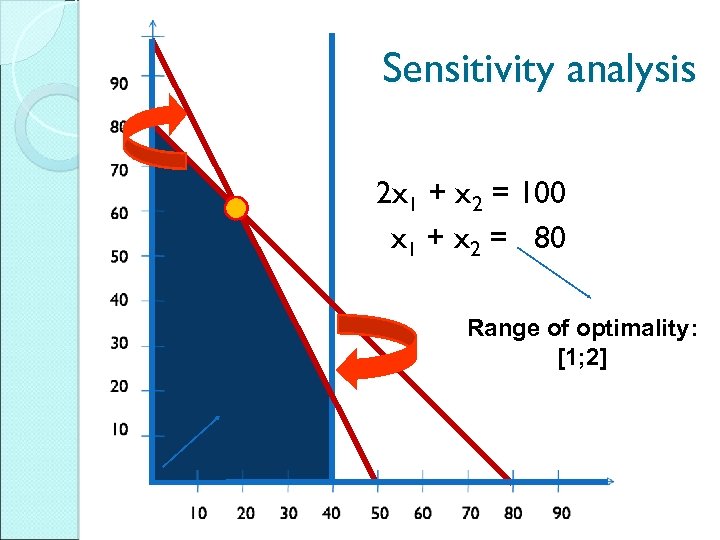
Sensitivity analysis 2 x 1 + x 2 = 100 x 1 + x 2 = 80 Range of optimality: [1; 2]
Duality theorem
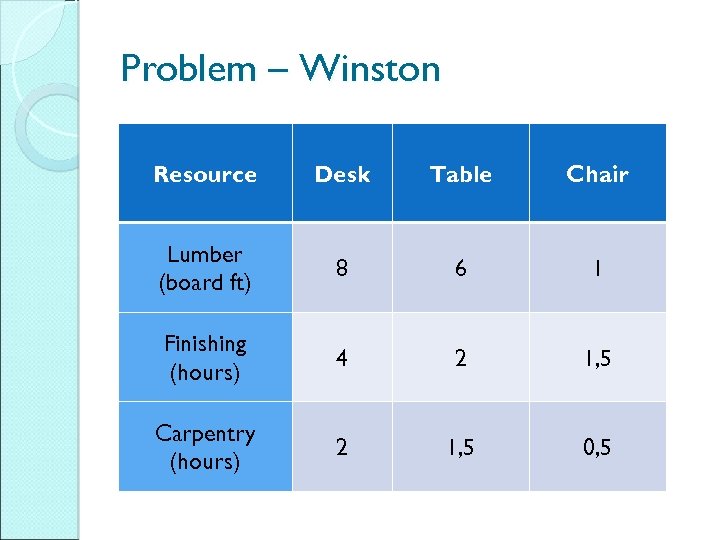
Problem – Winston The Dakota Furniture Company manufactures desks, tables, and chairs. The manufacture of each type of furniture requires lumber and two types of skilled labor: finishing and carpentry. The amount of each resource needed to make each type of furniture is given in the following table.
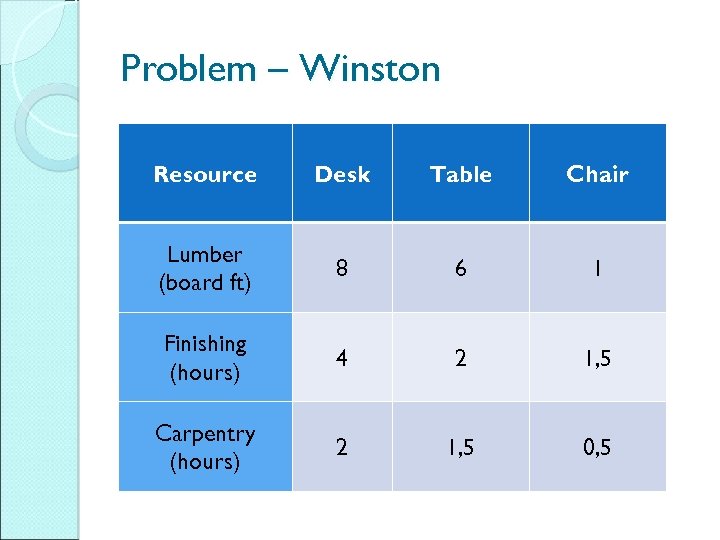
Problem – Winston Resource Desk Table Chair Lumber (board ft) 8 6 1 Finishing (hours) 4 2 1, 5 Carpentry (hours) 2 1, 5 0, 5
Problem – Winston At present, 48 board feet of lumber, 20 finishing hours, and 8 carpentry hours are available. A desk sells for $60, a table for $30, and a chair for $20. Since the available resources have already been purchased, Dakota wants to maximize total revenue.
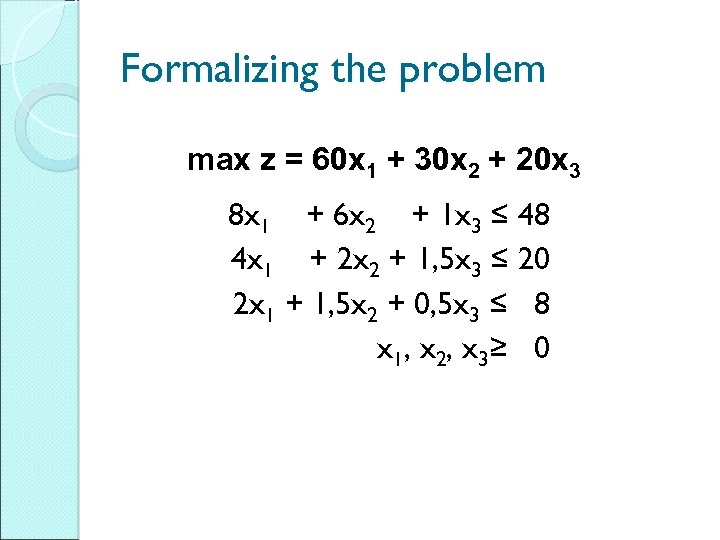
Formalizing the problem max z = 60 x 1 + 30 x 2 + 20 x 3 8 x 1 + 6 x 2 + 1 x 3 ≤ 48 4 x 1 + 2 x 2 + 1, 5 x 3 ≤ 20 2 x 1 + 1, 5 x 2 + 0, 5 x 3 ≤ 8 x 1, x 2, x 3≥ 0
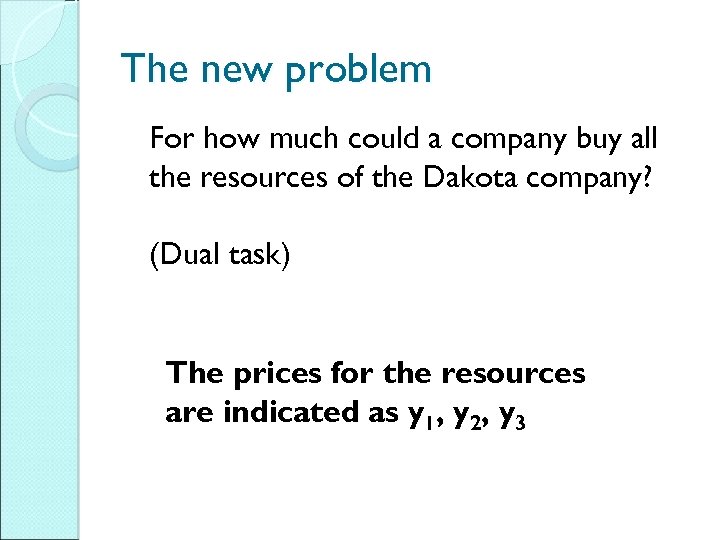
The new problem For how much could a company buy all the resources of the Dakota company? (Dual task) The prices for the resources are indicated as y 1, y 2, y 3
Problem – Winston Resource Desk Table Chair Lumber (board ft) 8 6 1 Finishing (hours) 4 2 1, 5 Carpentry (hours) 2 1, 5 0, 5
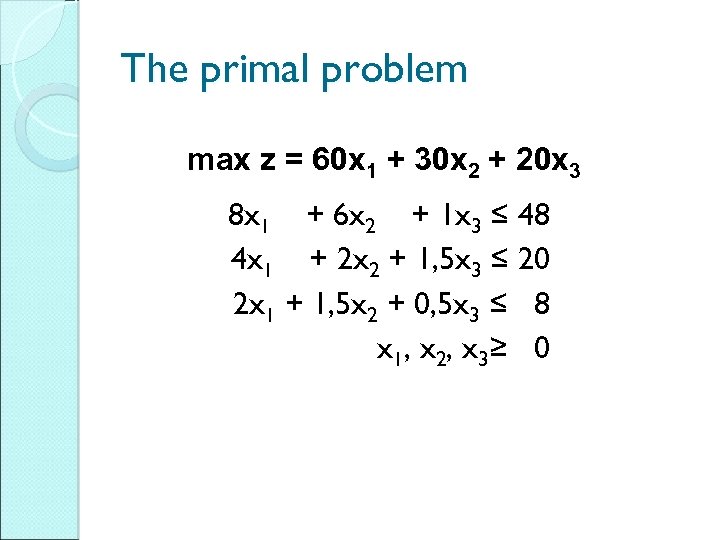
The primal problem max z = 60 x 1 + 30 x 2 + 20 x 3 8 x 1 + 6 x 2 + 1 x 3 ≤ 48 4 x 1 + 2 x 2 + 1, 5 x 3 ≤ 20 2 x 1 + 1, 5 x 2 + 0, 5 x 3 ≤ 8 x 1, x 2, x 3≥ 0
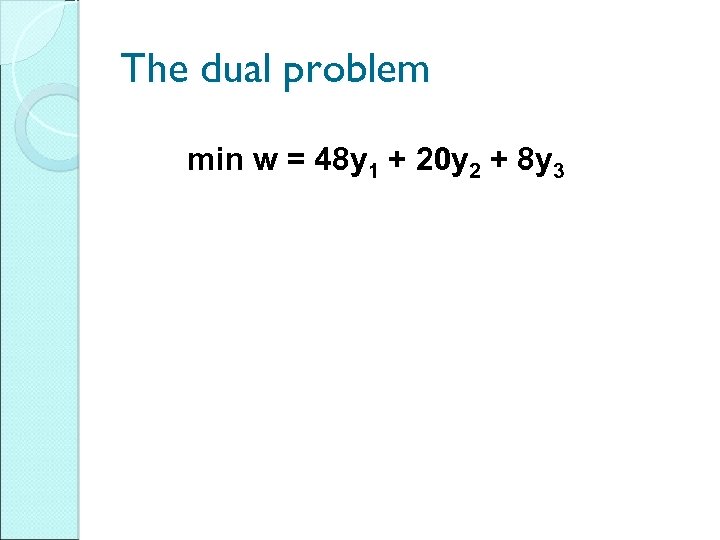
The dual problem min w = 48 y 1 + 20 y 2 + 8 y 3
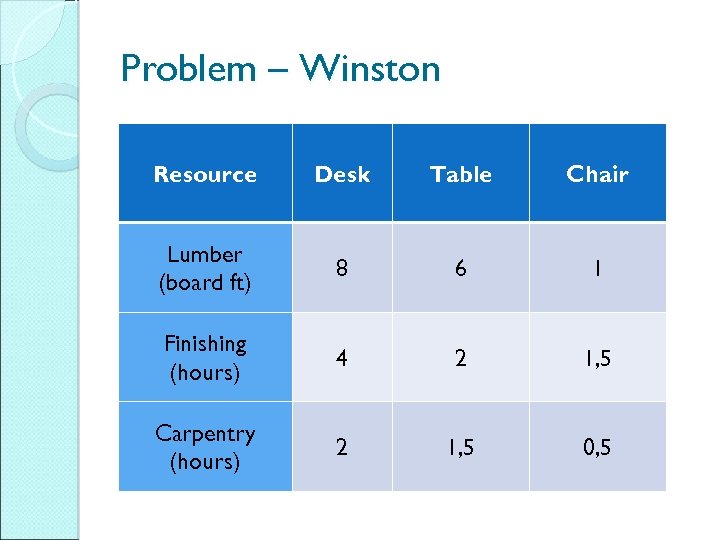
Problem – Winston Resource Desk Table Chair Lumber (board ft) 8 6 1 Finishing (hours) 4 2 1, 5 Carpentry (hours) 2 1, 5 0, 5
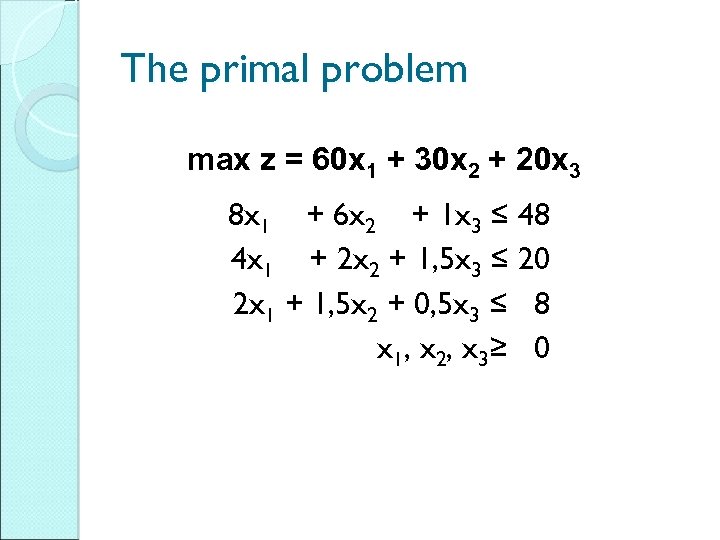
The primal problem max z = 60 x 1 + 30 x 2 + 20 x 3 8 x 1 + 6 x 2 + 1 x 3 ≤ 48 4 x 1 + 2 x 2 + 1, 5 x 3 ≤ 20 2 x 1 + 1, 5 x 2 + 0, 5 x 3 ≤ 8 x 1, x 2, x 3≥ 0
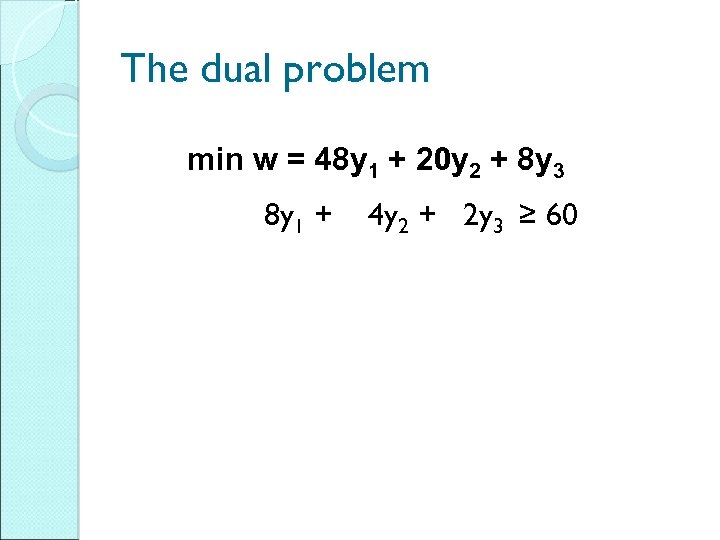
The dual problem min w = 48 y 1 + 20 y 2 + 8 y 3 8 y 1 + 4 y 2 + 2 y 3 ≥ 60
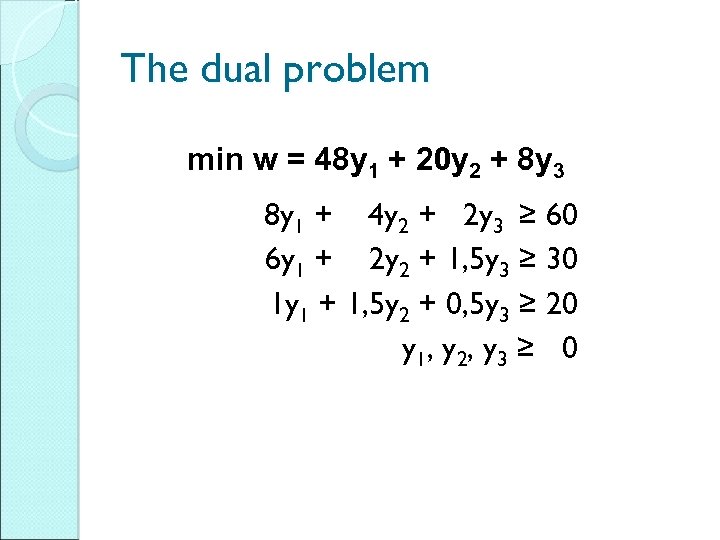
The dual problem min w = 48 y 1 + 20 y 2 + 8 y 3 8 y 1 + 4 y 2 + 2 y 3 ≥ 60 6 y 1 + 2 y 2 + 1, 5 y 3 ≥ 30 1 y 1 + 1, 5 y 2 + 0, 5 y 3 ≥ 20 y 1, y 2, y 3 ≥ 0
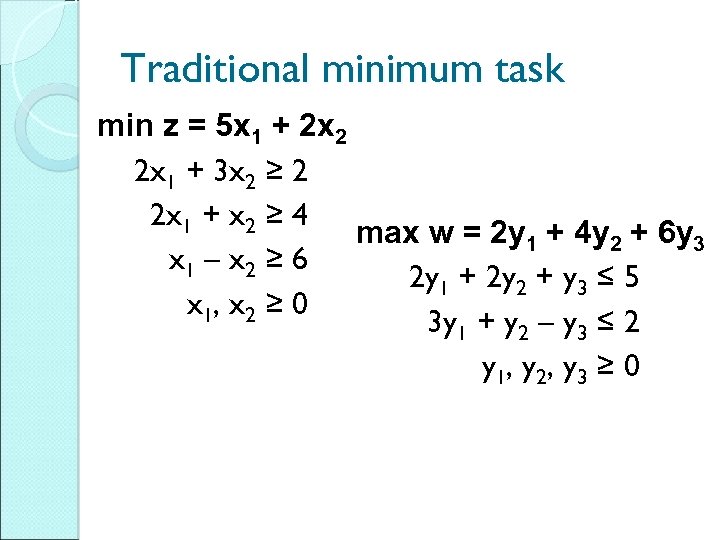
Traditional minimum task min z = 5 x 1 + 2 x 2 2 x 1 + 3 x 2 ≥ 2 2 x 1 + x 2 ≥ 4 max w = 2 y 1 + 4 y 2 + 6 y 3 x 1 – x 2 ≥ 6 2 y 1 + 2 y 2 + y 3 ≤ 5 x 1, x 2 ≥ 0 3 y 1 + y 2 – y 3 ≤ 2 y 1, y 2, y 3 ≥ 0
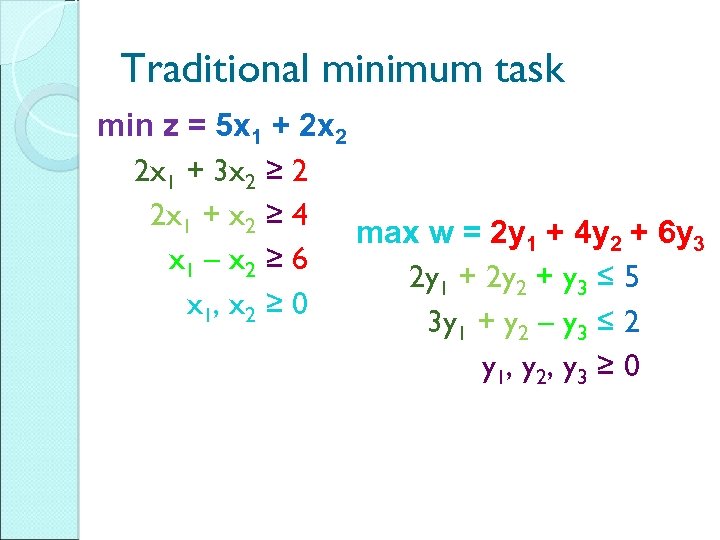
Traditional minimum task min z = 5 x 1 + 2 x 2 2 x 1 + 3 x 2 ≥ 2 2 x 1 + x 2 ≥ 4 max w = 2 y 1 + 4 y 2 + 6 y 3 x 1 – x 2 ≥ 6 2 y 1 + 2 y 2 + y 3 ≤ 5 x 1, x 2 ≥ 0 3 y 1 + y 2 – y 3 ≤ 2 y 1, y 2, y 3 ≥ 0
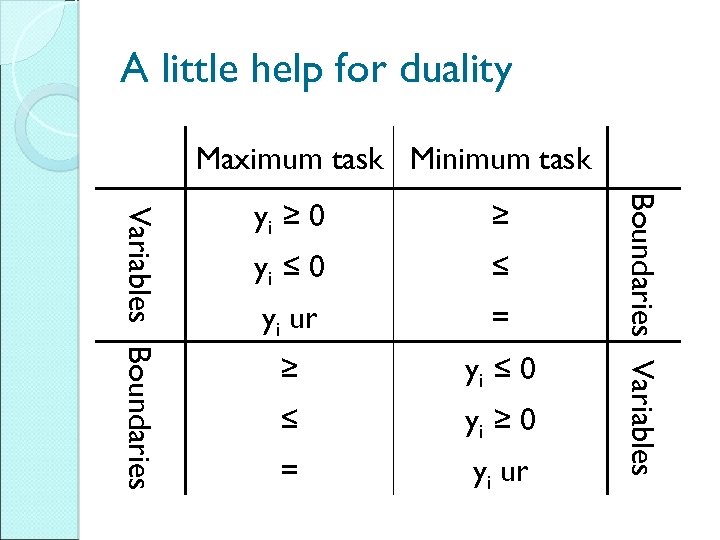
A little help for duality Maximum task Minimum task ≥ yi ≤ 0 ≤ yi ur = ≥ yi ≤ 0 ≤ yi ≥ 0 = yi ur Boundaries Variables Boundaries yi ≥ 0
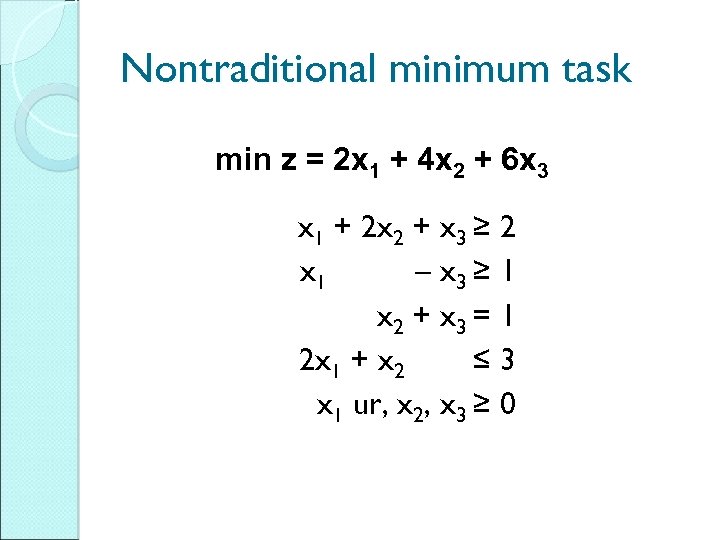
Nontraditional minimum task min z = 2 x 1 + 4 x 2 + 6 x 3 x 1 + 2 x 2 + x 3 ≥ 2 x 1 – x 3 ≥ 1 x 2 + x 3 = 1 2 x 1 + x 2 ≤ 3 x 1 ur, x 2, x 3 ≥ 0
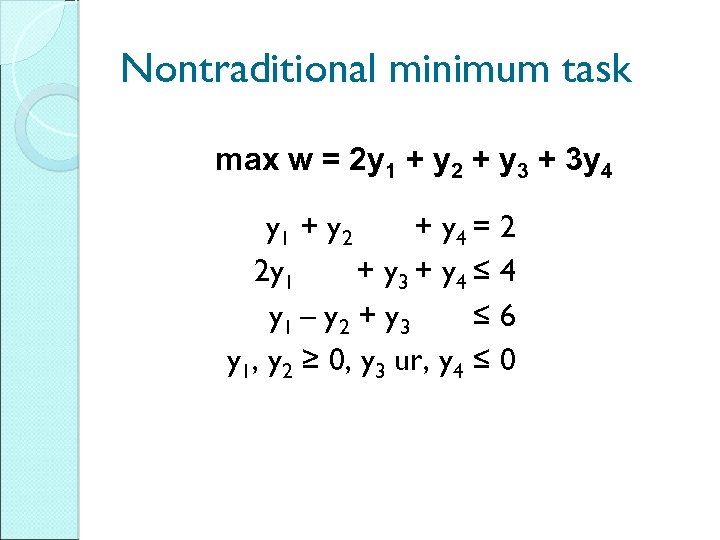
Nontraditional minimum task max w = 2 y 1 + y 2 + y 3 + 3 y 4 y 1 + y 2 + y 4 = 2 2 y 1 + y 3 + y 4 ≤ 4 y 1 – y 2 + y 3 ≤ 6 y 1, y 2 ≥ 0, y 3 ur, y 4 ≤ 0

Thank you for your attention!
Скачать презентацию Business Mathematics www uni-corvinus hu u 2 w 6
59caaa77ca3d977147818ad0d657ffdc.ppt