 Скачать презентацию Business Marketing Channels of Distribution Business Marketing
29891f08305a0f5d083610a0d3cd060e.ppt
- Количество слайдов: 23



Business Marketing Channels of Distribution
Business Marketing Channel Members • Channel members: – A set of independent companies – that form cooperative buyer-seller relationships – involving transactions • (such as raw materials, components, process materials, & finished goods for resale), – all leading to getting a particular product line to the final user.
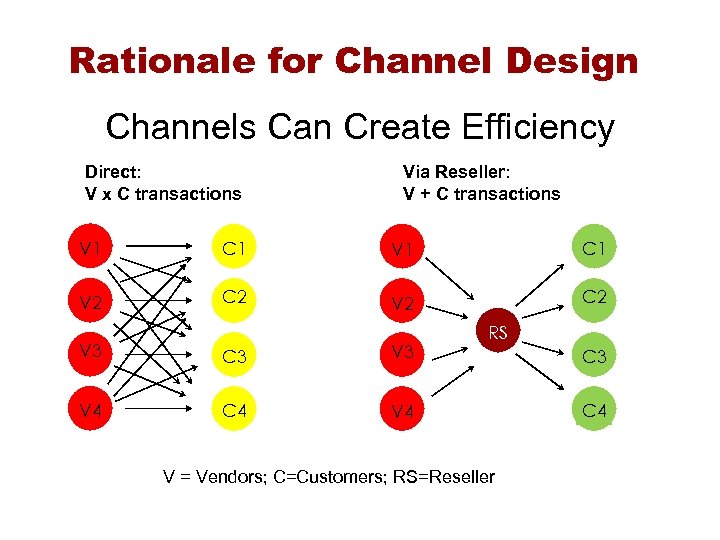
Rationale for Channel Design Channels Can Create Efficiency Direct: V x C transactions Via Reseller: V + C transactions V 1 C 1 V 2 C 2 V 3 C 3 V 4 C 4 RS V 4 V = Vendors; C=Customers; RS=Reseller C 3 C 4
Do Middlemen Cause Increases in Consumer prices? • Yes – If not adding value to product offering • No – If adding value thru creation of utilities • Form • Time • Place • Possession
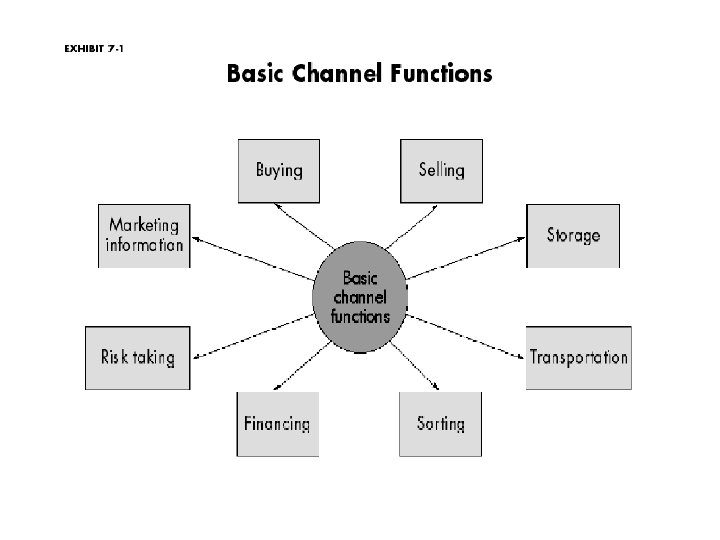
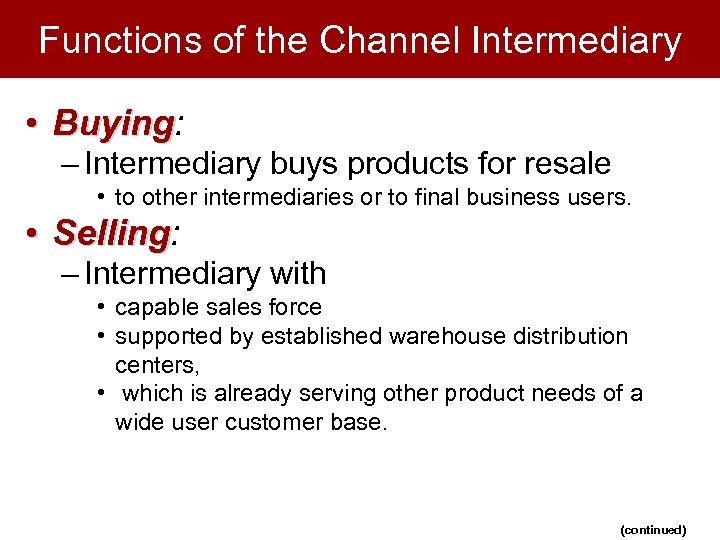
Functions of the Channel Intermediary • Buying: Buying – Intermediary buys products for resale • to other intermediaries or to final business users. • Selling: Selling – Intermediary with • capable sales force • supported by established warehouse distribution centers, • which is already serving other product needs of a wide user customer base. (continued)
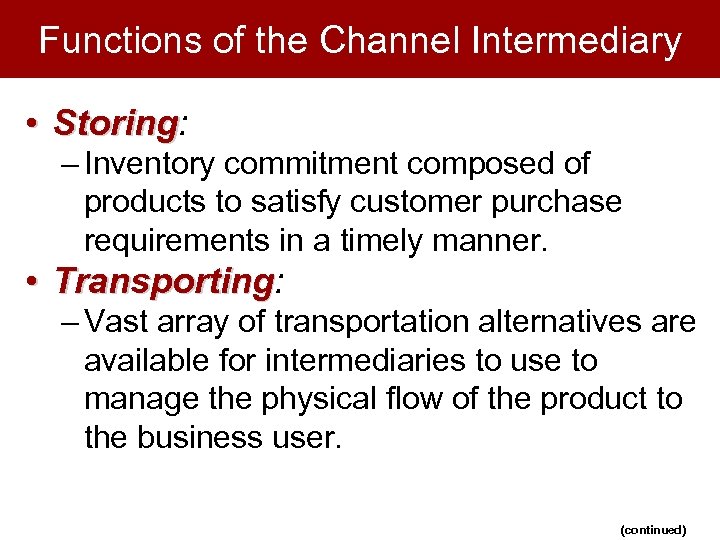
Functions of the Channel Intermediary • Storing: Storing – Inventory commitment composed of products to satisfy customer purchase requirements in a timely manner. • Transporting: Transporting – Vast array of transportation alternatives are available for intermediaries to use to manage the physical flow of the product to the business user. (continued)
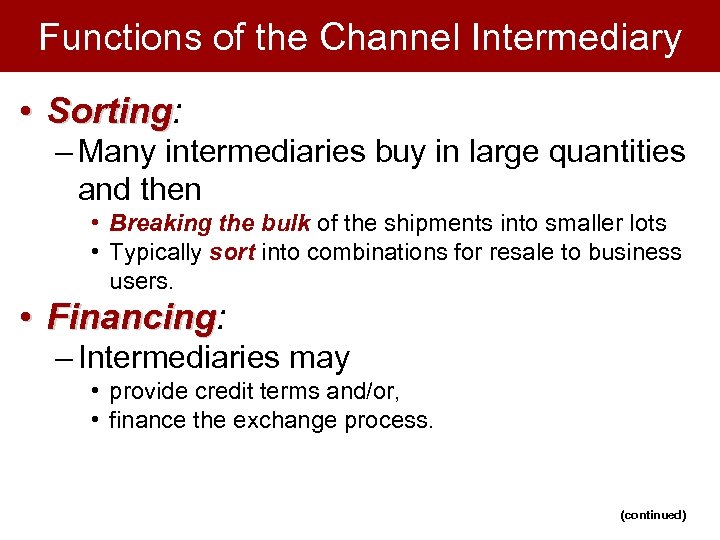
Functions of the Channel Intermediary • Sorting: Sorting – Many intermediaries buy in large quantities and then • Breaking the bulk of the shipments into smaller lots • Typically sort into combinations for resale to business users. • Financing: Financing – Intermediaries may • provide credit terms and/or, • finance the exchange process. (continued)
Functions of the Channel Intermediary • Risk taking: taking – Risk of ownership includes • Obsolescence • Deterioration • Uncollectable customer accounts. • Providing market information: information – Continuous & accurate flow of market information necessary concerning • • final user needs pricing conditions competitive conditions user satisfaction
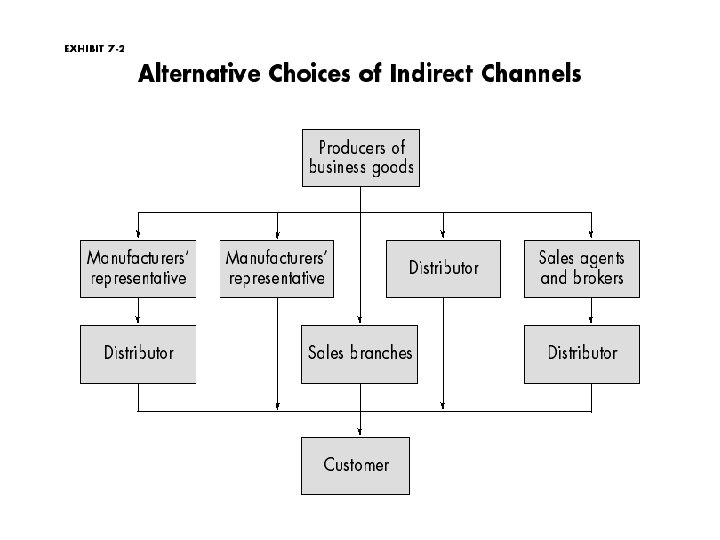
Channel Alternatives Issues 1. Number of levels to be included in the channel. 2. Types of intermediaries to employ. 3. Number of channel intermediaries. 4. Number of channels to employ.
Basic Channel Options • Direct Channel of Distribution – Producer sells directly to the user – Accounts for roughly 70% of all B 2 B transactions • Indirect Channel of Distribution – At least one intermediary (middleman) exists in the channel between the producer and the user
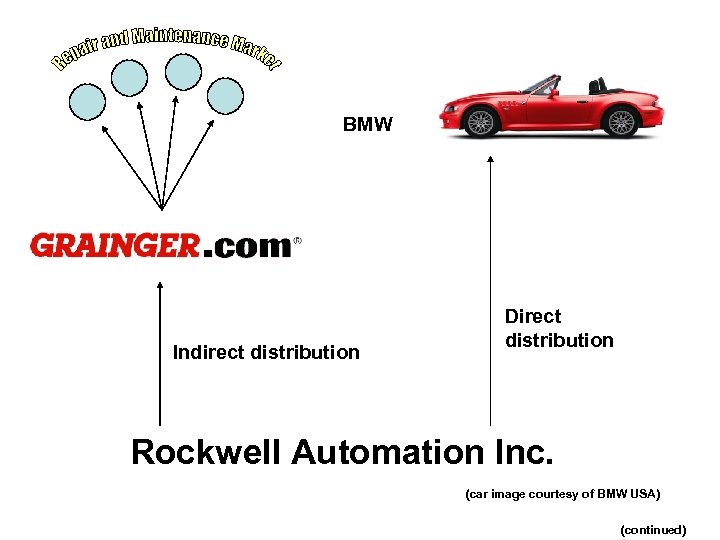
BMW Indirect distribution Direct distribution Rockwell Automation Inc. (car image courtesy of BMW USA) (continued)
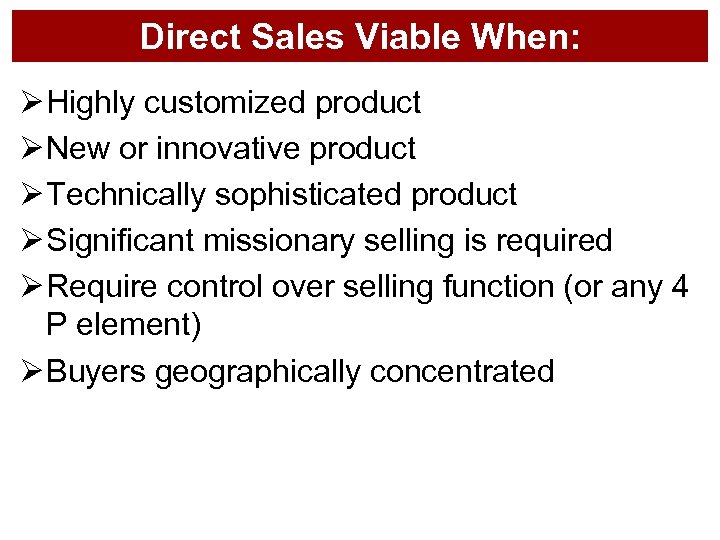
Direct Sales Viable When: Ø Highly customized product Ø New or innovative product Ø Technically sophisticated product Ø Significant missionary selling is required Ø Require control over selling function (or any 4 P element) Ø Buyers geographically concentrated
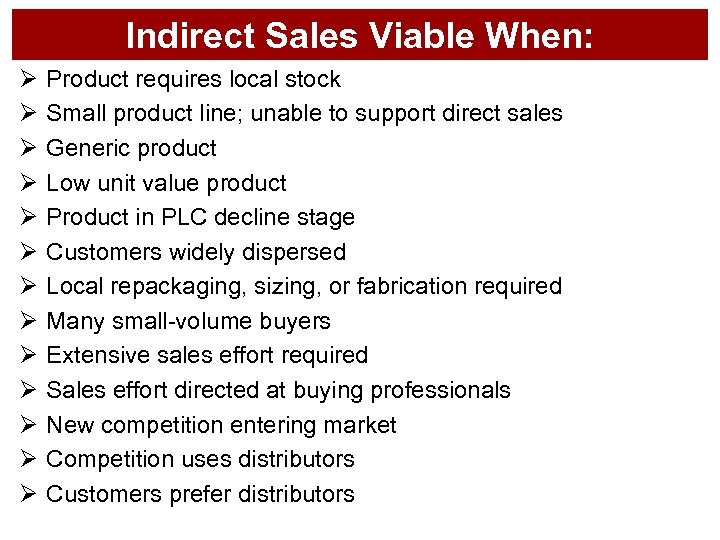
Indirect Sales Viable When: Ø Ø Ø Ø Product requires local stock Small product line; unable to support direct sales Generic product Low unit value product Product in PLC decline stage Customers widely dispersed Local repackaging, sizing, or fabrication required Many small-volume buyers Extensive sales effort required Sales effort directed at buying professionals New competition entering market Competition uses distributors Customers prefer distributors
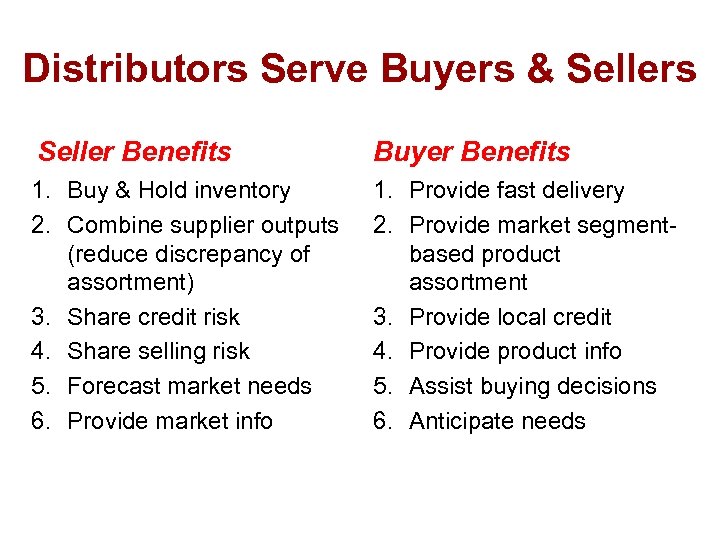
Distributors Serve Buyers & Sellers Seller Benefits Buyer Benefits 1. Buy & Hold inventory 2. Combine supplier outputs (reduce discrepancy of assortment) 3. Share credit risk 4. Share selling risk 5. Forecast market needs 6. Provide market info 1. Provide fast delivery 2. Provide market segmentbased product assortment 3. Provide local credit 4. Provide product info 5. Assist buying decisions 6. Anticipate needs
Distributors • Full-service intermediaries – Take title to the products they sell – Perform full range of marketing functions – Compensated by their profit margins • Classification of Distributors – General-line Distributors • Cater to broad array of industrial needs • Stock extensive variety of products – Specialists • Focus on one line or a few related lines – Combination House • Operates in 2 markets: industrial and consumer
Manufacturers’ Representatives • Do not take title to products • Do not hold inventory of products • Usually limited to defined geographic areas • Typically represent several companies in the same geographic area – Sell noncompeting, but complementary products • Compensated on commission basis
Sales Branches • • Part of manufacturer’s organization Can be on-site or off Typically do not carry inventory Role is to sell organization’s products
Sales Agents & Brokers • • Do not take title to products Do not hold inventory of products Usually no limit on geographic areas May represent several companies in the same geographic area – Sell competing products • Compensated on commission basis
Channel Transaction Facilitators • Do not take title • Do not carry inventory • Services such as – – Storage Transportation Arranging of sales Finance • Include – – Independent Warehouses Carriers Manufacturer’s Representatives Financial Institutions
Channel Conflict • Channel conflict may result when channel members have mutually exclusive values, interests, or goals. – Manufacturers may want control of distribution channels for better execution of their marketing strategies. – Intermediaries may not see the manufacturerdetermined strategies as in their best interest. • The Key to remember: – Channel conflict cannot be fully eliminated – It can be properly managed
Bases of Power in Marketing Channels “Soft” Bases of Power o. Expertise o. Information o. Identification “Hard” Bases of Power o. Reward o. Coercion o. Legitimate
Скачать презентацию Business Marketing Channels of Distribution Business Marketing
29891f08305a0f5d083610a0d3cd060e.ppt