 Скачать презентацию Business Finance Structure of the CSU 101
6ab6f958675c70dd238ca2db4842a531.ppt
- Количество слайдов: 105



Business & Finance Structure of the CSU 101 March 8 -11, 2009 Monterey Justine Heartt and Shawn Bibb
Summary §Funding Sources within the CSU §Revenue Management Program (RMP) Initiative §EO 1000 – Delegation of Fiscal Authority §Chart of Accounts March 2009 CSU 101, Heartt and Bibb 2
March 2009 CSU 101, Heartt and Bibb 3
§ California State University (CSU) receives funding from a number of different sources and all of these funds are the property of the State of California. Consequently, all funds administered by the CSU are covered by state laws, rules and policies. § While they are closely affiliated with the CSU, the Auxiliaries (501. c. 3) are separate, private, nonprofit, corporations organized consistent with the California Education and Corporation Codes, and their funds are not the property of the State of California. March 2009 CSU 101, Heartt and Bibb 4
Funding Sources within the CSU § General Fund/Student Fee Revenue – CSU Operating Fund § Housing Revenue § Parking Permit Revenue § Continuing Education Fee Revenue § Lottery § Campus/University Union § Capital Outlay § Other March 2009 CSU 101, Heartt and Bibb 5
Main Operating Fund § General Fund/Student Fee Revenue – CSU Operating Fund – The primary purpose of the CSU Operating Fund is to record revenues and expenditures for statesupported instruction. § Used to record the CSU’s share of state revenue and student fees. The state revenue portion, which is annually appropriated by the California Legislature to the CSU, is the main source of funds for the University operating budget. A secondary source of funds is student fees such as the CSU State University Fee, Non-Resident Tuition, Application Fee, Health Services fee, and other fees. March 2009 CSU 101, Heartt and Bibb 6
§ Housing – Revenues are generated from license fees paid by dormitory residents and must be used exclusively for the self-supported housing program March 2009 CSU 101, Heartt and Bibb 7
§ Trust Fund - Parking – Parking revenues are generated from the sale of parking permits and fines paid for citations issued. – Parking permit revenue must be used for new parking structures/lots, to maintain parking lots and for parking staff – Citation income may only be used for administration of citations and alternate transportation. March 2009 CSU 101, Heartt and Bibb 8
§ Trust Fund - Continuing Education (CERF) – These sources are generated by student fees for enrollment in Continuing Education courses. – Funds must be used for self-supported instruction in the Continuing Education program. March 2009 CSU 101, Heartt and Bibb 9
§ Lottery Education Fund – The funding source is cash generated from the sale of California State Lottery tickets, a portion of which is allocated to CSU campuses ( note: this model may be changing to being an augmentation to the Operating Fund) March 2009 CSU 101, Heartt and Bibb 10
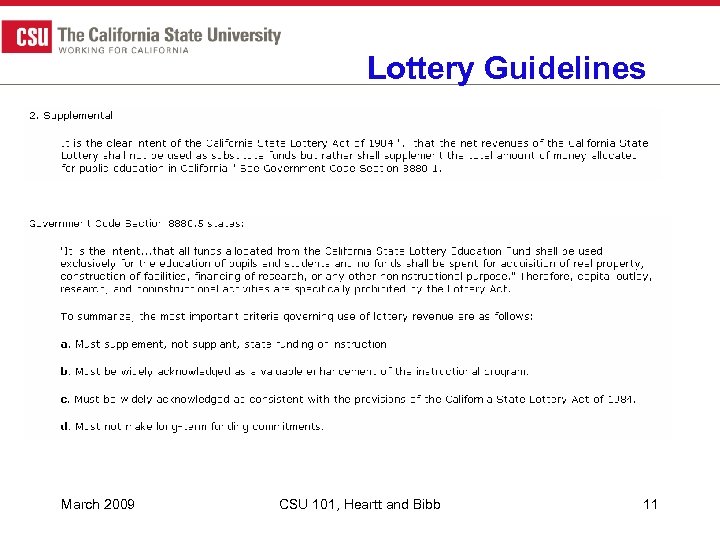
Lottery Guidelines March 2009 CSU 101, Heartt and Bibb 11
§ Campus Union – Revenues are generated from the mandatory Campus/University Union fee paid by students – Exclusively for the self-supported Campus University Union facilities and related programs. March 2009 CSU 101, Heartt and Bibb 12
§ Capital Outlay The two sources of funds for CSU capital outlay programs – state tax revenues appropriated by the state legislature – the proceeds from the sale of bonds. – funding is allocated to the University as either § Minor Capital Outlay (projects of $400, 000 or less) § Major Capital Outlay (projects greater than $400, 000). – The funding must be used for the construction projects specified. March 2009 CSU 101, Heartt and Bibb 13
A little info about the past… § Until very recently, most of the funding sources of the CSU were held on deposit with the state treasurer and accounted for by the State Controller March 2009 CSU 101, Heartt and Bibb 14
A little info about the past… § Cash was deposited daily by most campuses with the state treasurer – Campuses then notified the state controller through a cash remittance advice as to which state fund the cash should be posted § Campuses kept records at the campus level that had to be reconciled to the State Controller by SCO fund March 2009 CSU 101, Heartt and Bibb 15
A little info about the past… § Campuses had little to no cash. – All payments to vendors, employees, etc were made by the state controller via checks drawn on the state treasury. – Campuses had to notify the state controller regarding who was to be paid, how much, what for, etc. – The SCO would then issue the check and notify the campus – Again campus had to post the transaction to the campus ledgers and reconcile to the state March 2009 CSU 101, Heartt and Bibb 16
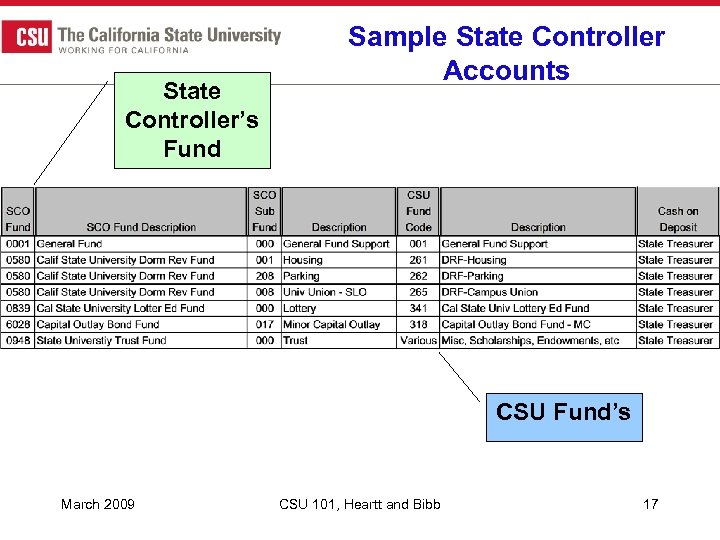
State Controller’s Fund Sample State Controller Accounts CSU Fund’s March 2009 CSU 101, Heartt and Bibb 17
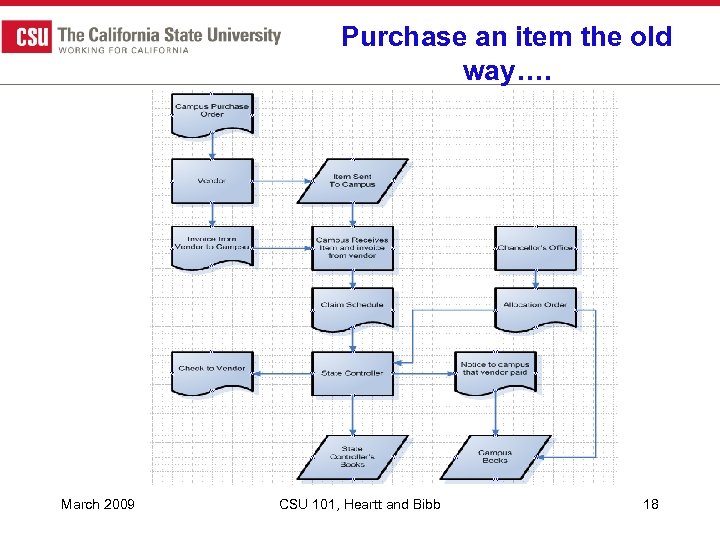
Purchase an item the old way…. March 2009 CSU 101, Heartt and Bibb 18
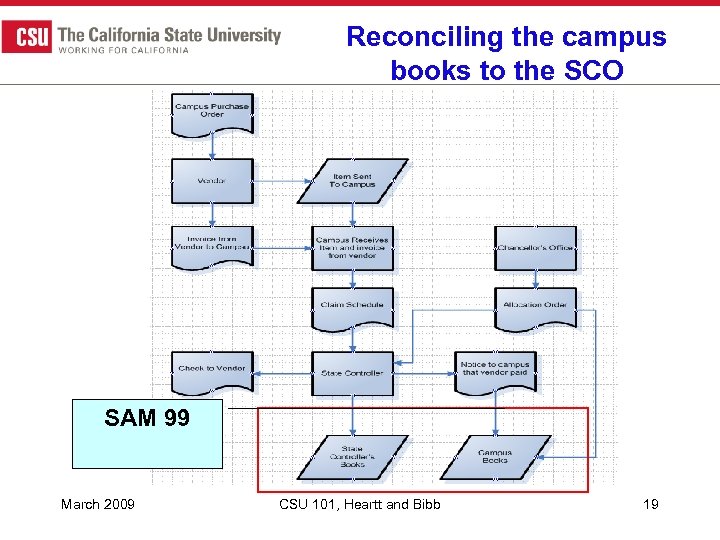
Reconciling the campus books to the SCO SAM 99 March 2009 CSU 101, Heartt and Bibb 19
How we handled Cash § Campuses collect cash – University Cashier § Campus deposit cash in bank account – State Treasury § Campuses notify the state controller via a remittance advice as to which state fund account these funds should be recorded March 2009 CSU 101, Heartt and Bibb 20
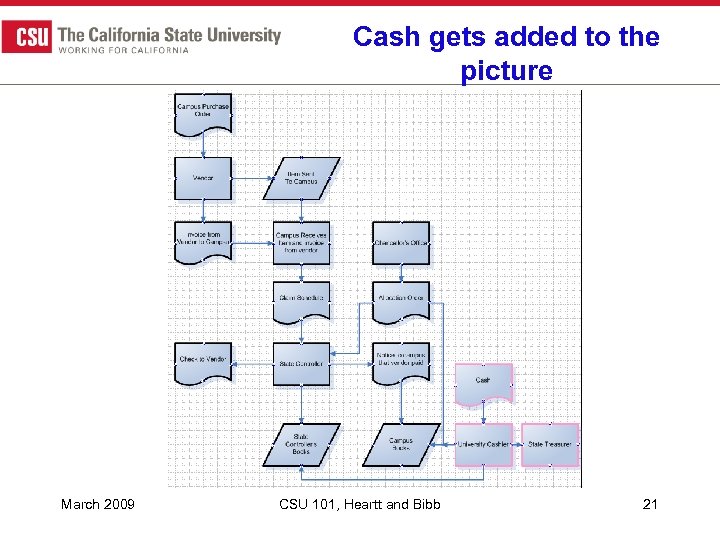
Cash gets added to the picture March 2009 CSU 101, Heartt and Bibb 21
Then Things Started to Change § Funds that no longer had debt had to move the accounting activity from within the DRF Fund to the actual Revenue Fund § Change in legislation allowed certain funds to be deposited within the State University Trust Fund which did not require separate accounting by the state controller § For Example: – Parking could be accounted for in § State Fund DRF-580 (had SRB Debt) § Parking Revenue Fund (Maintained separately by SCO) § State University Trust March 2009 CSU 101, Heartt and Bibb 22
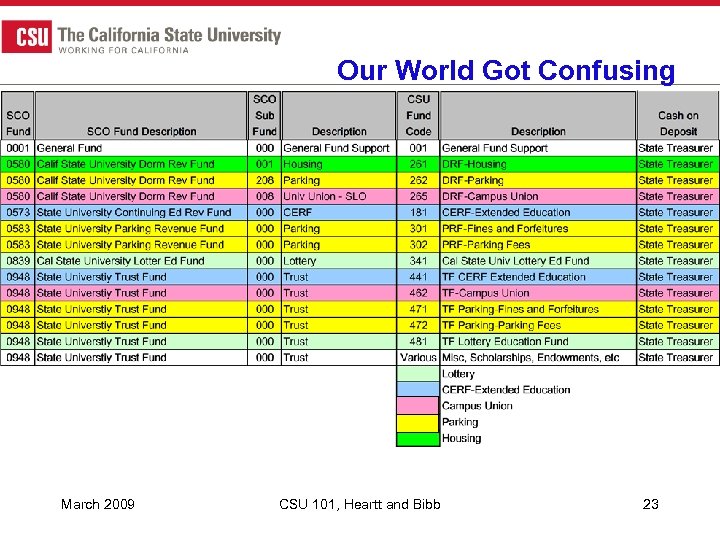
Our World Got Confusing March 2009 CSU 101, Heartt and Bibb 23
And then along came March 2009 CSU 101, Heartt and Bibb 24
What is Revenue Management Program? Legislation § Budget Trailer Bill 1802 – Passed effective July 1, 2006 – Amended Ed Code 89721 – “The Chief Fiscal Officer of each campus of the CSU shall deposit and maintain in local trust accounts…. . “ § (L) Moneys collected as higher education fees and income from students of any campus of the CSU and from other persons pursuant to Section 89700” Allows the CSU to deposit revenue from student fees into the State University Trust Fund March 2009 CSU 101, Heartt and Bibb 25
Possibilities of SB 1802 § Improve Financial Management – Demonstrate to rating agencies that the CSU has control of its finances – deposit and investment of fee revenue § Streamline Financial Reporting – eliminate redundant accounting processes – reduce the workload of the CSU and the State Controllers financial staff § Bring the states treatment of student fee revenue in line with other 4 -yr Universities nationwide March 2009 CSU 101, Heartt and Bibb 26
An Overview of CSU Funding § In general, the CSU has funded the support of instruction from two sources – 70% from state support – 30% from student fee revenue § The state funds $. 70 on the dollar and students fund $. 30 on the dollar – Campuses collected the $. 30 from the students § Campuses remitted the $. 30 to the state § The state then allocated $1. 00 back to the campus to spend § ALL expenditures had to be processed through the State Controller March 2009 CSU 101, Heartt and Bibb 27
Funding Model – Fee Revenue Management Program § The state will continue to fund $. 70 on the dollar = 70% § Campuses will continue to collect $. 30 on the dollar from the students – Campuses will deposit the fees collected from the student in State University Trust fund – Campuses will NOT remit student fees to the state § Campuses will continue to have $1. 00 in funding – $. 70 from the state – $. 30 from the student March 2009 CSU 101, Heartt and Bibb 28
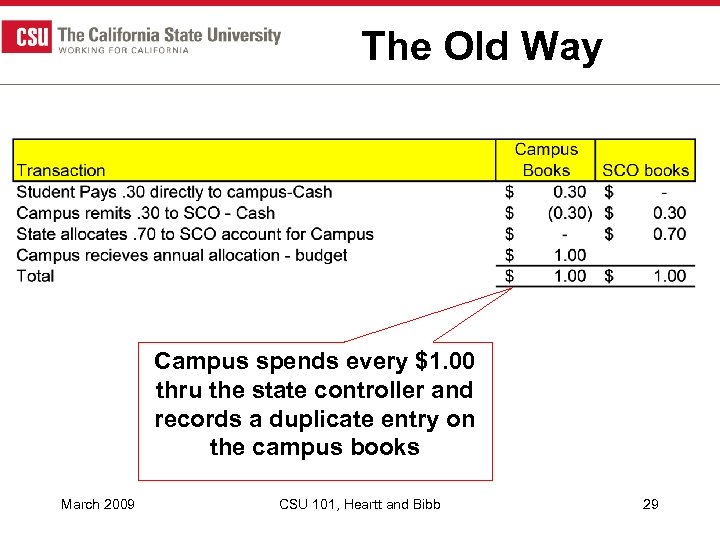
The Old Way Campus spends every $1. 00 thru the state controller and records a duplicate entry on the campus books March 2009 CSU 101, Heartt and Bibb 29
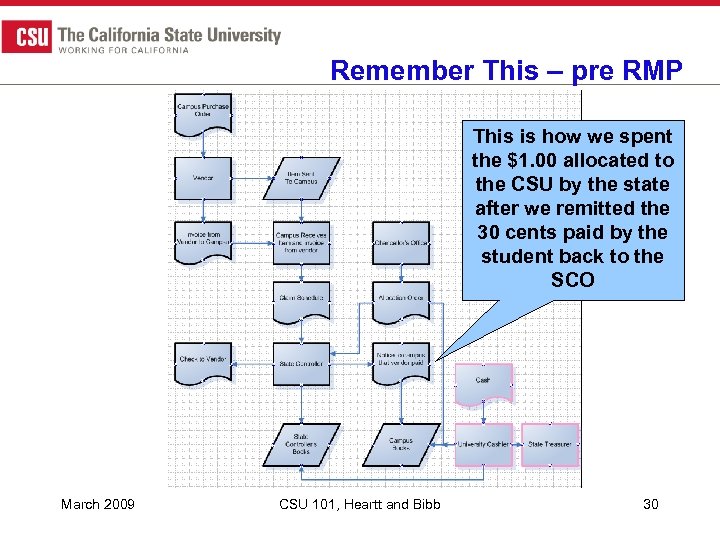
Remember This – pre RMP This is how we spent the $1. 00 allocated to the CSU by the state after we remitted the 30 cents paid by the student back to the SCO March 2009 CSU 101, Heartt and Bibb 30
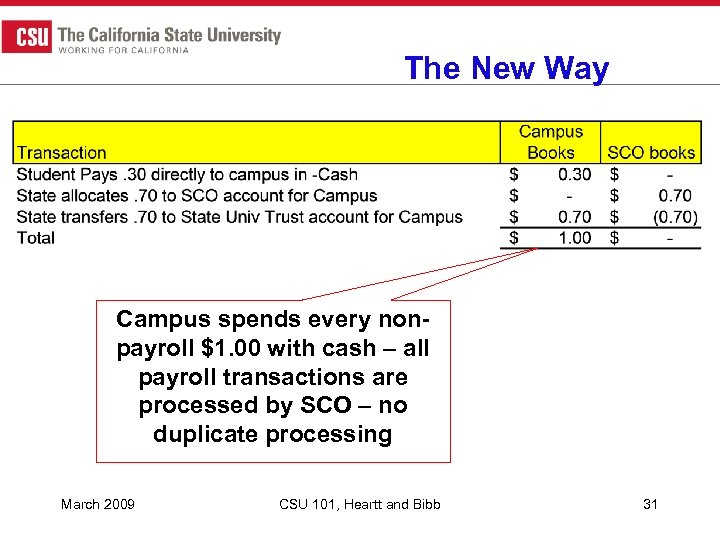
The New Way Campus spends every nonpayroll $1. 00 with cash – all payroll transactions are processed by SCO – no duplicate processing March 2009 CSU 101, Heartt and Bibb 31
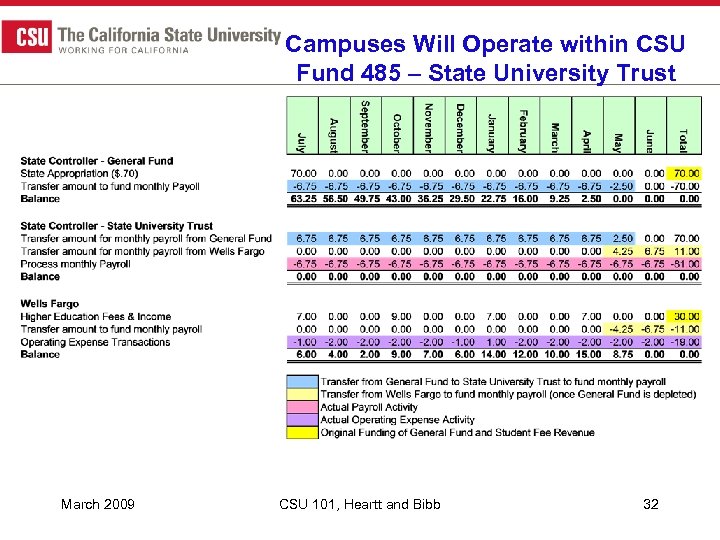
Campuses Will Operate within CSU Fund 485 – State University Trust March 2009 CSU 101, Heartt and Bibb 32
Meanwhile –while this is all being planned § Serious CSU issues in the financial reporting process. § CSU is the most complex university financial reporting entity in the country. § Fourteen of twenty-three campuses were unable to meet reporting deadlines in FY 2004 -2005 necessary to enable CSU GAAP consolidation. – Issues identified: § § Significant personnel attrition. Significantly increased complexity within the CSU system. New GASB requirements. Significant increase in construction projects. March 2009 CSU 101, Heartt and Bibb 33
Recap § It was March 2006 § Serious reporting problems in 2004 -2005 § Legislation was in the works for a significant change effective July 1, 2006 – Literally every business process performed at each campus will be effected – Need to be prepared for this change in 3 months – Need to close 2005 -2006 at the same time § By the way – it might not have passed March 2009 CSU 101, Heartt and Bibb 34
So we “Ran Until Tackled” § Legislation change for 2006 -2007 proposed by Fall 2006 § Once it was determined that the bill had support, campus financial officers were brought in March 2009 CSU 101, Heartt and Bibb 35
Committee met March 15, 2006 to discuss implication § Sub-committee of the Financial Officers Association (FOA) § From the committee report…. – The re-engineering of the operating business processes should not be considered lightly. This was an enormous undertaking that needed to be accomplished in a very short time period. – That said, the end result would revolutionize how the CSU did business with substantial improvements. March 2009 CSU 101, Heartt and Bibb 36
A Plan is made a the March 20 FOA Meeting § A task force was formed with experts from all areas of finance from all 23 campuses and the Chancellor’s Office – Over 70 members § Task force met for an entire week on three separate occasions § All members of the task force stayed at the same hotel so that could continue discussions over cocktails, dinners, treadmills, etc. March 2009 CSU 101, Heartt and Bibb 37
Meanwhile – another change was brewing § If the bill passed the CSU would issue an RFP for banking services – Looking for state of art services – Balances swept daily for investments – Positive pay files for disbursements – “We’ll think about that if it happens”………and it did March 2009 CSU 101, Heartt and Bibb 38
May 2006 – First Task Force Meeting § Held in Long Beach at the Chancellor’s Office – May 8 thru May 12 § Identified the critical training issues § Created a tentative timeline for major process changes § Especially the transition to operate in trust. Planned on January 2007 – gave us 8 months – Requires state controller, Dept of Finance and Payroll Office to agree to a major change in process – Team went to Sacramento to “pitch” the idea in June § Hold a training session for all finance staff on May 22 March 2009 CSU 101, Heartt and Bibb 39
Still “Running Until Tackled” § May 22 – over 300 CSU Finance Staff attended training – Training material put together in one week § Everything we know to this point was communicated at the training March 2009 CSU 101, Heartt and Bibb 40
Team visit to Sacramento – June 29 § “Pitched” the idea of operating with trust § Want the CSU payroll to issue from trust effective January 2007 § Explain all the benefits to the CSU and to the State Controller – efficiencies § Very well received § In fact…. . March 2009 CSU 101, Heartt and Bibb 41
They love it The Chief of Payroll services steps out of the room to “check” a few things…. “Yep” they can do – except it really works better for them if they did it effective July 1!!! THE NEXT DAY!!! March 2009 CSU 101, Heartt and Bibb 42
The team has a small anxiety attack Call an emergency teleconference with all campuses to explain that the payroll for July will be posting to trust not the general fund and they will have to make sure appropriate funds are there to cover the payroll. Oh and remember – the bill hadn’t passed yet March 2009 CSU 101, Heartt and Bibb 43
July 1, 2006 – Senate Bill 1802 Passes § Okay – we’re not tackled, and still running § Now we just had to work on year end closing for 2005 -2006 § The CSU got the RFP out for the new bank § The Task Force planned its second meeting in August March 2009 CSU 101, Heartt and Bibb 44
Task Force met in August § August 21 thru August 25 § Focus on the new CSU Central Bank – More changes March 2009 CSU 101, Heartt and Bibb 45
Second RMP Training for all Finance Staff § October 2006 – over 300 CSU staff from financial departments attended the second RMP training § 2 ½ days – 13 Sessions § We have our new bank – Wells Fargo March 2009 CSU 101, Heartt and Bibb 46
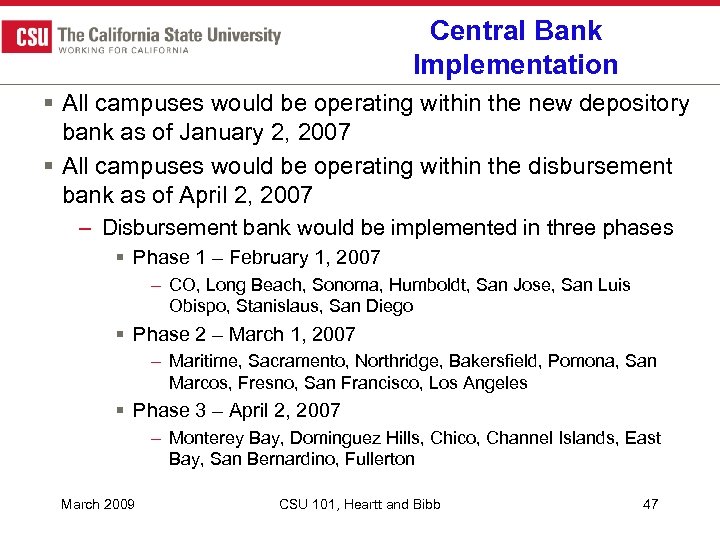
Central Bank Implementation § All campuses would be operating within the new depository bank as of January 2, 2007 § All campuses would be operating within the disbursement bank as of April 2, 2007 – Disbursement bank would be implemented in three phases § Phase 1 – February 1, 2007 – CO, Long Beach, Sonoma, Humboldt, San Jose, San Luis Obispo, Stanislaus, San Diego § Phase 2 – March 1, 2007 – Maritime, Sacramento, Northridge, Bakersfield, Pomona, San Marcos, Fresno, San Francisco, Los Angeles § Phase 3 – April 2, 2007 – Monterey Bay, Dominguez Hills, Chico, Channel Islands, East Bay, San Bernardino, Fullerton March 2009 CSU 101, Heartt and Bibb 47
Third & Final Task Force Meeting – February § Task force started to focus on revised CSU Standard, Definitions and Policies – Discussion on guidelines that included best practices – Training on third task force would be conducted at the Financial Officers Association Annual Conference in April March 2009 CSU 101, Heartt and Bibb 48
Recap § Process was very fast – All material posted to WEB Site – All campuses had access to network drive with all task force materials § Had excellent executive sponsorship § RMP is fully implemented § Changes to accounting structure underway – more to come on this. March 2009 CSU 101, Heartt and Bibb 49
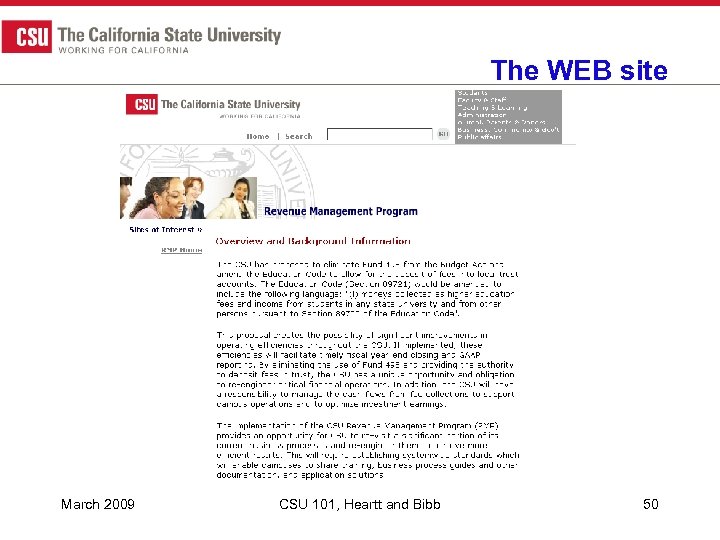
The WEB site March 2009 CSU 101, Heartt and Bibb 50
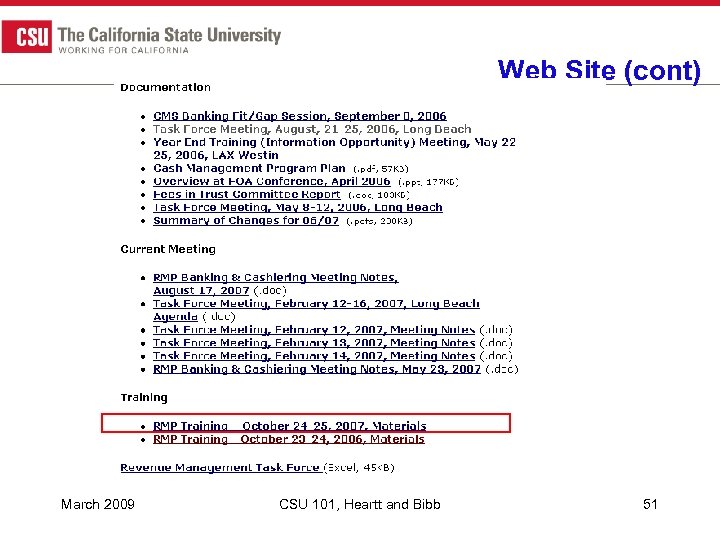
Web Site (cont) March 2009 CSU 101, Heartt and Bibb 51
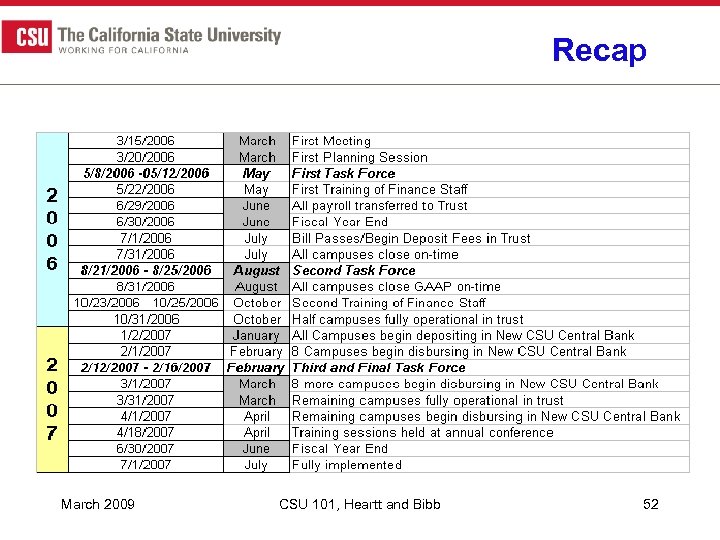
Recap March 2009 CSU 101, Heartt and Bibb 52
What we accomplished § All 23 campuses were operating in trust effective fiscal year 2006 -2007 § All campuses were fully invested and operating within the CSU Central Bank – Wells Fargo § New Executive Order issued for CSU Delegation of Authority – Executive Order 1000 March 2009 CSU 101, Heartt and Bibb 53
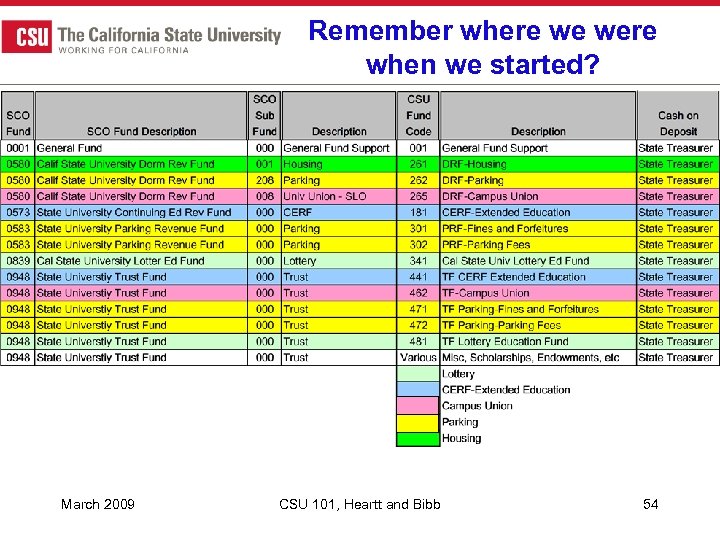
Remember where we were when we started? March 2009 CSU 101, Heartt and Bibb 54
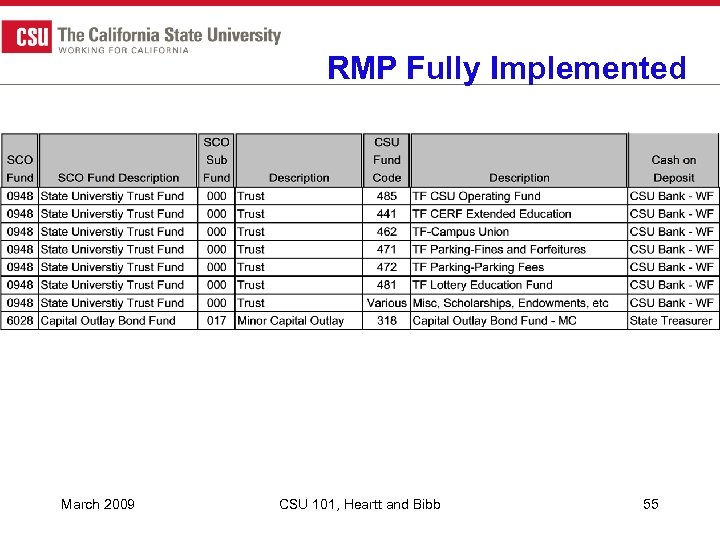
RMP Fully Implemented March 2009 CSU 101, Heartt and Bibb 55
RMP Changes § The Revenue Management Program changed more than just where we deposited our student fee revenue: – (L) Moneys collected as higher education fees and income from students of any campus of the CSU and from other persons pursuant to Section 89700”Allows the CSU to deposit revenue from student fees into the State University Trust Fund March 2009 CSU 101, Heartt and Bibb 56
RMP Changes § Campuses deposit and retain student fee revenue within State University Trust § CSU created a central bank outside the state treasury for all funds on deposit within the State University Trust § CSU centralized all investment activity – fully invested § General Fund is fully expended prior to the end of each appropriated year § All campus main operations are within State University Trust (0948) March 2009 CSU 101, Heartt and Bibb 57
RMP Changes § Except for Capital Outlay – all CSU Funds operate within § State University Trust § CSU Central Bank March 2009 CSU 101, Heartt and Bibb 58
March 2009 CSU 101, Heartt and Bibb 59
EO 1000 CSU Types § Executive Order 1000 established the CSU Fund Types that govern all activity within State University Trust Fund 0948 – Proprietary § Enterprise Funds § Internal Service Funds – Fiduciary § Investment Trust Funds § Private Purpose Funds Trust funds § Agency Trust Funds March 2009 CSU 101, Heartt and Bibb 60
§ The Proprietary Funds category is used to account for activities supported, at least in part, by fees or charges and includes two Fund types: – Enterprise Funds – Internal Service Funds. March 2009 CSU 101, Heartt and Bibb 61
Proprietary Funds Enterprise § Enterprise Funds are used to report any activity for which a fee is charged to external users for goods or services. § CSU policies, standards, and definitions may also require utilization of Enterprise Funds to meet accounting or reporting requirements March 2009 CSU 101, Heartt and Bibb 62
Enterprise Fund Criteria § a) The activity is financed with debt that is secured solely by a pledge, by the Trustees, of the net revenue from fees and charges of the activity, i. e. SRB Debt § b) Laws or regulations require that the activity’s costs of providing services, including capital costs be recovered with fees and charges rather than with taxes or similar revenues, i. e. Housing & Parking § c) CSU policies, standards, and definitions require that the activity establish fees and charges designed to recover its costs. These fees are directly related to , although not necessarily equal to, the costs of goods or services, (CSU/Campus created enterprise – International Programs) § d) CSU policies, standards and definitions require separate accounting or reporting of revenues, expenses, and/or net assets, i. e. IRA & CSU Operating Fund March 2009 CSU 101, Heartt and Bibb 63
Internal Service Fund Criteria § Internal Service Funds account for the financing of goods or services provided by a designated campus department or unit to other campus departments of units. § Established primarily to improve financial management of scarce campus resources March 2009 CSU 101, Heartt and Bibb 64
Fiduciary Funds § Used to account for assets held by a campus in a trustee capacity or as an agent for individuals, private organizations, or other governmental units, and therefore cannot be used to support CSU programs and activities. § Three Fund types – Investment Trust Funds – Private-Purpose Trust Funds – Agency Funds March 2009 CSU 101, Heartt and Bibb 65
Fiduciary Funds Criteria § Investment Funds – used to report the external portion of investment pools held for individuals, private organizations, or other governments § Private-Purpose Trust funds – used to report all other trust arrangements under which the principal and income benefit individuals, private organization s, or other governments § Agency Funds – used to report resources held by the campus in a purely custodial capacity March 2009 CSU 101, Heartt and Bibb 66
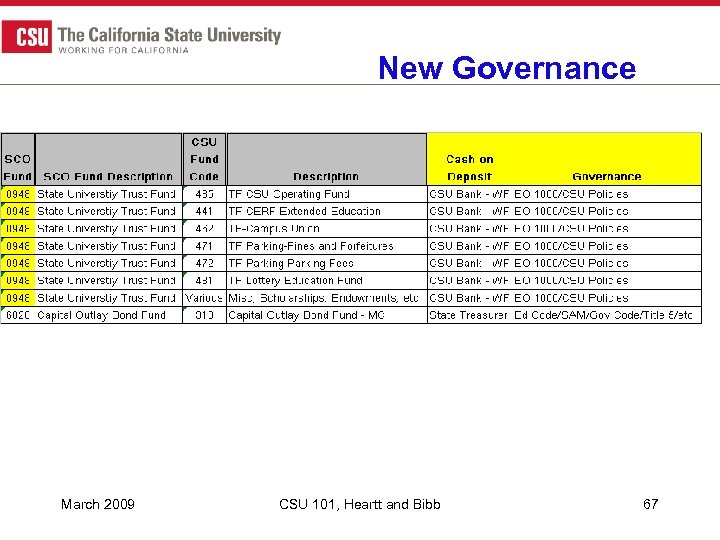
New Governance March 2009 CSU 101, Heartt and Bibb 67
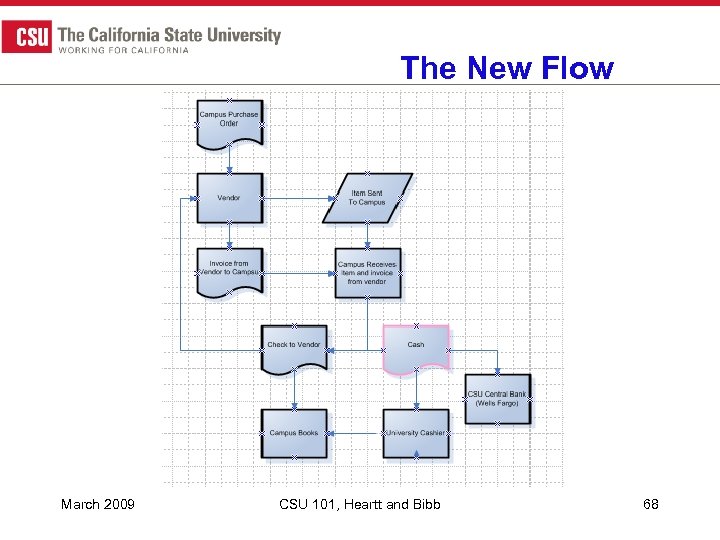
The New Flow March 2009 CSU 101, Heartt and Bibb 68
March 2009 CSU 101, Heartt and Bibb 69
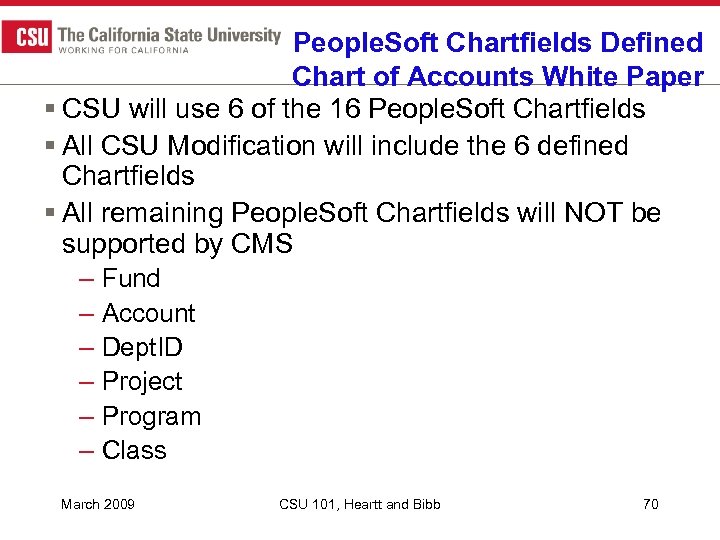
People. Soft Chartfields Defined Chart of Accounts White Paper § CSU will use 6 of the 16 People. Soft Chartfields § All CSU Modification will include the 6 defined Chartfields § All remaining People. Soft Chartfields will NOT be supported by CMS – Fund – Account – Dept. ID – Project – Program – Class March 2009 CSU 101, Heartt and Bibb 70
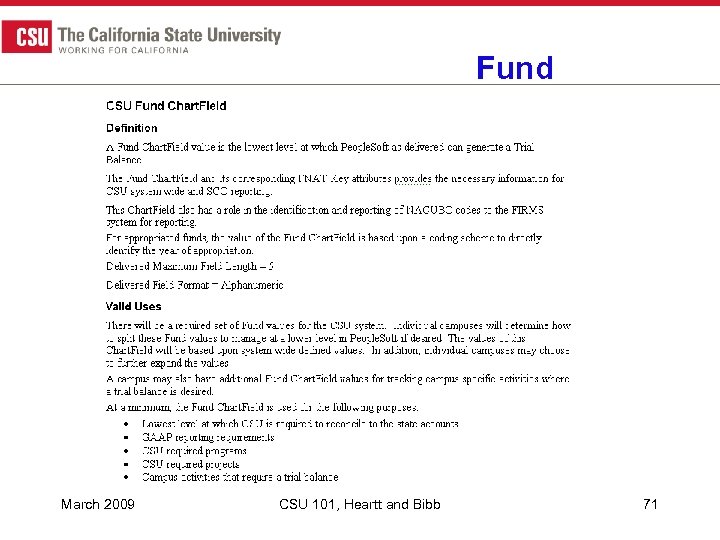
Fund March 2009 CSU 101, Heartt and Bibb 71
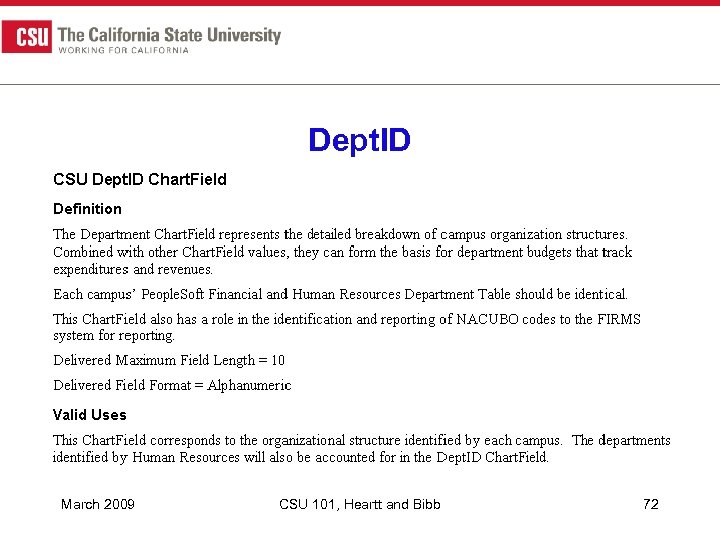
Dept. ID March 2009 CSU 101, Heartt and Bibb 72
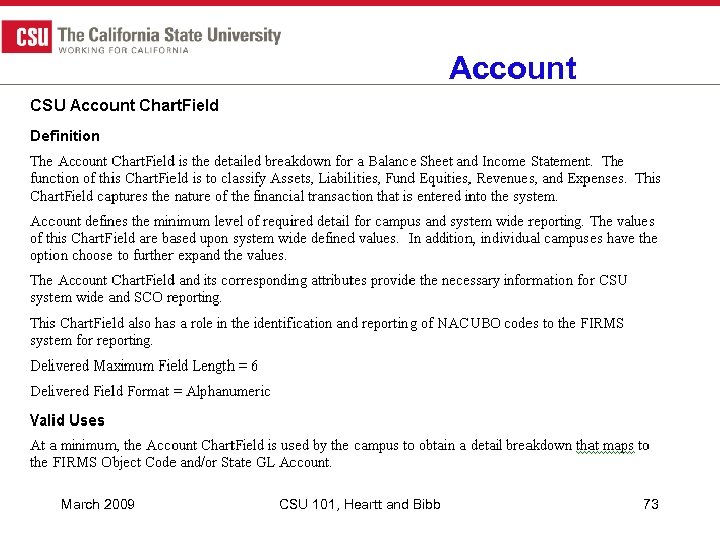
Account March 2009 CSU 101, Heartt and Bibb 73
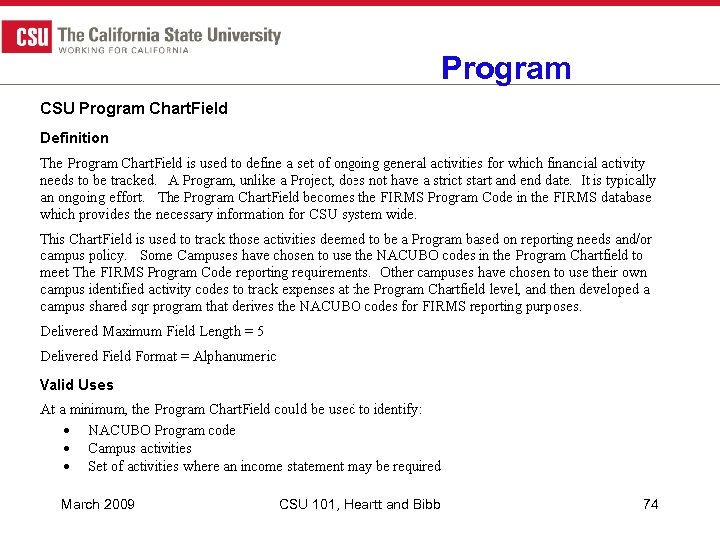
Program March 2009 CSU 101, Heartt and Bibb 74
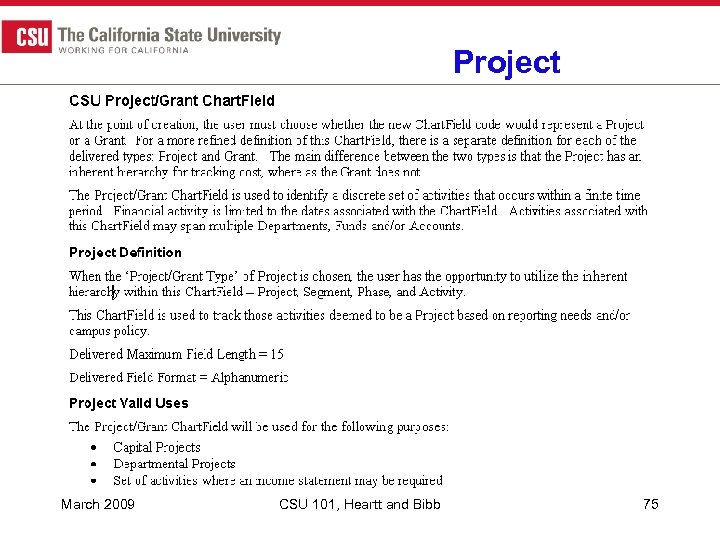
Project March 2009 CSU 101, Heartt and Bibb 75
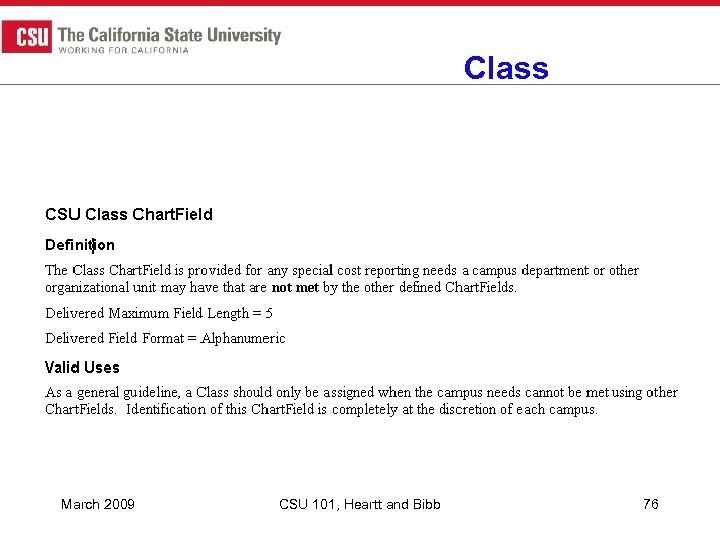
Class March 2009 CSU 101, Heartt and Bibb 76
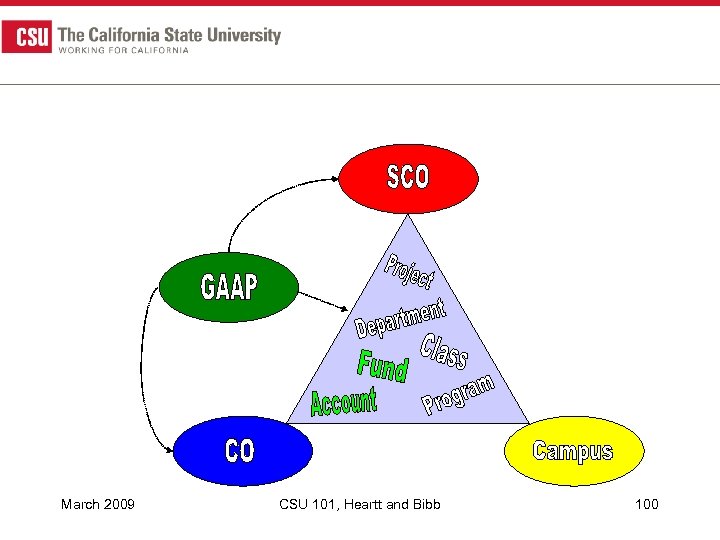
Overview of CSU Chart of Accounts § Each CSU Campus is accountable to three separate, distinct, and related entities – The State of California – The CSU Chancellor’s Office – The campus community § All three are tied together by the campus People. Soft chart of accounts – Fund Attributes - FNAT – Account Attributes - AAT March 2009 CSU 101, Heartt and Bibb 77
State of California § Examples of SCO Documents/files – SCO Reconciliation Report – Claim Schedules – SAM 99 (CSUGL 010) Report – Plan of Financial Adjustments – Cash remittance – Monthly SAM 99 file – Allocation Orders – Controller’s Transfers March 2009 CSU 101, Heartt and Bibb 78
CSU Chancellor’s Office § Sample of CO documents/files – Quarterly/Annual FIRMS Submission – Annual Budget FIRMS Submission – Year end Data Quality Review Report – Request for Allocation Orders March 2009 CSU 101, Heartt and Bibb 79
Campus Community § Sample of Campus documents/files – Transaction processing by department – Monthly transaction report for each department – Capital Outlay/Project reporting – Vice President/College level reporting – Campus trend analysis March 2009 CSU 101, Heartt and Bibb 80
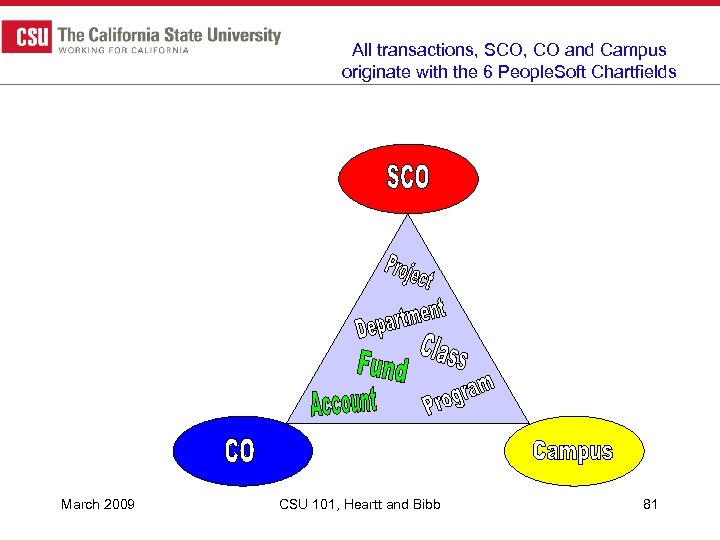
All transactions, SCO, CO and Campus originate with the 6 People. Soft Chartfields March 2009 CSU 101, Heartt and Bibb 81
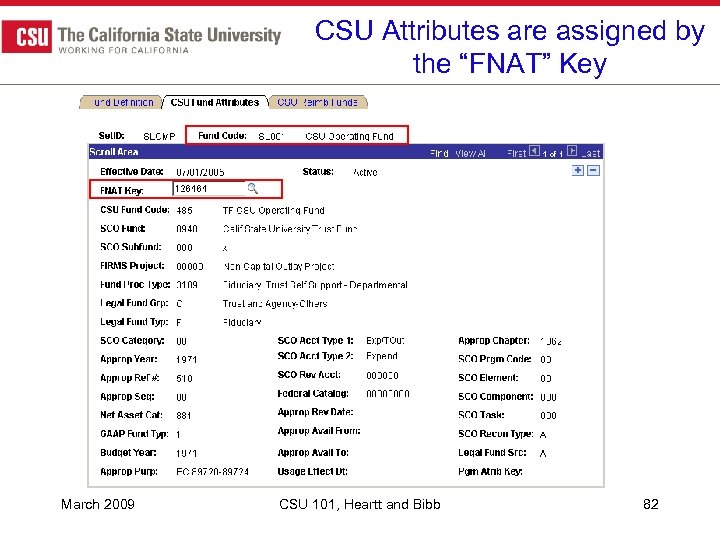
CSU Attributes are assigned by the “FNAT” Key March 2009 CSU 101, Heartt and Bibb 82
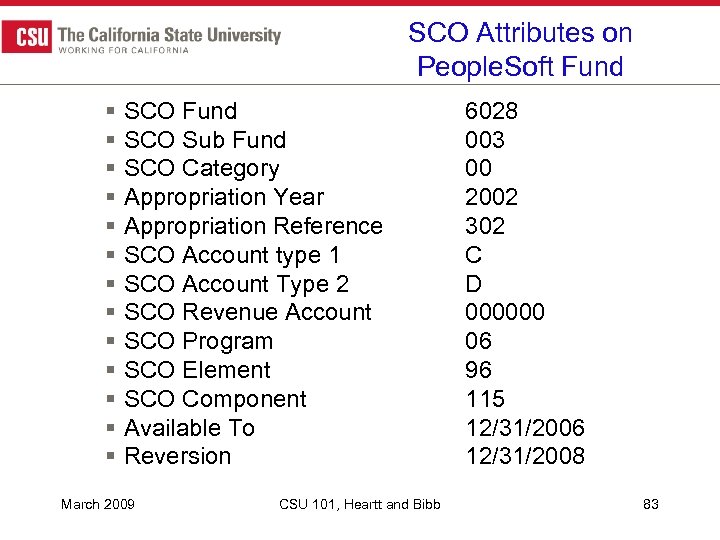
SCO Attributes on People. Soft Fund § SCO Sub Fund § SCO Category § Appropriation Year § Appropriation Reference § SCO Account type 1 § SCO Account Type 2 § SCO Revenue Account § SCO Program § SCO Element § SCO Component § Available To § Reversion March 2009 CSU 101, Heartt and Bibb 6028 003 00 2002 302 C D 000000 06 96 115 12/31/2006 12/31/2008 83
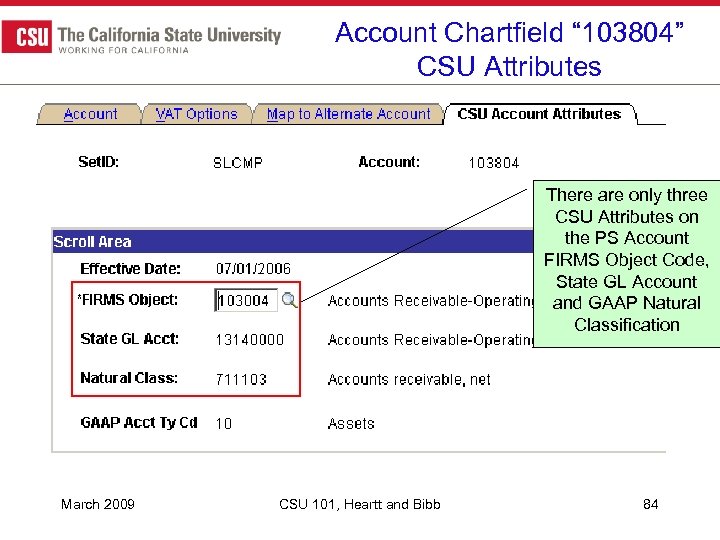
Account Chartfield “ 103804” CSU Attributes There are only three CSU Attributes on the PS Account FIRMS Object Code, State GL Account and GAAP Natural Classification March 2009 CSU 101, Heartt and Bibb 84
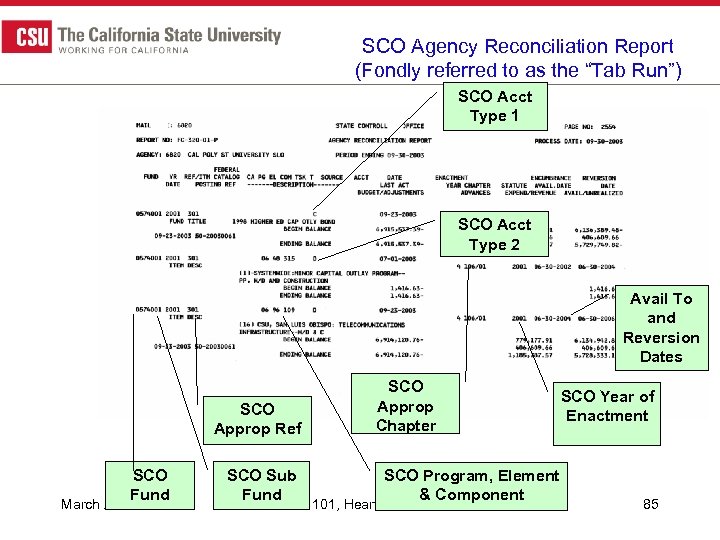
SCO Agency Reconciliation Report (Fondly referred to as the “Tab Run”) SCO Acct Type 1 SCO Acct Type 2 Avail To and Reversion Dates SCO Approp Ref SCO Fund March 2009 SCO Sub Fund SCO Approp Chapter SCO Program, Element & Component CSU 101, Heartt and Bibb SCO Year of Enactment 85
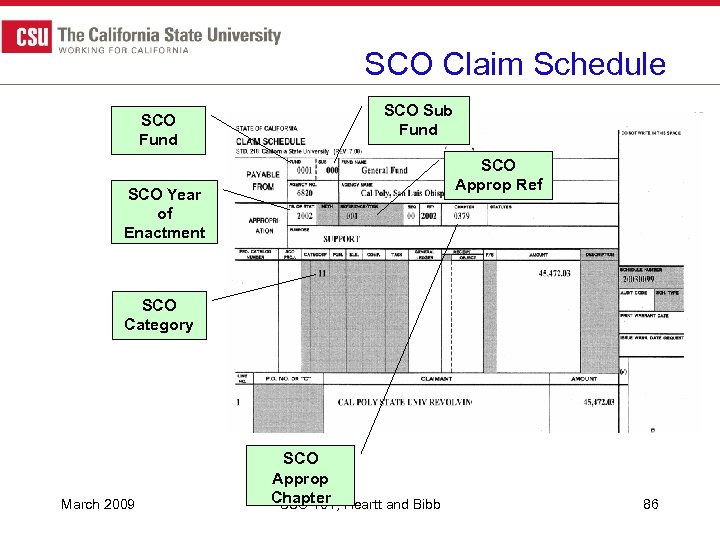
SCO Claim Schedule SCO Fund SCO Sub Fund SCO Approp Ref SCO Year of Enactment SCO Category March 2009 SCO Approp Chapter CSU 101, Heartt and Bibb 86
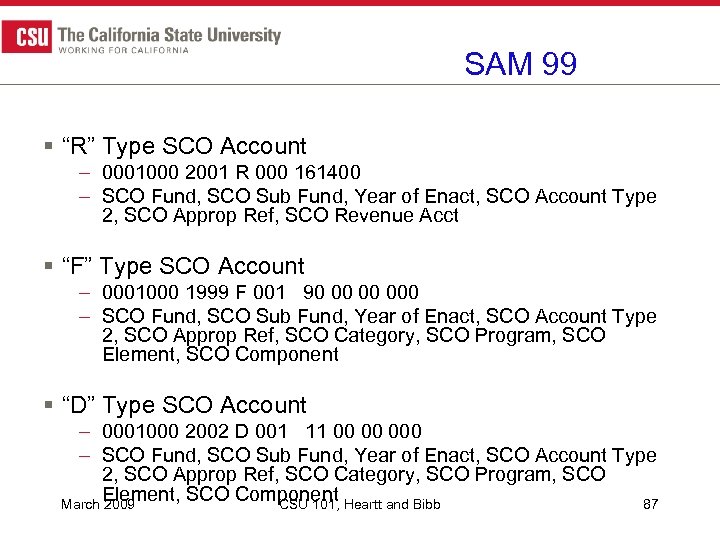
SAM 99 § “R” Type SCO Account – 0001000 2001 R 000 161400 – SCO Fund, SCO Sub Fund, Year of Enact, SCO Account Type 2, SCO Approp Ref, SCO Revenue Acct § “F” Type SCO Account – 0001000 1999 F 001 90 00 00 000 – SCO Fund, SCO Sub Fund, Year of Enact, SCO Account Type 2, SCO Approp Ref, SCO Category, SCO Program, SCO Element, SCO Component § “D” Type SCO Account – 0001000 2002 D 001 11 00 00 000 – SCO Fund, SCO Sub Fund, Year of Enact, SCO Account Type 2, SCO Approp Ref, SCO Category, SCO Program, SCO Element, SCO Component March 2009 CSU 101, Heartt and Bibb 87
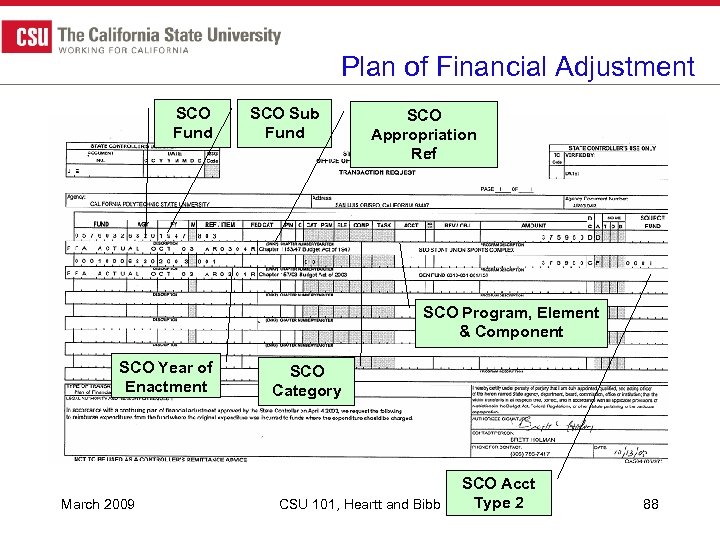
Plan of Financial Adjustment SCO Fund SCO Sub Fund SCO Appropriation Ref SCO Program, Element & Component SCO Year of Enactment March 2009 SCO Category CSU 101, Heartt and Bibb SCO Acct Type 2 88
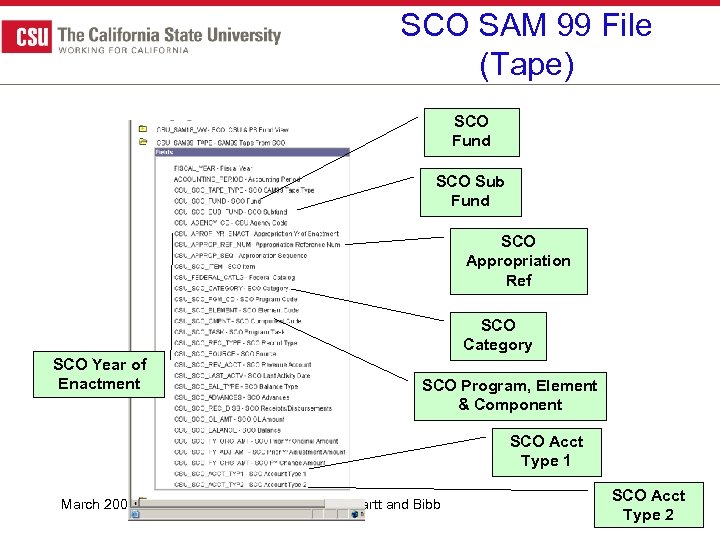
SCO SAM 99 File (Tape) SCO Fund SCO Sub Fund SCO Appropriation Ref SCO Category SCO Year of Enactment SCO Program, Element & Component SCO Acct Type 1 March 2009 CSU 101, Heartt and Bibb SCO Acct 89 Type 2
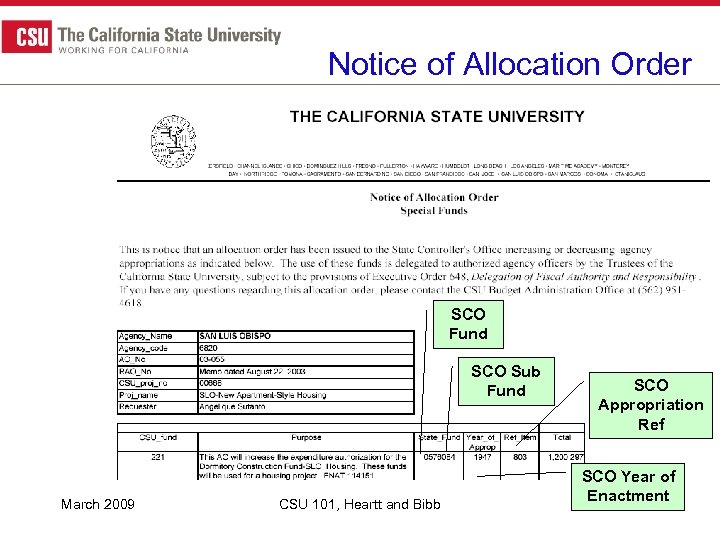
Notice of Allocation Order SCO Fund SCO Sub Fund March 2009 CSU 101, Heartt and Bibb SCO Appropriation Ref SCO Year of Enactment 90
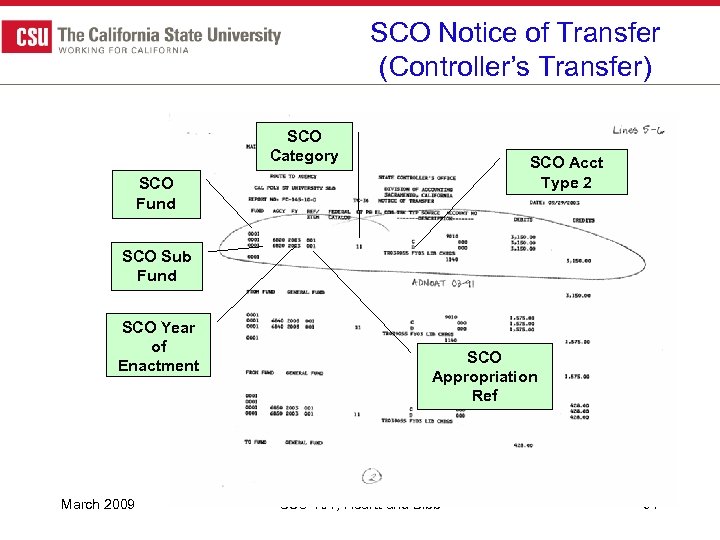
SCO Notice of Transfer (Controller’s Transfer) SCO Category SCO Acct Type 2 SCO Fund SCO Sub Fund SCO Year of Enactment March 2009 SCO Appropriation Ref CSU 101, Heartt and Bibb 91
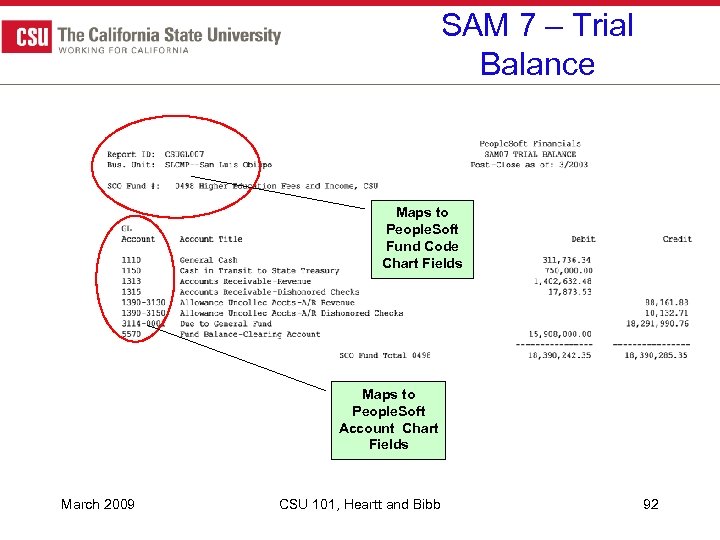
SAM 7 – Trial Balance Maps to People. Soft Fund Code Chart Fields Maps to People. Soft Account Chart Fields March 2009 CSU 101, Heartt and Bibb 92
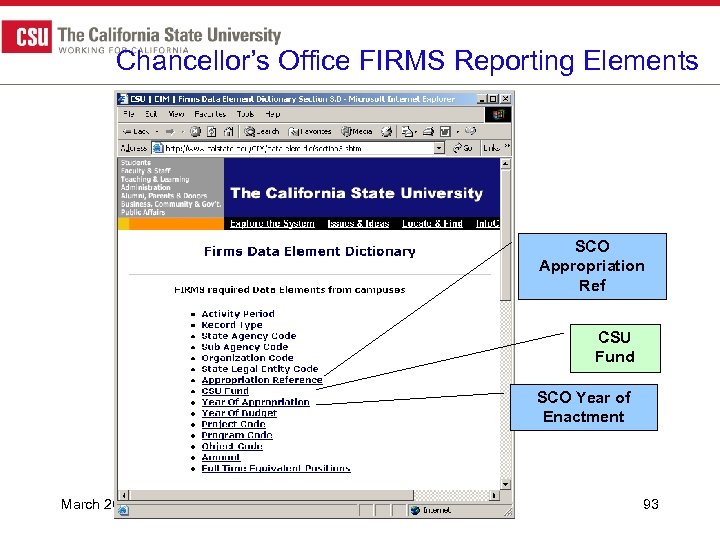
Chancellor’s Office FIRMS Reporting Elements SCO Appropriation Ref CSU Fund SCO Year of Enactment March 2009 CSU 101, Heartt and Bibb 93
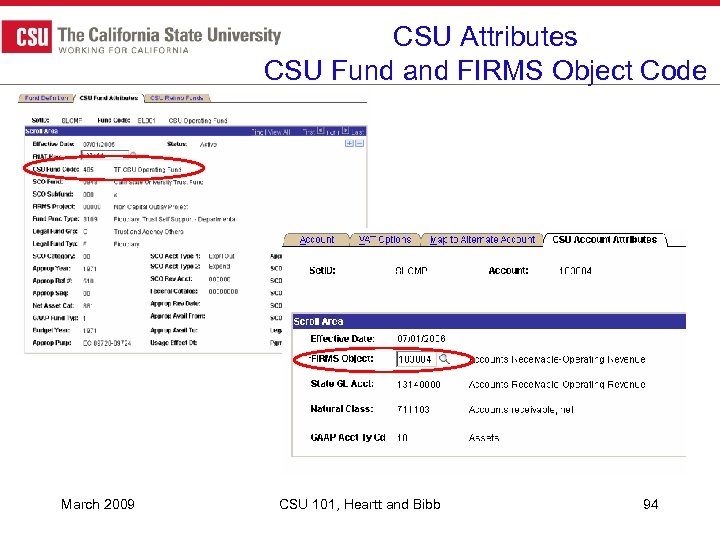
CSU Attributes CSU Fund and FIRMS Object Code March 2009 CSU 101, Heartt and Bibb 94
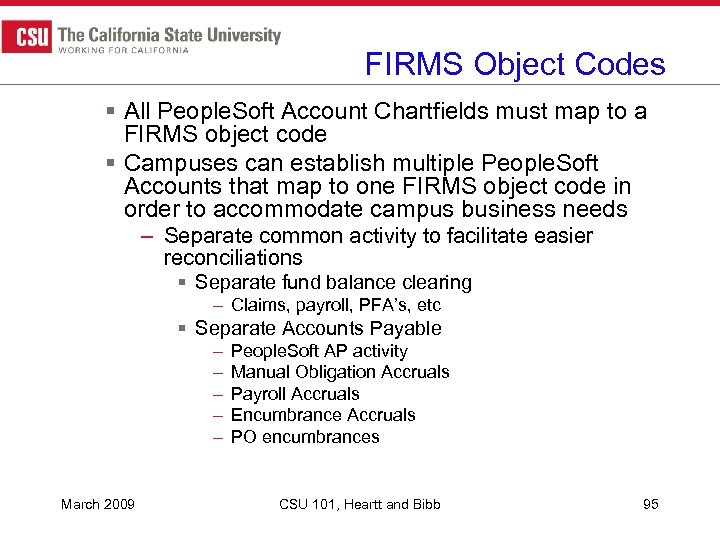
FIRMS Object Codes § All People. Soft Account Chartfields must map to a FIRMS object code § Campuses can establish multiple People. Soft Accounts that map to one FIRMS object code in order to accommodate campus business needs – Separate common activity to facilitate easier reconciliations § Separate fund balance clearing – Claims, payroll, PFA’s, etc § Separate Accounts Payable – – – March 2009 People. Soft AP activity Manual Obligation Accruals Payroll Accruals Encumbrance Accruals PO encumbrances CSU 101, Heartt and Bibb 95
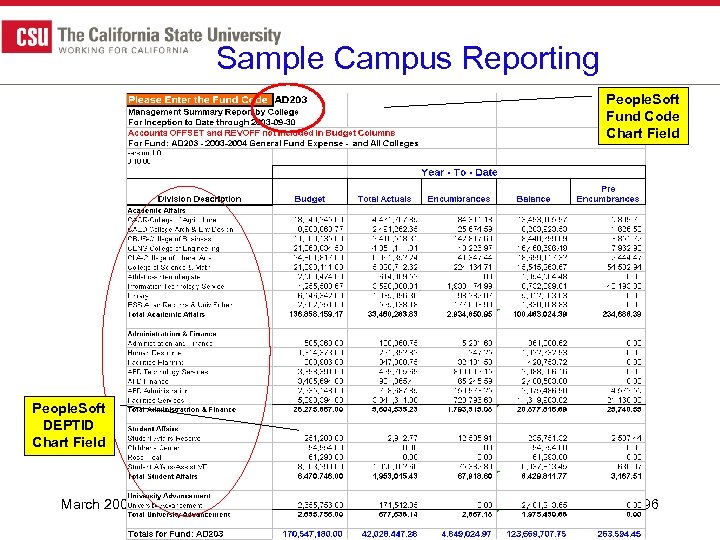
Sample Campus Reporting People. Soft Fund Code Chart Field People. Soft DEPTID Chart Field March 2009 CSU 101, Heartt and Bibb 96
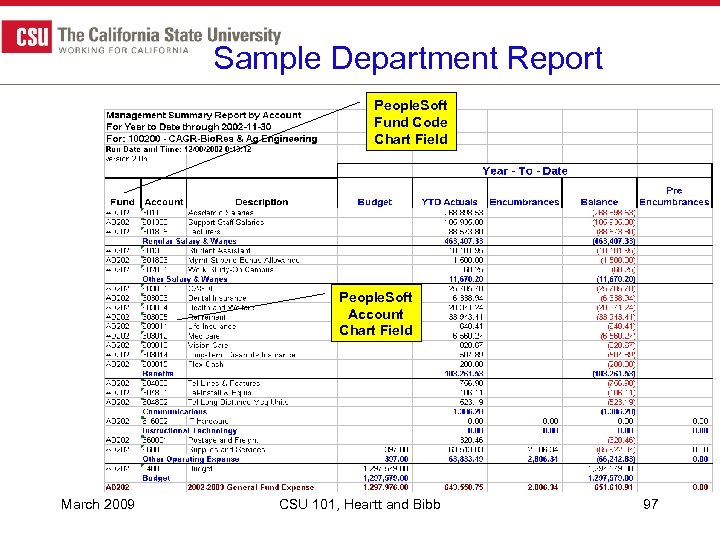
Sample Department Report People. Soft Fund Code Chart Field People. Soft Account Chart Field March 2009 CSU 101, Heartt and Bibb 97
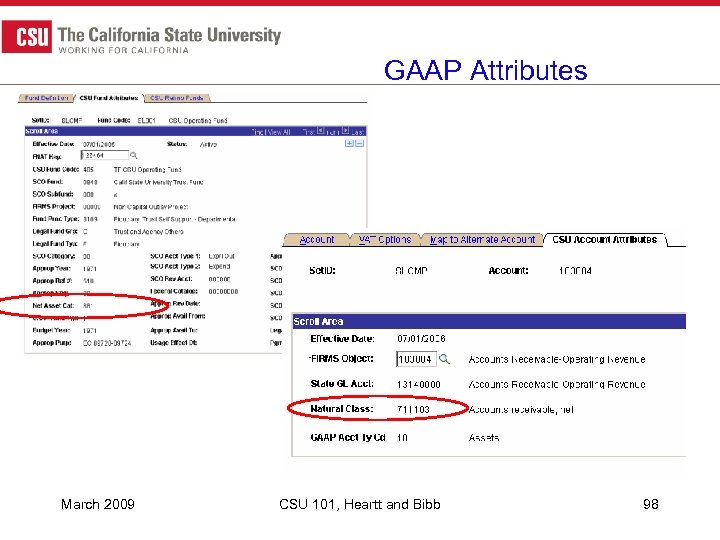
GAAP Attributes March 2009 CSU 101, Heartt and Bibb 98
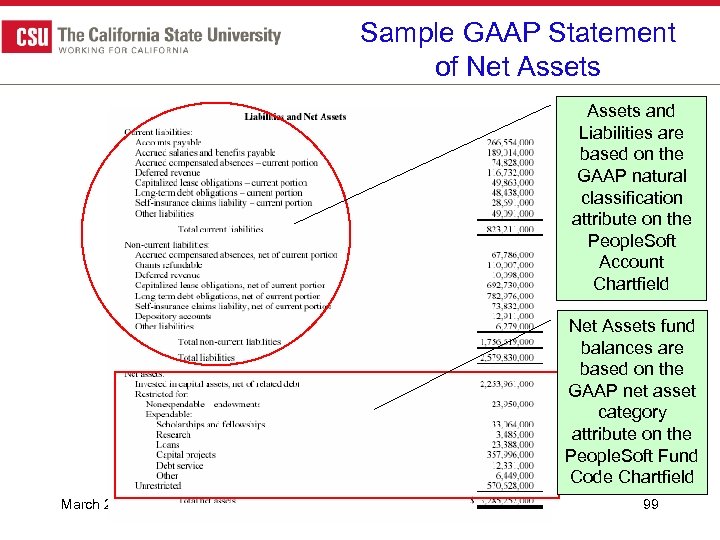
Sample GAAP Statement of Net Assets and Liabilities are based on the GAAP natural classification attribute on the People. Soft Account Chartfield Net Assets fund balances are based on the GAAP net asset category attribute on the People. Soft Fund Code Chartfield March 2009 CSU 101, Heartt and Bibb 99
March 2009 CSU 101, Heartt and Bibb 100
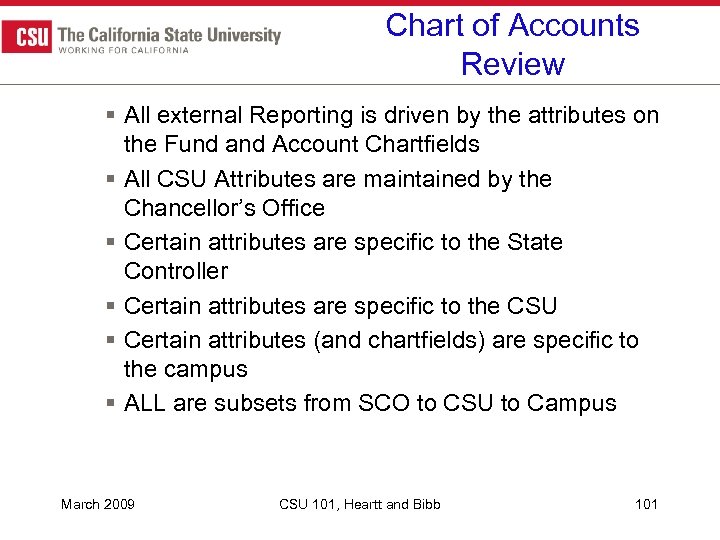
Chart of Accounts Review § All external Reporting is driven by the attributes on the Fund and Account Chartfields § All CSU Attributes are maintained by the Chancellor’s Office § Certain attributes are specific to the State Controller § Certain attributes are specific to the CSU § Certain attributes (and chartfields) are specific to the campus § ALL are subsets from SCO to CSU to Campus March 2009 CSU 101, Heartt and Bibb 101
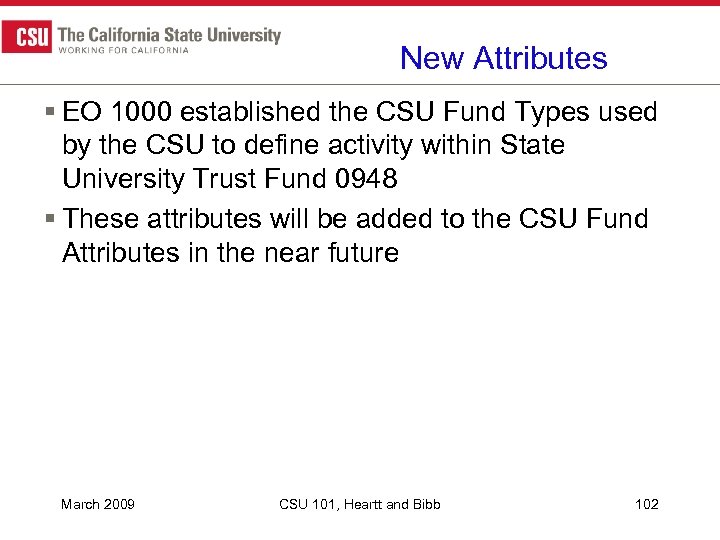
New Attributes § EO 1000 established the CSU Fund Types used by the CSU to define activity within State University Trust Fund 0948 § These attributes will be added to the CSU Fund Attributes in the near future March 2009 CSU 101, Heartt and Bibb 102
March 2009 CSU 101, Heartt and Bibb 103
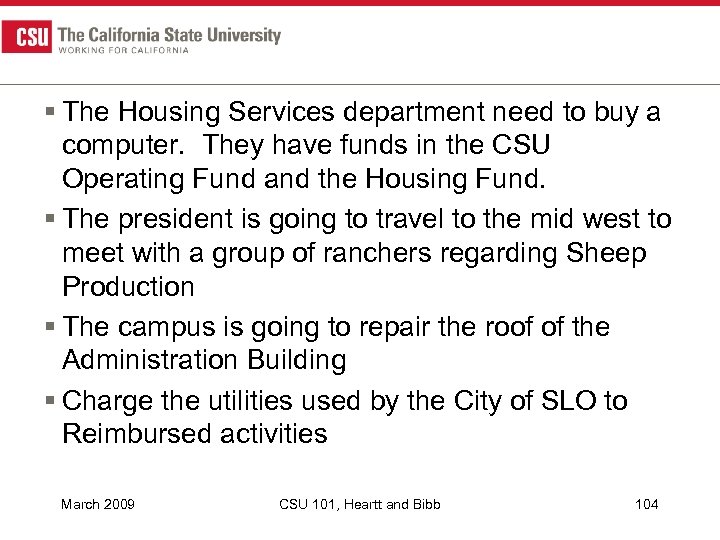
§ The Housing Services department need to buy a computer. They have funds in the CSU Operating Fund and the Housing Fund. § The president is going to travel to the mid west to meet with a group of ranchers regarding Sheep Production § The campus is going to repair the roof of the Administration Building § Charge the utilities used by the City of SLO to Reimbursed activities March 2009 CSU 101, Heartt and Bibb 104

www. calstate. edu/qi
Скачать презентацию Business Finance Structure of the CSU 101
6ab6f958675c70dd238ca2db4842a531.ppt